Proceedings of the 2019 Conference on Empirical Methods in Natural Language Processing 3672
Efficient Sentence Embedding using Discrete Cosine Transform
Nada Almarwani,∗1,2Hanan Aldarmaki,∗3Mona Diab1,4
1 Dept. of Computer Science, The George Washington University 2 Dept. of Computer Science, Taibah University
3Computer Science & Software Engineering Dept., UAEU 4 AWS, Amazon AI
[email protected], [email protected], [email protected]
Abstract
Vector averaging remains one of the most pop-ular sentence embedding methods in spite of its obvious disregard for syntactic structure. While more complex sequential or convolu-tional networks potentially yield superior clas-sification performance, the improvements in classification accuracy are typically mediocre compared to the simple vector averaging. As an efficient alternative, we propose the use of discrete cosine transform (DCT) to compress word sequences in an order-preserving man-ner. The lower order DCT coefficients repre-sent the overall feature patterns in repre-sentences, which results in suitable embeddings for tasks that could benefit from syntactic features. Our results in semantic probing tasks demonstrate that DCT embeddings indeed preserve more syntactic information compared with vector averaging. With practically equivalent com-plexity, the model yields better overall perfor-mance in downstream classification tasks that correlate with syntactic features, which illus-trates the capacity of DCT to preserve word order information.
1 Introduction
Modern NLP systems rely on word embeddings as input units to encode the statistical semantic and syntactic properties of words, ranging from standard context-independent embeddings such as word2vec (Mikolov et al.,2013) and Glove ( Pen-nington et al.,2014) to contextualized embeddings such as ELMo (Peters et al.,2018) and BERT ( De-vlin et al.,2018). However, most applications op-erate at the phrase or sentence level. Hence, the word embeddings are averaged to yield sentence embeddings. Averaging is an efficient composi-tional operation that leads to good performance. In fact, averaging is difficult to beat by more complex
∗
Both authors contributed equally.
compositional models as illustrated across several classification tasks: topic categorization, semantic textual similarity, and sentiment classification ( Al-darmaki and Diab,2018). Encoding sentences into fixed-length vectors that capture various full sen-tence linguistic properties leading to performance gains across different classification tasks remains a challenge. Given the complexity of most mod-els that attempt to encode sentence structure, such as convolutional, recursive, or recurrent networks, the trade-off between efficiency and performance tips the balance in favor of simpler models like vector averaging. Sequential neural sentence en-coders, like Skip-thought (Kiros et al.,2015) and InferSent (Conneau et al., 2017), can potentially encode rich semantic and syntactic features from sentence structures. However, for practical ap-plications, sequential models are rather cumber-some and inefficient, and the gains in performance are typically mediocre compared with vector av-eraging (Aldarmaki and Diab,2018). In addition, the more complex models typically don’t gener-alize well to out-of-domain data (Wieting et al.,
2015). FastSent (Hill et al.,2016) is an unsuper-vised alternative approach of lower computational cost, but similar to vector averaging, it disregards word order. Tensor-based composition can effec-tively capture word order, but current approaches rely on restricted grammatical constructs, such as transitive phrases, and cannot be easily extended to variable-length sequences of arbitrary structures (Milajevs et al.,2014). Therefore, despite its ob-vious disregard for structural properties, the effi-ciency and reasonable performance of vector aver-aging makes them more suitable for practical text classification.
DCT is a widely-used technique in digital signal processing applications such as image compres-sion (Watson,1994) as well as speech recognition (Huang and Zhao, 2000) , but to our knowledge, this is the first successful application of DCT for NLP applications, and in particular sentence em-bedding. We use DCT to summarize the general feature patterns in word sequences and compress them into fixed-length vectors. Experiments in probing tasks demonstrate that our DCT embed-dings preserve more syntactic and semantic fea-tures compared with vector averaging. Further-more, the results indicate that DCT performance in downstream applications is correlated with these features.
2 Approach
2.1 Discrete Cosine Transform
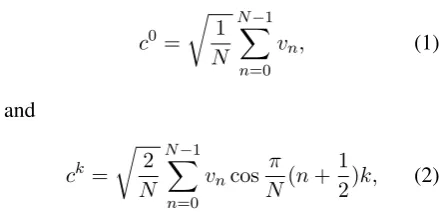
Discrete Cosine Transform (DCT) is an invertible function that maps an input sequence of N real numbers to the coefficients ofN orthogonal cosine basis functions. Given a vector of real numbers
~v=v0, ..., vN−1, we calculate a sequence of DCT
coefficientsc0, ..., cN−1as follows:1
c0 =
r
1
N N−1
X
n=0
vn, (1)
and
ck =
r
2
N N−1
X
n=0 vncos
π N(n+
1
2)k, (2)
for 1 ≤ k < N. Note thatc0 is the sum of the input sequence normalized by the square length, which is proportional to the average of the se-quence. TheN coefficients can be used to recon-struct the original sequence exactly using the in-verse transform. In practice, DCT is used for com-pression by preserving only the coefficients with large magnitudes. Lower-order coefficients repre-sent lower signal frequencies which correspond to the overall patterns in the sequence (Ahmed et al.,
1974).
2.2 DCT Sentence Embeddings
We apply DCT on the word vectors along the length of the sentence. Given a sentence of
N words w1, ..., wN, we stack the sequence of
1There are several variants of DCT. We use DCT type II
(Shao and Johnson,2008) in our implementation
AVG
c0 c1
man bites dog
dog bites man man bitten by dog
[image:2.595.307.521.65.137.2]w1 w2 w3 w4
Figure 1: Illustration of word vector averaging vs. DCT using the first 2 DCT coefficients. The word vectors are generated randomly from a standard normal distri-bution withd= 10.
d-dimensional word embeddings in an N × d
matrix, then apply DCT along the rows. In other words, each feature in the vector space is compressed independently, and the resultant DCT embeddings summarize the feature patterns along the word sequence. To get a fixed-length and consistent sentence vector, we extract and concatenate the first K DCT coefficients and discard higher-order coefficients, which results in sentence vectors of sizeKd. For cases where
N < K, we pad the sentence withK−N zero vectors. In image compression, the magnitude of the coefficients tends to decrease with increasing
k, but we didn’t observe this trend in text data except thatc0 tends to have larger absolute value than the remaining coefficients. Nonetheless, by retaining lower-order coefficients we get a consis-tent representation of overall feature patterns in the word sequence.
[image:2.595.70.290.404.510.2]un-parameterized, the downstream classifiers can in-corporate a hidden layer to learn these subtle vari-ations in higher-order features depending on the learning objective.
2.3 A Note on Complexity
The cosine terms in Equation 2 can be pre-calculated for efficiency. For a maximum sentence lengthNˆ and a givenK, the total number of terms is(K−1) ˆN for each feature. The run-time com-plexity is equivalent to calculatingKweighted av-erages, which is proportional to KN, where K
should be set to a small constant relative to the expected length.2 Note also that the number of in-put parameters in downstream classification mod-els will increase linearly withK. With parallel im-plementations however, the difference in run-time complexity between AVG and DCT is practically negligible.
3 Experiments and Results
3.1 Evaluation Framework
We use the SentEval toolkit3(Conneau and Kiela,
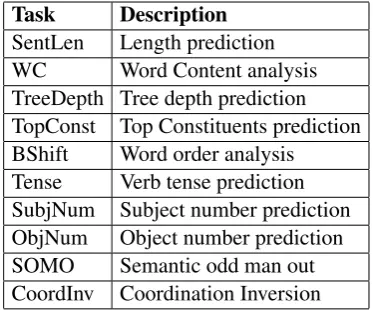
2018) to evaluate the sentence representations on different probing as well as downstream classi-fication tasks. The probing benchmark set was designed to analyze the quality of sentence em-beddings. It contains a set of 10 classification tasks, summarized in Table 1, that address va-rieties of linguistic properties including surface, syntactic, and semantic information (Conneau et al., 2018). The downstream set, on the other hand, includes the following standard classifica-tion tasks: binary and fine-grained sentiment clas-sification (MR, SST2, SST5) (Pang and Lee,2004;
Socher et al., 2013), product reviews (CR) (Hu and Liu,2004), opinion polarity (MPQA) (Wiebe et al.,2005), question type classification (TREC) (Voorhees and Tice,2000), natural language infer-ence (SICK-E) (Marelli et al.,2014), semantic re-latedness (SICK-R, STSB) (Marelli et al., 2014;
Cer et al., 2017), paraphrase detection (MRPC) (Dolan et al., 2004), and subjectivity/objectivity (SUBJ) (Pang and Lee,2004).
3.2 Experimental setup
For the word embeddings, we use pre-trained Fast-Text embeddings of size 300 (Mikolov et al.,
2018) trained on Common-Crawl. We generate
2
We experimented with1≤K≤7.
3https://github.com/facebookresearch/SentEval
Task Description
[image:3.595.323.510.62.217.2]SentLen Length prediction WC Word Content analysis TreeDepth Tree depth prediction TopConst Top Constituents prediction BShift Word order analysis Tense Verb tense prediction SubjNum Subject number prediction ObjNum Object number prediction SOMO Semantic odd man out CoordInv Coordination Inversion
Table 1: Probing Tasks
DCT sentence vectors by concatenating the first
K DCT coefficients, which we denote by c0:K. We compare the performance against: vector av-eraging of the same word embeddings, denoted by
AVG, and vector max pooling, denoted byMAX.4 For all tasks, we trained multi-layer perceptron (MLP) classifiers following the setup in SentEval. We tuned the following hyper-parameters on the validation sets: number of hidden states (in [0, 50, 100, 200, 512]) and dropout rate (in [0, 0.1, 0.2]). Note that the case with 0 hidden states corresponds to a Logistic Regression classifier.
3.3 Result & Discussion
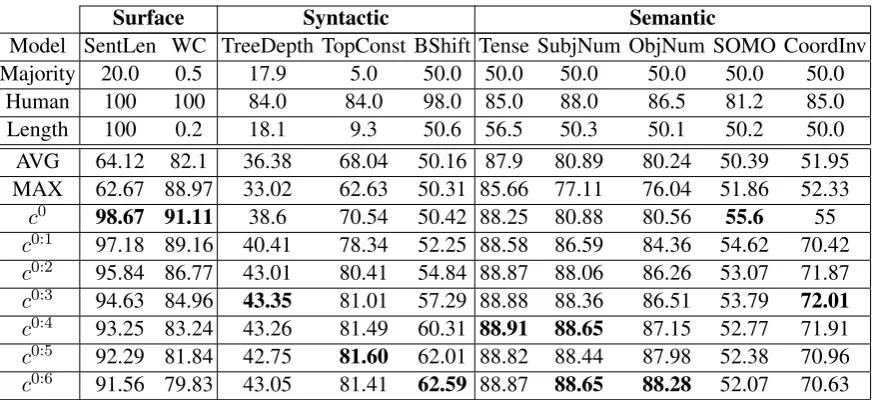
We report the performance in probing tasks in Ta-ble2. In general, DCT yields better performance compared to averaging on all tasks, and largerK
often yields improved performance in syntactic and semantic tasks. For the surface information tasks, SentLen and Word content (WC), c0 sig-nificantly outperforms AVG. This is attributed to the non-linear scaling factor in DCT, where longer sentences are not discounted as much as in aver-aging. The performance decreased with increas-ingKinc0:K, which reflects the trade-off between deep and surface linguistic properties, as discussed inConneau et al.(2018).
While increasing K has no positive effect on surface information tasks, syntactic and semantic tasks demonstrate performance gains with larger
K. This trend is clearly observed in all syntactic tasks and three of the semantic tasks, where DCT performs well above AVG and the performance improves with increasingK. The only exception
4To compare with other sentence embedding models,
Surface Syntactic Semantic
Model SentLen WC TreeDepth TopConst BShift Tense SubjNum ObjNum SOMO CoordInv Majority 20.0 0.5 17.9 5.0 50.0 50.0 50.0 50.0 50.0 50.0
Human 100 100 84.0 84.0 98.0 85.0 88.0 86.5 81.2 85.0 Length 100 0.2 18.1 9.3 50.6 56.5 50.3 50.1 50.2 50.0 AVG 64.12 82.1 36.38 68.04 50.16 87.9 80.89 80.24 50.39 51.95 MAX 62.67 88.97 33.02 62.63 50.31 85.66 77.11 76.04 51.86 52.33
c0 98.67 91.11 38.6 70.54 50.42 88.25 80.88 80.56 55.6 55
c0:1 97.18 89.16 40.41 78.34 52.25 88.58 86.59 84.36 54.62 70.42 c0:2 95.84 86.77 43.01 80.41 54.84 88.87 88.06 86.26 53.07 71.87
c0:3 94.63 84.96 43.35 81.01 57.29 88.88 88.36 86.51 53.79 72.01 c0:4 93.25 83.24 43.26 81.49 60.31 88.91 88.65 87.15 52.77 71.91
c0:5 92.29 81.84 42.75 81.60 62.01 88.82 88.44 87.98 52.38 70.96
[image:4.595.82.522.60.260.2]c0:6 91.56 79.83 43.05 81.41 62.59 88.87 88.65 88.28 52.07 70.63
Table 2: Probing tasks performance of vector averaging (AVG) and max pooling (MAX) vs. DCT embeddings with variousK. Majority (baseline), Human (human-bound), and a linear classifier with sentence length as sole feature (Length) as reported in (Conneau et al.,2018), respectively.
Sentiment Analysis
SUBJ Relatedness/Paraphrase Inference TREC
Model MR SST2 SST5 CR MPQA SICK-R STSB MRPC SICK-E
AVG 78.3 84.13 44.16 79.6 87.94 92.33 81.95 69.26 74.43 79.5 83.2 MAX 73.31 79.24 41.86 73.35 86.54 88.02 81.93 71.57 72.5 77.98 76.2
c0 78.45 83.53 44.57 79.81 88.36 92.79 82.61 71.11 72.93 78.91 84.8
c0:1 78.15 83.47 46.06 79.84 87.76 92.61 82.73 70.82 72.81 79.64 88.2
c0:2 78.02 82.98 45.16 79.68 87.62 92.5 82.95 70.36 72.87 79.76 89.8 c0:3 77.81 83.8 45.79 79.66 87.54 92.4 82.93 69.79 73.57 80.56 88.2
c0:4 77.72 83.75 44.03 80.08 87.4 92.61 82.53 69.31 72.35 79.72 89.8 c0:5 77.42 82.43 43.3 78.6 87.21 92.19 82.36 68.9 73.91 79.89 88.8
c0:6 77.47 82.81 42.99 78.78 87.06 92.15 81.86 68.17 75.07 79.76 86.4
Table 3: DCT embedding Performance in SentEval downstream tasks compared to vector averaging (AVG) and max pooling (MAX).
is SOMO, where increasingK actually results in lower performance, although all DCT results are still higher than AVG by about 1% to 34%.
The correlation between the performance in probing tasks and the standard text classification tasks is discussed inConneau et al.(2018), where they show that most tasks are only positively cor-related with a small subset of semantic or syn-tactic features, with the exception of TREC and some sentiment classification benchmarks. Fur-thermore, some tasks like SST and SICK-R are ac-tually negatively correlated with the performance in some probing tasks like SubjNum, ObjNum, and BShift. This explains why simple averaging often outperforms more complex models in these tasks. Our results in Table 3 are consistent with these observations, where we see improvements
in most tasks, but the difference is not as signifi-cant as the probing tasks, except in TREC question classification where increasing K leads to much better performance. As discussed in Aldarmaki and Diab(2018), the ability to preserve word order leads to improved performance in TREC, which is exactly the advantage of using DCT instead of AVG. Note also that increasingK, while preserves more information, leads to increasing the number of model parameters, which in turn may negatively affect the generalization of the model by overfit-ting. In our experiments,1 ≤ k ≤ 2yielded the best trade-off.
3.4 Comparison w. Related Methods
20-NG R-8 SST-5
Model P R F1 P R F1 P R F1
PCA 55.43 54.67 54.77 83.83 83.42 83.41 26.47 25.08 25.23 DCT* 61.07 59.16 59.78 90.41 90.78 90.38 30.11 30.09 29.53 Avg. vec. 68.72 68.19 68.25 96.34 96.30 96.27 27.88 26.44 24.81 p-means 72.20 71.65 71.79 96.69 96.67 96.65 33.77 33.41 33.26 ELMo 71.20 71.79 71.36 94.54 91.32 91.32 42.35 41.51 41.54
BERT 70.89 70.79 70.88 95.52 95.39 95.39 39.92 39.38 39.35 EigenSent 66.98 66.40 66.54 95.91 95.80 95.76 35.32 33.69 33.91 EigenSent⊕Avg 72.24 71.62 71.78 97.18 97.13 97.14 42.77 41.67 41.81
[image:5.595.92.507.61.220.2]ck 72.20 71.58 71.73 96.98 96.98 96.94 37.67 34.47 34.54
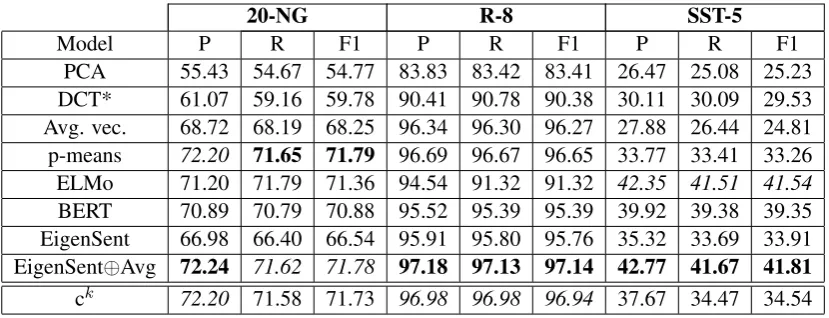
Table 4: Performance in text classification (20-NG, R-8) and sentiment (SST-5) tasks of various models as reported in (Kayal and Tsatsaronis,2019), where DCT* refers to the implementation in (Kayal and Tsatsaronis,2019). Our DCT embeddings are denoted as ckin the bottom row. Boldindicates the best result, anditalicindicates second-best.
frequency components, each revealing some infor-mation about the source signal, to enable analy-sis and compression. To the best of our knowl-edge, spectral methods have only been recently exploited to construct sentence embedding (Kayal and Tsatsaronis,2019).5.
Kayal and Tsatsaronis propose EigenSent that utilized Higher-Order Dynamic Mode Decompo-sition (HODMD) (Le Clainche and Vega, 2017) to construct sentence embedding. These embed-dings summarize the dynamic properties of the sentence. In their work, they compare EigenSent with various sentence embedding models, includ-ing a different implementation of the Discrete Co-sine Transform (DCT*). In contrast to our imple-mentation described in section 2.2, DCT* is ap-plied at the word level along the word embedding dimension.
For fair comparison, we use the same senti-ment and text classification datasets, the SST-5, 20 newsgroups (20-NG) and Reuters-8 (R-8), as those used inKayal and Tsatsaronis(2019). We also evaluate using the same pre-trained word em-bedding, framework and approaches as described in their work. Table 4shows the best results for the various models as reported inKayal and Tsat-saronis(2019), in addition to the best performance of our model denoted asck.6
Note that the DCT-based model, DCT*, de-scribed in Kayal and Tsatsaronis (2019) per-formed relatively poorly in all tasks, while our
5
independent from and in parallel with this work
6The best results were achieved with k=3 for SST-5 and
k=2 for 20-NG and R-8.
model achieved close to state-of-the-art perfor-mance in both the 20-NG and R-8 tasks. Our model outperformed EignSent on all tasks and generally performed better than or on par with p-means, ELMo, BERT, and EigenSent⊕Avg on both the 20-NG and R-8. On the other hand, both EigenSent⊕Avg and ELMo performed better than all other models on SST-5.
4 Conclusion
References
Nasir Ahmed, T Natarajan, and Kamisetty R Rao. 1974. Discrete cosine transform. IEEE transactions on Computers, 100(1):90–93.
Hanan Aldarmaki and Mona Diab. 2018. Evaluation of unsupervised compositional representations. In Proceedings of the 27th International Conference on Computational Linguistics, pages 2666–2677.
Daniel Cer, Mona Diab, Eneko Agirre, Inigo Lopez-Gazpio, and Lucia Specia. 2017. Semeval-2017 task 1: Semantic textual similarity multilingual and crosslingual focused evaluation. InProceedings of the 11th International Workshop on Semantic Eval-uation (SemEval-2017), pages 1–14.
Alexis Conneau and Douwe Kiela. 2018. Senteval: An evaluation toolkit for universal sentence representa-tions. InProceedings of the Eleventh International Conference on Language Resources and Evaluation (LREC-2018).
Alexis Conneau, Douwe Kiela, Holger Schwenk, Lo¨ıc Barrault, and Antoine Bordes. 2017. Supervised learning of universal sentence representations from natural language inference data. InProceedings of the 2017 Conference on Empirical Methods in Nat-ural Language Processing, pages 670–680, Copen-hagen, Denmark. Association for Computational Linguistics.
Alexis Conneau, Germ´an Kruszewski, Guillaume Lample, Lo¨ıc Barrault, and Marco Baroni. 2018. What you can cram into a single $ &!#* vector: Probing sentence embeddings for linguistic proper-ties. InProceedings of the 56th Annual Meeting of the Association for Computational Linguistics (Vol-ume 1: Long Papers), pages 2126–2136.
Jacob Devlin, Ming-Wei Chang, Kenton Lee, and Kristina Toutanova. 2018. Bert: Pre-training of deep bidirectional transformers for language understand-ing. arXiv preprint arXiv:1810.04805.
Bill Dolan, Chris Quirk, and Chris Brockett. 2004. Unsupervised construction of large paraphrase cor-pora: Exploiting massively parallel news sources. InProceedings of the 20th international conference on Computational Linguistics, page 350. Associa-tion for ComputaAssocia-tional Linguistics.
Felix Hill, Kyunghyun Cho, and Anna Korhonen. 2016. Learning distributed representations of sentences from unlabelled data. In Proceedings of NAACL-HLT, pages 1367–1377.
Minqing Hu and Bing Liu. 2004. Mining and summa-rizing customer reviews. InProceedings of the tenth ACM SIGKDD international conference on Knowl-edge discovery and data mining, pages 168–177. ACM.
Jun Huang and Yunxin Zhao. 2000. A dct-based fast signal subspace technique for robust speech recogni-tion. IEEE Transactions on Speech and Audio Pro-cessing, 8(6):747–751.
Subhradeep Kayal and George Tsatsaronis. 2019. Eigensent: Spectral sentence embeddings using higher-order dynamic mode decomposition. In Pro-ceedings of the 57th Conference of the Association for Computational Linguistics, pages 4536–4546.
Ryan Kiros, Yukun Zhu, Ruslan R Salakhutdinov, Richard Zemel, Raquel Urtasun, Antonio Torralba, and Sanja Fidler. 2015. Skip-thought vectors. In Advances in neural information processing systems, pages 3294–3302.
Soledad Le Clainche and Jos´e M Vega. 2017. Higher order dynamic mode decomposition. SIAM Journal on Applied Dynamical Systems, 16(2):882–925.
Marco Marelli, Luisa Bentivogli, Marco Baroni, Raf-faella Bernardi, Stefano Menini, and Roberto Zam-parelli. 2014. Semeval-2014 task 1: Evaluation of compositional distributional semantic models on full sentences through semantic relatedness and textual entailment. InProceedings of the 8th international workshop on semantic evaluation (SemEval 2014), pages 1–8.
Tomas Mikolov, Edouard Grave, Piotr Bojanowski, Christian Puhrsch, and Armand Joulin. 2018. Ad-vances in pre-training distributed word represen-tations. In Proceedings of the 11th Language Resources and Evaluation Conference, Miyazaki, Japan. European Language Resource Association.
Tomas Mikolov, Ilya Sutskever, Kai Chen, Greg S Cor-rado, and Jeff Dean. 2013. Distributed representa-tions of words and phrases and their compositional-ity. InAdvances in neural information processing systems, pages 3111–3119.
Dmitrijs Milajevs, Dimitri Kartsaklis, Mehrnoosh Sadrzadeh, and Matthew Purver. 2014. Evaluating neural word representations in tensor-based compo-sitional settings. Conference on Empirical Methods in Natural Language Processing (EMNLP).
Bo Pang and Lillian Lee. 2004. A sentimental educa-tion: Sentiment analysis using subjectivity summa-rization based on minimum cuts. InProceedings of the 42nd annual meeting on Association for Compu-tational Linguistics, page 271. Association for Com-putational Linguistics.
Jeffrey Pennington, Richard Socher, and Christopher Manning. 2014. Glove: Global vectors for word representation. InProceedings of the 2014 confer-ence on empirical methods in natural language pro-cessing (EMNLP), pages 1532–1543.
Zettlemoyer. 2018. Deep contextualized word rep-resentations. In Proceedings of the 2018 Confer-ence of the North American Chapter of the Associ-ation for ComputAssoci-ational Linguistics: Human Lan-guage Technologies, Volume 1 (Long Papers), pages 2227–2237.
Xuancheng Shao and Steven G Johnson. 2008. Type-ii/iii dct/dst algorithms with reduced num-ber of arithmetic operations. Signal Processing, 88(6):1553–1564.
Richard Socher, Alex Perelygin, Jean Wu, Jason Chuang, Christopher D Manning, Andrew Ng, and Christopher Potts. 2013. Recursive deep models for semantic compositionality over a sentiment tree-bank. In Proceedings of the 2013 conference on empirical methods in natural language processing, pages 1631–1642.
Ellen M Voorhees and Dawn M Tice. 2000. Building a question answering test collection. InProceedings of the 23rd annual international ACM SIGIR confer-ence on Research and development in information retrieval, pages 200–207. ACM.
Andrew B Watson. 1994. Image compression using the discrete cosine transform. Mathematica journal, 4(1):81.
Janyce Wiebe, Theresa Wilson, and Claire Cardie. 2005. Annotating expressions of opinions and emo-tions in language. Language resources and evalua-tion, 39(2-3):165–210.