Incremental Parsing, or Incremental Grammar?
∗Matthew Purver†and Ruth Kempson‡
Departments of†Computer Science and ‡Philosophy,
King’s College London, Strand, London WC2R 2LS,
UK
{matthew.purver, ruth.kempson}@kcl.ac.uk
Abstract
Standard grammar formalisms are defined with-out reflection of the incremental and serial na-ture of language processing, and incremental-ity must therefore be reflected by independently defined parsing and/or generation techniques. We argue that this leads to a poor setup for modelling dialogue, with its rich speaker-hearer interaction, and instead propose context-based parsing and generation models defined in terms of an inherently incremental grammar formal-ism (Dynamic Syntax), which allow a straight-forward model of otherwise problematic dia-logue phenomena such as shared utterances, el-lipsis and alignment.
1 Introduction
Despite increasing psycholinguistic evidence of incrementality in language processing, both in parsing (see e.g. (Crocker et al., 2000)) and in production (Ferreira, 1996), there is almost uni-versal agreement that this should not be re-flected in grammar formalisms which constitute the underlying model of language (for rare ex-ceptions, see (Hausser, 1989; Kempson et al., 2001)). Constraint-based grammar formalisms are accordingly defined neutrally between either of these applications, with parsing/generation systems (whether incremental or not) defined as independent architectures manipulating the same underlying system.1
Such assumptions however lead to formal architectures that are relatively poorly set up for modelling dialogue, for they provide no basis for the very rich de-gree of interaction between participants in dia-logue. A common phenomenon in dialogue is
∗ Related papers from the point of view of generation rather than parsing, and from the point of view of align-ment rather than increalign-mentality, are to be presented at INLG’04 and Catalog’04 respectively.
1
Authors vary as to the extent to which these archi-tectures might be defined to be reversible. See (Neu-mann, 1994).
that of shared utterances (Clark and Wilkes-Gibbs, 1986), with exchange of roles of parser and producer midway through an utterance:2
(1)
Daniel: Why don’t you stop mumbling and
Marc: Speak proper like?
Daniel: speak proper?
(2) Ruth: What did Alex . . .
Hugh: Design? A kaleidoscope.
Such utterances clearly show the need for a strictly incremental model: however, they are particularly problematic for any overall archi-tecture in which parsing and generation are in-dependently defined as applications of a use-neutral grammar formalism which yields as out-put the set of well-formed strings, for in these types of exchange, the string uttered by one and parsed by the other need not be a wellformed string in its own right, so will not fall within the set of data which the underlying formalism is set up to capture. Yet, with the transition be-tween interlocutors seen as a shift from one sys-tem to another, each such substring will have to be characterised independently. Many other di-alogue phenomena also show the need for inter-action between the parsing and generation pro-cesses, among them cross-speaker ellipsis (e.g. simple bare fragment answers towh-questions), andalignment (Pickering and Garrod, 2004), in which conversational participants mirror each other’s patterns at many levels (including lexi-cal choice and syntactic structure).
The challenge of being able to model these phenomena, problematic for theorists but ex-tremely easy and natural for dialogue partici-pants themselves, has recently been put out by Pickering and Garrod (2004) as a means of eval-uating both putative grammar formalisms and
2
models of language use. In response to this chal-lenge, we suggest that an alternative means of evaluating parsing implementations is by eval-uation of paired parsing-generation models and the dialogue model that results. As an illustra-tion of this, we show how if we drop the assump-tion that grammar formalisms are defined neu-trally between parsing and production in favour of frameworks in which the serial nature of lan-guage processing is a central design feature (as in Dynamic Syntax: (Kempson et al., 2001)), then we can define a model in which incremental sub-systems of parsing and generation are nec-essarily tightly coordinated, and can thus pro-vide a computational model of dialogue which directly corresponds with currently emerging psycholinguistic results (Branigan et al., 2000). In particular, by adding a shared model of con-text to previously defined word-by-word incre-mental parsing and generation models, we show how the switch in speaker/hearer roles during a shared utterance can be seen as a switch be-tween processes which are directed by different goals, but which share the same incrementally built data structures. We then show how this inherent incrementality and structure/context sharing also allows a straightforward model of cross-speaker ellipsis and alignment.
2 Background
Dynamic Syntax (DS) (Kempson et al., 2001) is a parsing-directed grammar formalism in which a decorated tree structure representing a se-mantic interpretation for a string is incremen-tally projected following the left-right sequence of the words. Importantly, this tree is not a model of syntactic structure, but is strictly se-mantic, being a representation of the predicate-argument structure of the sentence. In DS, grammaticality is defined as parsability (the successful incremental construction of a tree-structure logical form, using all the information given by the words in sequence): there is no cen-tral use-neucen-tral grammar of the kind assumed by most approaches to parsing and/or gener-ation. The logical forms are lambda terms of the epsilon calculus (see (Meyer-Viol, 1995) for a recent development), so quantification is ex-pressed through terms of typeewhose complex-ity is reflected in evaluation procedures that ap-ply to propositional formulae once constructed, and not in the tree itself. With all quantification expressed as typeeterms, the standard grounds for mismatch between syntactic and semantic
analysis for all NPs is removed; and, indeed, all syntactic distributions are explained in terms of this incremental and monotonic growth of par-tial representations of content. Hence the claim that the model itself constitutes a NL grammar formalism.
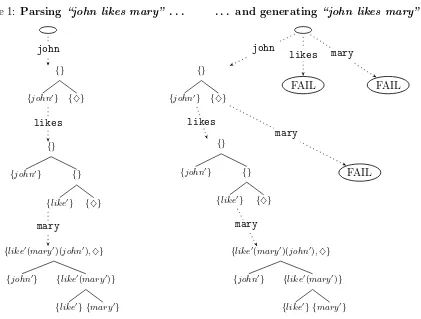
Parsing (Kempson et al., 2001) defines pars-ing as a process of buildpars-ing labelled semantic trees in a strictly left-to-right, word-by-word in-cremental fashion by using computational ac-tions and lexical acac-tions defined (for some natu-ral language) using the modal tree logic LOFT (Blackburn and Meyer-Viol, 1994). These ac-tions are defined as transition funcac-tions be-tween intermediate states, which monotonically extend tree structures and node decorations. Words are specified in the lexicon to have as-sociated lexical actions: the (possibly partial) semantic trees are monotonically extended by applying these actions as each word is consumed from the input string. Partial trees may be un-derspecified: tree node relations may be only partially specified; node decorations may be de-fined in terms of unfulfilled requirements and metavariables; and trees may lack a full set of scope constraints. Anaphora resolution is a fa-miliar case of update: pronouns are defined to project metavariables that are substituted from context as part of the construction process. Rel-ative to the same tree-growth dynamics, long-distance dependency effects are characterised through restricted licensing of partial trees with relation between nodes introduced with merely a constraint on some fixed extension (following D-Tree grammar formalisms (Marcus, 1987)), an underspecification that gets resolved within the left-to-right construction process.3
Quanti-fying terms are also built up using determiner and noun to yield a partially specified term e.g.
(, y, M an0(y)) with a requirement for a scope
statement. These scope statements, of the form
x < y (‘the term binding x is to be evaluated
as taking scope over the term binding y’), are added to a locally dominating type-t-requiring node. Generally, they are added to an accu-mulating set following the serial order of pro-cessing in determining the scope dependency, but indefinites (freer in scope potential) are as-signed a metavariable as first argument,
allow-3
Figure 1: Parsing “john likes mary” . . . and generating “john likes mary”
{}
{john0} {♦}
john
{}
{john0} {}
{like0} {♦}
likes
{like0(mary0)(john0),♦}
{john0} {like0(mary0)}
{like0} {mary0}
mary
{}
{john0} {♦}
FAIL FAIL
john
likes mary
{}
{john0} {}
{like0} {♦}
FAIL
likes
mary
{like0(mary0)(john0),♦}
{john0} {like0(mary0)}
{like0} {mary0}
mary
ing selection from any term already added, in-cluding temporally-sorted variables associated with tense/modality specifications. The gen-eral mechanism is the incremental analogue of quantifier storage; and once a propositional for-mula of type thas been derived at a node with some collection of scope statements, these are jointly evaluated to yield fully expanded terms that reflect all relative dependencies within the restrictor of the terms themselves. For example, parsingA man coughed yields the pairSi < x,
Cough0(, x, M an0(x)) (Si the index of
evalua-tion), then evaluated as M an0(a)∧Cough0(a) wherea= (, x, M an0(x)∧Cough0(x)).4
Once all requirements are satisfied and all partiality and underspecification is resolved, trees arecomplete, parsing is successful and the input string is said to be grammatical. Central to the formalism is the incremental and mono-tonic growth of labelled partial trees: the parser state at any point contains all the partial trees which have been produced by the portion of the string so far consumed and which remain can-didates for completion.5
4
For formal details of this approach to quantification see (Kempson et al., 2001) chapter 7; for an early imple-mentation see (Kibble et al., 2001).
5
Figure 1 assumes, simplistically, that linguistic names correspond directly to scopeless names in the
log-Generation (Otsuka and Purver, 2003; Purver and Otsuka, 2003) (hereafter O&P) give an initial method of context-independent tactical generation based on the same incre-mental parsing process, in which an output string is produced according to an input semantic tree, the goal tree. The generator incrementally produces a set of corresponding output strings and their associated partial trees (again, on a left-to-right, word-by-word basis) by following standard parsing routines and using the goal tree as a subsumption check. At each stage, partial strings and trees are tentatively extended using some word/action pair from the lexicon; only those candidates which produce trees which subsume the goal tree are kept, and the process succeeds when a complete tree identical to the goal tree is produced. Generation and parsing thus use the same tree representations and tree-building actions throughout.
3 Contextual Model
The current proposed model (and its imple-mentation) is based on these earlier definitions but modifies them in several ways, most signif-icantly by the addition of a model of context:
while they assume some notion of context they give no formal model or implementation.6
The contextual model we now assume is made up not only of the semantic trees built by the DS pars-ing process, but also the sequences of words and associated lexical actions that have been used to build them. It is the presence of (and as-sociations between) all three, together with the fact that this context is equally available to both parsing and generation processes, that allow our straightforward model of dialogue phenomena.7
For the purposes of the current implementa-tion, we make a simplifying assumption that the length of context is finite and limited to the result of some immediately previous parse (al-though information that is independently avail-able can be represented in the DS tree format, so that, in reality, larger and only partially or-dered contexts are no doubt possible): context at any point is therefore made up of the trees and word/action sequences obtained in parsing the previous sentence and the current (incom-plete) sentence.
Parsing in Context A parser state is there-fore defined to be a set of triples hT, W, Ai, where T is a (possibly partial) semantic tree,8
W the sequence of words and A the sequence of lexical and computational actions that have been used in building it. This set will initially contain only a single triple hTa,∅,∅i(where Ta is the basic axiom taken as the starting point of the parser, and the word and action sequences are empty), but will expand as words are con-sumed from the input string and the corre-sponding actions produce multiple possible par-tial trees. At any point in the parsing process, the context for a particular partial tree T in
6
There are other departures in the treatment of linked structures (for relatives and other modifiers) and quan-tification, and more relevantly to improve the incremen-tality of the generation process: we do not adopt the proposal of O&P to speed up generation by use of a re-stricted multiset of lexical entries selected on the basis of goal tree features, which prevents strictly incremental generation and excludes modification of the goal tree.
7
In building n-tuples of trees corresponding to predicate-argument structures, the system is similar to LTAG formalisms (Joshi and Kulick, 1997). However, unlike LTAG systems (see e.g. (Stone and Doran, 1997)), both parsing and generation are not head-driven, but fully (word-by-word) incremental. This has the ad-vantage of allowing fully incremental models for all languages, matching psycholinguistic observations (Fer-reira, 1996).
8
Strictly speaking, scope statements should be in-cluded in thesen-tuples – for now we consider them as part of the tree.
this set can then be taken to consist of: (a) a similar triplehT0, W0, A0igiven by the previous
sentence, where T0 is its semantic tree
repre-sentation, W0 and A0 the sequences of words
and actions that were used in building it; and (b) the triple hT, W, Ai itself. Once parsing is complete, the final parser state, a set of triples, will form the new starting context for the next sentence. In the simple case where the sentence is unambiguous (or all ambiguity has been re-moved) this set will again have been reduced to a single triplehT1, W1, A1i, corresponding to
the final interpretation of the stringT1 with its
sequence of wordsW1 and actions A1, and this
replaceshT0, W0, A0ias the new context; in the
presence of persistent ambiguity there will sim-ply be more than one triple in the new context.9 Generation in Context A generator state is now defined as a pair (Tg, X) of a goal tree
Tg and a set X of pairs (S, P), where S is a candidate partial string andP is the associated parser state (a set of hT, W, Ai triples). Ini-tially, the set X will usually contain only one pair, of an empty candidate string and the stan-dard initial parser state, (∅,{hTa,∅,∅i}). How-ever, as both parsing and generation processes are strictly incremental, they can in theory start fromany state. The context for any partial tree
T is defined exactly as for parsing: the previ-ous sentence triple hT0, W0, A0i; and the
cur-rent triple hT, W, Ai. Generation and parsing are thus very closely coupled, with the central part of both processes being a parser state: a set of tree/word-sequence/action-sequence triples. Essential to this correspondence is the lack of construction of higher-level hypotheses about the state of the interlocutor. All transitions are defined over the context for the individ-ual (parser or generator). In principle, con-texts could be extended to include high-level hypotheses, but these are not essential and are not implemented in our model (see (Millikan, 2004) for justification of this stance).
4 Shared Utterances
One primary evidence for this close coupling and sharing of structures and context is the ease with which shared utterances can be expressed. O&P suggest an analysis of shared utterances,
9
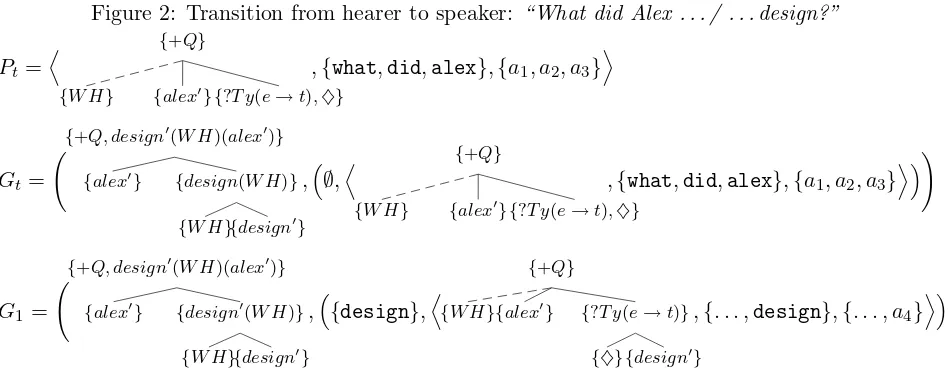
Figure 2: Transition from hearer to speaker: “What did Alex . . . / . . . design?”
Pt=
D
{+Q}
{W H} {alex0}{?T y(e→t),♦}
,{what,did,alex},{a1, a2, a3} E
Gt=
{+Q, design0(W H)(alex0)}
{alex0} {design(W H)}
{W H}{design0}
,∅,D
{+Q}
{W H} {alex0}{?T y(e→t),♦}
,{what,did,alex},{a1, a2, a3} E
!
G1 =
{+Q, design0(W H)(alex0)}
{alex0} {design0(W H)}
{W H}{design0}
,{design},D
{+Q}
{W H}{alex0} {?T y(e→t)}
{♦}{design0}
,{. . . ,design},{. . . , a4} E
!
and this can now be formalised given the cur-rent model. As the parsing and generation pro-cesses are both fully incremental, they can start from any state (not just the basic axiom state
hTa,∅,∅i). As they share the same lexical en-tries, the same context and the same semantic tree representations, a model of the switch of roles now becomes relatively straightforward.
Transition from Hearer to Speaker Nor-mally, the generation process begins with the initial generator state as defined above: (Tg,{(∅, P0)}), whereP0 is the standard initial
“empty” parser state {hTa,∅,∅i}. As long as a suitable goal tree Tg is available to guide gen-eration, the only change required to generate a continuation from a heard partial string is to replaceP0 with the parser state (a set of triples
hT, W, Ai) as produced from that partial string:
we call this the transition state Pt. The initial hearer A therefore parses as usual until transi-tion,10
then given a suitable goal treeTg, forms a transition generator stateGt= (Tg,{(∅, Pt)}), from which generation can begin directly – see figure 2.11
Note that the context does not change between processes.
For generation to begin from this transition state, the new goal tree Tg must be subsumed by at least one of the partial trees in Pt (i.e. the proposition to be expressed must be sub-sumed by the incomplete proposition that has been built so far by the parser). Constructing
10
We have little to say about exactlywhentransitions occur. Presumably speaker pauses and the availability to the hearer of a possible goal tree both play a part.
11
Figure 2 contains several simplifications to aid read-ability, both to tree structure details and by show-ing parser/generator states as sshow-ingle triples/pairs rather than sets thereof.
Tg prior to the generation task will often be a complex process involving inference and/or ab-duction over context and world/domain knowl-edge – Poesio and Rieser (2003) give some idea as to how this inference might be possible – for now, we make the simplifying assumption that a suitable propositional structure is available.
Transition from Speaker to Hearer At transition, the initial speaker B’s generator state G0
t contains the pair (St, Pt0), where St is the partial string output so far, and P0
t is the corresponding parser state, the transition state as far as B is concerned.12
In order for B to interpret A’s continuation, B need only use Pt0
as the initial parser state which is extended as the string produced by A is consumed.
As there will usually be multiple possible par-tial trees at the transition point, A may con-tinue in a way that does not correspond to B’s initial intentions – i.e. in a way that does not match B’s initial goal tree. For B to be able to understand such continuations, the genera-tion process must preserve all possible partial parse trees (just as the parsing process does), whether they subsume the goal tree or not, as long as at least one tree in the current statedoes
subsume the goal tree. A generator state must therefore rule out only pairs (S, P) for whichP
contains no trees which subsume the goal tree, rather than thinning the set P directly via the subsumption check as proposed by O&P.
It is the incrementality of the underlying grammar formalism that allows this simple switch: the parsing process can begin directly
12
from a state produced by an incomplete gener-ation process, and vice versa, as their interme-diate representations arenecessarily the same.
5 Cross-Speaker Ellipsis
This inherent close coupling of the two incre-mental processes, together with the inclusion of tree-building actions in the model of con-text, also allows a simple analysis of many cross-speaker elliptical phenomena.
Fragments Bare fragments (3) may be anal-ysed as taking a previous structure from con-text as a starting point for parsing (or genera-tion). WH-expressions are analysed as partic-ular forms of metavariables, so parsing a wh -question yields a type-complete but open for-mula, which the term presented by a subsequent fragment can update:
(3) A: What did you eat for breakfast?
B: Porridge.
Parsing the fragment involves constructing an unfixed node, and merging it with the contex-tually available structure, so characterising the wellformedness/interpretation of fragment an-swers to questions without any additional mech-anisms: the term (, x, porridge0(x)) stands in a
licensed growth relation from the metavariable
W H provided by the lexical actions of what. Functional questions (Ginzburg and Sag, 2000) with their fragment answers (4) pose no problem. As the wh-question contains a metavariable, the scope evaluation cannot be completed; completion of structure and evalu-ation of scope can then be effected by merg-ing in the term the answer provides, identifymerg-ing any introduced metavariable in this context (the genitive imposes narrow scope of the introduced epsilon term):
(4) A: Who did every student ignore?
B: Their supervisor.
{Si< x}
{(ι, x, stud0(x))} {}
{W H,♦} {ignr0}
→ {Si< x, x < y}
{(ι, x, stud0(x))} {}
{(, y, sup0(x)(y)}{ignr0}
VP Ellipsis Anaphoric devices such as pro-nouns and VP ellipsis are analysed as decorating tree nodes with metavariables licensing update from context using either established terms, or,
for ellipsis, (lexical) tree-update actions. Strict readings of VP ellipsis result from taking a suit-able semantic formula directly from a tree node in context: any node n ∈ (T0∪T) of suitable
type (e→t) with no outstanding requirements. Sloppy readings involve re-use of actions: any sequence of actions (a1;a2;. . .;an) ∈ (A0∪A)
can be used (given the appropriate elliptical trigger) to extend the current treeT if this pro-vides a formula of type e → t.13
This latter approach, combined with the representation of quantified elements as terms, allows a range of phenomena, including those which are problem-atic for other (abstraction-based) approaches (for discussion see (Dalrymple et al., 1991)):
(5)
A: A policeman who arrested Bill read him his rights.
B: The policeman who arrested Tom did too.
The actions associated with A’s use of read him his rightsin (5) include the projection of a metavariable associated with him, and its res-olution to the term in context associated with
Bill. B’s ellipsis allows this action sequence to be re-used, again projecting a metavariable and resolving it, this time (given the new context) to the term provided by parsingTom. This leads to a copy ofTom within the constructed predi-cate, and a sloppy reading.
This analysis also applies to yield parallellism effects in scoping (Hirschb¨uhler, 1982; Shieber et al., 1996), allowing narrow scope construal for indefinites in subject position:
(6) AB: A nurse interviewed every patient. : An orderly did too.
Resolution of the underspecification in the scope statement associated with an indefinite can be performed at two points: either at the immediate point of processing the lexical ac-tions, or at the later point of compiling the re-sulting node’s interpretation within the emer-gent tree.14
In (6), narrow scope can be as-signed to the subject in A’s utterance via this late assignment of scope; at this late point in the
13
In its re-use of actions provided by context, this ap-proach to ellipsis is essentially similar to the glue lan-guage approach (see (Asudeh and Crouch, 2002) and papers in (Dalrymple, 1999) but, given the lack of in-dependent syntax /semantics vocabularies, the need for an intermediate mapping language is removed.
14
parse process, the term constructed from the ob-ject node will have been entered into the set of scope statements, allowing the subject node to be dependent on the following quantified expres-sion. The elliptical word did in B’s utterance will then license use of these late actions, re-peating the procedures used in interpretingA’s antecedent and so determining scope of the new subject relative to the object.
Again, these analyses are possible because parsing and generation processes share incre-mentally built structures and contextual pars-ing actions, with this bepars-ing ensured by the in-crementality of the grammar formalism itself.
6 Alignment & Routinization
The parsing and generation processes must both search the lexicon for suitable entries at ev-ery step (i.e. when parsing or generating each word). For generation in particular, this is a computationally expensive process in principle: every possible word/action pair must be tested – the current partial tree extended and the result checked for goal tree subsumption. As proposed by O&P (though without formal definitions or implementation) our model of context now al-lows a strategy for minimising this effort: as it includes previously used words and actions, a subset of such actions can be re-used in ex-tending the current tree, avoiding full lexical search altogether. High frequency of elliptical constructions is therefore expected, as ellipsis licenses such re-use; the same can be said for pronouns, as long as they (and their correspond-ing actions) are assumed to be pre-activated or otherwise readily available from the lexicon.
As suggested by O&P, this can now lead di-rectly to a model of alignment phenomena, char-acterisable as follows. For the generator, if there is some actiona∈(A0∪A) suitable for
extend-ing the current tree, acan be re-used, generat-ing the wordw which occupies the correspond-ing position in the sequence W0 orW. This
re-sults in lexical alignment – repeating w rather than choosing an alternative word from the lex-icon. Alignment ofsyntacticstructure (e.g. pre-serving double-object or full PP forms in the use of a verb such as give rather than shifting to the semantically equivalent form (Branigan et al., 2000)) also follows in virtue of the procedu-ral action-based specification of lexical content. A word such as give has two possible lexical actions a0 and a00 despite semantic equivalence of output, corresponding to the two alternative
forms. A previous use will cause eithera0 ora00
to be present in (A0∪A); re-use of this action
will cause the same form to be repeated.15
A similar definition holds for the parser: for a wordwpresented as input, ifw∈(W0∪W) then
the corresponding actionain the sequenceA0or
A can be used without consulting the lexicon. Words will therefore be interpreted as having the same sense or reference as before, modelling the semantic alignment described by (Garrod and Anderson, 1987). These characterisations can also be extended to sequences of words – a sub-sequence (a1;a2;. . .;an) ∈ (A0∪A) can
be re-used by a generator, producing the cor-responding word sequence (w1;w2;. . .;wn) ∈ (W0 ∪W); and similarly the sub-sequence of
words (w1;w2;. . .;wn) ∈ (W0 ∪W) will cause
the parser to use the corresponding action se-quence (a1;a2;. . .;an) ∈ (A0 ∪A). This will
result in sequences or phrases being repeatedly associated by both parser and generator with the same sense or reference, leading to what Pickering and Garrod (2004) call routinization
(construction and re-use of word sequences with consistent meanings).
It is notable that these various patterns of alignment, said by Pickering and Garrod (2004) to be alignment across different levels, are ex-pressible without invoking distinct levels of syn-tactic or lexical structure, since context, content and lexical actions are all defined in terms of the same tree configurations.
7 Summary
The inherent left-to-right incrementality and monotonicity of DS as a grammar formalism al-lows both parsing and generation processes to be not only incremental but closely coupled, sharing structures and context. This enables shared utterances, cross-speaker elliptical phe-nomena and alignment to be modelled straight-forwardly. A prototype system has been im-plemented in Prolog which reflects the model given here, demonstrating shared utterances and alignment phenomena in simple dialogue sequences. The significance of this direct re-flection of psycholinguistic data is to buttress the DS claim that the strictly serial incremen-tality of processing is not merely essential to the modelling of natural-language parsing, but
15
to the design of the underlying grammar formal-ism itself.
Acknowledgements
This paper is an extension of joint work on the DS framework with Wilfried Meyer-Viol, on ex-pletives and on defining a context-dependent formalism with Ronnie Cann, and on DS gen-eration with Masayuki Otsuka. Each has pro-vided ideas and input without which the cur-rent results would have differed, although any mistakes here are ours. Thanks are also due to the ACL reviewers. This work was supported by the ESRC (RES-000-22-0355) and (for the second author) by the Leverhulme Trust.
References
A. Asudeh and R. Crouch. 2002. Derivational parallelism and ellipsis parallelism. In Pro-ceedings of WCCFL 21.
P. Blackburn and W. Meyer-Viol. 1994. Lin-guistics, logic and finite trees. Bulletin of the IGPL, 2:3–31.
H. Branigan, M. Pickering, and A. Cleland. 2000. Syntactic co-ordination in dialogue.
Cognition, 75:13–25.
R. Cann. 2003. Semantic underspecification and the interpretation of copular clauses in English. InWhere Semantics Meets Pragmat-ics. University of Michigan.
H. H. Clark and D. Wilkes-Gibbs. 1986. Re-ferring as a collaborative process. Cognition, 22:1–39.
M. Crocker, M. Pickering, and C. Clifton, ed-itors. 2000. Architectures and Mechanisms in Sentence Comprehension. Cambridge Uni-versity Press.
M. Dalrymple, S. Shieber, and F. Pereira. 1991. Ellipsis and higher-order unification. Linguis-tics and Philosophy, 14(4):399–452.
M. Dalrymple, editor. 1999. Syntax and Se-mantics in Lexical Functional Grammar: The Resource-Logic Approach. MIT Press.
V. Ferreira. 1996. Is it better to give than to donate? Syntactic flexibility in language pro-duction. Journal of Memory and Language, 35:724–755.
S. Garrod and A. Anderson. 1987. Saying what you mean in dialogue. Cognition, 27:181–218. J. Ginzburg and I. A. Sag. 2000. Interrogative
Investigations. CSLI Publications.
R. Hausser. 1989. Computation of Language. Springer-Verlag.
P. Hirschb¨uhler. 1982. VP deletion and across-the-board quantifier scope. In Proceedings of NELS 12.
A. Joshi and S. Kulick. 1997. Partial proof trees as building blocks for a categorial grammar.
Linguistics and Philosophy, 20:637–667. R. Kaplan and A. Zaenen. 1989.
Long-distance dependencies, constituent structure, and functional uncertainty. In M. Baltin and A. Kroch, editors,Alternative Conceptions of Phrase Structure, pages 17–42. University of Chicago Press.
R. Kempson, W. Meyer-Viol, and D. Gabbay. 2001. Dynamic Syntax: The Flow of Lan-guage Understanding. Blackwell.
R. Kibble, W. Meyer-Viol, D. Gabbay, and R. Kempson. 2001. Epsilon terms: a la-belled deduction account. In H. Bunt and R. Muskens, editors, Computing Meaning. Kluwer Academic Publishers.
M. Marcus. 1987. Deterministic parsing and description theory. In P. Whitelock et al., ed-itor, Linguistic Theory and Computer Appli-cations, pages 69–112. Academic Press. W. Meyer-Viol. 1995. Instantial Logic. Ph.D.
thesis, University of Utrecht.
R. Millikan. 2004. The Varieties of Meaning. MIT Press.
G. Neumann. 1994. A Uniform Computa-tional Model for Natural Language Parsing and Generation. Ph.D. thesis, Universit¨at des Saarlandes.
M. Otsuka and M. Purver. 2003. Incremental generation by incremental parsing. In Pro-ceedings of the 6th CLUK Colloquium. M. Pickering and S. Garrod. 2004. Toward a
mechanistic psychology of dialogue. Behav-ioral and Brain Sciences, forthcoming. M. Poesio and H. Rieser. 2003. Coordination in
a PTT approach to dialogue. In Proceedings of the 7th Workshop on the Semantics and Pragmatics of Dialogue (DiaBruck).
M. Purver and M. Otsuka. 2003. Incremental generation by incremental parsing: Tactical generation in Dynamic Syntax. In Proceed-ings of the 9th European Workshop in Natural Language Generation (ENLG-2003).
S. Shieber, F. Pereira, and M. Dalrymple. 1996. Interactions of scope and ellipsis. Linguistics and Philosophy, 19:527–552.