Discontinuous Incremental Shift-Reduce Parsing
Wolfgang Maier
Universit¨at D¨usseldorf Institut f¨ur Sprache und Information Universit¨atsstr. 1, 40225 D¨usseldorf, Germany
Abstract
We present an extension to incremental shift-reduce parsing that handles discon-tinuous constituents, using a linear clas-sifier and beam search. We achieve very high parsing speeds (up to 640 sent./sec.) and accurate results (up to 79.52 F1 on TiGer).
1 Introduction
Discontinuous constituents consist of more than one continuous block of tokens. They arise through phenomena which traditionally in linguis-tics would be analyzed as being the result of some kind of “movement”, such as extraposition or top-icalization. The occurrence of discontinuous con-stituents does not necessarily depend on the de-gree of freedom in word order that a language al-lows for. They can be found, e.g., in almost equal proportions in English and German treebank data (Evang and Kallmeyer, 2011).
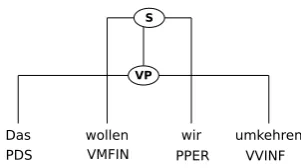
Generally, discontinuous constituents are ac-counted for in treebank annotation. One annota-tion method consists of using trace nodes that de-note the source of a movement and are co-indexed with the moved constituent. Another method is to annotate discontinuities directly by allowing for crossing branches. Fig. 1 shows an example for the latter approach with which we are concerned in this paper, namely, the annotation of (1). The tree contains a discontinuous VP due to the fact that the fronted pronoun is directly attached.
(1) Das
Thatwollenwant wirwe umkehrenreverse “This is what we want to reverse”
Several methods have been proposed for pars-ing such structures. Trace recovery can been
Das PDS
wollen VMFIN
wir PPER
umkehren VVINF
[image:1.595.329.480.229.313.2]VP S
Figure 1: Example annotation with discontinuous constituents from TiGer
framed as a separate pre-, post- or in-processing task to PCFG parsing (Johnson, 2002; Dienes and Dubey, 2003; Jijkoun, 2003; Levy and Manning, 2004; Schmid, 2006; Cai et al., 2011, among others); see particularly Schmid (2006) for more details. Directly annotated discontinuous con-stituents can be parsed with a dependency parser, given a reversible transformation from discontin-uous constituency trees to non-projective depen-dency structures. Transformations have been pro-posed by Hall and Nivre (2008), who use com-plex edge labels that encode paths between lexical heads, and recently by Fern´andez-Gonz´alez and Martins (2015), who use edge labels to encode the attachment order of modifiers to heads.
Direct parsing of discontinuous constituents can be done with Linear Context-Free Rewriting Sys-tem (LCFRS), an extension of CFG which allows its non-terminals to cover more than one contin-uous block (Vijay-Shanker et al., 1987). LCFRS parsing is expensive: CYK chart parsing with a binarized grammar can be done inO(n3k)where kis theblock degree, the maximal number of con-tinuous blocks a non-terminal can cover (Seki et al., 1991). For a typical treebank LCFRS (Maier and Søgaard, 2008),k ≈ 3, instead of k = 1for PCFG. In order to improve on otherwise imprac-tical parsing times, LCFRS chart parsers employ different strategies to speed up search: Kallmeyer
and Maier (2013) use A∗search; van Cranenburgh
(2012) and van Cranenburgh and Bod (2013) use a coarse-to-fine strategy in combination with Data-Oriented Parsing; Angelov and Ljungl¨of (2014) use a novel cost estimation to rank parser items. Maier et al. (2012) apply a treebank transforma-tion which limits the block degree and therewith also the parsing complexity.
Recently Versley (2014) achieved a break-through with aEaFi, a classifier-based parser that uses an “easy-first” approach in the style of Gold-berg and Elhadad (2010). In order to obtain dis-continuous constituents, the parser uses a strat-egy known from non-projective dependency pars-ing (Nivre, 2009; Nivre et al., 2009): For every non-projective dependency tree, there is a projec-tive dependency tree which can be obtained by reordering the input words. Non-projective de-pendency parsing can therefore be viewed as pro-jective dependency parsing with an additional re-ordering of the input words. The rere-ordering can be done online during parsing with a “swap” op-eration that allows to process input words out of order. This idea can be transferred, because also for every discontinuous constituency tree, one can find a continuous tree by reordering the terminals. Versley (2014) uses an adaptive gradient method to train his parser. He reports a parsing speed of 40-55 sent./sec. and results that surpass those re-ported for the above mentioned chart parsers.
In (continuous) constituency parsing, incremen-tal shift-reduce parsing using the structured per-ceptron is an established technique. While the structured perceptron for parsing has first been used by Collins and Roark (2004), classifier-based incremental shift-reduce parsing has been taken up by Sagae and Lavie (2005). A general formula-tion for the applicaformula-tion of the perceptron algorithm to various problems, including shift-reduce con-stituency parsing, has been introduced by Zhang and Clark (2011b). Improvements have followed (Zhu et al., 2012; Zhu et al., 2013). A similar strat-egy has been shown to work well for CCG parsing (Zhang and Clark, 2011a), too.
In this paper, we contribute a perceptron-based shift-reduce parsing architecture with beam search (following Zhu et al. (2013) and Bauer (2014)) and extend it such that it can create trees with crossing branches (following Versley (2014)). We present strategies to improve performance on dis-continuous structures, such as a new feature set.
Our parser is very fast (up to 640 sent./sec.), and produces accurate results. In our evaluation, where we pay particular attention to the parser performance on discontinuous structures, we show among other things that surprisingly, a grammar-based parser has an edge over a shift-reduce ap-proach concerning the reconstruction of discontin-uous constituents.
The remainder of the paper is structured as fol-lows. In subsection 2.1, we introduce the gen-eral parser architecture; the subsections 2.2 and 2.3 introduce the features we use and our strat-egy for handling discontinuous structures. Section 3 presents and discusses the experimental results, section 4 concludes the article.
2 Discontinuous Shift-Reduce Parsing Our parser architecture follows previous work, particularly Zhu et al. (2013) and Bauer (2014).
2.1 Shift-reduce parsing with perceptron training
An item in our parser consists of a queue q of token/POS-pairs to be processed, and a stack s, which holds completed constituents.1 The parser
uses different transitions: SHIFT shifts a termi-nal from the queue on to the stack. UNARY-X reduces the first element on the stack to a new constituent labeledX. BINARY-X-L and BINARY -X-R reduce the first two elements on the stack to a new X constituent, with the lexical head com-ing from the left or the right child, respectively. FINISH removes the last element from the stack. We additionally use an IDLEtransition, which can be applied any number of times after FINISH, to improve the comparability of analyses of different lengths (Zhu et al., 2013).
The application of a transition is subject to re-strictions. UNARY-X, e.g., can only be applied when there is at least a single item on the stack. We implement all restrictions listed in the ap-pendix of Zhang and Clark (2009), and add addi-tional restrictions that block transitions involving the root label when not having arrived at the end of a derivation. We do not use an underlying gram-mar to filter out transitions which have not been seen during training.
For decoding, we use beam search (Zhang and Clark, 2011b). Decoding is started by putting the
1As in other shift-reduce approaches, we assume that POS
Das PDS
wollen VMFIN
wir PPER
umkehren VVINF
VP S
[image:3.595.97.248.62.142.2]@S
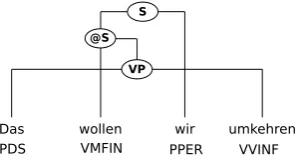
Figure 2: Binarization example
start item (empty stack, full queue) on the beam. Then, repeatedly, a candidate list is filled with all items that result from applying legal transitions to the items on the beam, followed by putting the highest scoringnof them back on the beam (given a beam size ofn). Parsing is finished if the high-est scoring item on the beam is a final item (stack holds one item labeled with the root label, queue is empty), which can be popped. Item scores are computed as in Zhang and Clark (2011b): The score of thei+1th item is computed as the sum of the score of theith item and the dot product of a global feature weight vector and the local weight vector resulting from the changes induced by the corresponding transition to thei+ 1th item. The start item has score 0. We train the global weight vector with an averaged Perceptron with early up-date (Collins and Roark, 2004).
Parsing relies on binary trees. As in previ-ous work, we binarize the incoming trees head-outward with binary top and bottom productions. Given a constituent X which is to be binarized, all intermediate nodes which are introduced will be labeled @X. Lexical heads are marked with Collins-style head rules. As an example, Fig. 2 shows the binarized version of the tree of Fig. 1.
Finally, since we are learning a sparse model, we also exploit the work of Goldberg and Elhadad (2011) who propose to include a feature in the cal-culation of a score only if it has been observed≥
MINUPDATEtimes.
2.2 Features
Features are generated by applying templates to parser items. They reflect different configurations of stack and queue. As BASELINE features, we use the feature set from Zhang and Clark (2009) without the bracketing features (as used in Zhu et al. (2013)). We furthermore experiment with fea-tures that reflect the presence of separating punctu-ation “,”, “:”, “;” (SEPARATOR) (Zhang and Clark, 2009), and with the EXTENDEDfeatures of Zhu et
unigrams
s0tc, s0wc, s1tc, s1wc, s2tc, s2wc, s3tc, s3wc,
q0wt, q1wt, q2wt, q3wt,
s0lwc, s0rwc, s0uwc, s1lwc, s1rwc, s1uwc
bigrams
s0ws1w, s0ws1c, s0cs1w, s0cs1c, s0wq0w, s0wq0t,
s0cq0w, s0cq0t, s1wq0w, s1wq0t, s1cq0w, s1cq0t,
q0wq1w, q0wq1t, q0tq1w, q0tq1t
trigrams
s0cs1cs2w, s0cs1cs2c, s0cs1cq0w, s0cs1cq0t,
s0cs1wq0w, s0cs1wq0t, s0ws1cs2c, s0ws1cq0t
extended
s0llwc,s0lrwc,s0luwc,s0rlwc,s0rrwc,
s0ruwc,s0ulwc,s0urwc,s0uuwc,s1llwc,
s1lrwc,s1luwc,s1rlwc,s1rrwc,s1ruwc
separator
s0wp, s0wcp, s0wq, s0wcq, s0cs1cp, s0cs1cq
s1wp, s1wcp, s1wq, s1wcq
Figure 3: Feature templates
al. (2013), which look deeper into the trees on the stack, i.e., up to the grand-children instead of only to children.
Fig. 3 shows all the feature templates. Note that
si andqi stands for theith stack and queue item, wstands for the head word,tfor the head tag and
c for the constituent label (w, tandc are identi-cal on POS-level). l and r (ll andrr) represent the left and right children (grand-children) of the element on the stack; u handles the unary case. Concerning the separator features, p is a unique separator punctuation between the head words of
s0ands1,qis the count of any separator punctua-tion betweens0ands1.
2.3 Handling Discontinuities
In order to handle discontinuities, we use two variants of a swap transition which are similar to swap-eager and swap-lazy from Nivre (2009) and Nivre et al. (2009). The first variant, SIN -GLESWAP, swaps the second item of the stack back on the queue. The second variant COM -POUNDSWAPi bundles a maximal number of ad-jacent swaps. It swapsi items starting from the second item on the stack, with1 ≤i < |s|. Both swap operations can only be applied if
1. the item has not yet been FINISHed and the last transition has not been a transition with the root category,
2. the queue is not empty,
4. if the first item of the stack has a lower index than the second (this inhibits swap loops). SINGLESWAP can only been applied if there are at least two items on the stack. For COM -POUNDSWAPi, there must be at leasti+ 1items.
Transition sequences are extracted from tree-bank trees with an algorithm that traverses the tree bottom-up and collects the transitions. For a given treeτ, intuitively, the algorithm works as follows. We start out with a queue t containing the pre-terminals ofτ, a stackσthat receives finished con-stituents, a countersthat keeps track of the num-ber of terminals to be swapped, and an empty se-quencer that holds the result. First, the first ele-ment oftis pushed onσand removed fromt.
While|σ|>0or|t|>0, we repeat the follow-ing two steps.
1. Repeat while transitions can be added: (a) if the top two elements on σ, l andr,
have the same parent p labeled X and
l/r is the head ofp, add BINARY-X-l/r tor, pop two elements fromσ and push
p;
(b) if the top element onσis the only child of its parentp labeled X, add UNARY -X, pop an element ofσand pushp. 2. If|t| > 0, while the first element oftis not
equal to the leftmost pre-terminal dominated by the right child of the parent of the top el-ement on σ (i.e., while there are terminals that must be swapped), add SHIFTto r, in-crement s, push the first element of t on σ
and remove it from t. Finally, add another SHIFTtor, push first element ofttoσ and remove it fromt (this will contribute to the next reduction). Ifs > 0, we must swap. Ei-ther we addsmany SWAP transitions or one COMPOUNDSWAPs to r. Then we move s many elements fromσto the front oft, start-ing with the second element ofσ. Finally we sets= 0.
As an example, consider the transition sequence we would extract from the tree in Fig. 2. Using SINGLESWAP, we would obtain SHIFT, SHIFT, SHIFT, SHIFT, SINGLESWAP, SINGLESWAP, BINARY-VP-R, SHIFT, BINARY-@S-R, SHIFT, BINARY-S-L, FINISH. Using COMPOUNDSWAPi, instead of two SINGLESWAPs, we would just ob-tain a single COMPOUNDSWAP2.
unigrams
s0xwc,s1xwc,s2xwc,s3xwc,
s0xtc,s1xwc,s2xtc,s3xwc,
s0xy,s1xy,s2xy,s3xy
bigrams
s0xs1c,s0xs1w,s0xs1x,s0ws1x,s0cs1x,
s0xs2c,s0xs2w,s0xs2x,s0ws2x,s0cs2x,
s0ys1y,s0ys2y,s0xq0t,s0xq0w
Figure 4: Features for discontinuous structures
We explore two methods which improve the performance on discontinuous structures. Even though almost a third of all sentences in the Ger-man NeGra and TiGer treebanks contains at least one discontinuous constituent, among all con-stituents, the discontinuous ones are rare, making up only around 2%. The first, simple method ad-dresses this sparseness by raising the importance of the features that model the actual discontinu-ities by counting all feature occurrences at a gold swap transition twice (IMPORTANCE).
Secondly, we use a new feature set (DISCO) with bigram and unigram features that conveys in-formation about discontinuities. The features con-dition the possible occurrence of a gap on previ-ous gaps and their properties.2 The feature
tem-plates are shown in Fig. 4. x denotes the gap type of a tree on the stack. There are three possi-ble values, either “none” (tree is fully continuous), “pass” (there is a gap at the root, i.e., this gap must be filled later further up in the tree), or “gap” (the root of this tree fills a gap, i.e., its children have gaps, but the root does not). Finally,y is the sum of all gap lengths.
3 Experiments 3.1 Data
We use the TiGer treebank release 2.2 (TIGER), and the NeGra treebank (NEGRA). For TIGER, we use the first half of the last 10,000 sentences for development and the second half for testing.3
We also recreate the split of Hall and Nivre (2008) (TIGERHN), for which we split TiGer in 10 parts, assigning sentenceito partimod10. The first of those parts is used for testing, the concatenation of the rest for training.
2See Maier and Lichte (2011) for a formal account on
gaps in treebanks.
3This split, which corresponds to the split used in the
From NeGra, we exclude all sentences longer than 30 words (in order to make a comparison with rparse possible, see below), and split off the last 10% of the treebank for testing, as well as the previous 10% for development. As a pre-processing step, in both treebanks we remove spu-rious discontinuities that are caused by material which is attached to the virtual root node (mainly punctuation). All such elements are attached to the least common ancestor node of their left and right terminal neighbors (as proposed by Levy (2005), p. 163). We furthermore create a continuous vari-ant NEGRACF of NEGRAwith the method usu-ally used for PCFG parsing: For all maximal con-tinuous parts of a disconcon-tinuous constituent, a sep-arate node is introduced (Boyd, 2007). Subse-quently, all nodes that do not cover the head child of the discontinuous constituent are removed.
No further preprocessing or cleanup is applied.
3.2 Experimental Setup
Our parser is implemented in Java. We run all our experiments with Java 8 on an Intel Core i5, al-locating 15 GB per experiment. All experiments are carried out with gold POS tags, as in previous work on shift-reduce constituency parsing (Zhang and Clark, 2009). Grammatical function labels are discarded.
For the evaluation, we use the corresponding module of discodop.4 We report several metrics
(as implemented indiscodop):
• Extended labeled bracketing, in which a bracket for a single node consists of its la-bel and a set of pairs of indices, delimiting the continuous blocks it covers. We do not include the root node in the evaluation and ignore punctuation. We report labeled preci-sion, recall and F1, as well as exact match (all brackets correct).
• Leaf-ancestor (Sampson and Babarczy, 2003), for which we consider all paths from leaves to the root.
• Tree edit distance (Emms, 2008), which con-sists of the minimum edit distance between gold tree and parser output.
Aside from a full evaluation, we also evaluate only the constituents that are discontinuous.
4http://github.com/andreasvc/discodop
60 62 64 66 68 70 72 74
2 4 6 8 10 12 14 16 18 20
F1 on dev
. set
Iteration
[image:5.595.308.502.66.213.2]1 2 4 8
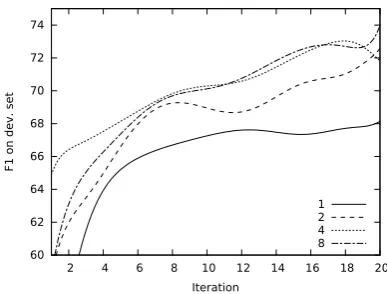
Figure 5: NEGRA dev results (F1) for different beam sizes
We perform 20 training iterations unless indi-cated otherwise. When training stops, we average the model (as in Daum´e III (2006)).
We run further experiments with rparse5
(Kallmeyer and Maier, 2013) to facilitate a com-parison with a grammar-based parser.
3.3 Results
We start with discontinuous parsing experiments on NEGRA and TIGER, followed by continu-ous parsing experiments, and a comparison to grammar-based parsing.
3.3.1 Discontinuous Parsing
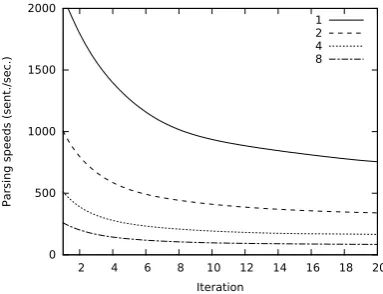
NeGra The first goal is to determine the effect of different beam sizes with BASELINE features and the COMPOUNDSWAPioperation. We run ex-periments with beam sizes 1, 2, 4 and 8; Fig. 5 shows the results obtained on the dev set after each iteration. Fig. 6 shows the average decod-ing speed durdecod-ing each iteration for each beam size (both smoothed).
Tracking two items instead of one results in a large improvement. Raising the beam size from 2 to 4 results in a smaller improvement. The im-provement obtained by augmenting the beam size from 4 to 8 is even smaller. This behavior is mir-rored by the parsing speeds during training: The differences in parsing speed roughly align with the result differences. Note that fast parsing during training means that the parser does not perform well (yet) and that therefore, early update is done more often. Note finally that the average parsing speeds on the test set after the last training iteration
All Discont. only
LR LP LF1 E LR LP LF1 E
BASELINEcombined with
SWAP 74.74 75.60 75.17 43.54 15.70 15.82 15.76 12.31
COMPOUNDSWAPi 75.60 76.37 75.98 43.04 16.46 19.96 18.05 12.05 BASELINE+ COMPOUNDSWAPicombined with
SEPARATOR 75.20 75.74 75.47 42.61 13.11 16.73 14.70 9.89 EXTENDED 76.15 76.92 76.53 44.46 15.09 20.62 17.43 12.70
DISCO 75.86 76.39 76.12 43.94 15.42 22.95 18.45 12.86
IMPORTANCE 75.72 76.61 76.16 43.86 16.16 20.42 18.04 12.38
BASELINE+ COMPOUNDSWAPi+ DISCOcombined with
[image:6.595.93.506.62.215.2]EXTENDED 76.68 77.19 76.93 44.10 15.27 26.88 19.47 13.61 EXTENDED+ SEPARATOR 76.21 76.45 76.33 43.29 15.57 26.56 19.63 13.52 IMPORTANCE 76.22 76.86 76.54 43.75 16.01 29.41 20.73 13.89 EXTENDED+ IMPORTANCE 76.76 77.13 76.95 44.30 15.09 28.86 19.82 13.23
Table 1: Results NEGRA, beam size8
0 500 1000 1500 2000
2 4 6 8 10 12 14 16 18 20
Parsing speeds (sent./sec.)
Iteration
1 2 4 8
Figure 6: NEGRAdev average parsing speeds per sentence for different beam sizes
range from 640 sent./sec. (greedy) to 80 sent./sec. (beam size 8).
For further experiments on NeGra, we choose a beam size of 8. Tab. 1 shows the bracketing scores for various parser setups. In Tab. 2, the corresponding TED and Leaf-Ancestor scores are shown.
In the first block of the tables, we com-pare SWAP with COMPOUNDSWAPi. On all
TED LA
BASELINEcombined with
SWAP 89.19 91.62
COMPOUNDSWAPi 89.60 91.93 BASELINE+ COMPOUNDSWAPicombined with
SEPARATOR 89.41 91.77 EXTENDED 89.68 91.99
DISCO 89.42 91.83
BASELINE+ COMPOUNDSWAPi+ DISCOcombined with
IMPORTANCE 89.64 91.90 EXTENDED 89.68 91.99 EXTENDED+ SEPARATOR 89.52 91.86 EXTENDED+ IMPORTANCE 89.80 91.98 Table 2: Results NEGRATED and Leaf-Ancestor
constituents, the latter beats the former by 0.8 (F1). On discontinuous constituents, using COM -POUNDSWAPigives an improvement of more than
four points in precision and of about 0.8 points in recall. A manual analysis confirms that as expected, particularly discontinuous constituents with large gaps profit from bundling swap transi-tions.
[image:6.595.74.266.262.409.2]EXTENDEDparticularly on the frequent discontin-uous categories (NP, VP, AP, PP), which indicates that the information about gap type and gap length is useful for the recovery of discontinuities. IM -PORTANCE (see Sec. 2.3) is not very successful, yielding results which lie in the vicinity of those of the BASELINE.
In the third block of the tables, we test the per-formance of the DISCO features in combination with other techniques, i.e., we use the BASELINE and DISCOfeatures with COMPOUNDSWAPi and combine it with EXTENDEDand SEPARATOR fea-tures as well as with the IMPORTANCE strategy. All experiments beat the BASELINE/DISCO com-bination in terms of F1. EXTENDEDand DISCO give a cumulative advantage, resulting in an in-crease of precision of almost 4%, resp. over 6% on discontinuous constituents, compared to the use of DISCO, resp. EXTENDED alone. Adding the SEPARATORfeatures to this combination does not bring an advantage. The IMPORTANCE strategy is the most successful one in combination with DISCO, causing a boost of almost 10% on preci-sion of discontinuous constituents, leading to the highest overall discontinuous F1of 29.41 (notably more than 12 points higher than the baseline); also on all constituents we obtain the third-highest F1. Combining DISCO with IMPORTANCE and EX -TENDEDleads to the highest overall F1on all con-stituents of 76.95, however, the results on discon-tinuous constituents are slightly lower than for IM -PORTANCE alone. This confirms the previously observed behavior: The EXTENDEDfeatures help when considering all constituents, but they do not seem to be effective for the recovery of disconti-nuities in particular.
In the TED and LA scores (Tab. 2), we see much less variation than in the bracketing scores. As re-ported in the literature (e.g., Rehbein and van Gen-abith (2007)), this is because of the fact that with bracketing evaluation, a single wrong attachment can “break” brackets which otherwise would be counted as correct. Nevertheless, the trends from bracketing evaluation repeat.
To sum up, the COMPOUNDSWAPi operation works better than SWAPbecause the latter misses long gaps. The most useful feature sets were EX -TENDED and DISCO, both when used indepen-dently and when used together. DISCOwas partic-ularly useful for discontinuous constituents. SEP -ARATOR yielded no usable improvements. IM
-PORTANCEhas also proven to be effective, yield-ing the best results on discontinuous constituents (in combination with DISCO). Over almost all ex-periments, a common error is that on root level, CS and S get confused, indicating that the present features do not provide sufficient information for disambiguation of those categories. We can also confirm the tendency that discontinuous VPs in relatively short sentences are recognized correctly, as reported by Versley (2014).
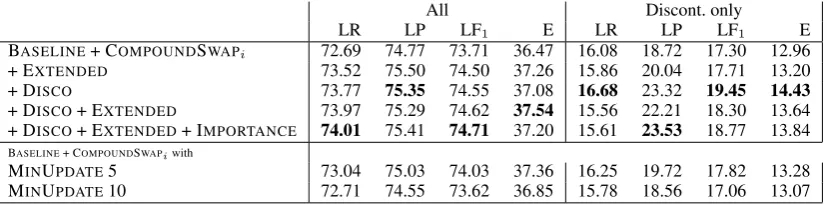
TiGer We now repeat the most successful exper-iments on TIGER. Tab. 3 shows the parsing results for the test set.
Some of the trends seen on the experiments with NEGRA are repeated. EXTENDED and DISCO yields an improvement on all constituents. How-ever, now not only DISCO, but also EXTENDED lead to improved scores on discontinuous con-stituents. As mentioned above, this can be ex-plained with the fact that for the EXTENDED fea-tures to be effective, the amount of training data available in NEGRAwas not enough. Other than in NEGRA, the DISCOfeatures are now more ef-fective when used alone, leading to the highest overall F1 on discontinuous constituents of 19.45. They are, however, less effective in combination with EXTENDED. This is partially remedied by giving the swap transitions more IMPORTANCE, which leads to the highest overall F1 on all con-stituents of 74.71.
The models we learn are sparse, therefore, as mentioned above, we can exploit the work of Goldberg and Elhadad (2011). They propose to only include the weight of a feature in the compu-tation of a score if it has been seen more than MIN -UPDATE times. We repeat the BASELINE experi-ment with two different MINUPDATEsettings (see Tab. 3). As expected, the MINUPDATEmodels are much smaller. The final model with the baseline experiment uses 8.3m features (parsing speed on test set 73 sent./sec.), with MINUPDATE 5 3.3m features (121 sent./sec.) and with MINUPDATE 10 1.8m features (124 sent./sec.). With MINUP -DATE 10, the results do degrade. However, with MINUPDATE5 in addition to the faster parsing we consistently improve over the baseline.
-All Discont. only
LR LP LF1 E LR LP LF1 E
BASELINE+ COMPOUNDSWAPi 72.69 74.77 73.71 36.47 16.08 18.72 17.30 12.96
+ EXTENDED 73.52 75.50 74.50 37.26 15.86 20.04 17.71 13.20
+ DISCO 73.77 75.35 74.55 37.08 16.68 23.32 19.45 14.43
+ DISCO+ EXTENDED 73.97 75.29 74.62 37.54 15.56 22.21 18.30 13.64 + DISCO+ EXTENDED+ IMPORTANCE 74.01 75.41 74.71 37.20 15.61 23.53 18.77 13.84
BASELINE+ COMPOUNDSWAPiwith
[image:8.595.94.508.62.164.2]MINUPDATE5 73.04 75.03 74.03 37.36 16.25 19.72 17.82 13.28 MINUPDATE10 72.71 74.55 73.62 36.85 15.78 18.56 17.06 13.07
Table 3: Results TIGER, beam size 4
LR LP LF1 E
BASELINE 81.89 82.49 82.19 49.05 EXTENDED 82.20 82.70 82.45 49.54
Table 4: Results NEGRACF
TENDED, and IMPORTANCE. The parsing speed on the test set drops to around 39 sentences per second. However, we achieve 75.10 F1, i.e., a slight improvement over the experiments in Tab. 3 that confirms the tendencies visible in Fig. 5. 3.3.2 Continuous Parsing
We investigate the impact of the swap transitions on both speed and parsing results by running an experiment with NEGRACF using the BASELINE and EXTENDEDfeatures. The corresponding re-sults are shown in Tab. 4.
Particularly high frequency categories (NP, VP, S) are much easier to find in the continuous case and show large improvements. This explains why without the swap transition, F1 with BASELINE features is 6.9 points higher than the F1on discon-tinuous constituents (with COMPOUNDSWAPi).
With the EXTENDED features, we obtain a small improvement.
Note that with the shift-reduce approach, the difference between the computational cost of pro-ducing discontinuous constituents vs. the cost of producing continuous constituents is much lower than for a grammar-based approach. When pro-ducing continuous constituents, parsing is only 20% faster than with the swap transition, namely 97 instead of 81 sentences per second.
In order to give a different perspective on the role of discontinuous constituents, we perform two further evaluations. First, we remove the dis-continuities from the output of the discontinuous baseline parser using the procedure described in Sec. 3.1 and evaluate the result against the con-tinuous gold data. We obtain an F1 of 76.70, 5.5 points lower than the continuous baseline.
LR LP LF1 E
All constituents 69.72 68.85 69.28 33.89 Disc. only 25.77 27.51 26.61 17.77
Table 5: Results NEGRArparse
Secondly, we evaluate the output of the continu-ous baseline parser against the discontinucontinu-ous gold data. This leads to an F1 78.89, 2.9 point more than the discontinuous baseline. Both evaluations confirm the intuition that parsing is much easier when discontinuities (i.e., in our case the swap transition) do not have to be considered.
3.3.3 Comparison with other Parsers
rparse In order to compare our parser with a grammar-based approach, we now parse NEGRA withrparse, with the same training and test sets as before (i.e., we do not use the development set). We employ markovization withv= 1,h= 2and head driven binarization with binary top and bot-tom productions.
The first thing to notice is that rparseis much slower than our parser. The average parsing speed is about 0.3 sent./sec.; very long sentences require over a minute to be parsed. The parsing results are shown in Tab. 5. They are about 5 points worse than those reported by Kallmeyer and Maier (2013). This is due to the fact that they train on the first 90% of the treebank, and not on the first 80% as we do, which leads to an increased number of unparsed sentences. In comparison to the baseline setting of the shift-reduce parser with beam size 8, the results are around 10 points worse. How-ever,rparsereaches an F1 of 26.61 on discontinu-ous constituents, which is 5.9 points more than we achieved with the best setting with our parser.
LF1 E
Versley (2014) 74.23 37.32
[image:9.595.73.202.64.114.2]this work 79.52 44.32 H&N (2008) 79.93 37.78 F&M (2015) 85.53 51.21
Table 6: Results TIGERHN, sentence length≤40
average occurrence count of rules with gap degree 0 is 12.18. Discontinuous rules have a much lower frequency, the average count of productions with one, two and three gaps being 3.09, 2.09, and 1.06, respectively. In PCFG parsing, excluding low fre-quency productions does not have a large effect (Charniak, 1996); however, this does not hold for LCFRS parsing, where they have a major influ-ence (cf. Maier (2013, p. 205)): This means that removing low frequency productions has a nega-tive impact on the parser performance particularly concerning discontinuous structures; however, it also means that low frequency discontinuous pro-ductions get triggered reliably. This hypothesis is confirmed by the fact that the our parser per-forms much worse on discontinuous constituents with a very low frequency (such as CS, making up only 0.62% of all discontinuous constituents) than it performs on those with a high frequency (such as VP, making up 60.65% of all discontin-uous constituents), whilerparseperforms well on the low frequency constituents.
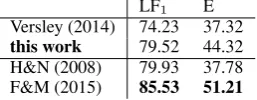
EaFi and Dependency Parsers We run an ex-periment with 40 iterations on TIGERHN, using DISCO, EXTENDED and IMPORTANCE. Tab. 6 lists the results, together with the correspond-ing results of Versley (2014), Hall and Nivre (2008) (H&N) and Fern´andez-Gonz´alez and Mar-tins (2015) (F&M).
Our results exceed those of EaFi6 and the
ex-act match score of H&N. We are outperformed by the F&M parser. Note, that particularly the com-parison toEaFimust be handled with care, since Versley (2014) uses additional preprocessing: PP-internal NPs are annotated explicitly, and the par-enthetical sentences are changed to be embedded by their enclosing sentence (instead of vice versa). We postpone a thorough comparison with both EaFi and the dependency parsers to future work.
6Note that Versley (2014) reports a parsing speed of
40-55 sent./sec.; depending on the beam size and the training set size, per second, our parser parses 39-640 sentences.
3.4 Discussion
To our knowledge, surprisingly, numerical scores for discontinuous constituents have not been re-ported anywhere in previous work. The relatively low overall performance with both grammar-based and shift-reduce based parsing, along with the fact that the grammar-based approach outperforms the shift-reduce approach, is striking. We have shown that it is possible to push the precision on discon-tinuous constituents, but not the recall, to the level of what can be achieved with a grammar-based ap-proach.
Particularly the outcome of the experiments involving the EXTENDED features and IMPOR -TANCEdrives us to the conclusion that the major problem when parsing discontinuous constituents is data sparseness. More features cannot be the only solution: A more reliable recognition of dis-continuous constituents requires a more robust learning from larger amounts of data.
4 Conclusion
We have presented a shift-reduce parser for dis-continuous constituents which combines previous work in shift-reduce parsing for continuous con-stituents with recent work in easy-first parsing of discontinuous constituents. Our experiments con-firm that an incremental shift-reduce architecture with a swap transition can indeed be used to parse discontinuous constituents. The swap transition is associated with a low computational cost. We have obtained a speed-up of up to 2,000% in compar-ison to the grammar-based rparse, and we have shown that we obtain better results than with the based parser, even though the grammar-based strategy does better at the reconstruction of discontinuous constituents.
In future work, we will concentrate on methods that could remedy the data sparseness concerning discontinuous constituents, such as self-training. Furthermore, we will experiment with larger fea-ture sets that add lexical information. An for-mal investigation of the expressivity of our parsing model is currently under way.
Acknowledgments
References
Krasimir Angelov and Peter Ljungl¨of. 2014. Fast statistical parsing with parallel multiple context-free
grammars. InProceedings of the 14th Conference of
the European Chapter of the Association for Com-putational Linguistics, pages 368–376, Gothenburg, Sweden.
John Bauer. 2014. Stanford shift-reduce parser.
http://nlp.stanford.edu/software/
srparser.shtml.
Adriane Boyd. 2007. Discontinuity revisited: An improved conversion to context-free representations. In Proceedings of The Linguistic Annotation Work-shop (LAW) at ACL 2007, pages 41–44, Prague, Czech Republic.
Shu Cai, David Chiang, and Yoav Goldberg. 2011. Language-independent parsing with empty
ele-ments. In Proceedings of the 49th Annual
Meet-ing of the Association for Computational LMeet-inguis- Linguis-tics: Human Language Technologies, pages 212– 216, Portland, OR.
Eugene Charniak. 1996. Tree-bank grammars. Tech-nical Report CS-96-02, Department of Computer Science, Brown University, Providence, RI.
Michael Collins and Brian Roark. 2004.
Incremen-tal parsing with the perceptron algorithm. In
Pro-ceedings of the 42nd Meeting of the Association for Computational Linguistics (ACL’04), Main Volume, pages 111–118, Barcelona, Spain.
Hal Daum´e III. 2006. Practical Structured Learning
Techniques for Natural Language Processing. Ph.D. thesis, University of Southern California, Los Ange-les, CA.
P´eter Dienes and Amit Dubey. 2003. Antecedent
re-covery: Experiments with a trace tagger. In
Pro-ceedings of the 2003 Conference on Empirical Meth-ods in Natural Language Processing, pages 33–40, Sapporo, Japan.
Martin Emms. 2008. Tree distance and some
other variants of Evalb. In Proceedings of the
Sixth International Language Resources and Eval-uation (LREC’08), pages 1373–1379, Marrakech, Morocco.
Kilian Evang and Laura Kallmeyer. 2011. PLCFRS parsing of English discontinuous constituents. In
Proceedings of the 12th International Conference on Parsing Technologies (IWPT 2011), pages 104–116, Dublin, Ireland.
Richard Farkas and Helmut Schmid. 2012. Forest
reranking through subtree ranking. InProceedings
of the 2012 Joint Conference on Empirical Methods in Natural Language Processing and Computational Natural Language Learning, pages 1038–1047, Jeju Island, Korea.
Daniel Fern´andez-Gonz´alez and Andr´e F. T. Martins.
2015. Parsing as reduction. InProceedings of the
53rd Annual Meeting of the Association for Compu-tational Linguistics and Teh 7th International Joint Conference on Natural Language Processing of the Asian Federation of Natural Language Processing, Beijing, China. To appear.
Yoav Goldberg and Michael Elhadad. 2010. An effi-cient algorithm for easy-first non-directional
depen-dency parsing. InHuman Language Technologies:
The 2010 Annual Conference of the North American Chapter of the Association for Computational Lin-guistics, pages 742–750, Los Angeles, CA.
Yoav Goldberg and Michael Elhadad. 2011. Learning sparser perceptron models. Technical report, Ben Gurion University of the Negev.
Johan Hall and Joakim Nivre. 2008. Parsing dis-continuous phrase structure with grammatical func-tions. In Bengt Nordstr¨om and Aarne Ranta, editors,
Advances in Natural Language Processing, volume
5221 ofLecture Notes in Computer Science, pages
169–180. Springer, Gothenburg, Sweden.
Valentin Jijkoun. 2003. Finding non-local
dependen-cies: Beyond pattern matching. In The
Compan-ion Volume to the Proceedings of 41st Annual Meet-ing of the Association for Computational LMeet-inguis- Linguis-tics, pages 37–43, Sapporo, Japan.
Mark Johnson. 2002. A simple pattern-matching al-gorithm for recovering empty nodes and their
an-tecedents. InProceedings of the 40th Annual
Meet-ing of the Association for Computational LMeet-inguis- Linguis-tics, pages 136–143, Philadelphia, PA.
Laura Kallmeyer and Wolfgang Maier. 2013. Data-driven parsing using probabilistic linear context-free rewriting systems. Computational Linguistics, 39(1):87–119.
Roger Levy and Christopher Manning. 2004. Deep dependencies from context-free statistical parsers: Correcting the surface dependency approximation. InProceedings of the 42nd Meeting of the Associa-tion for ComputaAssocia-tional Linguistics (ACL’04), Main Volume, pages 327–334, Barcelona, Spain.
Roger Levy. 2005. Probabilistic Models of Word
Or-der and Syntactic Discontinuity. Ph.D. thesis, Stan-ford University.
Wolfgang Maier and Timm Lichte. 2011. Characteriz-ing discontinuity in constituent treebanks. In For-mal Grammar. 14th International Conference, FG 2009. Bordeaux, France, July 25-26, 2009. Revised Selected Papers, volume 5591 ofLNCS/LNAI, pages 167–182. Springer-Verlag.
Wolfgang Maier and Anders Søgaard. 2008.
Tree-banks and mild context-sensitivity. In Philippe
de Groote, editor, Proceedings of the 13th
Wolfgang Maier, Miriam Kaeshammer, and Laura Kallmeyer. 2012. Data-driven PLCFRS parsing re-visited: Restricting the fan-out to two. In Proceed-ings of the Eleventh International Conference on Tree Adjoining Grammars and Related Formalisms (TAG+11), pages 126–134, Paris, France.
Wolfgang Maier. 2013. Parsing Discontinuous
Struc-tures. Dissertation, University of T¨ubingen.
Joakim Nivre, Marco Kuhlmann, and Johan Hall. 2009. An improved oracle for dependency parsing
with online reordering. InProceedings of the 11th
International Conference on Parsing Technologies (IWPT’09), pages 73–76, Paris, France.
Joakim Nivre. 2009. Non-projective dependency
pars-ing in expected linear time. In Proceedings of the
Joint Conference of the 47th Annual Meeting of the ACL and the 4th International Joint Conference on Natural Language Processing of the AFNLP, pages 351–359, Singapore.
Ines Rehbein and Josef van Genabith. 2007.
Eval-uating evaluation measures. In Proceedings of the
16th Nordic Conference of Computational Linguis-tics NODALIDA-2007, pages 372–379, Tartu, Esto-nia.
Kenji Sagae and Alon Lavie. 2005. A classifier-based parser with linear run-time complexity. In Proceed-ings of the Ninth International Workshop on Parsing Technology, pages 125–132, Vancouver, BC.
Geoffrey Sampson and Anna Babarczy. 2003. A test of the leaf-ancestor metric for parse accuracy. Journal of Natural Language Engineering, 9:365–380.
Helmut Schmid. 2006. Trace prediction and recov-ery with unlexicalized PCFGs and slash features. In
Proceedings of the 21st International Conference on Computational Linguistics and 44th Annual Meet-ing of the Association for Computational LMeet-inguis- Linguis-tics, pages 177–184, Sydney, Australia.
Djam´e Seddah, Reut Tsarfaty, Sandra K¨ubler, Marie Candito, Jinho D. Choi, Rich´ard Farkas, Jennifer Foster, Iakes Goenaga, Koldo Gojenola Gallete-beitia, Yoav Goldberg, Spence Green, Nizar Habash, Marco Kuhlmann, Wolfgang Maier, Yuval Mar-ton, Joakim Nivre, Adam Przepi´orkowski, Ryan Roth, Wolfgang Seeker, Yannick Versley, Veronika Vincze, Marcin Woli´nski, and Alina Wr´oblewska.
2013. Overview of the SPMRL 2013 shared
task: A cross-framework evaluation of parsing
morphologically rich languages. In Proceedings
of the Fourth Workshop on Statistical Parsing of Morphologically-Rich Languages, pages 146–182, Seattle, WA.
Hiroyuki Seki, Takashi Matsumura, Mamoru Fujii, and Tadao Kasami. 1991. On Multiple
Context-Free Grammars. Theoretical Computer Science,
88(2):191–229.
Andreas van Cranenburgh and Rens Bod. 2013. Dis-continuous parsing with an efficient and accurate
DOP model. In Proceedings of The 13th
Interna-tional Conference on Parsing Technologies, Nara, Japan.
Andreas van Cranenburgh. 2012. Efficient parsing with linear context-free rewriting systems. In Pro-ceedings of the 13th Conference of the European Chapter of the Association for Computational Lin-guistics, pages 460–470, Avignon, France.
Yannick Versley. 2014. Experiments with easy-first
nonprojective constituent parsing. In Proceedings
of the First Joint Workshop on Statistical Parsing of Morphologically Rich Languages and Syntactic Analysis of Non-Canonical Languages, pages 39– 53, Dublin, Ireland.
K. Vijay-Shanker, David Weir, and Aravind K. Joshi. 1987. Characterising structural descriptions used by
various formalisms. InProceedings of the 25th
An-nual Meeting of the Association for Computational Linguistics, pages 104–111, Stanford, CA.
Yue Zhang and Stephen Clark. 2009. Transition-based parsing of the Chinese treebank using a global
discriminative model. In Proceedings of the 11th
International Conference on Parsing Technologies (IWPT’09), pages 162–171, Paris, France.
Yue Zhang and Stephen Clark. 2011a. Shift-reduce
CCG parsing. In Proceedings of the 49th
An-nual Meeting of the Association for Computational Linguistics: Human Language Technologies, pages 683–692, Portland, OR.
Yue Zhang and Stephen Clark. 2011b. Syntactic pro-cessing using the generalized perceptron and beam search. Computational Linguistics, 37(1):105–151. Muhua Zhu, Jingbo Zhu, and Huizhen Wang. 2012.
Exploiting lexical dependencies from large-scale data for better shift-reduce constituency parsing. In
Proceedings of COLING 2012, pages 3171–3186, Mumbai, India.
Muhua Zhu, Yue Zhang, Wenliang Chen, Min Zhang, and Jingbo Zhu. 2013. Fast and accurate
shift-reduce constituent parsing. In Proceedings of the