C
ROWD-
IN-
THE-L
OOP: A Hybrid Approach for
Annotating Semantic Roles
Chenguang Wang†, Alan Akbik‡∗, Laura Chiticariu†, Yunyao Li†, Fei Xia§, Anbang Xu† †IBM Research - Almaden
‡Zalando Research, Berlin
§Department of Linguistics, University of Washington [email protected], [email protected] {chiti, yunyaoli, anbangxu}@us.ibm.com, [email protected]
Abstract
Crowdsourcing has proven to be an effec-tive method for generating labeled data for a range of NLP tasks. However, multiple recent attempts of using crowdsourcing to generate gold-labeled training data for se-mantic role labeling (SRL) reported only modest results, indicating that SRL is per-haps too difficult a task to be effectively crowdsourced. In this paper, we postu-late that while producing SRL annotation does require expert involvement in gen-eral, a large subset of SRL labeling tasks is in fact appropriate for the crowd. We present a novel workflow in which we em-ploy a classifier to identify difficult an-notation tasks and route each task either to experts or crowd workers according to their difficulties. Our experimental eval-uation shows that the proposed approach reduces the workload for experts by over two-thirds, and thus significantly reduces the cost of producing SRL annotation at little loss in quality.
1 Introduction
Semantic role labeling (SRL) is the task of label-ing the predicate-argument structures of sentences with semanticframesand theirroles(Baker et al.,
1998; Palmer et al., 2005). It has been found useful for a wide variety of NLP tasks such as question-answering (Shen and Lapata, 2007), in-formation extraction (Fader et al.,2011) and ma-chine translation (Lo et al., 2013). A major bot-tleneck impeding the wide adoption of SRL is the need for large amounts of labeled training data to ∗The work was done while the author was at IBM Re-search - Almaden.
capture broad-coverage semantics. Such data re-quires trained experts and is highly costly to pro-duce (Hovy et al.,2006).
Crowdsourcing SRL Crowdsourcing has shown its effectiveness to generate labeled data for a range of NLP tasks (Snow et al.,2008;Hong and Baker, 2011; Franklin et al., 2011). A core ad-vantage of crowdsourcing is that it allows the an-notation workload to be scaled out among large numbers of inexpensivecrowd workers. Not sur-prisingly, a number of recent SRL works have also attempted to leverage crowdsourcing to gen-erate labeled training data for SRL and investi-gated a variety of ways of formulating crowd-sourcing tasks (Fossati et al.,2013;Pavlick et al.,
2015; Akbik et al., 2016). All have found that crowd feedback generally suffers from low inter-annotator agreement scores and often produces in-correct labels. These results seem to indicate that, regardless of the design of the task, SRL is simply too difficult to be effectively crowdsourced. Proposed Approach We observe that there are significant differences in difficulties among SRL annotation tasks, depending on factors such as the complexity of a specific sentence or the difficulty of a specific semantic role. We therefore postulate that a subset of annotation tasks is in fact suitable for crowd workers, while others require expert in-volvement. We also postulate that it is possible to use a classifier topredictwhether a specific task is easy enough for crowd workers.
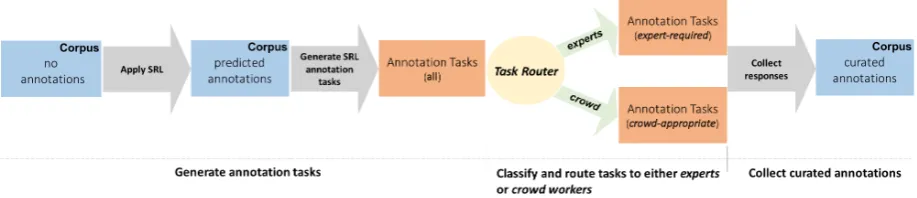
Based on these intuitions, we propose CROWD -IN-THE-LOOP, a hybrid annotation approach that
involves both crowd workers and experts: All an-notation tasks are passed through a decision func-tion (referred to as TASKROUTER) that
classi-fies them as either crowd-appropriate or expert-required, and sent to crowd or expert annotators accordingly. Refer to Figure1 for an illustration of this workflow.
Figure 1: Overview of proposedCROWD-IN-THE-LOOPapproach for curating SRL annotations.
We conduct an experimental evaluation that shows (1) that we are able to design a classifier that can distinguish between crowd-appropriate and expert-required tasks at very high accuracy (96%), and (2) that our proposed workflow allows us to pass over two-thirds of the annotation work-load to crowd workers, thereby significantly re-ducing the need for costly expert involvement. ContributionsIn detail, our contributions are:
• We propose CROWD-IN-THE-LOOP, a novel
approach for creating annotated SRL data with both crowd workers and experts. It re-duces overall labeling costs by leveraging the crowd whenever possible, and maintains an-notation quality by involving experts when-ever necessary.
• We propose TASKROUTER, an annotation task decision function (or classifier), that classifies each annotation task into one of two categories: expert-required or crowd-appropriate. We carefully define the classifi-cation task, discuss features and evaluate dif-ferent classification models.
• We conduct a detailed experimental evalua-tion of the proposed workflow against several baselines including standard crowdsourcing and other hybrid annotation approaches. We analyze the strengths and weaknesses of each approach and illustrate how expert involve-ment is required to address errors made by crowd workers.
Outline This paper is organized as follows: We first conduct a baseline study of crowdsourcing SRL annotation, and analyze the difficulties of re-lying solely on crowd workers (Section2). Based on this analysis, we define the classification prob-lem forCROWD-IN-THE-LOOP, discuss the design
of our classifier, and evaluate its accuracy (Sec-tion3). We then employ this classifier in the
pro-posed CROWD-IN-THE-LOOPapproach and
com-paratively evaluate it against a number of crowd-sourcing and hybrid workflows (Section 4). We discuss related work (Section5) and conclude the study in Section6.
2 Crowdsourcing SRL
We first conduct a baseline study of crowdsourcing SRL. We illustrate how we design and create an-notation tasks, how we gather and interpret crowd feedback, and analyze the results of the study to determine the applicability of crowdsourcing for producing SRL annotation.
SRL formalism. In this study, and throughout the paper, we use the PROPBANK formalism of
SRL (Palmer et al., 2005), which defines verb-specific frames (BUY.01,BUY.02), frame-specific
core roles (A0toA5), and frame-independent non-core roles (for temporal, location and other con-texts).
2.1 Annotation Task Design
To design the annotation task, we replicate a setup proposed in previous work (Akbik et al.,2016) in which crowd workers are employed tocuratethe output of a statistical SRL system. This setup gen-erates annotation tasks as following:
Sentence
And many fund managers have built up cash levels and say they will be buyingstockthis week.
Question
What is being boughtin this sentence? Is it: “stock”?
buy.01
Answer Options Yes
No, what is being bought isnotmentioned
No, what is being bought is mentioned here:copy and paste text
Figure 2:Example annotation task, consisting of asentence
Step 1. We use a statistical SRL system to predict SRL labels for a set of sentences (see Figure 1). While state-of-the-art SRL will predict many cor-rect labels, some predicted labels will be incorcor-rect, and some labels will be missing. Annotation tasks are therefore designed to detect and correct preci-sion and recall errors.
Step 2.We generate two types of annotation tasks for the study, namely CONFIRMPREDICTIONand
ADDMISSINGtasks: (1) The first, CONFIRMPRE -DICTIONtasks, ask users to confirm, reject or
cor-rect each predicted frame or role. This type of task addresses precision issues in the SRL. We present to workers a human-readable question-answer pair (He et al.,2015) for each predicted la-bel, an example of which is illustrated in Figure2. (2) The second, ADDMISSING tasks, address
po-tentially missing annotation, i.e. recall issues in the SRL. We generate a question without a sug-gested answer and ask workers to either confirm that this role does not appear in the sentence, or supply the correct span. We identify potentially missing annotation using PropBank frame defini-tions; any unseen core role in a sentence is consid-ered potentially missing.
We use a manually created mapping of frame-roles to questions to generate these tasks. See Ta-ble 1 for a mapping of the roles of the BUY.01
frame to questions.
Step 3.Each question is presented to crowd work-ers together with the sentence and a set of answer options. Example annotation tasks are illustrated in Figures2and3. A task thus is defined as fol-lows:
Definition 1 Annotation Task: A task consists of a sentence, a human readable question regarding a predicted label, and a set of answer options.
We collect worker responses to these tasks. If the majority of crowd workers agrees on a correction, we remove or correct incorrectly predicted labels
Frame:BUY.01 (purchase)
Role Description Question A0 buyer Who is buying something? A1 thing bought What is being bought? A2 seller From whom is something bought? A3 price paid What is the price paid? A4 benefactive For whom is something bought?
Table 1:Examples of mapping between semantic labels and question phrases of frameBUY.01. The description column
lists the textual role descriptions from PropBank frame files.
Agreement #Tasks #Correct #Incorrect Precision all 5 agree on answer 1,801 1,679 122 0.93
4 out of 5 agree 436 376 60 0.86 3 out of 5 agree 278 187 91 0.67
no majority answer 34 0 34 0.0
total 2,549 2,242 307 0.88
Table 2: Tasks in our crowdsourcing study by ratio of how many workers agreed on an answer. If all five workers agree, the majority answer is correct in 93% of cases. If fewer work-ers agree, the precision of the majority answer decreases.
for CONFIRMPREDICTIONtasks and add new
la-bels for ADDMISSINGtasks.
2.2 Crowdsourcing Study
We conduct a crowdsourcing study consisting of 2,549 annotation tasks, generated by running a state-of-the-art SRL system (Akbik and Li,2016) over 250 randomly selected gold-labeled sen-tences from the English training dataset in the CoNLL-2009 shared task (Hajiˇc et al.,2009). We generated tasks using our question mappings from the predicted labels. This setup allows us to com-pare crowd feedback to gold labels and determine how often the crowd provides incorrect answers. Human Annotators For crowd annotators, we employ five native speakers of English from UP -WORK1, selected using the following procedure:
We required workers to complete a short tutorial2, followed by 20 annotation tasks, which we eval-uated against the gold data. We used the results to select the best-scoring 5 of 7 applicants. We then asked them to complete the remaining label-ing tasks. The study was conducted in a span of three weeks. Crowd workers were paid a fixed sum for the completion of the study, which re-sulted in a cost of 2 cents per worker per task. In total, workers estimated an average of 9 hours to complete the full task.
2.3 Analysis
We gather crowd feedback and compare the major-ity answer for each task with the gold label. Refer to Table 2 for an overview of results. We make several observations:
The more workers agree, the better the an-swer. Generally, we note that majority answers tend to be more often correct if more workers agree. Specifically, as Table2shows, all 5
annota-1https://www.upwork.com/
Type Frame A0 A1 A2 A3 A4 LOC TMP
CONFIRM- Expert-required 134 (38%) 280 (32%) 382 (32%) 73 (33%) 6 (43%) 8 (50%) 36 (35%) 120 (36%)
PREDICTION Crowd-appropriate 222 (62%) 608 (68%) 797 (68%) 146 (67%) 8 (57%) 8 (50%) 67 (65%) 211 (64%)
ADD- Expert-required 0 82 (31%) 54 (33%) 240 (37%) 99 (34%) 72 (38%) 0 0
MISSING Crowd-appropriate 0 186 (69%) 111 (67%) 405 (63%) 190 (66%) 120 (62%) 0 0
Table 3: Breakdown of annotation tasks by question types and semantic labels, and proportion of expert-required tasks (formally defined in Section3). Percentages in each cell add up to 100%. On average, 34% of tasks are expert required. Task types that lie above this average are highlighted bold. For instance, 38% of all frame confirmation questions are expert-required, indicating that this question type is of above-average difficulty.
tors agreed in 1,801 out of all 2,549 tasks (71%). Of these tasks, the majority answer was correct in 1,679 cases, and incorrect in 122, yielding a pre-cision of93%for tasks in full agreement. If only 4 out of 5 agree (i.e. one annotator provided a dif-ferent answer), the precision drops to 86%. If only three annotators agree on an answer, the precision is even lower, at67%. Furthermore, we note 34 cases in which there was no majority answer (no agreement by at least 3 workers). We therefore see a direct correlation between agreement scores and the validity of majority answers.
Even if all workers agree, errors are made. We also note that all 5 crowd workers sometimes unanimously agree an incorrect annotation, in a total of 122 cases. To illustrate such a case, con-sider the example in Figure3: In our study, all 5 workers incorrectly selectedyesas answer. How-ever, (perhaps somewhat counterintuitively to non-experts) under the PropBank paradigm it is the “phone representative” that provide explicit help in this sentence, not “Vanguard.”
Characteristics of difficult annotation tasks.As illustrated in Table3, we break down annotation tasks by question types and semantic labels to gain a better understanding of which tasks are difficult for the crowd. The first row in the table lists results for CONFIRMPREDICTION tasks. We note that
Sentence
And Vanguard, among other groups, said it was adding more phone representatives today to helpinvestors get through.
Question
Who is helping in this sentence? Is it: “Vanguard”?
help.01
Answer Options Yes
No, who is helping isnotmentioned
No, who is helping is mentioned here:copy and paste text
Figure 3: Example of an annotation task where crowd workers unanimously provided an incorrect answer in our study (see2.3). This task is classified asexpert-required.
some tasks of this type require above-average ex-pert involvement, such as confirmation questions that pertain to the frame label or higher numbered roles (A3 and A4). The second row lists results for ADDMISSINGtasks. Here, we note that again
higher order roles tend to be above average expert-required3. However, while the breakdown in Ta-ble 3 indicates some general trends for the diffi-culty of annotation tasks, the question type itself does not suffice to determine whether an individ-ual instance requires expert involvement or not. Summary.Our crowdsourcing study supports the initial hypothesis that a portion of SRL tasks is in fact appropriate for crowd workers, but also shows that identifying such tasks is not straightforward since neither crowd agreement scores nor the an-notation task type is sufficient indicators of diffi-cult tasks. We investigate this problem further in the next section.
3 TASKROUTER: Annotation Task
Classification
Our study shows that some annotation tasks are appropriate for crowd workers, while others are not. In this section, we define a classification prob-lem in which we wish to classify each task into one of the two following classes:
Definition 2 Crowd-appropriate: A task for which: (1) All crowd workers agree on the answer. (2) The agreed-upon answer is correct.
Definition 3 Expert-required: A task that is not crowd-appropriate.
According to these definitions, our crowdsourcing study found that the task in Figure 2 is crowd-appropriate, i.e. easy enough for the crowd to pro-vide correct and consistent answers, while the task in Figure3is consideredexpert-required.
3Note that there are no ADDMISSING questions for
3.1 Features
To solve the task classification problem, we note two groups of distinct features (see Table4): Task-level features Xg capture the general dif-ficulty of a labeling task, as defined by a frame or role type. The intuition here is that cer-tain frames/roles are inherently difficult for non-experts, and that annotation tasks related to such frames/roles should be handled by experts. In the
BUY.01 frame for instance,buyer(A0) is a simple
crowd-appropriate semantic concept, while bene-factive(A4) generally produces lower agreement scores. Task-level features therefore include the frame and role labels themselves, as well as the complexity of each question, measured in features such as the question word (what,how,whenetc.), its length measured in number of tokens, and all tokens, lemmas and POS-tags in the question. Sentence-level features Xl capture complexity associated with the specifictask instance. The in-tuition is that some sentences are more complex and more difficult to understand than others. In such sentences, even roles with generally crowd-appropriate definitions might be incorrectly an-swered by non-experts. We capture the complexity of a sentence with features such as its length (num-ber of tokens in sentence), the num(num-bers of frames, roles, verbs, and nouns in the sentence, as well as all tokens, lemmas and POS-tags.
3.2 Classification Model
In addition to task- and sentence-level features, we present a classifier that also models the interplay between multiple annotation tasks generated from the same sentence. The intuition here is that there is an interdependence between labeling decisions in the same sentence. For instance, the presence of a difficult role may alter the interpretation of a sentence and make other labeling decisions more
Type Features Task-level
features Frame label; role label; question type; length ofquestion in # tokens; Wh-word; tokens, lemmas, POS tags of all words in question.
Sentence-level features
# of questions for sentence, # of question types for sentence; # of verbs, # of nouns, # of frames, # of roles in sentence; length of sentence in # tokens; tokens, lemmas and POS tags of all words in sentence; head word and dependency relation to head word.
Table 4:Features for annotation task classification.
complicated. We thus propose a fuzzy classifica-tion model with two layers (Ishibuchi et al.,1995) of SVM classifiers (Wang et al.,2016), which in-troduces the context of the task using fuzzy indica-tors to model the interplay between the two groups of features.
Specifically, we train alocal-layer SVM classi-fierLlusing the sentence-level featuresXl (com-puted from sentences). We also train a global-layer SVM classifier Lg using the task-level fea-turesXg (computed from tasks). We refer to the predictions of the local and global classifiers as
fuzzy indicatorsand we incorporate them as addi-tional features to the fuzzy two-layer SVM clas-sifier Lf as follows. Given task ai among all tasks a1 to an for a sentence s, the first layer of the fuzzy classifier, consists of applying the local-layer classifier using the sentence-level fea-tures ofs. The second layer of the fuzzy classifier consists in applying the global-layer classifier n times, each time using task-level features for task aj,1 ≤ j ≤ n, resulting in n+ 1 values: one local-layer indicator, and n global-layer indica-tors. Our final fuzzy classifier model uses then+1 local and global indicators as features, in addition to the sentence- and task-level features ofai.
Note that the classification of taskai considers features from other tasks aj from the same sen-tence, but more efficiently than placing all task-level features of all tasks into a single feature vec-tor. Formally, the objective function of the fuzzy two-layer SVM classification modelLf is:
max
α 1
Tα−1
2αTYK(Xf TXf)Yα (1)
s.t. yTα= 0,0≤α≤C1.
where K(Xf TXf) is the fuzzy two-layer RBF kernel function, Xf = [XgT,XlT,Y1gT,· · ·,YjgT,· · ·,YngT,YlT] is the fuzzy two-layer feature matrix, n is the number of annotation tasks generated from a sentence, Yjg represents thej-th fuzzy indicator generated by the j-th global classifier Lg
j, Yl is the fuzzy indicator generated by the local classifierLl,Yis the label matrix,1is a vector of all ones andCis a positive trade-off parameter. 3.3 Evaluation
To evaluate the accuracy of TASKROUTER we use
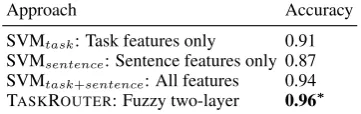
Approach Accuracy SVMtask: Task features only 0.91 SVMsentence: Sentence features only 0.87 SVMtask+sentence: All features 0.94 TASKROUTER: Fuzzy two-layer 0.96∗
Table 5: Performance of classifiers trained with five-fold cross validation on training set. The improvements of TASKROUTERover other classifiers are significant at the∗ 0.05 level, paired t-test.
in which we train an SVM with (1) task-level fea-tures, (2) sentence-level feafea-tures, (3) all feafea-tures, and (4) our proposed fuzzy two-layer classifier. Data. We use the dataset created in our crowd-sourcing study (see Section 2.2), which consists of 2,549 annotation tasks labeled as either expert-required or crowd-appropriate according to our definitions and the results of the study. We lever-age five-fold cross validation to train the classifiers over a training split (80%).
Results. The cross validation results are listed in Table 5. Our proposed classifier outperforms all baselines and reaches a classification accuracy of 0.96. Interestingly, we also note that task-level features are significantly more important than sentence-level features, as the setup SVMtask outperforms SVMsentence by 6 accuracy points. Furthermore, our proposed approach outperforms SVMtask+sentence, indicating a positive impact of modeling the global interplay of annotation tasks. These experiments confirm our initial postula-tion that it is possible to train a high quality classi-fier to detect expert-required tasks. We refer to the best performing setup as TASKROUTER.
4 CROWD-IN-THE-LOOPStudy
Having created TASKROUTER, we now execute
our proposed CROWD-IN-THE-LOOP workflow
and comparatively evaluate it against a number of crowdsourcing and hybrid approaches. We wish to determine (1) to what degree does having the crowd in the loop reduce the workload of experts? (2) How does the quality of the produced anno-tated data compare to purely crowdsourced or ex-pert annotations?
4.1 Approaches
We evaluate the following approaches:
1. Baseline without curationThe first is a simple baseline in which we use the output of SRL as-is, i.e. with no additional curation either by the crowd
or experts. We list this method to show the quality of the starting point for the curation workload. 2. CROWD (Crowdsourcing) The second base-line is a standard crowdsourcing approach as de-scribed in Section 2, i.e. without experts. We send all annotation tasks (100%) to the crowd and gather crowd feedback to correct labels in three different settings. We correct all labels based on majority vote, i.e., if at least 3 (CROWDmin3), 4
(CROWDmin4) or all 5 (CROWDall5) out of 5
an-notators agree on an answer.
3. HYBRID (Crowdsourcing + Expert cura-tion)In this setting, we replicate the approach pro-posed by (Akbik et al.,2016): After first executing crowdsourcing (i.e. sending 100% of the tasks to the crowd), we identify all tasks in which crowd workers provided conflicting answers. These tasks are sent to experts for additional curation (ex-pert answers are used for curation instead of the crowd response). We use three definitions of what constitutes a conflicting answer: (1) We consider all answers in which at least a majority (3 out of 5) agreed as crowd-appropriate and send the rest (2.2%) to experts. We refer to this setup as HYBRIDmin3. (2) Only tasks where 4 out of 5
agreed are crowd-appropriate, the remaining 9.9% go to experts (HYBRIDmin4). (3) Any task in
which there is no unanimous agreement (27.3%) is deemed expert-required (HYBRIDall5).
4. CROWD-IN-THE-LOOPThis setup isthe pro-posed approach in which we use TASKROUTER
trained over a holdout training set to split annota-tion tasks into crowd and expert groups. In our experiments, TASKROUTER determines the
fol-lowing partitions: 66.4% of tasks to the crowd, the remaining 33.6% to experts. To give an indi-cation of the lower bound of the approach given these partitions, we list results for two settings: (1) CROWD-IN-THE-LOOPRandom, a lower bound
setting in which we randomly split into these par-titions. (2) CROWD-IN-THE-LOOPT askRouter, the
proposed setting in which we use TASKROUTER
to perform this split.
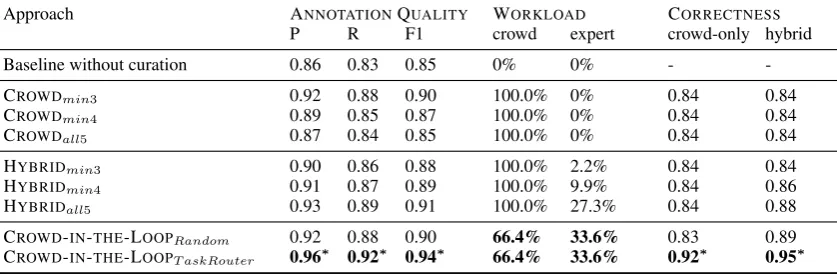
Refer to Table6for an overview of these exper-iments. The WORKLOAD columns indicate what
percentage of tasks is sent to crowd and experts.
4.2 Experimental Setup
Approach ANNOTATIONQUALITY WORKLOAD CORRECTNESS
P R F1 crowd expert crowd-only hybrid
Baseline without curation 0.86 0.83 0.85 0% 0% -
-CROWDmin3 0.92 0.88 0.90 100.0% 0% 0.84 0.84
CROWDmin4 0.89 0.85 0.87 100.0% 0% 0.84 0.84
CROWDall5 0.87 0.84 0.85 100.0% 0% 0.84 0.84
HYBRIDmin3 0.90 0.86 0.88 100.0% 2.2% 0.84 0.84
HYBRIDmin4 0.91 0.87 0.89 100.0% 9.9% 0.84 0.86
HYBRIDall5 0.93 0.89 0.91 100.0% 27.3% 0.84 0.88
CROWD-IN-THE-LOOPRandom 0.92 0.88 0.90 66.4% 33.6% 0.83 0.89
[image:7.595.89.508.64.201.2]CROWD-IN-THE-LOOPT askRouter 0.96∗ 0.92∗ 0.94∗ 66.4% 33.6% 0.92∗ 0.95∗
Table 6:Comparative evaluation of different approaches for generating gold-standard SRL annotation. The improvements of CROWD-IN-THE-LOOPT askRouterover other approaches are significant at the∗0.05 level, paired t-test.
or crowd-appropriate4. As shown in Section3.3, we use 80% of the dataset to train TASKROUTER
under cross validation, and conduct the compara-tive evaluation using the remaining 20%.
Human annotators & curation We simulate an
expert annotator using the CoNLL-2009 gold SRL labels and reuse the crowd answers from the study forcrowd annotators. For each setting, we gather crowd and expert answers to the annotation tasks, and interpret the answers to curate the SRL labels that were produced by the statistical SRL system. After curation, we evaluate the resulting labeled sentences against gold-labeled data to de-termine the annotation quality in terms of preci-sion, recall and F1-score.
Evaluation MetricsNext to the quality of result-ing annotations, we are interested to evaluate how effectively we integrate the crowd. We measure this in two metrics. (1) One is the percentage of tasks that go to the crowd and to experts respec-tively. Note that in the HYBRIDsetup, some tasks
go to both crowd workers and experts, so that the percentages can add up to over a hundred percent. This information is illustrated in column WORK -LOAD in Table 6. (2) The second is the
over-all validity of crowd feedback, referred to as cor-rectness, measured as the ratio of correct answers among all answers retrieved from the crowd. We provide two values for correctness in Table6, un-der column CORRECTNESS: The first is the
cor-rectness only over crowd feedback. Note that this value is the same for all CROWDand HYBRID
se-tups since in these approaches 100% of annotation tasks are passed to the crowd. The second named
hybridis the overall correctness of the resolved an-swers with both expert and crowd feedback.
4We will release the dataset soon.
4.3 Experimental Results
The results of our experiments are summarized in Table6. We make the following observations: CROWD-IN-THE-LOOP significantly increases annotation quality. Our evaluation shows that
CROWD-IN-THE-LOOP produces SRL annotation
with significantly higher quality compared to crowdsourcing or hybrid scenarios. With a result-ing F1-score of 0.94, it outperforms the best
per-forming crowdsourcing setup (0.90) by 4 points. More importantly, our proposed approach also outperforms other hybrid approaches that partially leverage experts. It outperforms the best hy-brid approach (0.91) by 3 points, indicating that TASKROUTER is better to select expert-required
tasks than a method with only crowd agreement. Significantly less expert involvement required. In our experiments, more than two-thirds of all tasks were determined to be crowd-appropriate by TASKROUTER. This considerably reduces the
need for expert involvement compared to expert labeling, while still maintaining relatively high an-notation quality. In particular, our approach com-pares favorably to other hybrid setups in which a similar partition of tasks is completed by experts. Since TASKROUTER is more capable to choose
expert-required tasks than previous approaches, we achieve higher overall quality at similar levels of expert involvement.
Crowd workers more effective. As the correct-ness column in Table 6 shows, the selection of tasks by TASKROUTER is more appropriate for
4.4 Discussion and Outlook
The proposed approach far outperforms crowd-sourcing and hybrid approaches in terms of an-notation quality. In particular, even at similar levels of expert involvement, it outperforms the HYBRIDall5approach. However, we also note that
with an F1-score of 0.94, our approach does not
yet reach the quality of gold annotated data. Insights for further improving quality. To fur-ther improve the quality of generated SRL training data, future work may (1) investigate additional features (Wang et al., 2015) and classification models to improve the TASKROUTERto better
dis-tinguish between crowd-appropriate and expert-required tasks, and (2) experiment with other SRL crowdsourcing designs to make more tasks crowd-appropriate. Nevertheless, we suspect that a small decrease in quality cannot be fully avoided if large amounts of non-experts are involved in a labeling task such as SRL. Given such involvement of non-experts, we believe that our proposed approach is a compelling way for increasing crowdsourcing quality while keeping expert costs relatively low. Flexible trade-off of costs vs quality. Another avenue for research is to experiment with classi-fier parameters that allow us to more flexibly con-trol the trade-off between how many experts we wish to involve and what annotation quality we desire (e.g., active learning (Wang et al., 2017)). This may be helpful to scenarios in which costs are fixed, or where one aims to compute the costs for generating annotated data of specific quality. Use for SRL domain adaptation. One intended avenue for study is to apply our approach to gen-erate training data for a specific textual domain for which little or no SRL training data currently ex-ists. We believe that due to its relatively lower costs, our approach may be an ideal candidate for practical domain adaptation of SRL.
Applicability to other NLP crowdsourcing tasks. Finally, while in this paper we focused on the task of generating labeled training data for SRL, we believe that our proposed approach may be applicable to other NLP tasks that have only reported moderate results to-date. To study this applicability, one would first need to conduct a similar study as in Section 2 to identify crowd-appropriate and expert-required tasks and attempt the training of a classifier.
5 Related Work
Crowdsourcing SRL Annotation Different ap-proaches have been adapted to formulate SRL tasks for non-expert crowd workers (Hong and Baker,2011). Typical tasks include selecting an-swers from a set of candidates (Fossati et al.,
2013), marking text passages that contain spe-cific semantic roles (Feizabadi and Pad´o, 2014), and constructing question-answer pairs (He et al.,
2015, 2016). However, a particular challenge is that SRL annotation tasks are often complex and crowdsourcing inevitably leads to low-quality an-notations (Pavlick et al.,2015).
Instead of attempting to design a better anno-tation task, our proposed approach addresses this problem by accepting that a certain portion of an-notation tasks is too difficult for the crowd. We create a classifier to identify such tasks and involve experts whenever necessary.
Routing TasksRecent approaches have been de-veloped to address the task routing problem in crowdsourcing (Bragg et al.,2014;Bozzon et al.,
2013;Hassan and Curry,2013). As workers vary in skill and tasks vary in difficulty, prior rec-ommended approaches often consider the match between the task content and workers’ profiles. However, these approaches are difficult to apply to the particular context of SRL annotation since we only distinguish between either experts famil-iar with PropBank, or non-expert crowd workers.
Rather than routing tasks to the most appro-priate workers, our proposed approach determines which SRL tasks are appropriate for crowdsourc-ing, and sends the remaining ones to experts. Human-in-the-loop MethodsOur method is sim-ilar in the spirit of human-in-the-loop learn-ing (Fung et al., 1992; Li et al.,2016). Human-in-the-loop learning generally aims to leverage hu-mans to complete easy commonsense tasks, such as the recognition of objects in images (Patterson et al.,2013). Recent work also proposed human-in-the-loop parsing (He et al.,2016) to include hu-man feedback into parsing. However, unlike these approaches, we aim to combine both experts and non-experts to address the difficulty of some SRL annotation tasks, while leveraging the crowd for the majority of tasks.
6 Conclusion
In this paper, we proposed CROWD-IN-THE-LOOP
data for SRL that leverages both crowd and ex-pert workers. We conducted a crowdsourcing study and analyzed its results to design a classi-fier to distinguish between crowd-appropriate and expert-required tasks. Our experimental evalua-tion showed that our proposed approach signif-icantly outperforms baseline crowdsourcing and hybrid approaches, and successfully limits the need for expert involvement while achieving high annotation quality.
References
Alan Akbik and Yunyao Li. 2016. K-srl: Instance-based learning for semantic role labeling. In Pro-ceedings of COLING 2016, the 26th International Conference on Computational Linguistics, pages 599–608.
Alan Akbik, Kumar Vishwajeet, and Yunyao Li. 2016. Towards semi-automatic generation of proposition banks for low-resource languages. InConference on Empirical Methods on Natural Language Process-ing, pages 993–998.
Collin F Baker, Charles J Fillmore, and John B Lowe. 1998. The berkeley framenet project. In Annual Meeting of the Association for Computational Lin-guistics, pages 86–90.
Alessandro Bozzon, Marco Brambilla, Stefano Ceri, Matteo Silvestri, and Giuliano Vesci. 2013. Choos-ing the right crowd: expert findChoos-ing in social net-works. In Proceedings of the 16th International Conference on Extending Database Technology, pages 637–648.
Jonathan Bragg, Andrey Kolobov, Mausam Mausam, and Daniel S Weld. 2014. Parallel task routing for crowdsourcing. InSecond AAAI Conference on Hu-man Computation and Crowdsourcing.
Anthony Fader, Stephen Soderland, and Oren Etzioni. 2011. Identifying relations for open information ex-traction. In Conference on Empirical Methods on Natural Language Processing, pages 1535–1545. Parvin Sadat Feizabadi and Sebastian Pad´o. 2014.
Crowdsourcing annotation of non-local semantic roles. In European Chapter of the Association for Computational Linguistics, pages 226–230.
Marco Fossati, Claudio Giuliano, and Sara Tonelli. 2013. Outsourcing framenet to the crowd. In An-nual Meeting of the Association for Computational Linguistics(2), pages 742–747.
Michael J Franklin, Donald Kossmann, Tim Kraska, Sukriti Ramesh, and Reynold Xin. 2011. Crowddb: answering queries with crowdsourcing. In Proceed-ings of the 2011 ACM SIGMOD International Con-ference on Management of data, pages 61–72.
Patrick T Fung, Graham Norgate, Timothy A Dilts, An-drew S Jones, and Rangaswamy Ravindran. 1992. Human-in-the-loop machine control loop. US Patent 5,116,180.
Jan Hajiˇc, Massimiliano Ciaramita, Richard Johans-son, Daisuke Kawahara, Maria Ant`onia Mart´ı, Llu´ıs M`arquez, Adam Meyers, Joakim Nivre, Sebastian Pad´o, Jan ˇStˇep´anek, et al. 2009. The conll-2009 shared task: Syntactic and semantic dependencies in multiple languages. InProceedings of the Thir-teenth Conference on Computational Natural Lan-guage Learning: Shared Task, pages 1–18.
Umairul Hassan and Edward Curry. 2013. A capabil-ity requirements approach for predicting worker per-formance in crowdsourcing. InCollaborative Com-puting: Networking, Applications and Worksharing (Collaboratecom), 2013 9th International Confer-ence ConferConfer-ence on, pages 429–437.
Luheng He, Mike Lewis, and Luke Zettlemoyer. 2015. Question-answer driven semantic role labeling: Us-ing natural language to annotate natural language. In
Conference on Empirical Methods on Natural Lan-guage Processing, pages 643–653.
Luheng He, Julian Michael, Mike Lewis, and Luke Zettlemoyer. 2016. Human-in-the-loop parsing. In
Conference on Empirical Methods in Natural Lan-guage Processing.
Jisup Hong and Collin F Baker. 2011. How good is the crowd at real wsd? InProceedings of the 5th linguistic annotation workshop, pages 30–37. Eduard Hovy, Mitchell Marcus, Martha Palmer, Lance
Ramshaw, and Ralph Weischedel. 2006. Ontonotes: the 90% solution. InHuman Language Technology Conference of the NAACL, pages 57–60.
Hisao Ishibuchi, Ken Nozaki, Naohisa Yamamoto, and Hideo Tanaka. 1995. Selecting fuzzy if-then rules for classification problems using genetic algorithms.
IEEE Transactions on fuzzy systems, 3(3):260–270. Jiwei Li, Alexander H Miller, Sumit Chopra,
Marc’Aurelio Ranzato, and Jason Weston. 2016. Dialogue learning with human-in-the-loop. arXiv preprint arXiv:1611.09823.
Chi-kiu Lo, Meriem Beloucif, and Dekai Wu. 2013. Improving machine translation into chinese by tun-ing against chinese meant. InIWSLT 2013, 10th In-ternational Workshop on Spoken Language Transla-tion.
Martha Palmer, Daniel Gildea, and Paul Kingsbury. 2005. The proposition bank: An annotated cor-pus of semantic roles. Computational linguistics, 31(1):71–106.
Ellie Pavlick, Travis Wolfe, Pushpendre Rastogi, Chris Callison-Burch, Mark Dredze, and Benjamin Van Durme. 2015. Framenet+: Fast paraphrastic tripling of framenet. pages 408–413.
Dan Shen and Mirella Lapata. 2007. Using seman-tic roles to improve question answering. In Con-ference on Empirical Methods on Natural Language Processing-CoNLL, pages 12–21.
Rion Snow, Brendan O’Connor, Daniel Jurafsky, and Andrew Y Ng. 2008. Cheap and fast—but is it good?: evaluating non-expert annotations for natu-ral language tasks. InProceedings of the conference on empirical methods in natural language process-ing, pages 254–263.
Chenguang Wang, Laura Chiticariu, and Yunyao Li. 2017. Active learning for black-box semantic role labeling with neural factors. InIJCAI, page to ap-pear.
Chenguang Wang, Yangqiu Song, Ahmed El-Kishky, Dan Roth, Ming Zhang, and Jiawei Han. 2015. In-corporating world knowledge to document cluster-ing via heterogeneous information networks. In
KDD, pages 1215–1224.
Chenguang Wang, Yangqiu Song, Haoran Li, Ming Zhang, and Jiawei Han. 2016. Text classification with heterogeneous information network kernels. In