Proceedings of the 2018 EMNLP Workshop W-NUT: The 4th Workshop on Noisy User-generated Text, pages 132–136 132
Lexical Analysis and Content Extraction from
Customer-Agent Interactions
Sergiu Nisioi Anca Bucur? Liviu P. Dinu
Human Language Technologies Research Center, ?Center of Excellence in Image Studies,
University of Bucharest
{sergiu.nisioi,anca.m.bucur}@gmail.com, [email protected]
Abstract
In this paper, we provide a lexical compara-tive analysis of the vocabulary used by cus-tomers and agents in an Enterprise Resource Planning (ERP) environment and a potential solution to clean the data and extract relevant content for NLP. As a result, we demonstrate that the actual vocabulary for the language that prevails in the ERP conversations is highly di-vergent from the standardized dictionary and further different from general language usage as extracted from the Common Crawl cor-pus. Moreover, in specific business commu-nication circumstances, where it is expected to observe a high usage of standardized lan-guage, code switching and non-standard ex-pression are predominant, emphasizing once more the discrepancy between the day-to-day use of language and the standardized one.
1 Introduction
It is often the case for companies that make use of a customer relationship management software, to collect large amounts of noisy data from the inter-actions of their customers with human agents. The customer-agent communication can have a wide range of channels from speech, live chat, email or some other application-level protocol that is wrapped over SMTP. If such data is stored in a structured manner, companies can use it to opti-mize procedures, retrieve information quickly, and decrease redundancy which overall can prove ben-eficial for their customers and maybe, more impor-tant, for the well-being of their employees work-ing as agents, who can use technology to ease their day-to-day job. In our paper, we work with email exchanges that have been previously stored as raw text or html dumps into a database and attempt bring up some possible issues in dealing with this kind of data lexically, from an NLP perspective,
but also to forward a solution for cleaning and ex-tracting useful content from raw text. Given the large amounts of unstructured data that is being collected as email exchanges, we believe that our proposed method can be a viable solution for con-tent extraction and cleanup as a preprocessing step for indexing and search, near-duplicate detection, accurate classification by categories, user intent extraction or automatic reply generation.
We carry our analysis for Romanian (ISO 639-1 ro) - a Romance language spoken by almost 24 million people, but with a relatively limited number of NLP resources. The purpose of our approach is twofold - to provide a comparative analysis between how words are used in question-answer interactions between customers and call center agents (at the corpus level) and language as it is standardized in an official dictionary, and to provide a possible solution to extract meaningful content that can be used in natural language pro-cessing pipelines. Last, but not least, our hope is to increase the amount of digital resources available for Romanian by releasing parts of our data.
2 Data
While acknowledging the limits of a dictionary, we consider it as a model of standardized words, and for this we make use of every morphologi-cal form defined in the Romanian Explicative Dic-tionary DEX1 - an electronic resource containing both user generated content and words normed by the Romanian Academy. We extract from the database a total of over 1.3 million words includ-ing all the morphological inflected forms. It is im-portant to note here, the user generated content is being curated by volunteers and that not every word appearing in the dictionary goes through an
official normative process for the language. In consequence, this resource may contain various region-specific word forms, low frequency or old terms and other technical neologisms.
While a dictionary can provide the list of words, it certainly lacks context and the way language is used in a large written corpus. One of the largest corpora of Romanian texts consists of news articles extracted from Common Crawl2, it con-sists of texts on various topics and genres, and re-cently it has been considered (Bojar et al.,2016) a reliable resource for training a generic language model for modern standard Romanian, as part of the News task, Workshop of Machine Translation 2016. This corpus contains 54 million words, it covers general content not related to a specific topic, and since it has been scraped from pub-lic websites, it is reasonable to assume it con-tains standard official Romanian text, grammati-cally and lexigrammati-cally correct.
The question-answer corpus consists of inter-actions saved from an Enterprise Resource Plan-ning (ERP) environment within a private Roma-nian company. All data has been anonymized be-fore usage and personally identifiable information has been removed. The topics are highly business-specific, covering processes such as sales, hu-man resources, inventory, marketing, and finance. The data consists of interactions in the form of tasks, requests, or questions (Q) and activities, re-sponses, or answers (A).
One question may have multiple answers and the documents may contain email headers, footers, disclaimers or even automatic messages. To alle-viate the effect of noise on our analysis, we have implemented heuristics to remove automatic mes-sages, signatures, disclaimers and headers from emails.
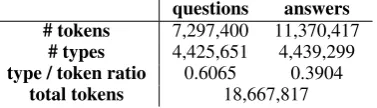
questions answers # tokens 7,297,400 11,370,417
# types 4,425,651 4,439,299 type / token ratio 0.6065 0.3904
[image:2.595.308.523.63.145.2]total tokens 18,667,817
Table 1: Question answering corpus size
The statistics regarding the size of the corpus are rendered in Table1, we observe that the num-ber of types (unique words) is quite similar for both questions and answers, however the total number of words used in the responses is a
mag-2http://commoncrawl.org
Questions Answers Common Crawl Vocabulary size 21,914 25,493 148,980
Dict diacr. overlap 41.75 40.65 42.22
Dict no diacr. overlap 55.51 52.96 60.87
Answers overlap 67.87 - 10.59
Answers diff English 4.83 - 7.28
Questions overlap - 58.34 8.96
Questions diff English - 20.95 8.04
C. Crawl overlap 60.9 61.86
-C. Crawl diff English 7.13 13.17
-Table 2: Comparison of overlapping dictionaries
nitude larger than the one corresponding to ques-tions. Considering that type to token ratio is a reasonable indicator for lexical richness (Read, 2000), then customers use a rich vocabulary to describe their problems, with a considerable high probability for new words to appear in the received queries, while agents show a more standardized, smaller vocabulary to formulate their replies.
3 Quantitative Lexical Analysis
We carry a comparison at the lexical level, in par-ticular by looking at the size and variety of the vo-cabulary with respect to a standard Romanian dic-tionary. We extract word2vec embeddings3using CBOW with negative sampling (Mikolov et al., 2013; Reh˚uˇrek and Sojka,ˇ 2010) for three cor-pora: Common Crawl, the corpus of Questions, and the one containing Answers. The models are trained to prune out words with frequency smaller than 5, shrinking the vocabulary to ensure that the words included have good vectorial represen-tations. From those vocabularies, we discard num-bers, punctuation and other elements that are not contiguous sequences of characters.
We then proceed to use the vocabulary from the trained models and compare against the entire dic-tionary Romanian of inflected forms. For the later, we build two versions - one which contains diacrit-ics and a second one which contains words both with and without diacritics.
For each vocabulary at hand we perform two simple measurements:
1. overlap- the percentage of overlap between one vocabulary and another
2. diff English - the percentage of differences between one vocabulary and another, that are part of an English WordNet synset (Fell-baum,1998)
3The resources are released at https://github.
[image:2.595.88.277.589.643.2]These basic measurements should give an indi-cator on how much of the vocabulary used in our ERP data is covered by the generic resources avail-able for Romanian, and how important domain
adaptation is for being able to correctly process
the texts.
Table 2contains the values for these measure-ments in a pair-wise fashion between each vocabu-lary - dictionary with and without diacritics, ques-tions and answers vocabulary, and Common Crawl model vocabulary. We also compare the vocabu-laries extracted from our corpora with the dictio-nary having diacritics removed, as it is often the case to write informal Romanian with no diacrit-ics. The second and third rows show an increase in overlapping percentage, regardless of the vocabu-lary, when the diacritics are ignored, which indi-cates that even official news articles contain non-standard words and or omissions of diacritics. It is, therefore, expected that a highly technical domain such as business-finance to have an even smaller overlap with the standard dictionary.
Somewhat surprising is the fact that a big major-ity of words from the Common Crawl vocabulary (approx. 39%) is not available in the full dictio-nary, and at a closer look we observe that 11.01% of words are also part of the English WordNet synsets (Fellbaum,1998).
Furthermore, both the lexicons used in ques-tions and answers present little overlap with Com-mon Crawl, and in accordance with the lexical richness evidenced in Table 1, we observe that the vocabulary specific to answers overlaps better with the one for questions than vice-versa. In addi-tion, over 20% of the words used in questions that do not appear in the answers are part of an English WordNet synset.
While the language of questions and answers is used in a business environment, one expecting it to be more formal and closer to the standard, the con-trary appears to be true - to improve the speed of communication, people prefer to code switch be-tween Romanian and English, not to use diacritics at all or to insert abbreviations and foreign words adapted to the Romanian morphology (e.g.,loga,
loghez, verb, used as in Englishto logorto log in
most similar to dictionary verbsto connectandto authenticate).
A few examples of queries from the models are rendered in Table4, showing that the domain-specific models learn good representations for
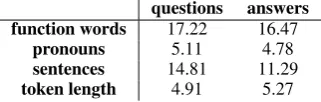
ab-questions answers function words 17.22 16.47
pronouns 5.11 4.78
sentences 14.81 11.29
[image:3.595.335.496.63.114.2]token length 4.91 5.27
Table 3: Average number of features / question or an-swer
breviations of specific terms (e.g.,exemplu
(exam-ple) - ex, factura (invoice) - fact, fc) being more
robust to noise and free-form lexical variations in language.
At last, in Table3, we count the average number of content independent features (function words, pronouns, number of sentences and average to-ken length) that appear in both questions and an-swers. These features can provide information re-garding the style of a text (Chung and Pennebaker, 2007), being extensively used in previous research for authorship attribution or literary style identifi-cation (Mosteller and Wallace,1963;Koppel et al., 2009). Here we observe a stylistic difference be-tween how questions and answers are formulated, questions being longer and more complex, which can also be a reason behind the smaller average length of the tokens, as Menzerath-Altmann law (Altmann and Schwibbe, 1989) states - the in-crease of a linguistic construct determines a de-crease of its constituents.
4 Content Extraction
The lexical analysis in the previous section strongly suggests that our question-answering cor-pus contains a high vocabulary richness that is non-standard and divergent from the generic re-source available for Romanian. Therefore, any type of text processing from classification, re-trieval, or tagging is error prone and can provide misleading results. An important step, is there-fore, to detect and extract the relevant content that best explains the customer’s intent, which can be further used for classification or automatic reply generation.
word Q/A model score C. Crawl model score
pentru (for)
pt 0.85 pt 0.61
Pentr 0.74 nevoie (need) 0.49
ptr 0.64 special 0.49
ex (for example)
exemplu (example) 0.77 676 0.78 Ex 0.65 pixuletz (pen) 0.78 Exemplu 0.65 dreaming 0.78 adica (which means) 0.6 thd 0.78
banca (bank):
registru (register) 0.79 autoritatea (authority) 0.79 numerar (cash) 0.78 lege (law) 0.78 casa (cash desk) 0.73 nationala (national) 0.78 plati (payments) 0.73 reforma (reform) 0.77
factura (invoice)
[image:4.595.160.439.61.211.2]facture 0.84 lunara (monthly) 0.85 comanda (order) 0.77 pompa (pump) 0.85 fact 0.76 ridicare (pulling) 0.83 fct 0.76 descarcare (offloading) 0.83 fc 0.72 inchidere (closing) 0.82
Table 4: Samples of most similar words from Q/A word embeddings compared to Common Crawl. English translation is provided between parentheses.
made at the line level, each line from the origi-nal document is being marked for removal or to be kept. The removed lines include footer and header information from email exchanges, multiple email replies, tables dumped into text, tags, error mes-sages, auto-replies, and sentences that did not have any connection to the problems stated in that re-quest. We removed these categories and consid-ered them irrelevant content. After this process, the pruned corpus shrunk to 73,000 words, aligned at the document and line level. We also decided to keep the email phrases, which are customary when starting and closing an email, as part of the con-tent in order to later build heuristics around those to differentiate between multiple replies.
Based on the annotations we’ve made, the sim-plest approach to clean the corpus would be to cre-ate a binary classifier that can identify if a sentence or a group of sentences are to be removed or not.
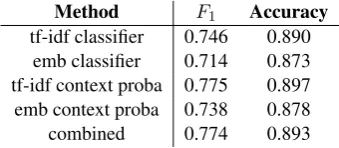
Method F1 Accuracy
tf-idf classifier 0.746 0.890 emb classifier 0.714 0.873 tf-idf context proba 0.775 0.897 emb context proba 0.738 0.878
combined 0.774 0.893
Table 5: Cross-validation scores for different corpus cleanup methods.
This does not take into consideration the context or the surrounding sentences. We train a simple lo-gistic regression classifier with regularization con-stant of 1, l2 penalty with liblinear solver (Fan et al., 2008;Pedregosa et al., 2011) on the tf-idf representations of each sentence. If a sentence has been removed by the annotator, it’s a negative ex-ample, else it’s a positive one. We compute the
tf-idf for all tokens with diacritics removed from a sentence, including punctuation marks, numbers, function words, content words, and word bigrams. We carry a 5-fold cross-validation at the document level so that we don’t shuffle the initial order of the sentences, obtaining an average cross-validation accuracy score of 0.89, and an averageF1 score of 0.74. Given the type of data at disposal, we were surprised to see such a good result, however, a closer look at the errors showed that the classifier was too rigid and biased towards the training data. When applied onto the entire corpus for cleanup, we could observe the removal of sentences and lines that should have been preserved. The source of this problem relies in the classifier not being aware of the context and surrounding sentences, and the tf-idf features being too dependent on the local training data to generalize well across the en-tire collection of texts that cover a wider diversity of topics than our annotations.
[image:4.595.96.266.536.610.2]slightly lower than the tf-idf representations. Table 5 contains the evaluation scores obtained during cross-validation. By combining the predictions of tf-idf models with the ones using embeddings, we obtain little improvements given the CV scores on the annotated dataset, however on the general dataset we observed a less restrictive behavior of the model that was able to preserve more easily out-of-domain content. Human evaluation is cur-rently under way to asses the content quality of the selected sentences on subsamples from the larger dataset.
5 Conclusion
We provide a lexical comparative analysis of the language used in Q-A and Common Crawl cor-pora to the officially standardized one which is found in the dictionary. As a result of this study, we demonstrate that the actual use of language that prevails in the Q-A and Common Crawl cor-pora has a rather small overlap with the dictio-nary version (at most 60%). Moreover, in specific business communication circumstances, where the overlapping rate is expected to have increased val-ues, code switching and non-standard expression are predominant, emphasizing once more the dis-crepancy between the day-to-day finacialized used language and the standardized one. In addition, we experiment with an approach to clean up the corpus based on a hybrid feature set consisting of word embeddings and tf-idf, to extract rele-vant content for further processing. Having few resources at disposal for Romanian, we believe it is mandatory to release parts of our data for repro-ducibility and future use.
Acknowledgments
This work has been supported by a grant of the Romanian National Authority for Scientific Re-search and Innovation, CNCS/CCCDI UEFIS-CDI, project number PN-III-P2-2.1-53BG/2016, within PNCDI III.
References
Gabriel Altmann and Michael H Schwibbe. 1989.Das Menzerathsche Gesetz in Informationsverarbeiten-den Systemen. Georg Olms Verlag.
Ondˇrej Bojar, Rajen Chatterjee, Christian Federmann, Yvette Graham, Barry Haddow, Matthias Huck, Antonio Jimeno Yepes, Philipp Koehn, Varvara
Logacheva, Christof Monz, Matteo Negri, Aure-lie Neveol, Mariana Neves, Martin Popel, Matt Post, Raphael Rubino, Carolina Scarton, Lucia Spe-cia, Marco Turchi, Karin Verspoor, and Marcos Zampieri. 2016. Findings of the 2016 conference on machine translation. InProceedings of the First Conference on Machine Translation, pages 131– 198. Association for Computational Linguistics.
Cindy Chung and James W Pennebaker. 2007. The psychological functions of function words. Social communication, pages 343–359.
Rong-En Fan, Kai-Wei Chang, Cho-Jui Hsieh, Xiang-Rui Wang, and Chih-Jen Lin. 2008. LIBLINEAR: A library for large linear classification. Journal of Machine Learning Research, 9:1871–1874.
Christiane Fellbaum. 1998. WordNet. Wiley Online Library.
Moshe Koppel, Jonathan Schler, and Shlomo Arga-mon. 2009. Computational methods in authorship attribution. Journal of the American Society for In-formation Science and Technology, 60(1):9–26.
Tomas Mikolov, Ilya Sutskever, Kai Chen, Greg S Cor-rado, and Jeff Dean. 2013. Distributed representa-tions of words and phrases and their compositional-ity. InAdvances in neural information processing systems, pages 3111–3119.
F. Mosteller and L. D. Wallace. 1963. Inference in an authorship problem. Journal of the American Statis-tical Association, 58(302):275–309.
F. Pedregosa, G. Varoquaux, A. Gramfort, V. Michel, B. Thirion, O. Grisel, M. Blondel, P. Pretten-hofer, R. Weiss, V. Dubourg, J. Vanderplas, A. Pas-sos, D. Cournapeau, M. Brucher, M. Perrot, and E. Duchesnay. 2011. Scikit-learn: Machine learning in Python. Journal of Machine Learning Research, 12:2825–2830.
John Read. 2000. Assessing vocabulary. Cambridge University Press.