A.C. Impedance of Single Muscle Fibres
By
Robert Eisenberg
A thesis presented for the degree of Doctor of Philosophy
in the un~versity of London
Department of Biophysics University College London
AoSTRACT
The impedance of single crab muscle fibres was determined with microelectrodes over t~e frequency range 1 c/s to 10 kc/s. Care was taken to analyze, reduce and correct for caFacitative artifact. The impedance of the fibre was analyzed using linear cable theory, tne accuracy of wbich is discussed. The equivalent circuit of the fibre distributed admittance is found in most
cases to have two capacitances, each in series with resistance, and a resistive shunt. In just two fibres only one capacitance shunted by a resistance was found. In several fibres there was evidence of a third very large capacitance.
rhe values of the elements of the equivalent circuit depend on which of several equivalent circuits is chosen. The .circuit considered most reasonable in the light of the anatomical
evidence consists of two parallel branches: a resistance R in e
series with a capacitance Ce; and a resistance Rb in series with a parallel combination of the resistance R and the capacitance C •
m m
The average circuit values for this model are R
=
21 ohm-cm2; eCe
=
47~F/cm
2;
Rb=
10.2 ohm-cm2; Rw=
173 ohm-cm2; Cm= 9.0~F/cm
2•
The relation of the equivalent circuit to the fine structure of crab muscle is discussed. R andm r ~
e · e
TABU: OF CONTENTS
Abstract
AcKnowledgements
Chapter 1:
Chapter 2:
Chapter
3:
Introduction
Theory
Linear Circuit Analysis Cable Theory
Simple Fibre ·Model
Simple Distributed Resistance Model Two Time Constant Model
Two Time Constant, Distributed Resistance Model
Other Two Time Constant, Distributed Resistance Models Curve Fitting Methods
Appendices:
Derivation of the Equivalence Relations Curve Fitting Computer Program
Methode
Procedure
Corrections for Stray Capacitances
Appendices
Derivation of the Cor~ection Equations The Cathode Follower
Error Analysis of the Corrections
Alternative Methods of Parameter Measure~ent
Chapter
4:
ResultsAppendix:
Description
Second Group of Fibres Third Group of Fibres
Errors Arising from the Neglect of 'rhree Dimensional Spread of Current
Equivalent Circuits of the Muscle Fibre Distributed Admittance
~valuation of Circuit Parameters Transient ~esponse of Muscle Fibre
The 'l'hree Dimensional Flow of Current
6
Ch:tpter ): Di::;cussion
Relation of Present Observations to Previous 15C Findings
Relation of Electrical Parameters to Muscle 15C Structure
T am very grateful to P. Fatt and G. Falk for their help and encouragement. I am also indebted to the other
members of the Biophysics Depar~ment and to L. Peachey and A.F. Huxley for many stimulating discussions.
I wish to thank J.L. Farkinson, L.J. ~ard,
~. Copeland, E. Ullrich and A.M. Paintin for technical assistance.
This work was done while I was a Graduate Fellow of
the National Science Foundation. I am grateful to the
Chapter 1
INTRODUCTION
The low frequency capacitance of muscle fibres as
~easured with intracellular electrodes is quite large, ranging from
8
~F/cm
2 in frog (Fatt·& Katz,1951)
to 40~F/cm
2 in crab (Fatt&
Katz,1953a;
Atwood,1963).
It is difficult to 'ccount for theee large values of capacitance assumingreasonable dielectric properties of a predominantly lipid sarcolemma. Recently, the large value of capacitance in frog muscle has been explained by attributing the greater part of it to the sarcotubular syete~ (falk
&
Fatt,1964),
the structure of which is reviewed in Porter,1961,
andfranzini-Armstrong,
1964.
It seemed of interest to see if the much larger cafacitance of crab muscle could also be attributed in greater part to the sarcotubular system (first investigated by Veratti, 1902, with the light microscope; more recently by Peachey&
Huxley,1964,
with the electron microscope).clltterent HC products if both c~pacitanc~s are in series with resistance. If either of these conditions is fulfilled, the paaaiv~ electrical propdrties of the fibre will reveal the existence of two capacitances.
The passive properties of a linear system can most ~~tlsfactorily be studied by measuring the impedance of the ~yatem to sinuisoidal currents of different frequencies; that
la,
by measuring the relative aagnitude and phase of thecurrent and voltage over a range of frequencies. The difficulties of separating different time constants make
measurements of thd transient response of a linear system less satisfactory. A detailed analysis of the relative merits of transient and frequency response methods in the determination of the number and size of the time constants of a linear system leads Lanczos
(1957,
p.279)
to conclude that the difficulty with transient response methods "lies not with the mannerof evaluation (of the time constants from the experimental data) but with the extraordinary sensitivity of the exponents {that is time constants) and amplitudes to very small changes of the data, which no amount of ••.• statistics could remedy.
The only remedy would be an increase of accuracy to limits which are f~r beyond the possibilities of our present measuring devices".
(Comments in b~ac~ets added). In view of this analysis the
Measurements of i~pedance were made over a wide
frequency range. The qualitative features of the data showed
that the equivalent circuit of most crab fibres contained two
capacitances. each in series with resistance. Values of the circuit elements were obtained from the best fit of such an
equivalent circuit to the experimental d~ta. Finally, the
different forms of the equivalent circuit and the values of
the circuit elemente are discussed in rel~tion to the fibre structure.
Chapter 2.
THEORY.
Linear Circuit Analyaie.
·rhe system under consideration is treated as linear and
passive: linear since the values of the circuit parameters are
independent of potential and current; passive since the only
internal voltage source is constant and can be subtracted from
all observed potentials. The theory of systems which fulfill
these requirements is based on the representation of currents
3nd voltages by complex numbers. The theory is valid for
excitations of arbitrary form but the derivation of the system
properties for the general case depends on the use of Laplace
transforms (Kuo, 1962). Our deriv~tion is restricted to
sinuisoidal excitations although the results are in fact Talid
for any excitation if the 'purely im3~nary frequency variable jw (where j
=
~) is replaced by the complex frequency variable s=
v
+ jw and the complex currents and voltages are interpreted as the Lapface transforms of the physical currentsand voltages.
fhe response of any linear passive system to a
me the excitation after transients have died away. Any
current or voltage in the system can then be written as
{ .
~·
w-t]
v<.t)::.
v~
C.05(cvt
+
¢)
~
1? ..
v ...
el-
e~
where t is time; · , and ~,are the phase differences of voltage and current from some reference, and Ref
J
·
denotes the real part of the complex quantity in the brackets. If we split off the time dependence (which is the same everywhere in the system) by defining a complex voltage
V
and complexcurrent I as
I
=
1 ... ~;.¢'
then the physical voltage and currents are given by
V(t) :
l?ef
V-e}..,i"}
t(t)
Re[I ei-..,j
12
·rhe physical currents and voltages are hardly ever needed in
circuit analysis since the ratios of various complex currents and voltages contain all the information usually of interest
(i.e. the relative phase and magnitude of the physical
quantities). rhe ratio of complex voltage to complex current
is a frequency dependent complex quantity called impedance
Z
,
whose real part is the effective (equivalent) resistance R,and whose ima~inary part is reactance X
z
y_
I
Ratios of volta~e to volt3ge and current to current as well as their reciprocal quantities can also be defined. The reciprocal of impedance is another complex quantity called admittance Y, with real part conductance g and imaginary part
suscepta~ce b
Y-
--
z -
I
It is important to note that the effective resistance is not the reciprocal of the conductance. The relations between the real
and imaginary I
Y=
--
z
p~s of the a~~ittance and
. b-
I4-
+
~
-
-~-
....
-;.~~
-x
b-
"R~
.
+ x~
impedance are given by
(5)
14
rhe impedance of each of the common circuit elements
~-ft be ~oflned by writing its current-voltage relation in
ctctllp.lex form. ·rhe impedance of a resistor of r ohms is then
real, independent of frequency and equal to r; the impedance
ot a
capacitor C is purely imaginary (i.e. purely reactive),trequ•ncy dependent and equals
.
-a:
wC
It can be shown that the complex currents, voltages,
.ad impedances all obey Kirchoff's and OO.'s laws. The
~nalysia of the response of a network to an arbitrary excitation
la then carried out as for a d.c. circuit except complex
·tuanti ties are used. (The discussion above is presented in
d•tail in a number of electrical engineering textbooks:
8.g. futtle,
1958;
Le Page&
Seeley,1952;
or Guillemin,1953).
Cable Theory
It is necessary to use cable theory since current
applied to the muscle fibre p~sses along the internal resistivity
of the fibre before it crosses the fibre membrane; in other
words, the current applied produces a potential drop across
15
Figure 2.1
The Muscle Fibre Treated as a Linear Cable
r ., the internal resistivity, andy, the complex distributed admittanc~, ~
refer to the properties of a very small length of the muscle fibre; they
I
t-·~
1..:
-~
.
I
~
~
rhtt rnembrane admittance is said to be distributed along the lOternal resistance. The fibre may be represented as a
linear (one dimensional) cable if as a flrst approximation tho potenti3l at any disb.nce along the fibre axis is assumed
to be the same throughout the fibre interior. (The validity
of this assumption in examined in Chapter
4:
Results). Itis also useful to assume that there are no potential drops in the external medium. This assumption can be tested and is found to be adequate as long as the source of current is not too
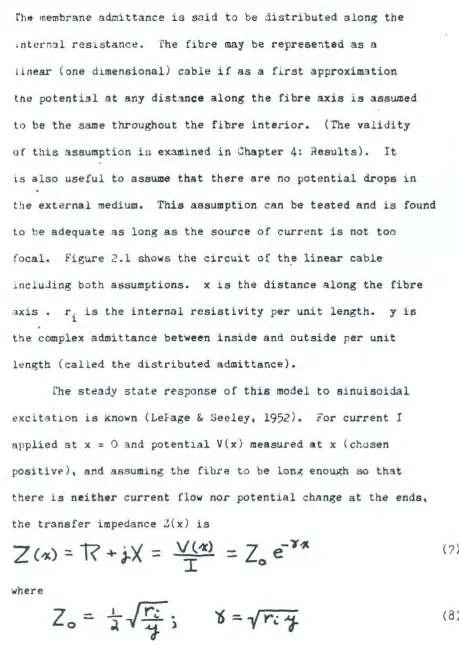
focal. Figure 2.1 shows the circuit of the linear cable
incluJing both assumptions. x is the distance along the fibre axis • r. is the internal resistivity per unit length. y is
1
the complex admittance between inside and outside per unit length (called the distributed admittance).
l'he steady state response of this model to sinuisoidal excitation is known (Lef·age & Seeley, 1952). ror current I applied at x : 0 and potential V(x) measured at x (chosen positive), and assuming the fib~e to be lon~ enough so that there is neither current flow nor potential change at the ends, the transfer impedance Z(x) is
where
V(..x)
I
17
(7)
[image:18.638.96.556.61.725.2]·rhe parameter
r
is discussed in the Appendix to Chapter 4:rtesults. In these experiments potential was usually measured
close to the point ~here current was applied. For that
case (7) becomes
(9)
An expression relating the effective lumped resistance aad
reactance (R and X) with the distributed conductance and
susceptance (g and b) can be derived by substituting
y z g + jb into (8) and takin8 real and imaginary parts
( 10).
R=
-X
I~ is important to realize that equation (10) contains
two physically distinct sets of variables: R and X, which refer
to the total impedance seen by a source of current at
x
=
0 (the ratio of potential at x=
0 to the current appliedelement of fibre membrane (the ratio of the potential acrose
that element of membrane to the current throu~h it1.
fhe physical difference bet~een these two sets of
parameters can be seen if one compares the effect of a
resistance H in ser~es ~ith the entire current flowing throu~h s
the cable with the effect of a resistance rb in series with
each element of the cable (see rigure 2.2). The effect of
placing a resistance in series with all the current would be
simply to add the positive real constant R to the i~pedance
z.
sAt any frequency the only effect ~auld be to increase the
effective resist3nce by R • If a plot were made of X vs. rt
s
the curve ~ould be displaced by R but its shape would not be s
chan~ed. On the other hand, the addition of a distri~uted
I
r·esistance r b in series \lfith the admittance y = g -+- jb
produces a ch~nge which is frequency dependent (since in
I I )
general both ~ and b are frequency dependent • r'he admittance
y
=
g + jb of an element of membrane consisting of resistance'
in series with y is~~
(' +
rb~')
+
(I
+
rbct
)"l.
+
b-19
Figure 2.2
T~o Kinds of Series Resistance
A: the entire fibre impedance in series with the
resistance R •
8
B: the distributed admittance y• in series with the
distributed resistance rb.
All quantities except R refer to a very small length of
s
[image:22.618.64.469.266.509.2]A
'
IJ
IJ
.
T?s
-
-8
I
rhe addition of a distributed resistance h~s two effects on a plot of X vs. R: first, there is ~ chan~e in the shape of the
curve; secondly, tif the model for y contains no induct3nces)
at very hi~h frequencies the capacit3nces in y have ne~ligible
impedance and the entire pot~ntial drop acrose the fibre
..!. -~,., u •vr .. ·'-Ru.
1\
~embrane is developed across rb. Thus, ~t very hi~h frequencies a plot of X vs. R must bend down to give a pure resistance.
The only mea.sul'ement made here with x ~ 0 ar~ those of the d.c. sp~ce constant •
7\
is found by setting b=
0(the renctance of any linear passive circuit is zero at zero
frequency) in (8):
c \
(12)
-;~ote that 1/g is identical with the total d.c. resistance of the
Jistributed admittance y; it is not necessarily identical with
~ , the resistance of the plasma membrane. Measurements with m
.,T
"o"'-~ro -(' ('fl•JilV>C.. iPS' r.
finite electrode separation''req:Jire the use of a more complicated
formula (equation
3,
p. 72 in FalK&
Fatt, 196.~). Suchmeasurements are not presented here.
rhe basic metnod of this investigation C3n now be seen.
,:mpedance measu.cements were rt\.•ide over .'l wide range of frequencies
data can be used. Ph=tse and magnitude, or resistance and
reactance can be plotted against log frequency (sometimes
called the Bode plot: Bode, 1945) or reactance can be plotted
against resistance (called the Cole-Cole plot: Cole and Cole,
1941). The latter plot is particularly useful in revealing
the qualitative features of the impedan~e function because
mathematically it i s the plot ('mapping') used to sho~ the
behaviour of a complex function (here Z) of a real variable
(w) (see Churchill, 1960}. Although the explicit dependence
f D X f . . . th. 1
\
i
-tt\~
f tio n and on requency 1s not g~vcn 1n ~s p ot, ac 1n orma on
is lost since any impedance function is specified (~ithin a
scale factor) if a relation bet·.,een two of its variable is
given (see Bode, 19~5. and Tuttle,
1958,
for proofs anddiscussion for lumped circuits; see Macdonald and Brachman,
1956,
for a general discussion of the physical significance of these
relations and a proof that they hold for distributed linear
passive systems). In practice, the scale factor is set bJ
labelling some point of the impedance locus ~ith the
corres-ponding frequency.
The other plot used, that of phase vs. log frequency,
has two advantages: it is sensitive at relatively low frequencies
to changes in values of circuit parameters and it shows random error
24
of phase, not H or A). The p~ots of resistance, m3~nitude of ~mpedance, or reactance against lo~ frequency were found to be
less useful since they were relatively insensitive to model
or parameter changes.
Simple iibre Model.
In a simple model of the fibre y is taken to be a
capacitance in p~allel with the membrane resista~ce r m
(Fig. 2.3). 'rhe expression for the real and imaginary parts
of the admittance are then
(13)
b:.
w
CWlThe d.c. space constant is
( 14)
and the input resistance
(15)
Fieure
2.
3
shows the shape of the impedance locus for thisFigure 2.3
The Impedance Locus ot the Simple Fibr~ Model
·The impedance locus ot th~ circuit in the upper right hand corner is shown.
The circuit elements are identified for use in the text. The scales are
given in terms o! Rin' th~ d.c. resistance. The solid
45°
line represents the line approached at high frequencies by the impedance plots of all.
1
~ •
1'\1
•
tJO
...
ra.
U"\
1'\1
• 0
X
0J
~ • 0
~
•
0
U'\
1'\1
•
0
this curve is independent of the actual values of the par~meters
c , r , and r .• This can be seen by writing the equations (13)
m m 1
in dimensionless form.
ca.
r~
=
I
b
rW\:::
-v
where the scale factor r is set by the input resistance, and
m
Simple Distributed Resistance Model.
Another model is that in which the circuit element of the
simple model·is in series with a resistance (Fig. 2.~). This
distributed resiGtance makes the impedance at infinite frequency
purely resistive. The admittance of this model is given by
( 1
+
r-)
+
""A
r
(' +
r)"l.-+-
"'Y>~ r~
where the dimensionless variables
+
(' +
r)"l.
+
lJ
4r~
r. .
- . ) v=wr~~~"c~
r"" •
have been used. The shape of this locus is seen to depend on
27
rigure 2.4
The Impedance Loci of the One Time Constant. Distributed Resistance Model
The impedance loci of the circuit in the upper rieht hand corner are shown.
Circuit elements are defined for use in text. fhe 45° line represents the
limiting high frequency locus of the circuit for rb
=
0; i.e. in theahsence o: distributed resista~ce. The lqrge numbers under the abcissa
give the value of R /H. for each curve. where R , the infinite freqyency
oo
1n ooresi
s
t~nce,
equals0.5
(rbri)*. !he small numbers on both axes give thescales in terms of R . .
on~y one parameter r
=
rb/rm• the s~ale factor rm being set bythe input resistance
The space constant for this model is given by
1
l/~
7\
=
.
[r..,;c:
r.
J
Two Time ~onstant Model.
Another model of the fibre is shown in Fig. 2.5. In
3ddition to the two parallel paths formed by r and c as in
m m
(17)
(18)
the simple models. there is a third path through the resistance
r and capacitance c • The inside-outside admittance of this
e e
model is ~iven by
I+
v~
using the dimensionless variables
If'\
.
rJ
.
t..:• •rl
r,,
1"\,J co <.:r
·-+
.
· (\J.
r l.
0 0
X
.::.>I
c:
·-0:::
\.()
CX)
.
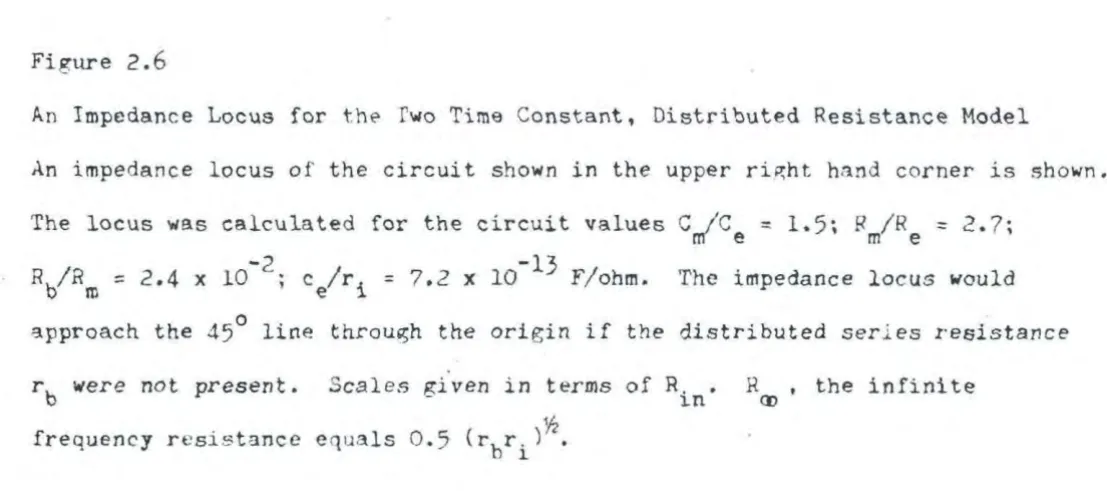
fwo fime Cvnst3nt, Jistributed ~esistance Model.
The circuit for this model is shown in Fig. 2.6. This
model 1s the only one which adequately fits ·all the impedance
loci observed. It is sornewh3t more complicated than the two
time constant model, but this complication is required by the
experimental data. The real and imaginary parts of the
admittance of this model are
D
br""'
(20)with
An Impedance Locus for th~ r~o Time Constant, Distributed Resistance Model
An impedance locus of the circuit shown in the upper ri~ht hand corner is shown.
The locus was calculated for the circuit values C /C ~ 1.5; R / R
=
2.7;m e m e
-2
-13
Rb/Rm
=
2.4 x 10 ; ce/ri = 7.2 x 10 F/ ohm. The impedance locus ~ouldapproach the 45° line through the origin if the distributed serles t·esistance
rb were not present. Scales given in terms of R. • R , the infinite
l.n <D
[image:39.925.157.711.206.451.2].
--,
.
' ' •
·'·
Cl1
v
X
I
.
81.{\
1\j
•
·:""'
8
v
=
cv c
e.
re. ·
.)are used.
It is instructive to examine the behaviour of this model
at high frequencies. !he high frequ~ncy limiting properties of the distributed admittance 3re
---.,..~~ ~
0
j
~c.....
Jb(neglected terms differ by factors of w2).
The corresponding limited behaviour of the lumped impedance
is
R-
il (
r .. r .. )
'I
-a.
=
7?_,
-X
Jn other words the resistance remains constant at high
frequencies ~hile the reactance decreases in 1nverse proportion
to the frequency. The impedance locus in the X/~ plot should then at-preach the real axis at an an~le of
90°.
fhis behaviour37
resistance, '"'here a similar 3.nalysis of high frequency behaviour
shows th~t che impedance locus ~t hiR~ frequencies coincides
·~ith a 45° line dr<t~n through the o.t·i~in ( Falk & Fatt, 1964).
Furthermore, in the model with distributed resistance it is
clear th3t the an~le between the real axis and a line drawn
from the origin to a point on the impedance locus (the phase
an~le/ must pass through a maximum and then decrease to zero.
~his can be seen analytically since at high frequency
Other Two rime Constant, Distributed rtesistance Models.
It is a basic property of impedance functions that the
3ynthesis yroblem (the 9roblem of finding a net~ork with a ~iven
impedance function) does not h3ve ~ unique solution. There are
many circuits with an impedance function id~ntical ~ith that of
the above model. rhese circuits may be classified into those
with the minimum number of circuit elements ~nd those ~ith more
t~~n the minimum number of circuit elements.
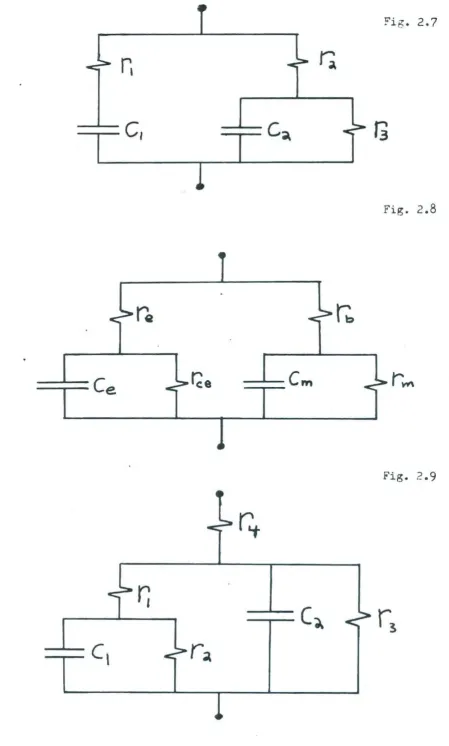
Lnly one ot~er equivalent circuit ~ith the minimum number
of ciLcuit elements is ~s~d h~re (s~e Fig. 2.7 for the circuit
and the 1dentification of varlables). The admittance vf this
Figures 2.7,
2
.
8
.
2.9E"~v;v~l e.v. t
'rhree Different bien miaian:aat Put•t•n=e Circuits
The equations for these c1rcuits are given in the
text. The symbols in the figure identify the
!"ig. 2.7
----.-- c,
Fig. 2.8
Fig.
2
.9
r't
[image:45.620.88.538.34.781.2]~t)
--v"'"r
+
-v~r..,.,c~r;
f3
+~+I
r:~I
""'v~
~
+ r.,.]-..+
r ..
,,;'-
r~
c-.. ( ~~"
(21)
+"} \)
rc
+
:~i
[1
+
r..,J~-+
""l> ....r ... c ... (
~r
r~ ~~
where
It is useful to ~ive the circuit parameters of the model
shown in fi~. 2.7 in terms of the circuit para~eters of the model shown in fir,. 2.6. The solution to this problem is not
unique since the d.c. p,th across the circuit may be made to
shunt either the larger oc smaller capacitance. The
~athematical re~son for this ambiguity is discussed in Appendix 1
This ambiguity does not occur in circuits where the infinite
frequency resistance is all located in one circuit element. The
values of the circuit elements in a model like th~t shown in
Fig. 2.6 are thus well determined.
The equivalence relations are
r"l.
=
c~--I-t
(H.,.-
H,)
rb
rb
l-+
.~
(
1-1
~-
11 , )
r-b
H. (
H,.-
H.)
o\,
Gf~[H, H~-
H,
(<.(,+<ll~ +~.c4;)
~
- [H.
H~-
1-t,
<..~
...
~.:'I
+
i·
~,.]
42
wnere
13
r~c
~ -t-r
'rl\c
W\ +r
)IYtc
e
A
==
r""'
r~cW\
c~---D
~
,fD-;).-'iEF
'lF
D
(23)fne other set of equiv~lcnce re~ations (for the shunt on
t~~ 0th~r capHClta~ce) can be founJ simply hy interchanging ~
2
:1nd HThe t~o c1rcuits with more than the minimum number of
circuit elements which are of interest are shown in Fig.
2.8
~nd rig. 2.9. In.each C3se one of the resistive shunts on the
capacitance is redundant. The equations relating the circuit
values of the model shown in Fig.
2
.8
with those of the modelin rig.
2.7
arer(l
Ce..
.
rm
-
-K
.
4-
(t-a..)
J"
1< D,
a...."J+L
L
?..
-( Cl.J
+
L)
.'Jith
t\
=
J=
L
=-l-1 (
D,- N,) (
D,-
N,.)
D, (D,
-~)H
N,
N~
D,
D~
H
(Q,.-
tv,)(
9,..
-N,)
t>~
\O:l-
Q)
- B
~
-J
Bl.-'-#A
.
G
=
c,
c.']..
r, r::l
Yl
.
B
=
~
c,
+
r~c.l.
+
c,
(r~-+
v-
3)Finally, the value of r (which must be known independently)
ce
f '
can b~ ~sed· to determine the parameter a (used in equations
(24) )
l -
a..
~K rce(Krc.e.+~)
). rc.~ J
\(
J-..J
These equations are ambiguous in that the symmetry of the circuit
shown in Fig.
2
.8
makes the two parallel branches.indisting-uishable.
'rhe circuit values of the model shown in Fig.
2.9
caneasily be derived from those shown in Fig. 2.6 since both rb
and em are unchanged by the presence of r2• That is,
Physically, this is reasonable since the high frequency behaviour
of either circuit is unaffected by the other circuit elements.
fhe equations giving the other values are
r3 (13/r..,JI
~
-
r~+ r~(t-~)
r.~r""'
(25)
c,
c-.(:
r._-\-r~(.l-/S)~~
r.
~""
where ~ is ~iven (in terms of the independently known parameter
I -
(3
=
_ r ._.,.,.,
+
r
~
-,J
r::
+
'i
r~
r
44
Curve Fitting Methods·.
An attempt was ma~a to fit the observed impedance loci using the methods of Falk
&
Fatt(1964).
Each of the approximations used there presented difficulties here. The low frequency plot was unreliable because of the presence of a very low-!requenc7 dispersion. The high frequency plot was applicable at only t.he very highest frequencies and thus was quite tinaccurate. The m~d-frequenc)' approximation to the shape of the curve waanot applicable because of the particular parameter values of crab fibres. Finally, the strong interaction of the various parameters prevented the refinement of inaccurate values b)' aucceasiYe approximation. It was thus necessary to develop another curve fitting technique.
The principle or the technique developed vaa to choose circuit parameters so that the deviation of the theoretical curve from ~he obserYed points waa minlmized. The deviation vas defined as the sum of the squared deviations from each experimental _point. The most satisfactory fits vere found if the theoretical curve
was fitted simultaneously to the phase characteristic and the X/R plot. (The reason for this is that the phase characteristic is particular!)' sensitive to small parameter changes.) The
t [
ct~[l?~:.-l
=,
where
k is the number of experimental observations (tho number of
frequencies at which impedance measurements were taken).
i represents the ith observation, made at frequency fi.
R~~;, -~~~~·
andP~~~
are the resistance and reactance (in kohaa).
and phase (in degrees) measUred at frequency fi' respectively •
. (i) (i) (i)
R
1, -X 1, and P 1 are the resistance, reactance, and pha8e
ca ca ca
(same units aa above) calculated at frequenc1 ri, respectivel1•
ai, bi, ci are the weights assigned to the resistance, reactance,
and phase measureaents made at frequency fi' respectively.
(Absolute rather than relative deviation is minimized since the
randoa error was felt to be relatively independent of frequency)
An electronic digital computer {The London University
Atlas) waa used to compute and minimize the function defined above.
Library Routine 970, written by D.C. Cooper !tn'd D.J. McConalogue
using the method of Rosenbrock
(1961)
and McCon&logue andStrickland
(1963),
found the miniau. reasonably quickl7, providednone of the parameters were too near zero. The program waa
checked by using different step lengths, initial values. and
accuracies of minimization. The major diffic·ulty with thia
method is that it cannot distinguish between aysteaatic and
random errors. The choice of the weights could compensate for
this difficulty to some extent. Because relatiyel7 aaall changea
in circuit parameter values (eaJ
15
per cent) produced largechanges in the fit of the curve, it is felt that the P-rameter
values are· w•ll determiped by the impedance·aeaaurementa, to an accuracy of about fifteen per cent.
A version of tbia program, written in Extended Mercury
APi·E:~JIX l TO Ci-iAf'rER 2.
Jerivation of the Equivalent Helations.
The conventional method of finding the relations bet~een
circuit values in potentially equivalent circuits involves the
simultaneous solution of several equations, usually those
describing the infinite frequency and zero frequency behaviour of
the circuit, and those describing the time constants of response
to a step function of applied current or voltage (Starr, 19}8).
Since these equations are usually quadratic. the mathematical
difficulties in fin1ing the simultaneous solution are formidable.
Another method of developing equivalence relations is given here.
If the impedance function is regarded as kno~n, the problem
of findin~ the equivalence relations reduces to the problem of
synthesizing a network of given configuration from a known
impedance function. '£his is a problem similar to those handled
in the theory of networK synthesis and so the methods developed
in Tuttle (1958) .,.,, ~.,illemin (lij)C,Z) can be used. The basic
approach is to synthesize part of the net•..tork from the given
impedance function and then remove that part of the circuit. The
remaining circuit is synthesized one part at a time, each time
removin~ the part just synthesized. This process of synthesis and
using different standard ('canonic •·) forms for realizing
(synthesizing) each part of the circuit, almost any configuration can be built up. For example, one way of synthesizing tbe
circuit in Fig. 2.7 (not the method used below) is by first
.using the parall~l branch canonic form and then treating the
remainder as a ladder standard form. In some cases the possibility of using different methods of synthesis leads to ambiguity in
the final equivalence relations. These cases will be discussed as they arise.
·rhe first equi.valence relations derived are tbose between the networks shown in Fig. 2.6 and Fig. 2.7. The adaittance of the circuit shown in Fig. 2.6 is known. The problem is then to synthesize a network of form given in Fig.
2.7
fro. the adaittance function given in (20) •. It is convenient to write the adaittance in terms of the complex frequencJ variable
s
s'a.
+
s
sl.
+
s
reCe
+
r..;.cM
+
r ..
Car ...
r.
c ...
c.
+
I
r,r.
c,
+
r.<.~c..+
r..-c."" ....
r"c..)
r~r.-- r~
c.
CctFactoring numerator 3nd denominator gives
(s
-q,) (
s-D\"')
(27)(S
-~,)(s-
Ha)
where the symbols on the right hand side of the second equation
are ~efined in (2)) of the text.
This admitt'lnce is now divided by s and expanded into
partial fractions.
:5f:_
q,OSa
..!..+
( H, -q,2(H,
-~2)f
5
H.
Harb
s
rb
H,
{H,-
H~)
s
H,
(
H~-
o(,)(
H~- ~?.)
'
+
rb
H~
(HA-
H,)
s-
H;t.
~ither the second or the third t~rm can be synthesized as the
branch containing r
1, c1 (Fig. 2.7). Only one of these two
1mbiguous cases will be developed here. It is clear that the
other can be derived simply by interchanging H1 and H
2 in all
the following·equationa. fhe form of the admittance of the
branch containing r
1 and c1 in series is
s
c.,
(29)
The equivalence celations can be found simply by examining the
behaviour of (29) and the second term of (28.) at the extremee
of frequency.
The admittance remaining when this branch ~as been synthesized
'
and removed is called Y and can be written as
y'
~
s
+
~H~- ~.)
(
w~ -~.J
ro
H;l,
lH,..
-1--1,)
s
(30)
52
sf
~
H.
H~(H,..-
HJ
\4,
H.-
H.
\tf,+4f~)+'f,
3ut this has the same form as the admittance of the second
br~nch (cons~sttn~ of r
2, r 5, and c2) in fi~.
2
.7.
Thes
+
t3 C.?,.~gain, examination of the behaviour of these expressions at the
extremes of frequency enables the equ1valence relations to be
der1ved.
·~he equivalence relations between circuits with redundant
parameters are also required. It is straightfor~ard, using the
above techniques, to go frorn the parameter values of a
redundant circuit to those of ll non-redundant circuit. Ho~ever,
we need the relations the other way round: going from the
parameter values of a non-redundant circuit to those of a
redundant circuit, the redundant parameter assumed ~o~n from
other information. rhe difficulty here is that some, perhaps
3ll the parameter values of the circuit being synthesized depend
on the value of the redundant parameter. The synthesis of the
circuit shown in Fi~.
2.8
from the impedance of the circuitshown in Fi~.
2
.7
is a case 1n point since all the parsmetervalues depend on the value of the redundant element r
ce
If the admit t:mce function ( 21) is writ ten in terms of
th~ complex variable s, Jivided hy s, ex~anded into partial
...
fraction~, and multiplied by ~. the result i •
l<
s
J
+
--.;...;....;;,---5-
D,
+
LS
S-
Da
( 32)where th• symbols J, K,
o
1,
n
2 are aa defined in (24). Sinewthe circuit.we ~ish to synthesize haa two d.c. patha1it is
necessary to split the corresponding term (the firetmrm in (32) )
into two parts.
+
a-J
+
L.S
54
·
s-o,
·
s
-
- o
·<JJ}t~~ -·
The procedure-'ia then to syntheaiu the desired circuit, one -··
branch being equiYalent to the· first two terma
ot
(33).
th•other to the last two terms ot
(33).
The expression& for all theparueters will contaiu the parueter ·'a' but •a• cau. be found
by solving for
•a•
in the expresaioa tor r ce •~ similar procedure enables th• equivalence relations
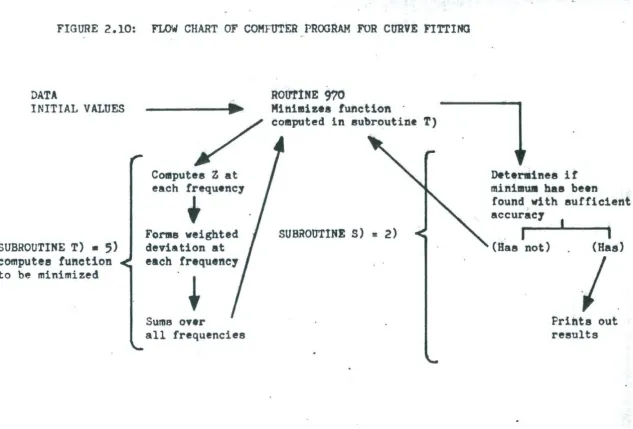
FIGURE 2.10: FLOW CHART OF COMFUTER PROGRAM FOR CURVE nTTING
DATA
INITIAL VALUES
SUBROUTINE T) • 5)
computes !unction
to be minimized..._
._.
/
C011putes
Z
ateach frequenc1
'
Fonaa weighted dev-iation at
each
!requene1
~
Sums oyer
all frequencies
ROtrrtNE
970
Minimizes function
computed in subroutine T)
SUB~OUTINE S) s 2)
O.teraines i
r
minimua has been
found vith sufficient accurae1
I
-.
I
I
(Baa not) (Has)
[image:62.876.186.819.47.476.2]APPDtDIX 2
ro CHAF1'ER 2.
Curve Fitting Computer Prosram.
The following is an ann~tated.Yersion of one of the coaputer programs used to !it the i11pedance- measurements. Th• progr ... ia
written in a user oriented computer. language Extended "ercur1 Autocode (Brooker. Richards. Berg, and Kerr, 1961). A· flow·
~. diagrws illustrating the basic method or co11putation ia shown in Fig. 2.10. This prograa fits th•.iapedaaea data witb the model
snown in Fig.
2.6.
PROORAM COMMENTS.
I
.] 0!1LSM32EAi·~
COMPUTING 0!JTPUT
RS EISENBER(l' RUN
S
SEPT'._.StY
'
! 5o oo I NSTRtJC'T tONS
I
: Job description whic•.
.
.yt~
o LINE PRINTER 2000 LINES
STORE 2 S 8 LOCKS' · '
; C0~1PJ1t.ER.
E!'f.'l
·'"
i
.
.
..
...
I ,·( y (.' ·"j>.. \
I
AUX J·J-.. .... ~R . o~t·oo:r:;.-:··-~ :_·: : I •• OUtfpg':• q : . .:i·
.
'· ... •'{:·'
:, .
l
...
l'tit
Ht~6cro:·
·
. . ~
ROUT I N F:' 9 7 Cf1
. . '
.
}' ...' names th• p.rograe.-. "·'
allocatee total.
' c011putinc time. autpu . space.- and, HJI01T spac ·
I . •
I
1 Set• nuaber of awd.Uazod
1
variable• requizecl
. ':
'"
"
..·
.
· .
,
t
,
, .
Seta nuabu of eultaac:riiDtHII·
-~··,i~·~···~.' ·yariable• requirecl·I
- ··· -- J
[image:63.585.17.556.54.665.2]'
The minimum value of the function is left-in F and the
corresponding values of the independent v~riables in
Yo, Yl ••• Y (N - 1).
'
t•
'
'•
I, J, ~. R, S, 1', N,
u ' v
t F ' G , H ' E are used by theroutine. I, J, ~ m.<J..y be used ·for working space by either
•
•
'
subroutine. G , H , E t1A1 be used ~• working apace by
sub-routine S) •
.:lubroutine T)' computes the function of the variables Yo, ••• to
be JDinimized
Subroutine S) determine• when the miniaua is known with sufficient
accuracy. It then prints out the desired data and, by setting.
R 2 0 instruct• the routine to return to the appropriate place
in Chapter 0.
'
The program works most efficiently it all th• Y s are of the
same order of magnitude. For that reason on• or our Yariablee
•
ce/ri is written as the product X Y2. Y2 can then be chosen
t
CHAP.fER o:. A~so .9?50 C?so D?so
E?so
V~25H?as
IJ?as G~.s;oY?ro
£?ro
H~soX?
so
F"="·
02N=J
Ui1=o
V1t=so
S)=2)
r>=s>
. READ(Kn)
I n
=
r ( r
) !<n
N F.: •·1f ... I N F.:
.! 0
6 S
I 0 ~ 0 1 ~ • If'{EHLl NE.
~PTTON
RUN· ON 0/\T.o\ ~! 1').
P
P.
I NT ( I 11 ) r 1 o~~AD(£n)
:1=.1
~EAD(A)
RE.~D (YJ)
A=roooA
READ(Yo}
READ (Yt) READ(Ya)
Direct'ivea allocating space for
subscripted variables '
Settins variablea· required by aoutine 970
Setti~ labela required b7 Routin• 970
•
Cycle enablios:K batcbea
or
data tobe proceaaecl in ozae run
'
Identifiea each batch. of data. ill output::'-i~
Seta accuracy with which mini.wa ia co11puted
A ia Rin (kohas)
Y3 is the initial gueaa for
:a
(
kohlla) ·.>
01)
Gonverts to ohma
Yo ia the. ~nitial. guess for C,/C
8
. Yl ia the. initial guess.
tor:
·
R-JR•Y2· tim•• X~' ia:. the illi.tial.. gufaa
60
'
.
READ'
(Xn
·
J
P.F..J\D ( p)
P is the number of observed impedance~
P.E.J\D ( l1)
JUHP I7
, ;."'· -' ..
M
is the number of seta o! reactance weightings----·
>>COt1PlJTES*
~
R;r:;.X;: ANDM TN I M IZESDEVIATION~
PROM'OBSERVED
'~
~
QXTA
...
.•
.
.-
~--· - ·-- .--
. - .-
-5) F'=o r··-Su?routine for COIIputing function to
IJ=r oooY ,·
c=xD
r v r
DE
(uu,
AA-Ufl)IJ=xSQRT (AA-UIJ)
K=r(r)P
V=1 XnY a ~~KtJU/Y r
I
be Dliniaaized: .the deviation. rroa thetheoretical curve
Coapute& theoretical curve·
tor
given··set o! Y' a
>>COr1PUTES DEN0f11NATOR OF' LUr1PED E~UATIONS'
.
~ \ ,..., D=r.CVVVVYoYoYrYr+VVr,CYrYrYoYo+aVVCCYrYrYo+VVCCYrYr+aVV~~YrD=~VVCCYr+2VVC+VVCC+VV+CC+2C+D+r
>>cor·1POTJ:?· RM X(1 .
. .
~~G
=.VVVVCYoYoY rYr+VVCYrYrYoYo+~
VVCYrYrYo+VVf:YrYr+~ VVC~"V
~
'l=VVC+~V~:q+~~~(l+r · I Computea the distributed coaductanc• - ...
. (j
::=r,
/D.
"'>>COMPUTES RMXB·.
'
IJ=VVVYoYt+VY"r+Wt:ro 1 Compute& the diatributecl auaceptaac•
f1=A/D
E=Gt1. C011p1tea lu11ped parameters Y=XSQRT{i+AB /E)
'·1=XS8Ri (2Cl+a BEJ/ll)
C::=XSt:2RI(Y+r)
G=IJE/~~
X=XS8Ri(Y-r)
X:::(J X/t~
.
'
c;K~/to·oo
XK=X/rooo
.
.
.
..>>COHPUTES THE' HE'l'(lHTED DEY I l\ T
IONS
SQUARED Hr<=xA RCTA!'! (SK ,.Xf<)IJf<=XARCT:~/U! ( AK, BK)
HV.=r 81')H!-\/r.
'f!(=r R oUK/r.
P=F'+V!<HKHK-3 VKHK1JK+VKUI<U!<
H=CKAI<AI<-~CI<AKGK+CKGKGK+DKBKBK-aDKXKBK+Dr<XT<XK
F=F'+H
-
.
--
-
-
,
..
~EPEAT
RETURN
0 ° 0~)L=L+r
r::L=Fn
· with Determines 1! llillillua haa been sufficient accuracr !oW1d·.,J!Jr1P ~ L=r
'/=Ef ....
-E
fL-I)V=xMOD
Cv/EL)
I .
r o) R=o '.Print a output
NE~·JL I NE
C .1\PT I ON:_..·~'"'~ ..• ~-' ... ·, : . . '
~fiJMBEf&
1.
0~
~
-
JiTs~~~s~~~
-
~
S1 \ PP.INT(r..) ~,o,.
NEHLINE
C.!.PTlONMINIMUM
SUM OP
DIF'FEReiCES -SQUARED~tiS.. ,~
P
R I NT ( Fn ) o • 6!'IE~JLI'NE .
CAPTL'ON-FOR
·
CM/CE::;;
·
PRINT(Yo) 3,3 CAPT.! ON
,RI-1/RE~
PRINT(YI)
3•3CAPTI'ON
·
, CE/R
f =PP.INT(XnYa) o,4
.
CAPi!'ON
PRH·!T(Yi) J,
,
J:
.
NEtJLINE.
I
o6s
·
,
0~.o,.
..
S•
I ( NEHLINE:NET·JL
INE
NEhll.INE.K=r(r)P
toln
=
o.S
HKHn=tm/e
NEHLI NE
P R I NT (
t~n )S •
3
CAPTION
C/S
NE'oJL I.NE
CAPTION
R t~EIQHTINfl IS
PRINT(CI<)
a,o
·
NEHLINE
CAPTION
-X t~EIQHTfNq It'S PRINT(DK)
z,o
NEt·.t. INE
CAPTION
R OBS.=
PRINT {AK)
.
2•3
.
CAPTI'O~N R CALC.~:::ar·
?
RINT (4KJ' 2•
.
l
NEHLINE·
CAPTION
-X OBS=
PRINi(BK)2."3
CAPTION
-X CALC.=
PRINT(XK)
2 1 3NE~·!L INE
NEHLINE
Z=XRADIIJS{AK,BK)
CAPTION
/ZOBS/=
·
·
PRINT (Z) 3 3
zn~XRADIUst~K,XK)
CAPTI'On
., /ZCALC•/='"· ·'
6z
Explanation of what is being priDted. can be found in program itself
·
(z;r)
213'NEHLI
N
E
CAPTIOf'.l
O
AS •
.
PHASE IS
Z=XARCTAN(AK, BK)
PRINT(r8oZ/r.) 312
CAPTION
DE4REES, CALC.
P
HASE I
S
~=XARCTAN(4KtXK)
PRINT{r8oZ/CJ 31 2
CAPTION
DEClREES
.r,n:xSIN(I<£/4)
c;n=xMoo(qn)
JUf1P' 47,4n>o. ooor
NEt•JL INE
ro6s.
,
o.,·
o •
.S•r
47)~11=o
nEHLINE
rr
E~·1L l N E.~!F:HLINE .
f•!E"lL INE ~EPE.~~T·
~)RETURN
I
7) K=r
K
=r(r)P
R
EAD
(l.JK)R
E.'\0
(AK%)R
E
.
A.D(CK)
P.
EAD(BK)
READ (DK}
RE:'\D (VK)
1.JK
=a£HK
R
EPEAt
O
=t(r)M
,JJJMP., .lF. ... O;:tn·: ·
Computes phas•
Reads in cia ta
..
Cycl• reada in at each fr•quenCJf4< '
·
•k,
th• trequencJ o:-·Ak, R (resistanc•)
C~ the Rtweighting
Bk, X
•(reactanc•)Dk, X ve'ighting
~~=r ( r) P
PEAD(DK)
REPEAT
NEt~ LINE
! 0 6 S 1, 0 •' 0 ,_ S e I
s
I )JUMPDO!t!N (R9 70)~EPEJ\T
~EPEAi
F.:~ID
CLOSE
Reads in additional set of
X ~eightings, if desired
Calla in Houtine 9?0
text brackets surround the name and meaning of the number found in
the corresponding position (but without bracketa) on the print out
of a data tape shown on the next pa~e. Every end of a line iD
the print out is indicated belov vitb the sysbol~ To illustrate:
t
" correep<)nds to the first nuaaber on the second line ot the print out;.,.
A, to the second number in the second line; etc.
t
(K the nuaber of batches of data) NL
-t
( x the accuracy of the Dlinimua)
(A the value of the input resistance)
(Y}. the estimate ot the infinite frequeDCJ resistance)
(Yo the estimate ot CmfCe)
(Yl th.e eatimate of RafRe>
(YZ a t~ctor ot the estimate of c~ri)
t
(X a factor of the estimate of c~r
1
)(P the nwaber of observed illpedaDcea)
(M the number of batches of reactance weigbtinge) ~
(ltk the frequencJ)
· (Ak the obaened resistance)
'(Ck the weighting of the resistance)
(Bk the obaerved reactance)
(D~ th•·weighting of the obserYed.reactance)
(Vk the phase weighting) NL
-This last line is repeated once for each frequency at which
impedance ••aaurementa were made; that is, P times.
•
The entire set
ot
data is repeated (vith the exception of K ) for each batch of data.# .., ,_,
o.'ooar· 20•72
o.s
2r
8r,.-r3
r.'ooo 20•'79
r
r.69 t o.s
r.:J68 , ao •. o9. I.. • . z •. 86 r
3··-tl;.~
...
e
o •.as
a. 54< .. . I'J•70,'r
·
Oe2-S3•'r6a · '-r·9•al' I ',
1•
,x
r. · ..... t.:. 0•.3.5::1• 6121 .. I 7.~89 I ~.; S!l .. I . oa·zs··
6.i8r.r
rs ..
67
1:·
.!lot
.
.
•
.
I.o.2
·
s
ro.'ot>
t3.!46.
.t 6•71. r .o-.
.
2s
I 1•'68 t r.'o2' I 7•oS. I a. 25.
3 I •' 51' 'J•'oa I 6.87 I Oe25
3r~6a .. 7•'ra r.· S• 89 I
o.as
'46el{a-
S~97 I.S•
a a I Oe2S68.J
r4
.·.
1~24 I3•9°
I o.asrooi.d 3 .. 79 r· l-124 I· o.as
I _.1)~8- 3 .. 28· I a-. 68: ' r Oe25
f ' · I
ars.-f4 a.Wa r a. r6~·: r Oe3S
.3.r6e!a :h S.;'J ..
r.
'.
t:t•
'
9df
•l
t .,~oas
• ,. • . . -r
...
.
;t~tt~% , ....
·.
, ..,
~ ~~r Ill
.46~
12 2 e
1
IO'- r · r.•ts~··
·
r
o.25
6:9 ... ) 1
.,
.
r.?
r~r
·
,
r •. a.r·'r
·
r.oz
r
r o .. a4 r
t
r
o.
7·1 tr 6.S8 t t o.s6 r
--~~
1!
-
tr;. o.as
o.:a
·
s
o-. aS.
o-,as
o.as
o.
'as
o. ~s
Chapter }.
METHODS.
Material and Apparatus.
The preparation used in these experiments was the flexor
of the carpopodite of the _first walking leg of Fortunua depurator
and Carcinus maenas bathed in crab Ringer solution (Pantin, 1934;
Fatt
&
Katz, 1953a). 'fhe flexor muscle was exposed by removingthe opposite part of the shell, together with the extensor muscle
and limb nerves. The ahell beneath the flexor was removed to
improve visibility and the muscle viewed in transmitted lilbt.
Surface fibres in the middl• half or the muscle and on the wide
aide of the apodeme wer• used for these experiments.
Micropipettes with reaiatancea or about
4
segohma (measUredwhen dipping into crab Ringer) were inaerteo into fibres on the
exposed surface ot the muscle under aicroscopic observation.
Microelectrodea used to apply currentto the euacle fibre were
filled with 2M sodiu. citrate (pH ...
6)
since these passed greatercurrents than the microelectrodea, filled with 3~ KCl, which
were used to record potential. Measurements or distance were made
-with the eyepiece graticule of the microscope.
Fi~e 3.1 shows a schematic drawing of the experimental set-up. rhe cathode followers (shown in Fig. 3.1 aa triangles
Figure 3.1
· Diagram
ot
the
Set-up used· tortlii
Measureaent_
bf
lmPeclanee vith Miei-oeleetrodee~ .
The triaDgles 8urrounding the
'1
In most experiments · ·cathode
.
amplifier. Identif1eati6n of
~
leiiera "CF'' reprfsent
~athode toll~e~s.
• ' I I f" ,
follower waa uaea
bet~een
,
-
...
aldt~e c~rrent
"· lion
I ... I .
symbols and further discileaion round ill text.
[image:76.875.217.801.202.378.2]Shield
~ 1 1 Voltage
-Current
mol~;;
""liP WSd
I
!_
__
J,e>-::-:<'Z''>', , ...
_...._._..._...
_
z
_
,
__~~_.,_
__
p ..
cc,« '' 'S '"« '"' \\ ''
'5" ''
''!\
I
PotentiometerPelti~
Coolins
El~~e~~R
IDOD
vertical) amplifier
Current horizontal uplifier
c
.a.T.
·
0
[image:77.890.99.873.85.566.2]surroundins th4r letters "CF") used. for di!fereistial. voltage
measurements were arranged so that a ssall amount of attenuation
could be applied to one or the other to improve the rejection
ratio of the· recordin~ system. The potentio.eter waa a d.c.
voltage source used to offset the resting potential of the muscle
fibre and waa repl&ced with a calibrator to measure the gain of
the voltage and current recording chaanela. The potentioaeter
w3a enclosed in a screening box driven b7 a separate cathode
follower in order to reduce the capacitance to earth, which would
f
otherwise significantly ahunt the. current eonitoring resistance
at hi~ frequenc7. The calibrator could. not b• u.aecl to oftaet
--e..
ff..c.
c.t.
~th• resting potential si~ce ita~capacitance to-eart~ waa quite
•
large. eve~ when. enclos&d iaA driven box.
Because· or the larg• teaperature co-efficient of ••brane
reaiatance.. in crab IIUacle (Fatt & Katz •.
l953a)
t•pel"ature had.to be accuratel1 controlled. A aelliconductor. conatant. t~ature
device (Copeland. 1961, 1962) waa. wsecl to maintain, th• auacle•,
o· · o
at • conatant te~~peratura
<.:t
0.1 C)' arouncl 5. C. Thia dericW.introchlc••· a larg& capacitance. to earth· sinc8' the coolins eleHata
in the circuit were esaentiallJ earthed. and wer~ cloe• to the
bathing solution. This capacitance waa reduced. b7 placing an inaulatect. ~
ehield between the coolin~ eletaenta ancl the bath and driviDs it.