Exploiting Unstable Paths in Urban-Scale Wireless Sensor
Networks
Farrukh Mirza
A Dissertation submitted to the University of Dublin, Trinity College
in fulfillment of the requirements for the degree of
Doctor of Philosophy (Computer Science)
Declaration
I declare that this thesis has not been submitted as an exercise for a degree at this or
any other university and it is entirely my own work.
I agree to deposit this thesis in the University’s open access institutional repository
or allow the library to do so on my behalf, subject to Irish Copyright Legislation and
Trinity College Library conditions of use and acknowledgement.
Farrukh Mirza
Permission to Lend and/or Copy
I, the undersigned, agree that Trinity College Library may lend or copy this
Disserta-tion upon request.
Farrukh Mirza
Acknowledgements
First and foremost, I wish to thank my supervisors, Professor Vinny Cahill and Dr.
Melanie Bouroche. They played a vital role in shaping the direction of this research
while providing valuable feedback over the years.
I wish to thank my parents and my wife, Javeria, who waited patiently for me to
complete my research and my thesis.
Additionally, I wish to thank the faculty, staff and students of the Distributed
Sys-tems Group and the School of Computer Science and Statistics.
In no particular order, Prof. Siobhan Clarke, Dr. Stefan Weber, Eamonn Mullins,
Dr. Anthony Harrington, Dr. Andronikos Nedos, Dr. Stefano Tennina, Dr. Ivana
Dusparic, Dan Marinescu, Jan Curn, Arshad Beg, Irfan Nazir, Haseeb Khan, Waqas
Ahmed, Dr. Atif Manzoor, Dr. Anurag Garg, Mithileash Mohan, Dr. Serena Fritsch,
Declan Ballantyne, Kamran Zafar, Prof. Mario Alves, Pedro Braga, Jose Rui Simoes, to
name just a few of the colleagues and friends, I express my heartiest gratitude to them
for their company and support when I needed it the most.
Farrukh Mirza
Abstract
Wireless sensor networks (WSNs) are composed of small autonomous devices called
sen-sor nodes, used to measure environmental phenomena. These sensen-sor nodes are typically
unattended battery-powered devices that typically have very limited storage,
compu-tation and communication capabilities. In particular, they have limited transmission
range, and therefore their data need to be collected via multi-hop routes, thereby
con-suming energy at all intermediary nodes. Sensor nodes deployed near a gateway may
experience high volumes of traffic and congestion, hence becoming a bottleneck in the
network, and therefore may consume much more energy, resulting in network partitions.
In urban environments, mobile devices such as smart phones, tablets and laptops
are present. These devices generally have much better resources than sensor nodes in
terms of storage, processing and communication capabilities. In particular, they may be
able to establish long-range communication with distant servers via the Internet. While
these devices also have a limited energy budget, they can typically be recharged easily.
The presence of such mobile devices might be exploited to (i) reduce energy
con-sumption at resource-constrained sensor nodes, (ii) bypass congested areas of the sensor
network, (iii) re-establish connectivity in the case of network partition and (iv) improve
end-to-end delays.
The majority of the existing work that considers the presence of mobile devices
in WSNs, however, does not exploit these devices to reduce traffic in the WSN.
0
aforementioned objectives or address how to conciliate them. In addition, in the MANET
(mobile ad hoc network) community, the few protocols that redirect traffic towards more
capable devices are not suitable for resource-constrained WSNs, due to their reliance on
route discovery and repair protocols, and poor or non-existent congestion controls.
Using mobile devices is difficult, because they may only appear for a short time,
due to mobility and user control. For this reason, the paths established by such devices
are inherently unstable, rendering route discovery a redundant task. Many existing
routing algorithms do not exploit routes through such devices because of their unstable
nature. Also, as these devices may not always be the closest ones to the destination,
pure geographic routing algorithms typically do not take advantage of them either.
This thesis explores the possibility of exploiting such unstable paths via more
capa-ble mobile devices to achieve the aforementioned objectives. More precisely, the thesis
addresses the problem of finding the best next hop in a WSN in order to outsource the
communication load to mobile devices while systematically balancing the achievement of
congestion reduction at critical WSN nodes, energy conservation at resource-constrained
nodes, reduction in end-to-end delays and fault tolerance with only acceptable
degra-dation in the data delivery ratio due to mobility and disappearance. In particular, this
research investigates how protocols and mechanisms can be designed in a way to keep
processing intensive tasks on mobile devices, thereby making such protocols practical
for resource-constrained sensor nodes.
This thesis empirically shows that, in WSNs with mobile devices, just by placing
the baseline discovery mechanism at more capable devices, the energy consumption
of the sensor nodes reduces significantly, and by utilizing location awareness, the
dis-covery time of the sensor nodes is improved. The empirical evidence also shows that
by utilizing mobile devices appropriately, the communication load and congestion at
resource-constrained critical sensor nodes is reduced, as well as the energy consumption
and end-to-end delays. The results also show that in the case of network partitions,
Contents
Acknowledgements v
Abstract v
List of Tables xiii
List of Figures xv
Chapter 1 Introduction 1
1.1 Background . . . 3
1.2 Motivation . . . 6
1.3 Application Scenario . . . 8
1.4 Challenges . . . 11
1.5 Goals and Requirements . . . 12
1.6 Contributions . . . 13
1.7 Scope . . . 15
1.7.1 Assumptions . . . 15
1.8 Evaluation . . . 18
1.9 Road Map . . . 19
0
Chapter 2 Related Work 21
2.1 Mobile Device Discovery Mechanisms in WSNs . . . 24
2.1.1 Baseline mobile device discovery mechanisms . . . 24
2.1.2 Using dual beacons and radio channels for discovering mobile devices 26 2.1.3 Discovery performed by mobile devices . . . 27
2.1.4 Learning based discovery protocols . . . 28
2.1.5 Radio triggered wake up . . . 29
2.1.6 Discussion . . . 29
2.2 Routing Protocols in Mobile Ad hoc and Wireless Sensor Networks . . . . 31
2.2.1 Traditional Wireless Ad Hoc Network Protocols . . . 32
2.2.2 Geographic Forwarding . . . 36
2.2.3 Routing with Link Estimation . . . 41
2.2.4 WSNs with Mobile Devices . . . 44
2.2.5 Hierarchical Protocols . . . 64
2.2.6 Delay-tolerant Protocols . . . 70
2.2.7 Device Aware Protocols . . . 74
2.2.8 Other . . . 82
2.2.9 Summary . . . 88
Chapter 3 Design 91 3.1 Design Overview . . . 92
3.1.1 Decision Making . . . 93
3.1.2 Performance Indicators . . . 95
3.1.3 Neighbour discovery . . . 98
3.1.4 Risk Feedback . . . 99
3.2 Wireless Sensor Network Structure and Architecture . . . 99
3.2.1 Wireless sensor network formation overview . . . 101
0
3.2.3 Adding a node as a child . . . 104
3.3 Discovery Mechanism . . . 105
3.3.1 Device discovery in IEEE-802.15.4 (2006) (Beacon-enabled mode) . 106 3.3.2 Stationary SNs periodically re-scan . . . 107
3.3.3 Mobile devices periodically re-scan . . . 111
3.3.4 Inverse Location-Aware Discovery . . . 113
3.4 The STEROID Routing Protocol . . . 113
3.4.1 Performance Indicators . . . 114
3.4.2 Credential and Risk Feedback . . . 117
3.4.3 Decision Making . . . 120
3.4.4 Decision Making at Sensor Nodes . . . 120
3.4.5 Decision Making at Mobile Device . . . 124
3.5 Summary . . . 135
Chapter 4 Evaluation 139 4.1 Discovery Mechanisms Evaluation . . . 140
4.1.1 Experimental design and setup . . . 141
4.1.2 Results and Analysis . . . 144
4.2 Simulation . . . 154
4.2.1 Discovery manager . . . 156
4.2.2 Network deployment scenarios . . . 158
4.2.3 Simulating Packet Loss . . . 160
4.2.4 Simulating Mobility . . . 160
4.2.5 Simulating Energy Consumption . . . 163
4.2.6 Limitations of the simulator . . . 166
4.3 STEROID Routing Protocol Evaluation . . . 167
4.3.1 Objectives of the Evaluation . . . 168
0
4.3.3 Data Loss Due to Mobility And Its Remedy . . . 174
4.3.4 Effect of the Selection Mechanism . . . 179
4.3.5 Effect of Mobile Devices on the End-to-End Latency . . . 184
4.3.6 Effect of Mobile Devices on the Communication Load . . . 187
4.3.7 Effect of Mobile Devices on Fault Tolerance . . . 191
4.3.8 Effect of Mobile Devices on Energy Consumption . . . 195
4.3.9 Energy Consumption of Mobile Devices . . . 197
4.3.10 Effect of the Speed of Mobile Devices . . . 198
4.3.11 Comparative Study . . . 202
4.3.12 Discussion . . . 207
4.4 Summary . . . 208
4.4.1 Discovery Mechanism . . . 208
4.4.2 Routing Protocol . . . 209
Chapter 5 Conclusions and Future Work 212 5.1 Achievements . . . 213
5.2 Critical Analysis . . . 215
5.3 Contributions . . . 217
5.4 Future Work . . . 218
5.5 Summary . . . 220
Appendices 221 Appendix A Design Techniques 222 A.1 Avoiding beacon collisions . . . 222
A.2 Finding possible children of a given node . . . 225
Appendix B Basic Communication Components 227 B.1 Communication between more capable devices . . . 227
0
B.2.1 Upward communication . . . 229
B.2.2 Downward communication . . . 229
B.3 Communication between more capable devices and sensor nodes . . . 231
B.4 Energy consumption on mobile devices with respect to different radio
technologies - A personal experience . . . 232
Appendix C Algorithms 233
C.1 Sensor node selection at mobile device . . . 233
Appendix D Simulation 237
D.1 Simulated node hierarchy . . . 237
List of Tables
2.1 Comparison of traditional routing protocols with envisaged goals and
re-quirements. . . 35
2.2 Comparison of geographic routing protocols with envisaged goals and
re-quirements. . . 40
2.3 Comparison of protocols that use link quality estimation. . . 43
2.4 Comparison of routing protocols with mobile devices within the context
of WSNs, with envisaged goals and requirements. . . 63
2.5 Comparison of hierarchical routing protocols with the envisaged goals and
requirements. . . 69
2.6 Comparison of delay-tolerant routing protocols with the envisaged goals
and requirements. . . 73
2.7 Comparison of device-aware routing protocols with the envisaged goals
and requirements. . . 83
2.8 Comparison of ExOR routing protocol with the envisaged goals and
re-quirements. . . 85
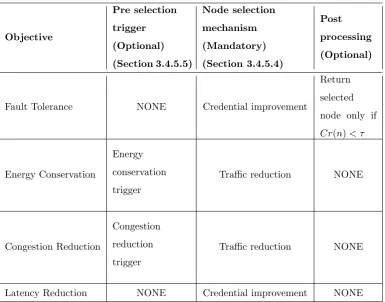
3.1 Prioritized objectives to be fulfilled by mobile device along with the action
to be taken to achieve each. . . 128
0
4.1 Common parameters for basic discovery mechanisms, for trajectory in
Figure 4.1. . . 143
4.2 Common parameters for all discovery mechanisms, for trajectory in Figure
4.2. . . 144
4.3 Observed properties from experiments, for the trajectory in Figure 4.1. . . 147
4.4 Observed properties from experiments, for trajectory in Figure 4.2, BO=8. 148
List of Figures
1.1 Exploiting a path via a mobile device. . . 7
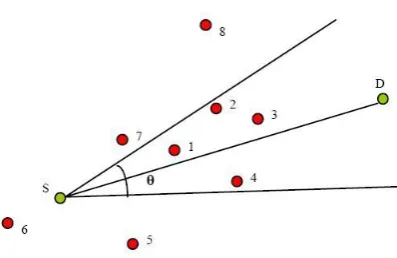
2.1 PGR example, illustrated from (Roosta and Menzo, 2004) . . . 38
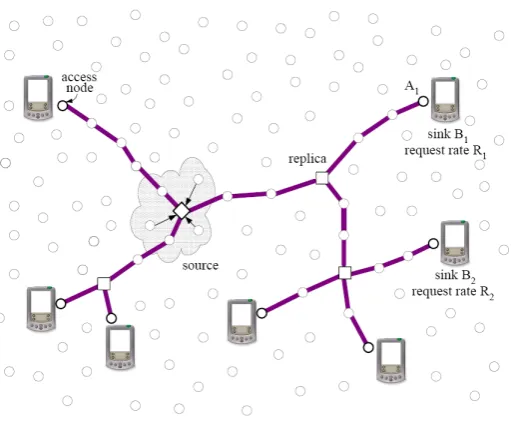
2.2 TTDD’s logical grid showing a source ’B’ and a sink ’S’ (Ye et al., 2002) . 46 2.3 SEAD’s steiner tree to service multiple mobile sinks (Kim et al., 2003) . . 49
2.4 Construction of path from access node to the mobile sink (Kim et al., 2003) 49 2.5 Construction of path from source node to the mobile sink. The path is shortened, once the old path becomes inefficient (Kim et al., 2010). . . 54
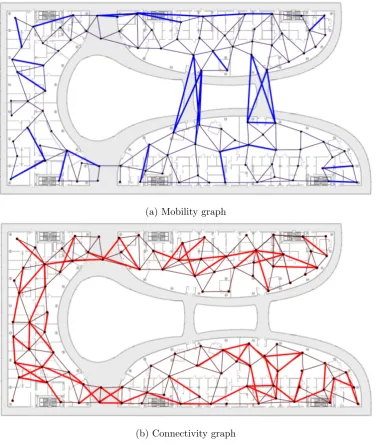
2.6 Difference between mobility and connectivity graphs (Kusy et al., 2009). (a) Additional lines represent represent mobility between opposite sections of the building, representing non-local movement. (b) Direct connectivity is not present between the opposite sections of the building. . . 58
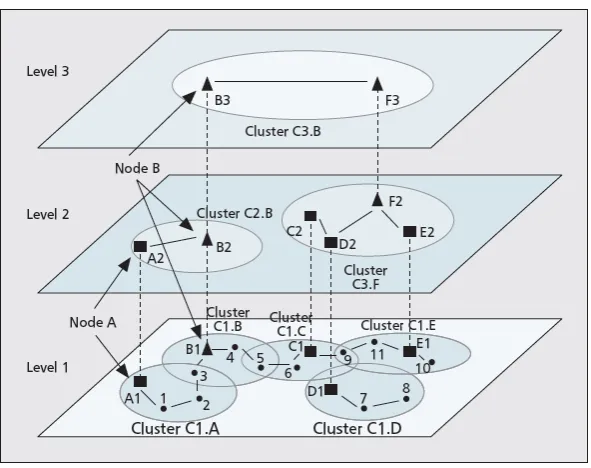
2.7 Example of hierarchical network architecture (Villasenor-Gonzalez et al., 2005). . . 65
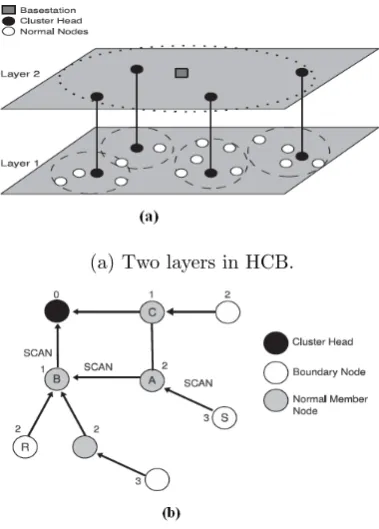
2.8 Hierarchical Cluster Based Routing (Xia et al., 2009). . . 67
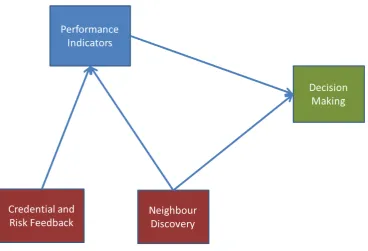
3.1 Solution components. . . 94
3.2 Cluster Tree Network Topology. . . 100
3.3 Sensor Node’s Operations at Boot Time. . . 101
3.4 Sensor Node Joining WSN. . . 103
0
3.6 Representation of achieving TDmin . . . 110
3.7 Representation of obtaining TDmax . . . 111
3.8 Cluster tree network topology modified due to presence of mobile device. . 118
3.9 Sensor node selection process at the mobile device. . . 132
4.1 Trajectory of the MDC in a single iteration. . . 141
4.2 Trajectory of the MDC, arriving 7 times in range in a single iteration. . . 143
4.3 Dotplot of TD for the existing discovery mechanisms, for the trajectory
in Figure 4.1. . . 145
4.4 Time series plot of TD from the existing discovery mechanisms, for the
trajectory in Figure 4.1. . . 146
4.5 Dotplot of TDfor the basic discovery mechanisms, following the trajectory
in Figure 4.2. . . 147
4.6 Comparative dotplot of TD for all discovery mechanisms, following
tra-jectory in Figure 4.2 and BackOff in Table 4.2. . . 149
4.7 Energy consumption at SN vs. time for different SO, BackOff and
discov-ery mechanisms, for the trajectory in Figure 4.2. . . 151
4.8 Energy consumption at SN vs. time for different BackOff and discovery
mechanisms, for the trajectory in Figure 4.2. . . 152
4.9 Overview of the components developed for implementing Inverse
Location-Aware Discovery mechanism and STEROID protocol in simulated
envi-ronment. . . 155
4.10 Variant of the strategy pattern, implemented to perform sensor node
se-lection by the mobile device using different combinations of pre sese-lection
filter, selection strategy, and post processor, in order to achieve prioritized
objectives. . . 157
0
4.12 Configuration 1: Network deployment with 28 sensor nodes and two
chil-dren per node. (Two Chilchil-dren Per Node - C1 - 28SN) . . . 169
4.13 Configuration 2: Single branch network deployment with 12 sensor nodes.
(Single Branch - C2 - 12SN) . . . 170
4.14 Configuration 3: Unbalanced network deployment with 14 sensor nodes.
(Unbalanced Network - C3 - 14SN) . . . 170
4.15 Configuration 4: Planned hierarchical network deployment with 61 sensor
nodes. (Hierarchical Designed Network - C4 - 61SN) . . . 171
4.16 Configuration 5: Half connected network deployment with 15 sensor nodes.
(Half Connected Network - C5 - 15SN) . . . 172
4.17 Configuration 6: Disconnected network deployment with 14 sensor nodes.
(Disconnected Network - C6 - 14SN) . . . 172
4.18 Configuration 7: Semi automatic circular network deployment with 137
sensor nodes. (Semi Automatic Circular - C7 - 137SN) . . . 173
4.19 Delivery ratio, with and without transmission retries, using network
con-figuration C1. . . 175
4.20 Delivery ratio, with and without transmission retries, using network
con-figuration C2. . . 176
4.21 Transmission required by sensors per generated packet, with and without
transmission retries, using network configuration C2. . . 177
4.22 Transmission overhead ratio per generated packet, with and without
trans-mission retries, using network configuration C2. . . 177
4.23 Transmission required by sensors per generated packet, with and without
transmission retries, using network configuration C1. . . 178
4.24 Transmission overhead ratio per generated packet, with and without
0
4.25 Results using different selection mechanisms showing better performance
with the traffic reduction selection mechanism, using the network
config-uration C7. . . 181
4.26 Results using different selection mechanisms showing better average hop
counts with the traffic reduction mechanism but better delivery ratios
with the credential improvement selection mechanism, using the network
configuration C7. . . 182
4.27 Energy consumption using different selection mechanisms, using the
net-work configuration C4. . . 182
4.28 Transmissions required by the sensor and transmission overhead ratio per
generated packet using different selection mechanisms, using the network
configuration C2. . . 183
4.29 Average number of hop counts traversed by generated packets, using
con-nected network configurations C1, C2, C3, C4 and C7. . . 185
4.30 Average number of hop counts traversed by generated packets, using
net-work configurations C5 and C6. . . 186
4.31 Transmission ratio by sensors, using the network configurations C1, C2,
C3, C4 and C7. . . 188
4.32 Transmission ratio by cluster heads, using network configurations C1, C2,
C3, C4 and C7. . . 189
4.33 Transmissions required by sensors per generated packet, using network
configurations C1, C2, C3, C4 and 7. . . 190
4.34 Transmissions overhead ratio by sensors per generated packet, using
net-work configurations C1, C2, C3, C4 and C7. . . 191
4.35 Delivery ratio, using the network configurations C5 and C6. . . 192
4.36 Transmission ratio by cluster heads, using the network configurations 5
0
4.37 Transmissions required by sensors per generated packet, using the network
configurations 5 and 6. . . 194
4.38 Energy consumption at sensor nodes in milliamperes, using network
con-figurations C1, C2, C3, C4 and 7. . . 195
4.39 Energy consumption at cluster heads in milliamperes, using network
con-figurations C1, C2, C3, C4 and C7. . . 196
4.40 Delivery ratio for different maximum speed and mobile devices, using the
network configuration C7. . . 199
4.41 Transmission overhead ratio per generated packet for different maximum
speed and mobile devices, using the network configuration C7. . . 199
4.42 Delivery ratio and transmission overhead ratio per generated packet for
different maximum speed with 10 mobile devices, using the network
con-figurations C1, C2, C3, C4 and C7. . . 200
4.43 Delivery ratio and transmission overhead ratio per generated packet for
different maximum speed with 50 mobile devices, using the network
con-figurations C1, C2, C3, C4 and C7. . . 201
4.44 Energy consumption with increasing number of P-nodes (Liu et al., 2011). 202
4.45 Delivery ratio with increasing number of P-nodes (Liu et al., 2011). . . 203
4.46 Average end-to-end delay with increasing number of P-nodes (Liu et al.,
2011). . . 203
4.47 The delivery ratio with increasing number of mobile nodes, using the
network configurations C1, C2, C3, C4 and C7. . . 204
4.48 Average end-to-end delay with increasing maximum speed of P-nodes (Liu
et al., 2011). . . 206
4.49 Delivery ratio with increasing maximum speed of P-nodes (Liu et al., 2011).206
A.1 Beacon Separation in Time Domain to Avoid Collisions. . . 223
0
B.1 Data transfer to a parent node (Coordinator) from a child node (Network
Device), IEEE802.15.4 (2006). . . 228
B.2 Data transfer to a child node (Network Device) from the parent node
(Coordinator), IEEE802.15.4 (2006). . . 229
B.3 Data transfer to a child node (Network Device) from the parent node
(Coordinator), as a broadcast packet with addressing fields in the network
layer header. . . 230
B.4 Fixed gateway (host) connected with a sensor node over USB
communi-cates with other sensor nodes over wireless link. . . 231
Chapter 1
Introduction
Wireless sensor networks (WSNs) are composed of resource-constrained autonomous
sensor nodes, used to measure environmental phenomena. They are typically unattended
battery-powered devices that have very limited storage, computation and communication
capabilities. Generally their transmission range and the number of bits per packet are
also limited to conserve energy, and therefore their data need to be collected via
multi-hop routes, thereby consuming energy at all intermediary nodes.
Frequently hierarchical sensor network deployments are preferred to allow the
net-work to scale, such that the sensor data is delivered to a central device (sink), which has
significantly higher resources than the sensor nodes. However, in a hierarchical network
structure, sensor nodes deployed near the sink may experience congestion due to high
volumes of incoming traffic. In addition, the energy reserves on such sensor nodes can
deplete more quickly than at other sensor nodes in the network due to frequent data
forwarding.
Communication is typically considered to be the core reason behind energy
consump-tion on sensor nodes as the energy consumed during processing tasks is comparatively
negligible. Reduction in communication based on complex data aggregation,
et al., 2012; Marcelloni and Vecchio, 2008; Kimura and Latifi, 2005; Mohamed et al.,
2013) may not always be suitable on the resource-constrained sensor nodes.
In modern urban environments, however, more capable mobile devices are
ubiqui-tously present. These devices usually have much better resources than sensor nodes.
Therefore, this thesis explores the possibility of exploiting such mobile devices to reduce
communication in a WSN, thereby reducing energy expenditure. The more capable
mo-bile devices, however, are individually owned and not under the control of the deployed
sensor network. Thus, these devices can appear and disappear at any time, either
be-cause they move fast (e.g., in vehicles) or bebe-cause the user (owner of the device) changes
the state of the radio responsible for communicating with the sensor network.
Thus, in this thesis, a new approach is developed in which unstable links through the
more capable mobile devices are exploited and the characteristics of each of the available
devices are used to differentiate between their capabilities, to reduce network traffic
within a WSN. Hence, this thesis addresses the problem of offloading communication
load from unattended sensor nodes to more capable mobile devices, in order to conserve
energy, reduce congestion, provide fault tolerance and improve latency.
In particular, the Inverse Location-Aware Discovery (ILAD) mechanism presented in
this thesis, demonstrates how mobile devices can be discovered quickly without
compro-mising the energy efficiency of the sensor nodes. In addition, the Smart Traffic Energy
and Resource aware Offloading using Inverse Discovery (STEROID) protocol shows how
communication tasks can be offloaded in urban-scale WSNs while achieving the
afore-mentioned objectives.
This thesis studies the relationships and tradeoffs between different parameters in
order to achieve the aforementioned goals and investigates how the risk of data loss
can be limited while using mobile devices in the STEROID protocol. As a result, the
STEROID protocol outsources the communication to extra-WSN devices, improving
end-to-end latency and energy conservation at the sensor nodes, in addition to reducing
partitions.
The rest of this chapter is organized as follows. Section 1.1 provides background on
WSNs and participatory sensing and briefly discusses problems associated with each.
Section 1.2 motivates the research in this thesis by discussing the problems associated
with typical WSNs. Section 1.3 discusses a hypothetical application scenario for the work
presented in this thesis. Section 1.4 discusses the challenges associated with this research
and formulates the problem. Section 1.5 maps out the requirements associated with the
envisaged solution. Section 1.6 discusses the contributions of this thesis. Section 1.7
formulates the scope of this thesis. Section 1.8 discusses the evaluation plan to evaluate
the contributed protocol. Section 1.9 briefly discusses the roadmap of this thesis. Finally
Section 1.10 summarizes this chapter.
1.1
Background
Verdone et al. (2010) define a Wireless Sensor and Actuator Network (WSAN) or WSN
as a network of small (in size) and simple devices (sensor nodes) that can sense the
environment and communicate the gathered information through wireless links. The
data is forwarded to a sink via (possibly) multi-hop routes. The sink is typically defined
as a single node within the WSN, that collects all the sensor data from the sensor nodes
that are directly or indirectly connected to it. The sink can use the data either locally or
further forward it to external networks (e.g., the Internet) via a gateway. The gateway
is defined as a device that bridges two (or more) distinct types of networks together,
e.g., a gateway can become a bridge between a WSN and the Internet. In this thesis, we
use the term“Fixed Gateway” to represent a stationary device that is a combination of
a typical WSN sink and a gateway connected to an external network (e.g., the Internet).
Assuming the presence of a fixed gateway allows the WSN to be connected to the external
network at all times (Tennina et al., 2011a).
computation and communication capabilities. Apart from sensor data delivery, energy
conservation is usually considered to be the most important requirement for the WSN,
because the sensor nodes are battery powered and unattended devices. Recharging the
batteries of the sensor nodes is typically impractical as the sensor nodes are deployed in
hard-to-access areas and physical access can incur high maintenance cost (Dohler et al.,
2007; Anastasi et al., 2009). Therefore, the protocols for WSN are typically designed to
ensure energy conservation.
In addition, WSN nodes also have limited transmission range and can typically only
send packets of small sizes. For example, the IEEE802.15.4 (2006) standard defines a
maximum packet size of 127 bytes that the physical layer shall be able to receive. In
order to conserve energy, the transmission range can be further limited by reducing the
transmission power. For this reason, multiple hops are used to route data towards the
sink.
Typically, data communication consumes the most energy reserves (Anastasi et al.,
2009; Pottie and Kaiser, 2000; Raghunathan et al., 2002; Chipcon, 2006). For this reason,
the data communication is minimized at all levels of the software stack and algorithms
are optimized for energy efficiency. The typical life cycle of the sensor node’s radio is
designed to alternate between active and sleep modes, such that the sensor node switches
off its radio to conserve energy during the sleep mode and listens for incoming traffic
during the active mode. The duty cycle of the on-board radio is configured in a way
that keeps the radio in sleep mode for the majority of the time. Data communication
is minimized using different techniques, at different levels of the software stack. For
example, IEEE802.15.4 (2006) has listening duty cycles in beacon-enabled mode to limit
the portion of time a node spends listening to the radio channel, routing protocols are
designed to be energy-aware (Yu et al., 2001; Roosta and Menzo, 2004; Akkaya and
Younis, 2004; Avudainayagam et al., 2003), and middleware systems are designed to
reduce packet transmissions either by sensor data aggregation (Tennina et al., 2011a),
by compressing the sensor data (Marcelloni and Vecchio, 2008; Kimura and Latifi, 2005;
Mohamed et al., 2013). In multi-hop WSNs, the sensor nodes not only transmit their
own data but also forward the data on behalf of other sensor nodes. Forwarding data
on behalf of other sensor nodes generally results in higher energy consumption at the
intermediary sensor nodes, as it generates extra transmissions.
The research community is advocating participatory and opportunistic mobile
sens-ing, where sensors embedded in mobile devices of individual users could be used to gather
environmental information (Burke et al., 2006; Mun et al., 2009; Lane et al., 2008). This
approach, however, is only suitable for cheap common sensors, as otherwise device costs
may become prohibitive. Data availability also highly depends on the availability of
par-ticipating devices in such cases, which means that if a device is not present in the target
area, then sensor readings cannot be gathered. For these reasons, participatory sensing
may be utilised for gathering generalised information, e.g., temperature and noise, for
which sensors can easily be embedded within consumer devices. This information could
then be used in non-critical applications. However, this approach is not suitable for
applications that require specialised sensors, e.g., CO2, N O2 and O3, due to the price
of such sensors, or for mission critical applications, where data could be required at
any time regardless of the presence of participating devices in the target area. WSNs
are expected to be useful in the applications where such specialised sensor readings are
required.
Overall, WSNs are suitable for sensing (specialized) environmental phenomenon
without depending on the availability of participating and opportunistic devices. Whereas,
simultaneously reducing communication activity on resource-constrained sensor nodes is
1.2
Motivation
In large-scale WSNs, a number of challenges are faced, such as energy conservation,
handling traffic congestion, fault tolerance, maximizing data delivery ratio, timeliness
and scalability, among others (Anastasi et al., 2009; Wan et al., 2003; Tennina et al.,
2011a). Most of these challenges are due to the limited capabilities of the devices used to
form such networks. All of these challenges ultimately affect the timely data delivery to
the final destination. As the number of hops increase in the sensor network, the
end-to-end latency increases. In addition, in typical deployments, the data is directed towards
the fixed gateway (GW) (Somasundara et al., 2006; Tennina et al., 2011a). Therefore,
packets from many sources converge towards nodes that are closer to the fixed gateway,
resulting in traffic congestion at these nodes (Somasundara et al., 2006; Wan et al.,
2003; He et al., 2003). These nodes, thus form critical resources in the network, and
may become bottlenecks. Due to higher volumes of data forwarding, these critical nodes
may drain their batteries comparatively quickly compared to the rest of the nodes. Once
these nodes become non-operational, severe network partitioning can be witnessed, such
that data from source nodes may not reach fixed gateway and beyond.
In urban environments, mobile devices such as smart phones, tablet PCs and laptops
are abundantly present. These devices generally have much better resources than sensor
nodes in terms of storage, processing and communicating capabilities. These devices
may also be able to establish long-range communication with distant servers via the
Internet. Since these devices are owned by individuals, even though they have limited
energy reserves, they can be recharged easily. Due to their higher capabilities, these
devices can be used to collect and process data from sensor networks. In addition, these
devices can be used to opportunistically forward data on behalf of sensor nodes in an
opportunistic and dynamic manner (Figure 1.1).
To alleviate the challenges associated with communication in WSNs, this thesis
and information dissemination tasks from resource-constrained sensor nodes. By taking
advantage of the paths created by participating mobile devices and using them as mobile
gateways, the data forwarding and routing load can be moved away from the deployed
WSN to more capable mobile devices. Shifting the communication, processing and data
forwarding tasks from resource-constrained sensor nodes to the aforementioned mobile
devices, the burden on the sensor nodes can be reduced. This technique can essentially
reduce the energy consumption on the sensor nodes, because now the sensor nodes do
not have to frequently forward data on behalf of other sensor nodes, possibly resulting in
longer network lifetime. Longer network lifetime generally translates into better return
on investment (ROI), reducing the operational costs of the WSN in terms of changing
batteries or deploying new sensor nodes when old ones deplete. Also, congested areas of
the sensor network can be avoided by forwarding the data through these mobile devices.
In case of network partitions, mobile devices can be used to re-establish connectivity
from disjoint portions of the sensor network. In addition, significant improvements are
expected to be achieved in end-to-end delays due to higher transmission rates and direct
connectivity to the destination via the Internet, if long range radio is available.
This hybrid strategy can potentially leverage the best of both paradigms, as
abso-lute reliance on deployed infrastructure to deliver information is reduced, while gathering
environmental information from sensor network deployment without relying on the
avail-ability of participatory sensors in the target region.
1.3
Application Scenario
The work presented in this thesis can be applied to an application scenario where a
company (such as a telecommunication network operator) decides to deploy
geographi-cally dispersed wireless sensors throughout an urban center. The sensor data could be
collected, for example, to understand the impact of marketing campaigns on consumer
higher value for the customers attract people towards the company’s retail outlets, and
if this results in actual sales. The company can also aim to expose the sensor data to
other companies or city council who wish to take advantage of such data, for example,
to build detailed real-time noise and pollution map for city planning purposes. In such
scenario, multiple companies along with city councils can cooperate to invest in such an
implementation of the sensor network.
In order to reduce the cost, the company chooses low cost wireless sensors to monitor
a number of environmental phenomena such as air, light and noise pollution, temperature
and humidity, proximity (using infrared proximity sensors) of pedestrians and vehicles
with the sensors deployed throughout the city. In order to reduce the cost associated
with connecting fixed power lines throughout the network, the company is likely to opt
for battery-operated sensors.
In order to achieve higher sensor data fidelity, the company opts to deploy sensors
quite close to each other, say approximately every 5-10 meters. The company decides
to organize the sensor network in cluster-tree network topology in order to allow the
network to scale easily (Tennina et al., 2011a,b). In such a scenario, the data acquired
by the sensors is delivered to a centralized location to understand consumer behaviour
by combining sales data and pedestrians’ mobility patterns with marketing campaigns,
weather and pollution levels (out of the scope of this research). The environmental
sensor data is also exposed to the wider research community and the industry at large
for a nominal fee by exposing a set of easy to use APIs (application program interface).
However, the company realizes that a number of problems emerge in wireless sensor
network due to their less capable nature as discussed in the previous sections. In order
to improve ROI, the company decides to crowd source sensor data communication and
delivery by utilizing their telecommunication network consumer base. The
communica-tion is not completely relied upon crowd sourcing because the company is interested in
acquiring the sensor data even if no data forwarding participants are available, i.e., the
unavailability of participants or if the communication via participatory mobile devices
has higher risk of data loss. In order to increase the number of participants who allow
their smart mobile devices to become the data carriers, the telecommunication company
offers tangible real-world rewards in exchange for consumer’s participation, e.g., free
talk time, extra data bundles, loyalty points (e.g., Tesco club card points when data is
forwarded via Tesco mobile subscribers, hypothetically) or free meal at a partner
restau-rant. Since the more capable mobile devices are owned by independent participants,
they can recharge their devices as required, e.g., when they connect their device to their
car or they can re-charge their device when they reach their destination. In addition,
the participants can allow the software published by the said company to use their
de-vice to forward sensor data when they have enough battery remaining on their dede-vices.
For these reasons, this thesis does not consider energy consumption optimization at the
mobile devices to be one of its crucial requirements.
In such a scenario, the location of the sensor nodes, along with their transmission
range, will be known a priori to the company deploying sensors throughout the city, as the
sensors will be considered as assets of the company, representing significant investment.
The company can share the location of the sensors with the smart mobile devices that
offer their services to forward data on behalf of the sensor network using the ILAD
mechanism and the STEROID protocol.
This thesis assumes compatible radios on both more capable mobile devices and less
capable sensor nodes where the transmission range of the sensor nodes is limited in
ac-cordance with desired operational life in terms of battery consumption. Because, the less
capable sensor nodes will not be allowed to increase their transmission power to respond
to mobile devices by sending acknowledgements, even if the mobile devices are allowed
to increase their transmission power to send packets to sensors deployed farther than
their normal range, the acknowledgement packets originating from the sensors will have
to be traversed using multi-hop paths. In such a scenario, the mobile device may never
mobile device, it may have moved and the path to the mobile device may have changed.
In essence, by allowing uni-directional links, the company will have to implement a
so-lution that is similar to the ones discussed in Chapter 2, Section 2.2.4, just to deliver
acknowledgement packets to the mobile devices. The uni-directional links also increase
the chances of loss of acknowledgement packets as the probability of transmission
er-ror will increase proportionally with the increase in the number of intermediary devices
while routing acknowledgement packets to the mobile device. For these reasons, there
is no need to allow the mobile devices to be able to communicate with sensors that are
farther away by increasing their transmission range in similar scenarios, thus reducing
the implementation cost.
1.4
Challenges
The most prominent characteristic of the paths introduced by these mobile devices is
that they are highly unstable. Indeed they can appear when mobile devices are present
in the vicinity and disappear as soon as any of the mobile devices within that path
moves outside the communication range of the other devices. The appearance and
disappearance of devices could also be triggered when the user of such a mobile device
turns on or off the radio responsible for communicating with the WSN. For this reason,
using such mobile devices to forward data increases the risk of data loss. Therefore, a
tradeoff exists between energy consumption, end-to-end delay, throughput and risk of
data loss when using these mobile devices.
Thus, this thesis addresses the problem of finding the best next hop in a WSN in
order to move data forwarding and processing load to more capable mobile devices, while
conserving energy, reducing congestion, providing fault tolerance and improving
end-to-end latency. This thesis also studies how these objectives can be achieved simultaneously
while limiting the risk of data loss due to the mobility of mobile devices.
communica-tion load to more capable mobile devices introduces the challenge of finding and then
using these devices efficiently. This means that the mobile devices must be discovered by
the stationary, less capable, sensor nodes as quickly as possible, to take advantage of the
potential routes provided by the mobile devices. In addition, the discovery mechanism
must also be energy efficient, especially at the sensor nodes in order to keep the sensor
nodes operational for longer durations.
As the sensor nodes are very resource-constrained devices with very limited memory
and processing capabilities, they cannot store information about all mobile devices that
may become available in their vicinity to take intelligent decisions, as high volumes of
mobile devices may be available for exploitation in urban environments with different
arrival patterns. Thus, only limited amounts of information can be stored temporarily
for decision making, in order to reduce memory and processing requirements.
1.5
Goals and Requirements
The main goal of this thesis is to investigate how to efficiently use mobile devices available
in urban environments to outsource data communication load from resource-constrained
sensor nodes in the network.
This thesis sets the following requirements while achieving the above-mentioned goal:
1. Device Aware: The routing and discovery protocols must be device aware such
that they can differentiate among different types of devices and their capabilities.
2. Latency Reduction: The routing protocol must minimize end-to-end latency by
reducing end-to-end packet delivery time for timely delivery of data packets.
3. Energy Conservation:
(a) The discovery protocol must be energy efficient at the sensor nodes without
(b) The routing protocol must increase network lifetime by reducing energy
con-sumption at the stationary intermediary sensor nodes, i.e., by reducing
pack-ets forwarded by these nodes, and by using energy-aware decision metrics.
4. Congestion Reduction: The routing protocol must decrease congestion at
crit-ical sensor nodes, i.e., reduce incoming traffic at sensor nodes engaged in high
data forwarding to increase productivity of the critical resource-constrained sensor
nodes.
5. Fault Tolerance: The routing protocol must provide fault tolerance in the case
of network partitions by taking advantage of mobile devices.
6. Fast Reactivity: The discovery protocol must quickly discover mobile devices in
order to allow the sensor network to leverage their presence in a timely manner.
7. Communication Load Reduction: The routing protocol must offload
commu-nication load from resource-constrained sensor nodes by redirecting traffic towards
more capable mobile devices.
8. Data Delivery Ratio: The routing protocol must limit the risk of data loss while
forwarding via mobile devices due to their mobility.
1.6
Contributions
The research described in this thesis contributes to the state-of-the-art in the area of
routing and device discovery within the domain of WSNs deployed in urban
environ-ments.
The core contributions of this thesis are as follows:
1. Extensive analysis of the state-of-the-art mobile device discovery protocols within
the context of WSNs, and closely-related routing protocols that utilize mobile
networks (MANETs), delay tolerant networks (DTNs) and wireless sensor networks
(WSNs). The analysis of the related work shows that none of the existing protocols
can be used in resource-constrained WSN environment to either discover mobile
devices quickly and energy-efficiently, or offload the communication and processing
load to more capable mobile devices to achieve energy conservation, fault tolerance,
congestion reduction and end-to-end latency reduction simultaneously with limited
risk of data loss.
2. A new location-aware device discovery mechanism (ILAD) that allows sensor nodes
and mobile devices to discover each other efficiently. This discovery mechanism
moves the discovery procedure to the more capable mobile devices. It achieves
faster discovery by exploiting location awareness at the mobile devices and
im-proved energy consumption at the sensor nodes when compared to the baseline
discovery mechanism. An implementation of the discovery mechanism is provided
on sensor nodes in TinyOS (Levis and Gay, 2009) on the TelosB (Crossbow, 2005)
platform and on mobile devices in Java, to understand its characteristics in a
test-bed environment, such as discovery time and energy consumption at the sensor
nodes.
3. A new routing protocol (STEROID) that allows the more capable mobile devices
to take over data forwarding activity from sensor nodes. This routing protocol
reduces end-to-end latency by avoiding multi-hop routes via sensor nodes. It
re-duces congestion by reducing packet arrivals at critical nodes. In addition, it also
improves energy consumption at intermediary nodes while reducing packet arrivals
at these intermediary nodes, and provides fault tolerance in the case of network
partitions. An implementation of the routing protocol is provided in a custom Java
based simulator that is portable on multiple operating systems, to understand its
impact on energy consumption, transmission overhead, delivery ratio,
under different network deployment scenarios.
1.7
Scope
This thesis mainly focuses on the routing problem in WSNs to offload communication
related tasks from resource-constrained sensor nodes to more capable mobile devices. In
particular, this thesis focuses on WSNs deployed in urban environments within the smart
cities context, where mobile devices, such as smart phones, tablet and laptop computers,
are abundantly present.
The research aims at reducing the data communication within the sensor network
by outsourcing the communication traffic originating from sensor nodes to extra-WSN
(cooperative) devices while bypassing the intermediary sensor nodes. The discovery
mechanism to discover mobile devices is within the scope of this thesis. In this work,
the mobile devices are used as mobile gateways to forward packets containing sensor
readings to a centralized command and control server (CC). However, the server side
network structure along with the security and privacy issues related to open access
networks are out of the scope of this thesis.
The mobile devices could be extended to act as sinks as well, in order to allow them
to also gather sensor readings. However, mobile sinks are out of the scope of this thesis,
as many existing protocols target supporting mobile sinks as their primary objective
(Akkaya and Younis, 2004; Kim et al., 2003; Ye et al., 2002; Kim et al., 2010; Kusy
et al., 2009).
1.7.1 Assumptions
This thesis makes the following assumptions about the environment:
1. The WSN is organized in a hierarchical cluster-tree network topology. WSNs
(Tennina et al., 2011a,b) suggests that WSNs deployed in a hierarchical cluster-tree
network topology scale well.
2. All the sensor data is forwarded towards a centralized command and control server
(CC) that is not co-located with the sensor network. The centralized CC can
physically comprise of multiple servers or virtual servers, but is assumed to be
logically exposed by a single end-point (IP address or URL) and is therefore,
referred to as a single unit. The location (URL end point) of this centralized
CC is assumed to be accessible via the Internet. Alternatively, the sensor data can
be consumed locally within the vicinity of the sensor network or can be forwarded
to different locations, however, accumulating sensor data in a centralized location
allows third-party software vendors to consume the sensor data by utilizing a set
of well known APIs such as webservices.
3. In order to gain targeted insight, once the sensor network is formed, all sensor
nodes start transmitting their sensor readings towards the fixed gateway, which in
turn forwards these readings to the command and control server.
4. Any third-party consumers of the sensor data can fetch the relevant information
from the command and control server connected to the Internet.
5. Each node in the sensor network knows its own location either by deployment time
configuration or by using localization techniques (Caballero et al., 2008;
Graefen-stein et al., 2009; Priyantha et al., 2005). The sensor nodes include their own
geographic location in their periodic beacon broadcast, that is used by the mobile
devices to perform traffic reduction by inferring the sensor nodes that are in range
of one another.
6. The transmission range of sensor nodes is known a priori as the transmission power
7. Mobile devices can obtain their location from an external source, such as the
Global Positioning System (GPS). The mobile device uses its own location to
perform location-aware discovery of the sensor nodes in its vicinity in order to
reduce discovery time.
8. The mobile devices can also obtain the location of the sensor network, (possibly)
even the sensor nodes, from the CC to perform location-aware discovery of the
sensor nodes in its vicinity.
9. All links are symmetric and bi-directional, i.e., if device ’A’ can communicate with
device ’B’, then device ’B’ can also communicate with device ’A’. This assumption
allows single hop transmissions to be bi-directional, i.e., if the data packets are
delivered in a single hop then their acknowledgement packets are also delivered in
a single hop. If the links are allowed to be uni-directional, i.e., the more
capa-ble device can increase its transmission power to reach farther destinations, then
the data transmission can happen in a single hop, whereas, the acknowledgement
packets may arrive at the source via multi-hop paths. Such mechanism requires
multi-hop routing of the acknowledgement packets in the reverse direction, that
may increase overall routing overhead (Du et al., 2006). If there are delays in the
arrival of the acknowledgement packets via multi-hop paths or such packets are
lost, then the source node may send the original data packet again in order to
increase delivery probability, thus unnecessarily increasing the network traffic. If
request-to-send (RTS) and clear-to-send (CTS) based communication mechanisms
are used at the lower layers of the traditional OSI model, then by allowing
uni-directional links, by the time CTS packet is received at the source via multi-hop
routes, the channel may not actually remain clear. Due to these problems faced
with uni-directional links, this thesis assumes and allows communication only via
bi-directional links. This assumption, however, does not mean that link layer
packet to device ’B’, then there is no guarantee that the acknowledgement packet
from device ’B’ to device ’A’ will not be lost or the data packet itself will not be
lost.
10. The energy consumption on the mobile device does not need to be optimized as a
mobile device is individually owned and thus can be easily recharged.
11. The command and control server, the fixed gateways and the mobile devices
support multi-threading because they are more capable devices as compared to
resource-constrained sensor nodes.
1.8
Evaluation
This thesis evaluates the routing protocol and the discovery mechanism on actual sensor
nodes to ensure real-world validation, and within a simulated environment to study
the impact of distinct network characteristics in isolation. The ILAD mechanism is
empirically evaluated in terms of energy consumption at the sensor nodes and the interval
of observed discovery time. The STEROID routing protocol is empirically evaluated in
terms of reduction of the traffic load within the sensor network, energy consumption
at the sensor nodes, end-to-end latency and packet delivery ratio, within the simulated
environment.
This thesis studies the impact of the protocol on the sensor network under
differ-ent environmdiffer-ents. A number of differdiffer-ent network deploymdiffer-ents and configurations are
used to understand the impact of the location of sensor nodes, and their connectivity
with respect to the fixed gateway and mobile devices. As the number of combinations
of experimental parameters is high, simulations are used to conduct the study in order
to reduce the configuration and experimental design time, and increase the
experimen-tal flexibility. Each experimenexperimen-tal configuration is executed multiple times to improve
The network deployments used in the evaluation of the routing protocol generally
fall under two categories:
1. Planned: Manually planned deployment to study different aspects of the protocol.
2. Generated: Algorithmically generated to avoid human intervention and achieve
an easy deployment strategy.
The proposed routing protocol (STEROID) is evaluated with randomized mobility
traces, whereas the proposed discovery mechanism (ILAD) is evaluated with fixed
mobil-ity traces. Two separate mobilmobil-ity trace generators were implemented that generate the
traces based on either fixed locations that a mobile device visits or the random waypoint
model with zero (0) pause time1.
1.9
Road Map
The remainder of this thesis is organized as follows. Chapter 2 presents the
state-of-the-art in mobile device discovery and routing in ad hoc and wireless sensor networks, with
a particular emphasis on protocols that consider stationary sensor networks with mobile
devices, and protocols that redirect traffic towards more capable devices. It
demon-strates that none of the existing work is suitable to completely fulfil the requirements
set out in Section 1.5. Chapter 3 discusses in detail the design of the ILAD mechanism
and the design of the STEROID routing protocol. Chapter 4 empirically validates the
hypotheses discussed in this chapter and evaluates the ILAD mechanism in terms of
energy consumption at the sensor nodes and discovery time, and the STEROID routing
protocol in terms of average number of traversed hops, delivery ratio, transmission ratio
at the sensor nodes, transmissions required by sensor nodes for delivering packets,
trans-mission overhead at the sensor nodes and energy consumption at the sensor nodes, in a
1
test-bed and simulated environment respectively under different sensor network
deploy-ments. Additionally, Chapter 4 also discusses the custom simulator used in the course of
this research. Chapter 5 concludes this thesis and discusses the future work associated
with this research.
1.10
Summary
This chapter began by introducing WSNs and the major emphasis of the research
com-munity in the area. It then motivated the research presented in this thesis by outlining
the problems associated with resource-constrained sensor networks and the approach
taken to overcome those issues, i.e., to outsource data communication to
individually-owned mobile devices present in urban environments. This chapter also discussed a
hypothetical application scenario where ILAD and STEROID protocols can be used.
This chapter then outlined the challenges associated with this approach and the goals
and requirements that are to be met in order to achieve a successful implementation.
The contributions of the thesis were systematically outlined later in this chapter. The
scope of this thesis along with the assumptions made by the system were also defined in
this chapter. The chapter concluded by outlining the approach taken for evaluation of
Chapter 2
Related Work
The problem of shifting communication load to more capable mobile devices comprises
of device discovery and routing sub problems. Existing mechanisms have used a variety
of techniques to resolve these two sub problems. This chapter discusses existing work
in the field of device discovery and packet routing within the context of wireless sensor
networks (WSNs) and develops a taxonomy of the most relevant protocols.
Discovery protocols related to discovering mobile devices in WSNs are discussed first,
along with their shortcomings. The majority of the existing discovery protocols in WSNs
have placed the burden of discovery on resource-constrained sensor nodes. The discovery
protocols discussed in this chapter mainly differ in the way they optimize the discovery
process to quickly discover the mobile devices. This chapter first discusses the base line
discovery protocols that either continuously, randomly or periodically scan for mobile
devices. This chapter also discusses the discovery protocols that use either two beacons
or two different radios each listening on a different radio channel, to discover mobile
devices more efficiently than the baseline discovery protocols. More intelligent discovery
protocols use learning techniques to predict the arrival times of the mobile devices, thus
improving the state-of-the-art. Even though potent, these techniques are complex to
in terms of limited energy reserves and processing and storage capabilities. The most
efficient protocols discussed in this chapter use hardware oriented techniques to wakeup
the sensor nodes with which communication is intended. These protocols, however,
introduce extra hardware on the sensor nodes that may result in higher manufacturing
cost. As the majority of the protocols assume that the resource-constrained sensor
nodes will scan for beacons originating from mobile devices, this chapter also discusses an
alternative protocol in which the mobile devices scan periodically for beacons originating
from the sensor nodes. This alternative technique inspires the development of the inverse
location-aware discovery protocol discussed in this thesis that reduces the listening tasks
performed by the resource-constrained sensor nodes while improving the discovery time
when compared to the baseline discovery mechanisms.
After discussing the discovery protocols, this chapter discusses the traditional and
geographic routing protocols employed in MANETs. The traditional routing protocols
are discussed first because these protocols provided the basis for establishing ad hoc
net-works without a fixed infrastructure. However, these traditional routing protocols suffer
in terms of their reactivity due to mobility because they flood the network with route
requests whenever a new route is required. This drawback has been largely overcome in
MANETs by employing geographic routing protocols that use the location information
of their destination and their neighbourhood to route packets towards the destination.
However, if the destination moves away from the known location, then the geographic
routing protocols also fail to deliver data. If the destination is a server located behind
an IP network, then geographic routing protocols can only deliver data to a gateway
from where the data is forwarded via IP network routing protocols.
Because this thesis focuses on using mobile devices with stationary WSN, routing
protocols that employ mobile devices in some capacity within the context of WSNs are
discussed next. This discussion shows that the majority of the existing work focuses
on routing the sensor data to specific mobile devices that use the sensor data for their
paths towards mobile devices and track the movement of these mobile devices in order
to deliver their data. However, the existing work in this area does not use the mobile
devices to offload the communication tasks from the resource-constrained sensor nodes.
Hierarchical routing protocols are explored next in this chapter because the WSN
assumed in this thesis is organized in hierarchical network topology. Even though these
protocols employ mobile devices and form the network as a hierarchy of heterogeneous
devices, they mostly focus on reducing the information maintained in the routing tables
and reducing the impact of route requests in the network by avoiding route request
flooding throughout the network. The discussion on hierarchical routing protocols show
that these protocols are not suitable in the scenario targeted in this research either where
the communication load is to be offloaded to more capable mobile devices.
Another interesting category of routing protocols deals with disjoint and partitioned
networks. Because the delay tolerant routing protocols focus on sharing information
when devices arrive in the proximity of each other, they also show similarity with the
scenario presented in this research. Thus delay tolerant routing protocols are also
in-cluded in this chapter and the problems associated with this category of protocols are also
discussed. Even though, the delay tolerant routing protocols achieve fault tolerance in
case of network partition, they do not focus on reducing the load on resource-constrained
devices, because these protocols are designed for scenarios where the partition has
al-ready occurred and thus achievement of energy conservation or congestion reduction is
not their priority. Most protocols in this category, with few exceptions (Pasztor et al.,
2007), assume devices with sufficient resources that are capable of storing undelivered
packets until the packets are transferred to devices that have a better chance of delivery
to the destination.
The routing protocols that redirect the traffic towards more capable devices in order
to reach the destination comes close to solving the scenario presented in this thesis.
These protocols are also developed for WSNs, however, they rely on traditional routing
destination, but to also find a more capable device in the network that can be used
to redirect traffic away from the less capable nodes. This chapter also discusses the
short-comings associated with the existing work in this category of routing protocols.
The chapter concludes by summarizing the problems associated with the existing
protocols and identifies the gap that this thesis addresses.
2.1
Mobile Device Discovery Mechanisms in WSNs
Network protocols that use Mobile data collectors (MDCs) to transport data to its
des-tination have implemented different discovery mechanisms. The discovery mechanisms
implemented in these protocols deal with discovering the mobile devices to establish
com-munication between the sensor nodes and the mobile devices. The majority of discovery
mechanisms focus on discovering the mobile devices quickly. This section discusses the
discovery mechanisms used by such networking protocols below.
2.1.1 Baseline mobile device discovery mechanisms
Somasundara et al. (2006) have targeted controlled mobility of the MDC while delivering
data to the destination. In this case, the mobility of the mobile device is under the control
of the sensor network and the movement of the mobile device is adjusted to improve
network performance, e.g., the mobility is planned in a way that the mobile device visits
all available sensor nodes deployed in the target area. They analyzed the network with
and without MDCs, and report a small network energy consumption and a small increase
in transmissions required to deliver data, when increasing the network density while using
MDCs, without compromising the data rate significantly. The authors suggest that the
sensor nodes always listen for periodic beacon packets from the mobile data collectors.
Although simple, this technique of discovering mobile data collectors typically incur high
energy consumption at the sensor nodes, as the sensor nodes have to always keep their
Jain et al. (2006) introduced the MULE architecture where the data generated by
the sensor nodes (SNs) is delivered to the access points with Internet connectivity using
MULEs. In this case, a MULE visits the sensor nodes and collects data from these sensor
nodes and stores locally. The MULE then visits the access point, where it offloads all the
collected data to the access point, from where the data is sent to the final destination
using the Internet. A MULE (MDC) is assumed to have better resources (such as
storage and energy) than the SNs, and is used to reduce work on SNs such that
end-to-end multi-hop paths from the sensor nodes to the access point are not required to
deliver data to the destination. In this work, the SNs listen to the periodic discovery
messages broadcasted by the MULEs. However, unlike Somasundara et al. (2006), the
authors of the MULE architecture use periodic listening duty cycles at the sensor nodes
to discover the mobile devices, such that the sensor nodes listen for a small discovery time
period (DT) every beacon interval (BI), where BI represents the time period between
two consecutive beacons broadcasted by the mobile device and the listening duty cycle
at the sensor nodes is given by DTBI.
Similarly, Sadaphal and Jain (2008) analyze periodic wake up cycles of the sensor
nodes. In addition, the authors of this work also analyze random wake up cycles of
the sensor nodes, such that the sensor node may start listening at the radio channel at
random time. The authors show that an upper bound exists for the delay between the
time when the mobile device arrived in range to the time when it was detected. For
both, random and periodic wakeup cycles implemented at the sensor nodes, the authors
assume that the mobile devices are cooperative with the sensor nodes, such that the
mobile devices broadcast periodic beacons, whereas, the responsibility of detection lies
2.1.2 Using dual beacons and radio channels for discovering mobile devices
The work discussed in this section improves on the baseline discovery mechanisms for
discovering mobile devices in the context of WSNs, by employing either multiple radios
or multiple types of beacon in order to discover mobile devices quicker than the baseline
mechanisms.
Schurgers et al. (2002) use an active polling technique to wake up a node with which
data transfer is intended. The polling (beaconing) is performed on a different radio
frequency than the one used for data transmission, by using two different radios on
each node. The beacons contain addressing information of the source and the target
node with which data transfer is intended. In this work, a node must periodically
listen for beacon messages on the frequency designated for beacon packets, however no
distinction is made between a sensor node and a mobile device, rather the work focuses
on connectivity between two nodes of any type.
Unlike Schurgers et al. (2002), that uses two different frequency bands, Kondepu et al.
(2011) target sparse WSNs and use dual beacons to detect mobile devices, typically on
the same radio frequency channel. They use a long-range (LR) and short-range (SR)
beacon broadcasted periodically in an interleaved manner. Sensor nodes are initially
configured at a low duty cycle, which is increased as soon as they receive a LR beacon,
in order to be ready to receive SR beacons. Upon reception of a SR beacon, the SN gets
ready for data transmission. The authors show improved performance when compared
to baseline periodic listening techniques with single beacons.
Kohvakka et al. (2009) explicitly target IEEE-802.15.4 networks assuming a
hierar-chical cluster-tree network topology. A node scans the channel and synchronizes with
the beacons of a parent. The beacon contains synchronization information of other
bea-coning neighbours. The synchronization information of other beabea-coning nodes can be
This protocol reduces the scan duty cycle by using the synchronization information of
non-parent devices. The protocol uses two types of beacons, i.e., network and cluster
beacons. The network beacons are broadcasted a configured time before the cluster
beacons. In this protocol, a node is synchronized to more than one parent at a time.
The network beacon contains synchronization information about the non-parent devices,
whereas, the cluster beacon contains information about the parent device. In order to
receive two beacons, a child node must wake up a certain time before the cluster beacon
is expected. Even though, a node does not have to always receive network beacons, but
the protocol advises that the network beacons should be received sporadically to
main-tain synchronization information