Abstract—Traditional process control models suppose
certain input control parameters, which are not pragmatic. They cannot support uncertainty of an industrial process, which has multifactor involved. Then, the responses of industrial process are inconsistent. So, a method that can handle uncertainty should be applied to such problems. Design of experiment (DOE) is one of the most efficient methods for multifactor experiments. Another method, called fuzzy logic is nowadays a capable methodology in many applications with unpredictability. So, these approaches were proposed for a case study factory. 2k design of experiments (DOE) was studied and used to find the suitable process control parameters. Fuzzy Inference System (FIS) was considered and represented by linguistic terms. Then, the generated fuzzy rules were utilized to extract the fuzzy process control parameters continuously. The process control parameters were corrected depending on the FIS system. In this research, both approaches were compared with the existing process parameters. The results indicated that the proposed FIS model achieved better performance than DOE model for this application.
Index Terms—design of experiment (DOE), fuzzy inference
system (FIS), process control parameters
I. INTRODUCTION
ROCESS control means the methods that are applied to
control process variables when producing a product and maintain the output of a particular process within a required range. Process control can be classified as manual or automatic. Normally, this classification refers to the amount of human effort needed to accomplish a common function. Manual control consists of open-loop and feed-forward control which involve a lot of physical adjustments by operators. Automatic control consists of closed-loop and feedback control, which use a feedback path that samples the output to control the process automatically [1]. Automatic feedback control is the most common form of control. The methods to deal with process control consist of classical and modern methods. The classical control methods such as on-off control, proportional integral derivative (PID) control,
Manuscript received March 21, 2017; revised April 02, 2017. Prasert Aengchuan is with School of Manufacturing Engineering, Institute of Engineering, Suranaree University of Technology, Nakhon Ratchasima, 30000 Thailand (+66-81641-5235; fax: +6644-224494; e-mail: [email protected]).
Busaba Phruksaphanrat is with Department of Industrial Engineering, Faculty of Engineering, Thammasat University, Rangsit Campus, Pathum Thani, 12120 Thailand (e-mail: [email protected]).
etc. are mostly concerned with mathematical and constant variables. Design of experiment (DOE) method is a critically important engineering tool for improving a manufacturing process [2]. Application of DOE in process control will produce information that can lead to process improvement. Reference [3] applied a design of experiment (DOE) to predict product and process parameters for a spray dried vaccine. The modern control method such as artificial intelligence (AI) is also developed for highly complex processes and random variables. Process control is widely used in industry such as power plants, petrochemical plants, cement plants, and many others. Process control empowers automation and AI methods such as fuzzy logic by which a few operators can control a complex process from a central control room. During the last decade a number of researchers have contributed their innovations in this category. Reference [4] presented the consistency stipulations and controller design for structural and mechanical systems expressed by fuzzy models. The application of support vector regression, FIS and adaptive neuro-fuzzy inference system (ANFIS) for cement fineness online monitoring has presented [5]. The application of FIS inventory system design has presented [6]. Reference [7] presented the comparison of FIS, FIS with artificial neural networks and FIS with adaptive neuro-fuzzy inference system for inventory control.
Many researches apply simulation for the main study, but there are very few publications regarding comparative studies, especially the comparison of DOE and FIS for the plaster process control. So, this research proposes the comparison of the methodologies of DOE and FIS models for predicting the target setting of process control variables and establishing the model of the pragmatic problem with the fuzzy inputs for the process control manufacturing system. The process control problem of a construction material company in Thailand was selected as a manufacturing system case study. The plasterboard production process consists of various control parameters and is quite complicated to control, so requires highly experienced operators.
II. SYSTEM DESCRIPTION AND APPLICATION
A. System Description
The case study company is a make-to-stock manufacturer that produces two types of standard size plasterboard
A Comparative Study of Design of Experiments
and Fuzzy Inference System for Plaster Process
Control
P. Aengchuan, and B. Phruksaphanrat,
Member, IAENG
products, recessed edge and square edge. In the production process, the main material is plaster powder, which is generally produced by the calcining process. Gypsum (CaSO4 2H2O) is the oldest inorganic substance that has been extensively used in construction and buildings. Plaster or hemi-hydrate (CaSO4 0.5H2O) is produced by grinding and heating gypsum at 150 degree Celsius to remove 75% of its combined water from 2 molecules of water to 0.5 molecules of water.
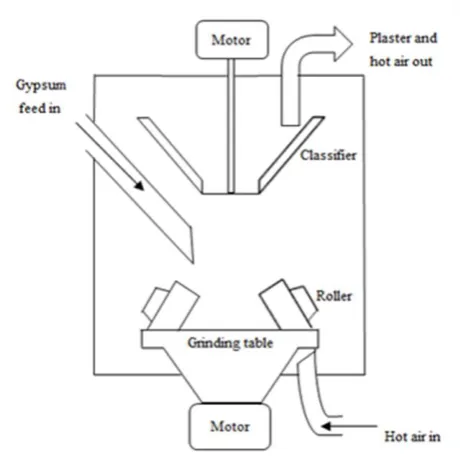
The flow diagram of the plaster manufacturing process is illustrated in Fig 1. In this process, the natural gypsum is crushed and fed into a vertical roller mill (VRM). The schematic diagram of VRM is shown in Fig 2. The gypsum is ground and dried inside the VRM to become the plaster powder. VRM is comprised of a grinding table and rollers installed on the table circumference. The grinding table rotates with an accurate fixed rotational speed around the vertical axis going through the center. A blower functions at the process vent to pneumatically convey plaster to the next process. A classifier is installed at the uppermost of the mill to screen the required particle size. The oversize is collected the base and returned back to the mill by bucket elevators. The plaster is segregated from the hot air in the bag house and transported to the storage silo for later packaging or producing plasterboard.
The quality of the plaster is tested by collecting a plaster sample at the silo to test the combined water (CW). The combined water indicates the percentage of water remaining in the chemical bonding of plaster. Normally, combined water is tested by weighing the collected plaster sample before and after heating at 150 °C for 15 minutes. The combined water value can be calculated
100
)
(
(%)
i i o
w
w
w
CW
(1) [image:2.595.305.538.262.494.2]where wo is the sample weight before heating and wi is the sample weight after heating.
Fig 1. The flow diagram of plaster manufacturing process.
The target CW for the plaster production process, recommended by expert’s experience, is 5.8% and the variation is controlled in the range 5.6% to 6.0%. Low combined water indicates too much cooking of the plaster or less water in the plaster. High combined water indicates under cooking of the plaster or high water in the plaster. The main factors influencing the plaster quality are: the gypsum feed rate, air circulation rate, the classifier operating speed and temperature inside the mill. Lower feed rate of gypsum
[image:2.595.47.294.500.646.2]will cause more effectively grinding and is indicated by lower roller mill motor current and will result in increase of combined water. High feed rate of gypsum will produce less effective grinding and result in decrease of combined water. Likewise, low air circulation rate will cause a lower quantity of ground material to pass through the classifier and result in increase of combined water. The high air circulation rate will make a high quantity of ground material pass through the classifier and result in decrease of combined water. A high classifier speed will allow fine particles to pass through it and will result in increase of combined water. A low classifier speed will result in decrease of combined water. High temperature inside the mill caused by more heat for cooking of grinding gypsum will result in decrease of combined water. The lower temperature inside the mill resulting from less heat for cooking will result in increase of combined water.
Fig 2. The schematic diagram of vertical roller mill (VRM).
B. Application to Design of Experiment (DOE) Model
Factorial design was applied to screen factors that may have significant effects on response(s) because it is the most efficient available method for conducting multifactor experiments. The significant factors can then be used to develop a model to optimize and predict the response [2], if needed. The most common factorial design is the two level (or 2k) design. Based on the analysis of variance (ANOVA), the significant factors are determined and used to produce the multiple regression prediction model. The multiple regression model representation of a 24 factorial experiment can be written as:
4 ,..., 2 , 1 , 4 ,..., 2 , 1 , 4 ,..., 2 , 1 , 4 ,..., 2 , 1 , ˆ
ˆ ˆ ˆ ˆ ˆ ˆ ˆ ˆ
0
l k
j i
D C B A
C B A B A D C B A Y
l k j i ijkl
k j i ijk j i ij l l k k j j i i
(2)
whereYˆis the response,
ˆ
0is the mean of all treatment combinations,
ˆi,
ˆj,
ˆk,ˆ ,l
ijˆ , ijk
ˆ , and
ˆijklare half of the effect estimated corresponding to significant effects, Ai, Bj,effects and take on values between -1 and +1, and
is a random error term. The random error terms are assumed to have a normal distribution, a constant variance, and are independent [8].C. Application to Fuzzy Inference System (FIS) Model
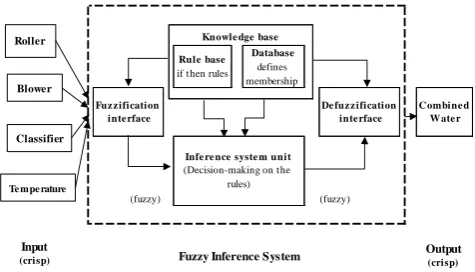
The primitive structure of fuzzy inference system model is shown in Fig 3. FIS consists of three different types: Mamdani, Sugeno and Tsukamoto [9]. The distinction between Mamdani and Sugeno depends on the outcome of fuzzy rules. While Mamdani applies fuzzy sets as rule outcome, Sugeno applies linear functions as rule outcome. For Tsukamoto, the outcome of each fuzzy rule applies a monotonical membership function. Mamdani is selected for this study.
The significant steps to develop FIS are: converting crisp inputs to be fuzzified inputs, fuzzification of the fuzzy inputs, developing of the rule base and defuzzification by converting the fuzzified output to be the crisp output value. FIS is applied in many applications [10]-[12].
Database
defines membership
C ombine d W ate r
Infe re nce syste m unit
(Decision-making on the rules)
(fuzzy) (fuzzy)
Fuzzy Inference System Knowle dge base Rule base
if then rules
Fuz z ification inte rface
De fuz z ification inte rface Input (crisp) Output (crisp) Roller Blower Classifier
[image:3.595.299.556.175.355.2]Te mpe rature
Fig 3. A scheme of process control fuzzy inference system.
For this study, five data sets of the plaster grinding process from August to December of year 2016 were investigated. Each month the process parameters consisted of 100 data. Four input parameters, roller mill current (Ri), blower hot air flow current (Bi), classifier speed (Ci) and temperature (Ti) were taken as the input parameters of the proposed models. The output variable was combined water (CWi). Fuzzy logic toolbox of MATLAB was implemented to the process control fuzzy inference system model to calculate combined water (CW). The process control FIS model is shown in Fig 4.
System Process Control: 4 inputs , 1 outputs, 81 rules RollerMill (3)
Blower (3)
Clas sifier (3)
Temp (3)
CW (5) Process C ontrol
(mamdani)
81 rules
Fig 4. The process control FIS model.
Fuzzy inputs were roller mill current (Ri), blower hot air
flow current (Bi), classifier speed (Ci) and temperature (Ti), represented by membership functions,
i i
i B C
R
, , and
i T
, respectively, and were set after checking and validation of existing data. Fuzzy output was combined water (CWi), represented by membership functions,i
CW
. The universe of discourse, memberships functions, linguistic values of each variable of fuzzy inputs and fuzzy output are displayed in Table I.TABLE I
DESCRIPTION OF FUZZY INPUTS AND FUZZY OUTPUT
Fuzzy Parameters
Variables Universe
of discourse Membership functions Linguistic values*
Inputs roller mill
current (µR )
[Rmin,
Rmax]
Rmin, R
R , R,
R
R , Rmax
L, M, H
blower hot air flow current (µB)
[Bmin,
Bmax]
Bmin, B
B , B,
B
B , Bmax
L, M, H
classifier speed (µC)
[Cmin,
Cmax]
Cmin, C
c , C,
C
c , Cmax
L, M, H
temperature (µT)
[Tmin,
Tmax]
Tmin, T
T , T,
T
T , Tmax
L, M, H
Output combined
water (µCW)
[CWmin,
CWmax]
CWmin,
CW CW ,
CW, CWCW,
CWmax
VL, L, M, H, VH
* VL = very low, L = low, M = medium, H = high, VH = very high
The fuzzy rule is interpreted by an order of IF-THEN, according to algorithms describing what activity or output should be chosen with respect to the currently noticed information. A set of fuzzy rules is developed by expert’s experience or a human being’s knowledge, based on each real condition. This IF-THEN rule is utilized by the FIS to evaluate the degree to which the input data corresponds to the rule restriction. Since the output, combined water is fuzzy sets, a FIS of Mamdani type is selected for evaluating and aggregating the fuzzy rules. The IF-THEN rule can be described by Cartesian product of the fuzzy inputs,
x1x2x3x4 [13]. The relationship between roller mill current x1, blower hot air flow current x2, classifier speed x3, temperature x4, (IFs) and combined water y (THEN) are described by 81 rules. The fuzzy reasoning of these rules creates fuzzy outputs by utilizing the max-min compositional operation. Fuzzy combined water ( (y ))
i
CW
can bedescribed as )) ( ) ( ) ( ) ( ( . ) ( ) ( ) ( ) ( ( ) ( 4 3 2 1 4 1 3 1 2 1 1 1 x μ x μ x μ x μ .. x μ x μ x μ x μ y μ n n n B n R T C B R CW i T i C i i i i i i i (3)
where
is the minimum operation and
is the maximum operation. Ri, Bi, Ci, Tiand CWi are fuzzy subsets represented by the according membership functions, i.e.,i i i i
i B C T CW
R
[image:3.595.50.288.309.445.2]combined water are computed as
81
1 81
1 *
) (
)) ( (
n n CW n
n
y y y
y
i i C W
for i = 1, 2, ..., n (4)
D. Performance Parameters
The models can be evaluated with the statistical parameters: the coefficient of determination (R2), the root mean squared error (RMSE) and the mean absolute error (MAE) as represented in equations (5), (6) and (7).
n
i i n
i
i i
i
y y
y y R
1
2 1
2
2
1 (5)
n y y RMSE
n
i
i i
1
2
(6)
n
y
y
MAE
n
i
i i
1 , (7)where
y
iis the actual output.
i
y
is the predicted model output.y
i is the average of actual output. n is the total number of samples.Actually R2 has a value between zero and one and represents the gap between dependent variables and independent variables which interprets the variability of the prediction. A value for R2 approaching one implies a good fit of predicting model and a value approaching zero implies a poor fit. MAE would disclose if the results suffer from a bias between the predicted and actual datasets. RMSE is a measure adapted to calculate the error between predicted values and the actual values. RMSE and MAE are positive numbers with no upper limit.
III. RESULTS AND DISCUSSION
In this study, statistically significant factors that affect the performance of process control were screened based on the DOE technique. A 2k full factorial design was applied to study the effects of four factors, roller mill current (R), blower hot air flow current (B), classifier speed (C) and temperature (T). In addition, combined water (CW) was also used as responses to evaluate process performance. For four factors, the design requires 16runs with 3 replicates which are totally 48 runs as shown in Table II.
The analysis of variance of experimental design shows that T are the main factors affecting the response (CW). Moreover, the results also show that the interaction RB, BC, BCT and RBC have a significant effect to CW and the factor
T has contributed the highest effect on the response.
The regression model of experiment has been formulated as the follow and used to predict the results for comparing
[image:4.595.313.532.83.295.2]with FIS model.
TABLE II
24 EXPERIMENTAL DESIGN
Run R B C T 1 2 3
1 50 50 245 146 6.26 6.16 6.19
2 60 50 245 146 6.21 5.99 6.20
3 50 61 245 146 6.19 5.98 6.05
4 60 61 245 146 6.20 6.13 5.95
5 50 50 260 146 6.00 5.65 5.74
6 60 50 260 146 6.16 6.22 6.15
7 50 61 260 146 6.20 6.16 6.14
8 60 61 260 146 6.05 5.83 6.17
9 50 50 245 156 5.10 5.25 5.30
10 60 50 245 156 5.41 5.27 5.73
11 50 61 245 156 5.65 5.70 5.72
12 60 61 245 156 5.70 5.54 5.73
13 50 50 260 156 5.72 5.83 5.60
14 60 50 260 156 5.92 6.10 5.75
15 50 61 260 156 5.50 5.89 5.10
16 60 61 260 156 5.18 5.16 5.34
[image:4.595.333.517.335.551.2]CW(Replicates)
TABLE III
THE COMPARISON OF STATISTICAL VALUES OF 5 DATA SETS
Data set FIS DOE
R2 1 0.8045 0.1223
2 0.6939 0.0415
3 0.5502 0.0026
4 0.9898 0.3429
5 0.5768 0.1584
Avg. 0.7230 0.1335
RMSE 1 0.1211 0.3366
2 0.1804 0.3718
3 0.2013 0.4019
4 0.0251 0.3639
5 0.1476 0.2781
Avg. 0.1351 0.3505
MAE 1 0.0698 0.3537
2 0.1083 0.2946
3 0.0950 0.4793
4 0.0253 0.5055
5 0.0825 0.2611
Avg. 0.0762 0.3788
RBC BC
RB
BCT T
Y
05062 . 0 7479 . 0 07521 . 0
12229 . 0 26646 . 0 816042 . 5 ˆ
(8)
The FIS process control model of the plaster manufacturing system has been modeled systematically as well as with DOE approach. The prediction of combined water of both models compared to actual values represented that the FIS model outperformed the DOE model (as shown in Fig 5). The comparison of statistical values of 5 data sets for each model is displayed in Table III.
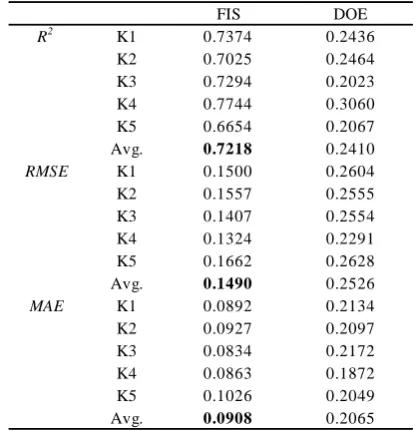
by R2, RMSE and MAE as shown in Table V. The results showed that FIS model represented better performance than DOE model.
5.2 5.4 5.6 5.8 6 6.2
1 3 5 7 9 11 13 15 17 19 21 23 25 27 29 31 33 35 37 39 41 43 45 47
CW
[image:5.595.47.291.99.235.2]Actual FIS DOE
Fig 5. The prediction of combined water of the proposed models compared to actual values.
[image:5.595.49.290.293.365.2]
TABLE IV
THE RANGE OF INPUT DATA AND OUTPUT DATA
Minimum Maximum Average SD
Input R 37 61.1 52 4.4
B 49.1 56.6 51.4 1
C 245 260 264.6 5.7
T 138.3 161.6 148.8 4.4
Output CW (FIS) 5.105 6.283 5.944 0.256
CW (DOE) 4.968 6.529 5.868 0.221
[image:5.595.63.273.413.629.2]Note: SD = Standard deviation Parameters
TABLE V
THE K-FOLD CROSS VALIDATION RESULTS OF EACH MODEL
FIS DOE
R2 K1 0.7374 0.2436
K2 0.7025 0.2464
K3 0.7294 0.2023
K4 0.7744 0.3060
K5 0.6654 0.2067
Avg. 0.7218 0.2410
RMSE K1 0.1500 0.2604
K2 0.1557 0.2555
K3 0.1407 0.2554
K4 0.1324 0.2291
K5 0.1662 0.2628
Avg. 0.1490 0.2526
MAE K1 0.0892 0.2134
K2 0.0927 0.2097
K3 0.0834 0.2172
K4 0.0863 0.1872
K5 0.1026 0.2049
Avg. 0.0908 0.2065
IV. CONCLUSION
A comparative study of DOE model and FIS model were done for solving the problem of process control of the plaster manufacturing system with uncertain conditions. Roller mill current (R), blower hot air flow (B), classifier speed (C), temperature (T) were inputs and combined water was the output of the system. 2k design of experiment (DOE) was applied to find the suitable process control parameters. An analysis of variance resulted that T was the main factors affecting the response (CW). Moreover, the interaction RB,
BC, BCT and RBC have a significant effect to CW and the
factor T has contributed the highest effect on the response. For FIS model, linguistic values were adapted for all fuzzy inputs and output. Fuzzy rules were designed based on the historical experience of the case study plant. The results have shown that FIS model achieved better performance than the DOE model. From this study, the prediction of combined water for plaster process control of FIS model was more accurate than the DOE model. However, FIS model required a lot of historical data and information from the experts. Although the DOE model performed less accurately predicting results, but it represented the main factors and the interaction those have significant effect to the response. For future study, the hybrid method, which combines of DOE model and FIS model would be recommended. This hybrid method can use the beneficial performance of the DOE model in first step for selecting main factors and interaction between each factor. Then, the FIS model can easily utilize in the second step for predicting the process control response.
REFERENCES
[1] D.R. Patrick, and S.W. Fardo, Industrial process control systems. New York:Delmar Publishers, Albany, 1997.
[2] D. C. Montgomery, Introduction to statistical quality control. NJ: Wiley, Hoboken, 2013.
[3] G. Kanojia, G. J. Willems, H.W. Frijlink, G. F.A. Kersten, P. Soema, and J.P. Amorij, “A Design of Experiment approach to predict product and process parameters for a spray dried influenza vaccine,”
International Journal of Pharmaceutics, vol. 511, pp. 1098-1111, 2016.
[4] C.W. Chen, “Stability conditions of fuzzy systems and its application to structural and mechanical systems,” Advances in Engineering Software, vol. 37, pp. 624-629, 2006.
[5] A.K. Pani, and H.K. Mohanta, “Soft sensing of particle size in a grinding process: Application of support vector regression, fuzzy inference and adaptive neuro fuzzy inference techniques for online monitoring of cement fineness,” Powder Technology, vol. 264, pp. 484-497, 2014.
[6] P. Aengchuan, and B. Phruksaphanrat, “Inventory system design by fuzzy logic control: A case study,” Advanced Materials Research, vol. 811, pp. 619-624, 2013.
[7] P. Aengchuan, and B. Phruksaphanrat, (2015, September).
Comparison of fuzzy inference system (FIS), FIS with artificial neural networks (FIS + ANN) and FIS with adaptive neuro-fuzzy inference system (FIS + ANFIS) for inventory control. Journal of Intelligent Manufacturing. [Online]. pp. 1-19.
[8] K. Kazemi, B. Zhang, L.M. Lye, Q. Cai,and T. Cao, “Design of experiment (DOE) based screening of factors affecting municipal solid waste (MSW) composting,”Waste Management, vol. 58, pp. 107–117, 2016.
[9] O. Castillo, and P. Melin. Type-2 fuzzy logic theory and applications. Berlin: Springer-Verlag, 2008.
[10] R. Maia, M. Silva, R. Araujo, and U. Nunes, “Electrical vehicle modeling: A fuzzy logic model for regenerative braking,” Expert Systems with Applications, vol. 42, pp. 8504–8519, 2015.
[11] Z. Zhang, Q. Fang, and X. Gu, “Fuzzy inference system based automatic Brunnstrom stage classification for upper-extremity rehabilitation,” Expert Systems with Applications, vol. 41, pp. 1973– 1980, 2014.
[12] L. Abdullah, “Modeling of health related quality of life using an integrated fuzzy inference system and linear regression,” Procedia Computer Science, vol. 42, pp. 99 – 105, 2014.
[13] E.H. Mamdani and S. Assilian, “An experiment in linguistic synthesis with fuzzy logic controller,” International Journal of Man– Machine Studies,vol. 7, pp. 1–13, 1975.