Original Article
Single nucleotide polymorphisms in VEGF gene
are associated with an increased risk of osteosarcoma
Zhang Tie1*, Rui Bai2*, Zhongwen Zhai2, Gang Zhang2, Hong Zhang2, Zhenqun Zhao2, Deshan Zhou1, Wanlin
Liu2
1Department of Human Anatomy Histology and Embryology, School of Basic Medicine, Capital Medical University,
Beijing, China; 2Department of Pediatric Orthopedics, The Second Affiliated Hospital of Inner Mongolia Medical
University, Hohhot, China. *Equal contributors.
Received September 24, 2014; Accepted November 8, 2014; Epub October 15, 2014; Published November 1, 2014
Abstract: We aimed to assess whether the five common SNPs can affect the risk of osteosarcoma, and its associa
-tion with demographic characteristics of osteosarcoma. 165 osteosarcoma patients and 330 cancer-free controls
were enrolled into our study. Five common SNPs in VEGF gene, -2578C/A (rs699947), -1156G/A (rs1570360), +1612G/A (rs10434), +936C/T (rs3025039) and -634G/C (rs2010963), were detected by polymerase chain
re-action-restriction fragment length polymorphism (PCR-RFLP). Conditional logistic regression analyses found that individuals with AA genotype and A allele of rs699947 were associated with an increased risk of osteosarcoma. Individuals with GG genotype and G allele of rs2010963 were associated with an increased risk of osteosarcoma. By stratified analysis, AA genotype of rs699947 was associated with an increased risk of osteosarcoma in those with shorter age, males and a family history of cancer, and GG genotype of rs2010963 was correlated with an in
-creased risk of osteosarcoma in those with shorter age, females and a family history of cancer. Our study suggests that rs699947 and rs2010963 polymorphisms may play a role in the pathogenesis of osteosarcoma.
Keywords: Single nucleotide polymorphism, vascular endothelial growth factor, osteosarcoma
Introduction
Osteosarcoma is an aggressive malignant tumor arising from mesenchymal tissues, which most often occurs in the long bones, such as distal femur, proximal tibia and humer -al metaphysis. Osteosarcoma most often affects children between 10 and 25 years of age. It is estimated that the annual incidence of osteosarcoma is about 4-5/105 worldwide
[1-3].
It is well known that development of osteosar -coma is a complex, multistep and multifactorial process, and many environmental and genetic factors are involved in the process [4-6]. Several previous studies are reported that can-cer stem cells can play an important role in causing tumors [7, 8]. Recently, many studies have conducted and reported that many genet-ic factors are involved in the development of osteosarcoma, such as GSTs, RECQL5, CTLA-4 and MDM2 gene polymorphisms [9-12].
It is reported that vascular endothelial growth factors (VEGF) is a common pro-angiogenic growth factor, and it is one of the most potent endothelial cell mitogens [13, 14]. The stimula-tion of VEGF under hypoxic condistimula-tions is involved in prolonging the lifetime of malignant cell which play a critical role in tumor growth and invasion, and also play an important role in the development of metastases of malignant tumor. It is well known that single nucleotide polymorphisms (SNPs) in VEGF can affect the expression of this gene. Previous studies showed that -2578C/A (rs699947), -1156G/A (rs1570360), +1612G/A (rs10434), +936C/T (rs3025039) and -634G/C (rs2010963) are five common SNPs in the VEGF, and they are reported to have a role in VEGF protein synthe-sis [15].
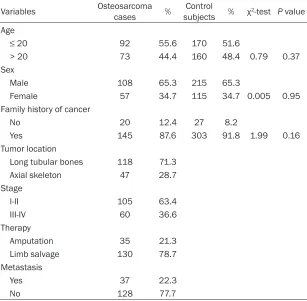
Table 1. Demographic and clinical characteristics of osteosarcoma cases and control subjects
Variables Osteosarcoma cases % subjectsControl % χ2-test P value Age
≤ 20 92 55.6 170 51.6
> 20 73 44.4 160 48.4 0.79 0.37 Sex
Male 108 65.3 215 65.3
Female 57 34.7 115 34.7 0.005 0.95
Family history of cancer
No 20 12.4 27 8.2
Yes 145 87.6 303 91.8 1.99 0.16 Tumor location
Long tubular bones 118 71.3
Axial skeleton 47 28.7 Stage
I-II 105 63.4 III-IV 60 36.6 Therapy
Amputation 35 21.3 Limb salvage 130 78.7 Metastasis
Yes 37 22.3 No 128 77.7
three VEGF polymorphisms and osteosarcoma risk in a Chinese population [20]. Therefore, the aim of this present study is to assess whether the five common SNPs can affect the risk of osteosarcoma, and its association with demo-graphic characteristics of osteosarcoma.
Materials and methods
Study population
All patients in this hospital-based case-control study were histologically confirmed to be osteo -sarcoma at the Second Affiliated Hospital of Inner Mongolia Medical University between January 2011 and January 2013. The study population consisted of 165 osteosarcoma patients who were newly diagnosed and histo-logically confirmed to be osteosarcoma. The 330 cancer-free controls were randomly recruit -ed from a pool of individuals who came to receive a health up in the health check-up center of the same hospitals, and the con -trol subjects are free from any cancer, and two health control subjects were matched to one case by sex and age.
notyping
After participating into this study, cases and control subjects were asked to provide 5 mL blood sample. 0.5 mg/ml EDTA was used for anticoagulant of blood and stored in -70°C until use. Genomic DNA was isolated from peripher -al blood with TIANamp Blood DNA Kit (Tiangen, Beijing, China) according to the manufacturer’s instructions. Five SNPs of the VEGF gene were detected by polymerase chain reaction-restric-tion fragment length polymorphism (PCR-RFLP) according to manufacturer’s instructions, in-cluding VEGF-2578C/A (rs699947), -1156G/A (rs1570360), +1612G/A (rs10434), +936C/T (rs3025039) and -634G/C (rs2010963). The primers and probes of rs699947, rs-1570360, rs10434, rs3025039 and rs201- 0963 in VEGF were designed using Sequenom Assay Design 3.1 software (Sequenom, San Diego, CA). The cycling programme of PCR reac -tion condi-tion involved preliminary denatur-ation at 95°C for 10 min, followed by 35 cycles of denaturing at 95°C for 30 s, 62°C for 30 s and 72°C for 30 s, and performing a final exten
-All the cases and control subjects signed an in- formed consent before participating into this study, and the protocol of this study was approved by the institutional eth-nics committee of the First Affiliated Hospital of Chongqing Medical Uni- versity and the Second Affiliated Hospital of Inner Mongolia Medical University.
Data collection
We collected data regard-ing demographic and clin-ical characteristics from a self-designed question -naire or medical records, including sex, age, family history of cancer, tumor location, metastasis and tumor stage as well as therapy.
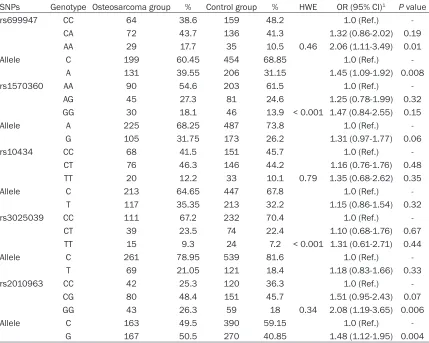
ge-Table 2. Genotype distribution of five SNPs in VEGF gene between cases and controls
SNPs Genotype Osteosarcoma group % Control group % HWE OR (95% CI)1 P value rs699947 CC 64 38.6 159 48.2 1.0 (Ref.)
-CA 72 43.7 136 41.3 1.32 (0.86-2.02) 0.19 AA 29 17.7 35 10.5 0.46 2.06 (1.11-3.49) 0.01 Allele C 199 60.45 454 68.85 1.0 (Ref.)
-A 131 39.55 206 31.15 1.45 (1.09-1.92) 0.008 rs1570360 AA 90 54.6 203 61.5 1.0 (Ref.)
-AG 45 27.3 81 24.6 1.25 (0.78-1.99) 0.32 GG 30 18.1 46 13.9 < 0.001 1.47 (0.84-2.55) 0.15 Allele A 225 68.25 487 73.8 1.0 (Ref.)
-G 105 31.75 173 26.2 1.31 (0.97-1.77) 0.06 rs10434 CC 68 41.5 151 45.7 1.0 (Ref.)
-CT 76 46.3 146 44.2 1.16 (0.76-1.76) 0.48 TT 20 12.2 33 10.1 0.79 1.35 (0.68-2.62) 0.35 Allele C 213 64.65 447 67.8 1.0 (Ref.)
-T 117 35.35 213 32.2 1.15 (0.86-1.54) 0.32 rs3025039 CC 111 67.2 232 70.4 1.0 (Ref.)
-CT 39 23.5 74 22.4 1.10 (0.68-1.76) 0.67 TT 15 9.3 24 7.2 < 0.001 1.31 (0.61-2.71) 0.44 Allele C 261 78.95 539 81.6 1.0 (Ref.)
-T 69 21.05 121 18.4 1.18 (0.83-1.66) 0.33 rs2010963 CC 42 25.3 120 36.3 1.0 (Ref.)
-CG 80 48.4 151 45.7 1.51 (0.95-2.43) 0.07 GG 43 26.3 59 18 0.34 2.08 (1.19-3.65) 0.006 Allele C 163 49.5 390 59.15 1.0 (Ref.)
-G 167 50.5 270 40.85 1.48 (1.12-1.95) 0.004
HWE: Hardy-Weinberg equilibrium. 1Adjusted for sex, age and family history of cancer.
sion at 72°C for 10 minutes. We also randomly selected 5% of the cases and control subjects to repeat genotyping the five SNPs, and the results were confirmed with the previous results.
Statistical analysis
All statistical analyses were conducted using the STATA version 9.0 statistical software. Continuous and categorical variables were expressed shown as the mean ± SD and ana-lyzed by student t test. Categorical variables were expressed as frequencies and percentage of study participants and analyzed by χ2-test,
respectively. The Hardy-Weinberg equilibriums of rs699947, rs1570360, rs10434, rs3025039 and rs2010963 genotype frequencies betwe-en groups in control subjects were compared by χ2-test. The difference in demographic and clinical factors between groups was compared by χ2-test. Unconditional logistic regression
was conducted to assess the effects of rs699947, rs1570360, rs10434, rs3025039 and rs2010963 on the risk of osteosarcoma. The results were expressed with odds ratio (OR) and their corresponding 95% confidence inter -vals (CI). All P-values were two sided, and a
P-value was regarded as statistically significant when it less than 0.05.
Results
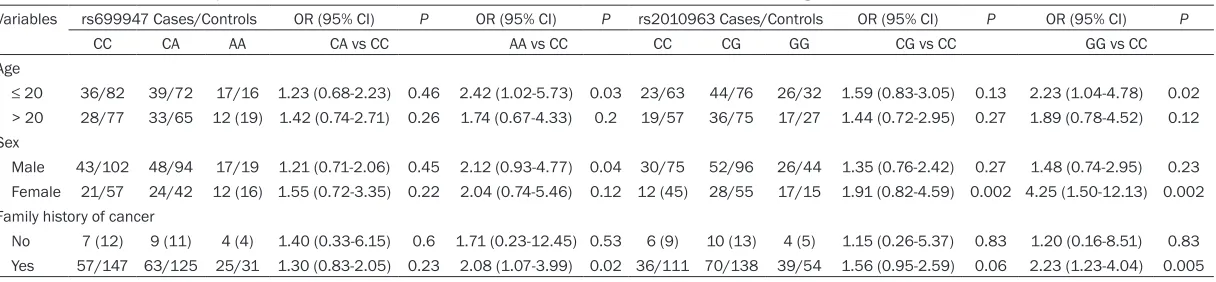
[image:3.612.93.522.85.428.2]Table 3. Stratification analysis on the association between rs699947 and rs2010963 and demographic characteristics in osteosarcoma risk Variables rs699947 Cases/Controls OR (95% CI) P OR (95% CI) P rs2010963 Cases/Controls OR (95% CI) P OR (95% CI) P
CC CA AA CA vs CC AA vs CC CC CG GG CG vs CC GG vs CC
Age
≤ 20 36/82 39/72 17/16 1.23 (0.68-2.23) 0.46 2.42 (1.02-5.73) 0.03 23/63 44/76 26/32 1.59 (0.83-3.05) 0.13 2.23 (1.04-4.78) 0.02 > 20 28/77 33/65 12 (19) 1.42 (0.74-2.71) 0.26 1.74 (0.67-4.33) 0.2 19/57 36/75 17/27 1.44 (0.72-2.95) 0.27 1.89 (0.78-4.52) 0.12 Sex
Male 43/102 48/94 17/19 1.21 (0.71-2.06) 0.45 2.12 (0.93-4.77) 0.04 30/75 52/96 26/44 1.35 (0.76-2.42) 0.27 1.48 (0.74-2.95) 0.23 Female 21/57 24/42 12 (16) 1.55 (0.72-3.35) 0.22 2.04 (0.74-5.46) 0.12 12 (45) 28/55 17/15 1.91 (0.82-4.59) 0.002 4.25 (1.50-12.13) 0.002
Family history of cancer
The rs699947, rs1570360, rs10434, rs30- 25039 and rs2010963 genotype frequencies in cases and control subjects, and their asso-ciation with osteosarcoma risk were shown in Table 2.
The genotype distributions of rs699947, rs10434, and rs2010963 were in Hardy-Weinberg equilibrium in the control subjects, but distributions of rs1570360 and rs3025039 were not. Conditional logistic regression analy-ses found that individuals with AA genotype of rs699947 were associated with an increased risk of osteosarcoma compared to CC genotype (OR = 2.06, 95% CI = 1.11-3.49), and A allele had an increased cancer risk (OR = 1.45, 95% CI = 1.09-1.92). Individuals with GG genotype of rs2010963 were associated with an increased risk of osteosarcoma compared to CC genotype (OR = 2.08, 95% CI = 1.19-3.65), and G allele was correlated with an enhanced risk of cancer (OR = 1.48, 95% CI = 1.12-1.95). However, we did not find significant association between rs1570360, rs10434 and rs3025039 and osteosarcoma risk.
Moreover, we conducted the analysis on the association between rs699947 and rs2010963 in VEGF and demographic characteristics in osteosarcoma patients (Table 3). The stratifica -tion analysis with variables of age, sex and fam -ily history of cancer were shown in Table 3. We found that AA genotype of rs699947 was asso -ciated with an increased risk of osteosarcoma in those with shorter age, males and a family history of cancer. Moreover, GG genotype of rs2010963 was correlated with an increased risk of osteosarcoma in those with shorter age, females and a family history of cancer.
Discussion
VEGF is considered as a growth factor that reg -ulates angiogenesis in human cancer, and this gene plays an important role in the process of carcinogenesis. The underlying mechanism of VEGF gene polymorphisms on the risk of osteo -sarcoma is still not very clear. It is well known that angiogenesis is an important factor for the development and prognosis of tumors, VEGF expression can regulates angiogenesis, and thus VEGF can have be involved in promoting endothelial cell proliferation and regulating the extracellular matrix in the blood vessels [21, 22].
Several functional SNPs in the VEGF gene are associated with altering the expression levels of VEGF protein in cancer cells, and thus influ -ence the tumor angiogentic activity and sus-ceptibility of several kinds of cancers, such as bladder cancer, breast cancer, lung cancer and renal cell carcinoma [16-19]. Only one recent study reported the association between VEGF genetic polymorphisms and susceptibility of osteosarcoma [20]. Wang et al. reported that TT genotype and T allele of +936C/T could increase the risk of osteosarcoma, and VEGF genetic variants are potentially related to risk of osteosarcoma [20]. Therefore, we conducted this case-control study to explore the role of five SNPs of VEGF gene on the risk of osteosarcoma.
differences in ethnicities, study design, tumor types, and sample size.
Several limitations should be considered in our study. First, cases and controls were selected from one hospital, which may not be represen -tative of other populations. However, the con -trols were a random sample from a pool of indi -viduals who came to receive a health check-up, which may well represent the general popula-tion. Second, since the rarity of osteosarcoma, the sample size of osteosarcoma patients is relatively small. The small sample size could limit the statistical power to find the associa -tion between groups. Third, the risk of osteo -sarcoma could be modified by many other genetic factors in the angiogenesis pathway except for VEGF. Therefore, further studies with more subjects are needed to confirm the asso -ciation between VEGF gene polymorphisms and risk of osteosarcoma.
In this case-control study, we suggest that rs699947 and rs2010963 in VEGF gene may play a role in the pathogenesis of osteosarco -ma. Further large sample studies are needed to confirm these associations.
Disclosure of conflict of interest
None.
Address correspondence to: Deshan Zhou, Depart-
ment of Human Anatomy Histology and Embryology, School of Basic Medicine, Capital Medical University,
Beijing, China. E-mail: [email protected]
References
[1] Mirabello L, Troisi RJ, Savage SA. Osteosarcoma
incidence and survival rates from 1973 to 2004: Data from the surveillance, epidemiolo -gy, and end results program. Cancer 2009; 115: 1531-43.
[2] Ottaviani G, Jaffe N. The epidemiology of os -teosarcoma. Cancer Treat Res 2009; 152: 15-32.
[3] Picci P. Osteosarcoma (osteogenic sarcoma). Orphanet J Rare Dis 2007; 2: 6.
[4] Powers M, Zhang W, Lopez-Terrada D, Czerniak BA, Lazar AJ. The molecular pathology of sar
-comas. Cancer Biomark 2010; 9: 475-91.
[5] Bovee JV, Hogendoorn PC. Molecular
patholo-gy of sarcomas: Concepts and clinical implica -tions. Virchows Arch 2010; 456: 193-9. [6] de Alava E. Molecular pathology in sarcomas.
Clinical & translational oncology: official publi
-cation of the Federation of Spanish Oncology
Societies and of the National Cancer Institute of Mexico 2007; 9: 130-144.
[7] Osuna D, de Alava E. Molecular pathology of
sarcomas. Rev Recent Clin Trials 2009; 4: 12-26.
[8] Berger M, Muraro M, Fagioli F, Ferrari S.
Osteosarcoma derived from donor stem cells carrying the norrie’s disease gene. N Engl J
Med 2008; 359: 2502-4.
[9] Teng JW, Yang ZM, Li J, Xu B. Predictive role of glutathione S-transferases (GSTs) on the prog
-nosis of osteosarcoma patients treated with chemotherapy. Pak J Med Sci 2013; 29:
1182-6.
[10] Zhi LQ, Ma W, Zhang H, Zeng SX, Chen B. Association of RECQL5 gene polymorphisms
and osteosarcoma in a Chinese Han popula-tion. Tumour Biol 2014; 35: 3255-9.
[11] He J, Wang J, Wang D, Dai S, Yv T, Chen P, Ma R, Diao C, Lv G. Association between CTLA-4 genetic polymorphisms and susceptibility to osteosarcoma in Chinese Han population. Endocrine 2014; 45: 325-30.
[12] He J, Wang J, Wang D, Dai S, Yv T, Chen P, Ma R, Diao C, Lv G. Association analysis between
genetic variants of MDM2 gene and osteosar -coma susceptibility in Chinese. Endocr J 2013; 60: 1215-20.
[13] Patard JJ, Pouessel D, Bensalah K, Culine S. Targeted therapy in renal cell carcinoma. World J Urol 2008; 26: 135-40.
[14] Motzer RJ, Hutson TE, Tomczak P, Michaelson MD, Bukowski RM, Rixe O, Oudard S, Negrier S, Szczylik C, Kim ST, Chen I, Bycott PW, Baum CM, Figlin RA. Sunitinib versus interferon alfa
in metastatic renal-cell carcinoma. N Engl J Med 2007; 356: 115-24.
[15] Maeda A, Nakata M, Yasuda K, Yukawa T, Saisho S, Okita R, Hirami Y, Shimizu K. Influence of vascular endothelial growth factor
single nucleotide polymorphisms on non-small cell lung cancer tumor angiogenesis. Oncol Rep 2013; 29: 39-44.
[16] Liu X, Guan Y, Zhang W, Liu S, Liu J, Wang L, Niu Y. Predictors of recurrence in breast can -cer subtypes with negative lymph node in a Chinese population. Int J Clin Exp Pathol 2014; 7: 3202-12.
[17] Yang Y, Zhang X, Song D, Wei J. Association be
-tween vascular endothelial growth factor gene polymorphisms and bladder cancer risk. Mol
Clin Oncol 2014; 2: 501-505.
[18] Tung MC, Hsieh MJ, Wang SS, Yang SF, Chen SS, Wang SW, Lee LM, Lee WJ, Chien MH.
Associations of VEGF-C genetic polymorphisms with urothelial cell carcinoma susceptibility dif
-fer between smokers and non-smokers in
Taiwan. PLoS One 2014; 9: e91147.
[19] Kapahi R, Manjari M, Sudan M, Uppal MS,
+405C > G and +936C > T polymorphisms of the vascular endothelial growth factor gene
with sporadic breast cancer in North Indians. Asian Pac J Cancer Prev 2014; 15: 257-63. [20] Wang Z, Wen P, Luo X, Fang X, Wang Q, Ma F, Lv
J. Association of the vascular endothelial growth factor (VEGF) gene single-nucleotide
polymorphisms with osteosarcoma suscepti-bility in a Chinese population. Tumour Biol 2014; 35: 3605-10.
[21] Kushner EJ, Bautch VL. Building blood vessels in development and disease. Curr Opin Hematol 2013; 20: 231-6.
[22] Roy H, Bhardwaj S, Ylä-Herttuala S. Biology of vascular endothelial growth factors. FEBS Lett
2006; 580: 2879-87.
[23] Zhao Z, Ba C, Wang W, Wang X, Xue R, Wu X. Vascular endothelial growth factor (VEGF) gene
polymorphisms and colorectal cancer: a
meta-analysis of epidemiologic studies. Genet Test Mol Biomarkers 2012; 16: 1390-4.
[24] Song N, Liu B, Wu J, Zhang R, Duan L, He W,
Zhang C. Vascular endothelial growth factor
(VEGF) -2578C/A and -460C/T gene
polymor-phisms and lung cancer risk: a meta-analysis
involving 11 case-control studies. Tumour Biol 2014; 35: 859-70.
[25] Xu Y, Zhu S. Associations between vascular en
-dothelial growth factor polymorphisms and prostate cancer risk: a meta-analysis. Tumour
Biol 2014; 35: 1307-11.
[26] Zhang Y, Li S, Xiao HQ, Hu ZX, Xu YC, Huang Q. Vascular endothelial growth factor gene poly -morphisms and renal cell carcinoma: A sys-tematic review and meta-analysis. Oncol Lett 2013; 6: 1068-78.
[27] Deng ZC, Cao C, Yu YM, Ma HY, Ye M. Vascular
endothelial growth factor -634G/C and vascu
-lar endothelial growth factor -2578C/A poly
-morphisms and lung cancer risk: a case-con -trol study and meta-analysis. Tumour Biol 2014; 35: 1805-11.
[28] Wang K, Liu L, Zhu ZM, Shao JH, Xin L. Five polymorphisms of vascular endothelial growth factor (VEGF) and risk of breast cancer: a me -ta-analysis involving 16,703 individuals. Cyt-
okine 2011; 56: 167-73.
[29] Supic G, Jovic N, Zeljic K, Kozomara R, Magic
Z. Association of VEGF-A genetic polymor