warwick.ac.uk/lib-publications
A Thesis Submitted for the Degree of PhD at the University of Warwick
Permanent WRAP URL:
http://wrap.warwick.ac.uk/106712/
Copyright and reuse:
This thesis is made available online and is protected by original copyright.
Please scroll down to view the document itself.
Please refer to the repository record for this item for information to help you to cite it.
Our policy information is available from the repository home page.
DEHALOGENASES IN SOIL BACTERIA
by David J. Hardman BSc.
A thesis submitted in fulfillment of the requirements for the degree of Doctor of Philosophy.
University of Warwick
Department of Environmental Sciences
University of Warwick
Coventry CV47AL
CONTENTS PAGE
Contents
List of Tables
List of Figures
Acknowledgements
Declaration
Summary
1. INTRODUCTION 1
1.1 MICROBIAL DEGRADATION OF HALOGENATED ORGANIC
CUMFUUNUb--- 1
1.1.1 Naturally-occurring halogenated compounds 1
1.1.2 Halogenated xenobiotic compounds 3
1.1.3 Halogenated pesticides in the soil environment 3
1.1.4 Dehalogenation of halogenated aromatic compounds 6
1.1.5 Dehalogenases in bacteria and fungi. 8
1.2 CONTINUOUS-FLOW CULTURE 19
1.2.1 Theoretical considerations of continuous culture 20
1.2.2 Departures from theory 25
1.2.3 Enzyme and metabolic regulation in chemostat
cultures 28
1.2.4 Bacterial evolution in chemostat cultures 35
1.2.5 Continuous culture in microbiological research 43
1.3 ISOENZYMES 44
1.3.1 Definition 44
1.3.2 The causes of enzyme multiplicity 46
1.3.3 Apparent enzyme multiplicity 49
1.3.4 The biological significance of isoenzymes 51
1.3.5 The neutralist-selectionist controversy 55
1.3.6 Isoenzymes and phylogeny 57
1.4 THE EVOLUTION OF BACTERIAL ENZYME SYSTEMS 58
1.4.1 Retroevolution 59
1.4.2 Gene duplication 59
1.4.3 Derepression as a mode of evolution 62 1.4.4 Substrate ambiguity - the fortuitous error concept 64
1.5 PLASMIDS 70
1.5.1 Plasmids: An introduction to their concept 70
1.5.2 Degradatlve plasmids 72
1.5.3 Evolution of plasmid-associated catabolic pathways 76
2 MATERIALS AND METHODS 79
2.1 CONDITIONS FOR CULTURING THE BACTERIAL ISOLATES 79
2.1.1 Batch culture 79
2.1.2 Culturing on solidified media 79
2.1.3 Chemostat continuous-flow culture 80
2.1.3.1 Continuous-flow culture system 80
2 . 1 . 3 . 2 Growth medium 82
2 . 1 . 3 . 3 In o cu la tio n 82
2 . 1 . 3 . 4 Determination o f steady s t a t e 82
2.2 ISOLATION AND GROWTH OF BACTERIA 83
2.2.1 Methods of isolation 83
2.2.2 Determination of maximum specific growth rate 84
2.3 MEASURE OF DEHALOGENASE ACTIVITY 85
2.3.1 Estimation of free chloride ions 85
2.3.2 Assay procedure for dehalogenase activity 86
2.3.3 Modifications to the enzyme assay procedure for
further characterization of the enzyme systems 87
2.3.4 Determination of protein concentration 88
2.4 ELECTROPHORETIC STUDIES OF THE DEHALOCENASE SYSTEMS 89
2.4.1 Preparation of disc polyacrylamide gels 89
2.4.2 Sample preparation and electrophoresis 91
2.4.3 Visualization of dehalogenase activity 91
2.4.4 Gel preservation 92
2.4.5 Modifications to incubation conditions of electrophoresed 94 samples
2.5 ELECTROPHORESIS OF THE PROTEIN COMPONENTS OF THE
B'A'L ILHIAL ISTOTLb--- 94
2.5.1 Electrophoretic separation of the protein components 94
2.5.2 Protein visualization 95
2.6 SCREENING FOR THE PRESENCE OF PLASMID DMA IN THE
B/CCTeRTAI'TsI O T E S --- 96
2.6.1 Growth of isolates for plasmid analysis 96 2.6.2 Procedure for rapid screening of bacteria for plasmid
2.7 PLASMID ASSOCIATED DEHALOGENASE ACTIVITY 98 1
2.7.1.1 Curing experiments 98 I
2.7.1.2 Rate of reversion to parental phenotype 99 1
2.7.2 Mating experiments 99 I
2.7.2.1 Selection of antibiotic resistant strains used as
recipients in mating experiments 100 1
2.7.2.2 Method for membrane mating experiments 101 1
2.7.2.2 Membrane mating experiments 103 1
2 .8 RESISTANCE TO HEAVY METALS
103 1
1 2.9 SIZING THE WHOLE PLASMID 104 1
2.1 0 RESTRICTION ENDONUCLEASE ANALYSIS 104 1
2.10.1 Preparative system for the isolation of plasmid DNA 104 I
2.1 0 .2 Primary gel electrophoresis 106 1
2.10.3 Restriction endonuclease digestion 107 I
2.10.4 Sizing the plasmids from the endonuclease digest
patterns 109 1
2.11 MATERIALS 109 I
2.11.1 Materials used in enzyme analysis 109 1
2.1 1 .2 Materials used in plasmid identification and
characterization 110 1
3
ISOLATION AND IDENTIFICATION OF SOIL BACTERIA CAPABLE
OF UTILIZING HALOGENATEr ALKAN0IC ACIDS AS THE SOLE
SOURCE OF CARBON AND ENERGY 112
3.1 Isolation methods 112
3.2 Results from the two isolation techniques 113
3.3 Growth substrate specificities 114
3.4 Identification of the soil isolates 116
3.5 Discussion 121
4
DEHALOGENASE COMPLEMENT UNDER BATCH CULTURE CONDITIONS 1254,1
Relative dehalogenase activities 1254,2
Specific dehalogenase activities 1294.3 Electrophoretic studies of the dehalogenase mechanism 131
4.4 Dehalogenase profiles of the different isolates 135
4.5 Substrate specificities of the isolated enzymes 138
4.6 Maximum specific growth rates 144
4,7
Physical properties of the dehalogenase system of Pseudomonas sp. strain E4 1465 DEHALOGENASE COMPLEMENT IN CONTINUOUS-FLOW CULTURE 169
5.1 Dehalogenase complement of Pseudomonas sp. strain E4
in continuous-flow culture with MCA or 2MCPA as the
sole carbon source 169
5.2
5.3
5.4
5.5
5.6
Dehalogenase complement of Pseudomonas sp. strain E2
in continuous-flow culture at different dilution
rates 180
Dehalogenase complement of Pseudomonas sp. strain E3
in continuous-flow culture at different dilution
rates 184
Dehalogenase complement of Pseudomonas sp. strain E6
in continuous-flow culture at different dilution
rates 18b
Dehalogenase complement of Aloaligenes sp. strain E20
in continuous-flow culture at different dilution
rates 187
Discussion 187
6 EVIDENCE FOR THE ASSOCIATION OF DEHALOGENASE ACTIVITY WITH THE PRESENCE OF A NUMBER OF PLASMIDS IN THE SOIL
ISOLATES 197
6.1 Determination of plasmid presence in the soil isolates 197
6.2 Plasmid nomenclature 198
6.3 Sizing the whole plasmids 198
6.4 Sizing of the plasmids by summation of the molecular weights of restriction endonuclease fragments 200
6.5 Plasmid characterization by restriction endonuclease
analysis 203
6 .6 Plasmid curing experiments 216
6.7 Heavy metal resistance 220
6 .8 Conjugal transfer of the plasmids from the Pseudomonas
spp. 224
6.9 The use of plasmid R68-45 to co-transfer the dehalogenase
plasmids 225
6.10 Discussion 228
7 DISCUSSION AND GENERAL REMARKS 235
REFERENCES 243
APPENDIX I - Dehaloqenases in Soil Bacteria
1.1 Fortuitous enzymic dehalogenations 10
1.2 Dehalogenase induction in bacteria and fungi 11
1.3 Comparison of bacterial halidohydrolases 15
1.4 Multiple forms of enzymes 45
1.5 Examples of bacterial plasmids 71
2.1 Outline of making experiments attempted in order to
transfer dehalogenase activity from a donor to a
recipient as proof of the plasmid association with
dehalogenase activity 102
2.2 Molecular weights of the plasmids used as standards
in electrophoresis of whole plasmid preparations to
determine the molecular weight of the isolated
List of Tables Page
plasmids 105
3.1 Substrate specificities of a number of soil bacteria
isolated by enrichment on halogenated substrates 115
3.2 Identification of soil Isolates 117
3.3 Identification of soil isolates 118
3.4 Identification of soil isolates 119
4.1 Relative dehalogenase activity in cell-free extracts
of 16 soil Isolates 127
4.2 Dehalogenase specific activities in cell-free extracts
of 16 soil bacteria grown in closed culture 130
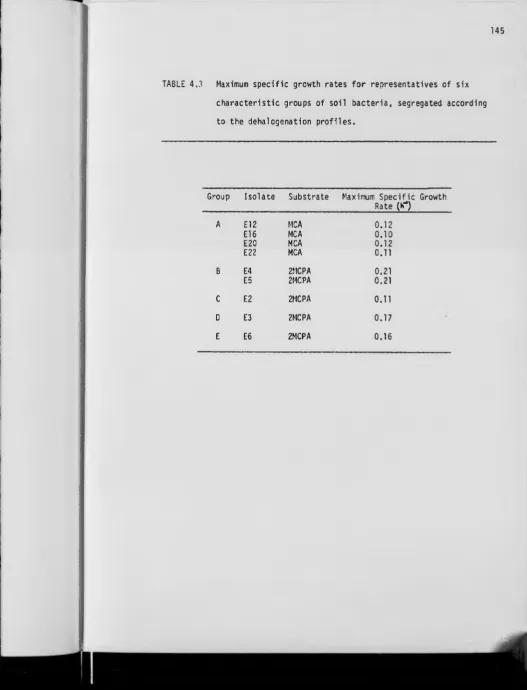
4.3 Maximum specific growth rates for representatives of
six characteristic groups of soil bacteria, segregated
according to the dehalogenation profiles 145
4.4 Dehalogenase substrate specificity in cell-free
extracts of Pseudomonas sp. strain E4 156
5.1 The effect of dilution rate on the dehalogenase specific
activities in a steady-state culture of Pseudomonas
sp. strain E4 with MCA as the growth-limiting substrate 175
5.2 The effect of dilution rate on the dehalogenase specific
activities 1n a steady-state culture of Pseudomonas
sp. strain E4 with 2MCPA as the growth-limiting
Table Page
5.3 The effect of dilution rate on the relative
dehalogenase activities in steady-state culture of Pseudomonas sp. strain E4 with MCA as the growth-
limiting substrate 178
5.4 The effect of dilution rate on the relative dehalogenase activities in steady-state culture
of Pseudomonas sp. strain E4 with 2MCPA as the growth-
limiting substrate 179
5.5 A comparison of the effect of dilution rate on the
dehalogenase specific activity of five soil isolates 181 5.6 Relative dehalogenase activity of five soil isolates 182
6.1 Restriction endonuclease size determination 201
6.2 The effect of ethidium bromide on the viability of an
overnight culture of Pseudomonas sp. E4 plated onto
defined recovery medium with either succinate or
2MCPA as the carbon and energy source 218
6.3 Resistance to heavy metals by plasmid-containing and
plasmid-free strains Of Pseudomonas and Aloaligenes spp 222
List of Figures Page
1.1 Two mechanisms suggested by Goldman et al. (1968) to
explain the accompanying inversion of configuration
during the dechlorination of L-2MCPA and L-2MCBA 14
1.2 Dehalogenation mechanism suggested by Little and
Williams (1971) involving a base catalysis by a
histidine residue 17
1.3 The self-regulating capacity of chemostat cultures 23
1.4 Theoretical steady-state conditions derived from
equations (5) and (6) x, steady-state biomass
concentration; s, steady-state substrate concentration;
Sp, initial substrate concentration; t^ culture doubling
time; D-, productivity. 24
1.5 Departures from the theory of continuous culture 26
1.6 Effect of dilution rate on enzyme activity.
A: Changes in the level of isocitrate dehydrogenase in
Candida utilia after changes in the dilution rate.
B: Effect of D (h-1) on amidase synthesis by
P. aeruginosa growing with succinate + acetamide
C: Effect of D on the synthesis of pectin lyase in a
pectin-limited chemostat
D; Effect of D on the B-galactosidase activity of
Klebsiella aerogenea 29
1.7 The effect of increasing dilution rate on the amidase
activity of Paeudomonaa aeruginosa strain 8602 32
2.1 Apparatus for preserving polyacrylamide gels 93 3.1 SDS polyacrylamide gel electrophoresis of the protein
constituents of the soil isolates 120
4.1 Distribution of five dehalogenases from 16 of the soil
bacteria and Peeudomonae putida strain PP3, after
separation by polyacrylamide gel electrophoresis 132
4.2 Distribution of five dehalogenases from 16 of the soil
bacteria and Paeudomonaa putida strain PP3, after
Page
4.3 Distribution of dehalogenase activity towards four
substrates - for six soil bacteria selected as
representatives of different characteristic groups
4.4 Diagramatic representation of the distribution of
dehalogenase activity towards four substrates
4.5 pH profiles of dehalogenase activity in a cell-free
extract of Pseudomonas sp. strain E4
4.6 Stability of dehalogenase activity in a cell-free
extract of Pseudomonas sp. strain E4 at 50°C
4.7 Electrophoretic study on the effect of incubation at
50°C on dehalogenase activity of cell-free extracts
of Pseudomonas sp. strain E4
4.8 The effect of N-ethylmaleimide on dehalogenase activity
towards MCA by cell-free extracts of Pseudomonas sp.
strain E4
4.9 Electrophoretic study visualizing the effect of
N-ethylmaleimide on dehalogenase I activity in cell-
free extracts of Pseudomonas sp. strain E4
5.1 Summary of the initial results from cell-free extracts
prepared from chemostat cultures of Pseudomonas sp.
strain E4 with MCA or 2MCPA as the growth-limiting
substrate
5.2 The gradual change in dehalogenase profile resulting from
a shift in the dilution rate from 0.04h ^ to O.lh ^ in
cell-free extracts Of Pseudomonas sp. strain E4 with MCA
as the growth-limiting substrate
5.3 The effect of growth rate on the dehalogenase profiles
of the soil isolates
6.1 Agarose gel electrophoresis demonstrating the relative
mobilities of pUU204 with respect to various plasmids of
1
Fi y u re Page
6 .2 Hind III restriction endonuclease digest pattern of
the Paeudomonaa sp. strain E2 plasmid, pl)U202 204 6.3 Restriction endonuclease digest patterns of the
Paeudomonaa sp. strain E4 plasmid, pUU204 205 6.4 Restriction endonuclease digest patterns of the
Paeudomoma sp. strain E4 plasmid, pUU204 206 6.5 Hind III and Xho I restriction endonuclease digest
patterns of the Pseudomonaa sp. strain E47 plasmid,
pUU247 207
6 .6 Restriction endonuclease digest patterns of the
Paeudomonaa sp. strains E3 and E6 plasmid, pl)U206 o CO
C
M
6.7 Restriction endonuclease digest patterns of the
Aloaligenea sp. strain E20 plasmid, pUU220 209
6 .8 Restriction endonuclease digest patterns of the pUU222 plasmid using 4 endonucleases and a comparison
with the Hind III and Xho I digest patterns of the
plasmid pUU204 210
6.9 Restriction endonuclease digest patterns of the
Aloaligenea sp. strain E22 plasmid pUU222 211 6 .1 0 Summary of the digest patterns obtained for pUU202,
pUU204, pUU206, pUU220 and pUU222 using the
restriction endonuclease Hind III in all cases 213
6.1 1 Summary of the digest patterns obtained for pUU204, pl)U206, pUU220 and pUU222 using the restriction
endonuclease Pat I 214
6 .1 2 Summary of the digest patterns obtained for pUU204, pUU206, pUU220 and pUU222 using the restriction
endonuclease Xho I 215
6.13 Inhibition of Paeudomonaa sp. strains E4 (pl)U204)
and E41 (plasmid-free) growth by mercury, tellurium and selenium as measured by growth inhibition zones in
bacterial lawns 221
Figure
6.14 A comparison of the Pst I restriction endonuclease
digest patterns of the plasmid R68-45 from Pseudomonas aeruginosa PA08, the plasmid pUU224 from Pseudomonas
sp. strain E4R and the plasmid pUU225 from Pseudomonas
Acknowledgements
I wish to thank Dr J.H. Slater for his guidance and valuable
advice given to me throughout the course of this study. I also wish
to thank Professor D.P. Kelly and other members of the Department of
Environmental Sciences for helpful discussions and acknowledge the
expert assistance of the technical staff of this department, especially
Mrs A. Filipiuk.
Thanks are also due to Mrs A. Branch for typing this thesis
accurately and efficiently, to my parents for their continued interest
and support and to my fiancee for waiting.
Finally, I gratefully acknowledge the financial support of the
Natural Environment Research Council.
Declaration
I declare that this thesis is a report of the research undertaken
by myself during the years 1978-1981 in the Department of Environmental
Sciences under the supervision of Dr J.H. Slater. It 1s my own original,
unaided work and has, to the best of my knowledge, not been previously
Summary
A number of bacterial strains were isolated from soil, by direct plating and enrichment culture, which were able to grow on chlorinated alkanoic acids as the sole carbon and energy source. Sixteen of these isolates were divided into five groups on the basis of differences in their
dehalogenase activities towards monochloroacetic acid (MCA), dichloroacetic acid (DCA), 2-monochloropropionic acid (2MCPA) and 2,2-dichloropropionic acid (22DCPA).
Disc gel electrophoresis of crude extracts identified four distinct dehalogenases exhibiting different electrophoretic mobilities. The groups were characterized by the possession of one or more of these enzymes
although one of the groups was split into two on the basis of the possession of two different dehalogenases. In some cases, dehalogenases with the same electrophoretic mobilities, from different isolates, appeared to be identical enzymes, while in others, enzymes from different isolates, with the same electrophoretic mobilities, had different substrate activity profiles.
Representatives of each group were grown in continuous-flow culture with either MCA or 2MCPA as the growth-limiting substrate. In all but one instance the dehalogenase profiles were different from those of the same organism grown in closed culture and were seen to be dependent on both growth rate and the growth-limiting substrate.
The same strains were seen to possess different plasmids with molecular weights ranging from 109 to 190 Md. Five plasmids were characterized on the basis of their restriction endonuclease digest patterns. Curing experiments indicated that these plasmids encoded for the dehalogenase activities and resistance towards tellurium or mercury, selenium and tellurium.
INTRODUCTION
1.1 MICROBIAL DEGRADATION OF HALOGENATED ORGANIC COMPOUNDS
1.1.1 Naturally-occurring halogenated compounds
The existence of a number of microorganisms capable of degrading
halogenated compounds has been amply demonstrated, largely as a result
of the use of chlorine-substituted pesticides and the research into
their persistence in natural environments. The biodegradation of these
compounds suggests that naturally-occurring, halogen-substituted molecul
existed before man polluted the environment with economically important
halogenated compounds. A number of surveys have been made of these
natural organic molecules (Bracken, 1954; Petty, 1961; Fowden, 1968;
Suida & DeBernardis, 1973).
Among the first chlorine-containing organic compounds to be
discovered were those produced by fungi and lichens. Clutterbuck
et al. (1940) studied 27 species of Aspergillus and 96 species of Peniaillium as well as 13 other fungal genera, although only a minority
were capable of converting inorganic chlorine-containing compounds
into organic compounds. A number of similar compounds are described
by Bracken (1954) and by the year 1973 Suida and DeBernardis (1973)
were able to list more than 200 halometabolites, of which chlorinated compounds exceeded 150 and brominated exceeded 50.
Halometabolites have been identified in a number of higher
organisms. Higher plants have been widely studied for the metabolism
of chlorine-containing compounds (Petty, 1961) presumably because of
the development and use of chlorinated herbicides (Section 1,1.3).
Fluorocitrate and iodinated substances, such as thryoxins, are
2
The chlorinated metabolites of fungi show antimicrobial action
and several have been used clinically, for example, Chlortetracycline,
chloramphenicol and griseofulvin as antibiotics. The compound
pyoluteorin is a chlorine-containing antibacterial agent produced
by Pseudomonas aeruginosa (Birch et al.,1964) and P. pyrrocinia and
P. fluoresoens produce pyrrolnitrins: ,R1
3H
Cl // S // V - C
OH
pyoluteorin
H or Cl H or Cl H or OH
Pyrrol ni tri ns
The marine environment is particularly rich in halogenated
compounds with a number of algae producing bromometabolites. Hodgkin
et al. (1966) isolated, at a high yield, a compound from Polysiphonia lanosa which contained two bromine atoms. Craigie and Gruenig (1967)
described a number of brominated aromatic compounds isolated from red
algae, Suzuki and Kurosawa (1978) isolated two halogenated sesquiterpenes
and Beechan and Sims (1973) isolated a novel class of halogenated
lactones. Naturally-occurring halocarbons in the air and sea have been
described by Lovelock (1973, 1975). Halogen-containing cyclic organic
molecules are more common than substituted alkanoic molecules (Petty,
1961). Fowden (1968) noted that only one natural haloalkanoic acid had
been identified at that time: this was 6-chlorolaevulinic acid (C1-CH2-C0^CH2.CH2.C00H) which was believed to be an intermediate in the synthesis of caldariomycin by Caldariomyces fumago. However,
alkanoic compounds are more difficult to detect than the cyclic
structures, as most of the latter compounds have been identified after
observing their toxic or chromatic properties. Thus halometabolites
3
tended to remain unnoticed. A number of naturally-occurring chlorinated
alkanoic acids were described by Murray and Riley (1973).
1.1 .2 Halogenated xenobiotic compounds
Numerous man-made halogenated compounds eventually contaminate
the environment, whether indirectly through the dumping of waste
material or more directly by the use of pesticides. Originally the
toxic nature of a number of compounds remained unnoticed, largely
because the principle of microbial infalibility (Alexander, 1965)
gave man a false feeling of security, believing that the extensive
catabolic potential of microbial communities and the ubiquity of
microorganisms would ensure that any compound released into the
biosphere would eventually be degraded. Although metabolic recalcitrance
of novel synthetic compounds in the environment became apparent, with
increasing levels of undegraded pesticides being found in food chains,
it was observed, as in the case of dichlorodiphenyltrichloroethane (DDT),
that most of these compounds were eventually degraded (Faber, 1979),
if they were susceptible to attack by the catabolic mechanisms already
present in the microbial population (Hill, 1978).
With the increasing awareness of the dangers associated with
recalcitrance, toxicity and accumulation, investigations into the
effects of these compounds on the environment were undertaken.
1.1.3 Halogenated pesticides in the soil environment
A number of factors are responsible for determining the fate
of a chemical in the soil (Edwards, 1964; Kunze, 1966): the soil
type; type of chemical (Kaufman, 1966; Hammond & Alexander, 1972;
Dorn & Knackmuss, 1978; Hance, 1979); method of application; and
4
the biological population. Kaufman (1964) found that Dalapon was
degraded mainly by bacteria in silty and sandy loams, but in loam and
silty clay loams numerous fungi were involved.
The initial studies into the persistence of pesticides consisted
mainly of experimental systems, such as soil microcosms and perfusion
columns, to which samples of the pesticide were added and the rate of
disappearance followed by biochemical or biological assay procedures
(Holstun & Loomis, 1956; Upchurch & Mason, 1962). The actual
microbial populations involved were not studied and often their involve
ment was assumed after control experimental systems, containing sterile
soil, failed to show any breakdown of the compound in question.
One of the major problems of working with these experimental
systems is separating biological from physical effects. The physical
parameters are beyond the scope of this introduction although the
factors involved include adsorption and leaching which are important in
determining retention time of a pesticide in the environment (Rao &
Davidson, 1979), and in the degradation process itself (Holstun &
Loomis, 1956; Kunze, 1966). Bahadir e t a l . (1978) showed that up
to 70% oxidative mineralization of the chloro-fluoro-compound CCIg^
occurred upon adsorption to Mecca sand. Photochemical reactions are
also thought to play a major role in breakdown through oxidation,
although it is difficult to demonstrate this in the environment (Plimmer,
1970, 1972; Crosby, 1972, 1976; Brown, e t a l . , 1978a).
One of the major problems with all experimental systems, such
as soil columns, for determining the biological activity is that in
taking the soil sample, the environmental conditions are immediately
changed, especially if air dried soils are used (Holstun & Loomis, 1956).
Extrapolation to the natural environment of any results should be
approached with great care (Wingfield et al. 1977).
The effect of pesticides on soil microorganisms has been studied
both in 8itu and in the laboratory. They have been seen to select
bacterial populations capable of degrading them. When first applied
a lag period ensues, before degradation takes place, but with subsequent
additions, degradation commences almost immediately. The compounds can
be used as carbon, nitrogen or other mineral sources (Alexander, 1977)
and can give rise to increased bacterial and fungal populations (Percich
& Lockwood, 1978). MacGregor (1963) followed the disappearance of Dalapon
from soils and concluded that enrichment caused some members of the
microbial population to proliferate. Fletcher (1960) studied the
effect of Dalapon (25 ppm) on nitrifying bacteria in soils and found
that after an initial inhibition of nitrification of about 1 month the normal rates of nitrification returned. The same conclusions were
reached by Hale et al. (1957) who examined the effects of herbicides
on nitrification under laboratory conditions, and Wainwright (1978)
concluded that field rates of application of a number of pesticides
had little effect on any of the major biogeochemical cycles in the
soil.
Martin (1966) stressed the importance of the differences between
the soil environment and pure culture conditions, the pathways of
decomposition may be very different. A comparison of the biodegradation
of Dalapon by mixed and pure cultures of Arthrobacter sp. was
undertaken by Beall et al. (1964) and Senior et al. (1976a S b) used
a mixed population of soil microorganisms in chemostat culture with
community consisting of four primary and three secondary utilizers.
Apart from acting as a nutrient source, pesticides may also be
degraded as a result of cometabolism (Horvath & Alexander, 1970),
during which the compound is metabolized while the organism utilizes
another source of carbon and energy for growth. The inability to grow
on the compound that it can metabolize may result from the fact that
although the initial enzymes in the pathway can act on a substituted
substrate, subsequent enzymes are only active towards unsubstituted
forms. The cometabolism of monofluorobenzoates by a mixed soil
population was described by Horvath and Flathman (1976) and Rosenberg
and Alexander (1980) studied the cometabolism in v it r o of 2,4,5-
trichlorophenoxyacetic acid (2,4,5-T) by bacteria. Pseudomonas aurantiaoa
strains can cometabolize 3,4-dichloroalanine while utilizing glucose
and propanide for growth (Surovtse va & Funtikova, 1978).
Halogenated alkanes from pesticides and refrigerants, or produced
'naturally* when water is chlorinated in municipal water treatment plants,
are dehalogenated by sewage samples. However, Omori and Alexander (1978a)
were unable to isolate an organism able to utilize 1,9-dichlorononane as its sole carbon source. It was suggested that these compounds were
also acted upon by cometabolism.
1.1.4 Dehalogenatlon of halogenated aromatic compounds
The dehalogenation step in the metabolism of halogenated aromatic
compounds apparently occurs in one of three ways. Firstly as a
spontaneous reaction during the oxygenase cleavage of the ring structure,
secondly as a spontaneous enzymatic reaction after the ring has been
7
An example of the second pathway is the metabolism of 3-chloro-
4-chloro- and 3,5-dichlorobenzoates by a Pseudomonad (Hartmann et a l .
1979). Strains were selected which exhibited various isoenzymes (Section
1.4) with different stereospecificities towards chlorocatechols enabling
them to overcome the high degree of stereospecificity demonstrated by
the enzymes of the unsubstituted benzoate pathway. The halogen was
eventually eliminated from the nonaromatic metabolites generated by
ring cleavage.
Bacteria often cannot use fluoro-aromatic compounds as their
sole carbon source but can cometabolize them. Knackmuss and Hellwig
(1978) suggested that this was due to the accumulation of halocatechols
and Harper and Blakley (1971a 8 b) believed the inability of a bacterium to utilize fluorocompounds was related to its inability to avoid the
accumulation of fluoroacetate. Such an accumulation was seen with
a Nooardia sp. induced to metabolize fluorobenzoate but unable to
utilize it as a carbon source because fluoroacetate readily converts
to fluorocitrate, which is a potent inhibitor of the TCA cycle.
Klages and Lingens (1979, 1980) and Klages et a l. (1981) provided two examples of the third mechanism. A Peeudomonaa sp. CBS3
degraded 3-chlorobenzoic acid by cleaving the halogen substituent
before ring cleavage, although no halogenated catechols were identified
as degradation products, as in other work.
The enzyme catalysing the dehalogenation of 4-chlorobenzoate
was found to be induced by its substrate only. The specific induction
was observed for 4-chlorobenzoate 4-hydroxylase(a) which appeared to
differ from other hydroxylating enzymes in phenylalanine, phenylacetate
1
COOH
COOH
COOH
COOH
8
4-chlorobenzoic 4-hydroxybenzoic protocatechuic 3-carboxy cis.cis
acid acid acid muconic acid
Dehalogenation prior to ring cleavage of 4-chlorophenylacetic
acid was observed by Klages e t a t . (1981) which suggested that
Pseudomonas sp. CBS 3 possessed two different dehalogenating systems which
operated before ring cleavage.
Non-enzymatic cleavage of a fluorine atom from 3-fluoro-3-hexenedioic
acid via fluorosuccinate, a straight chain molecule, was demonstrated by
Harper and Blakiey (1971b). The pathway suggested was:
COOH
IF — CM
i
UiiCOOH
IF — C
► II-Cl!
cfic
r coon
- \ IF ----oil
I
CHo
_ cioil _
HF non- en?yr.i-atic
COOl!
I
sssOl
H,
TCA cycleCOOl I
COOH
COOH
fluorosuccinate fluoro- 2-fluoromalate oxaloacetate fumarate
Omori and Alexander (1978b) suggested the following mechanism for the
non-enzymic cleavage of halogens from a-halogenated fatty acids:
Cl
o-/
,R _ C
;
R — C — C -
OH
;
- U
OH^o
I
h
Ns°"
I
H
HI
^
R ___C __c
Ih
1.1.5 Dehalogenases in bacteria and fungi
In order to utilize halogenated substrates, microorganisms must remove
the halogen substituent to allow complete mineralization. Spontaneous
dehalogenation does occur (Section 1.4.4) but often the partial degradation
of the halogenated substrate represents a lethal synthesis by producing
toxic metabolites (Peters, 1952).
9
dehalogenation reaction. The release of halogens in ionic form when
organisms utilize halogenated substrates has been demonstrated (Magee &
Colmer, 1959; Hirsch & Alexander, 1960: MacGregor, 1963). It is
possible that some enzymes catalysing unrelated reactions are capable
of dehalogenating the substrate. Garrett e t a l . (1979) demonstrated
the dehalogenation of 5-bromo- and 5-iodo-2'deoxyuridilate by
thymidylate synthetase producing the enzyme's normal substrate,
2'deoxyuridilate. Other adventitious dehalogenations are listed
in Table 1.1.
In a number of cases, however, specific dehalogenating enzymes
have been identified. These enzymes are known as dehalogenases (Jensen,
1960; 1963) or halidohydrolases (Goldman e t a l . 1963; Little &
Williams, 1971). Bollag (1974) segregated these enzymes into three
groups: Hydrolytic dehalogenation, - R t ^X RCHgOH, e.g., fluoroacetate
■+• glycollate (Goldman, 1965); reductive dehalogenation, RCX^ -*• RCXj,
e.g., dichlorodiphenyltrichloroethane (DDT) -*■ dichlorodiphenyldichloro-
ethane (DDD); and dehydrodehalogenation, RCH^CX^ -*• RCH = CX2, e.g., DDT -*• dichlorodiphenylethane (DDE) or Dalapon -*• pyruvate.
The first example of a dehalogenating enzyme was found in DDT-
resistant flies and was studied in a purified state. DDT-dehydrochlorinase
inactivates DDT by removing a hydrochloric acid group from the
trichloroethane moiety. Jensen (1957, 1959) demonstrated the existence
of enzymes in bacteria and fungi capable of catalysing dehalogenation
reactions. Two types of chloride-liberating enzyme are seen in a strain
of Triahoderma v ir i d e (Jensen 1959), One induced by monochloroacetic
acid (MCA) and active towards this compound only, while the other,
10
TABLE 1.1: Fortuitous enzyme dehalogenations (after Goldman, 1972)
Substrate Enzyme Product
p-Fluorophenylalanine Phenylalanine hydroxylase Tyrosine, F"
p-lodophenylalanine Phenylalanine hydroxylase Tyrosine, I"
B-Chloroalanine Homeserine dehydratase Pyruvate, NH^, Cl
Fluorooxaloacetate Aspartate aminotransferase Oxaloacetate, F* NHj
FI uorofumarate Fumarate hydratase Oxaloacetate, F”
2,2-Difluorosuccinate Succinate dehydrogenase FI uorofumarate, F
L-Monof1uorosucci nate Succinate dehydrogenase Fumarate, F”
1-FIuoro2,4-dinitrobenzene Carbonic anhydrase Dinitrophenol, F’
a-D-Glucosylfluoride a-D-glucosidase Glucose, F”
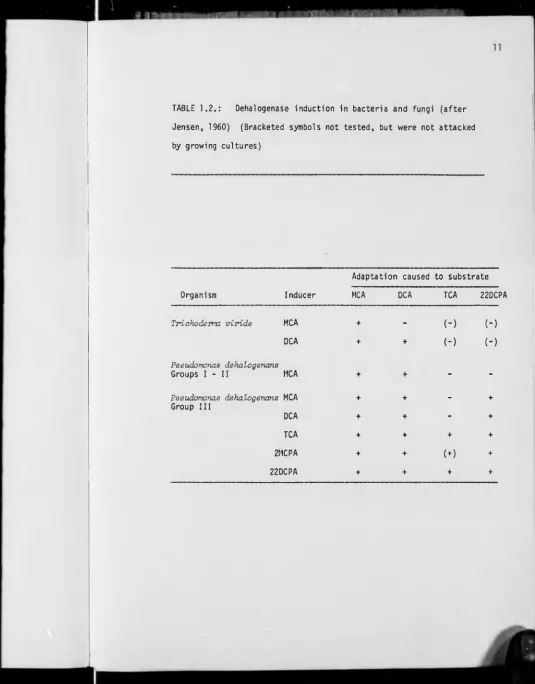
TABLE 1.2.: Dehalogenase induction in bacteria and fungi (after
Jensen, 1960) (Bracketed symbols not tested, but were not attacked
by growing cultures)
Adaptation caused to substrate
Organism Inducer MCA DCA TCA 22DCPA
Triahodevma vivide MCA + - (-) (-)
DCA + + (-) (-)
Paeudomonaa dehalogenana
Groups I - II MCA + -
-Paeudomonaa dehalogenans MCA
Group III
+ + - ♦
DCA + + - +
TCA ♦ + + +
2MCPA + + (+) ♦
An alternative hypothesis suggested that DCA induced both enzymes, each
specific for MCA in the former case and DCA in the latter.
The dehalogenases of bacteria and fungi appear to differ with
respect to pH profiles and also substrate specificity (Jensen, 1960).
(Table 1.2). Jensen noted that the MCA induced dehalogenase of
Paeudornottas dehalogenana in groups I and II attacked MCA and DCA, but
in group III the specificity was increased to include 22DCPA.
These enzymes were believed to cleave the halogen from the carbon
chain by hydrolysis of the carbon-halogen bond, resulting in the
formation of hydroxyalkanoic acids.from monosubstituted haloalkanoic
acids and oxoalkanoic acids from disubstituted compounds (Foy, 1975).
The molecules of HC1 then accumulate while the alkanoic acids enter
the normal metabolic pathways of the organism.
Davies and Evans (1962) examined sonicated cells of
P. dehalogenans and found that the extracts catalysed the reaction:
Cl c h2c o o h + h2o h o c h2c o o h + HC1 monochloroacetic acid glycolUc acid
The enzymatic cleavage of the carbon-fluorine bond in
fluoroacetate by haloacetate halidohydrolase (Goldman 1965) was
seen during the utilization of fluoroacetate by a soil Pseudomonad
as its sole carbon source. The following reaction, analogous to the
chloroacetate -*■ glycol late reaction involving a thioether was suggested:
Rate-1imiting
Enz-S” + XCH2C00' ---» Enz-S-CH2C00" + X' Enz-S-CH2C00' + OH' --- » HOCH^OO' + Enz-S"
13
for F, then Cl and slowly for I. Goldman and Milne (1966) proved that 18
the hydroxyl ion originated from water by using ( 0) oxygen. The
enzyme also exhibited specificity towards fluoroacetates and would not
cleave fluoropropionates.
The isolation of two more dehalogenases from a soil pseudomonad,
(Goldman e t a l . 1968) again showed different induction mechanisms for
each enzyme. One was induced by MCA, the other by DCA. These
enzymes were able to dehalogenate mono- and dichloroacetates, iodoacetate,
2-monochloropropionate and 2-chlorobutyrate (2MCBA). A major
difference between these two enzymes and haloacetate halidohydrolase
was their lack of sensitivity towards sulphydryl-blocking agents.
Two mechanisms were put forward to explain the accompanying
inversion of configuration during the dechlorination of L-2MCPA
and L-2MCBA (Figure 1.1). A further two suggested mechanisms were
disregarded as they failed to produce the inversion observed.
Tonomura e t a l . (1965) isolated a pseudomonad which could use
fluoroacetate as a carbon source by converting it to glycollate.
The enzyme properties of this organism were similar to those isolated
by Goldman e t a l . (1968), as was also the case with the Gram-negative
organism isolated by Kelly (1965) which could utilize fluoroacetate
or fluoroacetamide as its carbon source. Other bacteria capable of
defluorinating sodium fluoroacetate (compound 1080, used in New
Zealand for the control of "noxious animals" (Lien e t d l. 1979))were
isolated by Lien e t a l . (1979) who suggested that a rich and diverse
indigenous population of defluorinating microorganisms existed in the
Figure 1.1 Two mechanisms suggested by Goldman et ai. (1968) to explain the aooompanying inversion of configuration during
• 18
14
8) to tion during
uae 180
15 sulphonate p-chloromercurtbenzene Iodoacetamide y-ethylnaleimide p-chloromercuri benzoate L-2-chlorobutyrate Diehloropropionate L-2-chloropropionate Dichloroacetate Monoiodacetate Honobromoacetate Monofluoroacetate Honochloroacetate
O' 2 p
»r U
I s 2 s
m
s 8 ’<
H
8 1 1 • o .1
( O 70 0* (2 .4 )
0* m© o
8 100* (20) 100* (1.
3 ) 10 0* (1 .3 ) §; r-4
« o il 1
29
61
pu
*
in * ♦»
* tl 5 5
s i s•a
i/i 2 8
c j z -6
I ? 3 _ ZI s .2
07
32 3 5 - 1 5 = 2 _J
•85* -8 -8 ¿J2 1 ■ i
£5t £S
16
Little and Williams (1969, 1971) further studied the haloacetate
halidohydrolase of Pseudomonas dehalogenans NCIB 9061. They believed
that two distinct forms of these enzymes could be distinguished by
the effect of thiol reagents on enzyme activity. Those isolated by
Davies and Evans (1962) and Goldman (1965) being completely inhibited
by these reagents and those of Goldman e t a l . (1968) being virtually
unaffected. The P . dehalogenans NCIB 9061 enzyme was only slightly
affected by the thiol reagents, which was contrary to the results
in the 1969 communication. A comparison of the bacterial halido-
hydrolases isolated in those early studies is shown in Table 1.5.
The inhibition studies suggested that there may be two distinct
mechanisms for halide hydrolysis. The mechanism suggested by Goldman
(1965) involving the formation of a 6-carboxymethyl intermediate
could not be involved, Little and Williams (1971) believed in the
enzyme system they isolated. The mechanism suggested for this enzyme
is shown in Figure 1.2. It involved base catalysis by a group which
the results suggested, was a histidine residue. If the base group
was a thiol, then the differences between the two enzyme systems may
be due to the degree of protection the thiol group obtains from the
rest of the molecule.
Slater e t a l . (1976, 1979) described the differing capabilities
of two strains of Pseudomonas p u tid a , strains S3 and P3 (Senior et a l .
1976b)to utilize a range of chlorinated acetic, propionic and butyric
acids. Strain P3 possessed enzyme levels 10 to 40 times greater than
strain S3 and although S3, a secondary utilizer in the Dalapon degrading
community (Senior e t a l . 1976b) could not grow on any of the 9
chlorinated compounds tested, strain P3 could grow on 2MCPA and 22DCPA.
17
nÇ O Ç P — +
R H
n \ /
ß“ H—O— C— X
+
l
• •
ß
H18
It was suggested that P3 originated from S3 in the chemostat culture.
Chemostat selection studies confirmed that P3-1ike strains could be
selected from pure cultures of S3 (Senior e t a l . 1976b; A.J. Weightman & J.H.
Slater, unpublished observations).
This work also indicated that strain P3 contained at least
2 dehalogenases, one mainly active towards chlorinated acetic acids
and the other towards chlorinated propionic acids. This work represents
the second example of an organism containing two dehalogenases, the first
was that of Goldman e t a l . (1968), but in that case the enzymes were
separately induced.
The work of Slater's group showed that the dehalogenase systems
of P . putida exhibited different substrate specificities. One enzyme,
the fraction II dehalogenase, was more active towards the halogenated
acetates and the other, the fraction I dehalogenase was more active
towards the chlorinated propionates and brominated compounds.
Berry et a l . (1979) found the dehalogenase activity of a
Rhizobium sp. was greater towards 2MCPA than 22DCPA, in contrast to
Kearney e t a l . (1964) who showed that the enzyme from an A rthrobacter
sp. liberated chloride ions from 22DCPA more readily than from 2MCPA.
These differences may represent minor variations in enzyme structure,
when more than one enzyme is present in a given organism, or differences
in the control mechanisms, or differences in the actual mechanism of
reactions as described by Little and Williams (1971).
Thus far, the enzymes considered have all acted upon the
substitution of thecarbon-2 of each compound. However, Castro and
3-bromo-19
-propanol to 3-hydroxypropionate which was then completely mineralized.
Such compounds are used as nematocides in soils, so their biodegradation
may be mediated by such organisms. A strain of Microcooaus d e n itr ificc m s
(Bollag & Alexander, 1971) could utilize 3-chloropropionic acid (3MCPA)
as its sole carbon source. Its dehalogenase was specific for 3-carbon-
substituted compounds and, as no 3-hydroxypropionate as an intermediate
was observed, it was tentatively suggested that the mechanism involved
dehydrodehalogenation.
The release of halogen substituents from a number of xenobiotic
compounds has been shown to be mediated by a number of different bacterial
and fungal genera. The ability may have evolved as a result of contact
with haloqenated compounds produced by other microorganisms and could
represent a detoxification mechanism, as a number of these compounds are
bactericidal. For example, the possession of such enzymes may prevent
the lethal synthesis of fluorocitrate from fluoroacetate by dehalogenating
the latter. This would incidentally enable the microorganism to use
the halogenated compound as a source of energy, carbon, nitrogen or
other minerals.
1.2 CONTINUOUS-FLOW CULTURE
Traditionally batch culture systems have been used for the study
of microbial growth. These cultures are characterized by initially high
concentrations of all nutrients and no through-put of materials once
the medium has been inoculated. Thus it is a discontinuous process in
which the environment is continually changing due to nutrient depletion
and increasing levels of metabolites, producing only transient states
The behaviour of organisms, at a given time, is influenced by the
growth and metabolism of their ancestors which developed under different
environmental conditions.
The continuous-flow culture of microorganisms divorces them from
their histrry at any given time, by maintaining a constant environment.
There are two types of continuous-flow system:
(1) the turbidostat where the organisms grow at, or very
close to, their maximum specific growth rate (u__w ). The actual rate
being determined by the genetic properties of the organism; that is,
growth under internal control.
(2) the second type, known as chemostats, subject cultures
to external control such that the growth rate is determined by the
rate of supply of a limiting growth substrate. Continuous-flow cultures
balance the input of nutrients with the output of organisms, metabolic
products and unused nutrients, enabling the attainment of steady state
conditions, during which the average values of all culture and organism
properties remain theoretically constant over an indefinite time.
Since the initial development by Monod (1950) and Novick and Szilard
(1950a) the continuous culturing of organisms, both prokaryotic and
eukaryotic, has become increasingly important in research and industry
(Bull, 1974; Parkes, 1982).
1.2.1 Theoretical considerations of continuous culture
The derivation of the mathematical equations used to describe
the continuous culture of microorganisms will not be described, as
numerous accounts have been published (Herbert e t ai.,1956; Tempest,
1970,1978; Bull, 1974; Pirt, 1975; Harder at a l . 1977; Slater,
21
The basis from which the mathematical models have been derived
is an equation, analogous to the Michaelis-Menten enzyme kinetics
equation, suggested by Monod (1942), which describes the relationship
between growth-limiting substrate concentration and growth rate.
It reflects the similarity between the bacterial cell and an enzyme
molecule reacting with the substrate (S) (Schulze & Lipe, 1964):
where u is the specific growth rate at a given growth-limiting
substrate concentration, S; u is the maximum specific growth rate
obtained when S is large and not limiting; K$ is the substrate saturation
constant corresponding to the concentration of S at which y is 0.5 umax.
y is specific for each organism and the physicochemical environment
in which the organism is growing.
In chemostat cultures, the growth rate is determined by the rate
of supply of the limiting substrate and is controlled by the fractional
rate of medium displacement, that is the dilution rate, D (units: h ^)
which is defined as:
is the volume of the culture (units: «,). Thus D is a measure of the
number of culture volume changes achieved in unit time. The reciprocal
of D represents the mean residence time, 9 (units: h) which is the
average time an organism remains in the vessel, e is related to the
organism's doubling time, t^, (units: h) by: S
y (1)
F
D = V (2)
Where F is the medium flow through the fermenter (units: fl.h”') and V
(2)
td 0 In 2
A
(3)22
from which the chance of an organism undergoing cell division before being
washed out of the culture vessel is:
e ' D t d (4)
Hence the greater the culture doubling time the higher the probability
that an organism will be removed from the system before it divides.
An analysis of chemostat theory in terms of organism biomass,
x (units: g dry wt i,"^), and substrate concentration in the culture
vessel, S (units: g substrate l when u = D and dx/dt = 0 and ds/dt
= 0 (that is, when the system is in steady state) leads to the derivation
of the steady state organism biomassj^and growth-limiting substrate(5)
equations:
where Y is the observed growth yield, the ratio of weight of cells
produced to weight of substrate utilized; and SR is the initial
concentration of the growth-limiting substrate.
Equations (5) and (6) indicate the self-regulating capacity of
chemostat cultures to produce steady-states at different values of D
because the dilution rate determines S which in turn determines u
(Fencl, 1966). Thus, changing the dilution rate results in a change
in p, producing new and unique steady-state values. So an infinite
number of steady states can be obtained by varying D and SR . Minor
changes in biomass concentration or limiting-substrate concentration
at a fixed dilution rate results in opposing changes in the specific
s - K,S D (5)
max - D
and
x - Y
Figure 1.4 Theoretical steady-state conditions derived from equations (S) and (6) x, steady-state biomass
concentrationj s, steady-state substrate concentration;
Sp, initial substrate concentration; tj, culture
25
growth rate of the culture, such that the original steady state is
restored (Figure 1.3).
Theoretical steady-state conditions derived from equations
(5) and (6) have been frequently represented as seen in Figure 1.4
(Herbert e t a l .,1956; Fencl, 1966; Bull, 1974; Veldkamp, 1976;
Slater, 1979). This indicates that the dilution rate cannot be made
greater than umax if steady state conditions are to be maintained.
The maximum value of the dilution rate is known as the critical
dilution rate (Dcrit) and is nearly equal to If D > Dcrit then
exponential wash-out of the organisms occurs, at which time s = SR .
Dcrit ’s not constant but depends on the organism and the initial
concentration of the growth-limiting substrate (SR):
Sr
Dcrit ” ^max Z 7 7 ^
Ks + bR
As well as a maximum specific growth rate and the Dcr^t value, evidence
is also accumulating to support the theory of a minimum growth rate.
Bull (1974) suggested a value of 6% of umax for the minimum growth
rate (um^n). Below um ^n cultures apparently fail to grow correctly.
Practice indicates that the chemostat can support steady state
populations over the range um ^n to Dcr^t or approximately 5 to 95% umax.
1.2.2 Departures from theory
The kinetic model described above is based on ideal parameters
and as a result is oversimplified. The theoretical predictions are
often found to be inexact when compared with practical results.
Experimental departures from the predicted steady state organism
concentrations as shown in Figure 1.5 are caused by the following
can occur in carbon limited chemostats due to maintenance energy
requirements which could also explain the existence of a ym^n value.
The opposite effect, at low dilution rates (B), occurs in cultures
under nitrogen or phosphorus limitation. Phosphorus limitation restricts
nucleic acid synthesis and low nitrogen concentrations restrict protein
synthesis. However, the polysaccharide and lipid content of the cells
continue to rise as intracellular reserves, so producing larger biomass
concentrations than would be expected.
A change in dilution rate may also lead to shifts in metabolism
(C) which result in a decrease in substrate utilization efficiency, so
resulting in a decrease in biomass concentration. The model assumes
perfect and instantaneous mixing of fresh medium with the growing
culture, which in reality does not occur, and so some regions of the
culture may effectively exist in a pocket of higher or lower dilution
rate (Herbert e t a l . ,1956; Pirt, 1975). When in a pocket of lower
dilution rate an apparent increase in Dcr^t can be observed (D), a
phenomenon also caused by wall growth.
Monod's equation (equation (1)) describes substrate concentration
as being asymptotic to u iilaX. However, some substrates are toxic even
at low concentrations. This causes a decrease in the expected biomass
concentration (E). Similar results are also seen if metabolic products
are toxic and so become inhibitory.
The requirement for a growth factor, for example a vitamin
or amino acid, can produce an apparently low Dcr<t (F). Initially
the growth factor is supplied in the original inoculum, but with time
28
of bacteria at low population densities and suggested that below certain
substrate concentrations organisms are unable to grow whatever the
dilution rate. It was also suggested that these results supported
the concept of growth-stimulating relationships between organisms
in a population, enabling growth on a medium which does not meet all
the growth requirements of a single organism. Thus, the internal
growth factor becomes limiting when the population density falls below
certain values.
Reference should be made to the discussion by Powell (1967) of
formulae which he suggested represented quite closely the transition
of batch cultures from the exponential to stationary phases. This
provides a variation from the model of Monod based on the dependence
of growth rate on substrate concentration. A further model system
(Yamani e t al.,1979) described the start-up conditions in batch and fed-batch cultures to initiate chemostat growth, and was offered to
enable more efficient start-up strategies for continuous culture.
1.2.3 Enzyme and metabolic regulation in chemostat cultures
The steady state, obtainable in chemostat cultures, enables
quantitative changes in enzyme levels, in response to environmental
parameters, to be observed. The chemostat is also an ideal system
in which to study the control mechanisms involved. Furthermore
it allows the selection of constitutive strains and hyperproducing
organisms exemplified by the Escherichia coli B-galactosidase experiments
(Horiuchi e t al. 1962a; Vojtisek e t ai.,1969; PavlasovS e t al.,1980a
& b, 1981).
Figure 1.6 Effect of dilution rate on enzyme activity. A: Changes in the level of isocitrate dehydrogenase in
Candida utilis after changes in the dilution rate. (0),
Isocitrate dehydrogenase; ( • ), biomass. (after Fencl, et. al. 1972) B: Effect of D (h 1) on amidase synthesis by P. aeruginosa
growing with succinate + acetamide. At time zero the in going medium was changed from lOmM succinate to lOmM succinate + 20mM acetamide. Results recorded as amidase specific
activity (\im(mg dry wt) 1min 1) against D (h 1) (after Boddy et_ al., 1967 ) (0) D 1 0.22; (+) D 1 0.38; (A), D 1 0.54; (A)
D 1 0.76.
C: Effect of D on the synthesis of pectin lyase in a pectin-limited chemostat (A) steady state specific activity (^SOOnm min'1 mg protein“1) (0) biomass (gl 1) (after Almengor-Hecht & Bull, 1978).
multiply as rapidly as possible. However, because few rich environments,
outside the laboratory, exist which permit the maximum growth rate
being obtained, it was suggested that bacteria have developed control
mechanisms which help to bring the intracellular environment into
conditions suitable for rapid growth. For example, permeases can
create high intracellular substrate concentrations, even when extra
cellular levels are extremely low (Pardee, 1961).
Enzyme production can be linked with growth rate and lienee,in
chemostat cultures to the dilution rate. Dean (1972) identified five
types of dependency of enzyme activity on dilution rate, namely: the
enzyme activity remains constant irrespective of dilution rate;
activity passes through a maximum value at a given dilution rate; activity
passes through a minimum value at a given dilution rate or activity
increases or decreases as the dilution rate increases (Figure 1.6).
When in a steady state, growth rates and yields remain constant.
However, this does not necessarily apply to individual enzymes in the
organisms (Sikyta & Fencl, 1976). In a number of experiments levels
of certain enzymes have been shown to oscillate about an average value,
a phenomenon more pronounced in the production of extracellular enzymes.
Sikyta and Fencl (1976) suggested two explanations for this oscillatory
behaviour. Firstly, that the changes in enzyme levels are the
consequence of the loss of culture history (Section 1.2), or secondly
that these changes are caused by the accumulation of low or non-producing
mutants within the chemostat population, which would cause the observed
oscillations by apparently changing the overall specific activity of
the culture for the enzyme concerned. Macleod e t a t . (1975) working
oscillations in enzyme activity even after steady state conditions
had been reached. The amplitude of the oscillations was 20% of the
mean value and had a periodicity of one hour.
Theoretical considerations (Goodwin, 1966;)
predicted the periodic oscillation of enzyme synthesis, and that the
oscillations depend to some extent on growth rate. Dean (1969) reported
the damped oscillatory nature of Aerobaoter (Klebsiella) aerogenes
during the switch from batch to continuous culture. Such damped
oscillations have also been observed after increasing the dilution
rate from one value to another.
Boddy et al. (1966) observed fluctuations in the bacterial
biomass concentration and amidase levels in chemostat cultures of
Pseudomonas aeruginosa strain 8602 and Boddy et al. (1967) suggested
that the oscillatory nature of the biomass was a reflection of the
oscillating enzyme level, and hence, only reflected changes in
concentration of the inducer or catabolite repressor. Although biomass
fluctuation may result from the oscillation of an enzyme the periodicity
of each need not be in phase with each other.
In batch culture the dual control of enzyme synthesis, induction
and repression, manifests itself as diauxic growth, but in continuous
culture the balance between the opposing controls is far more obvious.
Boddy et al. (1966, 1967) and Clarke et al. (1968) provided a good
example with the aliphatic amidase synthesis in Pseudomonas aeruginosa
strain 8602. The effect of increasing the dilution rate on enzyme
activity (Figure 1.7) was interpreted in the following way by Clarke
et al. (1968). At low dilution rates catabolite repression is minimal so the
Figure 1. 7 The effect of increasing dilution rate on the amidase activity of Pseudomonas aeruginosa strain 8602 (after Clarke et al. 1968), c m - constikutiv« mutant
e anidase 02 (after
t
O
Q
2
.
0.4
0.6
of amidase synthesis is dependent on the rate at which acetamide
becomes available. Under these conditions an increase in dilution
rate results in an increase in the specific activity of the amidase.
As the dilution rate increased above 0.3h"\ the growth rate increased
to a point where metabolic intermediates form at a rate sufficiently
high to cause catabolite repression. At a dilution rate of 0.6h 1
the enzyme concentration had decreased considerably, with the specific
activity remaining similar to overnight batch cultures.
A constitutive mutant of P. aeruginosa demonstrated a gradual
decrease in specific activity with increasing dilution rate (Figure
1.7) which is consistent with increasing catabolite repression,
resulting from an increased rate of metabolite formation of the enzyme
which requires no induction. Similar dual control was cited as the
explanation for the specific activity of pectin lyase passing through a
maximum value at a dilution rate of approximately 0.04h ^ in a pectin-
limited chemostat (Almengor-Hecht & Bull, 1978).
Clarke e t a l . (1968) concluded that the effect of an inducer
depended on the metabolic state of the organism with respect to the
production of catabolite repressor molecules. That is, wnen the
concentration of metabolites is high, enzyme repression is severe,
so changes in inducer levels will have little effect on enzyme synthesis.
When the carbon pool is low, catabolite repression will be negligible
and enzyme activity will depend on the inducer concentration.
Other environmental parameters also have an effect on enzyme
activity. Marriott e t a l . (1981) found that in Azotobacter b e ije r in a k ii