Evaluation of the Morphologic Method for the Detection
of Animal and Herbal Content in Minced Meat
Javad Sadeghinezhad1, Bahador haJimohammadi 2, Farkhondeh izadi 2, Fatemeh Yarmahmoudi 1 and rocco Latorre 3
1department of Basic Sciences, Faculty of Veterinary medicine, university of tehran,
tehran, iran; 2research Center for molecular identification of Food hazards, Shahid Sadoughi university of medical Sciences, Yazd, iran; 3department of medical and Surgical Science,
university of Bologna, Bologna, italy
Abstract
Sadeghinezhad J., Hajimohammadi B., Izadi F., Yarmahmoudi F., Latorre R. (2015): Evaluation of the mor-phologic method for the detection of animal and herbal content in minced meat. Czech J. Food Sci., 33: 564–569.
The quantitative and qualitative accuracy of the routine histological method for the determination of unauthorised animal and herbal content in minced meat was to evaluated. Laboratory adulterated minced beef meat; each containing 5, 10, 15 and 20% of soya and chicken gizzard was prepared. Then each sample was divided into three parts and four paraffin embedded blocks were prepared from each part. The sections were stained using haematoxylin and eosin, toluidine blue and Masson’s trichrome. The histological examination revealed the soya and gizzard tissues clearly in all the samples. The histometrical analysis showed that there was no significant difference between the estimated percentages of both additive tissues and the real related percentages. Overall, neither was there any significant differ-ence between the data of the three parts of each sample and the real percentages. The findings of the present research suggest the histological technique as an effective method for qualitative and quantitative evaluations of minced meat.
Keywords: histology; meat; adulteration; soya; chicken gizzard
Producing meat products with ingredients which are not consistent with the label is considered fraud (Ballin 2010). There are several reports available regarding the presence of plant materials and animal tissues alongside skeletal muscle, collagen and adi-pose tissue as standard ingredients in meat products (Ding & Xu 2000; Prayson et al. 2008a,b; Botka-Petrak et al. 2011).
Plant additives in meat products are important not only in meat product quality as adulterations but also for the food safety as allergens (Pospiech et al. 2009). Therefore various methods such as im-munochemical (Moriyama et al. 2005; Renčová & Tremlová 2009) and molecular biological (Meyer et al. 1996; Hernández et al. 2006) as well as his-tological methods have been developed to detect the plant materials in meat products. Nevertheless, in most cases these methods are time consuming or
they do not qualify for the quantitative analysis of the plant materials (Castro et al. 2007).
Several methods such as electrophoresis, chroma-tography and DNA-based assays are available for the detection of all animal species present in the meat products (Hsieh et al. 1995; Macedo-Silva et al. 2000; Rodríguez et al. 2004; Kesmen et al. 2007; Rao & Hsieh 2007). Evaluation of collagen content is the major method for the tissue differentiation in the meat products using spectroscopic and chro-matographic techniques (Colgrave et al. 2008). Aside from the adulteration aspect, it is important to note that some animal tissues like the brain and the spinal cord can bear infective agents which are transmissible to humans (Herde et al. 2005).
Tremlová & Starha 2003; Gout et al. 2004; Pray-son et al. 2008a,b) in the cooked meat products by a histological technique.
On the basis of all that has been said above and considering that the previous studies mainly focused on cooked meat products, this experimental study was designed to evaluate the accuracy of the routine histological technique as a simple and inexpensive method for the determination of unauthorised animal and herbal content in raw minced meat. Furthermore, the findings presented in this article suggest a rapid and economical procedure for a quantitative analysis of the unauthorised tissues in meat products.
MAtEriAl AnD MEtHoDs
Preparation of meat samples. Samples of minced beef meat, each containing 5, 10, 15, and 20% textured soya protein (as a plant material) and chicken gizzard (as an animal material) were prepared. All the samples with different percentages were evaluated for flavour, tenderness, juiciness, and overall acceptability by 10 different persons. Then each sample was divided into three equal parts, four pieces of each part were collected, and fixed in 10% neutral-buffered formalin. Histological and histometrical study. The tissues were routinely processed for light microscopy and embedded in paraffin. Each paraffin-embedded block was cut into 6 µm sections and one slide from each block was taken and stained using haematoxylin and eosin (H&E). Toluidine blue and Masson’s trichrome were used to detect more details of added soya and chicken gizzard, respectively. After that, the tissue sections were dehydrated in alcohol, cleared in xylene, and mounted in a resinous mountant (Entellan New; Merck, Darmstadt, Germany). The slides were ob-served by a histologist under a microscope (N-180 M; NOVEL, Beijing, China) equipped with electronic eyepiece (MD130; OME-TOP System, New Taipei City, Taiwan) for the detection of additive tissues. Then five photographs were taken from random points of each slide. The area surface of the additive tissues (soya and gizzard) was measured using the Axiovi-sion software (Carl Zeiss, Oberkochen, Germany).
Quantitative analysis. The proportions of the area surface of the additive tissues and the total area surface were reported for each photograph as mean ± standard deviation. The t-test was used to deter-mine significant differences between the real and the estimated percentages. A value of P < 0.05 was
considered significant. In addition, the values of the estimated percentages were compared with those of the real percentages using the correlation coefficient.
rEsults AnD DisCussion
(IHC) methods have mostly been used for the detec-tion of central nervous tissue as a hazardous material in the transmission of the infective agent of bovine spongiform encephalopathy (Zijderveld & Koolmees 1990; Tersteeg et al. 2002; Herde et al. 2005). The problem with using IHC is the heating process of the cooked-meat products in which the antigens became altered. Beyond that, neuron-specific enolase (NSE) immunoreaction was suggested as a reliable marker of CNT in meat products as a consequence of the
[image:3.595.121.468.102.389.2]extraordinary resistance of the enzyme (Lücker et al. 1999; Wenisch et al. 1999). It has recently been reported that the effect of heating can be minimised by antigen retrieval (Bednářová et al. 2015). A normal histological staining can easily identify the presence of plant materials based on their typical morphol-ogy. By using basic staining with toluidine blue, the vegetable proteins become different shades of blue, in contrast to other components in the product, for example soya was labelled dark blue in this study. It
Table 1. The estimated percentages of additive soya and chicken gizzard with different percentages
Samples 5% 10% 15% 20% Correlation coefficient
Soya 4.1 ± 2.6 (P = 0.2) 8.06 ± 6.24 (P = 0.3) 13.65 ± 6.78 (P = 0.5) 19.06 ± 6.39 (P = 0.62) 0/71*
Chicken gizzard 10.28 ± 9.79 (P = 0.08) 14.91 ± 12.49 (P = 0.2) 18.03 ± 9.1 (P = 0.27) 20.07 ± 7.36 (P =0.97) 0/35**
[image:3.595.62.535.650.716.2]Measurements are expressed as mean ± standard deviation; significance level (P-value) calculated for the comparison of the estimated percentages with the real percentages is given within parenthesis; correlation between various estimated and real percentages is significant at the 0.05 level (*) and at the 0.01 level (**)
has been revealed that some special staining such as the PAS-Calleja stain which targets polysaccharides can indicate soya flour (Pospiech et al. 2011). Flint (1990) applied a micro-technique which relied on the microscopic appearance of the different hydrocolloid particles when treated with aqueous Toluidine Blue under neutral and acid conditions. Furthermore, the immunohistochemical methods have been used to label the vegetable proteins even in low percentages, but it has limitations due to the low protein content in some vegetables, like wheat (Pospiech et al. 2009; Randulová et al. 2011).
The mean values of additive soya and chicken giz-zard with different percentages are shown in Table 1. Notably, there was no significant difference between the estimated percentages of both additive tissues and the real percentages. The values 4.1 ± 2.6% (P = 0.2) and 10.28 ± 9.79% (P = 0.08), 8.06 ± 6.24% (P = 0.3) and 14.91 ± 12.49% (P = 0.2), 13.65 ± 6.78% (P = 0.5) and 18.03 ± 9.1% (P = 0.27), 19.06 ± 6.39% (P = 0.62), and 20.07 ± 7.36% (P = 0.97) were obtained for the samples, each containing 5, 10, 15 and 20% soya and chicken gizzard, respectively.
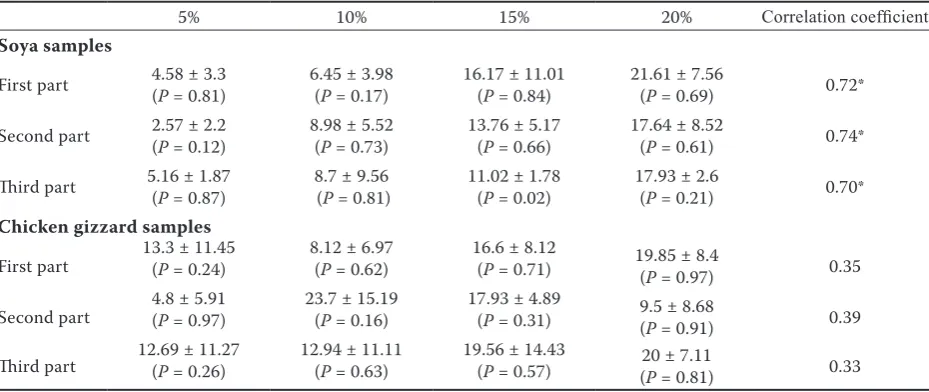
The values of the three different parts of each sam-ple with a different percentage of soya and chicken gizzard are summarised in Table 2. The statistical analysis did not indicate any differences in the data of the three parts of each sample. The comparison of the results with the real percentages did not show
any significant difference, except for the third part of the 15% soya sample in which the related differ-ence was significant (11.02 ± 1.78 vs. 15%, P = 0.02). Overall, according to the correlation coefficient (r = 0.7) there were correlations between the real and the estimated percentages in different parts of the soya samples.
As the estimated percentages of additive tissues in minced meat closely resemble those real percentages, they must be regarded as a sufficient method for the quantitative evaluation of the meat products. The amount of meat in the different brands of hamburg-ers (Prayson et al. 2008b) and hotdogs (Prayson et al. 2008a) were previously measured using grids in histological photographs. Tremlová and Starha (2003) established a quantitative examination of the bone tissue content in meat products using image analysis. Sifre et al. (2009) set up a system based on the histology and the image analysis to quantify muscle fibre destruction in meat.
In conclusion, the histological technique is an effective method for qualitative and quantitative evaluations of minced meat. At least four histological sections were offered in this examination.
references
[image:4.595.65.530.137.333.2]Ballin N.Z. (2010): Authentication of meat and meat prod-ucts. MeatScience, 86: 577–587.
Table 2. The estimated percentages of the first, second and third parts of the soya and chicken gizzard samples with different percentages
5% 10% 15% 20% Correlation coefficient
soya samples
First part 4.58 ± 3.3 (P = 0.81) 6.45 ± 3.98 (P = 0.17) 16.17 ± 11.01 (P = 0.84) 21.61 ± 7.56 (P = 0.69) 0.72*
Second part 2.57 ± 2.2 (P = 0.12) 8.98 ± 5.52 (P = 0.73) 13.76 ± 5.17 (P = 0.66) 17.64 ± 8.52 (P = 0.61) 0.74*
Third part 5.16 ± 1.87 (P = 0.87) (8.7 ± 9.56 P = 0.81) 11.02 ± 1.78 (P = 0.02) 17.93 ± 2.6 (P = 0.21) 0.70* Chicken gizzard samples
First part 13.3 ± 11.45 (P = 0.24) 8.12 ± 6.97 (P = 0.62) 16.6 ± 8.12 (P = 0.71) 19.85 ± 8.4 (P = 0.97) 0.35
Second part 4.8 ± 5.91 (P = 0.97) 23.7 ± 15.19 (P = 0.16) 17.93 ± 4.89 (P = 0.31) 9.5 ± 8.68 (P = 0.91) 0.39
Third part 12.69 ± 11.27 (P = 0.26) 12.94 ± 11.11 (P = 0.63) 19.56 ± 14.43 (P = 0.57) (20 ± 7.11 P = 0.81) 0.33
Bednářová M., Pospiech M., Tremlová B., Řezáčová Lukáš-ková Z., Bednář J. (2015): Antigen retrieval and fixation of sections on slides for immunohistochemical detection of soya protein in meat products. Journal of Food and Nutrition Research, 54: 1–8.
Botka-Petrak K., Hraste A., Lucić H., Gottstein Ž., Gomerčić M.Đ., Jakšić S., Petrak T. (2011): Histological and chem-ical characteristics of mechanchem-ically deboned meat of broiler chickens. Veterinarski Arhiv, 81: 273–283. Boutten B. (1999): Quantification of soy proteins by
associa-tion of immunohistochemistry and video image analysis. Food and Agricultural Immunology, 11: 51–59.
Castro F., García M.C., Rodríguez R., Rodríguez J., Marina M.L. (2007): Determination of soybean proteins in com-mercial heat-processed meat products prepared with chicken, beef or complex mixtures of meats from different species. Food Chemistry, 100: 468–476.
Colgrave M.L., Allingham P.G., Jones A. (2008): Hydroxy-proline quantification for the estimation of collagen in tissue using multiple reaction monitoring mass spec-trometry. Journal of Chromatography A, 1212: 150–153. Ding H.B., Xu R.J. (2000): Near-infrared spectroscopic tech-nique for detection of beef hamburger adulteration. Jour-nal of Agricultural and Food Chemistry, 48: 2193–2198. Flint F.O. (1990) Micro-technique for the identification of
food hydrocolloids. Analyst, 115: 61–63.
Gout S., Valdivia H., McDwell D., Harris N. (2004): Detec-tion of neuronal tissue in meat using tissue specific DNA modifications. Biotechnologie, Agronomie, Société et Environnement, 8: 229–234.
Herde K., Bergmann M., Lang C., Leiser R., Wenisch S. (2005): Glial fibrillary acidic protein and myelin basic protein as markers for the immunochemical detection of bovine central nervous tissue in heat-treated meat products. Journal of Food Protection, 68: 823–827. Hernández M., Esteve T., Pla M. (2006): Real-time
polymer-ase chain reaction bpolymer-ased assays for quantitative detection of barley, rice, sunflower, and wheat. Journal of Agricul-tural and Food Chemistry, 54: 4076–4076.
Hsieh Y.H.P., Woodward B.B., Ho S.H. (1995): Detection of species substitution in raw and cooked meats using immunoassays. Journal of Food Protection, 58: 555–559. Kesmen Z., Sahin F., Yetim H. (2007): PCR assay for the
identification of animal species in cooked sausages. Meat Science, 77: 649–653.
Macedo-Silva A., Barbosa S.F.C., Alkmin M.G.A., Vaz A.J., Shimokomaki M., Tenuta-Filho A.A. (2000): Hamburger meat identification by dot-ELISA. Meat Science, 56: 189–192.
Meyer R., Chardonnens F., Hübner P., Lüthy J. (1996): Poly-merase chain reaction (PCR) in the quality and safety
assurance of food: Detection of soya in processed meat products. Zeitschrift für Lebensmittel-Untersuchung und -Forschung, 203: 339–344.
Moriyama T., Machidori M., Ozasa S., Maebuchi M., Urade R., Takahashi K., Ogawa T., Maruyama N. (2005): A novel enzyme-linked immunosorbent assay for quantification of soybean beta conglycinin, a major soybean storage protein, in soybean and soybean food products. Journal of Nutritional Science and Vitaminology, 51: 34–39. Lücker E., Eigenbrodt E., Wenisch S., Failing K., Leiser R.,
Bülte M. (1999): Development of an integrated proce-dure for the detection of central nervous tissue in meat products using cholesterol and neuron-specific enolase as markers. Journal of Food Protection, 62: 268–276. Pospiech M., Tremlová B., Renčová E., Randulová Z. (2009):
Immunohistochemical detection of soya protein – Opti-misation and verification of the method. Czech Journal of Food Sciences, 27: 11–19.
Pospiech M., Tremlová B., Renčová E., Randulová Z., Řezáčová-Lukášková Z., Pokorná J. (2011): Comparison of the results of the ELISA, histochemical, and immunohis-tochemical detection of soya proteins in meat products. Czech Journal of Food Sciences, 29: 471–479.
Prayson B.E., McMahon J.T., Prayson R.A. (2008a): Apply-ing morphologic techniques to evaluate hotdogs: what is in the hotdogs we eat? Annals of Diagnostic Pathology, 12: 98–102.
Prayson B., McMahon J.T., Prayson R.A. (2008b): Fast food hamburgers: what are we really eating? Annals of Diag-nostic Pathology, 12: 406–409.
Randulová Z., Tremlová B., Řezáčová-Lukášková Z., Po-spiech M., Straka I. (2011): Determination of soya protein in model meat products using image analysis. Czech Journal of Food Sciences, 29: 318–321.
Rao Q., Hsieh Y.H.P. (2007): Evaluation of a commercial later-al flow feed test for rapid detection of beef and sheep con-tent in raw and cooked meats. Meat Science, 76: 489–494. Renčová E., Tremlová B. (2009): ELISA for detection of
soya proteins in meat products. Acta Veterinaria Brno, 78: 667–671.
Rodríguez M.A., García T., González I., Asensio L., Hernán-dez P.E., Martín R. (2004): PCR identification of beef, sheep, goat, and pork in raw and heat-treated meat mix-tures. Journal of Food Protection, 67: 172–177.
Sifre L., Andre B., Coton J.P. (2009): Development of a system to quantify muscle fibre destructuration. Meat Science, 81: 515–522.
Tersteeg M.H., Koolmees P.A., van Knapen F. (2002): Im-munohistochemical detection of brain tissue in heated meat products. Meat Science, 61: 67–72.
Wenisch S., Lücker E., Eigenbrodt E., Leiser R., Bülte M. (1999): Detection of central nervous tissue in meat prod-ucts – An immunohistochemical approach. Nutrition Research, 19: 1165–1172.
Zijderveld M.H., Koolmees P.A. (1990): Utility of immu-nohistochemical identification of muscle proteins in microstructural studies of comminuted meat products. Meat Science, 27: 55–60.
Received: 2015–04–07 Accepted after corrections: 2015–08–14
Corresponding author: