Optimizing channel cross section in irrigation area using
improved cat swarm optimization algorithm
Liu Dong
1,2,3,
Hu Yuxiang
1,4,
Fu Qiang
1,2,3*,
Khan Muhammad Imran
1,
Cui Song
1,
Zhao Yinmao
1(1. School of Water Conservancy and Civil Engineering, Northeast Agricultural University, Harbin 150030, China; 2. Heilongjiang Provincial Collaborative Innovation Center of Grain production Capacity Improvement, Northeast Agricultural University, Harbin 150030, China; 3. Key Laboratory of High Efficiency Utilization of Agricultural Water Resource of Ministry of Agriculture, Northeast Agricultural University, Harbin 150030, China; 4. Jilin Agriculture Science and Technology College, Jilin 1301002, China)
Abstract: This research aimed to design the channel cross section with low water loss in irrigation areas. The traditional methods and models are based on explicit equations which neglect seepage and evaporation losses with low accuracy. To rectify this problem, in this research, an improved cat swarm optimization (ICSO) was obtained by adding exponential inertia weight coefficient and mutation to enhance the efficiency of conventional cat swarm optimization (CSO). Finally, the Fifth main channel of Jiangdong Irrigation area in Heilongjiang Province was taken as a study area to test the ability of ICSO. Comparing to the original design, the reduction of water loss was 20% with low flow errors. Furthermore, the ICSO was compared with genetic algorithm (GA), the particle swarm optimization (PSO) and cat swarm algorithm (CSO) to verify the effectiveness in the channel section optimization. The results are satisfactory and the method can be used for reliable design of artificial open channels.
Keywords: cat swarm optimization (COS), exponential inertia weight coefficient, adoptive mutation operation, water loss, cross section, open channel
DOI: 10.3965/j.ijabe.20160905.2531
Citation: Liu D, Hu Y X, Fu Q, Imran K M, Cui S, Zhao Y M. Optimizing channel cross section in irrigation area using improved cat swarm optimization algorithm. Int J Agric & Biol Eng, 2016; 9(5): 76-82.
1 Introduction
Artificial open channels are used to convey water for irrigation and drainage in irrigation areas[1]. The
Received date: 2016-06-07 Accepted date: 2016-08-08
Biographies: Liu Dong, PhD, Professor, research interests: system analysis of agricultural water and soil resources, Email: [email protected]; Hu Yuxiang, MA, Lecture, research interests: system analysis of agricultural water and soil resources, Email: [email protected]; Khan Muhammad Imran, MA, Lecture, research interests: system analysis of agricultural water and soil resources, Email: [email protected]; Cui Song,
PhD, Associate professor, research interests: environmental effects of agricultural water and soil resources, Email: cuisong-bq@ neau.edu.cn; Zhao Yinmao, undergraduate, research interests: system analysis of agricultural water and soil resources, Email: [email protected].
*Corresponding author: Fu Qiang, PhD, Professor, research interests: system analysis of agricultural water and soil resources. Address: School of Water Conservancy and Civil Engineering, Northeast Agricultural University, Harbin 150030, China. Tel/Fax: +86-451-5519-0209, Email: [email protected].
increased world population has forced researchers to investigate better channel cross section for the high demand of water distribution[2]. The abatement of water
September, 2016 Liu D, et al. Optimizing channel cross section in irrigation area using improved cat swarm algorithm Vol. 9 No.5 77
commonly used channel cross sections. The optimal channel cross sections are usually obtained by using numerical method, trial procedures (time-consuming)[5] or graphical method (low accuracy owing to its log-scale representation)[6]. However, from the perspective of a hydraulic engineering, it would be preferred to have an optimal method with reasonable mathematical model and high accuracy for designing the channel cross section.
In order to design the optimal channel cross section, the Swarm Intelligence (SI) algorithms[7] such as Artificial Bee Colony Algorithm, Genetic Algorithm have been used to optimize problems across channel cross section over the last decades[8]. It is more efficient and accurate as compared to conventional methods for solving the highly nonlinear optimization problems. For example, Adaptive Particle Swarm Optimization (APSO) has successfully been used in continual cross sections optimization of the trapezoidal channels under the global condition. Liu et al.[9] used Cat Swarm Optimization (CSO) for obtaining optimal channel dimensions based on safety and stability of the side walls and found it was better in channel cross section under problem constraints its computational speed, and the robustness was not efficient.
Therefore, the improved cat swarm optimization (ICSO) method is proposed in this paper by adopting the exponential inertia weight coefficient and adoptive mutation operation into the tracing mode process of the CSO method. The Fifth main channel of Jiangdong Irrigation area in Heilongjiang Province was taken as an example. The computed results showed that 24.8%, 16.5% and 10.2% water loss could be saved as compared with genetic algorithm, particle swarm optimization and cat swarm optimization respectively.
2 Study area
Jiangdong Irrigation Area belongs to Songnen Plain which is affiliated with Heilongjiang Province. The climate is windy continental monsoon. It is bounded with Wuyuer River embankment in the east and adjacent to Qiqihar City embankment in the west. It reaches to Fuyu County to the North and shares boundary with the Durbat Mongol Nationality Autonomous County to the South. The annual precipitation and evapotranspiration
are 420 mm and 1485 mm, respectively. Nanhu Reservoir is in the southeast, which is the main water source that supplemented by the ground water. It is 45 km wide from east to west and 101 km long from south to north. The irrigation area has been cultivating for 52 years, which covers 544 km2 including 82 km2 dry farmland, 275 km2 paddy field and 187 km2 woodland. The efficiency of water conveyance for irrigation channel is lower than 0.5[10]. Because the reservoir has not been extensively repaired for many years, serious seepage and siltation are found in most channels, which restrain the economic progress in the irrigation area. The water-saving renovation is urgently needed in Jiangdong irrigation area so as to ensure its normal operation and fully utilize its natural advantages[11].
Figure 1 Location of Jiangdong Irrigation area in Heilongjiang Province
3
Improved cat swarm optimization algorithm
The conventional CSO algorithm originally proposed by Chu and Tsai[12] was based on the natural behavior of cats[13]. The strong curiosity to moving objects and the
outstanding hunting skill are two distinctive features of a cat. Even though cats spend most of their time in resting, they always remain alert[14]. When the prey is present,
they chase it very quickly so large amount of energy is spent[15]. The two characteristics of resting with slow movement and chasing with high speed are represented by seeking mode and tracing mode respectively[16]. 3.1 Seeking mode
next position to move forward[14]. In seeking mode, we define four main parameters: Seeking Memory Pool (SMP): the number of copies produced by a cat in seeking mode; Seeking Range of selected Dimension (SRD): the maximum difference between the new and old values in the dimension selected for mutation in the range of [0, 1]; Counts of Dimension to Change (CDC): the number of dimensions to be mutated in the range of [0, 1]; Self Position Consideration (SPC): a Boolean valued variable, indicating whether the point at which the cat is already standing will be one of the candidate points to move to. The steps executed in seeking mode are:
1) Generate copies of catk, where j=SMP. If the value of SPC is true, let j=SMP−1 and return the present position as one of the candidates.
2) According to CDC, plus/minus SRD percent’s of the current value randomly and replace the old one.
3) Calculate the fitness values (FS) of all candidate points, respectively.
4) If all the fitness values are not exactly equal, calculate the selecting probability Pi of each candidate point, shown as follows:
max min
i b
i
FS FS
P
FS FS
−
= , where 0<i< j (1)
If the goal of the fitness function is to find the minimum solution, FSb=FSmax, otherwise FSb=FSmin.
5) Randomly pick the point to move from the candidate points and replace the position of catk.
3.2 Tracing mode
Tracing mode is similar to the behavior of swarm intelligence based on PSO algorithm. When a cat enters into tracing mode, it moves according to its own velocity[15]. The steps involved in this mode are as follows: 1) Compute the new velocity using Equation (2) for every dimension (Vk,d).
Vk+1,d=ωVk,d+r1C(Xbest,d – Xk,d), d=1, 2, …, M (2) where, ωis the inertia weight, ω=1; Xbest,d is the position of the cat, which is the best fitness value; Xk,d is the position of catk, C is a constant and r1 is a random value
in the range of [0,1].
2) Check if the velocities are in the range of maximum velocity. In case the new velocity is over range, make sure it is equal to the limit. The limit here is given before the start of the algorithm, if the new
velocity exceeds the limit, then set it to a given boundary value.
3) Compute new position of catk using Equation (3).
Xk+1,d=Xk,d+Vk,d (3) 3.3 Exponential inertia weight coefficient
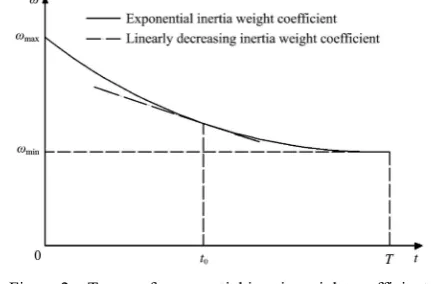
It can be found that, in terms of Equation (2), a bigger value of ω is beneficial to a global search technique and a smaller value is beneficial to a local search technique[17]. Thus, parameter ω is significant to the balance between the global and local search ability of CSO[9]. In general, a constant inertia weight coefficient (ω=1) is used in conventional CSO. In order to overcome the defect of the conventional CSO including prematurity, slow convergence in the later generation and liability to getting trapped in local optima can make use of an exponential function to adjust ω.
/
min max min
( )t [( )e t T]
ω =ω + ω −ω − (4)
where, ωmax and ωmin values are usually specified to be
0.9 and 0.4, respectively; t is current generation; T is maximum generation.
An appropriate parameter ω and generation (t) is shown in Figure 2.
Figure 2 Traces of exponential inertia weight coefficient
In the earlier stage (t<t0), ω decreases faster and
makes the velocity of cats relatively lower which could relieve the prematurity problem. In the later stage (t>t0),
by contrast, causes ω to decrease more slowly which could in turn cause the cats to maintain a relatively higher velocity and further enhance the diversity of populations which extend the scope of search space and prevent the CSO algorithm from falling into local optimization. 3.4 Adoptive mutation operation
September, 2016 Liu D, et al. Optimizing channel cross section in irrigation area using improved cat swarm algorithm Vol. 9 No.5 79
algorithm. The variance of fitness value (σ2) is shown as follows:
2 2
max
avg
f f
f
σ = ⎛⎜ − ⎞⎟
⎝ ⎠
∑
(5)where, f is the fitness of function; favgis the average value of fitness function; fmax is the maximum value of fitness
function;σ2 reflects the convergence of the algorithm. The conventional CSO algorithm can be augmented with an additional mutation operator such as Random operator. The mutation rate (p) is shown as follows.
2 2
, 0
d
k p= ⎨⎧ σ <σ
⎩ (6) where, σd2 is in the range of [0, 1]; k is a constant in the range of [0, 1].
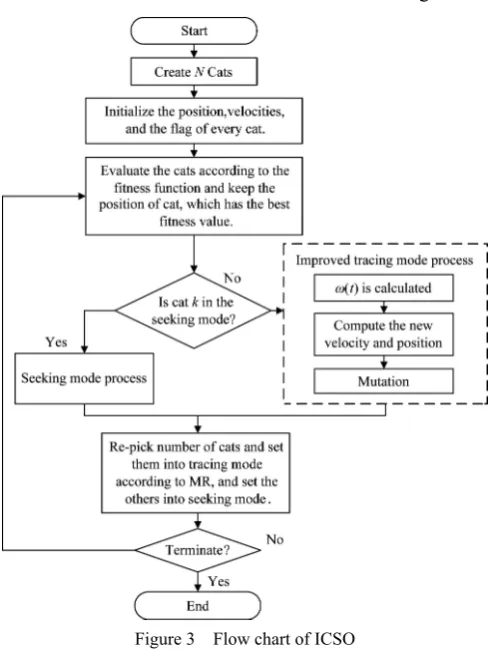
ICSO includes two sub models, the seeking mode and the tracing mode to solve the optimization problem. A mixture ratio (MR) defines the ratio of number of cats in tracing mode to that of number of cats in seeking mode is used. The flow chart of the ICSO is shown in Figure 3.
Figure 3 Flow chart of ICSO
4 Optimization model
4.1 Design variable
There are two main sources of water loss seepage and evaporation[18]. The trapezoidal section is the most
common channel cross section which is showed in Figure 4. The value of flow rate Q is given below by Manning’s formula[14]:
2 5/3 0
2 2/3 0
( )
( 2 1 )
i bH m H Q
n b H m
+ =
+ +
(7) where, Q is the designed discharge, m3/s; b is the width of
channel bottom, m; H is the height of channel, m; i is the longitudinal channel bed slope; n is the Manning’s roughness coefficient; m0 is the side slope of channel. Q, n, i areknown, while b, H and m0are design variable.
Figure 4 Geometric dimensions for trapezoidal cross section 4.2 Objective function
The seepage loss from a channel in a homogeneous and isotropic porous medium can be expressed as[19]:
qs = Fχ (8) where, qs is the seepage discharge per unit length of channel, m2/s; F is the hydraulic conductivity of the porous medium, m/s; χis the wetted perimeter, m.
In trapezoidal channel section, the equation of wetted perimeter is as following[20]:
2 0
2 1
b H m
χ= + +
(9) The evaporation loss can be expressed as:
qe=EB (10) where, qe is the evaporation discharge per unit length of channel, m2/s; E is the evaporation discharge per unit free surface area, m/s; B is the width of free surface, m.
Combining Equations (8) and (10) the total water loss qw (m2/s) was expressed as:
qw =Fχ+EB (11) The objective function is based on minimum water loss from a trapezoidal channel cross section due to seepage and evaporation given by Equation (11) along with some constraints.
f = min (Fχ+EB) (12) 4.3 Problem constraints
1) Velocity-constraint
Vmin<V<Vmax (13)
The minimum permissible velocity (Vmin) is the
lowest velocity that will not initiate sedimentation and will not induce the growth of vegetation. The maximum permissible velocity (Vmax) is the highest velocity that
will cause scour and erosion on the channel surface material.
2) Case of constant side slope m
Based on the code for designing a given channel lining, the channel side slope, m, is decided as follow.
1.25<m0<2 (14)
5 Results and analysis
The optimization model is validated by the following data extracted from the Fifth main channel. In this optimization, concrete lining is designed for the channel. Discharge, Qd =1.62 m3/s; longitudinal slope, i=1/10000; roughness parameters n=0.017, non-scouring velocity vmax=2.5 m/s, non-silting velocity vmin=0.4 m/s. Assume
channel lining are cracked and F=10-6 m/s. The
maximum evaporation loss E was estimated as 2.5×10⁻⁶ m/s.
The water loss per unit length of channel was calculated by Equation (11). The solutions of optimal water loss obtained by ICSO are presented in Table 1. Comparing the original design, the reduction of water loss were 20% with the low flow errors.
The values of wetted perimeterχand bed width B are
given below by following formula:
2 0
2 1
b m H
χ= + + (15)
0
2
B b= + m H (16) The result (in Table 1) also shows that parameters obtained by the ICSO can minimize the wetted perimeter (lining cost) and the bed width (land occupation) under the condition of satisfying the optimum hydraulic section. Comparing to the original design, the reduction of wetted perimeter and the bed width were 12% and 21% respectively with the low flow errors. The results obtained using ICSO are satisfactory and the method can be used for reliable design of artificial open channels.
Table 1 Optimal results
Algorithm m0 H/m b/m /×10Water loss -6 m2·s-1 Error /% perimeter/mWetted width/mBed
Original
design 2 1.26 1.5 25.5 7.8 7.13 7.34
ICSO 1.25 1.477 1.568 20.6 0.57 6.3 5.8
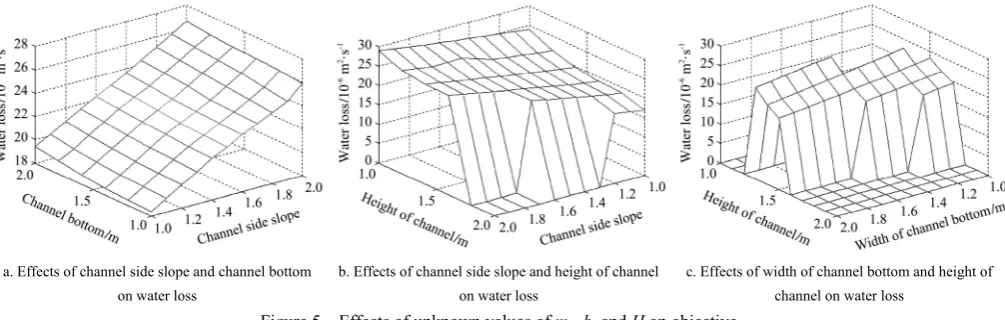
The water loss is plotted in the Figure 5 to assist the designer to analyze the optimal dimension of the channel for unknown values of m0, b, and H respectively. It can
be seen that both channel side slope (m0) and channel
bottom (b) increases as the water loss increases while it decreases when the height of channel (H) increases (Figures 5a and 5b). In Figure 5c, the objective continues for 1.25<m0<2. The water loss for this
constraint is highly sensitive to a decrease in height of channel (H).
a. Effects of channel side slope and channel bottom on water loss
b. Effects of channel side slope and height of channel on water loss
c. Effects of width of channel bottom and height of channel on water loss
Figure 5 Effects of unknown values of m0, b, and H on objective
6 Discussion
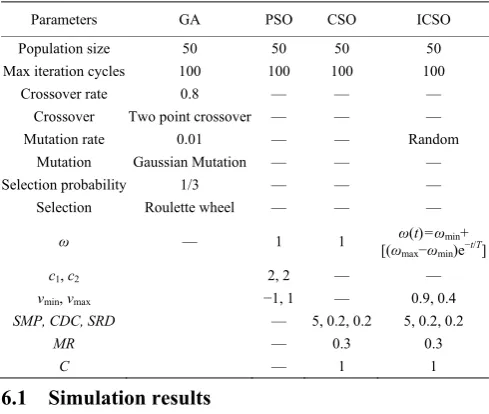
The simulation was done using MATLAB version 2012b for the design. To simulate the model using GA, PSO, CSO and ICSO method, the following parameters
which are shown in Table 2 involves: population size of 50; max iteration cycles of 100; crossover rate of 0.8; mutation rate of 0.01; selection probability of 1/3; acceleration coefficients c1 = 2 and c2 = 2; seeking memory
September, 2016 Liu D, et al. Optimizing channel cross section in irrigation area using improved cat swarm algorithm Vol. 9 No.5 81
of 0.2; seeking range of selected dimension (SRD)of 0.2; mixture ratio (MR) of 0.5; acceleration constant (C) of 1.
Table 2 Parameters set for GA, PSO, CSO, and ICSO
Parameters GA PSO CSO ICSO
Population size 50 50 50 50
Max iteration cycles 100 100 100 100
Crossover rate 0.8 — — —
Crossover Two point crossover — — —
Mutation rate 0.01 — — Random
Mutation Gaussian Mutation — — —
Selection probability 1/3 — — —
Selection Roulette wheel — — —
ω — 1 1 ω(t)=ωmin+
[(ωmax−ωmin)e−t/T]
c1, c2 2, 2 — —
vmin, vmax −1, 1 — 0.9, 0.4
SMP, CDC, SRD — 5, 0.2, 0.2 5, 0.2, 0.2
MR — 0.3 0.3
C — 1 1
6.1 Simulation results
The water loss per unit length of channel was calculated by Equation (11). The solutions of optimal water loss obtained by different solution methods are presented in Table 3. For b value ranging from 1.568 m to 1.922 m and m0 value ranging from 1.25 to 1.9, the
critical water depths were obtained using Manning’s equation.
Table 3 Simulation results
Algorithm m0 H/m b/m Water loss/×10-6 m2·s-1 Error/%
GA 1.9 1.386 1.88 25.7 1.1
PSO 1.65 1.293 1.922 24.0 0.7
CSO 1.505 1.357 1.778 22.7 0.1
ICSO 1.25 1.477 1.568 20.6 0.57
Table 3 shows the optimization results from the four algorithms. It is shown that optimization algorithms also gave reliable results. The results from a trapezoidal section with the ICSO method are the global optimization with larger error than CSO within the allowable range. It saves 24.8%, 16.5% and 10.2% water loss compared with GA, PSO and CSO respectively with low flow errors. Therefore, b, m, h are determined by the objective function, while we optimized them by using the optimize algorithm. Figure 6 shows that the most striking parameter deciding the optimal water loss is the wetted perimeter (χ) and width of the channel at the bed width (B) which indicates an increase trend with an increase of optimal value. It can be seen that there is much significant difference in optimal value of the GA, PSO, CSO and ICSO methods.
Figure 6 Optimal solutions of GA, PCO, CSO and ICSO 6.2 Computational time
Table 4 shows the time consumption comparison of GA, PSO, CSO and ICSO under different population numbers. It is thus clear that the improved cat swarm optimization consumes longer computation time than GA and PSO but shorter than CSO.
Table 4 The computation time in seconds with different population size
Algorithm Number of CATS/Particles 20 Number of CATS/ Particles 40 Number of CATS/Particles 50
GA 23 33 50
PSO 28 38 55
CSO 35 48 62
ICSO 30 42 58
6.3 Algorithm convergence ability
The convergence of swarm algorithms are showed in Figure 7. The horizontal axis represents the generation and the vertical axis represents the objective function. GA shows the optimal solution in the 24th generation. PSO presents the optimal solution in the 23rd generation and the cat swarm algorithm presents the optimal solution in the 22nd generation. Combining with the optimization
results, we can see that the ICSO is the fastest in the optimization process in the 15th generation and it is the least prone to the local optimum.
7 Conclusions
In this paper, improved cat swarm optimization (ICSO) method is presented for solving optimization of channel trapezoidal section. In order to overcome the inherent drawbacks, such as prematurity, slow convergence, and liability to falling into local optima, the conventional CSO algorithm was improved in two ways. Adoptive mutation operation and exponential inertia weight coefficient are adopted to render the algorithm capable of better balance ability in both global and local searches. The performance of ICSO optimization was investigated in channel cross section with minimum loss of water and the results are encouraging and promising in both computational efficiency and search ability when compared with CSO, PSO and GA. The proposed ICSO can provide efficient and effective solutions with respect to the optimization of channel cross section.
Acknowledgments
This study was supported by the National Natural Science Foundation of China (No.51579044, No.41071053, No.51479032), Specialized Research Fund for Innovative Talents of Harbin (Excellent Academic Leader) (No.2013RFXXJ001), Science and Technology Program of Water Conservancy of Heilongjiang Province (No.201319, No.201501, No.201503).
[References]
[1] Schulz M, Priegnitz J, Klasmeier J, Heller S, Meinecke S, Feibicke M. Effect of bed surface roughness on longitudinal dispersion in artificial open channels. Hydrological Processes, 2012; 26(2): 272–280.
[2] Das A. Optimal channel cross section with composite roughness. Journal of Irrigation & Drainage Engineering, 2014; 126(1): 68–72.
[3] Overloop P J V, Horváth K, Aydin B E. Model predictive control based on an integrator resonance model applied to an open water channel. Control Engineering Practice, 2014; 27(5): 54–60.
[4] Swamee P K, Mishra G C, Chahar B R. Design of minimum seepage loss canal sections. Journal of Irrigation & Drainage Engineering, 2014; 126(1): 28–32.
[5] Swamee P K, Rathie P N. Exact equations for critical depth in a trapezoidal canal. American Society of Civil Engineers, 2005; 131(5): 474–476.
[6] Liu J L, Wang Z Z, Leng C J, Zhao Y F. Explicit equations
for critical depth in open channels with complex compound cross sections. Flow Measurement & Instrumentation, 2012; 24(2): 13–18.
[7] Turan M E, Yurdusev M A. Optimization of open canal cross sections by differential evolution algorithm. Mathematical & Computational Applications, 2011; 16(1): 77–86.
[8] Kentli A, Mercan O. Application of different algorithms to optimal design of canal sections. Journal of Applied Research & Technology, 2014; 12(4): 762–768.
[9] Liu D, Hu Y, Fu Q, Imran K M. Optimizing channel cross-section based on cat swarm optimization. Water Science and Technology: Water Supply, 2016; 16(1): 219–228.
[10] Zhang X, Pei D, Hu C. Conserving groundwater for irrigation in the North China Plain. Irrigation Science, 2002; 21(4): 159–166.
[11] Moya P, Lin H, Dawe D, Chen C. The impact of on-farm water saving irrigation techniques on rice productivity and profitability in Zhanghe Irrigation System, Hubei, China. Paddy & Water Environment, 2004; 2(4): 207–215.
[12] Chu S C, Tsai P W. Computational intelligence based on the behavior of cats. International Journal of Innovative Computing Information & Control Ijicic, 2007; 3(1): 163–173.
[13] Wang Z H, Chang C C, Li M C. Optimizing least-significant-bit substitution using cat swarm optimization strategy. Information Sciences, 2010; 192(6): 98–108. [14] Pappula L, Ghosh D. Linear antenna array synthesis using
cat swarm optimization. AEU - International Journal of Electronics and Communications, 2014; 68(6): 540–549. [15] Panda G, Pradhan P M, Majhi B. IIR system identification
using cat swarm optimization. Expert Systems with Applications an International Journal, 2011; 38(10): 12671–12683.
[16] Saha S K, Ghoshal S P, Mandal D, Kar R. Cat swarm optimization algorithm for optimal linear phase FIR filter design. Isa Transactions, 2013; 52(6): 781–794.
[17] Zhang J, Wu Z, Cheng C T, Zhang S Q. Improved particle swarm optimization algorithm for multi-reservoir system operation +. Water Science & Engineering, 2011; 4(1): 61–74.
[18] Ghazaw Y M. Design and analysis of a canal section for minimum water loss. AEJ - Alexandria Engineering Journal, 2014; 50(4): 337–344.
[19] Bhattacharjya R K, Satish M G. Optimal design of a stable tsrapezoidal channel section using hybrid optimization techniques. Journal of Irrigation & Drainage Engineering, 2007; 133(4): 323–329.