Open Access
Research article
High-resolution analysis of copy number alterations and associated
expression changes in ovarian tumors
Peter M Haverty
1, Lawrence S Hon
1, Joshua S Kaminker
1, John Chant*
2and
Zemin Zhang*
1Address: 1Department of Bioinformatics, Genentech, Inc, South San Francisco, CA, USA and 2Department of Molecular Biology, Genentech, Inc,
South San Francisco, CA, USA
Email: Peter M Haverty - [email protected]; Lawrence S Hon - [email protected]; Joshua S Kaminker - [email protected]; John Chant* - [email protected]; Zemin Zhang* - [email protected]
* Corresponding authors
Abstract
Background: DNA copy number alterations are frequently observed in ovarian cancer, but it remains a challenge to identify the most relevant alterations and the specific causal genes in those regions.
Methods: We obtained high-resolution 500K SNP array data for 52 ovarian tumors and identified the most statistically significant minimal genomic regions with the most prevalent and highest-level copy number alterations (recurrent CNAs). Within a region of recurrent CNA, comparison of expression levels in tumors with a given CNA to tumors lacking that CNA and to whole normal ovary samples was used to select genes with CNA-specific expression patterns. A public expression array data set of laser capture micro-dissected (LCM) non-malignant fallopian tube epithelia and LCM ovarian serous adenocarcinoma was used to evaluate the effect of cell-type mixture biases.
Results: Fourteen recurrent deletions were detected on chromosomes 4, 6, 9, 12, 13, 15, 16, 17, 18, 22 and most prevalently on X and 8. Copy number and expression data suggest several apoptosis mediators as candidate drivers of the 8p deletions. Sixteen recurrent gains were identified on chromosomes 1, 2, 3, 5, 8, 10, 12, 15, 17, 19, and 20, with the most prevalent gains localized to 8q and 3q. Within the 8q amplicon, PVT1, but not MYC, was strongly over-expressed relative to tumors lacking this CNA and showed over-expression relative to normal ovary. Likewise, the cell polarity regulators PRKCI and ECT2 were identified as putative drivers of two distinct amplicons on 3q. Co-occurrence analyses suggested potential synergistic or antagonistic relationships between recurrent CNAs. Genes within regions of recurrent CNA showed an enrichment of Cancer Census genes, particularly when filtered for CNA-specific expression.
Conclusion: These analyses provide detailed views of ovarian cancer genomic changes and highlight the benefits of using multiple reference sample types for the evaluation of CNA-specific expression changes.
Published: 6 May 2009
BMC Medical Genomics 2009, 2:21 doi:10.1186/1755-8794-2-21
Received: 23 October 2008 Accepted: 6 May 2009
This article is available from: http://www.biomedcentral.com/1755-8794/2/21
© 2009 Haverty et al; licensee BioMed Central Ltd.
Background
Ovarian cancer is the fifth most common cancer among women and leading cause of death from gynecological cancers in the United States [1]. Treatment options include surgery, chemotherapy, and occasionally radia-tion therapy. To develop targeted therapies, which have the potential to be more effective and less toxic, candidate target genes must be identified. Trastuzumab, an antibody to HER2 for breast cancer therapy, provides a good exam-ple of an amplified cancer gene as a specific therapeutic target. As somatic DNA copy number alterations (CNAs) can indicate the presence of genes involved in tumorigen-esis, studies of DNA instability in ovarian cancers could potentially lead to identification of causal genes and thus therapeutic targets. Indeed, several groups have used genomic technologies to systematically survey copy number changes in ovarian cancer [2-11].
Array comparative genomic hybridization (CGH) tech-nology is frequently used for measuring copy number gains or losses. Early studies used Bacterial Artificial Chro-mosome arrays with resolutions of approximately 1 Mbp [2-4,6,8,9,11]. The Affymetrix 10K single nucleotide poly-morphism (SNP) arrays, with the average resolution of 210 kb, have also been used to measure copy number changes in ovarian serous carcinoma [7,10]. Recently, the Affymetrix 500K SNP Chip has been applied to further survey the prevalence of copy number changes across the genome, focusing on rare micro-deletions [5]. Recurrent patterns of DNA amplification in regions including 3q26, 8q24, 12p13, and 20q13 were detected in multiple stud-ies [3,5,6,9,11] (summarized in Additional file 1).
However, significant challenges remain in selecting the most important CNAs and in distinguishing driver genes from other passengers or bystanders. This is reminiscent of difficulties encountered in cancer genome re-sequenc-ing projects where the discovery of driver somatic muta-tions is often complicated by the preponderance of passenger mutations [12-15]. Likewise, genes exhibiting copy number alterations are not necessarily functionally relevant in oncogenesis. In fact, due to the large size of most tumor amplicons, the vast majority of genes located in a given amplicon are likely passenger genes. The mini-mal region of overlap in an altered region can suggest a set of potential driver genes, but these regions can often span several megabase pairs. Currently, most studies have relied heavily on prior biological knowledge to select causal genes in amplified regions, which can potentially lead to inconsistency or domain-knowledge bias. For example, while the PIK3CA gene was selected from the 3q26 amplicon as the oncogene for subsequent func-tional analysis [16], the PRKCI gene from the same region was proposed by a different group to be the oncogene in ovarian cancer [17]. While many known or putative onco-genes were credited as the driver onco-genes, some less
charac-terized genes may have been overlooked. A systematic, unbiased approach should help find cancer-driving genes in ovarian cancer.
We have applied Affymetrix 500K SNP Chips to survey and compare copy number alterations (CNAs) in fresh-frozen ovarian tumor samples, of several subtypes, from 52 patients. Five additional samples were available from four patients allowing a comparison of CNAs from pri-mary and metastatic samples as well as those in metastatic samples from different sites. To distinguish important changes from random CNAs, we have applied a statistical method (GISTIC: Genomic Identification of Significant Targets in Cancer) [18] that considers both the frequency and degree of copy number gains. This filtering leads to a relatively small set of genomic regions that reach statisti-cal significance. To further evaluate the importance of genes in these regions to oncogenesis, we profiled the expression patterns of these tumors and whole ovary nor-mal samples with Affymetrix U133A and B chips, filtering out genes with expression patterns that were inconsistent with their copy number. Combining copy number and expression data has been successful in other indications [19-21]. Lastly, as the ovarian surface epithelia (OSE) that are thought to give rise to the epithelial subtypes of ovar-ian cancer comprise a small percentage of the ovary [22], we also assessed the cancer-specific expression differences of genes in CNA regions using a public data set (GSE10971) consisting of Laser Capture Micro-dissected (LCM) normal fallopian epithelia and LCM serous aden-ocarcinoma.
Methods
Sample Information and SNP Array Analysis
Fifty-seven ovarian tumor samples from 52 patients were selected for analysis (Source: GeneLogic, Inc., Gaithers-burg, MD). These tumors include 36 serous adenocarcino-mas, 9 mullerian mixed tumors, 4 carcinomas of unspecified type, 3 clear cell carcinomas, 2 endometriod adenocarcinomas, 2 mucinous cystadenocarcinomas, and 1 granulosa cell tumor. All tumors were fresh frozen and possessed greater than 75% neoplastic cell content. Thirty-one samples were primary tumors while the remaining 26 were metastasized tumors. Forty-eight patients provided a single tumor. Matched primary and metastatic samples were available from three patients, one of which provided one primary and two metastatic sam-ples. Two metastatic samples were available for one addi-tional patient. Details regarding each sample, including tumor subtype, stage, and primary/metastasis status are available in Additional file 2.
(Build date Nov 30, 2005) using the PM/MM difference model and invariant set normalization. Data for 48 nor-mal samples were downloaded from the Affymetrix web-site http://www.affymetrix.com and analyzed at the same time.
The dChip-normalized signal intensities were converted to log2 ratios and segmented as follows. For each auto-somal probeset, the log2 tumor/normal ratio of each tumor sample was calculated using the average intensity for each probeset in the normal samples. For Chromo-some X, the averages of the 20 female normal samples were used. The log2 ratios were centered to a median of zero and segmented using GLAD [24]. For each resulting genomic segment, GLAD estimates the mean, or inferred log2 ratio. DNA copy number was calculated as 2 (inferred log ratio + 1). The raw and normalized SNP array data (CEL files
and copy number) data are available at the NCBI GEO website (GSE11960). Hierarchical clustering of log2 ratio scale copy number values was performed with the Eucli-dean distance metric and complete linkage clustering.
Comparison of CNAs to Germline Polymorphisms
A summary of 1193 published germline Copy Number Variants (CNVs) annotated as gain or loss was down-loaded from version 5 of the Database of Genomic Vari-ants [25].
Prioritizing Altered Genomic Regions
Outliers in the segmented data were removed by merging segments of < 8 probesets with the neighboring segment having the most similar inferred log ratio. Probesets with an inferred log ratio > 0.3 or < -0.3 (~2.5 and ~1.6 copies) were classified as gain and loss, respectively. These values were selected to capture higher-confidence changes. Regions of significant gains or losses were identified using the GISTIC (Genomic Identification of Significant Targets in Cancer) application, version 0.9.2 [18].
GISTIC is similar in spirit to the STAC [26], CMAR [27] and MCR [28] methods in that it seeks to select the genomic regions containing the most important copy number alterations. GISTIC differs from these methods in that it assesses the statistical significance of the combina-tion of alteracombina-tion frequency and magnitude across the genome. In brief, GISTIC scores each probeset across the genome for the frequency with which it shows copy gain, times the average level of cancer/normal log2 ratio for the samples showing copy gain. The statistical significance of each score is then determined by comparison to the distri-bution of scores obtained from all permutations of the data. Multiple hypothesis testing is accounted for using the False Discovery Rate (FDR) Q-value statistic of Ben-jamini and Hochberg [29] and a cutoff of 0.25 (25% FDR) was used to select significant regions.
The GISTIC application selects the significant independ-ent peaks on each chromosome by following a method called "Peel-Off". Peel-Off analyzes each peak on a chro-mosome in decreasing order of significance. For each peak it sets the log2 ratio of all probes in individual aberrations overlapping a more significant peak on the same chromo-some to zero and then re-calculates the Q-value for the remaining peaks using the original permutation-derived null distribution G-scores. If a peak still meets the FDR cutoff of 0.25 after all more significant peaks on the chro-mosome have been peeled-off, it is reported in the final list of GISTIC peaks.
GISTIC determines the boundaries of each peak by serially removing one sample and repeating the analysis. The boundaries are taken to be the outer bounds of the start and end of the region across all iterations. Significant regions were assessed to be "broad" if the width of the GISTIC G-score peak at the level of significance (0.25 FDR) or half the maximal G-score for that peak spanned more than half the chromosome. Peaks narrower than this were judged to be "focal". DNA copy loss was ana-lyzed in the same manner.
Expression Microarray Analyses
All 57 samples were assayed for mRNA abundance using Affymetrix U133A and U133B microarrays. Affymetrix MAS 5.0 signal method [30] intensities were scaled to a mean of 500 (excluding the top and bottom 2% of val-ues). For each gene, the probeset with the highest expres-sion variance across cancer samples was selected unless noted otherwise. As a basis of comparison, 76 whole ovary samples from patients without ovarian cancer were also assayed in the same manner.
to have "CNA-specific expression". The ANOVA was per-formed using R and Dunnett's Test was perper-formed using the "multcomp" package for R http://cran.r-project.org.
An external expression data set was downloaded from GEO [31] (GSE10971). Affymetrix U133 Plus 2.0 CEL files were processed using the MAS 5.0 method [30]. Intensities were scaled to a mean of 500 (excluding the top and bottom 2% of values). Twelve samples annotated as laser capture micro-dissected (LCM) non-malignant fallopian tube epithelium without BRCA1 or BRCA2
mutations were selected. Eleven LCM high-grade serous carcinoma samples were also selected after removing two additional samples from these same patients. Partek 6.4 was used to analyze cancer-specific gene expression differ-ences [32]. Batch removal was applied to remove minor systematic differences between samples in this GEO data set that were run on different dates. This method applies a two-way ANOVA to each gene to estimate linear coeffi-cients of expression variability due to sample batch and cancer/normal variables. The significance of cancer-spe-cific expression differences was obtained from an F-test of the variability explained by the cancer/normal variable. The resulting P-values were corrected for multiple testing using the Benjamini and Hochberg method [29]. Signifi-cant expression differences were defined as a FDR < 1% and a cancer/normal ratio > 1.5 for gain or < 0.66 for loss. A gene was judged to show significant expression change if any probeset assigned to that gene was considered to be significant. When comparing this LCM data set to our own, we reduced potential difficulties related to microar-ray platform differences by analyzing the data sets sepa-rately and comparing them at the significant gene-list level, rather than comparing their raw data directly.
Associations Among Prevalent Gains and Losses
The association between all pairs of the 30 genome regions identified by GISTIC was calculated using Pear-son's correlation. P-values for each test were corrected for multiple testing using the Benjamini and Hochberg method [29]. Significant pairs were selected using a FDR cutoff of 0.25.
LOH Analysis
Genotypes were generated using the BRLMM method (apt-probeset-genotype version 1.8.5 from the Affymetrix Power Tools package). The HMM-based method imple-mented in Partek 6.3b was used to detect LOH in each sample using the default parameters.
Gene Set Analysis
The genes in the GISTIC peaks for gain and loss with CNA-specific expression patterns were analyzed for the relative abundance of the 364 genes listed in the Cancer Gene Census [33] (downloaded 2-6-2009). Entrez Gene IDs were used as the basis for matching genes and only genes
represented by an Affymetrix U133A or U133B probeset were considered. Fisher's Exact Test was used to test for a positive association of Cancer Gene Census genes and genes located within a GISTIC peak, relative to all genes. Likewise Fisher's Exact Test was used to test for a positive association of Cancer Gene Census genes and genes located within a GISTIC peak showing a CNA-specific expression pattern.
Pathway Analysis
Genes in the GISTIC peaks that showed CNA-specific expression were overlaid onto a global molecular network developed from information contained in the Ingenuity knowledge base (Ingenuity Systems®, http://www.ingenu
ity.com). Networks of these genes were then algorithmi-cally generated based on their connectivity. Pathways Analysis also identified the pre-specified canonical path-ways that were most over-represented in the data set. Fisher's Exact test was used to calculate a P-value for the association between the genes in the data set and the path-way. The resulting P-values were corrected for multiple testing using the Benjamini and Hochberg method [29].
Gene Locations
SNP Chip probesets were mapped to the genome, NCBI assembly version 36, using annotation provided by the Affymetrix web site http://www.affymetrix.com/products/ arrays/specific/500k.affx. Genes and Affymetrix expres-sion probesets were localized on the genome by aligning RefSeq sequences and probeset targets to the genome, NCBI Version 36, using GMAP [34]. Cytoband and miRNA locations, for the NCBI Version 36 of the genome, were downloaded from the UCSC genome browser http:/ /www.genome.ucsc.edu.
Results
General characteristics of copy number alterations in ovarian tumors
global differences in CNA across subtypes, the number and magnitude of gains and losses were not significantly different (P-values > 0.1). Given the low number of sam-ples from the more rare subtypes and the limited tumor stage information for these samples, it is difficult to attribute the similarity of these samples to stage or sub-type. Outside the cluster of 15 samples with infrequent CNAs, primary and metastatic samples were not distin-guishable (Fig. 1).
Samples from different sites in the same patient display similar CNA and expression profiles
To further evaluate the practicality of analyzing a mixed collection of primary and metastatic samples, we then examined whether different tumors from the same donors would exhibit similar CNAs. The inferred DNA copy num-bers of 9 tumors from 4 distinct donors were examined using un-supervised hierarchical clustering analysis. It is apparent that although different donors display distinct patterns of DNA copy number gains and losses, tumors from different sites of the same donor show remarkable similarity and are clustered together (see Additional file 4). Such similarities apply to secondary tumors metasta-sized to different sites, and to primary and metastametasta-sized tumors in the same individual. These few samples also did not reveal any statistically significant genes, after multiple testing correction, in two-way ANOVAs testing for copy number or expression differences between primary and metastasized tumors controlling for patient ID. Therefore, despite the fact that the different ovarian tumors were col-lected from different sites, the genomic and expression patterns remain largely the same. Strong similarities in primary and metastatic CNA profiles have been reported
before for ovarian cancer [35] and colorectal cancer [36]. For the subsequent analyses, we selected a single tumor sample to represent each distinct donor (see Additional file 2).
Cancer-specific aberrations are quantitatively different than germline polymorphisms
In general, copy number changes we observed seem to have features distinct from the copy number variants (CNVs) recently reported to be present in the general pop-ulation [25]. Notably, the copy number gains in ovarian cancer tend to be considerably broader than CNVs in the general population (P-value = 1.91e-94, two-sided t-test) (see Additional file 5). The median length of genomic regions with gain is 3.34 Mb in ovarian cancer, which is larger than the median length of 20.4 kb in the CNVs. Similarly, the regions of copy number loss in the ovarian cancer samples are also significantly larger than those of CNVs (see Additional file 5). More importantly, the distri-bution of tumor-associated copy number alterations in the genome is not uniform (Fig. 1), providing opportu-nity to infer oncogenic events based on the recurrent nature of such changes.
Defining minimal tumor amplicons with statistical significance
Since numerous regions show some degree of copy number alteration, it is important to assign statistical sig-nificance to a given location. Selecting genome segments with a log2 ratio of < -0.3 and > 0.3 as "loss" and "gain", respectively, we then applied the GISTIC algorithm [18] to select the most statistically significant regions. For each probed location across the genome GISTIC calculates a
Summary of Copy Number Changes for 52 Ovarian Tumors Figure 1
Summary of Copy Number Changes for 52 Ovarian Tumors. A heatmap and hierarchical clustering dendrogram of the inferred copy number values across each sample are depicted. In the heatmap, red represents copy gain and blue represents copy loss in units of log2(cancer/normal). Probes are proportionately spaced and arranged in genome order from 1 pter to
"G-score" which is the fraction of samples showing gain at that probeset multiplied by the average log2 ratio for those samples showing gain. The significance of each G-score is assessed by comparison to a null-distribution of G-scores arising from permutations of the log2 ratios for all sam-ples. The resulting P-value is then corrected for multiple testing across all probesets to generate a Q-value. Copy number loss is then analyzed in the same manner. The utility of this algorithm has been demonstrated in analy-ses of non-small cell lung cancer [37], glioblastoma [18], and breast tumors [38].
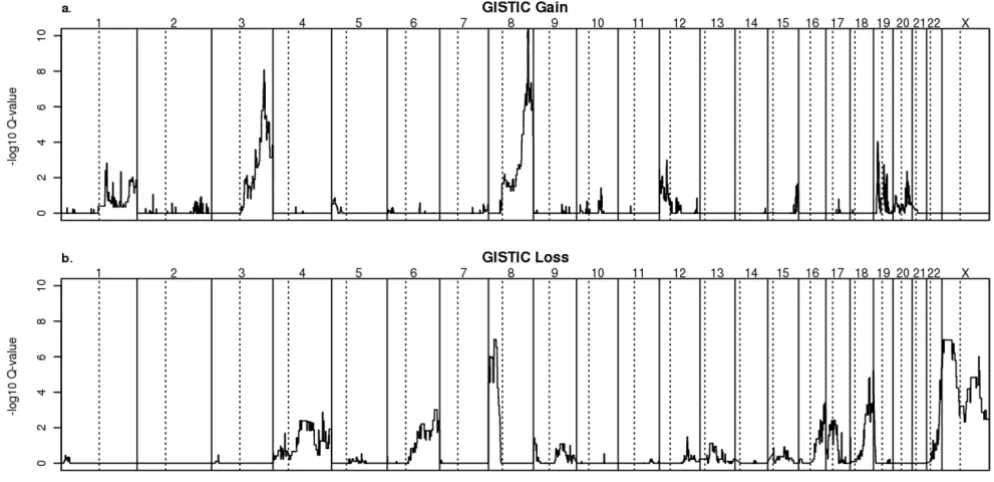
Given the potential for the selection of different CNAs in different ovarian cancer subtypes (Fig. 1), we elected to focus our search for the most significant recurrent CNAs on the 32 serous adenocarcinoma samples. Despite the complexity of genomic profiles of individual tumors, the plot of GISTIC-based Q-values reveals a relatively simple pattern of amplification (Fig. 2a). Using an FDR cutoff of 25% as the threshold, we identified 16 distinct minimal regions ("Gistic Peaks") of gain on chromosomes 1, 2, 3, 5, 8, 10, 12, 15, 17, 19, and 20 (see Additional file 6). When expanded to the cytoband level, many of these regions can be matched to regions previously reported
(see Additional file 1). GISTIC analysis of all 52 samples produced similar results with respect to the most signifi-cant gain and loss peaks.
Prioritization of potential driver genes with CNA-specific gene expression
To further facilitate the enrichment of driver genes in each minimal amplicon, we compared the expression levels of genes within the bounds of each GISTIC peak among three groups of samples 1) tumors with the CNA in ques-tion 2) tumors without that CNA and 3) a pool of normal whole ovary samples. Genes showing significant expres-sion differences among the three groups (1-way ANOVA) and between either groups 1 and 2 or 1 and 3 were judged to have significant "CNA-specific expression" (see Meth-ods). While increased or decreased gene expression accompanying DNA gain or loss does not necessarily indi-cate functional significance, the lack of such a change would suggest that a gene is likely a passenger gene. Inter-estingly, only a small number of genes in the GISTIC peak regions display CNA-specific expression patterns (Addi-tional files 6, 7, 8). By making these multiple comparisons we can avoid false-negatives that could arise due to other cancer-specific mechanisms of expression dis-regulation
Selection of Statistically Significant Recurrent Copy Number Alterations Figure 2
or differences in cell-type proportions in tumor and whole ovary normal samples.
The whole ovary normal samples available in our data set may not be optimal references. The epithelial portion of the ovary, which is believed to give rise to ovarian serous adenocaricinoma, comprises a small portion of the whole ovary [22]. Therefore, we have cross-referenced our expression findings to Laser Capture Micro-dissected (LCM) ovarian serous adenocarcinoma and LCM normal fallopian epithelia from a public data set (GSE10971), as described in the following sections.
Enrichment for Cancer Census genes using copy number and gene expression
Although individual driver genes cannot be definitively determined in this study, we can estimate whether our approach leads to the enrichment of known cancer genes. All 364 genes in the Cancer Gene Census set [33] were selected to represent known cancer genes. We did not select only ovarian-cancer-specific genes as cancer genes tend to be relevant to more than one tissue. We detected a significant enrichment of Cancer Gene Census genes in the GISTIC Peak regions (one-sided Fisher's Exact, P-value = 4.06e-2, odds ratio 1.46). Selecting for only those genes in the GISTIC Peak regions with CNA-specific expression patterns showed an even higher degree of significance (one-sided Fisher's Exact Test, P-value = 1.08e-3, odds ratio 2.24).
GISTIC gain peaks contain a small number of over-expressed genes
We examined several GISTIC peak regions in detail. The most significant region of gain was 8q24 where 59% of samples showed gain. This region contains only MYC,
PVT1, TMEM75 and a cluster of four microRNAs (Fig. 3). In samples with this amplicon, MYC, PVT1 and TMEM75
do not show CNA-specific expression although the scores for MYC are suggestive (ANOVA FDR 0.02, Cancer with CNA vs. Cancer without CNA FDR 0.10, log2 ratio 0.75). Unexpectedly, in tumors with gain in this region, MYC is expressed at a level slightly less than the level in normal tissues (log2 ratio -0.12). Data on 25 of the 32 serous ade-nocarcinoma samples and 51 whole ovary normals from the Affymetrix U133 Plus 2.0 array shows similar data for
MYC. However, this newer array offers a probeset with probes distributed along the length of PVT1
(1558290_a_at). This probeset shows that PVT1 is over-expressed relative to non-amplified samples (2.5×) and to normal (1.6×) (Fig. 3c). The LCM data did not show sig-nificant expression difference between cancer and normal samples for any gene at this locus.
The region 3q26.2 is the next most significant. It shows gain slightly more often than 8q24 (63%), but at a lower
level (2.91 copies among those showing gain relative to 3.21 copies, see Additional file 6). The most prominent peak on this chromosome is located at 3q26.2, but an interesting secondary peak can be observed at 3q26.31 (Fig. 4a). The first peak contains eight significantly over-expressed genes, EVI1, MDS1, MYNN, TLOC1, GPR160,
PHC3, PRKCI, and SKIL. PRKCI has been shown to be a target of amplification in ovarian cancer that contributes to transformation in cooperation with mutant Ras in addition to contributing to anchorage independent growth [17]. These genes generally show dramatic up-reg-ulation in samples with this amplicon, relative to normal ovary samples, and less over-expression in cancer samples with this amplicon relative to those without (Fig. 4d). Interestingly, CLDN11 shows dramatic under-expression in cancer, especially in samples with this amplicon. The LCM data set shows over-expression of CLDN11, MYNN,
PRKCI, and SKIL in ovarian serous adenocarcinoma.
The 3q26.2 amplicon is adjacent to an interesting focal amplification. This region contains 5 genes, of which only
TNFSF10, AADACL1 and ECT2 show over-expression in tumors with this amplification relative to normal whole ovary (Fig. 4e). A heatmap of aberrations on chromosome 3 (see Additional file 9) suggests that this adjacent peak results from one focal, high-level amplification in one sample in addition to frequent gain of a much wider region of 3q. This may explain why it not classified as a secondary significant peak by GISTIC's Peel-Off method (see Methods). Interestingly, PIK3CA, which has been sug-gested as an oncogene and driver of 3q gain in ovarian cancer [16], is not within either peak, although it is located in the shoulder region of the 3q26.2 peak. Gain of
PIK3CA is less prevalent (49%) than at the major 3q peak in our samples (63%). The LCM data set shows significant over-expression of ECT2 (FDR 5.00e-4, cancer/normal ratio 1.88) and suggests over-expression of TNFSF10 (FDR 0.014, cancer/normal ratio 1.78).
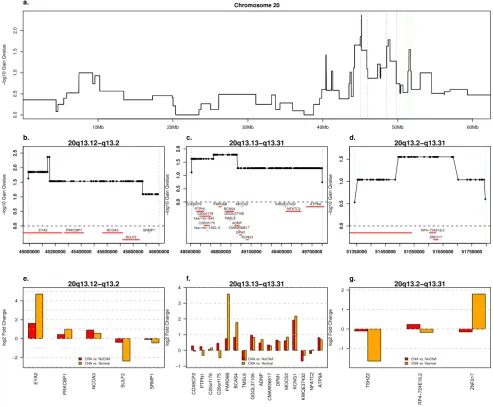
GISTIC selects one significant peak on chromosome 20 (see Additional file 6). The most significant peak, at 20q13.12, spans a genomic region that shows gain in 28% of samples and shows significant over-expression of EYA2,
PRKCBP1, and NCOA3 (Fig. 5b, e). Closer inspection of the Q-values in this region reveals three narrow peaks (Fig. 5a), which is in line with previous findings of three cores of amplification in this region [39]. The second region, at 20q13.12-q13.13, shows gain in 31% of samples and spans 16 genes represented on the expression array (Fig. 5c, f). Of these PARD6B, BCAS4, and KCNG1 are expressed greater than two-fold higher in cancer samples with the amplification relative to normal (Fig. 5f). The third peak, also gained in 32% of samples, contains three genes represented on the expression array (Fig. 5d). Only
cancer [40] shows over-expression in cancer samples with this amplification (Fig. 5g). A broader and less prevalent (25%) peak containing AURKA is visible distal to this region. AURKA showed a log2 ratio of 0.95 in tumors with AURKA gain relative to those without and a log2 ratio of 1.43 in those tumors relative to normal whole ovary. Inspection of a heatmap of this region (See Additional file 9) shows some independent support for these secondary peaks although the focus of ZNF217 peak is formed by
one narrow, high-level aberration. Of these chromosome 20 genes, only ZNF217 (FDR 2.67e-2, cancer/normal ratio 1.57) and AURKA (FDR 5.52e-5, cancer/normal ratio 2.32) were also significant in the LCM data set. Amplifica-tion of 20q13 may be particularly heterogeneous as
AURKA [41], TGIF2, PTPN1 and ZNF217 [39], and
ADRM1 [42], and other genes, have been cited as drivers of 20q13 amplification in ovarian cancer.
Chromosome 8 Amplifications and Associated Expression Changes Figure 3
Chromosome 8 Amplifications and Associated Expression Changes. a) GISTIC Q-values for gain on chromosome 8, plotted as in Fig. 2. b) Close-up of the region of panel "a" indicated by vertical, red lines. The locations of all genes associated with a RefSeq transcript or Affymetrix probeset are indicated in red. c) Expression ratios for genes in the genome region depicted in panel "b" and represented on the U133A and B arrays. The probeset with the highest variance in cancer samples was selected for each gene. Red bars indicate the log2 ratio of the mean value in tumor samples with copy gain of this gene and the mean value in tumor samples without gain of this gene. Orange bars represent the log2 ratio of the mean value in samples with copy gain of this gene and the mean expression level in the normal whole ovary samples.
−log10 Gain Qvalue
Chromosome 8
20Mb 40Mb 60Mb 80Mb 100Mb 120Mb 140Mb
02468
1
0
a.
−log10 Gain Qvalue
128600000 129000000 129400000 129800000 130200000
02468
1
0
1
2
8q24.21−q24.22
MYC PVT1 TMEM75 hsa−mir−1205
hsa−mir−1206 hsa−mir−1207
hsa−mir−1208 b.
MYC PVT1
TMEM75
log2 Fold Change
−0.5 0.0 0.5 1.0
Expression data points to potential tumor suppressors in broader recurrent deletions
GISTIC peaks for deletion were reported on chromosomes 4, 6, 8, 9, 12, 13, 15, 16, 17, 18, 19, 22, and X (see Addi-tional file 7). The p-arms of chromosomes X and 8 are the dominant features (Fig. 2b), which we examined in fur-ther detail to identify potential tumor suppressors.
The GISTIC peak on chromosome X spans 4.6 Mb of Xp22.31 and includes 17 genes with RefSeq or Affymetrix annotation. Of these, 8 genes showed a significant decrease in expression in tumor samples with this dele-tion relative to tumors samples without this deledele-tion:
ARSD, ARSE, MXRA5, PRKX, LOC729137, NLGN4X,
HDHD1A, and STS (see Additional files 7, 8). Chromosome 3 Amplifications and Associated Expression Changes
Figure 4
Chromosome 3 Amplifications and Associated Expression Changes. a) GISTIC Q-values for gain on chromosome 3, plotted as in Fig. 2. b) Close-up of the region of panel "a" indicated by vertical, red lines. The locations of all genes associated with a RefSeq transcript or Affymetrix probeset are indicated in red. c) Close-up of the region of panel "a" indicated by vertical, blue lines. The locations of all genes associated with a RefSeq transcript or an Affymetrix probeset are indicated in red. d) Expression ratios for genes in the genome region depicted in panel "b" and represented on the U133A and B arrays. The probeset with the highest variance in cancer samples was selected for each gene. Red bars indicate the log2 ratio of the mean value in tumor samples with copy gain of this gene and the mean value in tumor samples without gain of this gene. Orange bars represent the log2 ratio of the mean value in tumor samples with copy gain of this gene and the mean expression level in the normal samples. e) Expression ratios for genes in the genome region depicted in panel "c", plotted as in panel "d".
−log10 Gain Qvalue
Chromosome 3
50Mb 100Mb 150Mb
02468
a.
−log10 Gain Qvalue
169400000 169800000 170200000 170600000 171000000 171400000
02468
3q26.2−q26.31
hsa−mir−551b LOC253820 EVI1 MDS1
TERC
ARPM1 MYNN LRRC34 LOC344657
LRRC31 SAMD7
TLOC1 GPR160
PHC3 PRKCI
SKIL AQVR36834
CLDN11 FLJ37228
SLC7A b.
−log10 Gain Qvalue
173000000 173200000 173400000 173600000 173800000 174000000
02468
3q26.31−q26.32
LOC375380 FNDC3B GHSR TNFSF10 AADACL1
WPNS18320 ECT2 c.
LOC253820
EVI1
MDS1
ARPM1 MYNN LRRC34 LRRC31 TLOC1
GPR160
PHC3 PRKCI SKIL
AQVR36834
CLDN11 SLC7A14
log2 Fold Change
−4 −2 0 2
CNA vs. NoCNA CNA vs. Normal 3q26.2−q26.31 d.
PLD1
LOC375380
FNDC3B
GHSR
TNFSF10 AADACL1
WPNS18320
ECT2
log2 Fold Change
−3 −2 −1 0 1 2 3
GISTIC identifies chromosome 8p as the autosome with the most statistically significant deletion. The most signif-icant GISTIC peak in the 8p region spans 8p21.3 (Fig. 6). Although this extended peak contains 63 genes only 31 show significant down-regulation (see Additional files 7, 8). Among these are a number of pro-apoptotic proteins. The minimal peak includes the death receptors
TNFRSF10A (DR4) and TNFRSF10B (DR5), the decoy death receptors TNFRSF10C and D (see Additional file 7) and all but TNFRSF10C show significant down-regula-tion. EGR3, which has been reported to induce the expres-sion of the death ligand FASL [43] is among the most dramatically down-regulated genes in this GISTIC Peak.
Loss of Heterozygosity (LOH) was also analyzed to further characterize likely tumor suppressor genes (See Methods). LOH was indicated frequently throughout the genome, but without any clearly preferred regions (data not shown).
Associations among prevalent gains and losses
The correlation of the occurrence of the recurrent CNAs was studied to assess potential interactions among the prevalent CNAs. The Pearson's correlation of the copy number values in all pairs of the 30 genomic regions iden-tified by GISTIC (16 gain and 14 loss) was calculated. Chromosome 20 Amplifications and Associated Expression Changes
Figure 5
Chromosome 20 Amplifications and Associated Expression Changes. GISTIC Q-values and expression ratios for three regions of chromosome 20 plotted as in Fig. 2. Probeset 230533_at was eliminated as it mapped to the extreme 5' end of the PRKCBP1 transcript and disagreed with the majority of the other 6 probesets for that gene.
−log10 Gain Qvalue
Chromosome 20
10Mb 20Mb 30Mb 40Mb 50Mb 60Mb
0.0
0.5
1.0
1.5
2.0
a.
−log10 Gain Qvalue
45000000 45200000 45400000 45600000 45800000 46000000
0.0
0.5
1.0
1.5
2.0
2.5
20q13.12−q13.2
EYA2 PRKCBP1 NCOA3
SULF2 SRMP1 b.
−log10 Gain Qvalue
48500000 48800000 49100000 49400000 49700000
0.0
0.5
1.0
1.5
2.0
20q13.13−q13.31
COX6CP2 PTPN1
C20orf176 hsa−mir−645 C20orf175 hsa−mir−1302−5
PARD6B BCAS4
TMSL6 GGQL37106
ADNP CMAW36817
DPM1 MOCS3
KCNG1
KWQE37432 NFATC2
ATP9A c.
−log10 Gain Qvalue
51350000 51450000 51550000 51650000 51750000
0.0
0.5
1.0
1.5
20q13.2−q13.31
RP4−724E16.2 ZNF217 d.
EYA2
PRKCBP1
NCOA3 SULF2 SRMP1
log2 Fold Change
−2 0 2 4
CNA vs. NoCNA CNA vs. Normal 20q13.12−q13.2 e.
COX6CP2
PTPN1
C20orf176 C20orf175 PARD6B BCAS4 TMSL6
GGQL37106
ADNP
CMAW36817
DPM1
MOCS3 KCNG1
KWQE37432
NFATC2 ATP9A
log2 Fold Change
−1 0 1 2 3 4
CNA vs. NoCNA CNA vs. Normal 20q13.13−q13.31 f.
TSHZ2
RP4−724E16.2
ZNF217
log2 Fold Change
−1 0 1 2
After correcting for multiple testing, 17 distinct pairs showed a FDR of < 25% (see Additional file 10).
Two adjacent GISTIC peaks on chromosome 19 are the most significantly correlated, likely because they are often co-amplified. The next most significant association is between 12p12.1, which over-expressed BCAT1 and is adjacent to KRAS, and 15q26.3, which contains IGF1R
among other genes. Associations were detected between the BCAT1 and IGF1R peaks and the 8q24 peak contain-ing MYC and PVT1. Curiously, the only anti-correlations among the significant interactions involve the IGF1R gain peak (4/5) or the IGF2R loss peak (1/5). These anti-corre-lations may indicate that alteration of signalling through the IGF axis may create selective pressure against acquiring certain other aberrations. Interestingly the deletion of the death receptors TNFRSF10A and TNFRSF10B on chromo-some 8p did not correlate with the amplification of their ligand TNFSF10 on chromsome 3q.
Discussion
We have applied high-resolution SNP arrays to survey the diversity of copy number alterations in ovarian cancer. Statistical analysis of the frequency and magnitude of these changes across the genome has identified the most significant changes. The analysis of expression changes correlated with these events has greatly reduced the field of potential "driver" genes for these most relevant CNAs. Co-occurrence analyses of these significant CNAs
sug-gested potential synergistic or antagonistic relationships between some of the CNAs. Comparisons of subtypes and matched primary/metastatic samples have revealed potential differences among ovarian cancer subtypes and striking similarity among samples from the same patient. As a whole, these analyses provide a unique view of ovar-ian cancer and insight into key CNAs and their driver genes.
The strategy used here to evaluate CNA-specific expression changes highlights the difficulty of assigning CNA driver gene status on the basis of expression. Many likely candi-date drivers were shown to have CNA-specific expression differences relative to tumors lacking the CNA in question and to whole ovary. However, the difference was often more dramatic when compared to normal samples than when compared to tumors lacking the CNA in question. Likely this is due to other mechanisms of expression dis-regulation in cancer that have an effect on expression sim-ilar to that of the CNA [28]. Additionally, differences between the mix of cell types in a tumor and whole ovary normal samples may cause certain disparities. For exam-ple, amplified CLND11 is reported as under-expressed when compared to our whole ovary normal samples, but is over-expressed when comparing LCM ovarian cancer and normal fallopian epithelium. Unexpected results such as this highlight the importance of using more than one reference expression level.
Chromosome 8 Deletions and Associated Expression Changes Figure 6
Chromosome 8 Deletions and Associated Expression Changes. a) GISTIC Q-values for loss on chromosome 8, plot-ted as in Fig. 2. b) Expression ratios for genes in the genome region depicplot-ted by blue dotplot-ted lines in panel "a" and represenplot-ted on the HGU133A and B arrays. Red bars indicate the log2 ratio of the mean value in tumor samples with copy gain of this gene and the mean value in tumor samples without gain of this gene. Orange bars represent the log2 ratio of the mean value in tumor samples with copy gain of this gene and the mean expression level in the normal samples.
−log10 Loss Qvalue
Chromosome 8
20Mb 40Mb 60Mb 80Mb 100Mb 120Mb 140Mb
0246
a.
PSD3
SH2D4A
LKGC12933
ChGn
INTS10
LPL
SLC18A1 ATP6V1B2
LZTS1
LOC286114
GFRA2 DOK2 XPO7 NPM2 FGF17 EPB49 RAI16
NUDT18
HR
REEP4
LGI3
SFTPC BMP1 PHYHIP POLR3D PIWIL2
SLC39A14 PPP3CC SORBS3 PDLIM2 C8orf58
KIAA1967
BIN3
FLJ14107
EGR3
PEBP4
RHOBTB2
TNFRSF10B LOC375653 MGC31957 TNFRSF10C TNFRSF10D TNFRSF10A LOC375654 CHMP7 R3HCC1 LOXL2 ENTPD4
SLC25A37 PRO1496 clone 4−3
NKX3−1
STC1
ADAM28
ADAMDEC1
ADAM7 NEFM NEFL
log2 Fold Change
−4 −3 −2 −1 0 1 2
The expression pattern of the amplified MYC oncogene, especially relative to its neighbor PVT1, presents another interesting example of this phenomenon. The relatively minor expression change in tumors with MYC amplifica-tion may be due to over-expression of MYC in a subset of the non-amplified tumors through alternate mechanisms. The apparent under-expression of MYC upon amplifica-tion relative to whole ovary normal samples could be due to different cell type proportions in the tumor and normal samples. The LCM tumor and normal data set provides no clarity, as it did not show significant over-expression of
MYC or PVT1.
Despite the long history of MYC as an oncogene, recent evidence suggests that PVT1 may be a driver of this ampli-con. While MYC and PVT1 knock-downs both reduced proliferation of breast and ovarian cancer cell lines with amplification and over-expression of MYC and PVT1, knock-down of PVT1 in these lines also elicited a strong apoptotic response. Knock-down of MYC did not [44]. Mouse T-cell lymphomas show retroviral insertions at
PVT1 and over-expression of PVT1 and one of PVT1's microRNA products and more retroviral insertions are seen at the PVT1 locus than at the MYC locus [45]. Many transformed cell types, including neuroblastomas, express
PVT1 and do not express MYC [46]. In the end, both genes may be important in the context of their amplification as
PVT1 may be regulated by MYC [46] and PVT1-encoded microRNAs may regulate MYC [47].
The functions of these putative driver genes, selected on the basis of their location in the GISTIC peak and copy-driven expression, suggest an important role for apopto-sis-related genes in this cohort of tumors. Genes showing significant CNA-specific expression changes were submit-ted to the Ingenuity Knowledge Base (Ingenuity Systems®,
http://www.ingenuity.com) in order to determine if the GISTIC peaks highlight related genes. CNA-specific genes were selected rather than all genes with cancer-specific expression in order to detect direct relationships among genes in GISTIC peaks. The most significantly over-repre-sented network inferred from pairs of associated genes documented in the Knowledge Base shows relationships among CASP8, CASP10, and CFLAR (gained on chromo-some 2), DIABLO (gained on chromosome 12), NFKBIB
(IKB) (gained on chromosome 19), and the TNFRSF10
family (deleted on chromosome 8) (see Additional file 11). Additionally, we have shown amplification of the
TFNSF10 chromosome 3, although this was not among
the GISTIC peaks. Analysis of the over-representation of genes from canonical pathways among the genes with sig-nificant CNA-specific expression changes shows that Death Receptor signaling is among the most significant pathways (Additional file 12). Taken as a whole, these
findings indicate that modulation of apoptosis may be a major driving factor in the selection of CNAs.
Conclusion
Based on these analyses, we believe that the identification of driver genes in tumor amplicons can be greatly facili-tated by selecting statistically significant minimal recur-rent amplicons and by studying gene expression patterns in conjunction with gene network data. The combination of the expression and high-resolution copy number data has provided a short list of candidate genes that are con-sistent with tumor driving roles.
Competing interests
The authors declare that they have no competing interests.
Authors' contributions
PMH carried out the copy number analyses, the analysis of gene expression in regions of CNA, and the pathway analyses, and drafted the manuscript. LSH participated in the "Cancer Gene" over-representation analysis. JSK par-ticipated in the gene network analysis. JC conceived of the study, and participated in its design and coordination. ZZ participated in study design and coordination and helped to draft the manuscript. All authors read and approved the final manuscript.
Additional material
Additional file 1
Table S1: Comparison To Previously Reported Recurrent CNAs. The table lists published examples of regions of gain and loss in ovarian cancer.
Click here for file
[http://www.biomedcentral.com/content/supplementary/1755-8794-2-21-S1.xls]
Additional file 2
Table S2: Sample Information. The table provides the available clinical details for each tumor sample.
Click here for file
[http://www.biomedcentral.com/content/supplementary/1755-8794-2-21-S2.xls]
Additional file 3
Figure S1: Copy Number Alteration Trends by Subtype. Raw copy number values were segmented into contiguous regions with the same copy number, or segments. The average log2 cancer/normal ratio of each
seg-ment is inferred as that segseg-ment's log2 ratio (See Methods). a) The
number of transitions from segment to another (breakpoints) per sample, stratified by ovarian cancer subtype. b) The sum of segment log2 ratios that
are > 0.3 (gain) in each sample, stratified by subtype. c) The sum of the log2 ratios for each segment that are < -0.3 (loss) in each sample, stratified
by subtype.
Click here for file
Acknowledgements
The authors would like to thank Guy Cavet, Jane Fridlyand, Steven Guer-rero, William Forrest, Kenneth Jung, Shiuh-Ming Luoh, Zora Modrusan, Rich Neve, David Stokoe, Thomas Wu and Jiping Zha for thoughtful discus-sions and technical assistance and Fred de Sauvage and William Wood for their support. The authors would like to acknowledge the GeneLogic Cor-poration for preparing the raw SNP and expression data.
References
1. Jemal A, Siegel R, Ward E, Murray T, Xu J, Smigal C, Thun MJ: Cancer statistics, 2006. CA: a cancer journal for clinicians 2006,
56(2):106-130.
2. Bernardini M, Lee CH, Beheshti B, Prasad M, Albert M, Marrano P, Begley H, Shaw P, Covens A, Murphy J, et al.: High-resolution map-ping of genomic imbalance and identification of gene expres-sion profiles associated with differential chemotherapy response in serous epithelial ovarian cancer. Neoplasia 2005,
7(6):603-613.
3. Caserta D, Benkhalifa M, Baldi M, Fiorentino F, Qumsiyeh M, Moscarini M: Genome profiling of ovarian adenocarcinomas using pangenomic BACs microarray comparative genomic hybridization. Molecular Cytogenetics 2008, 1(1):10.
4. Cheng KW, Lahad JP, Kuo WL, Lapuk A, Yamada K, Auersperg N, Liu J, Smith-McCune K, Lu KH, Fishman D, et al.: The RAB25 small GTPase determines aggressiveness of ovarian and breast cancers. Nat Med 2004, 10(11):1251-1256.
5. Gorringe KL, Jacobs S, Thompson ER, Sridhar A, Qiu W, Choong DY, Campbell IG: High-resolution single nucleotide polymorphism array analysis of epithelial ovarian cancer reveals numerous microdeletions and amplifications. Clin Cancer Res 2007,
13(16):4731-4739.
6. Kim SW, Kim JW, Kim YT, Kim JH, Kim S, Yoon BS, Nam EJ, Kim HY:
Analysis of chromosomal changes in serous ovarian carci-noma using high-resolution array comparative genomic hybridization: Potential predictive markers of chemoresist-ant disease. Genes, chromosomes & cancer 2007, 46(1):1-9. 7. Nakayama K, Nakayama N, Jinawath N, Salani R, Kurman RJ, Shih Ie
M, Wang TL: Amplicon profiles in ovarian serous carcinomas.
International journal of cancer 2007, 120(12):2613-2617.
8. Nanjundan M, Nakayama Y, Cheng KW, Lahad J, Liu J, Lu K, Kuo WL, Smith-McCune K, Fishman D, Gray JW, et al.: Amplification of MDS1/EVI1 and EVI1, located in the 3q26.2 amplicon, is associated with favorable patient prognosis in ovarian can-cer. Cancer research 2007, 67(7):3074-3084.
Additional file 4
Figure S2: Copy Number Profiles of Matched Primary and Metastatic Samples. Heatmap of nine samples from four patients plotted and clus-tered as in Fig. 1. The primary/metastasis status of each sample and the ID of patient from which each sample was derived are annotated by color columns between the dendrogram and heatmap. Labels for these sample annotations are provided in a legend below the heatmap.
Click here for file
[http://www.biomedcentral.com/content/supplementary/1755-8794-2-21-S4.tiff]
Additional file 5
Figure S3: Comparison of CNA and CNV lengths. The length of each genomic segment of contiguous copy number (see Methods) is plotted as a histogram. a) Lengths for segments with an average log2 ratio > 0.3 (gain) are shown in red. Lengths of polymorphisms in normal populations reported as a gain of copy number [25] are plotted in blue. b) Segments with an average log2 ratio < -0.3 (loss) are shown in red. Lengths of pol-ymorphisms in normal populations reported as a loss of copy number [25] are plotted in blue.
Click here for file
[http://www.biomedcentral.com/content/supplementary/1755-8794-2-21-S5.pdf]
Additional file 6
Table 1: Recurrent Gain Regions. The table lists details regarding the significant regions of gain.
Click here for file
[http://www.biomedcentral.com/content/supplementary/1755-8794-2-21-S6.xls]
Additional file 7
Table 2: Recurrent Loss Regions. The table lists details regarding the sig-nificant regions of loss.
Click here for file
[http://www.biomedcentral.com/content/supplementary/1755-8794-2-21-S7.xls]
Additional file 8
Table S3: Significant Expression Differences in CNAs. The table pro-vides statistics for the copy-number-associated expression changes in each region of gain or loss.
Click here for file
[http://www.biomedcentral.com/content/supplementary/1755-8794-2-21-S8.xls]
Additional file 9
Figure S4: GISTIC and Heatmaps for CNAs on Chromosomes 3, 8, and 20. Details of the amplicon structure and statistical significance in 32 ovarian serous adenocarcinoma samples is presented for a) chromo-some 3; b) chromochromo-some 8; c) chromochromo-some 20. Heatmaps and GISTIC amplification significance were prepared and plotted as in Fig. 1 and 2.
Click here for file
[http://www.biomedcentral.com/content/supplementary/1755-8794-2-21-S9.tiff]
Additional file 10
Table S4: Interactions Among CNAs. The table provides statistics for the association among regions of gain and loss.
Click here for file
[http://www.biomedcentral.com/content/supplementary/1755-8794-2-21-S10.xls]
Additional file 11
Figure S5: Pathway Analysis of Genes with CNA-specific Expression. Pathway analysis inferred connectivity among genes in GISTIC peak regions of gain and loss with CNA-specific expression. Network nodes have been colored using the log2 ratio for expression change in tumor sam-ples with a given CNA relative to normal whole ovary. Green represents decreased expression and red indicates increased expression. White net-work nodes represent molecules not in our set of genes, but that are related to these genes through the Ingenuity database.
Click here for file
[http://www.biomedcentral.com/content/supplementary/1755-8794-2-21-S11.pdf]
Additional file 12
Table S5: Canonical Pathways Enriched in Genes with CNA-specific Expression. The table lists statistics regarding the over-representation of genes from canonical pathways in the regions of gain and loss.
Click here for file
9. Nowee ME, Snijders AM, Rockx DA, de Wit RM, Kosma VM, Hama-lainen K, Schouten JP, Verheijen RH, van Diest PJ, Albertson DG, et al.: DNA profiling of primary serous ovarian and fallopian tube carcinomas with array comparative genomic hybridiza-tion and multiplex ligahybridiza-tion-dependent probe amplificahybridiza-tion.
The Journal of pathology 2007, 213(1):46-55.
10. Park JT, Li M, Nakayama K, Mao TL, Davidson B, Zhang Z, Kurman RJ, Eberhart CG, Shih Ie M, Wang TL: Notch3 gene amplification in ovarian cancer. Cancer research 2006, 66(12):6312-6318. 11. Snijders AM, Nowee ME, Fridlyand J, Piek JM, Dorsman JC, Jain AN,
Pinkel D, van Diest PJ, Verheijen RH, Albertson DG: Genome-wide-array-based comparative genomic hybridization reveals genetic homogeneity and frequent copy number increases encompassing CCNE1 in fallopian tube carcinoma. Oncogene
2003, 22(27):4281-4286.
12. Greenman C, Stephens P, Smith R, Dalgliesh GL, Hunter C, Bignell G, Davies H, Teague J, Butler A, Stevens C, et al.: Patterns of somatic mutation in human cancer genomes. Nature 2007,
446(7132):153-158.
13. Haber DA, Settleman J: Cancer: drivers and passengers. Nature
2007, 446(7132):145-146.
14. Sjoblom T, Jones S, Wood LD, Parsons DW, Lin J, Barber TD, Man-delker D, Leary RJ, Ptak J, Silliman N, et al.: The consensus coding sequences of human breast and colorectal cancers. Science
2006, 314(5797):268-274.
15. Stephens P, Edkins S, Davies H, Greenman C, Cox C, Hunter C, Bignell G, Teague J, Smith R, Stevens C, et al.: A screen of the com-plete protein kinase gene family identifies diverse patterns of somatic mutations in human breast cancer. Nat Genet 2005,
37(6):590-592.
16. Shayesteh L, Lu Y, Kuo WL, Baldocchi R, Godfrey T, Collins C, Pinkel D, Powell B, Mills GB, Gray JW: PIK3CA is implicated as an oncogene in ovarian cancer. Nat Genet 1999, 21(1):99-102. 17. Zhang L, Huang J, Yang N, Liang S, Barchetti A, Giannakakis A,
Cadun-gog MG, O'Brien-Jenkins A, Massobrio M, Roby KF, et al.: Integra-tive genomic analysis of protein kinase C (PKC) family identifies PKCiota as a biomarker and potential oncogene in ovarian carcinoma. Cancer Res 2006, 66(9):4627-4635.
18. Beroukhim R, Getz G, Nghiemphu L, Barretina J, Hsueh T, Linhart D, Vivanco I, Lee JC, Huang JH, Alexander S, et al.: Assessing the sig-nificance of chromosomal aberrations in cancer: Methodol-ogy and application to glioma. Proc Natl Acad Sci USA 2007,
104(50):20007-20012.
19. Chin SF, Teschendorff AE, Marioni JC, Wang Y, Barbosa-Morais NL, Thorne NP, Costa JL, Pinder SE, Wiel MA van de, Green AR, et al.:
High-resolution aCGH and expression profiling identifies a novel genomic subtype of ER negative breast cancer. Genome Biol 2007, 8(10):R215.
20. Nigro JM, Misra A, Zhang L, Smirnov I, Colman H, Griffin C, Ozburn N, Chen M, Pan E, Koul D, et al.: Integrated array-comparative genomic hybridization and expression array profiles identify clinically relevant molecular subtypes of glioblastoma. Cancer research 2005, 65(5):1678-1686.
21. Pollack JR, Sorlie T, Perou CM, Rees CA, Jeffrey SS, Lonning PE, Tib-shirani R, Botstein D, Borresen-Dale AL, Brown PO: Microarray analysis reveals a major direct role of DNA copy number alteration in the transcriptional program of human breast tumors. Proc Natl Acad Sci USA 2002, 99(20):12963-12968. 22. Zorn KK, Jazaeri AA, Awtrey CS, Gardner GJ, Mok SC, Boyd J, Birrer
MJ: Choice of normal ovarian control influences determina-tion of differentially expressed genes in ovarian cancer expression profiling studies. Clin Cancer Res 2003,
9(13):4811-4818.
23. Lin M, Wei LJ, Sellers WR, Lieberfarb M, Wong WH, Li C: dChip-SNP: significance curve and clustering of SNP-array-based loss-of-heterozygosity data. Bioinformatics 2004,
20(8):1233-1240.
24. Hupe P, Stransky N, Thiery JP, Radvanyi F, Barillot E: Analysis of array CGH data: from signal ratio to gain and loss of DNA regions. Bioinformatics 2004, 20(18):3413-3422.
25. Iafrate AJ, Feuk L, Rivera MN, Listewnik ML, Donahoe PK, Qi Y, Scherer SW, Lee C: Detection of large-scale variation in the human genome. Nat Genet 2004, 36(9):949-951.
26. Diskin SJ, Eck T, Greshock J, Mosse YP, Naylor T, Stoeckert CJ Jr, Weber BL, Maris JM, Grant GR: STAC: A method for testing the significance of DNA copy number aberrations across
multi-ple array-CGH experiments. Genome research 2006,
16(9):1149-1158.
27. Rouveirol C, Stransky N, Hupe P, Rosa PL, Viara E, Barillot E, Rad-vanyi F: Computation of recurrent minimal genomic altera-tions from array-CGH data. Bioinformatics (Oxford, England) 2006,
22(7):849-856.
28. Aguirre AJ, Brennan C, Bailey G, Sinha R, Feng B, Leo C, Zhang Y, Zhang J, Gans JD, Bardeesy N, et al.: High-resolution characteri-zation of the pancreatic adenocarcinoma genome. Proc Natl Acad Sci USA 2004, 101(24):9067-9072.
29. Benjamini Y, Hochberg Y: Controlling the False Discovery Rate: a Practical and Powerful Approach to Multiple Testing. J R Statist Soc 1995, 57(1):289-300.
30. Hubbell E, Liu WM, Mei R: Robust estimators for expression analysis. Bioinformatics (Oxford, England) 2002, 18(12):1585-1592.
31. Edgar R, Domrachev M, Lash AE: Gene Expression Omnibus:
NCBI gene expression and hybridization array data reposi-tory. Nucleic Acids Res 2002, 30(1):207-210.
32. Downey T: Analysis of a multifactor microarray study using Partek genomics solution. Methods in enzymology 2006,
411:256-270.
33. Futreal PA, Coin L, Marshall M, Down T, Hubbard T, Wooster R, Rahman N, Stratton MR: A census of human cancer genes. Nat Rev Cancer 2004, 4(3):177-183.
34. Wu TD, Watanabe CK: GMAP: a genomic mapping and
align-ment program for mRNA and EST sequences. Bioinformatics (Oxford, England) 2005, 21(9):1859-1875.
35. Israeli O, Gotlieb WH, Friedman E, Korach J, Friedman E, Goldman B, Zeltser A, Ben-Baruch G, Rienstein S, Aviram-Goldring A:
Genomic analyses of primary and metastatic serous epithe-lial ovarian cancer. Cancer genetics and cytogenetics 2004,
154(1):16-21.
36. Buffart TE, Coffa J, Hermsen MA, Carvalho B, Sijp JR van der, Ylstra B, Pals G, Schouten JP, Meijer GA: DNA copy number changes at 8q11-24 in metastasized colorectal cancer. Cell Oncol 2005,
27(1):57-65.
37. Weir BA, Woo MS, Getz G, Perner S, Ding L, Beroukhim R, Lin WM, Province MA, Kraja A, Johnson LA, et al.: Characterizing the can-cer genome in lung adenocarcinoma. Nature 2007,
450:893-898.
38. Haverty PM, Fridlyand J, Li L, Getz G, Beroukhim R, Lohr S, Wu TD,
Cavet G, Zhang Z, Chant J: High-resolution genomic and
expression analyses of copy number alterations in breast tumors. Genes, chromosomes & cancer 2008, 47(6):530-542. 39. Watanabe T, Imoto I, Katahira T, Hirasawa A, Ishiwata I, Emi M,
Takayama M, Sato A, Inazawa J: Differentially regulated genes as putative targets of amplifications at 20q in ovarian cancers.
Jpn J Cancer Res 2002, 93(10):1114-1122.
40. Collins C, Rommens JM, Kowbel D, Godfrey T, Tanner M, Hwang SI, Polikoff D, Nonet G, Cochran J, Myambo K, et al.: Positional clon-ing of ZNF217 and NABC1: genes amplified at 20q13.2 and overexpressed in breast carcinoma. Proc Natl Acad Sci USA 1998,
95(15):8703-8708.
41. Chung CM, Man C, Jin Y, Jin C, Guan XY, Wang Q, Wan TS, Cheung AL, Tsao SW: Amplification and overexpression of aurora kinase A (AURKA) in immortalized human ovarian epithe-lial (HOSE) cells. Molecular carcinogenesis 2005, 43(3):165-174. 42. Fejzo MS, Dering J, Ginther C, Anderson L, Ramos L, Walsh C, Karlan
B, Slamon DJ: Comprehensive analysis of 20q13 genes in ovar-ian cancer identifies ADRM1 as amplification target. Genes, chromosomes & cancer 2008, 47(10):873-883.
43. Mittelstadt PR, Ashwell JD: Cyclosporin A-sensitive transcrip-tion factor Egr-3 regulates Fas ligand expression. Mol Cell Biol
1998, 18(7):3744-3751.
44. Guan Y, Kuo WL, Stilwell JL, Takano H, Lapuk AV, Fridlyand J, Mao JH, Yu M, Miller MA, Santos JL, et al.: Amplification of PVT1 con-tributes to the pathophysiology of ovarian and breast cancer.
Clin Cancer Res 2007, 13(19):5745-5755.
45. Beck-Engeser GB, Lum AM, Huppi K, Caplen NJ, Wang BB, Wabl M:
Pvt1-encoded microRNAs in oncogenesis. Retrovirology 2008,
5:4.
46. Carramusa L, Contino F, Ferro A, Minafra L, Perconti G, Giallongo A, Feo S: The PVT-1 oncogene is a Myc protein target that is overexpressed in transformed cells. Journal of cellular physiology
Publish with BioMed Central and every scientist can read your work free of charge "BioMed Central will be the most significant development for disseminating the results of biomedical researc h in our lifetime."
Sir Paul Nurse, Cancer Research UK
Your research papers will be:
available free of charge to the entire biomedical community
peer reviewed and published immediately upon acceptance
cited in PubMed and archived on PubMed Central
yours — you keep the copyright
Submit your manuscript here:
http://www.biomedcentral.com/info/publishing_adv.asp
BioMedcentral
47. Huppi K, Volfovsky N, Runfola T, Jones TL, Mackiewicz M, Martin SE, Mushinski JF, Stephens R, Caplen NJ: The identification of micro-RNAs in a genomically unstable region of human chromo-some 8q24. Mol Cancer Res 2008, 6(2):212-221.
Pre-publication history
The pre-publication history for this paper can be accessed here: