O R I G I N A L A R T I C L E
Open Access
The effects of toe grip training on physical
performance and cognitive function of
nursing home residents
Ryota Tsuyuguchi
1*, Satoshi Kurose
2, Takayuki Seto
3, Nana Takao
1, Aya Fujii
1, Hiromi Tsutsumi
2,
Shingo Otsuki
3and Yutaka Kimura
2Abstract
Background:Toe grip-related training requires individuals to actively exercise muscles that are not frequently used; therefore, it may improve not only toe grip strength but also cognitive function. The purpose of this study was to examine the effects of toe grip-related training on predictors of physical performance and cognitive function in nursing home residents.
Methods:A total of 35 nursing home residents (35 left and 35 right feet; mean age, 82.1 ± 7.9 years) were included in this study. The participants were divided into two groups: a training group and a control group. The Mini-Mental State Examination (MMSE) was used to assess the cognitive function of the participants, and the Fall Risk Index (FRI) was used to evaluate the risk of falls. Toe grip-related physical function was also assessed. Baseline endpoints were evaluated and the effects of toe grip-related training were examined following a 12-week training intervention. Results:The training group showed significant improvements in MMSE score, FRI score, toe grip strength, and the toe skill (TS) test; however, the control group did not show these changes. The training group showed significant increases inΔMMSE,Δtoe grip strength, andΔTS (right foot) than the control group. Stepwise regression analysis revealed thatΔtoe grip strength is an independent factor ofΔMMSE.
Conclusions:Toe grip training improves not only toe grip strength itself, but also cognitive function. Furthermore, change in toe grip strength was an independent factor of change in MMSE in those populations.
Trial registration:UMIN,UMIN000027437. Registered on 26 May 2017.
Keywords:Cognitive function, Nursing home residents, Toe grip strength, Toe grip training
Background
Toe grip strength has recently begun to gain attention. Toe gripping is performed using the flexor hallucis bre-vis, flexor hallucis longus, lumbricals, flexor digitorum brevis, and flexor digitorum longus muscles. Toe grip strength is related to both gait speed and the ability to balance on one leg and plays an important role in
con-trolling fall-related lower limb movements [1–3]. In
addition, muscle activity around the ankle joint is sup-ported by toe grip strength, because the crural muscles
achieved 30–50% integrated electromyography of the
maximum voluntary contraction during exertion of max-imal foot-ripping strength force in all positions [4]. The action of the toe is believed to be a strong predictor of falls because it plays an important role in balance con-trol. In our previous studies, logistic regression analysis performed in community-dwelling elderly people, with presence or absence of falls as the dependent variables, identified toe grip strength as an independent risk factor for falls [5]. Recently, a device has been developed to measure toe grip strength. Toe grip strength could be a useful measure to predict the likelihood of falls.
As Japan is becoming a“super-aged”society, the
num-ber of nursing home residents has increased. The inci-dence of falls is significantly higher in nursing home residents than in community-dwelling elderly people.
© The Author(s). 2019Open AccessThis article is distributed under the terms of the Creative Commons Attribution 4.0 International License (http://creativecommons.org/licenses/by/4.0/), which permits unrestricted use, distribution, and reproduction in any medium, provided you give appropriate credit to the original author(s) and the source, provide a link to the Creative Commons license, and indicate if changes were made. The Creative Commons Public Domain Dedication waiver (http://creativecommons.org/publicdomain/zero/1.0/) applies to the data made available in this article, unless otherwise stated. * Correspondence:[email protected]
1Department of Health Science, Graduate School of Medicine, Kansai Medical
While the rate of community-dwelling elderly people
who fall more than once per year is about 30% [6–8],
that of nursing home residents is 30–56% [9–11]. The
incidence of fall-related bone fractures is 0.5–8.4%, and 95% of fractures in nursing home residents are caused
by a fall [12, 13]. Falls and fractures reduce the quality
of life (QoL) of individuals because of severe physical and psychological distress and functional impairment; therefore, prevention of falls is extremely important in those populations. Although residents in a nursing or a care home tend to have high levels of activities of daily living (ADL), it is important to prevent a decline in the QoL of these individuals, caused by low levels of physical activity. In addition, it has been reported that dementia is related to falls [14]. Thus, a comprehensive interven-tion, not only for toe grip strength, but also for declining cognitive function and other related factors is required. Toe grip-related training requires individuals to actively exercise muscles that are not frequently used; therefore, it may improve not only toe grip strength but also cogni-tive function [15]. Previous studies have found that there is a limitation to the level of improvement in cognitive function that can be achieved with simple exercise [16]. The simple exercise structured moderate-intensity phys-ical activity program that included walking, resistance training, and flexibility exercises or a health education program of educational workshops and upper-extremity stretching. The dorsal and ventral premotor cortexes are activated by performing multiple tasks requiring move-ment of the fingers [17]. However, no studies have eval-uated both toe grip strength and cognitive function in nursing home residents. Thus, a study that develops training to improve toe grip strength and demonstrates the importance of toe grip strength in the prevention of falls and dementia is clinically significant.
We hypothesized that toe grip-related training would improve toe grip strength and cognitive function in nursing home residents. The purpose of this study was to examine the effects of toe grip-related training on predictors of physical performance (e.g., toe grip strength) and cognitive function in nursing home resi-dents. The results of this intervention study will contrib-ute to the aging society for the improvement of the current situation in the elderly populations.
Methods
Participants
A total of 35 nursing home residents (35 left and 35 right feet; mean age, 82.1 ± 7.9 years) from Joyo City, Kyoto, Japan, were included in this study. This facility has a maximum capacity of 50 people. The rate of certi-fication of long-term care insurance was 60.0% (from support level 1 to care level 2). In the long-term care in-surance system of Japan, when persons require
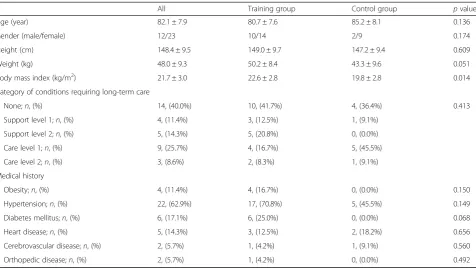
long-term care due to being bedridden or having dementia (a condition of need for long-term care) or support for daily life such as housework and dressing (a condition of need for support), they are eligible to receive nursing-care services. It is determined whether a person is in need for long-term care or in need for support, and if long-term care is needed, the level of nursing-care re-quirement is determined by the long-term care approval board located in municipalities and by insurers. The characteristics of nursing home residents are shown in Table1.
The participants were divided into two groups, accord-ing to whether they wished to participate in the health exercise program or not: the training group (the group
that received toe grip-related training, n= 24) and the
control group (the group was instructed not to make
any changes in their usual activities, n= 11). Nursing
homes are facilities specified by the act on social welfare
for the elderly aged≥60 years with low ADL
independ-ence and without a family or family support. Individuals with a visible toe deformity and those with cerebral palsy or those who have difficulty living by themselves inde-pendently were excluded from this study. The inclusion criteria required participants to be able to undergo the measurements required by the study protocol. Toe grip-related training was conducted three times per week for 12 weeks. The participants were instructed not to change their lifestyles. The training was conducted under staff supervision. Management of the training protocol was performed by the facility staff, who created a calendar at the start date and recorded the date and time of training performed by each participant. The control group was instructed to continue normal daily activities and not to do any special exercise.
The participants were explained the purpose of the study and the methods used during the distribution of questionnaires. Participants provided individual written informed consent during the collection of the question-naires. This study was approved by the Ethics Committee of Kansai Medical University (approval number: 1609).
Study protocol
The study protocol is shown in Fig.1. This was a
single-center non-randomized controlled study. Participants were subsequently divided into two groups: the training group (i.e., the group that received toe grip-related train-ing) and the control group (i.e., the group that was instructed to lead a totally normal life without toe grip-related training). Baseline endpoints were evaluated, and the effects of toe grip-related training were examined
following a 12-week intervention (Fig. 2). The primary
Endpoints
Measurement of toe grip strength
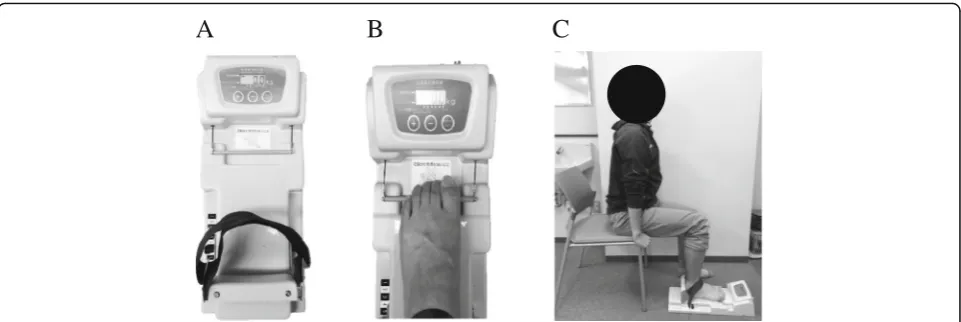
Measurement of toe grip strength is shown in Fig.3. A toe
grip dynamometer (T.K.K. 3361; Takei Scientific Instru-ments, Niigata, Japan) was used to measure toe grip strength. The reliability of this instrument has been
previ-ously reported (Fig. 3a) [18]. The usefulness of the
equipment in clinical settings and field research for people
aged 20–79 years has been established [18,19]. The
sub-stantial intra-rater and inter-rater reliabilities of the toe grip dynamometer, based on the criteria by Landis and Koch, indicate that it is suitable for clinical use [20]. The intraclass correlation coefficients (ICCs) of the toe grip
dynamometer are 0.97 (95% CI 0.93–0.99) [21]. The
Table 1Characteristics of nursing home residents at baseline
All Training group Control group pvalue
Age (year) 82.1 ± 7.9 80.7 ± 7.6 85.2 ± 8.1 0.136
Gender (male/female) 12/23 10/14 2/9 0.174
Height (cm) 148.4 ± 9.5 149.0 ± 9.7 147.2 ± 9.4 0.609
Weight (kg) 48.0 ± 9.3 50.2 ± 8.4 43.3 ± 9.6 0.051
Body mass index (kg/m2) 21.7 ± 3.0 22.6 ± 2.8 19.8 ± 2.8 0.014
Category of conditions requiring long-term care
None;n, (%) 14, (40.0%) 10, (41.7%) 4, (36.4%) 0.413
Support level 1;n, (%) 4, (11.4%) 3, (12.5%) 1, (9.1%)
Support level 2;n, (%) 5, (14.3%) 5, (20.8%) 0, (0.0%)
Care level 1;n, (%) 9, (25.7%) 4, (16.7%) 5, (45.5%)
Care level 2;n, (%) 3, (8.6%) 2, (8.3%) 1, (9.1%)
Medical history
Obesity;n, (%) 4, (11.4%) 4, (16.7%) 0, (0.0%) 0.150
Hypertension;n, (%) 22, (62.9%) 17, (70.8%) 5, (45.5%) 0.149
Diabetes mellitus;n, (%) 6, (17.1%) 6, (25.0%) 0, (0.0%) 0.068
Heart disease;n, (%) 5, (14.3%) 3, (12.5%) 2, (18.2%) 0.656
Cerebrovascular disease;n, (%) 2, (5.7%) 1, (4.2%) 1, (9.1%) 0.560
Orthopedic disease;n, (%) 2, (5.7%) 1, (4.2%) 0, (0.0%) 0.492
Data are presented as mean ± SD
The statistical analysis used in the Mann-WhitneyUtest and the chi-square test
The condition of need for support, including levels 1 and 2, is a condition in which a person is able to live almost by oneself but requires certain support for maintaining/improving physical activity as prevention against developing to the condition of need for long-term care. The condition of need for long-term care, including levels 1–5, is a condition requiring long-term care in which a person is in poor physical condition and has difficulty living alone
minimal change detectable using this instrument was shown to be 0.95 kg in our previous study [5]. Before measurement, patients were asked to practice several times. Then, we performed the measurement on both sides in duplicate and calculated the mean values of the better scores.
In order to perform a measurement, the grip bar of the instrument was adjusted to the first metatarsophalangeal joint of the participant (Fig.3b). The participant sat on the edge of their seat keeping their trunk in a vertical position, with both hands holding the chair, with hip and knee joints
bent to approximately 90° (Fig.3c). The measurement was
performed twice, on both right and left sides, after a few practice measurements. The highest values obtained were used for data analysis. Assessment was performed by two health fitness programmers.
Mini-Mental State Examination
Cognitive function was assessed using Mini-Mental State Examination (MMSE; point). The MMSE cutoff score is 23/24 points for cognitive dysfunction and 27/28 points
for mild cognitive impairment [22, 23]. The maximum
MMSE score is 30 points. The lower the score is, the higher the severity of cognitive disorders. A score of 20
A
B
C
D
E
F
to 24 suggests mild dementia: in this study, the cutoff for suspected dementia was set between 20 and 21. One-to-one interviews were conducted by survey staff using the MMSE questionnaire.
Fall Risk Index
Fall risk was assessed using the Fall Risk Index (FRI; point). The FRI is a fall risk prediction table consist-ing of 21 items (8 items coverconsist-ing physical function; 7 items studying cognition, sensory organs, and locomo-tive organs; 1 item looking at medication; and 5 items examining environmental factors) for early detection of a fall risk [24]. One-to-one interviews were con-ducted by survey staff using the FRI.
Physical function endpoints were measurement of toe grip strength, the toe skill test (TS), standing on one leg with eyes open, the 10 times sit-to-stand test (SS-10), the timed up and go (TUG) test, and the 5-min gait speed test.
Toe skill test
The toe skill test is shown in Fig.3. In the toe skill test, the participants performed rock-paper-scissors movements using their toes. Flexion of all the toes and the ability to op-pose the hallux were examined using the“rock”and“
scis-sors” movements, respectively. Toe abduction of both feet
and the ability to spread the toes without them touching
each other were examined using the “paper” movement.
The participants were given 1 point for each successful trial, with a maximum of 3 points possible. Assessment was per-formed by two health fitness programmers.
The evaluation of other physical fitness is shown in
Table 2.
Statistical analysis
All data are presented as mean ± standard deviation (SD)
or 95% confidence interval (CI). Changes (Δ) were
calcu-lated as differences between pre- and post-interventions. The minimal detectable change (MDC) was calculated by multiplying the standard error of measurement
A
B
C
Fig. 3Measurement of toe grip strength:aA toe grip dynamometer (T.K.K. 3361; Takei Scientific Instruments, Niigata, Japan) used to measure toe grip strength.bThe grip bar of the instrument was adjusted to the first metatarsophalangeal joint of the participant.cThe participants sat on the edge of their seat keeping their trunk in a vertical position, with both hands holding the chair and the hip and knee joints bent to
approximately 90°
Table 2Measurement sites
Site Measurement method
Standing on one leg with eyes open [25] The participants put their hands on their waist and stood on one leg with eyes open. The participants were performed twice and the highest score was recorded. Maximum value was 120 s.
10 times sit-to-stand test [26] This measurement started with standing using a 40-cm chair.
The elapsed time of 10 trials of the sit-to-stand movement was recorded.
Timed up and go [27] The distance between the edge of the participant’s chair and the distant edge of a mini-cone was 3 m.
The participants were instructed to check the position of the chair before sitting down.
5-m gait speed test [28] The maximum speed reached by participants.
(SEM) by 1.96 to correspond to the 95% confidence interval and the square root of 2 to adjust for sampling from baseline score. The distribution-based minimal clinically important difference (MCID) was estimated using the Cohen effect size benchmark. An effect size of 0.5 (i.e., SD of the baseline score) indicated an important change and was used as the MCID in this study. We performed the Shapiro-Wilk test to examine normality.
The Mann-Whitney Utest and the chi-square test were
performed to analyze comparisons of characteristics at baseline, change in variables between the training group and the control group. The Wilcoxon signed-rank test
was used for pre and post comparisons. Spearman’s rank
correlation coefficient was used to analyze the
correl-ation betweenΔtoe grip strength and ΔMMSE as well
as Δ physical function. A stepwise multiple regression
analysis was used for multivariable analysis, in order to
examine independent predictors ofΔMMSE. IBM SPSS
version 21.0 (IBM Co., Armonk, NY, USA) was used for statistical analysis. A p value of < 0.05 (two-tailed) was considered statistically significant.
Results
Comparison of baseline characteristics of participants
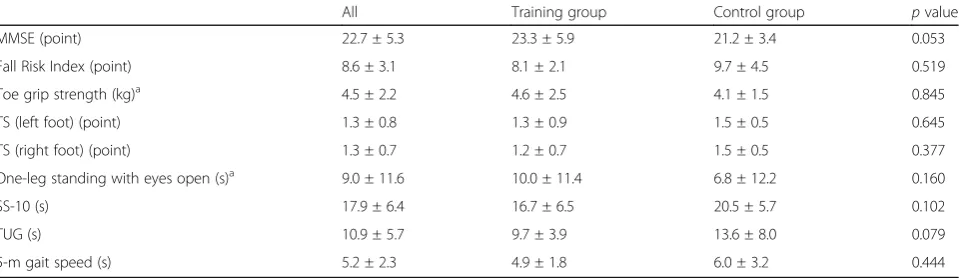
Table 3 shows the baseline characteristics for the
train-ing group and the control group. No significant differ-ences were observed in any factors between the two groups.
Intervention
The training group showed significant improvements in
MMSE (23.3 ± 5.9 to 24.9 ± 5.3 points, p= 0.024), FRI
(8.1 ± 2.1 to 6.8 ± 2.3 points, p= 0.003), toe grip strength (4.6 ± 2.5 to 6.5 ± 2.3 kg, p< 0.001), toe grip strength test (TS) (left foot) (1.3 ± 0.9 points to 1.9 ± 0.7 points, p= 0.009), and TS (right foot) (1.2 ± 0.7 to 1.8 ± 0.8 points,p= 0.003). In addition, SS-10 scores decreased significantly in
both the training group (16.7 ± 6.5 to 19.1 ± 8.7 s,p= 0.014) (Table4) and the control group (20.5 ± 5.7 to 27.1 ± 6.4 s,
p= 0.013). The MDC was 2.5 points in MMSE, 1.0 kg in
toe grip strength, and the MCID was 2.6 points in MMSE, 1.1 kg in toe grip strength at baseline.
Post-intervention in both groups showed significant
differences in MMSE (24.9 ± 5.3 to 20.2 ± 4.4 points,p=
0.005), FRI (6.8 ± 2.3 to 9.5 ± 3.6 points, p= 0.035), toe grip strength (6.5 ± 2.3 to 3.9 ± 1.6 kg, p= 0.002), SS-10 (19.1 ± 8.7 to 27.1 ± 6.4 s,p= 0.006), and TUG (10.2 ± 5.9 to 13.5 ± 5.6 s,p= 0.047).
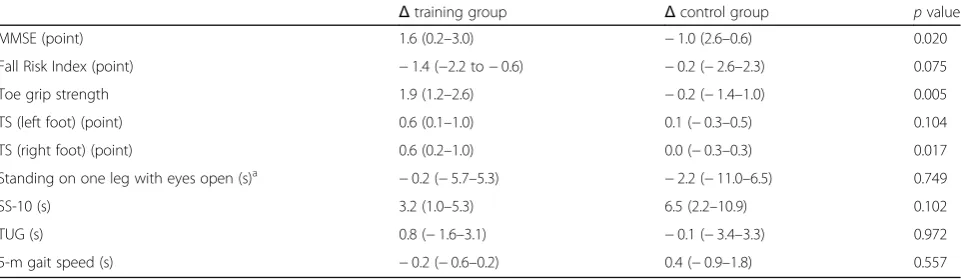
Comparisons of changes in scores collected at baseline and following intervention between the two groups are shown in Table5. The training group showed significant in-creases inΔMMSE [1.6 (0.2–3.0) to−1.0 (2.6–0.6) points, p= 0.020],Δtoe grip strength [1.9 (1.2–2.6) to−0.2 (−1.4– 1.0) kg,p= 0.005], andΔTS (right foot) [0.6 (0.2–1.0) to 0.0 (−0.3–0.3) points,p= 0.017] than the control group.
Correlations and multivariate analyses ofΔtoe grip strength andΔphysical function
The correlations between Δ toe grip strength and Δ
physical function are shown in Table 6. Δ toe grip
strength showed a significant positive correlation withΔ
MMSE (r= 0.415, p= 0.013). In contrast, there was no
significant correlation between Δ toe grip strength and
other items.
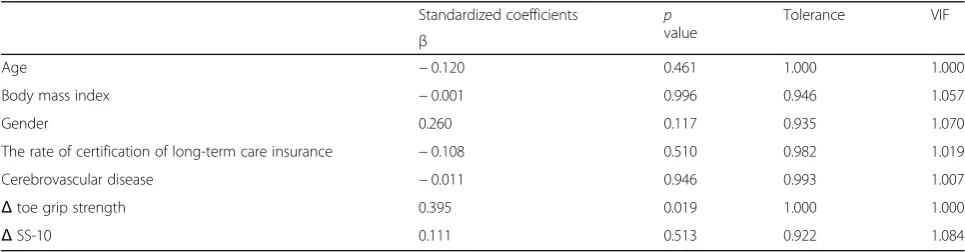
Thus, a stepwise multiple regression analysis was used
to identify the factors forΔcognitive function. The
mul-tiple regression analysis was performed using Δ MMSE
as a dependent variable, and Δ toe grip strength, Δ
SS-10, and adjustment factors (including age, gender, body mass index, the rate of certification of long-term care in-surance, and cerebrovascular disease) as independent variables. The results identified toe grip strength as the only independent risk factor (unstandardized coefficients
Table 3A comparison of baseline values between the training group and the control group
All Training group Control group pvalue
MMSE (point) 22.7 ± 5.3 23.3 ± 5.9 21.2 ± 3.4 0.053
Fall Risk Index (point) 8.6 ± 3.1 8.1 ± 2.1 9.7 ± 4.5 0.519
Toe grip strength (kg)a 4.5 ± 2.2 4.6 ± 2.5 4.1 ± 1.5 0.845
TS (left foot) (point) 1.3 ± 0.8 1.3 ± 0.9 1.5 ± 0.5 0.645
TS (right foot) (point) 1.3 ± 0.7 1.2 ± 0.7 1.5 ± 0.5 0.377
One-leg standing with eyes open (s)a 9.0 ± 11.6 10.0 ± 11.4 6.8 ± 12.2 0.160
SS-10 (s) 17.9 ± 6.4 16.7 ± 6.5 20.5 ± 5.7 0.102
TUG (s) 10.9 ± 5.7 9.7 ± 3.9 13.6 ± 8.0 0.079
5-m gait speed (s) 5.2 ± 2.3 4.9 ± 1.8 6.0 ± 3.2 0.444
Data are presented as mean ± SD
The statistical analysis used in the Mann-WhitneyUtest
MMSEMini-Mental State Examination,TStoe grip strength test,SS-1010 times sit-to-stand test,TUGtimed up and go
a
0.639, standardized coefficients 0.395, 95%CI 0.113– 1.166,r2= 0.131,p< 0.05) (Table7).
Discussion
The results of this study have established our hypothesis. The 12-week toe grip-related training program, which was performed three times per week, significantly im-proved MMSE score, FRI, toe grip strength, and TS. The control group was instructed to lead a totally normal life without performing any special exercise. Although there
were significant differences in both ΔMMSE and Δtoe
grip strength between the two groups, the value of SS-10 significantly decreased in both groups. To our know-ledge, this is the first study to demonstrate that toe grip training improves cognitive function and toe grip strength in nursing home residents. There were no oc-currences of trauma or injury during the study period.
In addition, there was a significant correlation between
Δ toe grip strength and Δ MMSE. The results of the
multivariable analysis, following adjustment for age, body mass index, gender, the rate of certification of long-term care insurance, and cerebrovascular disease,
still identifiedΔtoe grip strength as the only
independ-ent factor ofΔMMSE. It is believed that cognitive
func-tion can be improved by the effects of conscious toe grip training on factors including cerebral metabolism and cranial nerve activity, when the toes are not frequently exercised [15]. Thus, we found a whole-body coordin-ation in these populcoordin-ations. Voluntary exercises are re-quired because the toes are not exercised on a daily basis. In addition, it has been reported that performing toe exercises increases peripheral somatosensory input and cerebral blood flow in the primary somatosensory
area [29, 30]. Training intervention for the toes, which
are not routinely used, may improve cognitive function via an increase in the rate of cerebral blood flow. Based on the above, it is thought that toe grip training may contribute to an improvement in cognitive function. In
Table 4Measurements performed on the two groups
Training group Control group
Pre-intervention Post-intervention pvalue Pre-intervention Post-intervention pvalue
MMSE (point) 23.3 ± 5.9 24.9 ± 5.3 0.024 21.2 ± 3.4 20.2 ± 4.4 0.181
Fall Risk Index (point) 8.1 ± 2.1 6.8 ± 2.3 0.003 9.7 ± 4.5 9.5 ± 3.6 0.833
Toe grip strength (kg)a 4.6 ± 2.5 6.5 ± 2.3 < 0.001 4.1 ± 1.5 3.9 ± 1.6 0.878
TS (left foot) (point) 1.3 ± 0.9 1.9 ± 0.7 0.009 1.5 ± 0.5 1.5 ± 0.5 0.564
TS (right foot) (point) 1.2 ± 0.7 1.8 ± 0.8 0.003 1.5 ± 0.5 1.5 ± 0.5 1.000
Standing on one leg with eyes open (s)a 10.0 ± 11.4 9.9 ± 15.2 0.932 6.8 ± 12.2 4.6 ± 5.0 1.000
SS-10 (s) 16.7 ± 6.5 19.1 ± 8.7 0.014 20.5 ± 5.7 27.1 ± 6.4 0.013
TUG (s) 9.7 ± 3.9 10.2 ± 5.9 0.615 13.6 ± 8.0 13.5 ± 5.6 0.790
5-m gait speed (s) 4.9 ± 1.8 4.6 ± 1.6 0.415 6.0 ± 3.2 6.5 ± 3.9 0.657
Data are presented as mean ± SD
The statistical analysis used in the Wilcoxon signed-rank test and the Mann-WhitneyUtest
MMSEMini-Mental State Examination,TStoe grip strength test,SS-1010 times sit-to-stand test,TUGtimed up and go
a
The value is an average of scores from both legs
Table 5Comparison of changes between the training group and the control group
Δtraining group Δcontrol group pvalue
MMSE (point) 1.6 (0.2–3.0) −1.0 (2.6–0.6) 0.020
Fall Risk Index (point) −1.4 (−2.2 to−0.6) −0.2 (−2.6–2.3) 0.075
Toe grip strength 1.9 (1.2–2.6) −0.2 (−1.4–1.0) 0.005
TS (left foot) (point) 0.6 (0.1–1.0) 0.1 (−0.3–0.5) 0.104
TS (right foot) (point) 0.6 (0.2–1.0) 0.0 (−0.3–0.3) 0.017
Standing on one leg with eyes open (s)a
−0.2 (−5.7–5.3) −2.2 (−11.0–6.5) 0.749
SS-10 (s) 3.2 (1.0–5.3) 6.5 (2.2–10.9) 0.102
TUG (s) 0.8 (−1.6–3.1) −0.1 (−3.4–3.3) 0.972
5-m gait speed (s) −0.2 (−0.6–0.2) 0.4 (−0.9–1.8) 0.557
Data are presented as mean (95% CI)
The statistical analysis used in the Mann-WhitneyUtest
MMSEMini-Mental State Examination,TStoe grip strength test,SS-1010 times sit-to-stand test,TUGtimed up and go
a
the single variable correlation analysis of Δ toe grip
strength, only Δ MMSE was significantly correlated.
However, we considered that because this analysis took into account only two variables, it needs to be adjusted for age and gender, and thus, we used the stepwise
mul-tiple regression. In addition, Δ toe grip strength was
shown to be an independent predictor of Δ MMSE in
the present model, but only 13% of the variance was ex-plained and the presence of other influencing factors is expected.
The MDC and MCID of toe grip strength were 1.0 and 1.1 kg at baseline in this study, respectively. In this study, the change in toe grip strength was identified to be meaningful at 1.9 kg. Conversely, because the MDC and MCID of MMSE were 2.5 and 2.6 points, respect-ively, at baseline in this study, the possibility of measure-ment error remains, and the clinical significance of improvements of 1.6 points was unclear. It was however an interesting finding that warrants further investigation. The change in MMSE between the two groups showed a significant difference, and the MMSE in the non-inter-vention groups did not show a significant change (range
−0.1 to 0.7 points) in the 12-week intervention study for
the elderly [31, 32]. Thus, we believe that a change of
1.6 points is induced by toe grip training and has im-portant physiological implications. At least, toe grip training had an effect of toe grip strength and toe skill, and toe grip strength was an independent factor of
change in MMSE (Table6).
On the other hand, toe grip training did not improve predictors of physical performance other than toe grip strength, and SS-10 scores decreased significantly in both groups. The toe grip training performed in this study seems to have improved the ability to press the toes downward and grip with the toes by directly affect-ing them. The activity of the flexor digitorum longus promotes the simultaneous contraction of the leg muscle and the muscles surrounding the ankle joint and is
in-volved in multi-joint functions [1–5]. The reason that
static or dynamic balance and gait function did not im-prove in this study may be that the contraction of the flexor digitorum longus causes the functional chain movement of the lower extremities through indirect ef-fects. In other words, toe grip training alone is not
Table 6Correlations betweenΔtoe grip strength andΔcognitive and physical function
Δtoe grip strength
Correlation coefficient pvalue (two-tailed)
ΔMMSE 0.415 0.013
ΔFall Risk Index −0.272 0.114
ΔTS (left foot) 0.102 0.562
ΔTS (right foot) 0.120 0.491
Δone-leg standing with eyes open −0.226 0.193
ΔSS-10 −0.300 0.079
ΔTUG −0.013 0.940
Δ5-m gait speed 0.177 0.309
The single correlation analysis used in Spearman’s rank correlation coefficient
MMSEMini-Mental State Examination,TStoe grip strength test,SS-1010 times sit-to-stand test,TUGtimed up and go
Table 7Stepwise multiple regression analysis of the changes in cognitive function
Standardized coefficients p
value
Tolerance VIF
β
Age −0.120 0.461 1.000 1.000
Body mass index −0.001 0.996 0.946 1.057
Gender 0.260 0.117 0.935 1.070
The rate of certification of long-term care insurance −0.108 0.510 0.982 1.019
Cerebrovascular disease −0.011 0.946 0.993 1.007
Δtoe grip strength 0.395 0.019 1.000 1.000
ΔSS-10 0.111 0.513 0.922 1.084
Adjustment factors were age, body mass index, sex, the rate of certification of long-term care insurance, cerebrovascular disease, andΔSS-10 The multivariable analysis used in a stepwise multiple regression analysis
sufficient to improve locomotive performance in nursing
home residents [16, 17]. Toe grip training needs to be
combined with a conventional aerobic or resistance training program [33]. Toe grip training is a safe and convenient training method that can be performed at any time (for example, while watching TV) and any-where (for example, in the bed or bath).
This study is unique in that it examined the effects of toe grip training in nursing home residents. The partici-pants in this study were elderly individuals, with high ADL, who lived in a home for the elderly. One of the problems with exercise intervention in the elderly is the low rate of continuation of exercise programs. In this study, with the support of the facility staff, the exercise continuation rate was high (85.7%). The reason for the high exercise continuation rate and exercise effects may be that the facility staff that was familiar with partici-pants provided the instructions for the toe grip training. Toe grip training is an easy and safe method that may help prevent falls and dementia. This technique is a use-ful new method in the field of long-term preventative care.
In this study, the subjects divided themselves into the two groups. As members of the TG group had decided for themselves to participate in this training, it is pos-sible that they were more highly motivated than mem-bers of the CG group. In real life, in most care homes, participation in activities is voluntary. It is thus likely that the intervention in this study reflects the way that people live and act in actual institutions. The fact that participation was voluntary also generated some vari-ation in sample size, but there were no significant differ-ences in age, sex, or MMSE at baseline. Nevertheless, the fact that members of the TG group were younger and included more men than the CG group may have contributed to differences in baseline values. For ex-ample, the mean BMI of the CG group was significantly lower, suggesting that it may have been affected by age and sex ratio. There was also a two-point difference in baseline MMSE and differences in cognitive ability which may contribute to the aging process [34]. Over the short term, however, activities of daily living and regular exercise interventions have a greater effect on the body composition and cognitive abilities of elderly people than age or sex [35]. The possibility that allowing the subjects to allocate themselves to each group may have resulted in more active subjects congregating in the intervention group cannot be excluded. However, this is a reflection of real life. The changes between the two groups thus convey an important message which is a sig-nificant physiological anthropological result.
This study has a number of limitations that should be dis-cussed. First, the participants were divided into two groups according to their personal preference. Although most
participants in the training group were expected to be moti-vated and active in a daily life and in the nursing home, this study did not assess physical activity in their daily lives. In previous studies reporting significant associations between physical activity and cognitive function in the elderly [36], both groups were instructed to lead a normal life without performing any special activities during the intervention period. Thus, cognitive function and physical performance may not have been affected by physical activity in these people. There was no significant difference in the partici-pants’ characteristics or physical function at the baseline values. Since all participants lived in a single facility, phys-ical/human environments and meals were controlled. In addition, confounding factors are considered to have been adjusted by using multivariate analysis. Second, the physical activity in elderly nursing home residents varies widely de-pending on the facility. Thus, to exclude the difference, we performed this study in residents of a single facility. Finally, the MMSE scores in this study were somewhat low. The validity of the questionnaire survey in this study is guaran-teed because the survey interviews were conducted on a one-on-one basis. Lastly, this study showed that toe grip strength and MMSE were significantly improved by training
and the independent factor of ΔMMSE was Δ toe grip
strength.
Conclusions
Toe grip training increased the toe grip strength, toe skill, and cognitive function. Furthermore, change in cognitive function was associated with change in toe grip strength.
Abbreviations
FRI:Fall Risk Index; MMSE: Mini-Mental State Examination; SS-10: 10 times sit-to-stand test; TS: Toe grip strength test; TUG: Timed up and go
Acknowledgements
We would like to thank the staff of the moderate fee homes for the aged Villa Joyo for their expert help in conducting this study.
Authors’contributions
RT wrote the manuscript. RT, NT, and AF conducted the field research. HT contributed to the study design. SK helped to carry out the experiments and analyze the data. SK, SO, and YK participated in designing and coordinating the experiment and helped to draft the manuscript. RT, SK, TS, NT, AF, HT, SO, and YK conceived of the study, participated in its design and coordination, and helped to draft the manuscript. All authors read and approved the final manuscript.
Funding None.
Availability of data and materials
The datasets used and analyzed during the current study are available from the corresponding author on reasonable request.
Ethics approval and consent to participate
amendments or comparable ethical standards. Informed consent was obtained from all individual participants included in the study. This study was approved by the Ethics Committee of Kansai Medical University (approval number: 1609).
Consent for publication Not applicable.
Competing interests
The authors declare that they have no competing interests.
Author details
1Department of Health Science, Graduate School of Medicine, Kansai Medical
University, 2-5-1 Shinmachi, Hirakata, Osaka 573-1010, Japan.2Department of Health Science, Kansai Medical University, 2-5-1 Shinmachi, Hirakata, Osaka 573-1010, Japan.3Faculty of Sport and Health Sciences, Osaka Sangyo University, 3-1-1 Nakagaito, Daito, Osaka 574-8530, Japan.
Received: 22 March 2019 Accepted: 7 August 2019
References
1. Misu S, Doi T, Asai T, et al. Association between toe flexor strength and spatiotemporal gait parameters in community-dwelling older people. J Neuroeng Rehabil. 2014;11:143.
2. Cebolla EC, Rodacki AL, Bento PC. Balance, gait, functionality and strength: comparison between elderly fallers and non-fallers. Braz J Phys Ther. 2015; 19(2):146–51.
3. Kataoka H, Miyatake N, Kitayama N, et al. Relationship of toe pinch force to other muscle strength parameters in men with type 2 diabetes. Environ Health Prev Med. 2016;21:179–85.
4. Soma M, Murata S, Kai Y, et al. The activities of the muscles around the ankle joint during foot-gripping are affected by the angle of the ankle. J Phys Ther Sci. 2013;25(12):1625–7.
5. Tsuyuguchi R, Kurose S, Seto T, et al. Toe grip strength in middle-aged individuals as a risk factor for falls. J Sports Med Phys Fitness. 2017.https:// doi.org/10.23736/S0022-4707.17.07473-4.
6. Luukinen H, Koski K, Laippara P, et al. Predictors for recurrent falls among the homedwelling elderly. Scand J Prim Health Care. 1995;13(4):294–9. 7. O’Loughkin JL, Robitaille Y, Boivin JF, et al. Incidence of and risk factors for
falls and injurious falls among the community-dwelling elderly. Am J Epidemiol. 1993;137(3):342–54.
8. Tinetti ME, Speechley M, Ginter SF. Risk factors for falls among elderly persons living in the community. N Engl J Med. 1998;319(26):1701–7. 9. Fernie GR, Gryfe CI, Holliday PJ, et al. The relationship of postural sway in
standing to the incidence of falls in geriatric subjects. Age Ageing. 1982; 11(1):11–6.
10. Lipsitz LA, Jonsson PV, Kelley MM, et al. Causes and correlates of recurrent falls in ambulatory frail elderly. J Gerontol. 1991;46(4):M114–22. 11. Yip YB, Cumming RG. The association between medications and falls in
Australian nursing-home residents. Med J Aust. 1992;160(1):14–8. 12. Cali CM, Kiel DP. An epidemiological study of fall-related fractures among
institutionalized older people. J Am Geriatr Soc. 1995;43(12):1336–40. 13. Emily Kwan MD, Straus SE. Assessment and management of falls in older
people. CMAJ.2014;186(16):E610–21.
14. Mirolsky-Scala G, Kraemer T. Fall management in Alzheimer-related dementia: a case study. J Geriatr Phys Ther. 2009;32(4):181–9.
15. Weuve J, Kang JH, Manson JE, et al. Physical activity, including walking, and cognitive function in older women. JAMA.2004;292(12):1454–61. 16. Sink KM, Espeland MA, Castro CM, et al. Effect of a 24-month physical
activity intervention vs health education on cognitive outcomes in sedentary older adults. The LIFE randomized trial. JAMA. 2015;314(8):781–90. 17. Van de Winckel A, Sunaert S, Wenderoth N, et al. Passive somatosensory
discrimination tasks in healthy volunteers: differential networks involved in familiar versus unfamiliar shape and length discrimination. Neuroimage. 2005;26:441–53.
18. Uritani D, Fukumoto T, Matsumoto D, et al. Reference values for toe grip strength among Japanese adults aged 20 to 79 years: a crosssectional study. J Foot Ankle Res. 2014;7:28.
19. Uritani D, Fukumoto T, Matsumoto D, et al. Associations between toe grip strength and hallux valgus, toe curl ability, and foot arch height in Japanese adults aged 20 to 79 years: a cross-sectional study. J Foot Ankle Res.2015;8:18. 20. Landis JR, Koch GG. The measurement of observer agreement for
categorical data. Biometrics.1977;33(1):159–74.
21. Uritani D, Fukumoto T, Matsumoto D. Intrarater and interrater reliabilities for a toe grip dynamometer. J Phys Ther Sci. 2012;24(8):639–43.
22. Folstein MF, Folstein SE, McHugh PR.“Mini-Mental State”. A practical method for grading the cognitive state of patients for the clinician. J Psychiatr Res. 1975;12(3):189–98.
23. Tsoi KK, Chan JY, Hirai HW, Wong SY, Kwok TC. Cognitive tests to detect dementia: a systematic review and meta-analysis. JAMA Intern Med. 2015; 175:1450–8.
24. Toba K, Okochi J, Takahashi T, et al. Development of a portable fall risk index for elderly people living in the community. Jpn J Geriatr. 2005;42(2): 346–52 (in Japanese).
25. Col Barbara A, Marin CR, Cyhan T, et al. Normative values for the unipedal stance test with eyes open and closed. J Geriatr Phys Ther. 2007;30:8–15. 26. Richard W. Test-retest reliability of the five-repetition sit-to-stand test a
systematic. J Strength Cond Res. 2011;25:3205–7.
27. Shamay S, Hui-Chan CW. The timed up & go test: Its reliability and association with lower-limb impairments and locomotor capacities in People with chronic stroke. Arch Phys Med Rehabil. 2005;86:1641–7. 28. Kon SSC, Patel MS, Jane L, et al. Reliability and validity of the four metre gait
speed in copd. ERJ Express. 2012;6:1–30.
29. Ngai AC, Jolley MA, D’Ambrosio R, Winn HR, et al. Frequency-dependent changes in cerebral blood flow and evoked potentials during somatosensory stimulation in the rat. Brain Res. 1999;837(1–2):221–8. 30. Matsuura T, Kanno I. Quantitative and temporal relationship between local
cerebral blood flow and neuronal activation induced by somatosensory stimulation in rats. Neurosci Res. 2001;40(3):281–90.
31. Byun JE, Kang EB. The effects of senior brain health exercise program on basic physical fitness, cognitive function and BDNF of elderly women - a feasibility study. J Exerc Nutrition Biochem. 2016;20(2):8–18.
32. Yanagawa M, Umegaki H, Uno T, et al. Association between improvements in insulin resistance and changes in cognitive function in elderly diabetic patients with normal cognitive function. Geriatr Gerontol Int. 2011;11(3):341–7.
33. Kanda K, Yoda T, Suzuki H, et al. Effects of low-intensity bodyweight training with slow movement on motor function in frail elderly patients: a prospective observational study. Environ Health Prev Med. 2018;23:4. 34. Faber MJ, Bosscher RJ, Marijke J, Paw CA, et al. Effects of exercise programs
on falls and mobility in frail and pre-frail older adults a multicenter randomized controlled trial. Arch Phys Med Rehabil. 2006;87:885–96. 35. Jacqmin-Gadda H, Fabrigoule C, Commenges D, et al. A 5-year longitudinal
study of the MiniMental State Examination in normal aging. Am J Epidemiol. 1997;145:498–506.
36. Colcombe SJ, Erickson KI, Scalf PE, et al. Aerobic exercise training increases brain volume in aging humans. J Gerontol A Biol Sci Med Sci. 2006;61(11): 1166–70.
Publisher’s Note