A Comparative Study on Drying and Coating of Osmotic
Treated Apple Rings
P. Farzaneh1 ; H. Fatemian2 ; E. Hosseini1* ; Gh. H. Asadi1 ; F. Darvish3
1: Department of Food Science and Technology, Science and Research Branch, Islamic Azad University, Tehran, Iran.
2: Department of Food Science and Agricultural Engineering Research, Ministry of Jahad-e-Agriculture, Karaj, Iran.
3: Department of Agronomy, Science and Research Branch, Islamic Azad University, Tehran, Iran.
Received: July, 24, 2011 Accepted: October, 17, 2011
ABSTRACT
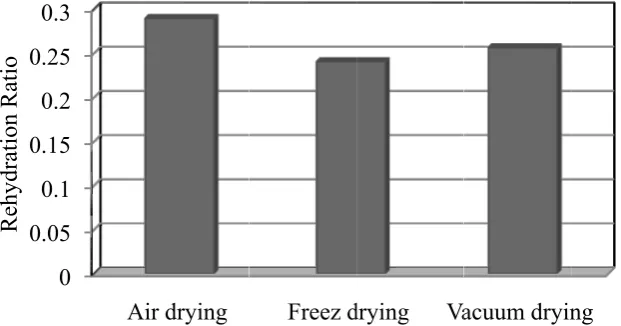
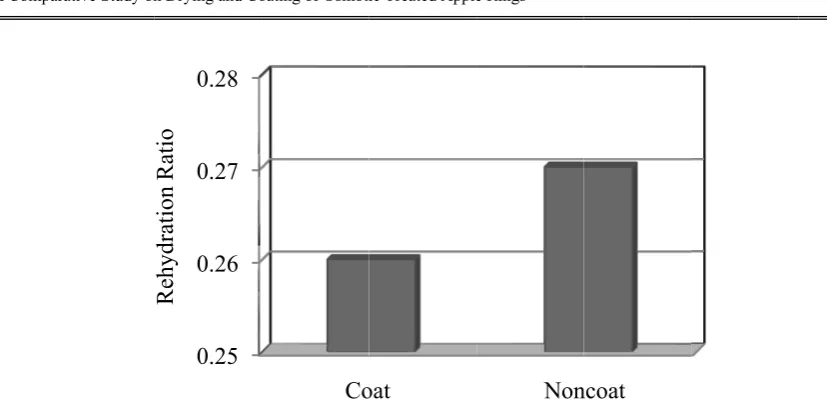
In this study, the effect of edible coat (carboxy methyl cellulose) before osmotic dehydration and different drying methods on sensory and physical properties of dried apple (V. Golden delicious) rings was investigated. The coated and non-coated samples pretreated with 50% sucrose osmotic solution and dried in freeze drier (-40 to -50°C, 0.026-0.017 mbar, 24 hr), vacuum drier (70°C, 200 mbar, 8-10 hr), air dryer (60°C, 1.5 m/s, 2-3 hr). Sensory evolutions, Rehydration ratio (RR), color changes (∆E), shear strength (SS), true density and shrinkage present of dried samples were determined. Effect of using edible coats before osmotic process was significant on the SS, RR and color changes. As the lowest shrinkage, color changes, RR, and highest SS were found in freeze dried apples. The air and vacuum dried samples had the highest RR and true density, respectively. The best sample in sensory evolutions was coated and freeze dried samples.
Keywords: Freeze drying; Vacuum drying; Air drying; Coating; Osmotic pretreatment; Physical properties.
58 International Journal of Agricultural Science and Research Volume 2, Number 2, Spring 2011(Serial #3) INTRODUCTION
One of the methods to increase shelf life is drying (Famurewa et al., 2006). Dried fruits are beneficial to human health because they are a rich source of vitamins, minerals, anti-oxidants, and especially fiber (including soluble fibers) due to their concentration during processing (Konopacka et al., 2009). The effect of convention drying is to change the structure, non-enzymatic browning, loss of vitamins and volatile flavor compounds (karel, 1980; Lewicki, 2004; Warczok, 2005). Convective drying of fruits is a widely exploited process to increase shelf-life, reduce packaging costs, to lower shipping weights and to maintain nutritional value. However, drying affects the quality of the final product due to extensive shrinkage and micro-structural changes in vegetable tissue (Gobbi, 2009).
Therefore, the best option would be to combine it with some pre-treatment preserving method, which will decrease the heat exposure time (Warczok, 2005). One of the non-thermal preserving methods is osmotic dehydration (OD). OD involves soaking foods such as fruit, vegetables in a hypertonic (osmotic) solution i.e. concentrated sugar, salt, alcohols or soluble starch solutions, which partially dehydrates the food (Mújica-Paz et al., 2003; Erle & Schubert, 2001). The differences in chemical potential between components in the solution and the material lead to mass transfer. This mass transfer involves water transfer from the material to the solutions, uptake of solutes from solution into dehydrated material and leach low molecular mass compounds, minerals, vitamins, colorants from the material to the osmotic medium(Sablani & Rahman, 2003; Mayor et al., 2006). It can improve food quality (reduce heat damage) when combined with air, freeze or vacuum drying (Pękosławska & Lenart, 2009). This process has received considerable attention as a pretreatment since it reduces energy consumption, inhibits micro organism's growth, retains the fruit natural color (without sulfide addition) and also helps to retain volatile aromas during the subsequent air-drying (Sueli & Fabiano, 2007).
Edible coatings are used as barriers to protect the plant tissue from adverse microbiological, chemical and physical changes (Lenart & Dobrowska, 2001). The coatings should be biodegradable, capable of modifying the product’s surrounding i.e. to act as a promoter of water removal (Ljubinko et al., 2008). The edible coatings are usually made of various polysaccharides, proteins or lipids. For their successful application in osmotic dehydration process, the properties of coating materials should fit several requirements: good mechanical properties, satisfactory sensory properties, easy and rapid film formation, high water diffusivity and prevention of excessive solute uptake by the tissue (Camirand, 1992).
The aim of the present work was to investigate the effect of coating and different drying on the sensory and physical properties of osmotic treated apples rings.
MATERIAL AND METHODS Raw material
Apples (var. Golden delicious) of uniform quality were purchased at the local market in Karaj, Iran and stored at 1±1ºC and 80-90% relative humidity for 2 days, until they achieve an equal temperature. Then fresh apples were washed, peeled, cut into flat rings with 5 mm thickness, and then cored with circular mould. The initial content of the fresh apples varied from 84.1-84.7% (wet basis).
Coating treatment
The ring of apples immersed in CMC solution (0.5%) for 30 second and then put in calcium chloride solution (2%) for 2 minutes. Then they dried at 55-60°C for 5-10 minutes, because the coat has fixed on the samples.
Osmotic treatment
59
A Comparative Study on Drying and Coating of Osmotic Treated Apple Rings
Drying
After osmotic treatment, drying of samples performed in a pilot plant tray-dryer at an air temperature of 60°C and air velocity of 1.5 m/s with direction of air flow through the product for 2-3 hours. The freezing technique to submit was with liquid nitrogen. Freeze-drying tests were performed with vacuum chamber total pressure and temperature equal to 0.0170.026 mbar and -40°C to-50°C, respectively. Average freeze-drying time was approximately 24 hr. Vacuum drying was performed in 70°C and 200 mbar for 8-10 hours. The drier type Ehret VTs 70 was used for vacuum-drying, GPERGN model was used for freeze-drying and Armfield Itd. 13481 was used for air-drying. The final moisture content of dried samples was 12±2 percent.
Analytical Methods
Rehydration Ratio (RR): The samples were rehydrated by immersing them in a water bath at ambient temperature (25°C). The approximate ratio of dried fruit and water volume was kept 1:10. The rehydrated fruits were spread on absorbent paper for the removal of free water on the surface of fruits. The maximum time of immersion of fruit sample was 6 hours (Fathabadi, 2008). Then the RR is calculated by bellow equation:
(eq. 1)
Shrinkage: It was calculated as the percentage change from the initial apparent volume. The shrinkage is calculated as:
% 1 100
Where Vºand Vt denote the initial and dried volume of the same apple slice, respectively (Singh
et al., 2007).
True density: It was determined by displacement method with toluene before and after drying (Mohsenin, 1986).
Color measurement: It was conducted using a colorimeter HUNTERLAB-D25-9000 to obtain CIElab values ,L* (illuminance), a* (red-green index) and b* (yellow-blue index).The subscripts 0 denote the color parameters of fresh apples. The higher ΔΕ represents greater color change from the fresh apple (Seiielou et al., 2010).
∆
Shear strength on Texture: It was measured using a Texture Analyzer (HOUNSFIELD-H5K5) with 6.4 mm penetration probe (Fathabadi, 2008).
Sensory evaluation: For sensory evaluations color, chew ability, flavor, appearance, overall acceptability were investigated by 9 trained panelists, which ranges from 1 (dislike extremely) to 5 (like extremely). The sensory evaluation was conducted using the hedonic test (Payan, 1997).
Statistical Analysis
The experiment was conducted according to a completely randomized design. Data were evaluated by analysis of variance (ANOVA) and Duncan test, using SPSS-16 software version 16.0.
(eq. 2)
60 RESU The Factors Coat ( Drying C*D Error R2 **: p<0 Reh capaci the dry structu dried s ice fro capaci time o
As s rehydr sticky
In
ULTS AND D
results of an
s Df (C) (D) D rs 1 2 2 12
.01, *: p<0.05,
hydration ra
ty in the pla y matters of ure of tissues samples and om the slice ty during lon f rehydration
shown in (F ration ratio o layer on the
0
0
0
Rehydration Ratio
nternational Jour DISCUSSIOnalysis of var
T Shear strengt ** ** ** 0.999 ns: no significa
atio: Drying ant tissue. Du f rehydrated
s (Bogdan, 2 lowest for fr matrix (Ph ng time of r n (Bogdan, 2
Figure 2) us of coated sam
surface of co
0
0.05
0.1
0.15
0.2
0.25
0.3
A
rnal of Agricultu
ON
riance for dri
Table 1: Analy r th Shrin ** ** n .99 ant products ha uring the reh materials tha 008). As sho reeze dried s ongsomboon rehydration. 2008).
sing of edib mples has b oated sample
Air drying
Fig.1:
ural Science and
ed apples we
ysis of variance nkage Tru * * s 96 ave decrease hydration, th at depend m own in (Figu samples due n & Intipuny
Similar resu
ble coats be been lower th
es (Tavakolip
Freez d
Effect of dryin
d Research Volum
ere shown in
e for dried app ue Density
ns ** ns
.989
ed in the wat here follow a mainly on the ure 1), the reh
to porosity f ya, 2009) an ult was repor
efore osmoti han non coa por et al., 20
drying
Va
ng method on R
me 2, Number 2
n Table 1.
ple Rehydration ** ** Ns .997 ter absorptio a loss in solu e chemical co
hydration rat formation du nd changing rted for carro
ic pretreatm ated samples 008).
acuum dryin
RR
2, Spring 2011(S
ratio Δ
.
on and maint uble constitu omposition a tio is highest uring sublima g the water h ot drying aft
ment cause th s due to prod
ng
Serial #3) ΔΕ ** ** ** 996 tenance uents of and the t for air ation of holding ter longA Comp
Shri
The sh density occur to Ma reducti longer (Morir
The apples uptake apples lowest 2007).
parative Study on
inkage: The hrinkage of y. Most of th
(Okos et al., auro et al.
ion than air d r time. In ot
ra et al., 2000
effect of co presented lo e was in the , collapse of t diffusivity
%Shrinkage
n Drying and Co
drying of a samples has he shrinkage , 1992). Free (2004), vacu dried sample ther research
0).
ating was si ower shrinka cells of the f external ce of water obt
0.25
0.26
0.27
0.28
Rehydration Ratio
86
88
90
92
94
96
Ai
oating of Osmoti
a product usu s shown in e occurs in th
eze dried sam uum dried e, reflecting t h, shrinkage
gnificant on age than
non-non-coated ells due to la
tained in the
Co
ir drying
Fig. 2: Effe
Fig.3: Effect
ic Treated Apple
ually results fig. 3. The he early dry mple had bee
sample pres the collapsin of freeze d
n the shrinka -coated samp
samples larg arge solute u e non-coated
oat
Freeze
fect of drying m
of drying meth
e Rings
in smaller s shrinkage in ing stage, w en the lowes sented highe ng of the soli dried apple w
age of sampl ples. In a res ger than coa uptake was d apples at fi
Non
drying
method on RR
hod on shrinka
size than the n volume is where 40 to 5 st shrinkage er density a id matrix and was lower th
es. As show earch had sh ated samples
observed. Th final drying p
ncoat
Vacuum dr
age present
original we s dependent 50% shrinkag
present. Acc and higher v
d remaining han air dried
wn (figure 4) hown that the . In the non his agrees w period (Khin
rying
61
et form. on the ge may cording volume wet for d apple
62
True
chemic Genera (Rahm moistu True d were r
Colo
indicat change sample coated non-co
In
e density: T cal reactions ally speaking man et al., 2 ure content in density of va
eported for d
or change: c tor of level o es (ΔΕ) repre es had the lo d samples wi oated apples
8
8
9
9
9
9
%Shrinkage
T
rue density
/
3
nternational Jour
The differenc s in the mat g, a low appa 2002). Accor ncreased as acuum and f dried apple (M
color is often of natural de esent greater wer ΔΕ than ith larger sol at final dryi
88
89
90
91
92
93
0
0.2
0.4
0.6
0.8
g/
cm
3
Fig
rnal of Agricultu
ce in particle terial caused arent density rding to kin the increase freeze dried Mauro et al.,
n associated eterioration o r color chang n non-coated lute uptake t ing period (K
non coat
Air drying
Fig.4: Effe
g. 5: Effect of d
ural Science and
e density for d by the coll y indicates a g
ngsly et al. e of mass is
apple was h , 2004), dried
with the qu of fresh food ge from the
samples; Du that causes th Khin et al., 2
t
g
Freeze
ect of coating o
drying on the t
d Research Volum
each food p lapse of cell great volume (2006), the more compa highest and d yam flours
ality of the p ds (Krokida
fresh apple ( ue to more c
he lowest di 2007). It sho
c
e drying V
on shrinkage p
true density of
me 2, Number 2
product can b ls and the t e of pores fo true densit ared to the i lowest cont s.
product and et al., 2000) (Seiiedlou et ollapse of ex iffusivity of owed that str
coat
Vacuum dryi
present
dried apples
2, Spring 2011(S
be explained emperature rmed during ty increased increase in v
ent. Similar
maybe take ). The higher t al., 2010). xternal cells water obtain ructural dest
ing
Serial #3)
d by the effects. g drying as the volume.
results
A Comp
affects related
Shea
drying non co Also, t (Phong decrea and de
The have b
parative Study on
s on color ch d to non-coat
ar strength:
g was 10%, 1 oated and va the effect of gsomboon & ase of solute ecreases shea
results of se been presente
1
1
∆
E
1
1
2
Shear Stress
N/cm
2
n Drying and Co
hange of samp ted and vacuu
The moistur 2% and 14% acuum dried f structural de & Intipunya,
uptake to te ar strength (B
nsory evalua ed in table 2.
0
200
400
600
800
1000
1200
Vac
0
5
10
15
20
Air
Fig
Fig.8: Effect o
oating of Osmoti
mples. As sho um dried and
re content of %, respective samples we estruction is 2009). Edib exture of sam Behrozi, 2008
ations (color Comparing
cuum drying
r drying
g.7: Effect of c
of coating- dry
ic Treated Apple
own (figure 7 d coated and
f dried apple ely. As shown
ere the highe significant. ble coat cau mple. The so 8).
, chew abilit of data with
Freeze
g
caot
CoatFreeze d
Coat
coating- drying
ying methods o
e Rings
7) the highes freeze drier
s with freeze n (figure 8), est and lowe Similar resu uses the incr olute uptake
ty, flavor, ap h Duncan test
e drying
non c
drying
V
Non Co
g methods on ∆
on shear streng
st and lowest samples.
e drying, air the coated a est shear stre ult was repor
rease of she in texture in
ppearance, ov t showed sig
Air dryin
coat
Vacuum dryi
oat
∆E of dried app
gth of dried ap
t color chang
drying and v and freeze dr
ength, respec rted for dried ear strength ncreases brit
verall accept gnificant diffe
ng
ing
ples
ples
63 ges was
vacuum ied and ctively. d carrot due to ttleness
64 coating drying Coat-Coat-O Coa Vac Non c A Non c Fre Non c Vac Table In
g and differe g methods we
-Osmosis-Air drying Osmosis-Freeze drying at-Osmosis-cuum drying coat-Osmosis-Air drying coat-Osmosis-eeze drying coat-Osmosis-uum drying
1
2
3
4
5
N
O
Evolution range
2: The results
nternational Jour
ent drying m ere significan Sampl Mean Std. deviati Mean Std. deviati Mean Std. deviati Mean Std. deviati Mean Std. deviati Mean Std. deviati
Non coat
Overall accep
Vacuum
of sensory evo (like extr
Fig.9: Effect o
rnal of Agricultu
methods sam nt on the che
Tast les 4.00 0.00 on 4.77 0.44 on 2.00 .000 on 3.44 .527 on 4.00 .000 on 2.33 .500 on
N
Coat
ptability
m drying
olution from a remely) with a
of coating- dry
ural Science and
mples as show ew ability, tas
Col te 3.22 0.44 0 0 4.77 0.44 8 1 2.44 0.52 0 0 2.55 0.52 4 7 4.55 .52 0 0 2.55 .52 3 0
Non coat
Tast
Air d
5 points hedon panel compos
ying methods o
d Research Volum
wn in figure ste and overa
Che abili lor 3.66 0.50 22 41 4.88 0.33 78 41 2.00 .000 44 27 2.55 .527 56 27 3.66 .500 56 27 2.00 .000 56 27
Coat
te
drying
nic scale, which sed of 9 trained
on sensory evol
me 2, Number 2
e 9. The effe all acceptabi Appea ew ity 3.8 0.2 67 00 4.7 0.4 89 33 3.1 .33 00 0 3.1 .33 56 7 3.7 .33 67 0 2.1 .33 00 0
Non coat
Chew a
Freeze
h ranges from d taste panels
lution of dried
2, Spring 2011(S
ects of coati lity. O accep arance 3 0 833 250 4 0 778 441 2 111 33 3 111 33 4 778 33 2 111 33
Coat
ability
e drying
1 (dislike extre
apples Serial #3) ing and verall ptability 3.778 0.441 4.889 0.333 2.111 .333 3.778 .441 4.000 .000 2.222 .441
65
A Comparative Study on Drying and Coating of Osmotic Treated Apple Rings
CONCLUSION
Using of edible coat before osmosis process had significant effect on the SS, ΔΕ, and RR. As coating decreases RR and ΔE and increase SS. Also, drying methods had significant effect on physical properties. The lowest and highest true density, shrinkage present, and ΔE was attributed to freeze and vacuum dried samples, respectively. The freeze and vacuum dried samples had highest and lowest SS, respectively. The air and freeze dried samples had highest and lowest RR. The coated and freeze dried samples had best flavor, texture, and acceptability in sensory evaluations
.
ACKNOWLEDGEMENT
Authors acknowledge supporting received from AERI (Agricultural Engineering Research Institute
).
REFERENCES
1. Behrozi, B. (2008). Comparative between two methods of osmotic drying and immersing frying in production of coated kiwi chips with edible coats. M. Sc. Thesis. Faculty of Agriculture. Islamic Azad University. Iran. Tehran.
2. Bogdan, S. (2008). Rehydration of carrot dried using various methods. Acta Agrophysica, 2008, 11(1), 239-251.
3. Camirand, W., Krochta, J. M., Cole, M. E. (1992). Properties of some edible carbohydrate polymer coatings for potential use in osmotic dehydration. Carbohydrate Polymers ., 17 , PP39 -49 .
4. Erle, U., Schubert, H. (2001). Combined osmotic and microwave-vacuum dehydration of apples and strawberries, Journal of Food Engineering., 49 193-199.
5. Famurewa. J. A. V., Oluwamukomi M. O., Adenuga A. L. (2006). Dehydration of osmosised Red Bell Pepar (Capsicum annum). Research Journal of Biological Sciences 1(1-4): 36-39,2006.
6. Fathabadi, A. (2008). Study the physicochemical properties osmotic solutions in osmotic dehydration process of apple. M. Sc. Thesis. Faculty of Agriculture. Islamic Azad University. Iran.
7. Gobbi, S. (2009). Osmo-air-drying to obtain dried crispy fruits: optimization and modeling of processing and product shelf life. Food Science Technology and Biotechnology.
8. Karel, M. (1980). Theory of drying process. In Spicer A. (Ed.) New methods of dehydration and drying of food., 53-100.
9. Khin-Mya, M., Zhou, W., Perera, C. O. (2007). Impact of process condition and coating on the dehydration efficiency and cellular structure of apple tissue during osmotic dehydration. J. of Food Engineering., 79 (2007) 817-827.
10.Kingsly, A. R. P., Singh, D. B., Manikantan, M. R., Jain, R. K. (2006). Moisture dependent physical properties of dried pomegranate seed (Anardana). J. of Food Engineering., 75(2006) 492-496.
11.Konopacka, D., Jesionkowska, K., Klewicki, R., Bonazzi, C., (2009). The effect of different osmotic agents on the sensory perception of osmo-treated dried fruit. Journal of Horticultural Science & Biotechnology., (2009) ISAFRUIT Special Issue 80–84.
12.Krokida, M. K., Karathanos, V. T., Maroulis, Z. B., Marinos-Kouris, D. (2000). Effect of osmotic dehydration on color and sorption characteristics of apple and banana. Drying Technology.,18, 937-950.
13.Lenart, A., Dobrowska, R. (2001). Influence of ediable coatings on osmotic treatment of apples. In Fito P. A. and Chiralt J. M. (Eds), Osmotic dehydration and vacuum impregnation, Pennsylvania, Technomic Publishing Company. pp. 43-49.
66 International Journal of Agricultural Science and Research Volume 2, Number 2, Spring 2011(Serial #3)
15.Ljubinko Lević, B., Gordana Koprivica, B., Nevena Mišljenović, M., Bojana Filipčev, V., Olivera Šimurina, D., Tatjana Kuljanin, A. (2008). Effect of starch as an edible coating material on the process of osmotic dehydration of carrot in sacchrose solution and sugar beet molasses. 1450-7188 (2008) 39, 29-36.
16.Mauro, C. P., Masson, M. L., Yamamoto, C. I. (2004). Osmo-convective effect on the color of yacon (polymnia Sonchifolia). Proceedings of the 14th International Drying Symposium. Agu.
22-25.Brazil. vol. C, pp. 2084-2090.
17.Mayor, L., Moreira, R., Chenlo, F., Sereno, A.M. (2006). Water sorption isotherms of fresh and partially osmotic dehydrated pumpkin parenchyma and seeds at several temperatures. European Food Research and Technology., 220, 163–167.
18.Mohsenin. N. (1986). Physical properties of Plant and Animal Materials. Chapter8:481-599. 19.Moreira, R., Figueiredo, A., Sereno, A. (2000). Shrinkage of Apple Disks Dyring by Warm Air
Convection and Freeze Drying. Drying Technology, 18 (182), 279-294(2000).
20.Mújica-Paz, H., Valdez-Fragoso, A., Lopez-Malo, A., Palou, E., Welti-Chanes, J. (2003). Impregnation and osmotic dehydration of some fruits: Effect of the vacuum pressure and syrup.concentration. Journal of Food Engineering., 57 305-314.
21.Okos, M.R., Narsimhan, G., Singh R. K., Weitnauer, A.C. (1992). Food Dehydration. In: Heldman, D. R. and D.B. Lund, D. B. (eds) Handbook of Food Engineering. Marcel Dekker. Inc. New York. 760.
22. Payan, R. (1997), The Basic of Quality Control in Food Industries. Iran: Karno publishes. 23.Pękosławska, A., Lenart, A. (2009). Osmotic dehydration of pumpkin in starch syrup. Journal
of Fruit and Ornamental Plant Research., Vol. 17/(2) 2009: 107-113.
24.Phongsomboon, P., Intipunya, P. (2009). Comparative study on drying of osmotic treated carrot slices. As. J. Food and Agro-Industry., 2009, 2(04), 448-456.
25.Rahman, M. S., Al-Amri, O. S., Al-Bulushi, I. M. (2002). Pores and Physico-chemical characteristics of dried tuna produced by different methods of drying. J. Food Engineering., Vol. 53, 301-313.
26.Sablani, S. S., Rahman, S. S. (2003). Effect of syrup concentration, temperature and sample geometry on equilibrium distribution coefficients during osmotic dehydration of mango. Food Res. Int., 36: 65-71.
27.Seiiedlou, S., Ghasemzade hamid, R., Talati, F., Moghaddam, M. (2010). Convection Drying of Apple: Mathematical Modeling and Determination of some Quality parameters. International Journal of Agriculture & Biology., Vol. 12, No. 2, 2010.
28.Singh, B., Panesar Parmjit, S., Nanda, V. (2007). Rehydration Kinitics of Un-Osmosed and Pre-Osmosed Carrot Cubes. World Journal of Dairy & Food Sciences. 2(1):10-17, 2007. 29.Sueli, R., Fernandes Fabiano, A. N. (2007). Image analysis of osmotically dehydrated fruits:
melons dehydration in a ternary system. Eur Food Res Technol., 225:685–691.
30.Tavakolipor, H., Jalaee, F., Fatemian, H., Fathabadi, A. (2008). Study the effect of coats on the quality and physicochemical properties osmotic dried apples. 18th National Congress on Food
Technology. Oct. 15-16. Mashhad. I.R. Iran.1-6.