Evaluation of Collapsibility Potential in Soil Layers Based
on Practical Methods
(Case study: Hir City-Ardabil Province)
Mahnam Roohi Hir 1, 2, Michael Yousefadeh3*, Rouzbeh Dabiri3
1 M.Sc. of Geotechnical Engineering, Department of Civil Engineering, East Azerbaijan Science and Research Branch, Islamic Azad
University, Tabriz, Iran.
2 M.Sc. of Geotechnical Engineering, Department of Civil Engineering, Tabriz Branch, Islamic Azad University, Tabriz, Iran. *3 Assistant Professor, Department of Civil Engineering, Tabriz Branch, Islamic Azad University, Tabriz, Iran.
*Corresponding author’s Email: [email protected]
(Date of received: 15/08/2018, Date of accepted: 21/02/2019)
ABSTRACT:
Collapsible soils is one of the problematic soil because of complex mechanism collapse in them, the recognizing and analyzing effective parameters on phenomenon is so important. Collapsible soil is non- saturate soil, due to moisten and specifically loading, connection between soil particles become loose and finally suddenly destroying happen in soil layer. In this study, collapsible potential in soil layers of Hir city based on practical methods were evaluated. 16 specimens were collected in study area. Practical methods were divided to qualitative and quantitative criterions. In quantitative procedure, double odeometer test based on ASTM were performed. Results of this study showed that between qualitative methods there is not good agreement. Although, quantitative procedure proposed high risk in terms of collapsibility in soil layer.
Keywords:Soil collapsibility, Quantitative methods, Qualitative methods, Hir city, Ardebil.
1- Introduction
an experimental procedure with using double odeometer test based on ASTM D5333-03 [9]. In this research, consequences of two procedures were compared in Hir City about collapsibility potential in soil layers.
2. Materials and Methods
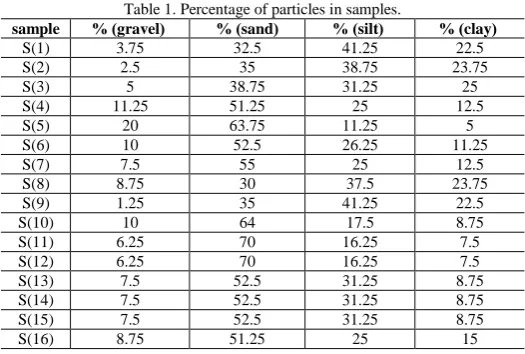
2.1. MaterialsAs mentioned above, in this research, collapsibility potential of soil layers in Hir city at Ardabil province in Iran was evaluated. For determining collapsibility 16 undisturbed samples were collected in different points of study area had been reported damages due to collapsible occurrence. Particle grading test was performed based on ASTM D421 [10] and ASTM D422 [11]. According to unified soils category method, type of samples taken generally is SM, SC and CL. Grading curve can be seen in Figure 1. Also, in Table 1 percentage of particles in samples separately was provided. Plasticity index and specific gravity (Gs) in specimens respectively were determined based on ASTM D4318-87 [12] and ASTM D854-87 [13]. Also, compaction test was carried out according to ASTM D698 [14]. Results can be seen in Table 2.
Fig.1. Grading curves of samples in study area.
Table 1. Percentage of particles in samples.
( clay % ) (
silt % ) (
sand % ) (
gravel % ) sample
22.5 41.25
32.5 3.75
S(1)
23.75 38.75
35 2.5
S(2)
25 31.25
38.75 5
S(3)
12.5 25
51.25 11.25
S(4)
5 11.25
63.75 20
S(5)
11.25 26.25
52.5 10
S(6)
12.5 25
55 7.5
S(7)
23.75 37.5
30 8.75
S(8)
22.5 41.25
35 1.25
S(9)
8.75 17.5
64 10
S(10)
7.5 16.25
70 6.25
S(11)
7.5 16.25
70 6.25
S(12)
8.75 31.25
52.5 7.5
S(13)
8.75 31.25
52.5 7.5
S(14)
8.75 31.25
52.5 7.5
S(15)
15 25
51.25 8.75
S(16) 0 10 20 30 40 50 60 70 80 90 100
0.0001 0.001 0.01 0.1 1 10 100
P
a
rt
icle
size
(m
m
)
Percent passing (%)
S1 S2
S3 S4
S5 S6
S7 S8
S9 S10
S11 S12
S13 S14
Table 2. Geotechnical properties of samples in study area.
Unified soil Classification Gs
Wopt (%)
𝛾
𝑑𝑚𝑎𝑥(gr/cm
3)
PI sample CL 2.379 5.4 1.45 17 S(1) CL 2.387 8.5 1.47 17 S(2) CL 2.532 6.2 1.46 20 S(3) SM 2.374 5.3 1.49 NP S(4) SM 2.549 5.6 1.57 NP S(5) SM 2.427 5.4 1.45 NP S(6) SC 2.626 7.7 1.49 10 S(7) CL 2.67 5.9 1.59 25 S(8) CL 2.697 5.7 1.71 18 S(9) SC 2.537 8.1 1.53 10 S(10) SC-SM 2.536 7.1 1.59 7 S(11) SC-SM 2.598 13.5 1.51 7 S(12) SC 2.573 7.1 1.59 13 S(13) SC 2.544 11.7 1.58 13 S(14) SC 2.556 8.7 1.58 13 S(15) SC 2.623 7 1.73 16 S(16) 2.2. Methodology
In this study, for evaluating collapsibility in soil layers two criterions based on quantitative and qualitative were used. In first step, geotechnical properties of samples based on laboratory test determined and mentioned above. Then, with applying practical methods have been proposed by Priklonski [15], Clevenger, Gibbs and Bara, Denisov and Feda qualitative analyses were carried out. I second step, with using double odeometer test according to ASTM D53333-03, quantitative analyses were performed on specimens too. In final, results of both methodology were compared.
3. Results and discussion
3.1. Evaluation of collapsibility in soil layers based on qualitative method 3.1.1. Priklonski criterion
In this standard, viscosity index (𝐾𝐷) for specimens with using Eq.1 were determined. While, 𝐾𝐷 is less than
0.5, collapsibility risk is so high. In contrast, KD value become more than 1, swelling potential can be seen in soil layers. Outcomes of collapsibility assessment in study area have been provided in Table.3. According to Table 3, it can be observed that collapsibility risk so high in study area.
(
1
) 𝐾𝐷=𝑤0−𝑃𝐿
𝑃𝐼
Table 3. Collapsibility evaluation based on Priklonski criterion.
if γdmax was less than 1.28 gr/Cm3, settlement happen in soil layer is probable. Whereas, this factor was more than 1.44 gr/Cm3 collapsibility risk in soil is so low. In third position, if γ
dmax was between to mentioned
number, settlement risk in soil have moderate risk. Outcomes of collapsibility assessment in study area have been provided in Table.4. As seen, based on this method collapsibility risk is so low.
Table 4. Collapsibility evaluation based on Clevenger criterion.
Interpretation of Collapsibility γdmax (gr/cm3)
sample
Low risk 1.45
S(1)
Low risk 1.47
S(2)
Low risk 1.46
S(3)
Low risk 1.49
S(4)
Low risk 1.57
S(5)
Low risk 1.45
S(6)
Low risk 1.49
S(7)
Low risk 1.59
S(8)
Low risk 1.71
S(9)
Low risk 1.53
S(10)
Low risk 1.59
S(11)
Low risk 1.51
S(12)
Low risk 1.59
S(13)
Low risk 1.58
S(14)
Low risk 1.58
S(15)
Low risk 1.73
S(16)
3.1.3. Gibbs and Bara criterion
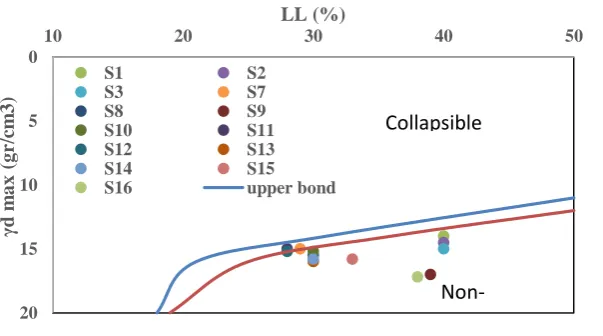
According to this rule, for assessing collapsibility in soil specimens, maximum dry unit weight and liquid limit (LL) is applied. In this method, it is assumed, if LL value in non-cemented soil was more than 20% and skeleton among soil particles become loose, collapsibility risk in soil is so high. With using diagrams in Figure 2 collapsible and non-collapsible soil con be recognized. With regard to Figure 2, it is observed more specimens in study area are non-collapsible.
Fig.2. Results of collapsibility evaluation based on Gibbs and Bara method in study area.
0
5
10
15
20
10 20 30 40 50
γd
m
a
x
(
g
r/cm
3
)
LL (%)
S1 S2
S3 S7
S8 S9
S10 S11
S12 S13
S14 S15
S16 upper bond
Collapsible
Non-3.1.4. Denisov criterion
In this criteria, 𝑒𝑒
𝑙𝑙 ratio for analyzing collapsibility in soils is used. In mentioned ratio, e is natural void ratio,
ell parameter is void ratio of soil liquid limit condition. Outcomes of evaluation according to present rule is observed in Table.5. Consequence of present criterion shows there is not collapsible soil in study area.
Table 5. Collapsibility evaluation based on Denisov criterion.
Interpretation of Collapsibility e/ell ell e sample Non- collapsible 0.675 0.975 0.641 S(1) Non- collapsible 0.634 0.978 0.621 S(2) Non- collapsible 0.674 1.08 0.734 S(3) Non- collapsible -0.591 S(4) Non- collapsible -0.622 S(5) Non- collapsible -0.674 S(6) Non- collapsible 0.911 0.84 0.766 S(7) Non- collapsible 0.557 1.22 0.680 S(8) Non- collapsible 0.545 1.05 0.574 S(9) Non- collapsible 0.809 0.811 0.657 S(10) Non- collapsible 0.871 0.684 0.596 S(11) Non- collapsible 1.034 0.701 0.726 S(12) Non- collapsible 0.708 0.874 0.620 S(13) Non- collapsible 0.709 0.864 0.614 S(14) Non- collapsible 0.713 0.869 0.620 S(15) Non- collapsible 0.534 0.97 0.518 S(16)
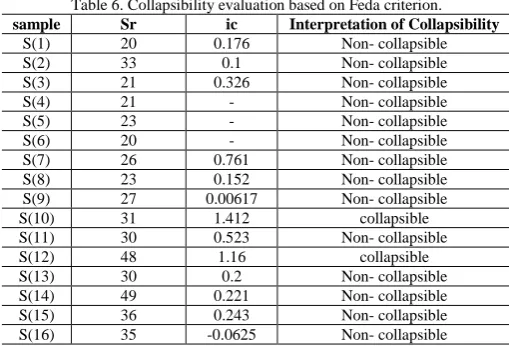
3.1.5. Feda criterion
Feda proposed a new criteria for evaluating collapsibility in soil layers according to Eq.2. In this rule,
𝑖
𝑐factor
is calculated. So that, if i
cand porosity degree respectively were more than 0.85 and 40%,
collapsibility occurrence is probable. In below equation, Sr is saturation degree, m is mass of
specimen. Results of collapsibility analysis in Hir City can be observed in Table 6. Similarity to
previous both mentioned method, collapsibility risk is low.
( 2 ) 𝑖𝑐 = 𝑚 𝑠𝑟 − 𝑃𝐿 𝑃𝐼
Table 6. Collapsibility evaluation based on Feda criterion.
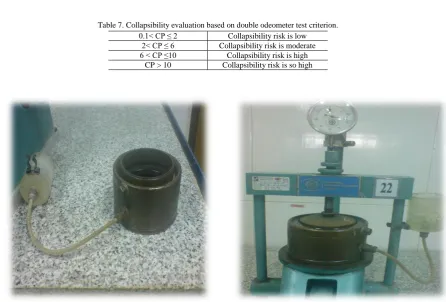
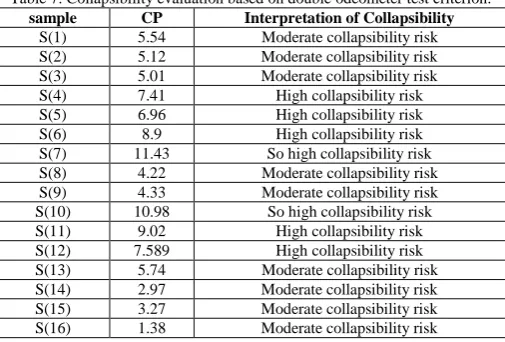
test according to ASTM D5333-0 was performed (Figure 3). As mentioned in previous parts, undisturbed specimens collected in study area. Results of test can be seen in Figure 4. Also, with combining criteria in Table 7 (Eq.3) and tests outcomes, collapsibility in samples evaluated. In difference with qualitative method, results of this study showed that in the Hir City collapsibility risk is moderate and so high.
(
3
)
CP = 0
1 e
e
(%)
Table 7. Collapsibility evaluation based on double odeometer test criterion. Collapsibility risk is low 0.1< CP ≤ 2
Collapsibility risk is moderate 2< CP ≤ 6
Collapsibility risk is high 6 < CP ≤10
Collapsibility risk is so high CP > 10
Fig.4. Results of double odeometer test on specimens study area.
Table 7. Collapsibility evaluation based on double odeometer test criterion.
Interpretation of Collapsibility CP
sample
Moderate collapsibility risk 5.54
S(1)
Moderate collapsibility risk 5.12
S(2)
Moderate collapsibility risk 5.01
S(3)
High collapsibility risk 7.41
S(4)
High collapsibility risk 6.96
S(5)
High collapsibility risk 8.9
S(6)
So high collapsibility risk 11.43
S(7)
Moderate collapsibility risk 4.22
S(8)
Moderate collapsibility risk 4.33
S(9)
So high collapsibility risk 10.98
S(10)
High collapsibility risk 9.02
S(11)
High collapsibility risk 7.589
S(12)
Moderate collapsibility risk 5.74
S(13)
Moderate collapsibility risk 2.97
S(14)
Moderate collapsibility risk 3.27
S(15)
Moderate collapsibility risk 1.38
S(16)
4. Conclusions
Collapsible soil is one of the problematic soil in constructions and civil engineering. In this research, results of practical methods based on quantitative and qualitative theories for evaluating collapsibility of soils at the Hir City in Ardabil province were compared. Outcomes of present study describe as follows:
1- Quantitative procedure according to double odeometer test showed that approximately 16 of the undisturbed specimen have moderate to so high risk in terms of collapsibility. It should be noted samples have been taken at the depth of 1 meter from the ground in study area.
2- There is good agreement between quantitative procedure and Priklonski criteria in qualitative method. 3- Generally, there is not good adaption among qualitative rules results for evaluating collapsibility in soil layer. The reason could be that each one of empirical method separately correlate to one of the geotechnical parameters. This conditions is caused of unfitting results.
0 0.1 0.2 0.3 0.4 0.5 0.6 0.7 0.8
0.1 1 10
e
P (kG/cm2)
S1 S2
S3 S4
S5 S6
S7 S8
S9 S10
S11 S12
S13 S14
commonly observed silty and slity clay. This condition prepare collapsibility potential in soil layers in study area.
It is offered that for increasing accuracy between qualitative and quantitative method in collapsibility analysing, with performing more experimental and field tests and applying soft computing method, unreliability parameters recognized and detected.
5. References
1. Rafie, B. M. A., Ziaie Moayed, R., Esmaeli. M., (2008). Evaluation of Soil Collapsibility Potential: A Case Study of Semnan Railway Station. Electronic Journal of Geotechnical Engineering, EJGE; 13(G): 1-7.
2. Vakili, A., Zomorodian, M., (2010). Study of collapsibility of soils in different points of compaction curve and research of effective parameters on collapsibility phenomenon. 4th International conference in geotechnical engineering and soil mechanic, Tehran, Iran. (In Persian)
3. Jennings, J. E., Knight, K., (1975). A Guide to construction or with materials exhibiting additional settlement due to collapse of grain structure. 6th Regional Conference for Africa on Soil Menchanics and Foundation Engineering, Durban, South Africa, September, 1, 99-105.
4. Khosravi, F., (2002). Soils and collapsibility potential on different area in Iran. Third International conference in geotechnical engineering and soil mechanic, Tehran, Iran. (In Persian).
5. Clevenger, W. A., (1959). Experiences with loess as a foundation material. Transactions American Society for Civil Engineers, 123, 51-80. 6. Gibbs, H. J., Bara, J. P., (1962). Predicting surface subsidence from basic soil test, ASTM Special Technical Publishing, 322, 231-246. 7. Denisov, N. Y., (1964). About the the nature of high sensitivity of Quick clays, Osnov. Fudam. Mekh. Grunt, 5, 5-8.
8. Feda, J., (1966). Structural stability of subsidence loess soils from Praha-Dejvice. Engineering Geology, 1, 201-219.
9. ASTM. (2003). Standard test method for measurement of collapse potential of soils. ASTM standard D5333-03, Annual Book of ASTM Standard, ASTM International, ASTM; 04(08).
10. ASTM D421-85, (1985). Dry Preparation of Soil Samples for Particle-Size Analysis and Determination of Soil Constants, Annual book of ASTM standards, (reapproved 1998).
11. ASTM D422-63, (1963). Standard Test Method for article-Size Analysis of Soils, Annual book of ASTM standards (reapproved 1998). 12. ASTM D 4318-95a, (1995). Standard test method for liquid limit, plastic limit an plasticity index for soils, Annual book of ASTM standards. 13. ASTM-D 854-02, (2002). Standard test method for specific gravity of soil solids by water pycnometer, Annual book of ASTM standards. 14. ASTM-D 698-00, (2000). Standard Test Methods for Laboratory Compaction Characteristics of Soil Using Standard Effort (12,400 ft-lbf/ft3 (600 kN-m/m3)), Annual book of ASTM standards.