DEMOGRAPHIC RESEARCH
VOLUME 31, ARTICLE 45, PAGES 1337–1364
PUBLISHED 4 DECEMBER 2014
http://www.demographic-research.org/Volumes/Vol31/45/ DOI: 10.4054/DemRes.2014.31.45
Research Article
The gender divide in urban China: Singlehood
and assortative mating by age and education
Yue Qian
Zhenchao Qian
© 2014 Yue Qian & Zhenchao Qian.
This open-access work is published under the terms of the Creative Commons Attribution NonCommercial License 2.0 Germany, which permits use, reproduction & distribution in any medium for non-commercial purposes, provided the original author(s) and source are given credit.
1 Introduction 1338
2 Background 1339
2.1 Theoretical framework 1339
2.2 Urban context in China and family norms 1340
2.3 The current study 1342
3 Data, sample, and measurement 1343
3.1 Data 1343
3.2 Sample 1343
3.3 Measurement 1344
4 Methods 1345
4.1 Marriage rate 1345
4.2 Log-linear models 1345
5 Results 1347
5.1 Marriage rates 1347
5.2 Assortative marriage patterns 1350
5.2.1 Descriptive analysis 1350
5.2.2 Log-linear models 1351
6 Discussion 1355
7 Acknowledgements 1357
The gender divide in urban China:
Singlehood and assortative mating by age and education
Yue Qian1 Zhenchao Qian2
Abstract
OBJECTIVE
Chinese media labels highly educated, urban women who are still single in their late 20s as “leftover ladies.” We investigate whether indeed highly educated women are less likely to marry than their less-educated counterparts, and how assortative mating patterns by age and education play a role in singleness.
METHODS
We use data from the urban samples of the Chinese General Social Surveys in the 2000s. In the analysis we calculate marriage rates to examine the likelihood of entry into marriage, and then apply log-linear models to investigate the assortative mating patterns by age and education.
RESULTS
We find that as education increases, the likelihood of marriage increases among men but decreases among women, especially among those over age 30. The results from log-linear models reveal that more marriages involve better-educated, older men and less-educated, younger women.
CONCLUSIONS
We argue that persistent traditional gender roles, accompanied by the rapid rise in women‟s education, contribute to low marriage rates among older, highly educated women.
1 Department of Sociology, The Ohio State University, 238 Townshend Hall, 1885 Neil Avenue Mall,
1. Introduction
In China, college education has expanded rapidly since 1999. Women have since then surpassed men in college enrollment and graduation (Yeung 2013). More young women with college education are seen to have challenged mate selection patterns in urban China. College-educated women who have not yet married by their late 20s are portrayed as having extreme difficulties finding a marital partner (e.g., Fincher 2012; Magistad 2013; Subramanian and Lee 2011). Chinese media uses a derogative term,
“shengnü” (“leftover ladies”), to describe these urban, highly educated, single women.
While stigmatizing these single women, this term reveals public and family anxiety about their marriage prospects. There was a similar unease in the 1980s in the United States for college-educated white women who were single by age 30 (Cherlin 1990). The unease was later found unwarranted because marriage rates in fact increased among college-educated women during that time, despite a decline in availability of marriageable partners (Qian and Preston 1993). This parallel raises the question of whether the concerns about marriage prospects of older, well-educated women in urban China are even valid.
In this paper, we examine gender differentials in entry into marriage by age and educational attainment. We explore whether education and age pairings of spouses contribute to such gender differences. In the United States, advances in women‟s education do not diminish the likelihood of marriage because highly educated women increasingly marry similarly educated men, or men with less education than themselves (Schwartz and Mare 2005). In other words, changes in educational assortative mating in American society respond to structural changes in men‟s and women‟s educational attainment. The question is whether mate selection patterns in China would maintain the traditional practice of hypergamy, i.e., men marry women younger and less educated than they are, or follow the U.S. pattern in response to rapid improvement in education, especially among women. The patterns of marriage formation and assortative mating in China shed light on whether traditional gender roles continue to constrain individual choice, even when society is experiencing rapid social and economic transformations.
vary in marriage formation by age and education and in patterns of age and educational assortative marriage in urban China.
2. Background
2.1 Theoretical framework
England and Farkas (1986) develop a framework stressing both individual choice and structural constraints to explain the relationships of household, employment, and gender in the United States. We apply this framework to help understand gendered patterns of marriage in contemporary urban China.
Individual choice is based on Becker‟s (1981) classic economic theory of marriage: In marriage markets, an individual makes rational choice and marries only if the utility from marriage exceeds the utility from remaining single. Becker posits that the gains to marriage can be greater when women exchange their non-market traits with men‟s earning power, because men tend to have a comparative advantage in labor markets and women often have a comparative advantage in domestic work. This argument supports the sex-role specialization in marriage, with the husband taking on the breadwinner role and the wife specializing in housework and childcare. However, increases in economic independence of women make sex-role specialization within marriage less advantageous (Becker 1981). Compared with less-educated women, highly educated women possess more market-oriented human capital and have higher earning potential. Consequently, they may find marriage less beneficial and thus forgo marriage. Empirical evidence for this argument is weak in the United States (Sweeney 2002), but strong in societies where segregated gender roles make it difficult for women to balance work and family (Raymo 2003).
Relatedly, individual choice is structurally constrained in societies where gender roles are such that wives focus on being a competent homemaker, and husbands bear the breadwinner role. In these societies, men do not value financial prospects in a potential spouse, and tend to look for younger women, who can bear and raise children while fulfilling the homemaker role. In contrast, women have strong incentives to marry men who are financially stable, typically older and highly educated (Raymo and Iwasawa 2005). Thus, marriage is formed between an older, better-educated man and a younger, less-educated woman.
not or no longer have a relationship established while in college. The longer the departure from school, the less likely it is that they would meet people with same levels of educational attainment (Mare 1991). Indeed, research on assortative mating in the United States shows that those married in age 30s tend to have lower educational homogamy than those married in age 20s (Qian 1998). More notably, men in age 30s are more likely than their female counterparts to marry someone who is less educated and younger. The “gendered double standard of aging” contributes to the deteriorating position of older women in marriage markets because a premium on youthful beauty devalues women more than men as they age (England and Farkas 1986; England and McClintock 2009). In sum, in societies with highly segregated gender roles, convergence in men‟s and women‟s educational attainment contributes to shrinking availabilities of potential partners and lower marriage prospects among older, highly educated women (Raymo and Iwasawa 2005).
2.2 Urban context in China and family norms
Under the conceptual framework employed in the current study, individual choice is constrained by structural factors. Indeed, China‟s contextual factors play an important role in shaping individual marriage behavior. The first factor is the gender system (England and Farkas 1986; Oppenheimer 1988). Empirically, the effect of education on marriage depends on gender role differentiation: in societies with greater gender-asymmetric division of labor within households, such as Italy and East and Southeast Asia, women‟s educational level is found to be negatively associated with entry into marriage (Jones and Gubhaju 2009; Pinnelli and De Rose 1995; Raymo 2003), while in societies with more gender-egalitarian division of labor within households, such as the United States, Sweden, and West Germany, women‟s education is insignificantly or positively related to marriage (Blossfeld and Rohwer 1995; Goldstein and Kenney 2001; Hoem 1995; Sweeney 2002).
market insecurity for women, women have strong incentives to marry up in status in categories such as age and education, to achieve high living standards through marriage. Relatedly, the breadwinner role of the husband and the homemaker role of the wife remain firmly in place in Chinese families (Qian and Qian 2014; Zuo 2003; Zuo and Bian 2001). Strikingly, since the 2000s, there has been a growing emphasis on traditional gender roles among Chinese men and women (Attané 2012). Urban women‟s domestic responsibilities are further reinforced by the unequal role given to mothers to raise the perfect child under the one-child family policy (Evans 2010; Greenhalgh 2010). Indeed, career-oriented women are commonly criticized as “selfish,” “nonfeminine,” and “irresponsible to household needs,” whereas husbands‟ failure to fulfill the provider role is often the primary source of marital conflict (Zuo and Bian 2001). This suggests that women value economic prospects in a potential mate, and that women with high earning potentials and career aspirations may not find marriage beneficial, due to clashes between career and family. Thus, we hypothesize that educational attainment is positively associated with men‟s but negatively associated with women‟s likelihood of marriage in urban China.
Meanwhile, attitudes toward gender equality vary substantially by gender itself. In China, women hold more egalitarian work and family values than men (Chang 1999). Highly educated individuals are more likely to hold egalitarian gender attitudes, but the educational effect is stronger for women than for men (Shu 2004). This suggests that highly educated women may not want to compromise their careers when they search for marriageable partners. In contrast, highly educated men with less egalitarian gender attitudes may prefer to marry less-educated women. As a result, the marriage pool may be small among highly educated women due to a shortage of similarly educated men who share similar levels of egalitarian gender-role expectations. This contributes to a “marriage squeeze” for highly educated women in urban China (Jones 2007).
2.3 The current study
In China, increasing educational opportunities have equalized the playing field in college education between men and women (Treiman 2013; Yeung 2013). Meanwhile, education is now strongly tied to occupational prestige; earnings returns to education -- college education in particular -- have increased rapidly (Bian and Logan 1996; Zhang and Zhao 2007; Zhao and Zhou 2007). Since education plays an increasingly important role in determining an individual‟s socioeconomic position, it is not a surprise that educational homogamy in urban China has increased between the 1970s and the late 1990s, as seen in the United States (Han 2010). Nevertheless, traditional gender roles are stronger today than in the recent past, which is predicted to produce different patterns of marriage formation and assortative mating from those in the United States and other developed countries (Blossfeld 1995; Qian 1998; Schwartz and Mare 2005). Based on the discussion above, we formulate the following hypotheses regarding marriage formation and assortative mating in urban China:
1) College-educated women have lower marriage rates than their male counterparts, especially among those who marry at later ages.
2) The patterns of educational and age assortative marriage are gender asymmetrical:
2.a) Among marriages in which two spouses have different levels of educational attainment, husbands tend to have more education than wives;
2.b) Among marriages in which two spouses differ in age, wives tend to be younger than husbands.
3. Data, sample, and measurement
3.1 Data
In this study, we pool nationally representative samples from the Chinese General Social Surveys (CGSS) conducted in 2003, 2005, 2006, and 2008. The CGSS is a repeated cross-sectional survey that started in 2003. Currently, four waves of data and related information are available online through a public data archive – Chinese Social Survey Open Database (www.cssod.org). The 2003 through 2008 waves of the CGSS used a multi-stage, stratified, random sampling method and included nationally representative samples of adults aged 18 and above (see Bian and Li 2012 for more details). The CGSS data are ideal for this study because the surveys collected information on respondents‟ current marital status and year of first marriage along with other sociodemographic characteristics for respondents and their spouses.
3.2 Sample
We restrict the analysis to urban residents because of strong urban and rural differences in education and marriage (Han 2010; Treiman 2012) and, more importantly, most highly educated men and women in China live in urban areas. Our analytic sample includes the couples first married between 2000 and 20083 and their never married counterparts at risk of forming such marriages over the same period. Specifically, we include the couples first married at ages 20 to 49 years between 2000 and 2008 and their never married counterparts in the same age range. We use this age range because the legal minimum age at marriage is 20 for women and 22 for men in China and almost no one marries for the first time after age 49 (Lindgren 2009). This study provides an important update, as no prior research has examined assortative marriage patterns since the 2000s, right after the 1999 college expansion in China.
We carry out the analysis in two steps. First, we calculate first marriage rates by education and age among men and women, respectively. To calculate first marriage rates, we follow Raymo and Iwasawa (2005) to reconstruct the population at risk of first marriage. Specifically, we generate person-year data for never married men and
3 We rely only on respondents‟ marital order to distinguish first marriages from higher-order marriages,
women, as each of them was at risk of first marriage at every single age, starting at age 20 until 49 years old or until censored by the surveys. We then generate person-year data among those married after 2000 – they remained single after age 20 until the age they married. We merge the data for the married and unmarried individuals for men and women, separately, and create never married person-year data starting at age 20 and ending at age 49, the age censored by the surveys, or the age they married, for the period between 2000 and 2008. We do not distinguish marriages within the period, because the data are sparse and because the substantive results are similar if the period is further classified into specific years. The final number of person-years is 11,311 for women and 14,156 for men.
Second, we explore assortative mating patterns by education and age. Dropping six observations with missing data results in a sample of 2,151 couples first married between ages 20 and 49 during the 2000–2008 period.
3.3 Measurement
The CGSS asked respondents their educational attainment, and, if married, their spouses‟ education at the time of the survey. We do not have information on educational attainment at the time of the wedding. However, these two measures should be similar because we focus on newlyweds, and educational upgrading after marriage is rare in China. We classify educational attainment into four groups: less than senior high school, senior high school, vocational college (Da Zhuan), and four-year college or higher. Due to compulsory nine-year education in urban China, all people with junior high school or less are collapsed into one educational group.
4. Methods
4.1 Marriage rate
Marriage rate is commonly used to measure the incidence of marriage (e.g., Preston and Richards 1975; Qian and Preston 1993; Raymo and Iwasawa 2005). The first marriage rate is based on the numerator (number of first marriages occurring within a given time period) and the denominator (“person-years” at the risk of first marriage during that time period) (Preston, Heuveline, and Guillot 2001). It takes the form:
Marriage Rate [0, T] =
(1)
For each person-year observation in our sample, if the event (i.e., first marriage) does not occur, that is, the person remains single in that year, the person-year observation then contributes one year to the denominator. If the person marries in that year, this person contributes half a year to the denominator because marriages in a given year are assumed to happen evenly throughout the year, which holds true for large populations. We follow the convention of multiplying the results from equation (1) by 1,000. Thus, marriage rates in this paper indicate incidence of first marriages per 1000 person-years.
4.2 Log-linear models
wife are in the same age groups. As a result, we overestimate the odds of age homogamy.
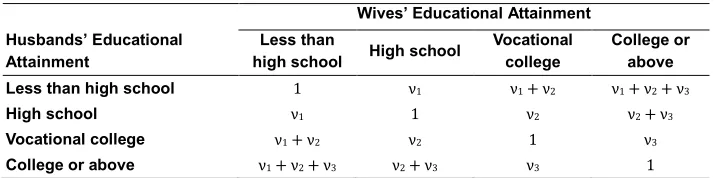
We employ crossings models. Table 1 presents the crossings parameters in detail. Suppose that intermarriage is a process of crossing barriers of different levels. Under crossings models each barrier is determined by which two adjacent levels it separates. For instance, the barrier between less than high school and high school is ν1, the barrier
between high school and vocational college is ν2, and so on (Hout 1983). Thus,
crossings models can reveal which two educational levels are serious barriers to intermarriage (Mare 1991). Parameters in Table 1 indicate log odds of intermarriage across two adjacent educational levels relative to log odds of homogamy, controlling for marginal distributions of husband‟s and wife‟s education. Prospective spouses with a greater distance in education must cross more barriers to get married, i.e., the log odds of marriage for couples across several educational levels are the sum of the crossings parameters separating husbands‟ and wives‟ educational levels (Schwartz and Mare 2005). Crossings models are gender-symmetrical, and assume that the difficulty of crossing each educational barrier is the same, no matter whether the husband or the wife has more education.
Table 1: Parameters for crossings effects on educational assortative marriage
Wives’ Educational Attainment Husbands’ Educational
Attainment
Less than
high school High school
Vocational college
College or above Less than high school 1 ν1 ν1 + ν2 ν1 + ν2 + ν3
High school ν1 1 ν2 ν2 + ν3
Vocational college ν1 + ν2 ν2 1 ν3
College or above ν1 + ν2 + ν3 ν2 + ν3 ν3 1
Note: Table is adapted from Schwartz and Mare (2005).
When gender asymmetry and crossings models are included, the model is as follows:
logNijkl = + ∑ + ∑ + ∑ + ∑
+ ∑ + ∑ + ∑ (2)
+ ∑ + ∑ + ∑ + ∑
where Nijkl denotes the expected number of marriages between men aged i with
parameters to be estimated. and denote age categories for men and women, respectively (i, j = 20–24; 30–49; 25–29 is the reference group). and denote educational categories for men and women, respectively (k, l = less than high school; vocational college; college or above; high school education is the reference group). People do not make marriage decisions on age independent of education, or vice versa. Rather, they consider these factors jointly (Qian 1997). Therefore, we control for the interactions between age and education for both husbands and wives in the model.
In the model, measures education homogamy (p = the husband in the same educational level as the wife), and denotes education hypergamy (q = the husband in a higher educational level than the wife). Likewise, measures age homogamy (r = the husband in the same age group as the wife), and denotes age hypergamy (s = the husband in an older age group than the wife). is a set of educational crossings parameters. The educational crossings parameters include marriages between persons with less than high school education and those with at least high school education; between persons with less than vocational college education and those with vocational college or above; and between persons with less than college education and those with at least college education.
5. Results
5.1 Marriage rates
Figure 1: First marriage rates, by gender and education
Note: <HS = less than senior high school, HS = senior high school.
Figure 2: First marriage rates, by education and age, males
Note: <HS = less than senior high school, HS = senior high school.
0 50 100 150 200 250 300 350
Total <HS HS Vocational
college
College or above
M
arri
age
R
at
es
(
‰
)
Male Female
0 100 200 300 400 500
Total <HS HS Vocational
college
College or above
M
arri
age
R
at
es
(
‰
)
Males' Educational Attainment
Figure 3: First marriage rates, by education and age, females
Note: <HS = less than senior high school, HS = senior high school.
Figures 2 and 3 present education-age-specific first marriage rates for males and females, respectively. Overall, men marry at later ages than women: women have higher marriage rates than their male counterparts at age groups 20–24 and 25–29 while men have a higher marriage rate than women at the age group 30–49. In addition, educational differences in marriage rates vary by age. Among 20–24 year-old men and women, marriage rates decrease with increasing levels of education, indicating the delaying effect of education on marriage. Regardless of educational level and gender, marriage rates peak at the age group 25–29, clearly the modal ages of first marriage for both men and women in urban China. Despite low marriage rates at younger ages, highly educated men quickly “catch up:” 30–49 year-old men with vocational college or college education have much higher marriage rates than their less-educated counterparts. For highly educated women, however, the marriage rates at the age group 30–49 fall further behind and are substantially lower than those for their less-educated counterparts.
Finally, gender gaps in marriage rates differ by age and education. At younger ages (i.e., 20–24 and 25–29), women have higher marriage rates than men regardless of education. Yet, among the 30–49 year-olds, marriage rates are lower among the least educated men than among their female counterparts, are about the same between men and women with high school education, and are 2.6 times and 3.7 times as high for men
0 100 200 300 400 500
Total <HS HS Vocational
college
College or above
M
arri
age
R
at
es
(
‰
)
Females' Educational Attainment
as for women with vocational college and college education, respectively. Therefore, consistent with Hypothesis 1, highly educated men have greater marriage rates than similarly educated women in their thirties.
5.2 Assortative marriage patterns
5.2.1 Descriptive analysis
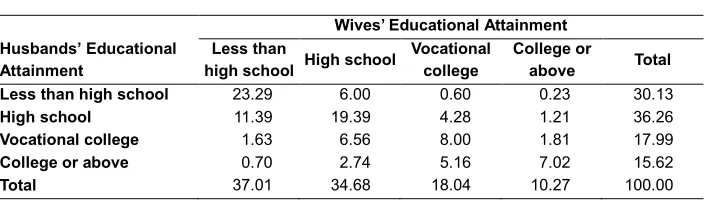
We now examine patterns of who marries whom with respect to education, to understand why highly educated women have lower marriage rates than their male counterparts. Table 2 presents the joint percentage distributions of husbands‟ and wives‟ educational attainment. More than half of the marriages (57.70%) formed between 2000 and 2008 involve men and women with same levels of educational attainment. In addition, the percentage of educational hypergamy (husbands with more education) is 28.18%, twice the percentage of educational hypogamy (wives with more education). We may also derive row and column percentages, showing spouse‟s educational distributions for a given level of educational attainment among men and women, respectively. For example, more men than women marry a spouse with less education than themselves. The gender difference is particularly sharp among the college-educated, 32% for women and 55% for men.4 In sum, most men and women in urban China marry within the same educational category, and more men than women marry spouses with lower educational attainment than themselves. Consequently, college-educated women have the lowest marriage rate.
Table 2: Percentage distribution of husbands’ and wives’ educational attainment
Wives’ Educational Attainment Husbands’ Educational
Attainment
Less than
high school High school
Vocational college
College or
above Total Less than high school 23.29 6.00 0.60 0.23 30.13
High school 11.39 19.39 4.28 1.21 36.26
Vocational college 1.63 6.56 8.00 1.81 17.99
College or above 0.70 2.74 5.16 7.02 15.62
Total 37.01 34.68 18.04 10.27 100.00
Note: N = 2,151. Table entries may not sum to 100.00 because of rounding error.
4
5.2.2 Log-linear models
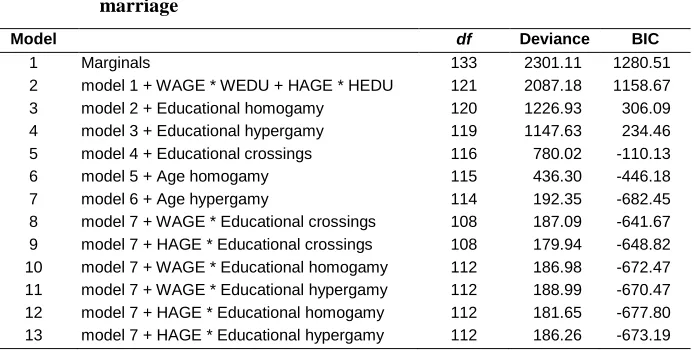
The results in Table 2 may be confounded by different educational distributions of men and women. For example, compared with women, fewer men have less than high school education and more have college education or above (as shown in Table 2). We apply log-linear models to explore assortative mating patterns net of differences in marginal distributions of spouses‟ schooling. Table 3 reports the goodness-of-fit statistics – the deviance and the BIC statistics for each log-linear model examined in this study. Model selection is crucial in log-linear modeling. The goal of log-linear modeling is to reveal the association among the variables in consideration by finding a parsimonious model with acceptable goodness of fit, using the Likelihood Ratio Test (L2) and the Bayesian information criterion (BIC) (Hout 1983). The BIC statistic is equal to L2 – (df) log(N) , which adjusts L2 based on degrees of freedom and sample size. A smaller value of BIC indicates a better fitting model (Raftery 1986).
Table 3: Fit statistics for log-linear models of age and educational assortative marriage
Model df Deviance BIC
1 Marginals 133 2301.11 1280.51
2 model 1 + WAGE * WEDU + HAGE * HEDU 121 2087.18 1158.67
3 model 2 + Educational homogamy 120 1226.93 306.09
4 model 3 + Educational hypergamy 119 1147.63 234.46
5 model 4 + Educational crossings 116 780.02 -110.13
6 model 5 + Age homogamy 115 436.30 -446.18
7 model 6 + Age hypergamy 114 192.35 -682.45
8 model 7 + WAGE * Educational crossings 108 187.09 -641.67
9 model 7 + HAGE * Educational crossings 108 179.94 -648.82
10 model 7 + WAGE * Educational homogamy 112 186.98 -672.47
11 model 7 + WAGE * Educational hypergamy 112 188.99 -670.47
12 model 7 + HAGE * Educational homogamy 112 181.65 -677.80
13 model 7 + HAGE * Educational hypergamy 112 186.26 -673.19
Note: df = degree of freedom; WAGE = wives’ age at marriage; HAGE = husbands’ age at marriage; WEDU = wives’ education;
HEDU = husbands’ education.
drop in deviance compared with Model 1 (L2 = 2301.11 – 2087.18 = 213.93, df = 12, p < 0.05), suggesting that people make marriage decisions based on joint characteristics of age and education.
We test our Hypothesis 2.a about educational assortative mating patterns by fitting Models 3 through 5. To capture the tendency for couples to marry within the same educational category, Model 3 adds an educational homogamy parameter, which substantially decreases the deviance (L2 = 2087.18 – 1226.93 = 860.25, df = 1, p < 0.05), indicating a strong pattern of educational homogamy. To test gender differences in educational assortative mating, Model 4 adds a uniform educational hypergamy parameter. The significant reduction in deviance (L2 = 1226.93 – 1147.63 = 79.31, df = 1, p < 0.05) indicates that wives tend to marry up in education, net of gender differences in educational composition. Based on changes in deviance, the educational homogamy parameter explains much more of the variance in the data than the educational hypergamy parameter. Educational crossings parameters are added in Model 5 and the model fit significantly improves (L2 = 1147.63 – 780.02 = 367.60, df = 3, p < 0.05). The BIC statistic for Model 5 is negative, indicating that Model 5 is preferred over the saturated model. Clearly, educational homogamy, hypergamy, and crossings parameters all have improved the model fit.
Next, in Models 6 and 7, we test our Hypothesis 2.b about age assortative marriage patterns. To test the propensity of individuals to marry someone of similar age, an age-group homogamy parameter is added in Model 6 and causes a significant reduction in deviance compared with Model 5 (L2 = 780.02 – 436.30 = 343.73, df = 1, p < 0.05), suggesting strong age-group homogamy. To test the gender asymmetry in age assortative mating, Model 7 adds a uniform age-group hypergamy parameter. A significant reduction in deviance (L2 = 436.30 – 192.35 = 243.95, df = 1, p < 0.05) indicates that women tend to marry men older than themselves, net of the marginal distributions of men‟s and women‟s age groups. Thus, both age-group homogamy and hypergamy parameters have improved the model fit. Overall, the improvement in model fit from Models 3 through 7 supports our Hypothesis 2 regarding the gender asymmetry in the Chinese assortative marriage patterns by education and age.
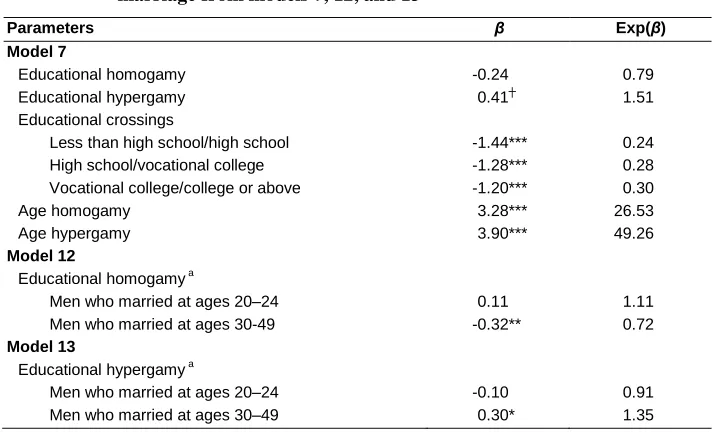
(L2 = 10.70, df = 2, p < 0.05) and Model 13 (L2= 6.09, df = 2, p < 0.05) fit more closely to the data than Model 7, suggesting that the educational homogamy and hypergamy patterns vary by men‟s but not women‟s age at marriage. The BIC statistics for Models 7, 12, and 13 are all negative and very close to one another, indicating the good fit of these three models. Thus, we now examine the parameter estimates of these three models.
Table 4: Select parameter estimates for age and educational assortative marriage from models 7, 12, and 13
Parameters β Exp(β)
Model 7
Educational homogamy -0.24 0.79
Educational hypergamy 0.41┼ 1.51
Educational crossings
Less than high school/high school -1.44*** 0.24
High school/vocational college -1.28*** 0.28
Vocational college/college or above -1.20*** 0.30
Age homogamy 3.28*** 26.53
Age hypergamy 3.90*** 49.26
Model 12
Educational homogamy a
Men who married at ages 20–24 0.11 1.11
Men who married at ages 30-49 -0.32** 0.72
Model 13
Educational hypergamy a
Men who married at ages 20–24 -0.10 0.91
Men who married at ages 30–49 0.30* 1.35
Note: aMen who married at ages 25–29 are the reference category. ┼
p < 0.10; *p < 0.05; **p < 0.01; ***p < 0.001.
which educational groups create the most difficult barrier for couples to cross. As expected, all the crossing parameters are smaller than the homogamy parameter, indicating that it is less likely to intermarry than to marry homogamously in educational attainment. Specifically, the odds of intermarriage between men with less than high school education and women with high school education are 0.30 times, the odds of hypogamous marriage across the high school/vocational college barrier are 0.35 times, and the odds of intermarriage between vocational-educated men and college-educated women are 0.38 times, respectively, the odds of homogamy.5 Therefore, the rigidity of education barriers decreases slightly as education increases.
In Model 7, age assortative mating patterns are investigated through age homogamy and hypergamy parameters. The odds of marrying in the same age group are more than 25 times higher than the odds of men marrying older women, and the odds of age hypergamy, marriages in which wives are younger than husbands, are nearly 50 times as high as the odds of age hypogamy, marriages in which wives are older than husbands. Taken together, Model 7 supports Hypotheses 2.a and 2.b – there is evidence of age and education hypergamy in urban China.
Models 12 and 13 examine how educational homogamy and hypergamy patterns differ by husbands‟ age at first marriage. Building on Model 7, Model 12 adds the interaction terms between the educational homogamy parameter and two age-group dummies for husbands, and Model 13 adds the interaction terms between the educational hypergamy parameter and age-group dummy variables for husbands. Compared with men marrying at 25–29, men marrying at 30–49 are 28% less likely in predicted marriage counts to marry women within the same educational category and 35% more likely to marry women with less education than themselves. In addition, despite no statistical significance of the coefficients for the youngest age group (i.e., 20–24), the signs of these coefficients suggest a consistent effect of husbands‟ age at marriage on educational assortative mating: relative to those marrying at 25–29, men marrying at 20–24 have higher odds of homogamy and lower odds of hypergamy. The results of Models 12 and 13 suggest that men who marry at older ages, in particular those who delay marriage until their thirties, are less likely to marry similarly educated women and more likely to marry less-educated women, compared with men who marry at younger ages. Therefore, our Hypothesis 3 is supported: women‟s age at marriage does not appear to be associated with marital sorting on education, maybe due to non-marriage; yet husbands‟ older age at first marriage is associated with higher odds of educational hypergamy and lower odds of educational homogamy.
5 To form comparison between cells, we need to calculate the difference in the sum of coefficients between
6. Discussion
In this paper, we use data from the Chinese General Social Surveys to examine gender differences in marriage formation and assortative mating patterns by education and age during the 2000s in urban China. The results show that overall the first marriage rate was higher among women than among men, but the gender differences varied substantially by education and age. With increasing levels of education, marriage rates declined among women but increased among men. College education was the only educational category in which the marriage rate of women was lower than that of men. In fact, in urban China college-educated women had the lowest marriage rate. After introducing age at marriage, we note a “catch up” effect among highly educated men in their thirties but not among their female counterparts. Among the 30–49 year-olds, highly educated men had higher marriage rates than less-educated men, whereas highly educated women had much lower marriage rates than less-educated women. Strikingly, the marriage rate in this age group was almost three times higher among college-educated men than among college-college-educated women. In sum, the results suggest that more education is associated with delayed marriage for men but with a higher likelihood of never marrying for women.
Clearly, school enrollment plays a large role in explaining the lower marriage rates of highly educated men and women aged 20 to 24, but does not contribute much to the lower marriage rate of highly educated women after age 30. It is because that in recent years, a nontrivial fraction of individuals in China are still in school before age 25, but only less than one percent are still enrolled after 25 (Treiman 2013). This pattern concurs with the findings based on individual-level event history analysis of transition into first marriage in urban China: the college-educated have lower odds of first marriage than their less-educated counterparts in their early 20s, but as they approach 30, only highly educated men, not highly educated women, start to close the gap with their less-educated counterparts (Tian 2013).
As our analysis shows, this pattern may be driven more by changes in assortative mating behaviors among older men as outlined in 3) than among older women.
Drawing on the framework that emphasizes both individual choice and structural constraints (England and Farkas 1986), we argue that both factors contribute to the gendered patterns of marriage formation and marital sorting in urban China. Individuals may choose when to marry, whether to marry, and whom to marry based on their mate preferences and their own attributes. However, the preferences and the values of the attributes are largely influenced by structural factors such as normative gender roles and attitudes as well as cultural systems in a society, which then shape marriage market conditions.
It is a widely held social norm in China that men marry women who are younger and less educated than themselves, and vice versa (Xu 2000; Yu 2011). This norm worked well in the past when college education was uncommon and men generally had more education than women. Improvement in education, especially among women, has, however, transformed the marriage market. On the one hand, highly educated women with strong earnings potentials are unwilling to marry men with fewer economic prospects than themselves. On the other hand, men do not value women‟s educational attainment as much especially when men in their 30s search for spouses. Women‟s college education is linked to strong career aspirations and appears to clash with the role of a good wife and mother. Our results show that educational homogamy was high when highly educated men and women married in their 20s maybe because such marriages mostly consisted of those in which men and women established their relationships while in college, but educational homogamy declined after age 30 during which highly educated men tend to cast a wider net to marry young and less-educated women while highly educated women must confront with a dwindling marriage market in which even divorced men are in short supply because of low divorce rates.
Gender roles in China remain traditional not so much because women‟s economic prospects (as indicated by their educational attainment) are not valued, but because the young couples are expected to bear the burden or responsibility of caring for children and aging parents (Yue and Ng 1999). This would undoubtedly fall on women‟s shoulder (Zhan and Montgomery 2003). Although nowadays parents seldom exert absolute control over their children‟s marriage, they continue to play a big role in their children‟s mate choices (Pimentel 2000; Riley 1994). It may be in the best interest of parents who have their sons to marry a woman who can take on the familial responsibilities or who have their daughters to find a husband with the best possible socioeconomic status. Given that familial ties are strong and most urban young men and women are the only child, parental influences are likely to be strong. In addition, a husband who takes on more domestic role in the family is often frowned upon while a wife‟s greater career aspirations and financial contributions often create family conflict (Zuo and Bian 2001). In sum, gender roles in the family remain highly segregated in China. We may continue to see the low marriage prospects of older, highly educated women until gender roles within families become more egalitarian.
Undoubtedly, with diminishing returns to gender-specialized marriage for highly educated women, they are likely to delay or forgo marriage. This is not an unprecedented phenomenon in China or elsewhere. However, what is intriguing in urban China today is that those women are labeled “leftover ladies,” regardless of the fact that they may choose to do so in response to undesirable gender roles in Chinese society. This gendered, stigmatizing term devalues women‟s own marital choices regarding whether they marry and whom they marry. Meanwhile, this phenomenon occurs during a time when the one-child policy has led to a skewed sex ratio in China where never married men substantially outnumber their female counterparts (Guilmoto 2012). Another phenomenon must also take place – Less-educated men also have difficulty getting married (Sharygin, Ebenstein, and Das Gupta 2013). We do not see strong evidence of it because most of them live in rural villages. Clearly, the movement toward egalitarian gender roles does not go hand in hand with rapid social and economic changes in urban China. This study reveals the great gender divide in the marriage market in urban China. The social implications warrant further study when rural marriage markets are also taken into account.
7. Acknowledgements
References
Attané, I. (2012). Being a woman in China today: A demography of gender. China
Perspectives 4: 5–15.
Becker, G.S. (1981). A treatise on the family. Cambridge, MA: Harvard University Press.
Bian, Y. (2002). Chinese social stratification and social mobility. Annual Review of
Sociology 28(1): 91–116. doi:10.1146/annurev.soc.28.110601.140823.
Bian, Y. and Li, L. (2012). The Chinese general social survey (2003–8). Chinese
Sociological Review 45(1): 70–97. doi:10.2753/CSA2162-0555450104.
Bian, Y. and Logan, J.R. (1996). Market transition and the persistence of power: The changing stratification system in urban China. American Sociological Review 61(5): 739–758. doi:10.2307/2096451.
Blossfeld, H. (1995). The new role of women: Family formation in modern societies. Boulder, CO: Westview Press.
Blossfeld, H. and Rohwer, G. (1995). West Germany. In: Blossfeld, H. (ed.). The new
role of women: Family formation in modern societies. Boulder, CO: Westview
Press: 56–76.
Chang, L. (1999). Gender role egalitarian attitudes in Beijing, Hong Kong, Florida, and Michigan. Journal of Cross-Cultural Psychology 30(6): 722–741. doi:10.1177/0 022022199030006004.
Cherlin, A. (1990). The strange career of the “Harvard-Yale study”. Public Opinion
Quarterly 54(1): 117–124. doi:10.1086/269187.
England, P. (2010). The gender revolution: Uneven and stalled. Gender and Society 24(2): 149–166. doi:10.1177/0891243210361475.
England, P. and Farkas, G. (1986). Households, employment, and gender: A social,
economic, and demographic view. New York, NY: Aldine.
England, P. and McClintock, E.A. (2009). The gendered double standard of aging in US marriage markets. Population and Development Review 35(4): 797–816. doi:10. 1111/j.1728-4457.2009.00309.x.
Fincher, L.H. (2012). China‟s „leftover‟ women. The New York Times: http://www.nytimes.com/2012/10/12/opinion/global/chinas-leftover-women.htm l.
Goldstein, J.R. and Kenney, C.T. (2001). Marriage delayed or marriage forgone? New cohort forecasts of first marriage for U.S. women. American Sociological
Review 66(4): 506–519. doi:10.2307/3088920.
Greenhalgh, S. (2010). Cultivating global citizens: Population in the rise of China. Cambridge, MA: Harvard University Press.
Guilmoto, C.Z. (2012). Skewed sex ratios at birth and future marriage squeeze in China and India, 2005–2100. Demography 49(1): 77–100. doi:10.1007/s13524-011-00 83-7.
Han, H. (2010). Trends in educational assortative marriage in China from 1970 to 2000.
Demographic Research 22(24): 733–770. doi:10.4054/DemRes.2010.22.24.
Hoem, B. (1995). Sweden. In: Blossfeld, H. (ed.). The new role of women: Family
formation in modern societies. Boulder, CO: Westview Press: 35–55.
Hout, M. (1983). Mobility tables. Beverly Hills, CA: Sage.
Jennings, E.A., Axinn, W.G., and Ghimire, D.J. (2012). The effect of parents‟ attitudes on sons‟ marriage timing. American Sociological Review 77(6): 923–945. doi:10 .1177/0003122412464041.
Jones, G.W. (2007). Delayed marriage and very low fertility in Pacific Asia. Population
and Development Review 33(3): 453–478. doi:10.1111/j.17284457.2007.00180.
x.
Jones, G.W. and Gubhaju, B. (2009). Factors influencing changes in mean age at first marriage and proportions never marrying in the low-fertility countries of East and Southeast Asia. Asian Population Studies 5(3): 237–265. doi:10.1080/17441 730903351487.
Kalmijn, M. (2010). Educational inequality, homogamy, and status exchange in black-white intermarriage: A comment on Rosenfeld. American Journal of Sociology 115(4): 1252–1263. doi:10.1086/649050.
Magistad, M.K. (2013). China‟s „leftover women‟, unmarried at 27. BBC News: http://www.bbc.co.uk/news/magazine-21320560.
Mare, R.D. (1991). Five decades of educational assortative mating. American
Sociological Review 56(1): 15–32. doi:10.2307/2095670.
Oppenheimer, V.K. (1988). A theory of marriage timing. American Journal of
Sociology 94(3): 563–591. doi:10.1086/229030.
Oppenheimer, V.K. (1994). Women‟s rising employment and the future of the family in industrial societies. Population and Development Review 20(2): 293–342. doi:10 .2307/2137521.
Oppenheimer, V.K. (1997). Women‟s employment and the gain to marriage: The specialization and trading model. Annual review of sociology 23: 431−453. doi:10.1146/annurev.soc.23.1.431.
Parish, W.L. and Busse, S. (2000). Gender and work. In: Tang, W. and Parish, W.L. (eds.). Chinese urban life under reform: The changing social contract. New York, NY: Cambridge University Press: 209–231.
Pimentel, E. (2000). Just how do I love thee?: Marital relations in urban China. Journal
of Marriage and the Family 62(1): 32–47. doi:10.1111/j.1741-3737.2000.00032.
x.
Pinnelli, A. and De Rose, A. (1995). Italy. In: Blossfeld, H. (ed.). The new role of
women: Family formation in modern societies. Boulder, CO: Westview Press:
174–190.
Preston, S.H., Heuveline, P., and Guillot, M. (2001). Demography: Measuring and
modeling population processes. Malden, MA: Blackwell Publishers.
Preston, S.H. and Richards, A.T. (1975). The influence of women‟s work opportunities on marriage rates. Demography 12(2): 209–22. doi:10.2307/2060761.
Qian, Y. and Qian, Z. (2014). Work, family, and gendered happiness among married people in urban China. Social Indicators Research: 1–14. doi:10.1007/s11205-0 14-0623-9.
Qian, Z. (1997). Breaking the racial barriers: Variations in interracial marriage between 1980 and 1990. Demography 34(2): 263–276. doi:10.2307/2061704.
Qian, Z. and Preston, S.H. (1993). Changes in American marriage, 1972 to 1987: Availability and forces of attraction by age and education. American
Sociological Review 58(4): 482–495. doi:10.2307/2096072.
Raftery, A.E. (1986). Choosing models for cross-classifications. American Sociological
Review 51(1): 145–146. doi:10.2307/2095483.
Raymo, J.M. (2003). Educational attainment and the transition to first marriage among Japanese women. Demography 40(1): 83–103. doi:10.1353/dem.2003.0008.
Raymo, J.M. and Iwasawa, M. (2005). Marriage market mismatches in Japan: An alternative view of the relationship between women‟s education and marriage.
American Sociological Review 70(5): 801–822. doi:10.1177/0003122405070005
04.
Raymo, J.M. and Xie, Y. (2000). Temporal and regional variation in the strength of educational homogamy. American Sociological Review 65(5): 773–781. doi:10.2 307/2657546.
Riley, N.E. (1994). Interwoven lives: Parents, marriage, and guanxi in China. Journal
of Marriage and the Family 56(4): 791–803. doi:10.2307/353592.
Schwartz, C.R. and Mare, R.D. (2005). Trends in educational assortative marriage from 1940 to 2003. Demography 42(4): 621–646. doi:10.1353/dem.2005.0036.
Sharygin, E., Ebenstein, A., and Das Gupta, M. (2013). Implications of China‟s future bride shortage for the geographical distribution and social protection needs of never-married men. Population Studies 67(1): 39–59. doi:10.1080/00324728.20 12.723893.
Shu, X. (2004). Education and gender egalitarianism: The case of China. Sociology of
Education 77(4): 311–336. doi:10.1177/003804070407700403.
Smits, J. and Park, H. (2009). Five decades of educational assortative mating in 10 East Asian societies. Social Forces 88(1): 227–255. doi:10.1353/sof.0.0241.
Song, L. (2009). The effect of the cultural revolution on educational homogamy in urban China. Social Forces 88(1): 257–270. doi:10.1353/sof.0.0246.
e/2011/10/for-chinas-educated-single-ladies-finding-love-is-often-a-struggle/246 892/.
Sweeney, M.M. (2002). Two decades of family change: The shifting economic foundations of marriage. American Sociological Review 67(1): 132–147. doi:10.2307/3088937.
Tang, W. and Parish, W.L. (2000). Chinese urban life under reform: The changing
social contract. New York, NY: Cambridge University Press.
Tian, F.F. (2013). Transition to first marriage in reform-era urban China: The persistent effect of education in a period of rapid social change. Population Research and
Policy Review 32(4): 529–552. doi:10.1007/s11113-013-9272-y.
Treiman, D.J. (2012). The “difference between heaven and earth”: Urban-rural disparities in well-being in China. Research in Social Stratification and Mobility 30(1): 33–47. doi:10.1016/j.rssm.2011.10.001.
Treiman, D.J. (2013). Trends in educational attainment in China. Chinese Sociological
Review 45(3): 3–25. doi:10.2753/CSA2162-0555450301.
Xu, A. (2000). Mate-selection preferences: Five decades of changes and causes.
Sociological Studies 6: 18–30.
Xu, X., Ji, J., and Tung, Y. (2000). Social and political assortative mating in urban China. Journal of Family Issues 21(1): 47–77. doi:10.1177/01925130002100100 3.
Xu, X. and Whyte, M.K. (1990). Love matches and arranged marriages: A Chinese replication. Journal of Marriage and the Family 53(3): 709–722. doi:10.2307/35 2936.
Yeung, W.-J. (2013). Higher education expansion and social stratification in China.
Chinese Sociological Review 45(4): 54–80. doi:10.2753/CSA2162-0555450403.
Yu, M. (2011). Gender Difference of graduated students‟ standards of choosing a spouse: Taking universities in Yunnan province for example. Youth Studies 1: 60–64.
Zhan, H.J. and Montgomery, R.J.V. (2003). Gender and elder care in China: The influence of filial piety and structural constraints. Gender and Society 17(1): 209–29. doi:10.1177/0891243202250734.
Zhang, J. and Zhao, Y. (2007). Rising returns to schooling in urban China. In: Hannum, E. and Park, A. (eds.). Education and reform in China. New York, NY: Routledge: 248–259.
Zhao, W. and Zhou, X. (2007). Returns to education in urban China‟s transitional economy: Reassessment and reconceptualization. In: Hannum, E. and Park, A. (eds.). Education and reform in China. New York, NY: Routledge: 224–247.
Zhou, J. (2003). Keys to Women‟s liberation in communist China: An historical overview. Journal of International Women’s Studies 5(1): 67−77.
Zuo, J. (2003). From revolutionary comrades to gendered partners: Marital construction of breadwinning in post-Mao urban China. Journal of Family Issues 24(3): 314– 337. doi:10.1177/0192513X02250888.