The Impacts of Teaching the Educational- Rumi's Compilation Pattern on
critical thinking
Tendency Students
Fariba Farazi*1
Ph.D. of Educational Psychology, Science and Research Unit, Islamic Azad University, Tehran, Iran
Abstract
Objective: The current research aims to study the impacts of teaching the Educational- Rumi's
Compilation pattern on critical thinking Tendency.
Method: The study approach is of Semi experimental pretest-posttest type with an existing control
group, the statistical population of which is all female students in the twelfth grade at Technical Schools in Birjand in the academic year of 2016-2017. A total of 30 people, who had the desired input characteristics, were selected by a multistage cluster sampling as the sample group. The of Ricketts critical thinking questionnaire (2003) was used to measure the variables of the research. The analysis of the research data was conducted through the Multivariate Covariance Examination.
Results: The results indicate that the teaching the Educational- Rumi's Compilation pattern increased the critical thinking (In all three dimensions, creativity, maturity and commitment) of the experimental group versus the control group.
Conclusion: According to the results, it can be said that through the training of the Educational-
Rumi's Compilation Pattern, critical thinking tendency is strengthened in children.
Keywords: Educational- Rumi's Compilation Pattern, critical thinking tendency, Students
*Corresponding Author Email:[email protected]
Introduction
Critical thinking is a kind of abstract thinking that flourishes in adolescence. According to Dinuta (2015), critical thinking is an active process that the child does it by questioning himself or herself and relates it to other aspects. It is a way of learning that proves a great deal of information. The findings of critical thinking are combined findings. critical thinking is having applied knowledge in order to convince yourself and get rid of dependent thoughts; it is learning to have effective thinking. Critical thinking from Facione's perspective (2000, 2011) involves the skills of interpretation, analysis, explanation and dissection, autoregulation and inference. It is clear that sufficient tendency and desire to develop and apply these skills is essential and critical thinking will not be happened without tendency and desire to it (Jane, Birma & Bradbury, 2004).
According to Ricketts and Rudd (2004), the tendency for critical thinking involves three dimensions of creativity, maturity, and commitment. Creativity is the desire of an individual to identify problems by being aware of their own desires and prejudices and others; Eloquence is the individual's desire to seek opportunities for rational use and confidence in the ability to reason and predict situations that require logic. Commitment means one's desire for rational desires and a desire to realize the truth. These tendencies motivate a person to make practical use of their critical thinking skills and without them the individual is reluctant to use his or her critical thinking skills. For this reason, in order to help to improve the critical thinking quality of students, the educator must pay attention to both this type of thinking skills and its related tendencies and also need to know the factors that influence their growth. Noone, Bunting & Hogan (2016), in a study entitled “Does mindfulness Increase Critical Thinking? Evidence for the mediating effects of executive operations in the relationship between mindfulness and critical thinking” has indicated that oriented mindfulness facilitates the performance of critical thinking and this effect is due to self-restraint dimension from executive performance.
However, related researches to critical thinking have mainly focused on its skills and, despite the importance of critical thinking tendencies, have only shifted their focus from skills to tendencies in recent years. For this reason, from the research point of view, not much attention has been paid to investigating the factors affecting the tendencies of critical thinking. So, given the needs of today's world and the necessity of Adolescent endowment from critical thinking, the introduction of Rumi’s Integrated-Instructional pattern in a planned and organized way to strengthen the tendency to critical thinking is necessary.
This pattern, which is a combination of didactic and Jan therapy patterns, is combined with technical eclecticism. The didactic pattern is a collection of principled efforts and practices that includes methods and techniques for changing behavior and personality in order to achieve optimal growth (Hambali, & Gipayana, 2016). The didactic Pattern focuses on providing counseling, guidance, counseling, and training on the use of media, groups, and supportive thinking in order to change behaviors, attitudes, and cognitions. In this model, the consultant has the skills that clients need to learn, and such skills can be achieved through training, modeling and facilitation. Clients can tackle challenging situations by learning these skills. Teaching these skills can enable clients to live more effectively. These skills as life skills include a wide range of aspects of contemporary life, such
as: Setting explicit and clear goals and values, Interpersonal communication, Developing new
perspectives, Parenting skills, health and spare time skills, decision making, Problem-solving and conflict-solving skills, Emotional awareness, career advancement skills, self- control skills and learning skills (Hornby, 1990). In didactic model, a wide range of techniques from theoretical approaches are used as the educational psychological intervention. For example, clients can be trained in the "communication skills" technique to improve their relationship with their parents (Gordont, 1976; Pattersong, 1977).
Spitzberg, 2003; Bijstra, Bosma & Jackson, 1997; cited by Ahmadi, 2014). Therefore, there are the increasing number of people who have problems with others, people who are afraid of social encounters and shyness, Adolescents who do not know what to say and how to behave when they are in the public and feel unable to talk to people and have lake of cooperation with them and also are unable to make decisions about their own daily issues, all cause adolescent identity disorders. People are not born shy or social from the beginning but provide the necessary education for them throughout their lives (Lowell, M. & Barbara, M, 1998; cited by Kayvand, Shafi'abadi & Soudani, 2010).
On the other hand, another approach in the realm of counseling patterns that has recently come to the fore in Iran has been the use of Iranian literature and the development of counseling patterns in accordance with indigenous and national culture. One of these patterns is the Jan therapy pattern. Rumi also considers adolescence and youth a lifeblood of mankind, and believes that in this phase of life, two springs are in symmetry. One is physical and the other is spiritual spring. The former makes the young body vigorous and powerful, and the latter makes the young sensitive, emotional, and mold (Zamani, 2003). In Jan therapy pattern, the meaning of the Jan is the human being, which is a more appropriate term for psyche for treatment. This pattern, extracted from the poetry of Maulavi i.e. Parrot and the Merchant, expresses the Jan of a human being who is captured in a cage and ultimately finds emancipation and freedom with death before his death. Parrot in this story is the symbol of human Jan (the symbol of pure and single Jan). The cage is the symbol of the body, which is the way to free it from the fictitious prisons of habit and inculcation and in general from materials (Forouzanfar, 2006).
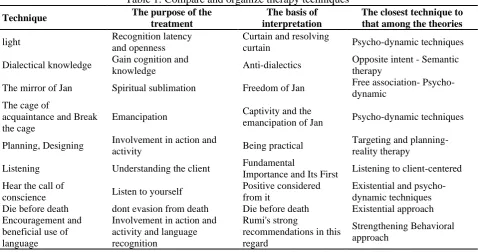
The richest part of the Jan therapy pattern is its theoretical part. In addition to the poet and mystic, Rumi is an instructor and anthropologist which has a deep and profound view of humans. The things he has pointed out centuries ago are now appearing in their therapeutic theory. In essence, the Jan therapy pattern in the dimension of the pathology in the content considers psychological problems related to the principle of Jan's veil. Which encompasses a number of cases, including Jan's cover, being in yourself, lack of awareness and understanding, Language inefficiency, Lack of dynamism and fluidity, the lack of unity and the totality of Jan, Inactivity, fear of death, lack of self-knowledge, breaking from the present and drowning in the past and future, search for happiness and liberation outside yourself and letting go of the Jan and staying in the body and lack of mastery the Jan. Jan therapy pattern is also the content, process of its goals and techniques. Table 1 shows the comparison and organization of these techniques (Mohammadi, 2010)
Table 1: Compare and organize therapy techniques
Technique The purpose of the
treatment
The basis of interpretation
The closest technique to that among the theories
light Recognition latency
and openness
Curtain and resolving
curtain Psycho-dynamic techniques
Dialectical knowledge Gain cognition and
knowledge Anti-dialectics
Opposite intent - Semantic therapy
The mirror of Jan Spiritual sublimation Freedom of Jan Free association-
Psycho-dynamic The cage of
acquaintance and Break the cage
Emancipation Captivity and the
emancipation of Jan Psycho-dynamic techniques
Planning, Designing Involvement in action and
activity Being practical
Targeting and planning-reality therapy
Listening Understanding the client Fundamental
Importance and Its First Listening to client-centered Hear the call of
conscience Listen to yourself
Positive considered from it
Existential and psycho-dynamic techniques Die before death dont evasion from death Die before death Existential approach Encouragement and
beneficial use of language
Involvement in action and activity and language recognition
Rumi's strong
recommendations in this regard
Allegory and poetry
from Rumi Achieve therapeutic goals
Applying allegory and metaphor to guide client
Metaphor - Narrative Therapy
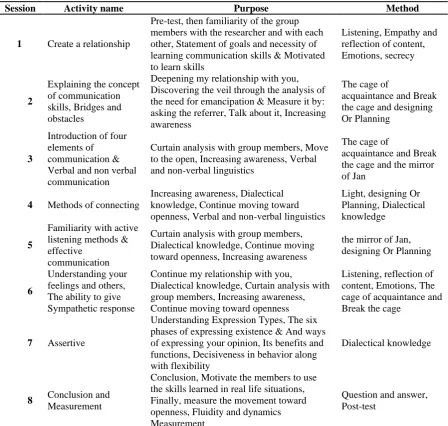
Finally, given that integration can occur at theoretical level (theoretical integration), at technical level (technical eclecticism), or more likely at both levels (absorption integration) (Esmaeili, 2015). In technical eclecticism such predictions take place: which interventions and for whom? In Rumi's didactic integrative pattern, with the help and integration of didactic and Jan therapy patterns, this prediction is carried out using the content and skills required to be taught in didactic pattern, and using different Jan therapy techniques (anticipation of intervention) in relation to the effect of the type of interactions that teens have with others.
Method
This research is a quasi-experimental with pre-test and post-test with control group design. The statistical population of this research consisted of all the female students of 12th grade of Birjand schools in the academic year of 2016-17, whose number was equal to... According to the quasi-experimental nature of the research and the educational aspect of it, and according to Delavar (2012), with regard to the selection of the sample size in quasi-experimental designs, 30 people were selected as the sample group. In this research, multistage cluster sampling method was used. In this way, first, two schools were randomly selected from girl schools, and then one field of study was randomly selected from the fields of study in each school, and finally, one class was randomly selected among from the available classes for the discipline. Eventually, one class was randomly selected as the experimental group and one class was selected as the control group (15 ones in each class). The inclusion criteria were age (16 years old), mental health, lack of specific physical problems, and the achievement of abstraction power. The measurement instrument in this research was Critical Thinking Tendency Questionnaire (Ricketts, 2003) as described below.
Critical Thinking Tendency Questionnaire (Ricketts, 2003): This questionnaire is a self-report tool that measures the likelihood of critical thinking in three scales of creativity (1, 5, 7, 11, 14, 17, 24, 25, 26, 28 and 29), maturity (2, 12, 15, 19, 23, 30, 31, 32, and 33) and commitment (3, 4, 6, 8, 9, 10, 13, 16, 18, 20, 21, 22, 27). This questionnaire was designed after Moore, Rudd, and Penfield (2003) obtained important and different results on the California Critical Thinking Disorder Inventory (CCTDI). The subject must indicate on a 5-point Likert scale (strongly disagree = 1 to strongly agree = 5) Specify the extent of your disagreement or agreement with each of the terms. In phrases: 2, 12, 15, 19, 23, 30, 32, and 33, the scoring is carried out inversely (strongly disagree = 5 to strongly agree = 1). Cronbach's alpha coefficient in Behzadi and Saroughad (2012) for creativity, maturity and commitment subscales was 0.62, 0.54 and 0.71, respectively. Cronbach's alpha in current research was 0.89, 0.43, 0.91 for creativity, maturity, and commitment subscales, respectively.
Table 2: Rumi’s didactic integrative pattern protocol
Session Activity name Purpose Method
1 Create a relationship
Pre-test, then familiarity of the group members with the researcher and with each other, Statement of goals and necessity of learning communication skills & Motivated to learn skills
Listening, Empathy and reflection of content, Emotions, secrecy
2
Explaining the concept of communication skills, Bridges and obstacles
Deepening my relationship with you, Discovering the veil through the analysis of the need for emancipation & Measure it by: asking the referrer, Talk about it, Increasing awareness
The cage of
acquaintance and Break the cage and designing Or Planning
3
Introduction of four elements of communication & Verbal and non verbal communication
Curtain analysis with group members, Move to the open, Increasing awareness, Verbal and non-verbal linguistics
The cage of
acquaintance and Break the cage and the mirror of Jan
4 Methods of connecting
Increasing awareness, Dialectical knowledge, Continue moving toward openness, Verbal and non-verbal linguistics
Light, designing Or Planning, Dialectical knowledge
5
Familiarity with active listening methods & effective
communication
Curtain analysis with group members, Dialectical knowledge, Continue moving toward openness, Increasing awareness
the mirror of Jan, designing Or Planning
6
Understanding your feelings and others, The ability to give Sympathetic response
Continue my relationship with you,
Dialectical knowledge, Curtain analysis with group members, Increasing awareness, Continue moving toward openness
Listening, reflection of content, Emotions, The cage of acquaintance and Break the cage
7 Assertive
Understanding Expression Types, The six phases of expressing existence & And ways of expressing your opinion, Its benefits and functions, Decisiveness in behavior along with flexibility
Dialectical knowledge
8 Conclusion and Measurement
Conclusion, Motivate the members to use the skills learned in real life situations, Finally, measure the movement toward openness, Fluidity and dynamics Measurement
Question and answer, Post-test
Findings
In this research, Multivariate Covariance Analysis (MANKOVA) was used to study the effect of Rumi’s didactic integrative pattern on Critical Thinking Tendency. Descriptive indicators including mean and standard deviations of the research variables are presented in Table 4.
Table 4 Descriptive indicators including mean and standard deviations
examination Group Control group
Variable Subscales pretest Post-test pretest Post-test
M SD M SD M SD M SD
Critical Thinking
creativity 2.70 0.41 3.89 0.61 2.87 0.37 2.87 0.37
Maturity 2.99 0.35 3.55 0.55 2.93 0.61 2.93 0.43
commitment 2.74 0.51 3.63 0.62 2.65 0.44 2.65 0.44
verify the equality of the observed covariance matrices by dependent variables. The results of the Levene’s test Critical thinking Tendency components include creativity (F= 2.19, P>0.01), Maturity (F=1.17, P>0.01) & commitment (F=0.15, P>0.01) showed that the level of F error in the Levene’s test was higher than 0.01; therefore, there were no significant differences between Critical thinking Tendency components error variances between the groups. The results of multivariate covariance analysis based on Wilks’s Lambda scale (F= 26.45, P< 0.01) showed a significant difference between the linear mean of the Critical thinking Tendency components scores of the two groups. Table 5 shows the results of MANCOVA test in two dimensions of national and religious identity in the two groups under study.
Table 5: the results of MANCOVA test in Critical thinking Tendency components in the two groups
Sources The dependent variables SS df MS F sig Effect size
Study group
Critical Thinking
creativity 9.67 1 9.67 82.62* 0.001 0.77
Maturity 1.99 1 1.99 22.43* 0.001 0.47
commitment 6.18 1 6.18 22.74* 0.001 0.47
P<0/05
According to the above table, given the results of the effects of between the subjects tests and the calculated indices (F ratios and their significant levels), it can be concluded that between the two components of Critical Thinking, the mean scores of the two groups (experimental and control) are different in all three components of critical thinking are creativity, maturity and commitment simultaneously. Given the value of the effect size, the level of explanation of the dependent variables by the group (interventions) is in order 77, 47 and 47 percentage. According to the results of the test, education using integrated pattern was effective in increasing the Critical thinking Tendency of the research participants.
Conclusion and discussion
The results of the current research indicated that training of integrated pattern cause to increase creativity, maturity and commitment of dimensions of critical thinking in the experimental group in comparison of the control group. The findings are in line with the research Farazi & et al (2017).
What distinguishes the educational-Rumi model from other models is the teaching of the necessary skills to individuals using Jan therapy techniques. Techniques extracted from the parable of the parrot and Bazargan in Masnavi Manavi are appropriate to Iranian culture. These techniques include listening (the purpose of which is to understand and recognize as many clients as possible and to establish a relationship between you and me) in counseling so that the client (you) speak. Making the ground for self-hearing and also listening to the counselor as one another in front of the client will strengthen the field in seeking to raise awareness of themselves and others and to improve relationships and deepen their thinking, therefore the most important evaluation for the growth of treatment is also the deepening of this between the counselor and the clients), The cage of acquaintance and Break the cage (the purpose of which is to persuade the authorities to identify their prisoners and attachments, express their feelings and excitements in this field, and move towards the goal of therapy), Dialectical knowledge (the purpose of which is to attain knowledge and increasing knowledge of ourselves and of our being), the mirror of Jan (aims to persuade the clients to recognize their capricious attachments and express their feelings and excitements in this field and move towards spiritual liberation), light (the purpose of which is to acquaint or open, and to uncover, hijab from the Jan) and designing (the purpose of which is the conflict in action and activity).
of the curriculum and the non-random selection of sample groups. In the end, considering that in this research, Rumi's didactic integrative pattern was implemented only on female students, it is recommended that this pattern be performed on parents in future research and gender differences be also considered.
References
Ahmadi, M. S. (2014). Effectiveness of Training Communication Skills on Self-regulated Learning of Male High School Students in Zanjan City. Knowledge and Research in Applied Psychology, 15(55), 113-120. [In Persian] Ak, M., Cinar, O., Sutcigil, L., Congologlu, E. D., Haciomeroglu, B., Canbaz, H., Yaprak, H., Jay, L., & Ozmenler, K.
N. (2011). Communication Skills Training for Emergency Nurses. International Journal of Medical Science Tertilrlfeiclcieces, 8(5), 397-401.
Anyamene, A., Nwokolo, C., & Madegbuna, U. (2015). Effects of psychoeducation technique on examination misconduct tendencies of secondary school students. European Scientific Journal, 11(11), 1857–7881.
Behzadi, B., & Sarvghad, S. (2012). The Relationship between Family Flexibility and Identity Styles with the Mediating Role of Critical Thinking in Adolescent Girls. Journal of Woman and Family Studies, 5(15), 63-80. [In Persian] Brown, N. W. (2018). Psychoeducational groups: process and practice (4th ed). New York: Routledge.
Delavar, A. (2012). Research method in psychology And Educational Science. Tehran: Virayesh Publishing.
Dinuta, N. (2015). The use of critical thinking in teaching geometric concepts in primary school. Social and Behavioral Sciences, 180, 788-794.
Erozkan, A. (2013). The Effect of Communication Skills and Interpersonal Problem-Solving Skills on Social Self-Efficacy. Educational Sciences: Theory & Practice, 13(2), 739-745.
Esmaeili, M. (2015). Paradigmatic Considerations in Family Therapy. Tehran: Elm Publishing. [In Persian].
Facione, P. A. (2000). The Disposition TowardCritical Thinking: Its Character, Measurement and Relationship to Critical Thinking Skill. lnformal Logic, 20(1), 61-84.
Facione, P. A. (2011). Critical thinking: What it is and why it counts (a resource paper). Millbrae, CA: California Academic Press.
Farazi, F., Esmaeili, M., Eskandari, H., & Hatami, M. (2017). Effect of Educational pattern Training on Parent-Child Relationship and Critical Thinking. Journal of Educational Research, 4(34), 75-94. [In Persian].
Farazi, F., Esmaeili, M., Eskandari, H., & Hatami, M. (2018). The impacts of teaching the educational pattern on improving the parent-child relationship and the national and religious identity Girl students of Birjand city. Quarterly journal of research in educational Systems, 12(41), 27-47. [In Persian]
Forouzan Far, B. Z (2006). Description of Mathnavi Sharif (3 vol.). Tehran: Zavar Publications. [Persian] Gordon, t. (1976). P.E.T. in Action (New York, Wyden).
Hambali, I. M., & Gipayana, M. (2016). A cognitive stage-experiential psycho-educational guidance model to enhance the Bhineka Tunggal Ika (Unity in diversity) awareness. Journal of Social Sciences, 5(1), 19-28.
Hornby, G. (1990). A humanistic developmental model of counselling: A psycho-educational approach, Counselling Psychology Quarterly, 3(2), 191-203.
Jin, G., Bierma, T.J. & Broadbear, J. (2004). Critical thinking among environmental health undergraduates and implications for the profession. Journal Environment Health, 67(3), 15-20.
Kallet, M. (2014). Think Smarter: Critical Thinking to Improve problem-solving and decision-Making Skills. New Jersey: John Wiley & Sons.
Kayvand, F., Shafiabadi, A., & Sodani, M. (2010). The effectiveness of teaching relation skills on social anxiety in boy's students of Ahvaz. Journal of Science and Research in Apply Psychology, 42, 1-24. [In Persian]
Mohammadi, R. (2010). Formulation of a therapeutic pattern based on the story of parrot and merchant (spiritual mathnavi) and determining its effectiveness on reducing despair. (Unpublished Master thesis). Allameh Tabatabaei University, Tehran, MA. [In Persian].
Moore, L., Rudd, R., & Penfield, R. (2002). Scale reliability and validity of the California Critical Thinking Disposition Inventory. Unpublished manuscript, University of Florida, Gainesville.
Noone, C., Bunting, B., & Hogan, M. J. (2016). Does Mindfulness Enhance Critical Thinking? Evidence for the Mediating Effects of Executive Functioning in the Relationship between Mindfulness and Critical Thinking.
Frontiers in Psychology, 19, 1-16.
Pattersong, R. (1977). Families. (New York, Research Press).
Ricketts, J. C. (2003), The efficacy of leadership development, critical thinking dispositions and student academic performance on the critical thinking skills of selected youth leaders. a dissertation presented to the graduate school of the University of Florida in partial fulfillment of the requirements for the degree of doctor of philosophy, University of Florida.