D G Baheti, BVP Deemed University, Poona College of Pharmacy, Erandwane, Pune-411 038 (Maharashtra) 9
Address for correspondence
Access this article online www.japer.in
Antiurolithiatic activity of a polyherbal formulation against
calcium oxalate induced urolithiasis in rats
Introduction
Urolithiasis, one of the common and painful ailments of the urinary tract disorder, has been occurring in humans from centuries. The worldwide increasing incidence and prevalence especially with the advancement in the industrialisation.[1-3] Moreover the age of onset is decreasing which make it a matter
of biomedical concern. [4]The overall prevalence of >
10% and an expected recurrence rate of ~ 50%,
started showing on the healthcare system. [5] It is
further observed that frequent recurrence is
associated with risk during relapse and shortened
duration between relapse. [6] Features associated
with major determinants of these recurrences are
young age of onset, family history, genetic makeup,
concurrent infection, size of stones and underlying
medical conditions. [7] Epidemiological studies also
revealed that it is more common in men (12%)
compared to women (6%) which need to be
considered during the research.[8]
As far as urinary system is concerned; it is 3rd prevalent disorder which usually starts with obstruction and if left untreated results in severe complications like multiple infections and hemorrhage suggesting need of ideal medical care.[9]
Pathophysiologically, urolithiasis occurs as a consequence of the breakdown of a delicate balance to be maintained by the kidneys i.e. excretion of materials that have a low solubility and conservation of water. These two opposing requirements must be balanced during adaptation to diet, climate and various activities. Whenever the urine becomes supersaturated with insoluble material, because excretion rates are excessive and/or reduced water conservation, crystals are formed, grow and aggregate to form a stones. The impact of these stones increases by many folds in the presence of other complaints like hypertension, obesity hepatic dysfunction etc.[10-13] The etiology of this disorder is multifactorial and is
strongly related to dietary habits or practices.[14] Research
Research Research
Research ArticleArticleArticleArticle
The present study was undertaken to investigate the effects of a polyherbal formulation (PHF)on experimentally-induced kidneystones. Oxalate urolithiasis in male rats was induced experimentally by administration of 0.75% v/v ethylene glycol with 1% w/v ammonium chloride in drinking water for three days followed by only 0.75% v/v ethylene glycol for 25 days. The PHF was administered to urolithiasis induced test group rats at three doses i.e. 200, 300 and 400mg/kg respectively for 28 days. After 28 days, highly significant deposition of calcium oxalate in the kidneys was noticed along with increase in the urine volume, urinary oxalate, calcium, levels and magnesium levels in urolithiasis control group rats as compared to normal group rats. The serum analysis showed significant increase in the serum uric acid, serum creatinine, and blood urea in urolithiasis control group rats. In addition, vehicle treated induction control group rats showed significant increase in the biochemical parameters such as ACP, ALP, AST, ALT levels and decrease in LDH levels in the kidney homogenate which indicated the induction of urolithiasis. Daily oral treatment with PHF at doses 300 and 400mg/kg significantlydecreased the quantity of calcium oxalate deposited in the kidneys but also reverted all the biochemical changes induced by calcium oxalate urolithiasis thus supporting its traditional claim. 200 mg/kg dose of PHF however, was found to be insignificant in these regards.
Keywords: Calcium oxalate, ethylene glycol, urolithiasis, polyherbal formulation.
ABSTRACT ABSTRACT ABSTRACT ABSTRACT D G Baheti* and S S Kadam
Bharati Vidyapeeth Deemed University, Poona College of Pharmacy, Erandwane, Pune-411038 (Maharashtra) India
The medical management of urolithiasis mainly involves techniques like extracorporeal shock wave lithotripsy and percutaneous nephrolithotomy, however, these treatment options are too costly and with these procedures recurrence is quite common. [15] The scientific documents revealed that The recurrence rate without preventive treatment is approximately 10% at 1 year, 33% at 5 year and 50% at 10 years suggesting its need, however continuation of therapy is adversely affected by wide range of undesirable side effects such as hemorrhage, hypertension, tubular necrosis and subsequent renal fibrosis etc. [16,17] The overall outcome gives clear cut indication for exploration of new remedy. In light of this, exploitation of natural sources has been assumed to be of greater potential. In the Indian traditional systems of medicine including Ayurveda, most of the remedies are derived from plants and their traditional applications are proved to be useful chiefly decreasing the recurrence rate of urolithiasis without causing any potential side effects. [18] However, the scientific documentation of their use is not well established through systematic scientific documentation making it worthwhile to explore. As per the indigenous system of medicine, the plants
Plectranthus mollis Spreng (PM), Didymocarpus
pedicellata (DP), Taraxacum officinale (EA),
Dendrophthoe elastic desr (DE)and Citrus medica Linn
have been traditionally claimed as well as scientifically documented for their various pharmacological activities revealing their usefulness various diseases and disorders.
Out of those Plectranthus mollis (Lamiaceae) is widely used in India to treat various blood conditions and also used as a respiratory stimulant, vasoconstrictor and a cardiac depressant. Plectranthus mollis has been reported to possess cytotoxic and anti-tumour promoting activity and can be used in the treatment of cancer. Plectranthus mollis is also reported to relax smooth as well as skeletal muscles. [19]
Didymocarpus pedicellata (Gesneriaceae) is widely
used in variety of renal afflictions. It is considered to
be of great value in the management of kidney and bladder stones. [20] According to a hypothesis this effect is due to regulation of calcium absorption in the body coupled with its diuretic effect and in maintaining healthy urinary tract. Used for centuries for natural kidney and bladder support, the leaves of DM contain an essential oil whose chief constituent, didymocarpene, is used in indigenous healthcare systems for its well-rounded urinary tract support. [21]
Taraxacum officinale (Asteraceae), the Common
Dandelion flowers are believed to have a medicinal value, in particular against liver complaints. A hepatoprotective effect of chemicals extracted from dandelion root has been reported. [22]
Dendrophthoe elastic desr Ettingsh (Loranthaceae), is
used ethnomedicinally for treating ulcers, asthma, impotence, paralysis, skin diseases, and wounds. The aerial parts are also used in menstrual troubles, psychic disorders, pulmonary tuberculosis, consumption and mania by the tribal of India. Its paste is applied on boils, setting dislocated bones and extracting pus. The plant has been scientifically proved to have antilithiatic, diuretic, cytotoxic and immunomodulatory activities. [23]The whole plant is used in indigenous system of medicine as cooling agent, astringent, aphrodisiac, narcotic and diuretic and is useful in treating pulmonary tuberculosis, asthma, menstrual disorders, swelling wounds, ulcers, renal and vesical calculi and vitiated conditions of kapha and pitta. [24-26] The decoction of plant used by women as an anti-fertility agent has been evidenced to possess anticancer activity. [27] It possesses remarkable potentials as a medicinal plant evident from the wound healing, microbial, anti-oxidant, antinociceptive properties of its ethanolic extracts.[26,28]
Citrus medica Linn (Rutaceae) possess properties like
abortion during pregnancy. Used as an anti-ulcer, anthelmintic, blood purifier. [29]
In the present study a polyherbal formulation of above plant extracts was prepared as per the standard formulas of Ayurvedic proprietary medicines and evaluated for its suitability as an antiurolithiatic therapy against calcium oxalate induced urolithiasis.
Materials and Methods
Plant material:
The plants Plectranthus mollis Spreng, Didymocarpus pedicellata, Teraxacum officinale, Dendrophthoe elastic
desr and Citrus medica were purchased from local
vendors and were identified and authenticated from National institute of science communication and information sources (NISCAIR). Certification No: NISCAIR/RHMD/Consult/08-09/1052/83/06. Preparation of Extracts for the polyherbal
formulation (PHF):
The pet ether extract of Plectranthus mollis Spreng,
hydroalcoholic extract of Didymocarpus pedicellata,
ethyl acetate extract of Taraxacum officinale,
methanolic extract of Dendrophthoe elastic desr and,
hydroalcoholic extract of Citrus medica Linn were prepared using standard procedures.
Preparation of Polyherbal Formulation:
As per the standard formulae of Ayurvedic Proprietary Medicines the following formulations shall be prepared:
Composition of the polyherbal formulation:
Plant Extract % Dose
(mg)
Methanolic extract Plectranthus mollis
Spreng (PM), 18.75 187.5
Hydroalcoholic extract of Didymocarpus
pedicellata (DP) 12.5 125
Ethyl acetate extract of Taraxacum
officinale (TO) 18.75 187.5
Dendrophthoe elastic desr (DE) 25 250
Hydroalcoholic extract of Citrus medica
Linn 25 250
Total 100 1000
Chemicals and apparatus:
Ethylene glycol was obtained from Merck Ltd., Mumbai, India. All other chemicals and reagents used were analytical grade and procured from approved
chemical suppliers. Apparatus such as the metabolic cages (Tecniplast, Italy), semiautoanalyzer (Metrolab, 1600-DR), cold centrifuge (Remi Instruments, C-30BL), UV-spectrometer (Shimadzu Scientific Instruments, UV-3600) were used in the study. Preparation of drug solution
Accurately weighed quantities of the powdered extracts were dissolved in DMSO to prepare required formulation. These formulations were stored in the refrigerator.
Route of administration
The above prepared polyherbal formulations were administered by oral route to respective groups using oral feeding needle no 18.
Preparation of solution of polyherbal formulation:
Test solutions of the polyherbal formulation were prepared in DMSO in order to make concentration 100 mg/ml.
Phytochemical Analysis of Polyherbal formulation:
The polyherbal formulation was tested for the presence
of various chemical constituents.
Animals:
Male Wistar albino rats (120-150gm) were used fo this experiment. They were maintained at 25 ± 2° C and relative humidity of 45 to 55% and under standard environmental conditions (12 hr. light 12 hr. dark cycle). The animals had free access to food (Chakan Oil Mills, Pune, India) and water ad libitum. Institutional Animal Ethical Committee (IAEC) approved the protocol. All experiments were carried out between 12:00- 16:00 hour.
Acute toxicity study:
Acute toxicity study was performed in healthy albino mice (30-50gm) as per guidelines (AOT 425) suggested by the Organization for Economical Co-operation and Development (OECD).
The polyherbal formulation was administered to the mice for oral toxicity study. These mice were then observed for incidence of mortality or any sign of toxicity up to 24 hours after oral administration. The dosing schedule as per the (OECD guideline 425) was as follows: Only one mouse received a dose at a
33
particular time. First mice received a dose of 175 mg/kg and were observed for 03 hours after dosing for any toxicity signs, survival or death. If the first animal died or appeared moribund, the second animal received a lower dose. The dose progression or reduction factor was 3.2 times of the previous dose. If no mortality was observed in the first animal then the second animal received a higher dose. Dosing of the next animal was continued depending on the outcome of the previously dosed animal for a fixed time interval (03 hours). The test was stopped when one of the stopping criteria was met:
• 05 reversals occur in any 06 consecutive animals tested.
• 03 consecutive animals died at one dose level.
Survived animals were observed for outcomes for a
period of 24 hours (AOT425 Guidelines)
Antiurolithiatic activity of Polyherbal formulation
Ethylene glycol and ammonium chloride induced hyperoxaluria model was used to induce calcium oxalate urolithiasis. [30] Seventy two animals were divided into five groups with six animals in each group. Group I served as normal group and received 1ml/kg distilled water.
All the remaining groups received calculi-inducing treatment for 28 days, comprised of 0.75% v/v ethylene glycol with 1% w/v ammonium chloride in drinking water ad libitum for three days to accelerate lithiasis followed by only 0.75% v/v ethylene glycol for 25 days. Group II served as induction control group and received distilled water 1ml/kg. Groups III to V served as test groups received the PHF at doses 200, 300 and 400 mg/kg respectively from first day to 28th day of calculi induction.
Collection and analysis of urine:
On the 28th day of calculi induction treatment, all animals were kept in individual metabolic cages and urine samples of 24 h were collected. The collected urine samples were measured for following parameters.
Urine volume:
Animals were placed in separate metabolic cages for
24 h and total urinary volume was measured using the
measuring cylinder and reported in ml.
Urine pH:
Uric acid crystals were found to deposit most
frequently in the concentrated acid urine. Thus, the
acidity of the urine was tested using the pH meter.
Urinary oxalate:
The 1 ml of urine was acidified beforehand by concentrated HNO3 to solubilize crystals and then adjusted to pH 7 by NaOH in the presence of color indicator, the bromothymol blue. About 2ml of saturated CaSO4 and 14 ml of pure ethanol were added to precipitate oxalate overnight. The samples were centrifuged at 450 × g for 10 min and then filtered on filter paper. The precipitate obtained was solubilized in 10 ml of water acidified by 2ml of concentrated sulfuric acid. The samples were titrated by a solution of KMnO4.
Urine calcium:
It was estimated by using commercially available standard kit of Biolab diagnostics Pvt. Ltd. Tarapur (India) as per o-cresolphthalein complexone method. Determination of urine calcium was done by using CHARIOT prince autoanalyser.
Urine magnesium:
It was estimated by using commercially available standard kit supplied by Biolab diagnostics Pvt. Ltd. Tarapur (India) as per Calmagite method. Determination of urine magnesium was done by using CHARIOT prince autoanalyser.
Collection and Serum analysis:
After urine collection period, blood was obtained from the retro-orbital under anaesthetic condition and animals were sacrificed by cervical decapitation. Serum were separated by centrifugation and analyzed for
Serum uric acid:
Serum creatinine:
It was estimated by using commercially available standard kit as per Urease/salisylate method. Determination of serum creatinine was done by using CHARIOT prince biochemistry autoanalyser.
Blood urea:
It was estimated by using commercially available standard diagnostic kit of Biolab Diagnostics-India using diacetymonoxime colorimetric end-point method. Determination of Blood urea was done by using CHARIOT prince biochemistry autoanalyzer. Kidney homogenate analysis:
The abdomen was cut open to remove both kidneys from each animal. Isolated kidneys were cleaned off extraneous tissue and rinsed in ice-cold physiological saline. The left kidney was finely minced and 10 % homogenate was prepared in Tris-Hcl buffer (0.02 mol/l, pH 7.4). The homogenate was used for measurement of various biochemical parameters. Estimation of biochemical markers:
The homogenate was used to assay the marker enzymes in serum, urine and tissue constituents like ACP, Alkaline phosphate (ALP), Aspartate
aminotransferase (AST), Alanine aminotransferase
(ALT) and Lactate dehydrogenase( LDH) were estimated respectively using different types of enzyme marker kits.
Statistical analysis
Data expressed as Mean S.E.M. The data were analyzed using one-way analysis of variance (ANOVA) followed by Dunnett’s test and p<0.05 considered as statistical significant.
Results
Phytochemical analysis of polyherbal formulation
(PHF):
The polyherbal formulation showed the presence of triterpenoids and flavonoids and glycosides.
Acute oral toxicity test for polyherbal formulation
(PHF):
All mice were free of any toxicity as per acceptable range given by the OECD guidelines up to the dose of 2000 mg/kg. From this data and pilot study reports; three different doses 200, 300 and 400 mg/kg of the polyherbal formulation were selected for this study. Calcium oxalate induced urolithiasis:
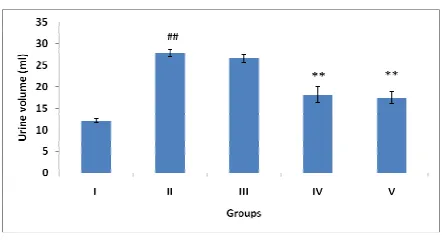
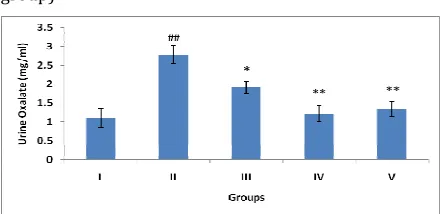
The oxalate induced urolithiasis produced severe alterations in the urinary parameters as compared to normal control group. Increase in the urinary volume, urinary oxalate and calcium levels and increase in the urinary magnesium levels were observed. These alterations were significantly attenuated in the polyherbal formulation (300 and 400 mg/kg) treated groups as copared to control group. The 300 and 400 mg/kg doses were equally significant (p<0.01) in reducing the increased urine volume and urinary oxalate due to urolithiasis. The dose 400mg/kg was more significant (P<0.01) than dose 300mg/kg in reducing urinary magnesium whereas vice versa was observed in reduction of urinary calcium. The dose 200 mg/kg was found to be almost insignificant in this concern.
Fig. 1: Effect of polyherbal formulation (PHF) on urine volume
Results are expressed as mean ± SEM. (n = 6). Data was analysed by comparing Group I with Group II using Student T test and comparing Group II with remaining groups using one way analysis of variance (ANOVA) followed by Dunnetts test. ##P<0.01, *P<0.05, **P<0.01.
Fig. 2: Effect of polyherbal formulation (PHF) on urine pH
Results are expressed as mean ± SEM. (n = 6). Data was analysed by comparing Group I with Group II using Student T test and comparing Group II with remaining groups using one way analysis of variance (ANOVA) followed by Dunnetts test. ##P<0.01, *P<0.05, **P<0.01.
(Group I –Normal control, Group II-Urolithiasis control, Group III-PHF 200 mg/kg treated Urolithiasis group, Group IV-PHF 300 mg/kg treated Urolithiasis group, Group V-PHF 400 mg/kg treated Urolithiasis group)
Fig. 3: Effect of polyherbal formulation (PHF) on urine oxalate
Results are expressed as mean ± SEM. (n = 6). Data was analysed by comparing Group I with Group II using Student T test and comparing Group II with remaining groups using one way analysis of variance (ANOVA) followed by Dunnetts test. ##P<0.01, *P<0.05, **P<0.01.
(Group I –Normal control, Group II-Urolithiasis control, Group III-PHF 200 mg/kg treated Urolithiasis group, Group IV-PHF 300 mg/kg treated Urolithiasis group, Group V-PHF 400 mg/kg treated Urolithiasis group)
Fig. 4: Effect of polyherbal formulation (PHF) on urine calcium
Results are expressed as mean ± SEM. (n = 6). Data was analysed by comparing Group I with Group II using Student T test and comparing Group II with remaining groups using one way analysis of variance (ANOVA) followed by Dunnetts test. ##P<0.01, *P<0.05, **P<0.01.
(Group I –Normal control, Group II-Urolithiasis control, Group III-PHF 200 mg/kg treated Urolithiasis group, Group IV-PHF 300 mg/kg treated Urolithiasis group, Group V-PHF 400 mg/kg treated Urolithiasis group)
Fig. 5: Effect of polyherbal formulation (PHF) on urine magnesium
Results are expressed as mean ± SEM. (n = 6). Data was analysed by comparing Group I with Group II using Student T test and comparing Group II with remaining groups using one way analysis of variance (ANOVA) followed by Dunnetts test. ##P<0.01, *P<0.05, **P<0.01.
(Group I –Normal control, Group II-Urolithiasis control, Group III-PHF 200 mg/kg treated Urolithiasis group, Group IV-PHF 300 mg/kg treated Urolithiasis group, Group V-PHF 400 mg/kg treated Urolithiasis group)
Collection and Serum analysis:
The induction control group showed significant increase in the serum uric acid, serum creatinine and
blood urea levels as compared to normal control group which were significantly decreased by the PHF at 300 and 400 mg/kg doses and both the doses showed almost equipotent activity.
Fig. 6: Effect of polyherbal formulation (PHF) on serum uric acid
Results are expressed as mean ± SEM. (n = 6). Data was analysed by comparing Group I with Group II using Student T test and comparing Group II with remaining groups using one way analysis of variance (ANOVA) followed by Dunnetts test. ##P<0.01, *P<0.05, **P<0.01.
(Group I –Normal control, Group II-Urolithiasis control, Group III-PHF 200 mg/kg treated Urolithiasis group, Group IV-PHF 300 mg/kg treated Urolithiasis group, Group V-PHF 400 mg/kg treated Urolithiasis group)
Fig. 7: Effect of polyherbal formulation (PHF) on serum creatinine
Results are expressed as mean ± SEM. (n = 6). Data was analysed by comparing Group I with Group II using Student T test and comparing Group II with remaining groups using one way analysis of variance (ANOVA) followed by Dunnetts test. ##P<0.01, *P<0.05, **P<0.01.
(Group I –Normal control, Group II-Urolithiasis control, Group III-PHF 200 mg/kg treated Urolithiasis group, Group IV-PHF 300 mg/kg treated Urolithiasis group, Group V-PHF 400 mg/kg treated Urolithiasis group)
Fig. 8: Effect of polyherbal formulation (PHF) on blood urea
Results are expressed as mean ± SEM. (n = 6). Data was analysed by comparing Group I with Group II using Student T test and comparing Group II with remaining groups using one way analysis of variance (ANOVA) followed by Dunnetts test. ##P<0.01, *P<0.05, **P<0.01.
(Group I –Normal control, Group II-Urolithiasis control, Group III-PHF 200 mg/kg treated Urolithiasis group, Group IV-PHF 300 mg/kg treated Urolithiasis group, Group V-PHF 400 mg/kg treated Urolithiasis group)
Kidney homogenate analysis
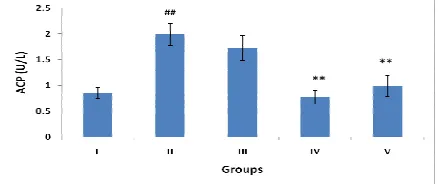
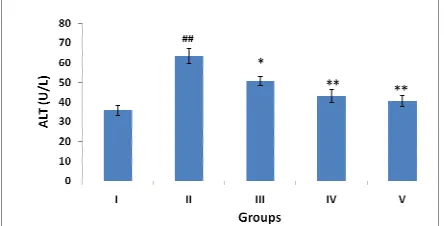
The oxalate induced urolithiasis showed significant increase in the biochemical parameters such as ACP, ALP, AST, ALT levels and decrease in LDH levels in the kidney homogenate of the induction control group as compared to normal control group. These alterations were significantly reversed in the polyherbal formulation (300 and 400 mg/kg) treated animals. The dose 300 mg/kg was found to be more significant (P<0.01) than 400 mg/kg (P<0.05) in reducing AST and LDL levels, whereas vice versa was observed in the case of ALP levels. Both the doses were equipotent in reducing ACP and ALT levels. In overall study the dose 200 mg/kg was found to be insignificant in reverting the alterations.
Results are expressed as mean ± SEM. (n = 6). Data was analysed by comparing Group I with Group II using Student T test and comparing Group II with remaining groups using one way analysis of variance (ANOVA) followed by Dunnetts test. ##P<0.01, *P<0.05, **P<0.01.
(Group I –Normal control, Group II-Urolithiasis control, Group III-PHF 200 mg/kg treated Urolithiasis group, Group IV-PHF 300 mg/kg treated Urolithiasis group, Group V-PHF 400 mg/kg treated Urolithiasis group)
Fig. 10: Effect of polyherbal formulation (PHF) on ALP levels of kidney
Results are expressed as mean ± SEM. (n = 6). Data was analysed by comparing Group I with Group II using Student T test and comparing Group II with remaining groups using one way analysis of variance (ANOVA) followed by Dunnetts test. ##P<0.01, *P<0.05, **P<0.01.
(Group I –Normal control, Group II-Urolithiasis control, Group III-PHF 200 mg/kg treated Urolithiasis group, Group IV-PHF 300 mg/kg treated Urolithiasis group, Group V-PHF 400 mg/kg treated Urolithiasis group)
Fig. 11: Effect of polyherbal formulation (PHF) on ALT levels of kidney
Results are expressed as mean ± SEM. (n = 6). Data was analysed by comparing Group I with Group II using Student T test and comparing Group II with remaining groups using one way analysis of variance (ANOVA) followed by Dunnetts test. ##P<0.01, *P<0.05, **P<0.01.
(Group I –Normal control, Group II-Urolithiasis control, Group III-PHF 200 mg/kg treated Urolithiasis group, Group IV-PHF 300 mg/kg treated Urolithiasis group, Group V-PHF 400 mg/kg treated Urolithiasis group)
Fig. 12: Effect of polyherbal formulation (PHF) on AST levels of kidney
Results are expressed as mean ± SEM. (n = 6). Data was analysed by comparing Group I with Group II using Student T test and comparing Group II with remaining groups using one way analysis of variance (ANOVA) followed by Dunnetts test. ##P<0.01, *P<0.05, **P<0.01.
(Group I –Normal control, Group II-Urolithiasis control, Group III-PHF 200 mg/kg treated Urolithiasis group, Group IV-PHF 300 mg/kg treated Urolithiasis group, Group V-PHF 400 mg/kg treated Urolithiasis group)
Fig. 13: Effect of polyherbal formulation (PHF) on LDH levels of kidney
remaining groups using one way analysis of variance (ANOVA) followed by Dunnetts test. ##P<0.01, *P<0.05, **P<0.01.
(Group I –Normal control, Group II-Urolithiasis control, Group III-PHF 200 mg/kg treated Urolithiasis group, Group IV-PHF 300 mg/kg treated Urolithiasis group, Group V-PHF 400 mg/kg treated Urolithiasis group)
Discussion
The formation of urinary tract stones is world wide, sparing no geographical, cultural or racial groups. [7] Those composed of calcium oxalate, either alone or mixed with calcium phosphate, are forming the most common uroliths accounting for more than 80% of the stones. [6] The mechanisms involved in the formation of calcific stones are not fully understood but it is generally agreed that urinary lithiasis is a multifaceted process involving events leading to crystal nucleation, aggregation and growth of insoluble particles. [10] Various therapies like diuretics are being used in attempt to prevent recurrence of hypercalciuria- and hyperoxaluria-induced calculi but scientific evidence for their efficacy is less convincing. [1]
Medicinal plants have played a significant role in various ancient traditional systems of medication. Even today, plants provide a cheap source of drugs for majority of world’s population. [31] Several pharmacological investigations on the medicinal plants used in traditional antiurolithic therapy have revealed theirtherapeutic potential in the in vitro or in
vivo models. [32, 33]
In the present investigation, a polyherbal formulation constituted with extracts of plants Plectranthus mollis
Spreng, Didymocarpus pedicellata, Taraxacum
officinale, Dendrophthoe elastic desr andCitrus medica
Linn was evaluated for antiurolithiatic activity against commonly occurring calcium oxalate urolithiasis. In any polyherbal formulation, pharmacological action exerted by formulation is mainly governed by certain phytochemicals; hence preliminary phytochemical evaluation of the polyherbal formulation was carried
out. The analysis of the polyherbal formulation showed the presence of triterpenoids and flavonoids and glycosides.
The presence of these different constituents and its interaction with other similair phytoconstituents may be responsible to alter the therapeutic profile of individual formulations. The overall presence of phytochemicals is in accordance with the previous published reports wherein antiurolithiatic action was established. [15,16] This further supports the selection of suitable plants.
Although the individual constituents of the polyherbal formulation have been documented for various pharmacological effects without any serious untoward effects, however it is essential to test it again for its toxicity profile to establish its safety when used in polyherbal formulation. In light of this, the acute oral toxicity study of the polyherbal formulation was carried out. Our findings indicated that the polyherbal formulation was found to be devoid of any serious toxic symptoms and no mortality was found up to the dose of 2000 mg/kg. Also, the administration of polyherbal formulation did not show any change in the alertness, touch response and locomotor activity. Based on these results, three different doses i.e 200, 300 and 400 mg/kg were selected for the further pharmacological evaluation. The polyherbal formulation was screened antiurolithiatic activity using calcium oxalate induced urolithiasis model. The oxalate induced urolithiasis produced severe alterations in the urinary parameters in induction control group animals. Increase in the urinary volume, urinary oxalate and calcium levels and increase in the urinary magnesium levels were observed. These alterations were significantly attenuated in the polyherbal formulation (300 and 400 mg/kg) treated groups as compared to induction control group. The dose 200 mg/kg was found to be almost insignificant in this concern. The induction control group also showed significant increase in the serum uric acid, serum creatinine and blood urea levels which were
39
significantly and equipotently decreased by the PHF at 300 and 400 mg/kg.
The oxalate induced urolithiasis also showed significant increase in the biochemical parameters such as ACP, ALP, AST, ALT levels and decrease in LDH levels in the kidney homogenate of the induction control group. The alterations in these injury marker enzymes in urolithiatic rats suggested damage to the brush border membrane of the renal tubules, which appears to associate with the retention and deposition of crystals in the kidney.[33]
These alterations were significantly reversed in the polyherbal formulation (300 and 400 mg/kg) treated animals showing significant antiurolithiatic activity against calcium oxalate induced urolithiasis. In overall study the dose 200 mg/kg was found to be insignificant in reverting the alterations.
Conclusion
In the present study the PHF at doses 300 and 400 mg/kg exhibited significant antiurolithiatic ativity against calcium oxalalte induced urolithiasis. Further analysis and fractionation of these extracts is needed to predict the phytochemical constituents of PHF responsible for the antiurolithiatic activity.
References
1. Hesse A, Bra¨ndle E, Wilbert D, Ko¨hrmann K-U, Alken
P. Study on theprevalence and incidence of urolithiasis
in Germany comparing the years 1979 vs. 2000. Eur
Urol 2003;44:709–13.
2. Taylor EN, Stampfer MJ, Curhan GC. Diabetes mellitus
and the risk of nephrolithiasis. Kidney Int
2005;68:1230–5.
3. Coward RJ, Peters CJ, Duffy PG, et al. Epidemiology of
paediatric renal stone disease in the UK. Arch Dis Child
2003;88:962–5.
4. Devuyst O, Pirson Y. Genetics of hypercalciuric stone
forming diseases. Kidney Int 2007; 72: 1065–1072.
5. Knoll T. Stone disease. Eur Urol Suppl 2007; 6: 717–
722
6. Tiselius HG. Epidemiology and medical management of
stone disease. BJU Int 2003; 91: 758–767.
7. Moe OW. Kidney stones: pathophysiology and medical
management. Lancet 2006; 367: 333–344.
8. Worcester EM, Coe FL. Nephrolithiasis. Prim Care
2008; 35: 369–391
9. Hadjzadeh, M., Khoei, A., Hadjzadeh, Z., Parizady, M.,
2007. Ethanolic extract of Nigella sativa L. seeds on
ethylene glycol-induced kidney calculi in rats. Urol. J. 4,
86–90.
10. Baumann JM. Stone prevention: why so little progress?
Urol Res 1998;26:77 – 81.
11. Leonetti F, Lechevallier E, Dussol B, Berland Y. Lithiase
Urinaire—La Revue du Praticien 1996;26:1557– 67.
12. Raats ICJ, van den Born J, Berden JHM. Glomerular
heparin sulfate alterations: mechanisms and relevance
for proteinuria. Kidney Int 2000;57:385–400.
13. Obligado SH, Goldfarb DS. The association of
nephrolithiasis with hypertension and obesity: a
review. Am J Hypertens 2008; 21: 257–264.
14. Taylor EN, Stampfer MJ, Curhan GC. Obesity, weight
gain, and the risk of kidney stones. JAMA 2005; 293:
455–462.
15. Prasad, K., Sujatha, D., Bharathi, K., 2007. Herbal drugs
in urolithiasis – a review. Phcog. Rev. 1, 175–179.
16. Bashir, S., Gilani, A.H., 2009. Antiurolithiatic effect
Bergenia ligulata rhizome: an explanation of the
underlying mechanisms. J. Ethnopharmacol. 122, 106–
116.
17. Doddametikurke, R.B., Biyani, C.S., Browning, A.J.,
Cartledge, J.J., 2007. The role of urinary kidney stone
inhibitors and promoters in the pathogenesis of
calcium containing renal stones. EAU-EBU Update
Series, vol. 5, pp. 126–136.
18. Siddiqui S. The constituents of Didymocarpus
pedicellata. Part 1. Isolation of a new series of
colouring matter. J Indian Chem Soc 1937;12:703-708.
19. Yoganarasimhan, S.N., 2000. Medicinal Plants of India,
Tamil Nadu. V. Srinivasan, N. Kosal Ram. Cyber Media,
Bangalore, p. 2.
20. Aleykutty NA, Shrinivasan KK, Rao PG, Udapa AL.
Fitoterpia 1993;64(4): 325-331.
21. Anarthe SJ, Bhalke RD, Jadhav RB, Surana SJ: In vitro
antioxidant activities of methanol extract of
Dendrophthoe falcata Linn. Stem. Biomed 3(2)
July-September 2008. pp. 182–189.
22. Kapoor, S.L. & L.D. Kapoor. 1976. On the botany and
distribution of `pashanbheda', Sachitra Ayurved 28, 12,
23. Kisiel, W., Barszcz, B., Szneler, E. 2000. A new
lupine-type triterpenoid from Taraxacum officinale. Polish
Journal of Chemistry. 74(2), 281-283.
24. Pattanayak SP, Mazumder PM, Sunita P. Dendrophthoe
falcata (Lf): a consensus review. Pharmacog Rev
2008;8: 359-368.
25. Shihab, HM, Iqbal, AM, Sukla, M, Methedi, MM, Kumar,
SS, Masami, I, Jamal, US. Antioxidant, antinociceptive
activity and general toxicity study of Dendrophthoe
falcata and isolation of quercitrin as the major
component. Oriental Pharmacy and Experimental
Medicine. 2006;6:355-360.
26. The wealth of India (raw material), 1st edition, Vol.III,
PID CSIR, New Delhi, 1952, 34,35.
27. Dey AC. Indian Medicinal Plants Used in Ayurvedic
Preparations. Bishen Singh, Mahendra Pal Singh, Dehra
Dun-248001, 1980; 202.
28. Yelne MB, Dennis TJ, Billore KV, Chaudhari BG. 2005.
Database of Medicinal Plants Used in Ayurveda, Vol.
VII, Central Council for Research in Ayurveda and
Siddha, 2005; 452-475.
29. Kraisintu, K., 2003. The status of medicinal and
aromatic plants in Cambodia, Laos, the Philippines,
Thailand and Vietnam. In: Vasisht, K., Kumar, V. (Eds.),
Medicinal Plants and Their Utilization. United Nations
Industrial Development Organization and the
International Centre for Science and High Technology,
Trieste, pp. 3–54.
30. Divakar K, Pawar AT, Chandrasekhar SB, Dighe SB,
Divakar G. Protective effect of the hydro-alcoholic
extract of Rubia cordifolia roots against ethylene glycol
induced urolithiasis in rats. Food Chem Toxicol
2010;48:1013-8.
31. Atmani, F., Slimani, Y., Mimouni, M., Hacht, B., 2003.
Prophylaxis of calcium oxalate stone by Herniaria
hirsute on experimentally induced nephrolithiasis in
rats. BJU International 92, 137–140.
32. Barros, M.E., Lima, R., Mercuri, L.P., Matos, J.R., Schor,
N., Boim, M.A., 2006. Effect of extract of Phyllanthus
niruri on crystal deposition in experimental
urolithiasis. Urological Research 34, 351–357.
33. Khan, S.R., Shevock, P.N., Hackett, R.L., 1992. Acute
hyperoxaluria, renal injury and calcium oxalate
urolithiasis. Journal of Urology 147,226–230.
How to cite this article: D G Baheti* and S S Kadam;
Antiurolithiatic activity of a polyherbal formulation against calcium oxalate induced urolithiasis in rats; J. Adv. Pharm. Edu. & Res. 2013: 3(1): 61-71