Volume 4, Issue 2 (2015) pp. 134-140
134 | Page
Original Article
The Impact of the Current Tax Collection on the
Economic Development of Iran
Mojtaba Ebrahimi Romanjan
Master of Accounting, Birjand, Southern Khorasan, Iran *Corresponding Author E-mail: [email protected]
Received: 19 March 2015, Revised: 18 April 2015, Accepted: 25 April 2015 ABSTRACT
Establishing the appropriate grounds for the growth and economic development of a society is one of the most important goals of the tax collection. The main objective of this study is to investigate the way the current tax collection method influences on the economic development of Iran. The population is composed of the academic teachers of accounting and economics and senior tax auditors. Three hypotheses are developed and the required data is collected through a researcher made questionnaire which its validity has been confirmed by the academic professors and its reliability has been found to be 84 percent. The findings of t test of the hypotheses reveal that the current tax collection method is effective in enhancing the social welfare but it does not help in increasing the efficiency of the capital market.
Keywords: Tax, Economic Development, Economic Growth, Social Welfare, Capital Market.
Introduction
The conflicts between the categories of income distribution and economic development rose when the east became the ensign of the deprive class and therefore became the pioneer of the justly income distribution and introduced it as the opponent of the investors and owners. On the other hand, the west was known to be the ensign of the economic development and welfare (Todaru, 2004). Using empirical analyses and their emergence in the developing countries, it is intended to find whether income distribution in the economic development works to benefit the deprived groups and find the contribution of the economic development by the betterment of the tax
135 | Page
emergence of the industrial revolution and the imbalances resulting from the surplus of production to the consumption make the role of the paper money, structural inflation and direct involvement of the government in the economic planning inevitable. In this situation, a tax is a financial charge drawn from an account. It mostly relies on the national wealth and considered as an instrument for setting the financial policies for the macroeconomic balance. It is intended to provide the appropriate positions for the economic growth and development.
Statement of problem
Taxes are the essential factors in dealing with the excess demands for the goods which are followed by the social welfare and improvement. Taxes are the only solutions to finance the government in order to implement the development plans as the significant plans of developing a country (Floza, 1997). Taxes are intended to reduce the gap between the poor and rich classes (Taghavi, 1997). That is, social welfare belongs to the public and most of the people are in a proper social and economic situation when the income is distributed fairly (Behkish, 2002). In a developing country, taxes are the most effective factors for transferring the resources and directing them towards the productive goals. Taxes should work so that they could reform the investment trend. In doing so, taxes are not levied to eradicate the private investments but they should encourage these investments to be properly established in a good manner (Mousavian, 2003). Taxes should not merely perform for the purpose of raising earnings but they should mainly seek for creating incentives for increasing saves and investments. Consequently, tax is an indirect tool held by the government by which it could impact the functions of an
economic entity and play a key role in the industrial development. Stated another way, taxpayers help the economic development. It seems that the tax aims to achieve three goals for the economy of the society. Paying tax influences on increasing the social welfare, developing and growing the economic situation, increasing the efficiency of the capital market and industry and reforming the investments. Therefore, this study intends to find an answer to a question about this: Does the current state of tax collection in Iran help achieving those goals known as the proxies of economic development?
Theoretical Bases and Research Background
Economic Development and Growth
136 | Page
growth and development. More productivity of these resources might accelerate the production capacity.
Capital accumulation is adding to the machinery, tools and other capital goods during the time. More investment is the achievement of capital accumulation. Social and Cultural Factors: Social welfare is included in this factor and comprises of a set of the situations and qualities satisfying the individual needs (physical and mental) and social requirements of the community so that all people feel secure in terms of the social, economic and political situations. The steps of the social welfare include: social security, employment, education, health and housing.
Growth of capital market: In the developing country, making a fair decision about the tax policy is a well-known method for attracting the capital and directing it towards the production. Therefore, tax systems of these countries should respond to the growth requirements and motivate the production and export needs. On the other hand, tax leads to the adjustment of the wealth and capital and prohibits the concentration of wealth in the hands of specific people. Accordingly, all countries decide for planning and making fair policies to increase investments in the production and services and goods needed by a country or even the needs of the other countries for increasing national income and justly income distribution among the public. In doing so, governments apply long-term or short-term plans in the needed contexts for more production of the goods and services having relational advantage. As a consequence of these functions, the individuals’ occupations to earn revenue are based on their expertise and productivity.
Definition of Tax
Tax is an involuntary fee levied on individuals that is enforced by a government in order to finance government activities and maintain the economic, social and political positions by the administrative leverages. Tax might be also defined as the amount received by the government from the individuals, corporations and institutes to reinforce the government and finance the public fees. Tax is the most important tool related to the governments for conducting their operations. Accordingly, tax is used for financing the capital expenditures and working capital and is also used for the fair distribution of the earnings (Mousavain, 2003). In doing so, the governments supply the sufficient earnings for directing the vital operations of the country such as the security, health, education and the fundamentals of the software and hardware operations. In addition, establishing an appropriate and an optimum tax system makes the earnings become fairly distributed among the population. Consequently, those who earn more money have to pay more taxes based on the double tax rate.
137 | Page
developing countries are directly involved in the economic activities through their ownership and control (Farjadi, 2004).
Necessity of Taxes
Five reasons are provided to better perceive the role of the collected taxes by the governments (Farjadi, 2004):
First, taxes are the effective factors in conflict with the surplus demand for the goods created by the economic growth, development and welfare. Consistent with the incremental national product and social welfare, the private earnings for the goods will increase. Taxes are the tools by which the governments control the pressure of the inflation in the economy and the taxes might decrease the demand for the goods by controlling the revenues.
Secondly, taxes aim to reduce the gaps between rich and poor classes. Principally, development means bringing social welfare of the public. Once the individuals are in a proper condition in terms of the social and economic situation, the earnings are distributed justly to make the people able to satisfy their basic needs.
Thirdly, taxes are the most effective tool for transferring the resources into the governmental sectors and directing them towards the productive plans. Governmental investments should increase to break the vicious circle of poverty and less savings and investments. In most of the less developed countries, private entities are very small and a limited number of the biggest entities involve in the production of the goods. Lack of the capital is the main reason for the limited economic activity of the private sector which is derived from low savings. Based on the low efficiency of the capital in the long run, most of the capital is invested in the nonproductive sections such as speculation. In this state, the government might capture the additional revenues from direct property taxes and invest it in the productive projects. Therefore, taxes are an effective tool for transferring the resources
from the nonproductive channels to the productive ones through the public investments.
Fourthly, taxes should be able to correct the investment trend. Taxes in the developing countries seek to allocate the resources from the private sectors to the governmental ones. However, this does not mean that taxes intend to eradicate the private taxes but taxes are used to motivate the investments and direct them towards the right path. Governments should be able to establish the necessary incentives for the private economic entities to expand their operations. This leads to an increase in the profits of the organizations and their reinvestments. Taxes should not decrease the determined amount of reinvestment. On the other hand, the received taxes should be invested in the social and economic plans such as educations, public health, transportation and other services.
Fifthly, taxes apply the economic surplus to develop and expand the operations. In the underdeveloped countries, the agriculture sector creates more than half of the gross national product and a major part of the value added in this sector is captured by the landowners and commercial intermediates. The surplus of the economic production is the difference between the real current production and real current consumption. This surplus might also exist in the other economic sectors. The government should unify these surpluses on the structural projects aimed to benefit the whole population and the economic development of the country. In this state, increases of the projects in the long run will lead to increases in the production and more surpluses in the agriculture section (Farahani, 2004).
Research Background
138 | Page
have an incremental trend or they had a very speedy trend because of the low tax ratio and improper implementation of the tax rules and inconsistency of the tax structure. Martin and Fardmanesh (1990) concluded that there is a negative relationship between the ratio of the tax revenues to the gross national product and the rate of the economic growth. Stated another way, an increase in the ratio of the tax revenues to the gross domestic product led to a decrease in the economic growth rate. Brgns and Styserd (1990) examined the financial information of 82 developing countries and found a significant weak relationship between the tax ratio and revenue of these countries. That is, increases in the taxes are weakly associated with the increases in the national income. Betanlar et al (2012) explored the impact of financial corruption on the tax revenues of the developing countries. Their findings demonstrate that the index of financial corruption and the ratio of the tax revenues has a positive impact on the economic development. Mojtahed et al (2007) examined the influence of tax revenues on the social welfare of the economy of Iran. They concluded that the consumption tax system works as the best tax system in Iran. In other words, a consumption tax system increases the social welfare in Iran.
Research Hypotheses
According to the theoretical bases and the literature review, three hypotheses are developed as follows:
The current tax collection method increases the social welfare of the country.
The current tax collection method increases the economic growth of the country.
The current tax collection method increases the capital market efficiency.
Materials and Methods
This is a descriptive survey classified as an applied study. The required data is gathered through a researcher made questionnaire. The questionnaire is designed by investigating the theoretical economic texts and the questions are developed in a way consistent with the main objective of the study. Some questions are regarded for the hypotheses based on the five point Likert scale. The primary questionnaire was distributed among some of the professors and tax experts and was corrected after using their intended corrections. SPSS software was also applied to measure the reliability of the questionnaire which was found to be 84 percent. Among 50 distributed questionnaires, 35 of them were returned back and used for the further analyses.
Results
A summary of the findings related to the analysis of the collected data is provided in tables 1 to 3. The first hypothesis: The current tax collection method increases the social welfare of the country.
Table1. Statistics of the first hypothesis
Variable Empirical mean Theoretical mean Std Deviation Error Mean difference Degree freedom of t Sig.
Impact of the current tax collection on the social welfare of the country
25 /
139 | Page Table 2. Statistics of the second hypothesis
Variable Empirical mean Theoretical mean DeviationStd Error differenceMean Degree of
freedom t Sig.
Impact of current tax
collection method for the economic
growth
99 /
3 3 0/72 0/10 0/98 49 8/36 0/001<
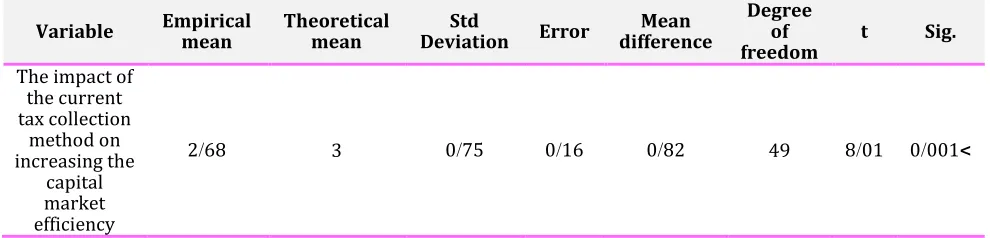
Table 3. Statistics of the third hypothesis
Variable Empirical mean Theoretical mean DeviationStd Error differenceMean Degree of
freedom t Sig.
The impact of the current tax collection
method on increasing the
capital market efficiency
68 /
2 3 0/75 0/16 0/82 49 8/01 0/001<
The findings of the table above show that the calculated t is more than the t of the table at 0.001 level of significance. In other words, the calculated mean for the impact of the current method of tax collection on the increase of social welfare is more than the assumed mean and this difference is statistically difference. Consequently, it is interpreted that the current tax collection method influences on increasing the social welfare in Iran.
The second hypothesis: The current tax collection method increases the economic growth of the country.
According to the table above, the calculated t value is more than its value in the table at 0.001 level of significance. Stated another way, the computed mean for the impact of the current tax collection method on increasing the economic growth is more than the third assumption and this is statistically significant. Consequently, it is interpreted that the
current tax collection method impacts the increase of economic growth of Iran. The third hypothesis: The current tax collection method increases the capital market efficiency.
The results indicate that t value is more than its value in the table at 0.001 level of significance. In other words, the computed mean for the influence of the current tax collection method on increasing the capital market efficiency is more than the third assumption. As a result, it can be concluded that the current tax collection method has no influence on increasing the capital market efficiency.
Discussion and Conclusion
140 | Page
to the hypotheses show that collecting taxes in the current state increase the social welfare and economic growth. However, increasing capital market efficiency will not be achieved through the current tax collection. As a result, the regulators are suggested to justify the tax rates and encourage the individuals to pay their taxes and increase the investment in the manufacturing and industry sections. This would finally direct the market towards the competitive situation and the capital market would be enhanced. The further researchers are offered to examine the weak points of the tax laws to develop and enhance the capital market efficiency of Iran.
Reference
AkbarShahi, M.R. (2011). Investigating the mechanisms to improve the social responsibility and implementing it in the urban services organizations with the approach of ISO 26000. Master thesis, University of Tehran. (In Persian)
Amani, J., Gholamali, M., ezhe'ei, J., Khezri, A. (2011). Investigating the relationships between cultural values and individual variables using the computer among the students. Journal of behavioral sciences, 5(1): 1-10.
Javaheri, M., KowsarNeshan, M.R. (2009). Investigating the relationship between leadership, organizational culture, learning organization, and employees' job satisfaction. Journal of police human development, 4(25): . 19-32. (In Persian)
Royaei, R, Mehrdoost, H. (2009). Investigating the role of cultural managers in improving the social responsibility. Research journal of social sciences. No. 3, Vol. 3. (In Persian)
Ghanbari, S., Maroofi, Y., Fatehi, Y. (2010). . Comparing the teachers' value system with those of the pre-university students. Journal of new training thoughts. (In Persian).
Moshabbaki, A., Khalili, V. (2010). Investigating the relationship between organizational culture and the organizations' social responsibility. Journal of applied sociology. (In Persian).
Akour, I. (2006). Factors influencing faculty computer Literacy and use in Jordan: Amultivariate analysis. Doctoral Dissertation, Louisiana Tech University.
Denison, D. (2000). Organizational Culture and Corporate Social Responsibility: Can it be a key lever for Driving Organizational? International Institute for Management Development, Denison@imd, Chapter 2.
How to cite this article:Mojtaba Ebrahimi Romanjan, The Impact of the Current Tax Collection on the Economic Development of Iran. International Journal of Advanced
Studies in Humanities and Social Science, 2015, 4(2), 134-140.