18
Available online at www.ijiere.com
International Journal of Innovative and Emerging
Research in Engineering
e-ISSN: 2394 – 3343 p-ISSN: 2394 – 5494
SOLAR POWERED KITCHEN CHIMNEY
J.S.Shiny
a, Dinesh kumar
a,Shanmuga priya
baAffiliation 1, Dr.mahalingam college of engineering & technology , Coimbatore, India
bAffiliation 2, Dr.mahalingam college of engineering & technology , Coimbatore, India
ABSTRACT:
A solar chimney is a chimney which uses solar energy as a power source for improving the natural ventilation of buildings by exhausting the combustion gases from work place to outer environment. A simple description of a solar chimney is that of exhaust fan utilizing solar energy to enhance the natural stack ventilation through a building. The suction created at the chimney's base can be used to ventilate and cool the building, though solar technology is the novel technology which uses the natural sunlight to produce electricity so the entire system uses the solar energy as a power source. It also consists of battery for energy backup and to supply energy when direct supply is unavailable. The basic design elements of a solar chimney are exhaust fan which exhaust the combustion gas from the work place to outer environment. In addition to this, the system consists of automatic speed control of exhaust fan as per the amount of combustion gas released from the kitchen or workplace. The speed control of DC exhaust fan is controlled by Arduino microcontroller. The main ventilation shaft, the inlet and outlet air apertures are designed in consideration with the location, height, cross section and the thermal properties of this structure as well as aerodynamic aspects of these elements are also considered.
Keywords: solar chimney, exhaust fan, micro controller, arduino, aerodynamic.
I. INTRODUCTION
A solar chimney often referred to as a thermal chimney is a way of improving the natural ventilation of buildings by using convection of air heated by passive solar energy. A simple description of a solar chimney is that of a vertical shaft utilizing solar energy to enhance the natural stack ventilation through a building. The solar chimney consists of a black-painted chimney. During the day solar energy heats the chimney and the air within it, creating an updraft of air in the chimney. The suction created at the chimney's base can be used to ventilate and cool the building below[1].
The chimney is the passage through which smoke and combustion gas escape from workplace to outer environment. The existing chimneys are operated based on AC source which is more costlier. In order to overcome this difficulty our entire system works on DC source. From solar panels we get sufficient DC supply to operate the entire system. Solar energy is a renewable energy which we can generate at low cost.
The normal exhaust fans in household as well as in all other workplaces have a manual speed control system. it is regulated using a rotary switch which internally involves a potentiometer, the potentiometer adjusts current flow to the exhaust fan and hence, the speed is adjusted this system creates a few problems in terms of user comfort. To avoid this automatic on/off control technique is implemented in our proposed system[2]
II. SYSTEMDESCRIPTION
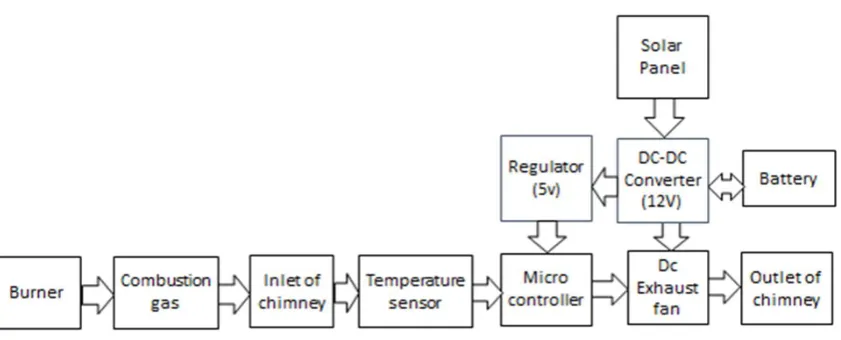
19 2.1 BLOCK DIAGRAM
Figure 2.1 Block diagram of solar powered chimney
2.2 BLOCK DESCRIPTION
1.BURNER
The gas burner is a device which is used to generate a flame in order to heat up products using a gaseous fuel which liberates the combustion gas. A combustion gas is a hot gas which enters into the chimney via inlet of chimney.
2.TEMPERATURE SENSOR
The Temperature Detection Module is responsible for reading temperature from the sensor and send required data to exhaust Fan Speed Control module. The temperature sensor (LM35) returns analog input to the Arduino board when called. The data received from LM35 needs to be converted to recognized temperature reading formats like Celsius, Fahrenheit etc. before the data starts making sense. For conversion of temperature to Celsius, a factor of 0.48828125 needs to multiplied to the received value. The received temperature must be within the specified minimum temperature – maximum temperature range. If the temperature is outside the range, the exhaust fan will be stopped. However, if the temperature is within the allowed range, then instructions with temperature and exhaust fan speed as parameters are sent to the fan controller. The temperature reading is updated in real time on the LCD screen for user reference. The exhuast Fan control module, controls the speed of the fan depending on the temperature values recorded by LM35 temperature sensor above.
3.MICRO CONTROLLER
Micro controller is a small computer on a single board of integrated circuits. Micro controllers are used in automatically controlled products and devices. In this system the micro controller used is Arduino-Uno.
4. DC EXHAUST FAN
The exhaust fan operates on DC supply .the exhaust fan device which exhaust the combustion gas from the kitchen or workplace to surroundings. The exhaust fan runs at 12volt power supply.
5. OUTLET OF CHIMNEY
The outlet of chimney is the part in which the combustion gas from the burner is emitted in to the outside environment to provide natural ventilation of buildings.
6. SOLAR PANEL
Solar panel refers to panel designed to absorb the sun’s rays as a source of energy to generate the electricity. Solar technology is the novel technology which uses the natural sunlight to produce electricity so the entire proposed system uses the solar energy as a power source.
7. DC-DC CONVERTER
20 8. BATTERY
The electricity is not generated all the time from the solar panel. The sun is the main source for the power generation but sun is not available for entire day so it is necessary to have the battery backup system in order to provide power suppLy to exhaust fan all over the day.
III SOFTWARE DESCRIPTION 3.1 PROTEUS SIMULATOR
Proteus is a software for microprocessor simulation, schematic capture, etc. Proteus is a simulation and design software tool developed by Lab center Electronics for Electrical and Electronic circuit design. It also possess 2D CAD drawing feature. It is a software suite containing schematic, simulation as well as PCB designing.
ISIS is the software used to draw schematics and simulate the circuits in real time. The simulation allows human access during run time, thus providing real time simulation.
ARES is used for PCB designing. It has the feature of viewing output in 3D view of the designed PCB along with components.
3.1.1 Features
ISIS has wide range of components in its library. It has sources, signal generators, measurement and analysis tools like oscilloscope, voltmeter, ammeter etc., probes for real time monitoring of the parameters of the circuit, switches, displays, loads like motors and lamps, discrete components like resistors, capacitors, inductors, transformers, digital and analog Integrated circuits, semi-conductor switches, relays, microcontrollers, processors, sensors etc.
ARES offers PCB designing up to 14 inner layers, with surface mount and through hole packages. It is embedded with the foot prints of different category of components like ICs, transistors, headers, connectors and other discrete components. It offers Auto routing and manual routing options to the PCB Designer. The schematic drawn in the ISIS can be directly transferred ARES[4].
3.2 ARDUINO SOFTWARE
The Arduino Uno is a microcontroller board based on the ATmega328 (datasheet). It has 14 digital input/output pins (of which 6 can be used as PWM outputs), 6 analog inputs, a 16 MHz crystal oscillator, a USB connection, a power jack, an ICSP header and a reset button. Arduino is an open-source electronics prototyping platform based on flexible, Arduino consists of both a physical programmable circuit board (often referred to as a microcontroller) and a piece of software, or IDE (Integrated Development Environment) that runs on our computer, used to write and upload computer code to the physical board. The key features are
• Arduino boards are able to read analog or digital input signals from different sensors and turn it into an output such as activating a motor, turning LED on/off, connect to the cloud and many other actions.
• We can control our board functions by sending a set of instructions to the microcontroller on the board via Arduino IDE (referred to as uploading software).
• Unlike most previous programmable circuit boards, Arduino does not need an extra piece of hardware (called a programmer) in order to load a new code onto the board. We can simply use a USB cable.
• Additionally, the Arduino IDE uses a simplified version of C++, making it easier to learn to program.
• Finally, Arduino provides a standard form factor that breaks the functions of the micro-controller into a more accessible package[4].
3.3 SOLID WORKS
Solid works is a solid modelling computer-aided design(CAD) and computer aided engineering(CAE). The design of outer cover of chimney is made by using solid works-CAD tool.
The knowledge of 1st angle projection and 3rd angle projection is required to handle this tool.Deletion: Delete the author and affiliation lines for the second affiliation.
IV HARDWARE DESCRIPTION
4.1 MICRO CONTROLLER (ARDUINO)
21
Figure :4.1 Arduino board[4]
Figure:4.2 Pin diagram of Arduino uno[4] 4.2 DC EXHAUST FAN
The DC exhaust fan pulls air out of a workplace and forces it into the attic space. This causes a positive pressure differential in the attic forcing air out through the gable vents, while at the same time producing a negative pressure differential inside the living areas which draws air in through open windows.Powered attic ventilators, by comparison, only serve to remove some hot air or the combustion gas from the attic.
Figure 4.2.1 DC exhaust fan 4.3 TEMPERATURE SENSOR
LM35 is a precision IC temperature sensor with its output proportional to the temperature (in oC). The sensor circuitry is sealed and therefore it is not subjected to oxidation and other processes. With LM35, temperature can be measured more accurately than with a thermistor. It also possess low self heating and does not cause more than 0.1 oC temperature rise in still air.
The operating temperature range is from -55°C to 150°C. The output voltage varies by 10mV in response to every oC rise/fall in ambient temperature, i.e., its scale factor is 0.01V/ oC[4].
22 4.4 LCD
Liquid crystal displays (LCDs) are a commonly used to display data in devices such as calculators, microwave ovens, and many other electronic devices.
The 16x2 LCD used in this experiment has a total of 16 pins. As shown in the table below, eight of the pins are data lines (pins 7-14), two are for power and ground (pins 1 and 16), three are used to control the operation of LCD (pins 4 -6), and one is used to adjust the LCD screen brightness (pin 3). The remaining two pins (15 and 16) power the backlight[4].
4.5 TRANSISTORS & DIODES
A transistor is a semiconductor device used to amplify or switch electronic signals and electrical power. It is composed of semiconductor material usually with at least three terminals for connection to an external circuit.
A voltage or current applied to one pair of the transistor's terminals controls the current through another pair of terminals. Because the controlled (output) power can be higher than the controlling (input) power, a transistor can amplify a signal. Today, some transistors are packaged individually, but many more are found embedded in integrated circuits.
4.6 LED
A light-emitting diode (LED) is a two-lead semiconductor light source. It is a p–n junction diode, which emits light when activated.[5]When a suitable voltage is applied to the leads, electrons are able to recombine with electron holes within the device, releasing energy in the form of photons.
This effect is called electroluminescence, and the color of the light (corresponding to the energy of the photon) is determined by the energy band gap of the semiconductor. LEDs are typically small (less than 1 mm2 ) and integrated optical components may be used to shape the radiation pattern[4]
V TEST RESULTS
EXHAUST FAN IN OFF CONDITION
23 HARDWARE OUTPUT
CONCLUSION AND FUTURE SCOPE
In our project we have designed a solar powered chimney,the entire system operates with the solar energy and automatically controls the speed of the DC exhaust fan using the temperature values sensed by the sensor. The temperature sensor reads through room temperature . This data is processed by a microcontroller to regulate exhaust fan speed automatically. The exhaust fan regulation is hence done with range of temperatures specified for a specific fan speed.
The future scope of our project is to design a chimney used in power system and large workspaces by adding additional sensors like humidity,light etc. And also auto cleaning system with mobile based monitoring can be added as an additional feature. The fan speed control can be done through internet.
REFERENCES
[1] Reid Smith and Lisa Cohn, "the 27 European Photovoltaic Solar energy conference and exhibition Messi Frankfurt Germany, 2012 [3] A.A. El-Haroun, Performance Evaluation of Solar Chimney, Int. J. Pure Appl. Sci. Techno.," ) 1/C04011_01-1834.pdf
[2] A.T. Sulaiman, I. Garba," Review of Solar Chimney Power Technology and Its Potentials in Semi-Arid region of Nigeria, International Journal of Modern Engineering Research (IJMER) www.ijmer.com Vol.3," ) http://www.ijmer.com/papers/Vol3_Issue3/AE331283128.pdf
[3] http://iosrjournals.org/iosr-jeee/Papers/NCEERA/volume-2/EE025-15.pdf?id=7590 [4] https://www.researchgate.net/publication/2345833 IEEE_SENSORS_JOURNAL [5] https://www.electrochem.org/dl/interface/wtr/wtr10/wtr10_p029-034.pdf