in the Language of an Indonesian Child
Patuan Raja
JPBS FKIP Universitas Lampung, Bandar Lampung e-mail: [email protected]
Abstract: The development of negative construction in the language of an Indonesian child is examined. The data were the male child’s utterances recorded for one year, from age 1;6 to 2;6, in a naturalistic parental participant observation. The results of data analysis seem to lead to a confirmation that the linguistic behaviors of language-acquiring children at the same time reflect species-specific, language-specific, and individual-specific processes of language acquisition.
Key words: language acquisition, negative construction development, universal
One of the characteristics of the Telegraphic Stage, which generally starts when children enter the second half of their second year of life and ends when they enter their third, is the appearance of multi-word utterances. This is important considering that when children start uttering two or more words in one intonation contour it means that they start employing syntax in their productive language. Bates and MacWhinney (1979, p. 169) suppose that there are only four means of expressing various, non-linear meanings through language: lexicon, word order, morphology, and intonation. Word order, i.e., syntax, then can be viewed as one way to map non-linear meanings into linear linguistic expressions, and how children develop their competence in this aspect is interesting in itself.
processes (see, for example, Clark & Clark, 1977; Volterra & Antinucci, 1979; Ingram, 1989; and Foster, 1990). Such developmental universals are apparently thought to be applicable to any child acquiring any language.
In the first stage of negative construction development (see also Figure 1 in Findings and Discussion), children acquiring English are claimed to add negative marker ‘no’ or ‘not’ either at the beginning or at the end of an utterance, resulting, for example, ‘no the sun shining,’ ‘no sit there,’ and ‘wear mitten no.’ In the second stage, they try to insert the negative marker into an utterance, resulting in utterances with intra-sentential negative markers such as ‘there no squirrels,’ ‘he no bite you,’ and ‘I no want envelope.’ In the third stage, the children attach the negative markers with intra-sentential auxiliaries, thus resulting in utterances such as ‘I didn’t caught it,’ ‘it’s not cold,’ and ‘don’t kick my box’ (examples are taken from Clark & Clark, 1977). After going through the third stage, they reach adult-language system approximately at age 4;0 to 4;6
Such complex stages, however, are not entirely applicable to children acquiring Indonesian language, as evident from Indonesian children’s language data (Dardjowidjojo, 2000, and Raja, 2003). Dardjowidjojo (2000, p. 152) states that, “Echa tampaknya tidak melalui proses yang rumit seperti ini [it seemed that Echa did not go through a complicated process such as this].” This might be attributed to the fact that in Indonesian language there are no auxiliary verbs to which negative markers should be attached. Anyway, the only task that Indonesian children must apparently accomplish is simply to insert a negative marker into an utterance, thus making it intra-sentential. However, there is another problem faced by Indonesian children since in Indonesian language there are a number of different negative markers, each with its specific meaning and distribution:
nggak, belum, jangan, and bukan.
The present article is intended to probe in some detail the stages through which an Indonesian child developed his negative construction using the four negative markers, and based on the findings to draw some conclusion concerning children’s negative construction development in light of acquisition universals.
METHODOLOGY
Week 52, for more detailed analysis. The child is the fifth in the family; his four elder brothers are Mada, aged 12 at the start of data collection, Mirza, 9, Mara, 5, and Mogi, 3. The study was originally aimed at examining the language of the child in the Telegraphic and Simple Sentence Stages, including lexical, phonological, morphological, syntactic, and semantic aspects (Raja, 2003). It was a naturalistic parental participant-observation study; the researcher acting both as an observer and as a participant in the setting in which the data were collected. In addition to the spontaneous utterances that the child produced, the necessary context of his utterances was also recorded, which is of two types: linguistic and situational (Brown & Yule, 1983). Besides, another type of context, i.e., ‘social and psychological environment,’ was also taken into account, which Ochs (1979, p. 2) defines as “[the] world in which the language user operates at any given time... [which is] shaped both by culture-specific values and expectations and by cognitive and interaction processes that affect language users...”All these were first recorded in plain field notes, which were then transcribed into classified cards for codification and further analysis.
In the analysis, the child’s multi-word utterances were classified into two broad categories: non-predicative and predicative, following Miller & Ervin-Tripp (1973), who believe that two constituents put together make a construction which might be either predicative or non-predicative. Two constituents are said to form a predicative construction if the resulting construction does not belong to the same class of either constituent. Thus, a predicative construction is exocentric. On the other hand, a non-predicative construction is formed if the resulting construction belongs to the same class as any one of the constituents. Thus, a non-predicative construction is endocentric. Nevertheless, a narrowing-down is deliberately made. A predicative construction in the present analysis of the child’s utterances is limited to a construction which consists of a subject and a predicate. In other words, it is semantically propositional. In short, the term ‘predicative construction’ in the present analysis is restricted to clausal construction, while the term ‘non-predicative construction’ is meant to refer to phrasal construction.
FINDINGS AND DISCUSSION
jangan, and bukan—in two ways: as a single utterance and as a part of a multi-word utterance.
Negative Marker Nggak
The child was recorded to pronounce the first negative word nggak as
[Νγα?], [νδα?], [Να?], [ΝγαΝ], [α?], ανδ [Νγα]. He was first observed to
produce it as a single utterance in the first week of the observation to express rejection to his brother’s contribution and to his mother’s suggestion as shown in Extract 1. An extract is a direct quotation taken from a classified card. In extracts, K stands for Mika, G Mogi, R Mara, Z Mirza, D Mada, M Mother, F Father, and T Tini. The figure in brackets indicates classified card number, while that in square brackets indicates observation week.
Extract 1 Nggak (0033) [1]
K was lying on the mattress in the living room. D and F were also there.
K : Mbaaaak! [calling]
D : Nggak ada Mbaknya! [Mbak is not here.] K : Nggak! [No!]
D : ... (no reply)
K : (looked to M) Bu, tsutsu. [Mom, milk.] M : Tadi kan udah. [You have drunk milk.] K : Abih. [Finished.]
M : Iya. Abis susunya. Nyanyi cicak aja. Cicak cicak di … (singing) [Yes. There is no more milk. Let’s just sing.]
K : Nggak. [No.]
Besides as an independent utterance, Mika also incorporated the word
nggak in his multi-word utterances. In this case, this word was found in two types of utilization: as an interrogative marker and as a negative marker. As an interrogative marker, the word was very often placed at the end of an utterance, at times followed by the word ya [yes], although it was occasionally inserted in the middle of an utterance (see Selected Instances of Interrogative Marker nggak, in which the figure to the left of each item indicates observation week). At a glance, the final-position interrogative marker nggak might be mixed up with the final-position negative marker
Selected Instances of Interrogative Marker nggak
34 Aa Mogi susu nggak ya [Does Brother Mogi want some milk?] 36 Aa Mogi ikut nggak [Is Brother Mogi coming?]
38 Aa mau nggak [Do you want some?] 41 boleh nggak keluar [May I go out?] 41 Mika boleh nggak keluar [May I go out?] 51 mau kacang nggak [Do you want some nuts?] 51 ada orang nggak [Is there anybody here?]
Extract 2 Final-Positioned Interrogative Marker nggak (3337) [48] MZRGK were in the living room. It was almost time for fast breaking. M got up, walked to the cupboard, and took out a bottle of syrup. She was going to prepare some drink for Z and R. K then got up and walked to M.
K : Apa itu? [What is that?] M : ... (no reply)
K turned hid head to look at G in the living room.
K : Acik! Nggi au nggak? (asik) (Aa Mogi mau nggak) [Great! Brother Mogi, do you want some?]
G got up, and approached M and K. G : Apa? [What?]
K : ... (not clear)
G and K then watched M prepare drink.
The negative marker nggak embedded in multi-word utterances was first recorded in Week 1, in nggak ada (see Selected Instances of Embedded Negative Marker nggak). In Week 6, it was first recorded in intra-sentential position in Ibu nggak ada [Mother is not here]. After quite a number of successful intra-sentential incorporations of negative marker
nggak into his multi-word utterances, in Week 22 Quarter 2 the child was recorded to start producing final-positioned negative marker nggak, as in
Mika bobo nggak [I (Mika) sleep not], Mika muntah nggak [I (Mika) vomit not], and Manda ngacak nggak [Manda messed up not] (the asterisked items in Selected Instances of Embedded Negative Marker nggak).
of negative construction was recorded in Week 40 in early Quarter 4, in
Mika muntah nggak [I (Mika) vomit not].
Selected Instances of Embedded Negative Marker nggak 1 nggak ada [not existent]
3 nggak pedes [not hot] 5 nggak pipis [not pee]
7 Aa Ija nggak ada [Brother Mirza (is) not here] 9 nggak kaget [not surprised]
20 Aa Mara nggak batuk [Brother Mara (does) not cough] 22 Mika bobo nggak* [I (Mika) sleep not]
32 Aa Mogi nggak susu [Brother Mogi (does) not (drink) milk] 33 Aa Mogi nggak muntah [Brother Mogi (does) not vomit] 33 Mika muntah nggak* [I (Mika) vomit not]
33 Mika bobo nggak* [I (Mika) sleep not]
35 tadi Mika nggak tumpah-tumpah [then I (Mika) (did) not spill (anything)]
36 Manda ngacak nggak* [Manda messed up not] 36 Mika nggak mi [I (Mika) (do) not (eat) noodle] 37 Mika keluar nggak* [I (Mika) went out not] 39 Aa Mogi pipis nggak* [Brother Mogi pees not]
39 Bapak nggak mana-mana [Father (did) not (go) anywhere] 40 Mika muntah nggak* [I (Mika) vomit not]
42 Mika nggak selimut Aa Ija [I (Mika) (do) not (use) Brother Mirza’s blanket]
43 harimau nggak jebur [(the) tiger (does) not plunge]
43 Mika nggak potong-potong [I (Mika) (did) not cut (anything)] 45 Mika nggak mana-mana kok [I (Mika) (am) not (going) anywhere] 47 Mika nggak mau makan [I (Mika) (do) not want to eat]
49 Mika nggak keliatan [I (Mika) (can) not see]
49 Mika nggak bobo Bapak [I (Mika) (did) not sleep (with) Father] 49 Ibu nggak kalah [Mother (did) not lose]
50 Bapak nggak usah lari [Father need not run]
50 Mika nggak keringetan [I (Mika) (am) not sweating] 50 Mika nggak kotor [I (Mika) (am) not dirty]
51 Mika nggak takut [I (Mika) (am) not afraid] 51 tadi Mika nggak nangis [then I (Mika) (did) not cry]
51 Aa Mogi nggak boleh kerupuk [Brother Mogi (was) not allowed crackers]
Extract 3 Final-Positioned Negative Marker Nggak (2905) [39] GK had been sleeping on the mattress in the living room. K had already woke up. And F had already taken him to the bathroom. Now K was lying again on the mattress and F was sitting beside him messaging K’s legs. Not long after, G woke up.
F : Pipis? Mogi mau pipis? [Pee? You want to pee, Mogi?] G : Nggak. [No]
K : Nggak. [No]
F : Hm? (messaging K’s legs) [Hm?]
K : Nggi pipis nggak. (Aa Mogi pipis nggak) [Brother Mogi pees not]
F : Nggak ya. [He doesn’t, does he?]
K : Ika adi pipis. (Mika tadi pipis) [I (Mika) peed just now] F : Iya, ya. [Yes, you did]
Thus, it could be summarized that at first Mika seemed to attach the negative marker nggak at the beginning of an utterance, resulting in, for example, nggak pedes [not hot], a non-predicative construction. After that, he started to insert the negative marker nggak into his predicative multi-word constructions, resulting in, for example, Aa Mara nggak batuk
[Brother Mara (does) not cough]. At the same time, he also produced constructions with final-positioned negative marker nggak, resulting in, for example, Mika keluar nggak [I (Mika) went out not]. These two types of negative constructions seemed to be in competition with each other for almost six months especially in Quarters 2 and 3, when the child was between 1;9 and 2;3.
Finally, in Quarter 4, by the time he was 2;6, the child seemed to have finished his negative construction development with nggak as reflected by the fact that (1) constructions with final-positioned negative marker nggak
were no longer produced, except for Mika muntah nggak [I (Mika) vomit not] in Week 40, i.e., the first week of Quarter 4, and (2) most of his negative constructions with nggak in this quarter were very much refined and syntactically almost indistinguishable from the adult-language constructions: tadi Mika nggak makan gula [I did not eat any sugar], Mika nggak mau makan [I do not want to eat], Bapak nggak mau makan kerupuk [Father does not want to eat crackers], Bapak nggak usah lari
Negative Marker Belum
The second negative marker is belum, which during the one-year observation the child pronounced with very great variability, i.e., with as many as 18 phonological variants: [υωοµ], [βυοµ], [βυωοµ], [βυοµ],
[βυωοΝ], [↔µ], [βοµ], [µβοΝ], [β↔ωοµ], [υΝ], [↔ωοµ], [ωυµ],
[ωοµ], [βυµ], [β↔υµ], [βυυµ], [ωυΝ], and [βυοΝ]. Similar to nggak,
Mika used the word belum in two manners: as a separate utterance and as a part of a multi-word utterance. The independent belum was first recorded to be produced in Week 3 (Extract 4).
Extract 4 Belum (0403) [3]
F : Mogi! Mau diminum nggak itu susunya? [Mogi, are you going to drink that milk?]
K : Buom… buom… (belum) [Not yet] M : Siapa yang ditanya?! [Who is asked?!] K : Ngka! (Mika) [Me!]
Extract 5 Final-Positioned Embedded Negative Marker Belum (2711) [36]
FRGK were on the mattress in the living room. RG were lying down. R was still wide awake, but G was almost asleep. F was sitting, K on his lap, watching TV.
R : Pak, susu itu supaya Mara nggak ngantuk ya? [Father, milk is to make me not sleepy, right?]
F : Hm. [Hm]
K : Pak, Ika atuk buom. (Mika ngantuk belum) [Father, I (Mika) (am) sleepy not yet]
F : Ya. [Yes]
Selected Instances of Embedded Negative Marker belum 9 belum bobo [not yet sleep]
19 Mika belum [I (Mika) not yet]
24 Aa Mogi belum [Brother Mogi not yet] 32 ini belum [this not yet]
36 Mika ngantuk belum [I (Mika) (am) sleepy not yet] 37 belum ada [not yet here]
43 Mika belum makan tadi [I (Mika) (have) not yet eaten] 44 Mika belum jajan [I (Mika) (have) not yet (got) snack] 44 kopi Ibu belum abis [Mother’s coffee (is) not yet finished] 47 belum abis [not yet finished]
While the independent negative marker belum was first recorded in Week 3, the first embedded one was recorded six weeks later in Week 9 (see Selected Instances of Embedded Negative Marker belum), in belum bobo [not yet sleep], the only one occurrence in Quarter 1. In Quarter 2, two more instances were recorded, i.e., in Week 19, in Mika belum [I (Mika) not yet], and in Week 24, in Aa Mogi belum [Brother Mogi not yet]. It should be noted that, while the first occurrence is a non-predicative construction, the second and third are predicative constructions. In other words, in Quarter 2, the child seemed to have been trying to move the negative marker belum into inter-sentential position.
In Quarter 3, four more instances were recorded, of which one is Mika ngantuk belum [I (Mika) (am) sleepy not yet]—a predicative construction with final-positioned negative marker (see Extract 5). Again, a competition between negative constructions with inter-sentential negative marker and those with final-positioned negative marker could be witnessed. In Quarter 4, as many as 15 instances of negative constructions with belum were recorded, none of which was final-positioned (see Selected Instances of Embedded Negative Marker belum).
Thus, the development of the negative marker belum could be perceived to be similar to that of the negative marker nggak. In Quarter 1,
belum was embedded to another word to form a non-predicative construction, resulting in belum bobo [not yet sleep]. In Quarters 2 and 3, it began to be inserted into predicative multi-word utterances, resulting in Aa Mogi belum [Brother Mogi not yet] and Mika ngantuk belum [I (Mika) (am) sleepy not yet]. Again, although not supported by an adequately large number of instances, a competition between inter-sentential belum and final-positioned belum could be witnessed during this period.
Finally, in Quarter 4, by the time he was 2;6, Mika appeared to have finished his negative construction development with belum as reflected by the fact that (1) constructions with final-positioned negative marker belum
were no longer produced and (2) most of his negative constructions with
yet full], Mika belum makan tadi [I (Mika) (have) not yet eaten], Mika belum jajan [I (Mika) (have) not yet (got) snack], and kopi Ibu belum abis
[Mother’s coffee (is) not yet finished].
Negative Marker Jangan
The third negative marker produced by the child is jangan, which he pronounced as [αNαN], [NαNαN], [αNαν], [αN], [α], [αΨ], [NαN], [αν], and [NαNα]. The first occurrence of this negative marker as a single utterance was recorded in Week 1 (Extract 6). Mika used the negative expression jangan mostly as a reaction to past events. However, he was also observed to use the expression as a pro-action to possible future events.
Extract 6 Jangan (0212) [1]
ZRK had been playing outside. ZR ran in, and entered the living room. Not long after, K ran in, too. He entered. T had been ironing. After K got in, she went to the door, and closed it. K turned and walked towards the door.
K : Angang… ngangang… (jangan) [don’t]
T opened it, and K walked outside alone. ZR were still in the living room.
Selected Instances of Embedded Negative Marker jangan 9 jangan gandeng [don’t be noisy]
11 jangan mandi [don’t take a shower] 12 jangan ikut [don’t come]
12 jangan potong [don’t cut] 16 jangan becek [don’t get wet] 18 jangan lari [don’t run] 37 jangan duduk [don’t sit] 47 jangan maen [don’t play]
47 Ibu jangan maen [Mother (is) not to play] 48 jangan ganti [don’t change]
later, in Week 9 (see Selected Instances of Embedded Negative Marker
jangan). All instances were of non-predicative construction except for Ibu jangan maen [Mother (is) not to play], which was produced in Week 47.
It first should be made clear that the position taken in the present study is that the child is regarded to be acquiring the informal spoken variety of Indonesian language. Therefore, if constructions such as Ibu jangan maen
[Mother (is) not to play]are to be frowned upon in the so-called standard Indonesian language, this is not substantially relevant to the present investigation. As long as it concerns the small speech community in which the child grew up, it should be asserted that such utterances are indeed grammatically acceptable, as are other similarly constructed utterances such as Ini jangan dimaenin[This is not to be played], Bapak jangan dikasih tahu [Father is not to be informed], or Aa jangan diajak [Brother is not to be asked (to come)].
Back to the main discussion, then, the occurrence of Ibu jangan maen
[Mother (is) not to play] in Week 47 indicates that the development of negative constructions with embedded jangan might be similar to that with embedded nggak as well as to that with embedded belum. This is so since the negative constructions with embedded jangan in Quarter 1 are all non-predicative, and the predicative construction with jangan which emerged in Quarter 4, Ibu jangan maen [Mother (is) not to play], sounds very much like, if not identical with, the adult-language construction. However, what distinguishes the development of jangan from that of nggak and belum is that there was no final-positioned jangan in Quarters 2 and 3. This might be because there were an insufficient number of recorded instances. This might as well be because negative constructions with final-positioned
jangan were simply non-existent in the child’s developing syntactic system. Whatever is the case, it is clear that based on the available data there existed no competition between the inter-sentential and the final-positioned negative marker jangan.
Negative Marker Bukan
Extract 7 Bukan (0418) [3]
K was squatting, intensely looking at some dirt on the floor. K : Muk. (semut)[Ant]
F : Itu bukan semut, itu! [That is not an ant] K : Ngkang. (bukan) [Not (ant)]
Note: Intonation of agreement.
K then got up, and walked to the front room.
Selected Instances of Embedded Negative Marker bukan 11 bukan itu [not that]
19 bukan ini [not this]
19 bukan begitu [not that way] 32 bukan Mika [not Mika] 33 bukan Mika [not Mika] 39 bukan bebek [not (a) duck] 40 bukan kereta api [not (a) train]
42 bukan mam Mika [not my (Mika’s) food] 44 bukan acak-acak [not mess up]
47 bukan monyet [not (a) monkey]
47 bukan monyet itu [that (is) not (a) monkey]
Similar to belum and jangan, it seemed that Mika needed quite a long period of time before he could use the negative marker bukan in a multi-word utterance: the first occurrence of embedded bukan was recorded in Week 11 (see Selected Instances of Embedded Negative Marker bukan), eight weeks after the first recorded emergence of single-word bukan. Both
belum and nggak occurred in the form of predicative construction quite early in Quarter 1; however, the negative marker bukan, similar to jangan, was observed to occur in a predicative construction quite late in Week 47 in Quarter 4 in bukan monyet itu [not monkey that (thatis not a monkey)]. Consequently, a competition between inter-sentential and final-positioned
bukan in Quarters 2 and 3 was not evident in Mika’s linguistic development, either due to insufficient recorded instances or due to the possibility that final-positioned bukan simply did not exist in the child’s developing syntax.
individual-specific, which of his behaviors could be regarded as language-specific, and which might likely be considered species-specific.
Negative Marker Emergence
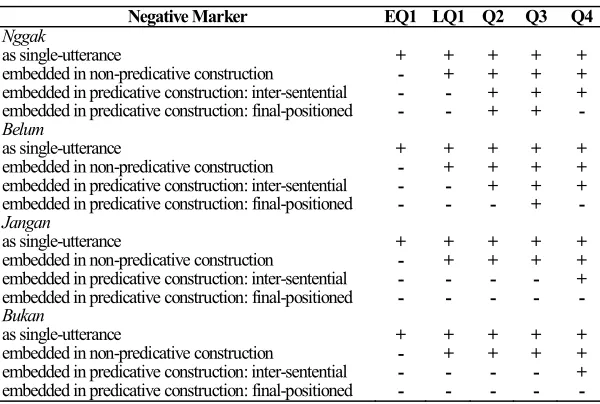
Table 1 summarizes the emergence of the four negative markers
nggak, belum, jangan, and bukan in Mika’s language. In the table, it is differentiated between early Quarter 1 (EQ1) and late Quarter 1 (LQ1) so as to highlight the fact that the emergence of the four negative markers as single utterances preceded that as a part of a multi-word utterance by several weeks.
Table 1 reveals that the emergence of the four negative markers as a part of a non-predicative multi-word utterance preceded that as a part of a predicative multi-word utterance by one quarter, in the case of nggak and
belum, and by three quarters, in the case of jangan and bukan. Another thing that the table displays is the fact that, while there occurred a competition between inter-sentential and final-positioned negative markers in Quarters 2 and 3, in the case of nggak, and in Quarter 3, in the case of
belum, such competition is not witnessed in the case of jangan and bukan.
Table 1. The Four Negative Markers across Quarters
Negative Marker EQ1 LQ1 Q2 Q3 Q4 Nggak
as single-utterance
embedded in non-predicative construction
embedded in predicative construction: inter-sentential embedded in predicative construction: final-positioned Belum
as single-utterance
embedded in non-predicative construction
embedded in predicative construction: inter-sentential embedded in predicative construction: final-positioned Jangan
as single-utterance
embedded in non-predicative construction
embedded in predicative construction: inter-sentential embedded in predicative construction: final-positioned Bukan
as single-utterance
embedded in non-predicative construction
embedded in predicative construction: inter-sentential embedded in predicative construction: final-positioned
+ - - - + - - - + - - - + - - - + + - - + + - - + + - - + + - - + + + + + + + - + + - - + + - - + + + + + + + + + + - - + + - - + + + - + + + - + + + - + + + -
bukan in the child’s syntactical system, or by the termination of the observation, meaning that final-positioned jangan and bukan might have occurred and might have been recorded if only the observation had been extended into subsequent age brackets. Another possibility is offered by the nativist’s view of language acquisition, in which the process of acquisition is thought to be basically a process of parameter setting (Ingram, 1989). When the negative markers nggak and belum were to be acquired, the necessary parameters might not have been set, and their acquisition somehow helped set the parameters. But, when the other two markers
jangan and bukan were to be acquired, the parameters might have been completely set, so the process was much simpler.
Negative Marker Acquisition Order
Dardjowidjojo (2000) reports that his subject Echa’s acquisition of the four negative markers is in the following order: bukan-belum-nggak
-jangan. This is contradictory to Mika’s order which is nggak-jangan
-belum-bukan for negative markers produced as single utterances and
nggak-belum-jangan-bukan for negative markers produced as part of multi-word utterances (see Table 2).
Table 2. Negative Marker Acquisition Order
Order
Child, Type I II III IV
Echa bukan belum nggak jangan
Mika: single utterance nggak jangan belum bukan
Mika: embedded nggak belum jangan bukan
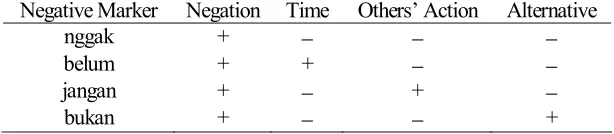
Table 3. Semantic Load of Negative Markers
Negative Marker Negation Time Others’ Action Alternative
nggak + − − −
belum + + − −
jangan + − + −
bukan + − − +
strict set of acquisition criteria, while Mika was regarded as having acquired a certain negative marker as soon as he was recorded to produce it for the first time. Anyway, based on the semantic properties of the negative markers, it seems that nggak is the simplest among the four, meaning that it only possesses one semantic meaning: negation. The other three are more complex since each possesses an extra meaning in addition to the meaning of negation (see Table 3). Both Slobin (1973) and Clark & Clark (1977) believe that cognitive complexities partly determine acquisition order, meaning that cognitively more complex items would be acquired relatively later than cognitively less complex ones. Thus, it should at least be logical to accept that the first negative marker Indonesian children would acquire is nggak, the one cognitively least complicated, not to mention that nggak
might well be considered as implicated by the other three.
Negative Construction Development
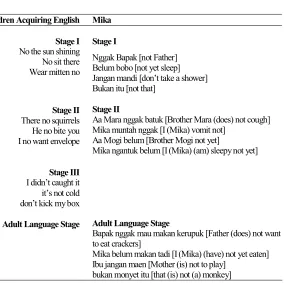
Three-stage negative construction development displayed by children acquiring English has been mentioned earlier. Regarding Mika, it might be tentatively forwarded that the child went through no more than two stages of negative construction development before reaching the adult language stage (see Figure 1).
Figure 1 shows that in the first stage Mika produced non-predicative negative constructions with the four negative markers. In the second stage, the child attempted to incorporate negative markers into his multi-word utterances; thus, he produced predicative constructions with inter-sentential and final-positioned markers. It is apparently the case that this second stage of his development overlaps with both Stage I and Stage II of English acquiring children. After going through the second stage, Mika reached the adult language stage, in which his negative constructions were no longer distinguishable from the adult language negative constructions; thus, skipping the third stage of English acquiring children’s negative construction development, in which the children have to work out the syntactical rules of properly combining negative markers with auxiliaries.
Children Acquiring English Mika
Stage I No the sun shining No sit there Wear mitten no
Stage II There no squirrels He no bite you I no want envelope
Stage III I didn’t caught it it’s not cold don’t kick my box
Adult Language Stage
Stage I
Nggak Bapak[not Father] Belum bobo [not yet sleep] Jangan mandi [don’t take a shower] Bukan itu [not that]
Stage II
Aa Mara nggak batuk[Brother Mara (does) not cough] Mika muntah nggak [I (Mika) vomit not]
Aa Mogi belum [Brother Mogi not yet]
Mika ngantuk belum [I (Mika) (am) sleepy not yet]
Adult Language Stage
Bapak nggak mau makan kerupuk[Father (does) not want to eat crackers]
Mika belum makan tadi [I (Mika) (have) not yet eaten] Ibu jangan maen [Mother (is) not to play]
bukan monyet itu [that (is) not (a) monkey]
Figure 1. Stages of Negative Construction Development
Mika’s negative construction development is definitely simpler than that of English acquiring children—Dardjowidjojo (2000) has observed the same thing to happen to his subject, perhaps since there are no auxiliary verbs in Indonesian language. While English acquiring children are said to complete their negative construction development, i.e., to master adult language negative constructions, when they reach age 4 to 4;6 (Clark & Clark, 1977; Ingram, 1989; and Foster, 1990), Indonesian acquiring children might complete theirs much earlier, i.e., by age 2;6.
CONCLUSION
children could be attributed to some underlying language-specific features; while the fact that children go through the stage of producing initial- and final-positioned negative marker before they reach the stage of producing inter-sentential negative marker which is grammatically acceptable by adult language standards might be considered a species-specific, i.e., universal, process of negative construction development.
REFERENCES
Bates, E., & MacWhinney, B. (1979). A functionalist approach to the acquisition of grammar. In E. Ochs, & B. B. Schieffelin (Eds.), Developmental pragmatics (pp. 167-211). New York: Academic Press.
Brown, G., & Yule, G. (1983). Discourse analysis. Cambridge: Cambridge University Press.
Clark, H. H., & Clark, E. V. (1977). Psychology and language: An introduction to psycholinguistics. San Diego: Harcourt Brace Jovanovich.
Dardjowidjojo, S. (2000). Echa: Kisah pemerolehan bahasa anak Indonesia. [Echa: An account of an Indonesian child’s language acquisition]. Jakarta: Grasindo.
Foster, S. H. (1990). The communicative competence of young children. London: Longman.
Ingram, D. (1989). First language acquisition: Method, description, and explanation. Cambridge: Cambridge University Press.
Miller, W. R., & Ervin-Tripp, S. M. (1973). The development of grammar in child language. In C. A. Ferguson, & D. I. Slobin (Eds.), Studies of child language development (pp. 355-380). New York: Holt, Rinehart and Winston.
Ochs, E. (1979). Introduction: What child language can contribute to pragmatics. In E. Ochs, & B. B. Schieffelin (Eds.), Developmental pragmatics (pp. 1-17). New York: Academic Press.
Raja, P. (2000). The phonological processes of two Indonesian children in the telegraphic stage. Paper presented at The Fourth International Symposium on Malay/Indonesian Linguistics (ISMIL 4), Jakarta, Indonesia.
Raja, P. (2003). The language of an Indonesian child named Mika in the telegraphic and simple sentence stages. Unpublished doctoral dissertation, Malang State University, Malang.
Slobin, D. I. (1973). Cognitive prerequisites for the development of grammar. In C. A. Ferguson, & D. I. Slobin (Eds.), Studies of child language development
(pp. 175-208). New York: Holt, Rinehart and Winston.
Volterra, V., & Antinucci, F. (1979). Negation in child language: A pragmatic study. In E. Ochs, & B.B. Schieffelin (Eds.), Developmental pragmatics