Experimentation and Analysis of an Automatic
Can/Plastic Bottle Crusher Machine
Vishal N. Kshirsagar Dr. S. K. Choudhary
M. Tech Student Department of Mechanical Engineering
Department of Mechanical Engineering KDK College of Engg., Nagpur, Maharashtra, India.
KDK College of Engg., Nagpur, Maharashtra, India.
Prof. A. P. Ninawe
Department of Mechanical Engineering KDK College of Engg., Nagpur, Maharashtra, India.
Abstract
This paper describes about the experimentation of can or plastic bottle crusher machine and analysis of mechanism used in machine. Hence in this the knowledge of analysis is necessary, and by analysis of various parts the quality and life of machine can be increased and improved. Overall, for experimentation this machine involves processes like design, fabrication, analysis and assembling of different components etc. From this the knowledge of all the parameters like design, fabrication and analysis etc. will get increase but most important the knowledge of analysis, the use of Ansys-Workbench Software is increasing day by day to determine the parameters like stress, strain, deflection etc. for safe design and long durability.
Keywords: Analysis, Deflection, Materials, Material Properties, Strengths, Stresses
_________________________________________________________________________________________________________
I.
INTRODUCTION
The purpose of this paper is to understand the fundamental knowledge of Analysis and Design. In this, analysis is carried out to determine the maximum stress induced in machine, failure occurs, deflection in machine etc. In this to carry out the analysis the knowledge of material is important aspect because the stresses and deflections such parameters are change accordingly of the material. In this analysis is done by using software Ansys-Workbench, determine the total deflection, maximum stress induced etc. To carry out the analysis number of steps has been followed such as modeling of machine, material properties assigning to the components, meshing, applying boundary conditions about the fixed point, applying pressure of 1104 psi on the surface of slider, by using all this determination of stresses has been done. In this, along with analysis and design some electronic components are used for fabrication of this machine to make this automatic one.
II.
STRUCTURAL ANALYSIS
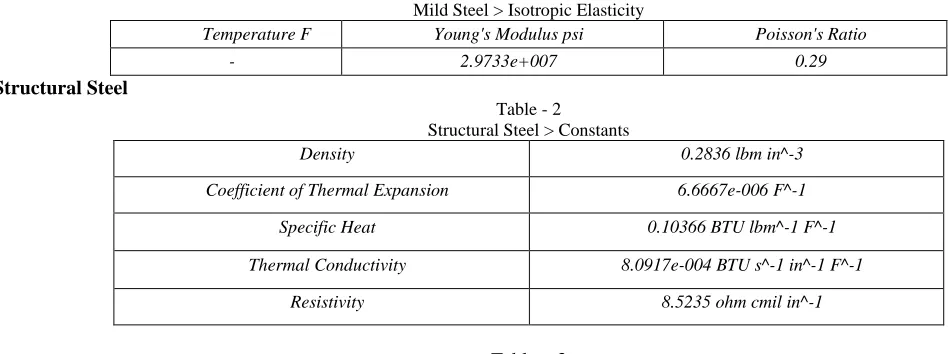
Material Data: In this, a material property has been assigned for improving life of components used. Mild steel
Table - 1
Mild Steel > Isotropic Elasticity
Temperature F Young's Modulus psi Poisson's Ratio
- 2.9733e+007 0.29
Structural Steel
Table - 2
Structural Steel > Constants
Density 0.2836 lbm in^-3
Coefficient of Thermal Expansion 6.6667e-006 F^-1
Specific Heat 0.10366 BTU lbm^-1 F^-1
Thermal Conductivity 8.0917e-004 BTU s^-1 in^-1 F^-1
Compressive Ultimate Strength psi 0
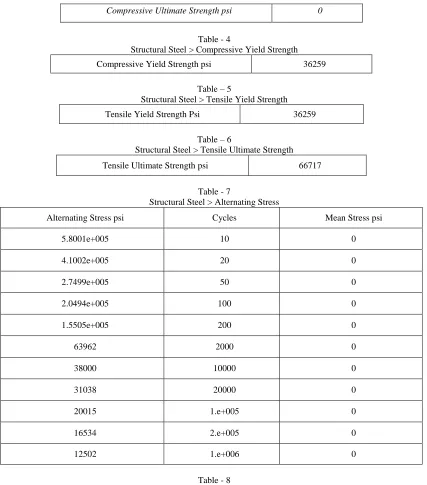
Table - 4
Structural Steel > Compressive Yield Strength
Compressive Yield Strength psi 36259
Table – 5
Structural Steel > Tensile Yield Strength
Tensile Yield Strength Psi 36259
Table – 6
Structural Steel > Tensile Ultimate Strength
Tensile Ultimate Strength psi 66717
Table - 7
Structural Steel > Alternating Stress
Alternating Stress psi Cycles Mean Stress psi
5.8001e+005 10 0
4.1002e+005 20 0
2.7499e+005 50 0
2.0494e+005 100 0
1.5505e+005 200 0
63962 2000 0
38000 10000 0
31038 20000 0
20015 1.e+005 0
16534 2.e+005 0
12502 1.e+006 0
Table - 8
Structural Steel > Strain-Life Parameters Strength
Coefficient psi
Strength Exponent
Ductility Coefficient
Ductility Exponent
Cyclic Strength Coefficient psi
Cyclic Strain Hardening Exponent 1.3343e+005 -0.106 0.213 -0.47 1.4504e+005 0.2
Table - 9
Structural Steel > Relative Permeability
Relative Permeability 10000
Table - 10
Structural Steel > Isotropic Elasticity
Temperature F Young's Modulus psi Poisson's Ratio
A. MESH
In this a tetrahedron type meshing is used. Simply meshing means to divide the single element into a number of elements to determine a stresses at every point of that single element so at which point the failure of part takes place can be determine easily. The meshing of modeling of machine is shown in figure below.
Fig. 1: Meshing of the Model
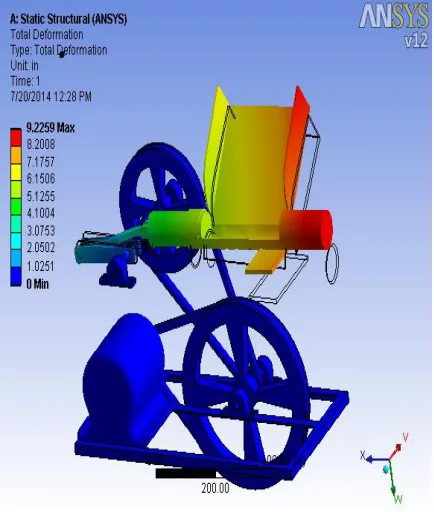
B. TOTAL DEFORMATION
In this, a static structural analysis has been done to determine the total deformation of machine and where it takes place. The following figure shows the static structural analysis for total deformation.
Fig. 2: Analysis for Total Deformation
C. EQUIVALENT STRESS
Fig. 3: Analysis for Equivalent Stress
III.
EXPERIMENTAL RESULTS
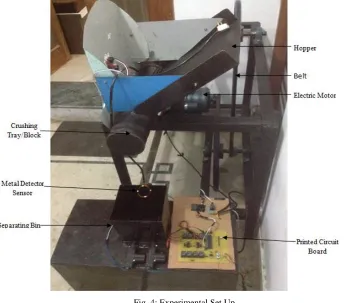
The machine fabricated on the basis of design and analysis of different components is shown in figure below. This machine is made automatic by using some electronic components such as Sensors, Micro-Controller, IC’s etc.
Diameter, D = 65 mm Length, L = 168 mm
Dimensions of Plastic bottle-500 ml Diameter, D = 58 mm
Length, L = 206 mm
The following tables show the comparison between uncrushed and crushed cans as well as plastic bottles. Table – 11
Reduction in Volume of Cans after Crushing
Sr. No. Time required Original Length (mm) Crushed Length (mm) Original Volume (mm3)
Crushed Volume (mm3)
Reduction in Volume (%)
1. 1.25 168 38 557.47×10³ 126.09×10³ 77.38
2. 1.25 168 37 557.47×10³ 122.77×10³ 77.97
3. 1.3 168 38 557.47×10³ 126.09×10³ 77.38
4. 1.25 168 38 557.47×10³ 126.09×10³ 77.38
5. 1.25 168 37 557.47×10³ 122.77×10³ 77.97
To determine the Reduction in Volume in percentage, = [(V - v)/ V] × 100 V – Original Volume
v – Crushed Volume.
Table – 12
Reduction in Volume of Plastic bottles after Crushing
Sr. No. Time required Original Length (mm) Crushed Length (mm) Original Volume (mm3)
Crushed Volume (mm3)
Reduction in Volume (%)
1. 1.6 206 58 544.26×10³ 153.24×10³ 71.84
2. 1.65 206 62 544.26×10³ 163.80×10³ 70.00
3. 1.6 206 63 544.26×10³ 166.45×10³ 69.5
4. 1.65 206 63 544.26×10³ 166.45×10³ 69.5
5. 1.7 206 60 544.26×10³ 158.52×10³ 70.87
IV.
CONCLUSION
In this, thus we determined where does the maximum stress and total deformation occurs in the machine by using ansys workbench software as well as by using this machine the volume of Cans and Plastic bottles can be reduce up to a seventy percent. By analysis of machine components most efficient and durable machine can be manufactured. By Analysis of machine it is concluded that the machine is safe through design point of view.
REFERENCES
[1] Mr. Ramkrushna S. More, Sunil J. Rajpalpublishes a review paper on “Study of Jaw Plates of Jaw Crusher”. International Journal of Modern Engineering Research (IJMER), Vol.3, Issue.1, Jan-Feb. 2013 pp-518-522 ISSN: 2249-6645.
[2] Mr. Patel Ronak A.presents a paper on “Slider Crank Mechanism for Four bar linkage”. IJSRD - International Journal for Scientific Research & Development|
Vol. 1, Issue 9, 2013 | ISSN (online): 2321-0613.
[3] Cao Jinxi, Qin Zhiyu, Rong Xingfu, Yang Shichun presents a paper on “ Experimntal Research on Crushing Force and its Distribution Feature in Jaw Crusher ”
2007 Second IEEE Conference on Industrial Electronics and Applications.1-4244-0737-0/07/$20.00© 2007 IEEE.
[4] C. LAROUCI(*), G.FELD (**), JP.DIDIER(*) presents a paper on “Modeling and control of the vehicle transmission chain using electric actuators”.