Nonextensive Information Theoretic Kernels on Measures
∗Andr´e F. T. Martins† [email protected]
Noah A. Smith [email protected]
Eric P. Xing [email protected]
School of Computer Science Carnegie Mellon University Pittsburgh, PA, USA
Pedro M. Q. Aguiar [email protected]
Instituto de Sistemas e Rob´otica Instituto Superior T´ecnico Lisboa, Portugal
M´ario A. T. Figueiredo [email protected]
Instituto de Telecomunicac¸˜oes Instituto Superior T´ecnico Lisboa, Portugal
Editor: Francis Bach
Abstract
Positive definite kernels on probability measures have been recently applied to classification prob-lems involving text, images, and other types of structured data. Some of these kernels are related to classic information theoretic quantities, such as (Shannon’s) mutual information and the Jensen-Shannon (JS) divergence. Meanwhile, there have been recent advances in nonextensive gener-alizations of Shannon’s information theory. This paper bridges these two trends by introducing nonextensive information theoretic kernels on probability measures, based on new JS-type diver-gences. These new divergences result from extending the the two building blocks of the classical JS divergence: convexity and Shannon’s entropy. The notion of convexity is extended to the wider concept of q-convexity, for which we prove a Jensen q-inequality. Based on this inequality, we in-troduce Jensen-Tsallis (JT) q-differences, a nonextensive generalization of the JS divergence, and define a k-th order JT q-difference between stochastic processes. We then define a new family of nonextensive mutual information kernels, which allow weights to be assigned to their arguments, and which includes the Boolean, JS, and linear kernels as particular cases. Nonextensive string kernels are also defined that generalize the p-spectrum kernel. We illustrate the performance of these kernels on text categorization tasks, in which documents are modeled both as bags of words and as sequences of characters.
Keywords: positive definite kernels, nonextensive information theory, Tsallis entropy, Jensen-Shannon divergence, string kernels
1. Introduction
In kernel-based machine learning (Sch¨olkopf and Smola, 2002; Shawe-Taylor and Cristianini, 2004), there has been recent interest in defining kernels on probability distributions to tackle several prob-lems involving structured data (Desobry et al., 2007; Moreno et al., 2004; Jebara et al., 2004; Hein and Bousquet, 2005; Lafferty and Lebanon, 2005; Cuturi et al., 2005). By defining a parametric family S containing the distributions from which the data points (in the input space X ) are assumed to have been generated, and defining a map from X from S (e.g., via maximum likelihood estima-tion), a distribution in S may be fitted to each datum. Therefore, a kernel that is defined on S×S
automatically induces a kernel on X×X , through map composition. In text categorization, this
framework appears as an alternative to the Euclidean geometry inherent to the usual bag-of-words representations. In fact, approaches that map data to statistical manifolds, equipped with well-motivated non-Euclidean metrics (Lafferty and Lebanon, 2005), often outperform support vector machine (SVM) classifiers with linear kernels (Joachims, 2002). Some of these kernels have a natural information theoretic interpretation, establishing a bridge between kernel methods and in-formation theory (Cuturi et al., 2005; Hein and Bousquet, 2005).
The main goal of this paper is to widen that bridge; we do that by introducing a new class of nels rooted in nonextensive information theory, which contains previous information theoretic ker-nels as particular elements. The Shannon and R´enyi entropies (Shannon, 1948; R´enyi, 1961) share the extensivity property: the joint entropy of a pair of independent random variables equals the sum of the individual entropies. Abandoning this property yields the so-called nonextensive entropies (Havrda and Charv´at, 1967; Lindhard, 1974; Lindhard and Nielsen, 1971; Tsallis, 1988), which have raised great interest among physicists in modeling phenomena such as long-range interactions and multifractals, and in constructing nonextensive generalizations of Boltzmann-Gibbs statisti-cal mechanics (Abe, 2006). Nonextensive entropies have also been recently used in signal/image processing (Li et al., 2006) and other areas (Gell-Mann and Tsallis, 2004). The so-called
Tsal-lis entropies (Havrda and Charv´at, 1967; TsalTsal-lis, 1988) form a parametric family of nonextensive
entropies that includes the Shannon-Boltzmann-Gibbs entropy as a particular case. Nonextensive generalizations of information theory have been proposed (Furuichi, 2006).
Convexity and Jensen’s inequality are key concepts underlying several central results of infor-mation theory, for example, the non-negativity of the Kullback-Leibler (KL) divergence (or
rela-tive entropy) (Kullback and Leibler, 1951). Jensen’s inequality (Jensen, 1906) also underlies the Jensen-Shannon (JS) divergence, a symmetrized and smoothed version of the KL divergence (Lin
and Wong, 1990; Lin, 1991), often used in statistics, machine learning, signal/image processing, and physics.
In this paper, we introduce new extensions of JS-type divergences by generalizing its two pil-lars: convexity and Shannon’s entropy. These divergences are then used to define new information-theoretic kernels between probability distributions. More specifically, our main contributions are:
• The concept of convexity, generalizing that of convexity, for which we prove a Jensen
q-inequality. The related concept of Jensen q-differences, which generalize Jensen differences,
is also proposed. Based on these concepts, we introduce the Jensen-Tsallis (JT) q-difference, a nonextensive generalization of the JS divergence, which is also a “mutual information” in the sense of Furuichi (2006).
• Definition of k-th order joint and conditional JT q-differences for families of stochastic pro-cesses, and derivation of a chain rule.
• A broad family of (nonextensive information theoretic) positive definite kernels, interpretable as nonextensive mutual information kernels, ranging from the Boolean to the linear kernels, and including the JS kernel proposed by Hein and Bousquet (2005).
• A family of (nonextensive information theoretic) positive definite kernels between stochastic processes, subsuming well-known string kernels (e.g., the p-spectrum kernel) (Leslie et al., 2002).
• Extensions of results of Hein and Bousquet (2005) proving positive definiteness of kernels based on the unbalanced JS divergence. A connection between these new kernels and those studied by Fuglede (2005) and Hein and Bousquet (2005) is also established. In passing, we show that the parametrix approximation of the multinomial diffusion kernel introduced by Lafferty and Lebanon (2005) is not positive definite in general.
The paper is organized as follows. Section 2 reviews nonextensive entropies, with empha-sis on the Tsallis case. Section 3 discusses Jensen differences and divergences. The concepts of q-differences and q-convexity are introduced in Section 4, where they are used to define and characterize some new divergence-type quantities. In Section 5, we define the Jensen-Tsallis q-difference and derive some of its properties; in that section, we also define k-th order Jensen-Tsallis
q-differences for families of stochastic processes. The new family of entropic kernels is introduced
and characterized in Section 6, which also introduces nonextensive kernels between stochastic pro-cesses. Experiments on text categorization are reported in Section 7. Section 8 concludes the paper and discusses future research.
2. Nonextensive Entropies and Tsallis Statistics
In this section, we start with a brief overview of nonextensive entropies. We then introduce the family of Tsallis entropies, and extend their domain to unnormalized measures.
2.1 Nonextensivity
In what follows,R+denotes the nonnegative reals,R++denotes the strictly positive reals, and
∆n−1,
(
(x1, . . . ,xn)∈Rn| n
∑
i=1xi=1,∀i xi≥0 )
denotes the(n−1)-dimensional simplex.
Inspired by the axiomatic formulation of Shannon’s entropy (Khinchin, 1957; Shannon and Weaver, 1949), Suyari (2004) proposed an axiomatic framework for nonextensive entropies and a uniqueness theorem. Let q≥0 be a fixed scalar, called the entropic index. Suyari’s axioms (Appendix A) determine a function Sq,φ:∆n−1→Rof the form
Sq,φ(p1, . . . ,pn) = (
k
φ(q) 1−∑
n i=1p
q i
if q6=1
−k∑ni=1piln pi if q=1,
where k is a positive constant, andφ:R+→Ris a continuous function that satisfies the following three conditions: (i)φ(q)has the same sign as q−1; (ii)φ(q)vanishes if and only if q=1; (iii)φis differentiable in a neighborhood of 1 andφ′(1) =1.
Note that S1,φ =limq→1Sq,φ, thus Sq,φ(p1, . . . ,pn), seen as a function of q, is continuous at
q=1. For anyφsatisfying these conditions, Sq,φ has the pseudoadditivity property: for any two independent random variables A and B, with probability mass functions pA∈∆nA−1and pB∈∆nB−1, respectively, consider the new random variable A⊗B defined by the joint distribution pA⊗pB∈
∆nAnB−1; then,
Sq,φ(A⊗B) =Sq,φ(A) +Sq,φ(B)−φ
(q)
k Sq,φ(A)Sq,φ(B),
where we denote (as usual) Sq,φ(A),Sq,φ(pA).
For q=1, Suyari’s axioms recover the Shannon-Boltzmann-Gibbs (SBG) entropy,
S1,φ(p1, . . . ,pn) =H(p1, . . . ,pn) =−k n
∑
i=1piln pi,
and pseudoadditivity turns into additivity, that is, H(A⊗B) =H(A) +H(B)holds.
Several proposals for φ have appeared in the literature (Havrda and Charv´at, 1967; Dar´oczy, 1970; Tsallis, 1988). In this article, unless stated otherwise, we setφ(q) =q−1, which yields the
Tsallis entropy:
Sq(p1, . . . ,pn) =
k
q−1 1−
n
∑
i=1pqi
!
. (2)
To simplify, we let k=1 and write the Tsallis entropy as
Sq(X),Sq(p1, . . . ,pn) =−
∑
x∈Xp(x)qlnqp(x), (3)
where lnq(x),(x1−q−1)/(1−q) is the q-logarithm function, which satisfies lnq(xy) =lnq(x) +
x1−qlnq(y)and lnq(1/x) =−xq−1lnq(x). This notation was introduced by Tsallis (1988). 2.2 Tsallis Entropies
Furuichi (2006) derived some information theoretic properties of Tsallis entropies. Tsallis joint and
conditional entropies are defined, respectively, as
Sq(X,Y),−
∑
x,yp(x,y)qlnqp(x,y)
and
Sq(X|Y),−
∑
x,yp(x,y)qlnqp(x|y) =
∑
yp(y)qSq(X|y), (4)
and the chain rule Sq(X,Y) =Sq(X) +Sq(Y|X)holds.
For two probability mass functions pX,pY ∈∆n, the Tsallis relative entropy, generalizing the KL divergence, is defined as
Dq(pXkpY),−
∑
xpX(x)lnq
pY(x)
pX(x)
Finally, the Tsallis mutual entropy is defined as
Iq(X ;Y),Sq(X)−Sq(X|Y) =Sq(Y)−Sq(Y|X), (6)
generalizing (for q>1) Shannon’s mutual information (Furuichi, 2006). In Section 5, we establish a relationship between Tsallis mutual entropy and a quantity called Jensen-Tsallis q-difference, generalizing the one between mutual information and the JS divergence (shown, e.g., by Grosse et al. 2002, and recalled below, in Section 3.2).
Furuichi (2006) also mentions an alternative generalization of Shannon’s mutual information, defined as
˜
Iq(X ;Y),Dq(pX,YkpX⊗pY), (7)
where pX,Y is the true joint probability mass function of (X,Y) and pX⊗pY denotes their joint probability if they were independent. This alternative definition of a “Tsallis mutual entropy” has also been used by Lamberti and Majtey (2003); notice that Iq(X ;Y)6=I˜q(X ;Y)in general, the case
q=1 being a notable exception. In Section 5, we show that this alternative definition also leads to a nonextensive analogue of the JS divergence.
2.3 Entropies of Measures and Denormalization Formulae
Throughout this paper, we consider functionals that extend the domain of the Shannon-Boltzmann-Gibbs and Tsallis entropies to include unnormalized measures. Although, as shown below, these functionals are completely characterized by their restriction to the normalized probability distri-butions, the denormalization expressions will play an important role in Section 6 to derive novel positive definite kernels inspired by mutual informations.
In order to keep generality, whenever possible we do not restrict to finite or countable sample spaces. Instead, we consider a measure space(
X
,M,ν)whereX
is Hausdorff and νis aσ-finite Radon measure. We denote by M+(X
) the set of finite Radonν-absolutely continuous measures onX
, and by M+1(X
)the subset of those which are probability measures. For simplicity, we often identify each measure in M+(X
) or M+1(X
) with its corresponding nonnegative density; this is legitimated by the Radon-Nikodym theorem, which guarantees the existence and uniqueness (up to equivalence within measure zero) of a density function f :X
→R+. In the sequel, Lebesgue-Stieltjes integrals of the form RA f(x)dν(x) are often written as
R
A f , or simply
R
f, if
A
=X
.Unless otherwise stated,νis the Lebesgue-Borel measure, if
X
⊆Rnand intX
6=∅, or the counting measure, ifX
is countable. In the latter case integrals can be seen as finite sums or infinite series.DefineR,R∪ {−∞,+∞}. For some functional G : M+(
X
)→R, let the set M+G(X
),{f ∈ M+(X
):|G(f)|<∞}be its effective domain, and M+1,G(X
),M+G(X
)∩M1+(X
)be its subdomain of probability measures.The following functional (Cuturi and Vert, 2005), extends the Shannon-Boltzmann-Gibbs en-tropy from M+1,H(
X
)to the unnormalized measures in M+H(X
):H(f) =−k
Z
f ln f =
Z
ϕH◦f, (8)
where k>0 is a constant, the functionϕH:R+→Ris defined as
and, as usual, 0 ln 0,0.
The generalized form of the KL divergence, often called generalized I-divergence (Csiszar, 1975), is a directed divergence between two measures µf,µg∈M+H(
X
), such that µf is µg-absolutely continuous (denoted µf ≪µg). Let f and g be the densities associated with µf and µg, respectively. In terms of densities, this generalized KL divergence isD(f,g) = k
Z
g−f+f ln f
g
. (9)
Let us now proceed similarly with the nonextensive entropies. For q≥0, let MSq
+(
X
) ={f ∈M+(
X
): fq∈M+(X
)}for q=6 1, and M+Sq(X
) =MH+(X
)for q=1. The nonextensive counterpart of (8), defined on M+Sq(X
), isSq(f) = Z
ϕq◦f, (10)
whereϕq:R+→Ris given by
ϕq(y) = (
ϕH(y) if q=1, k
φ(q)(y−yq) if q6=1,
(11)
andφ:R+→Rsatisfies conditions (i)-(iii) stated following Equation (1). The Tsallis entropy is obtained forφ(q) =q−1,
Sq(f) =−k Z
fqlnqf. (12)
Similarly, a nonextensive generalization of the generalized KL divergence (9) is
Dq(f,g) =−
k
φ(q)
Z
q f+ (1−q)g−fqg1−q,
for q6=1, and D1(f,g),limq→1Dq(f,g) =D(f,g). Define|f|,R
f =µf(
X
). For|f|=|g|=1, several particular cases are recovered: ifφ(q) = 1−21−q, then Dq(f,g)is the Havrda-Charv´at relative entropy (Havrda and Charv´at, 1967; Dar´oczy, 1970); ifφ(q) =q−1, then Dq(f,g)is the Tsallis relative entropy (5); finally, ifφ(q) =q(q−1), then Dq(f,g)is the canonicalα-divergence defined by Amari and Nagaoka (2001) in the realm of information geometry (with the reparameterizationα=2q−1 and assuming q>0 so thatφ(q) = q(q−1)conforms with the axioms).Remark 1 Both functionals Sq and Dq are completely determined by their restriction to the
nor-malized measures. Indeed, the following equalities hold for any c∈R++and f,g∈MSq
+(
X
), withµf ≪µg:
Sq(c f) = cqSq(f) +|f|ϕq(c),
Dq(c f,cg) = cDq(f,g),
Dq(c f,g) = cqDq(f,g)−qϕq(c)|f|+
k
φ(q)(q−1)(1−c
q)
For any f ∈MS+q(
X
)and g∈MS+q(Y
),Sq(f⊗g) =|g|Sq(f) +|f|Sq(g)−
φ(q)
k Sq(f)Sq(g).
If|f|=|g|=1, we recover the pseudo-additivity property of nonextensive entropies:
Sq(f⊗g) =Sq(f) +Sq(g)−
φ(q)
k Sq(f)Sq(g).
Forφ(q) =q−1, Dqis the Tsallis relative entropy and (13) reduces to
Dq(c f,g) =cqDq(f,g)−qϕq(c)|f|+k(1−cq)|g|.
By taking the limit q→1, we obtain the following formulae for H and D:
H(c f) = c H(f) +|f|ϕH(c),
D(c f,cg) = c D(f,g),
D(c f,g) = c D(f,g)− |f|ϕH(c) +k(1−c)|g|.
Consider f ∈MH
+(
X
)and g∈M+H(Y
), and define f⊗g∈M+H(X
×Y
)as(f⊗g)(x,y), f(x)g(y).Then,
H(f⊗g) =|g|H(f) +|f|H(g).
If|f|=|g|=1, we recover the additivity property of the Shannon-Boltzmann-Gibbs entropy, H(f⊗ g) =H(f) +H(g).
3. Jensen Differences and Divergences
In this section, we review the concept of Jensen difference. We then discuss three particular cases: the Jensen-Shannon, Jensen-R´enyi, and Jensen-Tsallis divergences.
3.1 The Jensen Difference
Jensen’s inequality (Jensen, 1906) is at the heart of many important results in information theory. Let E[.]denote the expectation operator. Jensen’s inequality states that if Z is an integrable random variable taking values in a set
Z
, and f is a measurable convex function defined on the convex hull ofZ
, thenf(E[Z])≤E[f(Z)].
Burbea and Rao (1982) considered the scenario where
Z
is finite, and took f ,−Hϕ, whereHϕ:[a,b]n→Ris a concave function, called aϕ-entropy, defined as
Hϕ(z),−
n
∑
i=1ϕ(zi), (14)
whereϕ:[a,b]→Ris convex. They studied the Jensen difference
Jϕπ(y1, . . . ,ym),Hϕ m
∑
t=1πtyt !
−
m
∑
t=1whereπ,(π1, . . . ,πm)∈∆m−1, and each y1, . . . ,ym∈[a,b]n.
We consider here a more general scenario, involving two measure sets(
X
,M,ν)and(T
,T,τ), where the second is used to index the first.Definition 2 Let µ,(µt)t∈T ∈[M+(
X
)]T be a family of finite Radon measures onX
, indexed byT
, and letω∈M+(T
)be a finite Radon measure onT
. Define:JΨω(µ) , ΨZ
Tω(t)µtdτ(t)
−
Z
Tω(t)Ψ(µt)dτ(t) (15)
where:
(i) Ψis a concave functional such that domΨ⊆M+(
X
);(ii) ω(t)µt(x)isτ-integrable, for all x∈
X
;(iii) R
T ω(t)µtdτ(t)∈domΨ;
(iv) µt∈domΨ, for all t∈
T
;(v) ω(t)Ψ(µt)isτ-integrable.
Ifω∈M+1(
T
), we still call (15) a Jensen difference.In the following subsections, we consider several instances of Definition 2, leading to several Jensen-type divergences.
3.2 The Jensen-Shannon Divergence
Let p be a random probability distribution taking values in {pt}t∈T according to a distribution π∈M+1(
T
). (In classification/estimation theory parlance, π is called the prior distribution andpt ,p(.|t)the likelihood function.) Then, (15) becomes
JΨπ(p) =Ψ(E[p])−E[Ψ(p)], (16)
where the expectations are with respect toπ.
Let nowΨ=H, the Shannon-Boltzmann-Gibbs entropy. Consider the random variables T and
X , taking values respectively in
T
andX
, with densities π(t) and p(x),RT p(x|t)π(t). Using
standard notation of information theory (Cover and Thomas, 1991),
Jπ(p) , JHπ(p) = H
Z
Tπ(t)pt
−
Z
Tπ(t)H(pt)
= H(X)−
Z
T π(t)H(X|T =t)
= H(X)−H(X|T)
= I(X ; T), (17)
KL divergence between the joint distribution and the product of the marginals (Cover and Thomas, 1991), we have
Jπ(p) =H(E[p])−E[H(p)] =E[D(pkE[p])]. (18)
When
X
andT
are finite with |T
|=m, JHπ(p1, . . . ,pm) is called the Jensen-Shannon (JS)di-vergence of p1, . . . ,pm, with weightsπ1, . . . ,πm(Burbea and Rao, 1982; Lin, 1991). Equality (18) allows two interpretations of the JS divergence:
• the Jensen difference of the Shannon entropy of p;
• the expected KL divergence from p to the expectation of p.
A remarkable fact is that Jπ(p) =minrE[D(pkr)], that is, r∗=E[p]is a minimizer of E[D(pkr)] with respect to r. It has been shown that this property together with Equality (18) characterize the so-called Bregman divergences: they hold not only for Ψ=H, but for any concave Ψ and the corresponding Bregman divergence, in which case JΨπ is the Bregman information (Banerjee et al., 2005).
When |
T
|=2 and π= (1/2,1/2), p may be seen as a random distribution whose value on{p1,p2}is chosen by tossing a fair coin. In this case, J(1/2,1/2)(p) =JS(p1,p2), where
JS(p1,p2) , H
p1+p2
2
−H(p1) +H(p2)
2
= 1
2D
p1
p1+2 p2
+1
2D
p2
p1+2 p2
,
as introduced by Lin (1991). It has been shown that √JS satisfies the triangle inequality (hence
being a metric) and that, moreover, it is a Hilbertian metric1(Endres and Schindelin, 2003; Topsøe, 2000), which has motivated its use in kernel-based machine learning (Cuturi et al., 2005; Hein and Bousquet, 2005) (see Section 6).
3.3 The Jensen-R´enyi Divergence
Consider again the scenario above (Section 3.2), with the R´enyi q-entropy
Rq(p) = 1 1−qln
Z
pq
replacing the Shannon-Boltzmann-Gibbs entropy. It is worth noting that the R´enyi and Tsallis
q-entropies are monotonically related through Rq(p) =ln
[1+ (1−q)Sq(p)]
1 1−q
, or, using the q-logarithm function,
Sq(p) =lnqexp Rq(p).
The R´enyi q-entropy is concave for q∈[0,1)and has the Shannon-Boltzmann-Gibbs entropy as the limit when q→1. LettingΨ=Rq, (16) becomes
JRπq(p) =Rq(E[p])−E[Rq(p)]. (19)
1. A metric d :X×X →Ris Hilbertian if there is some Hilbert space H and an isometry f :X →H such that
Unlike in the JS divergence case, there is no counterpart of equality (18) based on the R´enyi q-divergence
DRq(p1kp2) =
1
q−1ln
Z
pq1 p12−q. When
X
andT
are finite, we call JRπq in (19) the Jensen-R´enyi (JR) divergence. Furthermore,
when|
T
|=2 andπ= (1/2,1/2), we write JRπq(p) =JRq(p1,p2), where
JRq(p1,p2) =Rq
p1+p2
2
−Rq(p1) +2Rq(p2).
The JR divergence has been used in several signal/image processing applications, such as regis-tration, segmentation, denoising, and classification (Ben-Hamza and Krim, 2003; He et al., 2003; Karakos et al., 2007). In Section 6, we show that the JR divergence is (like the JS divergence) a Hilbertian metric, which is relevant for its use in kernel-based machine learning.
3.4 The Jensen-Tsallis Divergence
Burbea and Rao (1982) have defined Jensen-type divergences of the form (16) based on the Tsallis
q-entropy Sq, defined in (12). Like the Shannon-Boltzmann-Gibbs entropy, but unlike the R´enyi
entropies, the Tsallis q-entropy, for finite
T
, is an instance of aϕ-entropy (see Equation 14). LettingΨ=Sq, (16) becomes
JSπq(p) =Sq(E[p])−E[Sq(p)]. (20)
Again, as in Section 3.3, if we consider the Tsallis q-divergence,
Dq(p1kp2) =
1 1−q
1− Z
p1q p21−q
,
there is no counterpart of the Equality (18).
When
X
andT
are finite, JSπq in (20) is called the Jensen-Tsallis (JT) divergence and it has also been applied in image processing (Ben-Hamza, 2006). Unlike the JS divergence, the JT divergence lacks an interpretation as a mutual information. Despite this, for q∈[1,2], it exhibits joint convexity (Burbea and Rao, 1982). In the next section, we propose an alternative to the JT divergence which, among other features, is interpretable as a nonextensive mutual information (in the sense of Furuichi 2006) and is jointly convex, for q∈[0,1].4. q-Convexity and q-Differences
This section introduces a novel class of functions, termed Jensen q-differences, which generalize Jensen differences. Later (in Section 5), we will use these functions to define the Jensen-Tsallis
q-difference, which we will propose as an alternative nonextensive generalization of the JS divergence,
instead of the JT divergence discussed in Section 3.4. We begin by recalling the concept of q-expectation (Tsallis, 1988).
Definition 3 The unnormalized q-expectation of a random variable X , with probability density p,
is
Eq[X], Z
Of course, q=1 corresponds to the standard notion of expectation. For q6=1, the q-expectation does not match the intuitive meaning of average/expectation (e.g., Eq[1]6=1, in general). The q-expectation is a convenient concept in nonextensive information theory; for example, it yields a very compact form for the Tsallis entropy: Sq(X) =−Eq[lnqp(X)].
4.1 q-Convexity
We now introduce the novel concept of q-convexity and use it to derive a set of results, namely the
Jensen q-inequality.
Definition 4 Let q∈Rand
X
be a convex set. A function f :X
→Ris q-convex if for any x,y∈X
andλ∈[0,1],
f(λx+ (1−λ)y)≤λqf(x) + (1−λ)qf(y). (21)
If−f is q-convex, f is said to be q-concave.
Of course, 1-convexity is the usual notion of convexity. Many properties of 1-convex functions do not have q-analogues. For example, for q6=1, any q-convex function must be either nonnegative (if q<1) or nonpositive (if q>1); this simple fact can be shown through reductio ad absurdum by setting x=y in (21). However, other properties remain: the next proposition states the Jensen q-inequality.
Proposition 5 If f :
X
→Ris q-convex, then for any n∈N, x1, . . . ,xn∈X
andπ= (π1, . . . ,πn)∈∆n−1,
f
n
∑
i=1πixi !
≤
n
∑
i=1πq i f(xi).
Moreover, if f is continuous, the above still holds for countably many points(xi)i∈N.
Proof In the finite case, the proof can be carried out by induction, as in the proof of the standard Jensen inequality (Cover and Thomas, 1991). Assuming that the inequality holds for n∈N, then, from the definition of q-convexity, it will also hold for n+1:
f
n+1
∑
i=1πixi !
= f
n
∑
i=1πixi+πn+1xn+1
!
= f (1−πn+1)
n
∑
i=1π′
ixi+πn+1xn+1
!
≤ (1−πn+1)qf
n
∑
i=1π′
ixi !
+πqn+1f(xn+1)
≤
n
∑
i=1πq
i f(xi) +πqn+1f(xn+1) =
n+1
∑
i=1πq i f(xi),
where we used the fact that πn+1=1−∑ni=1πi, and we defined π′i ,πi/(1−πn+1) (note that ∑n
f
∞
∑
i=1πixi !
=f lim
n→∞
n
∑
i=1πixi !
=lim
n→∞f
n
∑
i=1πixi !
≤lim n→∞
n
∑
i=1πq i f(xi) =
∞
∑
i=1πq i f(xi).
Proposition 6 Let f ≥0 and q≥r≥0; then,
f is q-convex ⇒ f is r-convex (22)
f is r-concave ⇒ f is q-concave. (23)
Proof Implication (22) results from
f(λx+ (1−λ)y) ≤ λqf(x) + (1−λ)qf(y) ≤ λrf(x) + (1−λ)rf(y),
where the first inequality states the q-convexity of f and the second one is valid because f(x),f(y)≥
0 and tr≥tq≥0, for any t∈[0,1]and q≥r. The proof of (23) is similar.
4.2 Jensen q-Differences
We now generalize Jensen differences, formalized in Definition 2, by introducing the concept of Jensen q-differences.
Definition 7 Let µ,(µt)t∈T ∈[M+(
X
)]T be a family of finite Radon measures onX
, indexed byT
, and letω∈M+(T
)be a finite Radon measure onT
. For q≥0, defineTqω,Ψ(µ) , Ψ
Z
T ω(t)µtdτ(t)
−
Z
Tω(t)
qΨ(µ
t)dτ(t), (24)
where:
(i) Ψis a concave functional such that domΨ⊆M+(
X
);(ii) ω(t)µt(x)isτ-integrable for all x∈
X
;(iii) R
T ω(t)µtdτ(t)∈domΨ;
(iv) µt∈domΨ, for all t∈
T
;(v) ω(t)qΨ(µ
t)isτ-integrable.
Ifω∈M+1(
T
), we call the function defined in (24) a Jensen q-difference.Burbea and Rao (1982) established necessary and sufficient conditions on ϕ for the Jensen difference of aϕ-entropy (see Equation 14) to be convex. The following proposition generalizes that result, extending it to Jensen q-differences.
Proposition 8 Let
T
andX
be finite sets, with|T
|=m and |X
|=n, and let π∈M+1(T
). Letϕ:[0,1]→Rbe a function of class C2and consider the (ϕ-entropy, Burbea and Rao, 1982) function
Ψ:[0,1]n→Rdefined asΨ(z),−∑n
i=1ϕ(zi). Then, the q-difference Tqπ,Ψ:[0,1]nm→Ris convex
if and only ifϕis convex and−1/ϕ′′is(2−q)-convex.
5. The Jensen-Tsallis q-Difference
This section introduces the Tsallis q-difference, a nonextensive generalization of the Jensen-Shannon divergence. After deriving some properties concerning the convexity and extrema of these functionals, we introduce the notion of joint and conditional Jensen-Tsallis q-difference, a contrast measure between stochastic processes. We end the section with a brief asymptotic analysis for the extensive case.
5.1 Definition
As in Section 3.2, let p be a random probability distribution taking values in{pt}t∈T according to a
distributionπ∈M+1(
T
). Then, we may writeTqπ,Ψ(p) =Ψ(E[p])−Eq[Ψ(p)],
where the expectations are with respect to π. Hence Jensen q-differences may be seen as defor-mations of the standard Jensen differences (16), in which the second expectation is replaced by a
q-expectation.
LetΨ=Sq, the nonextensive Tsallis q-entropy. Introducing the random variables T and X , with values respectively in
T
andX
, with densitiesπ(t)and p(x),RT p(x|t)π(t), we have (writing Tqπ,Sq
simply as Tqπ)
Tqπ(p) = Sq(E[p])−Eq[Sq(p)]
= Sq(X)−
Z
Tπ(t)
qS
q(X|T =t)
= Sq(X)−Sq(X|T)
= Iq(X ; T), (25)
where Sq(X|T)is the Tsallis conditional entropy (4), and Iq(X ; T)is the Tsallis mutual information (6), as defined by Furuichi (2006). Observe that (25) is a nonextensive analogue of (17). Since, in general, Iq6=I˜q (see Equation 7), unless q=1 (in that case, I1=I˜1=I), there is no counterpart
of (18) in terms of q-differences. Nevertheless, Lamberti and Majtey (2003) have proposed a non-logarithmic version of the JS divergence, which corresponds to using ˜Iq for the Tsallis mutual q-entropy (although this interpretation is not explicitly mentioned).
When
X
andT
are finite with|T
|=m, we call the quantity Tqπ(p1, . . . ,pm)the Jensen-Tsallis(JT) q-difference of p1, . . . ,pm with weights π1, . . . ,πm. Although the JT q-difference is a gener-alization of the JS divergence, for q6=1, the term “divergence” would be misleading in this case, since Tqπmay take negative values (if q<1) and does not vanish in general if p is deterministic.
When|
T
|=2 andπ= (1/2,1/2), define Tq,T1/2,1/2
q ,
Tq(p1,p2) =Sq
p1+p2
2
−Sq(p1) +2qSq(p2). Notable cases arise for particular values of q:
• For q=0, S0(p) =−1+ν(supp(p)), whereν(supp(p))denotes the measure of the support
νis the counting measure,ν(supp(p)) =kpk0 is the so-called 0-norm (although it is not a norm) of vector p, that is, its number of nonzero components. The Jensen-Tsallis 0-difference is thus
T0(p1,p2) = −1+ν
supp
p1+p2
2
+1−ν(supp(p1)) +1−ν(supp(p2))
= 1+ν(supp(p1)∪supp(p2))−ν(supp(p1))−ν(supp(p2))
= 1−ν(supp(p1)∩supp(p2)); (26)
if
X
is finite andνis the counting measure, this becomesT0(p1,p2) =1− kp1⊙p2k0,
where⊙denotes the Hadamard-Schur (i.e., elementwise) product. We call T0 the Boolean
difference.
• For q=1, since S1(p) =H(p), T1is the JS divergence,
T1(p1,p2) =JS(p1,p2). • For q=2, S2(p) =1− hp,pi, whereha,bi=
R
Xa(x)b(x)dν(x)is the inner product between
a and b (which reduces toha,bi=∑iaibi if
X
is finite andνis the counting measure).Con-sequently, the Tsallis 2-difference is
T2(p1,p2) =
1 2−
1
2 hp1,p2i, which we call the linear difference.
5.2 Properties of the JT q-Difference
This subsection presents results regarding convexity and extrema of the JT q-difference, for certain values of q, extending known properties of the JS divergence (q=1). Some properties of the JS divergence are lost in the transition to nonextensivity; for example, while the former is nonnegative and vanishes if and only if all the distributions are identical, this is not true in general with the JT
q-difference. Nonnegativity of the JT q-difference is only guaranteed if q≥1, which explains why
some authors (e.g., Furuichi 2006) only consider values of q≥1, when looking for nonextensive analogues of Shannon’s information theory. Moreover, unless q=1, it is not generally true that
Tqπ(p, . . . ,p) =0 or even that Tqπ(p, . . . ,p,p′)≥Tqπ(p, . . . ,p,p). For example, the solution of the optimization problem
min p1∈∆n
Tq(p1,p2), (27)
is, in general, different from p2, unless q=1. Instead, this minimizer is closer to the uniform
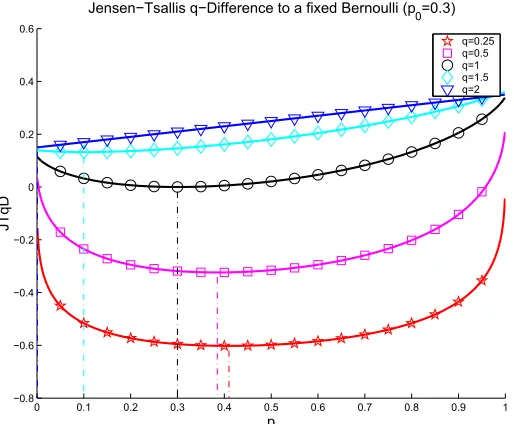
distribution if q∈[0,1), and closer to a degenerate distribution for q∈(1,2](see Fig. 1). This is not so surprising: recall that T2(p1,p2) = 12−12hp1,p2i; in this case, (27) becomes a linear program,
and the solution is not p∗1=p2, but p∗1=δj, where j=arg maxip2i.
0 0.1 0.2 0.3 0.4 0.5 0.6 0.7 0.8 0.9 1 −0.8
−0.6 −0.4 −0.2 0 0.2 0.4 0.6
p
JT
q
D
Jensen−Tsallis q−Difference to a fixed Bernoulli (p
0=0.3)
q=0.25 q=0.5 q=1 q=1.5 q=2
Figure 1: Jensen-Tsallis q-difference between two Bernoulli distributions, p1 = (0.3,0.7) and
p2= (p,1−p), for several values of the entropic index q. Observe that, for q∈[0,1),
the minimizer of the JT q-difference approaches the uniform distribution(0.5,0.5)as q approaches 0; for q∈(1,2], this minimizer approaches the degenerate distribution, as
q→2.
We start with the following corollary of Proposition 8, which establishes the joint convexity of the JT q-difference, for q∈[0,1]. (Interestingly, this “complements” the joint convexity of the JT divergence (20), for q∈[1,2], proved by Burbea and Rao 1982.)
Corollary 9 Let
T
andX
be finite sets with cardinalities m and n, respectively. For q∈[0,1], the JT q-difference is a jointly convex function on M+1,Sq(X
). Formally, let{pt(i)}t∈T, and i=1, . . . ,l, bea collection of l sets of probability distributions on
X
; then, for any(λ1, . . . ,λl)∈∆l−1,Tqπ
l
∑
i=1λip(1i), . . . , l
∑
i=1λip(mi) !
≤
l
∑
i=1λiTqπ(p
(i) 1 , . . . ,p
(i)
m).
Proof Observe that the Tsallis entropy (3) of a probability distribution pt ={pt1, ...,ptn} can be written as
Sq(pt) =− n
∑
i=1ϕ(pti), where ϕq(x) =
x−xq
1−q;
thus, from Proposition 8, Tqπ is convex if and only if ϕq is convex and−1/ϕ′′q is(2−q)-convex. Sinceϕ′′q(x) =q xq−2,ϕqis convex for x≥0 and q≥0. To show the(2−q)-convexity of−1/ϕ′′q(x) =
−(1/q)x2−q, for xt≥0, and q∈[0,1], we use a version of the power mean inequality (Steele, 2006),
−
l
∑
i=1λixi !2−q
≤ −
l
∑
i=1(λixi)2−q=− l
∑
i=1λ2−q i x
thus concluding that−1/ϕ′′
qis in fact(2−q)-convex.
A consequence of Corollary 9 is that, for finite
X
and any q ∈[0,1], the JT q-difference is upper bounded, namely Tqπ(p1, . . . ,pm)≤Sq(π). Indeed, since Tqπis convex and its domain is the Cartesian product of m simplices (a convex polytope), its maximum must occur on a vertex, that is, when each argument pt is a degenerate distribution at xt, denoted δxt. In particular, if|X
| ≥ |T
|,this maximum occurs at a vertex corresponding to disjoint degenerate distributions, that is, such that
xi6=xj if i6= j. At this maximum,
Tqπ(δx1, . . . ,δxm) = Sq m
∑
t=1πtδxt !
−
m
∑
t=1πtSq(δxt)
= Sq
m
∑
t=1πtδxt !
(28)
= Sq(π)
where the equality in (28) results from Sq(δxt) =0. (Notice that this maximum may not be achieved
if|
X
|<|T
|.) The next proposition provides a stronger result: it establishes upper and lower bounds for the JT q-difference to any non-negative q and to countableX
andT
.Proposition 10 Let
T
andX
be countable sets. For q≥0,Tqπ((pt)t∈T)≤Sq(π), (29)
and, if|
X
| ≥ |T
|, the maximum of Tqπis reached for a set of disjoint degenerate distributions. Thismaximum may not be attained if|
X
|<|T
|.For q≥1,
Tqπ((pt)t∈T)≥0,
and the minimum of Tqπis attained in the purely deterministic case, that is, when all distributions
are equal to the same degenerate distribution. For q∈[0,1]and
X
a finite set with|X
|=n,Tqπ((pt)t∈T)≥Sq(π)[1−n1−q]. (30)
This lower bound (which is zero or negative) is attained when all distributions are uniform.
Proof The proof is given in Appendix C.
Finally, the next proposition characterizes the convexity/concavity of the JT q-difference on each argument.
Proposition 11 Let
T
andX
be countable sets. The JT q-difference is convex in each argument,Proof Notice that the JT q-difference can be written as Tqπ(p1, . . . ,pm) =
∑jψ(p1 j, . . . ,pm j), with
ψ(y1, . . . ,ym) = 1
q−1
"
∑
i
(πi−πqi)yi+
∑
iπq iy
q
i −
∑
i
πiyi !q#
.
It suffices to consider the second derivative ofψwith respect to y1. Introducing z=∑mi=2πiyi,
∂2ψ
∂y21 = q
h
πq
1y
q−2 1 −π
2
1(π1y1+z)q−2
i
= qπ21(π1y1)q−2−(π1y1+z)q−2
. (31)
Sinceπ1y1≤(π1y1+z)≤1, the quantity in (31) is nonnegative for q∈[0,2]and non-positive for
q≥2.
5.3 Joint and Conditional JT q-Differences and a Chain Rule
This subsection introduces joint and conditional JT q-differences, which will later be used as a contrast measure between stochastic processes. A chain rule is derived that relates conditional and joint JT q-differences.
Definition 12 Let
X
,Y
andT
be measure spaces. Let(pt)t∈T ∈[M+1(X
×Y
)]T be a family ofmeasures in M+1(
X
×Y
)indexed byT
, and let p be a random probability distribution taking valuesin{pt}t∈T according to a distributionπ∈M1+(
T
). Consider also: • for each t∈T
, the marginals pt(Y)∈M+1(Y
),• for each t∈
T
and y∈Y
, the conditionals pt(X|Y =y)∈M1+(X
), • the mixture r(X,Y),RT π(t)pt(X,Y)∈M+1(
X
×Y
), • the marginal r(Y)∈M+1(Y
),• for each y∈
Y
, the conditionals r(X|Y =y)∈M1+(X
).For notational convenience, we also append a subscript to p to emphasize its joint or conditional
de-pendency of the random variables X and Y , that is, pXY ,p, and pX|Ydenotes a random conditional
probability distribution taking values in{pt(.|Y)}t∈T according to the distributionπ.
For q≥0, we refer to the joint JT q-difference of pXY by
Tqπ(pXY),Tqπ(p) =Sq(r)−Eq,T∼π(T)[Sq(pt)]
and to the conditional JT q-difference of pX|Y by
Tqπ(pX|Y),Eq,Y∼r(Y)[Sq(r(.|Y =y))]−Eq,T∼π(T)
Eq,Y∼pt(Y)[Sq(pt(.|Y=y))]
, (32)
Note that the joint JT q-difference is just the usual JT q-difference of the joint random variable
X×Y , which equals (cf. 25)
Tqπ(pXY) = Sq(X,Y)−Sq(X,Y|T) = Iq(X×Y ; T), (33)
and the conditional JT q-difference is simply the usual JT q-difference with all entropies replaced by conditional entropies (conditioned on Y ). Indeed, expression (32) can be rewritten as:
Tqπ(pX|Y) = Sq(X|Y)−Sq(X|T,Y) = Iq(X ; T |Y), (34)
that is, the conditional JT q-difference may also interpreted as a Tsallis mutual information, as in (25), but now conditioned on the random variable Y .
Note also that, for the extensive case q=1, (32) may also be rewritten in terms of the conditional KL divergences,
Jπ(pX|Y),T1π(pX|Y) = EY∼r(Y)[H(r(.|Y =y))]−ET∼π(T)EY∼pt(Y)[H(pt(.|Y =y))]
= ET∼π(T)
EY∼r(Y)[D(pt(.|Y =y)kr(.|Y =y))]
.
Proposition 13 The following chain rule holds:
Tqπ(pXY) =Tqπ(pX|Y) +Tqπ(pY)
Proof Writing the joint/conditional JT q-differences as joint/conditional mutual informations (33– 34) and invoking the chain rule provided by (4), we have that
Iq(X ; T|Y) +Iq(Y ; T) = Sq(X|T,Y)−Sq(X|Y) +Sq(Y|T)−Sq(Y)
= Sq(X,Y|T)−Sq(X,Y),
which is the joint JT q-difference associated with the random variable X×Y .
Let us now turn our attention to the case where Y =Xk for some k∈N. In the following, the notation(An)n∈Ndenotes a stationary ergodic process with values on some finite alphabet
A
.Definition 14 Let
X
andT
be measure spaces, withX
finite, and letF= [(Xn)n∈N]T be a family ofstochastic processes (taking values on the alphabet
X
) indexed byT
. The k-th order JT q-differenceofF is defined, for k=1, . . . ,n, as
Tqjoint,k ,π(F),Tqπ(pXk)
and the k-th order conditional JT q-difference ofF is defined, for k=1, . . . ,n, as
Tqcond,k ,π(F),Tqπ(pX
|Xk),
and, for k=0, as Tqcond,0 ,π(F),Tjoint,π
q,1 (F) =Tqπ(pX).
Proposition 15 The joint and conditional k-th order JT q-differences are related through:
Tqjoint,k ,π(F) = k−1
∑
i=0Tqcond,i ,π(F) (35)
5.4 Asymptotic Analysis in the Extensive Case
We now focus on the extensive case (q=1) for a brief asymptotic analysis of the k-th order joint and conditional JT 1-differences (or conditional Jensen-Shannon divergences) when k goes to infinity.
The conditional Jensen-Shannon divergence was introduced by El-Yaniv et al. (1998) to address the two-sample problem for strings emitted by Markovian sources. Given two strings s and t, the goal is to decide whether they were emitted by the same source or by different sources. Under some fair assumptions, the most likely k-th order Markovian joint source of s and t is governed by a distribution ˆr given by
ˆr=arg min
r λD(pˆskr) + (1−λ)D(pˆtkr). (36)
where D(.k.)are conditional KL divergences, ˆps and ˆpt are the empirical(k−1)-th order condi-tionals associated with s and t, respectively, andλ=|s|/(|s|+|t|)is the length ratio. The solution of the optimization problem is
ˆr(a|c) = λpˆs(c)
λpˆs(c) + (1−λ)pˆt(c) ˆ
ps(a|c) +
(1−λ)pˆt(c)
λpˆs(c) + (1−λ)pˆt(c) ˆ
pt(a|c),
where a∈
A
is a symbol and c∈A
k−1is a context; this can be rewritten as ˆr(a,c) =λpˆs(a,c) +
(1−λ)pˆt(a,c); that is, the optimum in (36) is a mixture of ˆpsand ˆpt weighted by the string lengths. Notice that, at the minimum, we have
λD(pˆskˆr) + (1−λ)D(pˆtkˆr) =JScondk ,(λ,1−λ)(pˆs,pˆt).
It is tempting to investigate the asymptotic behavior of the conditional and joint JS divergences when k→∞; however, unlike other asymptotic information theoretic quantities, like the entropy or cross entropy rates, this behavior fails to characterize the sources s and t. Intuitively, this is justified by the fact that observing more and more symbols drawn from the mixture of the two sources rapidly decreases the uncertainty about which source generated the sample. Indeed, from the asymptotic equipartition property of stationary ergodic sources (Cover and Thomas, 1991), we have that limk→∞1kH(pXk) =limk→∞H(pX|Xk), which implies
lim k→∞JS
cond,π
k = klim
→∞
1
kJS
joint,π
k ≤ klim
→∞
1
kH(π) = 0,
where we used the fact that the JS divergence is upper-bounded by the entropy of the mixture
H(π)(see Proposition 10). Since the conditional JS divergence must be non-negative, we therefore conclude that limk→∞JSkcond,π=0, pointwise.
6. Nonextensive Mutual Information Kernels
those kernels under a new information-theoretic light. After that, we give a brief overview of string kernels, and using the results of Section 5.3, we devise k-th order Jensen-Tsallis kernels between stochastic processes that subsume the well-known p-spectrum kernel of Leslie et al. (2002).
6.1 Positive and Negative Definite Kernels
We start by recalling basic concepts from kernel theory (Sch¨olkopf and Smola, 2002); in the fol-lowing,
X
denotes a nonempty set.Definition 16 Letϕ:
X
×X
→Rbe a symmetric function, that is, a function satisfyingϕ(y,x) =ϕ(x,y), for all x,y∈
X
.ϕis called a positive definite (pd) kernel if and only ifn
∑
i=1n
∑
j=1cicjϕ(xi,xj)≥0
for all n∈N, x1, . . . ,xn∈
X
and c1, . . . ,cn∈R.Definition 17 Letψ:
X
×X
→Rbe symmetric. ψis called a negative definite (nd) kernel if andonly if
n
∑
i=1n
∑
j=1cicjψ(xi,xj)≤0
for all n∈N, x1, . . . ,xn∈
X
and c1, . . . ,cn∈R, satisfying the additional constraint c1+. . .+cn=0.In this case, −ψ is called conditionally pd; obviously, positive definiteness implies conditional
positive definiteness.
The sets of pd and nd kernels are both closed under pointwise sums/integrations, the former being also closed under pointwise products; moreover, both sets are closed under pointwise con-vergence. While pd kernels “correspond” to inner products via embedding in a Hilbert space, nd kernels that vanish on the diagonal and are positive anywhere else, “correspond” to squared Hilber-tian distances. These facts, and the following propositions and lemmas, are shown in Berg et al. (1984).
Proposition 18 Letψ:
X
×X
→Rbe a symmetric function, and x0∈X
. Letϕ:X
×X
→Rbegiven by
ϕ(x,y) =ψ(x,x0) +ψ(y,x0)−ψ(x,y)−ψ(x0,x0).
Then,ϕis pd if and only ifψis nd.
Proposition 19 The functionψ:
X
×X
→Ris a nd kernel if and only if exp(−tψ)is pd for allt>0.
Proposition 20 The functionψ:
X
×X
→R+ is a nd kernel if and only if(t+ψ)−1 is pd for allt>0.
Lemma 22 If f :
X
→Rsatisfies f ≥0, then, forα∈[1,2], the functionψα(x,y) =−(f(x)+f(y))αis a nd kernel.
The following definition (Berg et al., 1984) has been used in a machine learning context by Cuturi and Vert (2005).
Definition 23 Let(
X
,⊕) be a semigroup.2 A functionϕ:X
→Ris called pd (in the semigroupsense) if k :
X
×X
→R, defined as k(x,y) =ϕ(x⊕y), is a pd kernel. Likewise,ϕis called nd if k isa nd kernel. Accordingly, these are called semigroup kernels.
6.2 Jensen-Shannon and Tsallis Kernels
The basic result that allows deriving pd kernels based on the JS divergence and, more generally, on the JT q-difference, is the fact that the denormalized Tsallis q-entropies (10) are nd functions on
(M+Sq(
X
),+), for q∈[0,2]. Of course, this includes the denormalized Shannon-Boltzmann-Gibbs entropy (8) as a particular case, corresponding to q=1. Although part of the proof was given by Berg et al. (1984) (and by Topsøe 2000 and Cuturi and Vert 2005 for the Shannon entropy case), we present a complete proof here.Proposition 24 For q∈[0,2], the denormalized Tsallis q-entropy Sqis a nd function on(M Sq
+(
X
),+).Proof Since nd kernels are closed under pointwise integration, it suffices to prove that ϕq (see Equation 11) is nd on(R+,+). For q6=1,ϕq(y) = (q−1)−1(y−yq). Let us consider two cases separately: if q∈[0,1),ϕq(y)equals a positive constant times−ι+ιq, whereι(y) =y is the identity map defined onR+. Since the set of nd functions is closed under sums, we only need to show that both −ι andιq are nd. Bothι and −ι are nd, as can easily be seen from the definition; besides, sinceιis nd and nonnegative, Lemma 21 guarantees thatιqis also nd. For the second case, where
q∈(1,2],ϕq(y)equals a positive constant timesι−ιq. It only remains to show that −ιqis nd for
q∈(1,2]: Lemma 22 guarantees that the kernel k(x,y) =−(x+y)q is nd; therefore −ιq is a nd function.
For q=1, we use the fact that,
ϕ1(x) =ϕH(x) =−x ln x=lim q→1
x−xq
q−1 =qlim→1ϕq(x),
where the limit is obtained by L’Hˆopital’s rule; since the set of nd functions is closed under limits,
ϕ1(x)is nd.
The following lemma, proved in Berg et al. (1984), will also be needed below.
Lemma 25 The functionζq:R++→R, defined asζq(y) =y−qis pd, for q∈[0,1].
We are now in a position to present the main contribution of this section, which is a family of
weighted Jensen-Tsallis kernels, generalizing the JS-based (and other) kernels in two ways: (i) they
allow using unnormalized measures; equivalently, they allow using different weights for each of the two arguments; (ii) they extend the mutual information feature of the JS kernel to the nonextensive scenario.