ISSN: 2306-9007 Sasidhar (2016) 1223
I
www.irmbrjournal.com September 2016I
nternationalR
eview ofM
anagement andB
usinessR
esearchVol. 5 Issue.3
R
M
B
R
Multiple Arc Network Model for Scheduling in a Single-stage,
Multi-item Compatible Process
Dr. BOKKASAM SASIDHAR
Professor at Quantitative Analysis Department, College of Business Administration King Saud University, Riyadh, Kingdom of Saudi Arabia
Email: [email protected]
Abstract
The problem of scheduling a given set of equipments in a single-stage, multi-item compatible environment, with the objective of maximizing capacity utilization is formulated as a maximal flow problem in a Multiple Arc Network (MAN). The production is usually planned against customers’ orders, and different customers are assigned different priorities. The model aims to provide optimal production schedule with an objective of maximizing capacity utilization, so that the customer-wise delivery schedules are fulfilled, keeping in view the customer priorities. Algorithms have been presented for solving the MAN formulation of the production planning with customer priorities. The suitability of the algorithms has been demonstrated with small examples.
Key Words: Scheduling, Maximal Flow Problem, Multiple Arc Network Model, Optimization.
Introduction
A Multiple Arc Network (MAN) model of production planning in a steel mill is presented in Sasidhar & Achary (1991). A decision support system for production planning has been presented in Gunter Schmidt (19912, 1996). Considering decision support system as a tool where executive’s judgment can be included along with the mathematical tool kit of the management scientist, the need to include problem management as an integral component of the decision support system for scheduling problems is indicated in Klaus Ecker et al. (1997).
ISSN: 2306-9007 Sasidhar (2016) 1224
I
www.irmbrjournal.com September 2016I
nternationalR
eview ofM
anagement andB
usinessR
esearchVol. 5 Issue.3
R
M
B
R
et al. (2003). Since the pioneering work of Ford & Fulkerson (2010) in 1962, the use of network models and algorithms have proved to be particularly successful in different application areas.
In this paper, a MAN model for production planning in a single-machine, multi-item compatible processing environment is considered. The model aims to provide an optimal production plan, with the objective of maximizing the capacity utilization.
The Problem
The problem of finding optimal schedule for each equipment in a production process is considered, which consists of a single stage of manufacturing and which can handle different types of products, where changeover for handling one type of product to the other type incurs certain costs. For example, we can consider the production process in an engineering workshop, which can process different products using similar equipment, such as a lathe, by suitably changing the set up. A similar situation can be encountered in a steel mill, which can produce different grades and sections of steel products, by suitably changing the rolls and sequences. The machine capacity is determined by the upper limit for the quantity that can be processed for each of the products in a set up. The changeover costs increase with the number of set ups and hence to minimize the costs associated with the product changeover, the planning should be such that similar types of products should be processed successively so that the total number of changeovers and in turn the associated set up costs are minimized. The problem of cost minimization is equivalent to the problem of minimizing the number of set ups or equivalently maximizing the capacity utilization in between every set up or maximizing the total capacity utilization. Further, certain planning procedures call for priority planning where different customers are assigned different priorities.
The problem of production planning in such a situation can be formulated into MAN model and can be solved sequentially using the following algorithms:
Algorithm 1: Algorithm for maximizing flow along a MAN.
Algorithm 2: Algorithm for maximizing flow along a MAN with priority arcs.
Multiple Arc Network
(MAN)Consider the flow network N=(s,t,V,A,b) with the digraph (V,A) together with a source sεV with 0 indegree, a sink or terminal tεV with 0 outdgree with |V| vertices or nodes. A has as elements subsets of V of cardinality two called arcs together with the arc number i and with |A| arcs, i=0,1,2,3,….,n where i denotes the arc number.
We use the following notations:
(x,i,y) = ith directed arc from the vertex x to the vertex y.
b(x,i,y) ε Z+ for each (x,i,y)εA is the bound or capacity of the arc (x,i,y). Ai(x) = {yεV/(x,i,y)εA}
Bi(x) = {yεV/(y,i,x)εA}
We assume that arcs of the form (x,i,x) for xεV do not exist in A.
Define A(x) = Ui Ai(x) and B(x) =
U
i Bi(x)A flow f in N is a vector in R|A|, one component f(x,i,y) for each arc (x,i,y)εA.
Let f(x,-,y) =
iISSN: 2306-9007 Sasidhar (2016) 1225
I
www.irmbrjournal.com September 2016I
nternationalR
eview ofM
anagement andB
usinessR
esearchVol. 5 Issue.3
R
M
B
R
Definition
A static flow of value v from source s to sink t in the network N is a function f from A to non-negative reals such that the following equations and inequalities are satisfied.
= v(f) if x=s
B(x) y A(x)
y
x)
f(y,-,
y)
f(x,-,
0 if x
s,t (1)= -v(f) if x=t
f(x,i,y)≤b(x,i,y)
(x,i,y) εA (2)f(x,i,y)≥0
(x,i,y) εA (3)The static flow problem is to maximize the flow from s to t such that the flow f satisfies (1), (2), and (3).
Man with Priority Arcs
Consider the MAN N=(s,t,V,A,b). The flow in the network N is characterized by permeability of flow from source s to sink t only through arcs with like priority numbers. For any arc (x,i,y) εA, let the arc number i denote the priority number as well.
Methodology
The problem of production planning can be formulated into MAN model. We consider the following notations:
Customers Ci i=1,2,…..n
Products Sk k=1,2,…..l
Equipments Er r=1,2,…..p
Demand for the product Sk by customer Ci Dki
Delivery time for the product Sk for customer Ci T(k,i)
Capacity of processing product Sk by equipment Er Akr
Processing time for the product Sk of customer Ci tki
Methodology for Determining the Periods for Process Commencement
ISSN: 2306-9007 Sasidhar (2016) 1226
I
www.irmbrjournal.com September 2016I
nternationalR
eview ofM
anagement andB
usinessR
esearchVol. 5 Issue.3
R
M
B
R
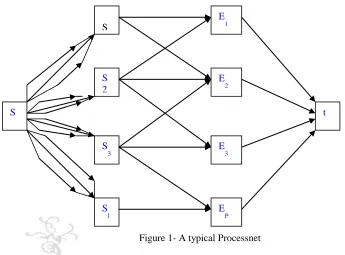
Figure 1- A typical Processnet
Methodology for Maximizing Flow Along A Man
The labeling algorithm for maximizing flow along a MAN is given below:
Algorithm 1
Step1: Start with flow f
0 as the feasible flow with v(f)=v(0)=0. Go to Routine A.Routine A
Step A1: Label s as (-,-,
).Step A2: Take any vertex x from the set of vertices which are labeled and unscanned through.
Step A3: If (x,i,y) εA and f(x,i,y)<b(x,i,y), label y as (x+,i,ε(y)), where ε(y)=Min.{ ε(x), (b(x,i,y)-f(x,i,y))}
If (y,i,x) εA and f(y,i,x)>0, label y as (x-,i,ε(y)), where ε(y)=Min.{ ε(x), f(y,i,x)}
Repeat this step until no further vertices can be labeled or t is labeled.
StepA4: If t is not labeled, it suggests that there is no flow augmenting path from s to t, and hence f is the maximal flow.
If t is labeled, go to Routine B.
Routine B
StepB1: If t has label (x+,i,ε(y)), determine f’(x,i,t) = f(x,i,t)+ ε(t). If t has label (x-,i,ε(y)), determine f’(t,i,x) = f(t,i,x)- ε(t).
S
S 1
S 2
S
3
S
l
E
1
E
2
E
3
E
P
t
ISSN: 2306-9007 Sasidhar (2016) 1227
I
www.irmbrjournal.com September 2016I
nternationalR
eview ofM
anagement andB
usinessR
esearchVol. 5 Issue.3
R
M
B
R
Step B2: In general, at vertex xi with path of labeled vertices as
x0=s, x1, x2, ….., xi,…..,xn, xn+1=t and if xi has label (x+i-1,i,ε(xi)), determine
f’(xi-1,i,xi) = f(xi-1,i,xi) + ε(t) for all (xj,i,xj-1) backward arcs and (xj-1,i,xj) forward arcs. If xi has label (x-i-1,i,ε(xi)), determine
f’(xi,i,xi-1) = f(xi,i,xi-1) - ε(t) for all (xj,i,xj-1) backward arcs and (xj-1,i,xj) forward arcs.
Step B3: If i>1, go to xi-1, repeat Step B2. If i=1, repeat step B2 and go to step 2.
Step 2: Erase all labeling. Go to Routine A with flow f’.
Methodology for Maximizing Flow along a Man with Priority Arcs
The labeling algorithm for finding a maximal flow along a MAN with priority arcs, where arc number i denotes the priority number as well, is given below:
Algorithm 2
Step 1: Set i=1.
Start with a feasible flow f
0 and with v(f)=v(0)=0.Step 2: Using Routines A and B of Algorithm 1, label arcs with ith priority arcs only.
Step 3: If i<n, set i=i+1. Go to step 2. If i=n, stop.
The Scheduling Procedure
The procedure for planning and scheduling a single-stage, multi-item compatible process consists of the sequential applications of the above algorithms. For the application of the MAN with priority arcs model for scheduling the process, MAN=(s,t,V,A,b) is considered. This network will have a specific structure and this network will be referred to as the PROCESSNET. Here,
b(s,i,Sk)=Dki b(Sk,-,Er)=Akr
For all other (x,i,y) εN, b(x,i,y)=
.The scheduling algorithm is explained below:
Step 1: Consider the PROCESSNET.
Periods for the process commencement is given by To=T(k,i)-tki.
Find { Dki
k,i such that T 0 is the same}Step 2: Using Algorithm 2, determine the optimal flow.
Illustrative Examples
Example 1: (Scheduling when order books are full)
ISSN: 2306-9007 Sasidhar (2016) 1228
I
www.irmbrjournal.com September 2016I
nternationalR
eview ofM
anagement andB
usinessR
esearchVol. 5 Issue.3
R
M
B
R
capable of manufacturing any of the products and the capacity of each of the lathes (Akr) is 400 units for each of the product during the time horizon. Consider the order position for the two customers C1 and C2 (in the same order of customer priorities) for the three roller sets S1, S2 and S3 to be as shown in Table 1. The delivery time (week number) for the product Sk for customer Ci, that is T(k,i), is given in the brackets.
Note that changeover for handling one type of roller to the other type incurs certain time and associated costs. Since the changeover costs increase with the number of set ups, to minimize the costs associated with the set ups, similar types of products should be processed successively so that the total number of changeovers are minimized. This problem is equivalent to the problem of maximizing the total capacity utilization.
Let us consider the problem of scheduling the workshop during this week (To), say, week number 10. This example illustrates the steps in scheduling for the current period.
Table 1 - Order position and delivery schedules for the two customers C1 and C2
Customer/Product S1 S2 S3
C1 600 500 300
(20) (25) (30)
C2 400 300 700
(20) (25) (30)
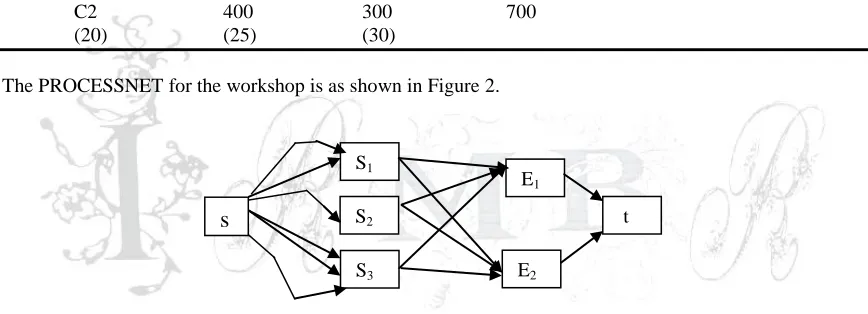
The PROCESSNET for the workshop is as shown in Figure 2.
Figure 2 - PROCESSNET for the Workshop.
Applying Step 1 by considering the processing times tkr along the arcs (Sk,Er) and applying the methodology for determining the periods for process commencement as in 4.1, the demand for the product Sk by customer Ci, viz., Dki for the week number 10 will be follows:
D11=600, D12=400, D21=500, D22=300, D31=300 and D32=700.
As Step 2, applying the Algorithm 2 of maximizing flow for the same multiple arc PROCESSNET the optimal schedule is arrived at. The capacity along the ith arc from s to Sk is the order quantity Dki for the product Sk by the customer Ci, with priority i. The capacity of the arc (Sk, Er) is considered as Akr which is the capacity of processing product Sk by equipment Er. The capacities of the arcs (Er,t) are considered as infinity. Applying Algorithm 2 of maximizing flow along the MAN with priority arcs, the following maximal flow is obtained:
f* = (600, 200, 500, 300, 300, 500, 400, 400, 400, 400, 400, 400, 1400, 1000)
Thus, the optimal quantities to be supplied to the customers and the corresponding unfulfilled demands (as shown in the brackets) are shown in Table 2. Observe that there are 200 units each of unfulfilled quantities
s
S1
1111
111
1 S2
1111
111
1 S3
1111
111
1
E1
1111
111
1 E2
1111
111
1
t
1111
111
ISSN: 2306-9007 Sasidhar (2016) 1229
I
www.irmbrjournal.com September 2016I
nternationalR
eview ofM
anagement andB
usinessR
esearchVol. 5 Issue.3
R
M
B
R
for customer C2 for the products S1 and S2. These quantities could be rescheduled with customer's concurrence.
Table 2 - Optimal supply quantities and the unfulfilled demands for the two customers C1 and C2
Customer/Product S1 S2 S3
C1 600 500 300
(0) (0) (0)
C2 200 300 500
(200) (0) (200)
Example 2: (Scheduling when order books are not full)
As a second example, the following illustration demonstrates the applicability of the scheduling procedure in situations when the orders books are not full. The procedure provides the optimal schedule together with the buffer capacities available. This information provides guidelines to the marketing personnel for procuring immediate orders.
Consider the order position and delivery schedules for the two customers C1 and C2 (in the same order of customer priorities) for the three roller sets S1, S2 and S3 be as shown in Table 3. The delivery time (week number) for the product Sk for customer Ci, that is T(k,i), is given in the brackets.
Let us consider the problem of scheduling the workshop during this week (To), say, week number 10. This example illustrates the steps in scheduling for the current period.
Table 3- Order position and delivery schedules for the two customers C1 and C2
Customer/Product S1 S2 S3
C1 100 250 500
(20) (25) (30)
C2 200 300 300
(20) (25) (30)
Using the same PROCESSNET for the workshop as in Figure 2 and applying Step 1, the demand for the product Sk by customer Ci, viz., Dki for the this example for the week number 10 will be follows:
D11=100, D12=200, D21=250, D22=300, D31=500 and D32=300.
As Step 2, by applying Algorithm 2 of maximizing flow along the MAN with priority arcs, the following maximal flow is obtained:
f* = (100, 200, 250, 300, 500, 300, 300, 0, 400, 150, 400, 400, 1100, 550)
Table 4 presents the optimal quantities to be supplied to the customers.
Table 4- Optimal supply quantities for the two customers c1 and c2
Customer/Product S1 S2 S3
C1 100 250 500
ISSN: 2306-9007 Sasidhar (2016) 1230
I
www.irmbrjournal.com September 2016I
nternationalR
eview ofM
anagement andB
usinessR
esearchVol. 5 Issue.3
R
M
B
R
The capacities, scheduled/utilized capacities and the corresponding spare capacity available for the two equipments are shown in Table 5.
Table 5- Equipment utilization and the spare capacities available
Equipment Capacity Scheduled Spare capacity available
E1 1200 1100 100
E2 1200 550 650
Further Consideration
In case the order books are not full for some of the products in a sequence, we can introduce a dummy customer with least priority having infinite orders, for each product. The scheduling of the orders for the dummy customer brings out the actual product-wise spare capacity. This serves as a guideline to the sales department in procuring further orders for particular products, so that the sequence and in turn the system capacity utilization is maximized.
Conclusion
The methodology of the system described above is in general applicable to all single-stage, multi-item compatible production processes where the process can handle different types of products involving changeover costs. Depending on the layout and process flow of the plant, a tailor-made production planning and scheduling system can be formulated using MAN techniques.
Acknowledgement
The researcher would like to thank the Deanship of Scientific Research at King Saud University represented by the Research Center at the College of Business Administration for supporting this research
financially.
References
Blazewicz, J., Finke, G., Haupt, R. & Schmidt, G. (1988). New Trends in Machine Scheduling, Journal of
Operational Research 37: 303-317.
Charles C. Holt. (2002). Online companion for Learning How to Plan Production, Inventories and Work Force, Operations Research, 50(1): 96-99.
Ford, L.R. & Fulkerson, D.R. (2010). Flows in Networks. Princeton University Press. Princeton, NJ. George C. Hadjinicola & Andreas C. Soteriou. (2003). Reducing the cost of defects in multistage
production systems: A budget allocation perspective, European Journal of Operational Research
145(3): 621.
Gunter Schmidt. (1992). A Decision Support System for Production Scheduling, Journal of Decision
Systems 1 (2-3): 243-260.
Gunter Schmidt. (1996). Modelling Production Scheduling Systems, International Journal of Production
Economics 46-47: 109-118.
Klaus Ecker, Jeet Gupta & Gunter Schmidt. (1997).'A Framework for Decision Support Systems for
Scheduling Problems, European Journal of Operational Research 101(3): 452-462.
ISSN: 2306-9007 Sasidhar (2016) 1231
I
www.irmbrjournal.com September 2016I
nternationalR
eview ofM
anagement andB
usinessR
esearchVol. 5 Issue.3
R
M
B
R
Saksena, J.P. (1982). Applications of O.R. Techniques -3. Decision Networks with Managerial
Applications. National Productivity Council, New Delhi, India.
Saksena, J.P. (1985). Applications of decision networks, Journal of Operational Research 19: 41-44.
Sasidhar, B. & Achary, K.K. (1991). A multiple arc network model of production planning in a steel mill,
International Journal of Production Economics, 22: 195-202.
Shan Feng, Ling Li, Ling Cen & Jingping Huang. (2003). Using MLP networks to design a production
scheduling system, Computers & Operations Research 30(6): 821
Shiqiang Liu & Ong H.L. (2002). A comparative study of algorithms for the flowshop scheduling problem,
Asia Pacific Journal of Operational Research, 19(2): 205-222.