World Maritime University
The Maritime Commons: Digital Repository of the World
Maritime University
World Maritime University Dissertations Dissertations
2001
Approaches to distance learning : an evaluation of
current methodologies, technologies and
operational costs as an alternative means of course
delivery for developing country academies
Elgin O'Dwyer C. Swapp
World Maritime University
Follow this and additional works at:http://commons.wmu.se/all_dissertations Part of theOnline and Distance Education Commons
This Dissertation is brought to you courtesy of Maritime Commons. Open Access items may be downloaded for non-commercial, fair use academic purposes. No items may be hosted on another server or web site without express written permission from the World Maritime University. For more information, please [email protected].
Recommended Citation
Swapp, Elgin O'Dwyer C., "Approaches to distance learning : an evaluation of current methodologies, technologies and operational costs as an alternative means of course delivery for developing country academies" (2001).World Maritime University Dissertations. 286.
WORLD MARITIME UNIVERSITY
Malmö, Sweden
APPROACHES TO DISTANCE LEARNING
An evaluation of current methodologies, technologies and operational
costs as an alternative means of course delivery for developing country
academies.
By
ELGIN O’DWYER C. SWAPP
Jamaica
A dissertation submitted to the World Maritime University in partial fulfilment of the requirements for the award of the degree of
MASTER OF SCIENCE
in
MARITIME AFFAIRS
(Maritime Education and Training – Nautical)
COPYRIGHT AUTHORISATION
WORLD MARITIME UNIVERSITY
Author’s name: Elgin O’Dwyer C. Swapp
Course: Maritime Education & Training – Nautical (2001)
Degree: Masters of Science:
Title of Dissertation: Approaches to distance learning: an evaluation of current methodologies, technologies and operational costs as an alternative means of course delivery for developing county academies.
Authorisation is hereby given to the World Maritime University to make this dissertation available to readers in the World Maritime University Library, or other library, either in its present form, in photomechanical, electronic, or other reproduction. The World Maritime University may also provide individual copies of this dissertation, if so requested, for private research or study. The University may charge for the cost of production of the copy. The author reserves other publication rights, and neither the dissertation nor extensive extracts form it may be printed or otherwise reproduced without the author’s written permission.
………
Signature of author
………
DECLARATION
I certify that all the material in this dissertation that is not my own work has been identified, and that no material is included for which a degree has previously been conferred on me.
The contents of this dissertation reflect my own personal views, and are not necessarily endorsed by the University.
___________________________ (Signature)
___________________________ (Date)
Supervised by:
Professor P. M. Muirhead. World Maritime University
Assessor:
Associate Professor T. M. Hikima. World Maritime University
Co-assessor: Captain G. Angas
ACKNOWLEDGEMENTS
I am indebted to the Caribbean Maritime Institute (CMI) for affording me the study
leave to pursue this postgraduate degree at the World Maritime University. It is only
fitting for me to formalise my gratitude by saying thanks to Lieutenant Commander
Michael Rodriquez for his encouragement and for nominating me for this programme.
My profound thanks to IMO-Norway Technical Co-operation Programme Fellowships
for their generous funding which made it possible to continue my education.
It is with pride and honour that I salute my mentor and supervisor Professor Peter
Muirhead for his able guidance, experience and support throughout this course.
Thanks to the staff of the World Maritime University in general for their support
throughout my studies. Special thanks to the library staff and particularly to Cecilia
Denny for going the extra mile in assisting with research material.
It would be utterly remiss of me by not expressing my profound gratitude to Shani
Moser, who volunteered her time to proof read my dissertation.
Last but not least my family, Camile – my dear and darling wife, daughters - Shara and
Anya for their tolerance, patience and understanding as I pursued this course that often
ABSTRACT
Title of Dissertation: Approaches To Distance Learning: An Evaluation of
Current Methodologies, Technologies and Operational Costs
as an Alternative Means of Course Delivery for Developing
Country Academies.
Degree: MSc
This dissertation is a study of the distance education continuum and the constant evolution that is taking place particularly due to the dynamism of information technology. Information technology has become the catalyst for change and, as a result, distance education is becoming the preferred choice of education among adults in higher education.
An overview is made of current and new technologies that are or can be used as media of transmission for distance learning. Effective methodologies used for delivery of distance learning is also examined and reviewed.
The challenges that distance learning pose to developing countries’ MET institutions lie in providing STCW courses via distance learning methodology. The issues of cost and quality assurance are additional challenges the developing countries will face. The importance of instructional design in the developmental stage and the information interface is an equally important consideration, which will be discussed throughout this investigation.
The conclusion and recommendation chapter looks at the challenges of change that will be synonymous with distance learning, particularly with MET institutions. The importance of quality standards systems, costs and the acceptance of STCW courses via distance education provide additional challenges which must be addressed upon the development of such a programme.
TABLE OF CONTENTS
Declaration i
Acknowledgements ii
Abstract iii
Table of Contents iv
List of Figures vi
List of Abbreviations vii
Introduction 1
1. Distance Learning in perspective 5
1.1. Definitions and concepts 5
1.2. Growth and development 11
1.3. Education and the challenge of change 13
1.4. Distance learning and assessment 13
1.5. Is there correlation between distance learning and
STCW’95? Quality standards system and validity 15
2. Current trends in distance learning 17
2.1. Statistical overview 17
2.2. Effective methodologies 20
2.3. New concept 26
2.4. Positioning maritime education and training: focus on
MET portfolio of courses that are suitable for distance
learning 27
2.5. Onboard Potential 27
3. The role of technology and the 21st century and beyond 30
3.2. Future concepts 45
3.3. Technology and its users 47
3.4. Choosing the right media 47
3.5. Interfacing technology with its users 48
3.6. Technology and the challenge of change 50
4. Cost analysis of distance learning 52
4.1. Putting a cost on distance learning 52
4.2. Costing web-based learning 56
4.3. What does it cost the host? 58
4.4. How economical is it for the users? 61
5. The MET model 63
5.1. Programme structure 63
5.2. Design considerations 65
5.3. The teaching/learning platform 68
5.4. Measuring performance 71
5.5. Quality assurance 73
6. Conclusions and recommendations 75
6.1. Conclusions 75
6.2. Recommendations 79
LIST OF FIGURES
Figure 1.1 Distance education continuum 11
Figure 2.1 Statistical overview of communication in
web-based and non web-web-based courses 18
Figure 2.2 Preferred means of communication for students
enrolled in distance learning 19
Figure 2.3 Advantages of distance learning 20
Figure 2.4 The skills of lecturing 21
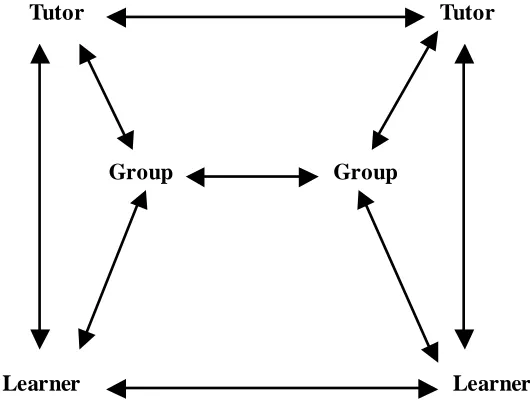
Figure 2.5 Variety of interactions possibilities 24
Figure 2.6 Combining skills of lecturing communication
possibilities 25
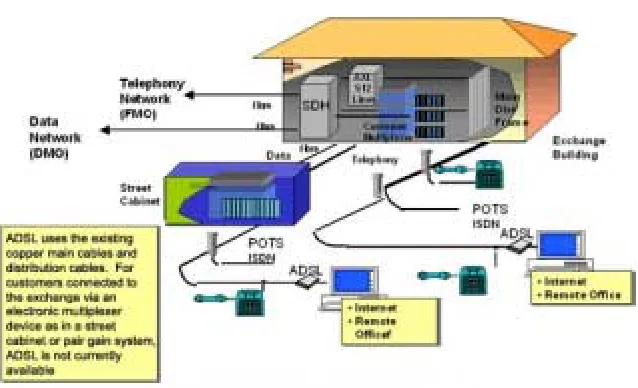
Figure 3.1 ADSL in distribution network 35
Figure 3.2 Hardware connectivity on ADSL line 36
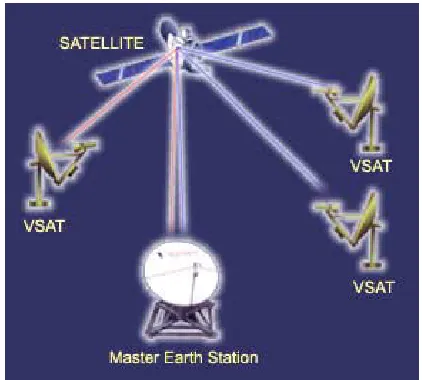
Figure 3.3 VSAT satellite & master earth station 37
Figure 3.4 VSAT remote earth station with subscriber
hardware 38
Figure 3.5 The Teledesic broadband market 40
Figure 3.6 The Teledesic network 41
Figure 3.7 The WAP network 44
Figure 4.1 Distance education project flow chart 54
Figure 4.2 Break-even point 55
Figure 4.3 Costing price performa 60
Figure 5.1 Curriculum development model 66
Figure 5.2 Teacher/learning platform 69
Figure 5.3 Parallel session for same learner 70
Figure 5.4 Integration of LTSA and simulator 71
Figure 6.1 Distance education and its relationships 76
ABBREVIATIONS
ADSL Asymmetric Digital Subscriber Line
ATM Asynchronous Transfer Mode
BRI Basic Rate Interface
CAL Computer Assisted Learning
CBT Computer Based Training
CCTV Closed Circuit Television
CDB Caribbean Development Bank
CD-ROM Compact Disc-Read Only Memory
CMC Computer Mediated Communication
CMI Caribbean Maritime Institute
CPU Central Processing Unit
DE Distance Education
DL Distance Learning
DMT Discrete Multitone
DVD Digital Video Disc
EDI Electronic Data Interchange
e-mail Electronic Mail
EU European Union
GAN Global Area Network
GHz Giga-Hertz
HTML Hyper Text Mark-up Language
HTTP Hyper Text Transfer Protocol
ICCE International Council for Correspondence Education
ICT Information and Communication Technology
IDU Indoor Unit
IEEE Institute of Electronic and Electrical Engineers
IMO International Maritime Organisation
INMARSAT International Maritime Satellite Organisation
IP Internet Protocol
IRC Internet Relay Chat
ISDN Integrated Service Digital Network
ISP Internet Service Provider
IT Information Technology
JMI Jamaica Maritime Institute
LAN Local Area Network
LEO Low Earth Orbiting Satellite
LMS Learning Management System
LTSA Learning Technology System Architecture
MET Maritime Education and Training
MIT Massachusetts Institute of Technology
MUD Multiple User Dungeons
MUSE Multiple-User Simulated Environment
NEA National Education Association
NGI Next Generation Internet
OA/DI Always On Dynamic Integrated Service Digital Network
OUD Outdoor Unit
OKI Open Knowledge Initiative
PC Personal Computer
POT Plain Old Telephone Line
PRI Primary Rate Interface
QSS Quality Standards System
ROI Return On Investment
STCW 95 International Convention on the Standards of Training,
Certification and Watchkeeping for Seafarers 1978 as
UK United Kingdom
UNESCO United Nations Education, Science and Cultural
Organisation
URI Uniform Resource Identifier
USA United States of America
USDLA United States Distance Learning Association
VSAT Very Small Aperture Terminal
WAP Wireless Application Protocol
WML Wireless Mark-up Language
WSP Wireless Session Protocol
WWW World Wide Web
INTRODUCTION
General
The buzzword among economists is globalisation, the transcendence of all geographic
boundaries making the world a common marketplace where commerce is concerned.
The use of technology is fundamental in the globalisation process. E-commerce is an
emerging concept and is slowly becoming the order of the day, in which technology
plays a very important role.
In the shipping industry, electronic data interchange (EDI) is now commonplace not
only commercially but also among shipyards and other stakeholders. The significance
here is the vast amount of information that is and can potentially be transferred using
available and emerging information and communication technologies. The level of
dynamism that information and communication technologies have brought to the
commercial arena has transformed the way business is conducted today, resulting in
more efficiency.
Education has been in a state of stagnation or has remained passive for the last forty to
fifty years, and is only now experiencing the same dynamism as the rest of the business
world. Information and communication technologies have been the catalyst for change
and are transforming the way education can be delivered today. This effervescence that
is occurring in education mainly in the realm of distance education (often referred to as
distance learning) is happening due to the new developments in technology. Distance
education is by no means new and dates back to the seventeenth century. What is new
acclaim of being more effective than the traditional classroom setting that has long been
the epitaph of learning. Distance education/learning is a part of the globalisation
phenomenon, and may be looked at as globalisation through education.
Background
The Caribbean Maritime Institute (CMI) the formerly Jamaica Maritime Institute (JMI),
is acclaimed as being the regional maritime academy for the Caribbean. In the fall of
2000, Parliament approved the name change to substantiate its regional status, as CMI is
the only institution of its kind in the English-speaking Caribbean. In September 1994, a
new course was introduced called the Diploma in Shipping Logistics that was geared for
the shipping and allied industry ashore. The aim of the course was to offer formal
training to personnel mainly at the supervisory and middle management level. The
programme has been well received by the local industry that it has become a
requirement for promotion and for entry into the industry.
The Diploma in Shipping Logistics programme was introduced to the rest of the
Caribbean and was well received. However, the main target group (supervisors and
middle managers) found it difficult to get released from work and, due to family
obligations, encountered difficulties in taking up a two years full-time resident course.
The idea to offer the course by distance education thus emerged. In 1996 CMI got
funding from the Caribbean Development Bank (CDB) for a distance learning pilot
project that was launched in 1998. The participating countries are Barbados, Trinidad
and Tobago, St. Kitts, St Lucia, Dominica, St Vincent and the Grenadines and locally in
Jamaica to Montego Bay, and Ocho Rios.
The challenge
As CMI continues to expand and diversify, distance learning is one aspect of the
technologies in its current distance learning programme. There are new frontiers still to
be conquered by distance education. One such is offering of the International Maritime
Organisation’s (IMO) Standard of Training Certification and Watchkeeping (STCW)
courses via distance learning. This is a challenge that maritime education and training
institutions need to confront. In the revised STCW convention the phrase ‘media of
delivery’ is used, which infers that distance education is a viable option for course
delivery.
The technology is available to support MET programmes via distance education as used
by other higher education institutions, and has proven very successful. The challenge
that MET institutions face, like other institutions of higher education, is that of quality
assurance. MET institutions have an obligation to fulfil as it relates to the guarantee of
quality as stipulated under the STCW 95 convention.
Should developing countries maritime academies like CMI sit back and wait for
developed countries to be the pioneers in MET distance education, or can they champion
the cause and be the forbearers? The expertise is not lacking in developing countries,
but the costs for such development could inhibit progress. Developing countries have to
be part and parcel of globalisation for the survival of their economies and, as a result,
they must have access to modern technology. Developing countries’ MET institutions
therefore can piggyback on the available technology to offer STCW courses via distance
education. In so doing, such institutions would be transcending geographical boundaries,
virtually expanding physical size, while becoming a part of the globalisation
phenomenon through education.
Aim and objectives
It is with these notions in mind that this dissertation seeks to explore and clarify the
numerous descriptors akin to distance learning and the various methodologies
happening globally and examines how technology has reshaped the educational
landscape, especially as it relates to delivery methodology and communication. The
issues of cost in the preparation and delivery of distance learning programmes are later
addressed, and important concepts are also highlighted that are vital for MET institutions
not to overlook in preparing their distance learning models.
The methodology
This dissertation undertakes an extensive literature search due to the new dynamism and
continuous evolution of information and communication technology being used in
distance learning. The literature search entails reviewing books, magazines, journals and
other publications, that were available in the World Maritime University’s library as
well as other institutions. In addition to this, the research included extensive, diligent
and painstaking Internet searches, sifting through thousands of URLs to find supportive
material that seems to be credible. Personal e-mails were sent to gather information from
companies involved directly or indirectly with distance learning.
CHAPTER 1
DISTANCE LEARNING IN PERSPECTIVE
1.1 Definitions and Concepts
Basic principles of economics lay down that needs within a society lead to a demand,
and to satisfy such demand a supply chain is created. Within the same subject area the
buzzword is globalisation, denoting that societies’ demands can be satisfied by the
global supply chain in broad terms. So what is the relevance of this analogy with the
topic at hand?
The need for higher education, especially among adults, is constantly rising; to keep
abreast with the advancement of today’s technological changes among professionals is a
growing problem. Companies’ rationalisation strategies with regard to human resources
make it more difficult to send staff away for upgrading or higher studies. As individuals’
personal commitments increase, it becomes more difficult to register into full time
studies. It becomes evident that there is a need for distance education and that this need
is not a new phenomenon but one that has existed for decades. Hence the demand for
continuing education for this niche of adults and professionals has to be met.
The emergence of distance education, sometimes referred to as distance learning, is the
facilitation of learning is by no means new. Williams et al (1999) indicate that distance
education can be traced back to the mid-1800s with correspondence study in higher
education. This concept for the facilitation of learning has adopted various terms like
correspondence education, home study, independent study, external study, distance
teaching, open learning, distance learning, e-Learning and distance education.
Keegan (1986) alludes to the definition of correspondence education as coined by the
United Nations Education Scientific and Cultural Organisation (UNESCO), as
“education conducted by the postal services without face-to-face contact between
teacher and learner. Teaching is done by written or tape-recorded materials sent to the
learner, whose progress is monitored through written or taped exercises to the
teacher, who corrects them and returns them to the learner with criticisms and
advice”.
His criticism of correspondence education is that it cannot encompass the didactic
potential that distance education has in the future; print, audio, video, and
computer-based possibilities must be reflected by the terminology chosen. His research leads him
to beleive that critics of the term tend to associate correspondence education with some
of the less successful aspects of distance education. The status accorded to this form of
study is still in question in many countries. It is his belief, however, that the term is
needed to designate the postal sub-group of the print-based forms of distance education
in which student contact is not encouraged.
Regarding to home study, Keegan (1986) indicates that this term has little claim of being
all-encompassing as it is used mainly in the United States and is therefore confined to
further education, primarily in technical and vocationally-oriented institutions and not
suggests that distance students may not in fact study at home but may study in part at
home and in part at other centres.
Independent study in the American context is generic for a range of teaching and
learning activities that sometimes go by separate names (correspondence study, open
education, radio-television teaching or individualised learning). In several European
countries such systems are clustered under the term distance education or are still
perceived as separate programmes without any basic, generic relationship as suggested
by Wedemeyer (Keegan, 1986). Independent study is often criticised for indicating
independence from an educational institution, which is not the case of distance
education. Wedemeyer notes there is hesitancy in using the term independent study, as it
is often used for individual study programmes containing periods of normal lectures
organised between a student and a faculty member.
External Studies is the term most widely used in Australia. It describes the ethos of
distance education as found in Australian universities and colleges of advanced
education. It is a form of education that is external to, but not separated from, the faculty
and staff of the institution. The same staffs have two groups of students, one on campus,
the other external. Both groups are prepared for the same examination and awards.
Keegan (1986) credits Moore for the definition of the term distance teaching, which he
describes as
“All those teaching methods in which because of physical separation of learners and
teachers, the interactive (stimulation, explanation, questioning, guidance) as well as
the pre-active phase of teaching (selecting objectives, planning curriculum and
instructional strategies), is conducted through print, mechanical or electronic
Williams et al (1999) contend that open learning has meant an arrangement in which
learners work primarily from self-instruction, completing courses structured around
specially prepared printed materials, supplemented with face-to-face tutorials and
examination. They suggest that open learning is a catchword or slogan used
interchangeably with distance education. The avid researcher in this field, Holmberg
(1989), suggests that open learning is not synonymous with distance education, nor is
distance education a subset of open learning. He alludes that open learning is a state of
mind. It is an approach taken to the planning, design, preparation and presentation of the
courses by educators, and an approach taken for the selection and use of learning
strategies and associated resources by students. This approach seeks to provide students
with as much choice and control as possible over content and learning strategies.
California Distance Learning Project (2000) uses this definition: Distance Learning (DL)
is an instructional delivery system which connects learners with educational resources.
DL provides educational access to learners not enrolled in educational institutions and
can augment the learning opportunities of current students. The implementation of DL is
a process, which uses available resources and will evolve to incorporate emerging
technologies.
The United States Distance Learning Association (USDLA, 2000) defines distance
learning as the delivery of education or training through electronically mediated
instruction including satellite, video, audio graphic, computer, multimedia technology
and other forms of learning at a distance. The USDLA notes that distance education
refers to teaching and learning situations in which the instructor and the learner or
learners are geographically separated and therefore rely on electronic devices and
Regarding distance learning (DL), the California Distance Learning Project (2001)
states, “DL as an instructional delivery system, which connects learners with educational
resources”. DL provides educational access to learners not enrolled in educational
institutions and can augment the learning opportunities of current students. The
implementation of DL is a process, which uses available resources and will evolve to
incorporate emerging technologies.
The use of network technology to design, deliver, select, administer, support and extend
learning. Several key features define distance learning. They are:
1. the separation of teacher and learner during at least a majority of each
instructional process;
2. the use of educational media to unite teacher and learner and carry course
content;
3. the provision of two-way communication between teacher, tutor, or educational
agency and learner;
4. separation of teacher and learner in space and/or time;
5. volitional control of learning by student rather than distance instructor.
Simply put, e-Learning is the emerging term for Internet-enabled, and technology
distributed, education and training (e-Learning Europe Conference, July 2000). Imagine
being able to access cutting edge knowledge and training on demand that is specific and
in just the amount you need, while being able to communicate with your peers, coaches
and experts, all through a simple Internet connection. The ultimate goal of e-Learning,
the e-Learning Europe Conference (July 2000), in concurrence with the Masie Center, is
to bring learning to people instead of bringing people to learning. Beyond delivering
learning, e-Learning also represents the ability to personalize the learning based on the
learner's knowledge, needs and experience. In its simplest form, e-Learning is the use of
Holmberg (1989) intimates that distance education covers the various forms of study at
all levels which are not under the continuous, immediate supervision of tutors present
with their students in lecture rooms or on the same premises, but which nevertheless
benefit from the planning, guidance and teaching of a supporting organisation. Keegan
(1986) credits earlier researchers like Moore for his own definition of distance education
as the family of instructional methods in which the teaching behaviours are executed
apart form the learning behaviours, including those that in a contiguous situation would
be performed in the learner’s presence, so that communication between the teacher and
the learner must be facilitated by print, electronic, mechanical or other devices.
Distance education includes distance teaching (the instructor's role in the process) and
distance learning (the student's role in the process). This opinion is supported by
Holmberg (1989) whose view is that distance study denotes the activity of the students,
and distance teaching is that of the tutorial organisation, particularly its developers and
tutors. Hence, it is fair to suggest that distance education constitutes the entire package
of teaching and learning. Distance teaching and learning are subsets of distance
education and therefore it is more appropriate to refer to this mode of providing
education as distance education as opposed to the others. The main characteristics of
distance education Holmberg suggests are:
• the separation of teacher and students.
• the input of the facilitating organisation for planning, production of
material and student support.
• the use of media and technology to bridge student and teacher for the
dissemination of content and feedback.
• facilitation of communication between student and teacher.
1.2 Growth and Development
Looking closely at the various descriptors and terms used over time to refer to distance
education it is evident that, as more technology became available and communications
improved between providers and learners, new names evolved. Credence may be
attached to the previous statement as Williams et al (1999) indicate that in 1972 the
International Council for Correspondence Education (ICCE) coined the term ‘Distance
Education’ which was about the time of the technological explosion in communications
and personal computers. This has made an indelible mark on education. In looking at the
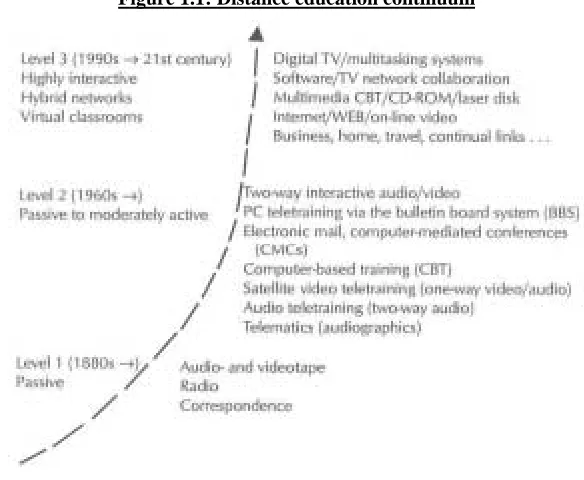
‘distance education continuum’ (figure 1) proposed by Williams et al (1999), the picture
becomes clear.
Figure 1.1: Distance education continuum
From the beginning of formal education, the classroom has been the focal point of
learning. Face-to-face contact between teacher and student has been the epitaph of
traditional learning. In today’s educational landscape and that of the future the walls of
the classroom are crumbling and soon the classroom will be virtual.
Mention was made earlier about correspondence education, heavily dependent on the
postal service, which was the artery of communication. With this there was no true
guarantee of reliability, making the feedback process between student and teacher slow.
Correspondence education is considered as a passive distance education medium being
that the student cannot interact with the teacher in real time. This allows only one-way
communication where the teacher transmits messages and material and after a lengthy
delay through the mailing system receives a response form the student. Williams et al
(1999) refer to this type of communicating environment as asynchronous. This makes
the feedback process slow, which can cause demotivation. Demotivation has no place
in education; motivation, on the other hand, is the catalyst for success.
If motivation is a catalyst for success and this motivation is attributable to the
communication process between teacher and student, the more communication is
facilitated the higher the success rate will be. Face-to-face (i.e. the classroom setting)
creates the absolute forum for constant communication and interaction. An experienced
and competent teacher will use various didactic strategies to maintain students’ interest
and foster interaction and thus the feedback process is immediate. The technology that is
currently available and constantly being improved is able to simulate the face-to-face
setting, being that interaction in real time is possible and creative didactic strategies can
be employed to motivate and foster greater interaction between teacher and student. The
platforms available today for providing distance education like digital TV, multitasking
systems software, TV network collaboration multimedia CBT, CD-ROM, Internet,
Intranet and the World Wide Web (WWW) are constantly evolving. With these hybrid
distance education platforms, distance learning will be the new way forward and the
1.3 Education and the Challenge of Change
Education was seen as an institutionalised process, meaning that to be educated one had
to attend an established institution. It was also believed that the face-to-face, ‘chalk and
talk’ approach of teaching was the preferred way to impart knowledge. In today’s
society such belief has no credence; in this era of information technology the entire
educational landscape has changed. The real question now is: are the educators, teachers,
students and society at large ready for the changes that are happening on the educational
frontier, especially as it relates to distance education. Technology is changing so fast that
it is extremely difficult to keep abreast with the changes.
In order for the business community such as private sector companies to maintain their
competitive advantage, they have to be very dynamic and constantly upgrade with
technology to improve efficiency. This energy of dynamism is not prevalent in
education and remains in many cases fortified with the ‘old guards’. These ‘old guards’
are often referred to as dinosaurs, who are often resistant to change because of the
looming insecurity of their existence.
1.4 Distance Learning and Assessment
As in traditional educational programmes, communication is an integral component of
the teaching and learning process for distance learning. Part of the communication
process involves both teacher and learner knowing how well the course is being received
and understood. Communication facilitates feedback and feedback is the medium
through which the teacher can detect the level of reception and understanding. An
integral component of the feedback process is assessment. According to Muirhead
(1997), the aim of assessment is to detect the level of learning (i.e. finding out how
much knowledge, understanding and skill have been learned). He further contends that
advancement, setting standards and providing feedback to students and teacher.
Similarly, Thorpe (1998) supports Muirhead’s later point by alluding to assessment as
“the driver of students’ approaches to study in distance education no less than the
campus based settings”. The integration of continuous assessment with course study is
both a vital opportunity for student learning as well as a process of judging the
performance of students and assigning grades (Thorpe 1998). The assessment process
can be varied however, by the setting of the assignment, test or examination which must
be clear about the objectives of the assessment if it is to achieve its purpose.
For distance education to be effective similar didactic strategies used in the classroom
setting must be incorporated like that of assessment. Therefore, the platform used to
deliver distance education must be able to properly and effectively support methods of
assessment. Thorpe (1998) in her research reports that the students’ experience of
assessment in distance education proved useful to them being that they discovered what
they knew and could do, and where their knowledge and abilities were weaker.
It is evident that assessment plays a vital role in the delivery process of distance
education. As new technology evolves, the administration, control and security of
assessment will be like that of the classroom situation. The primary concerns are based
on security. How will the teacher know that the person who has submitted the
assessment has actually undertaken the work? The other is assessment: if the work must
be done without any external help or references, how will the teacher know none was
actually used? These are the real issues that must be addressed in order to maintain
1.5 The Correlation Between Distance Learning and STCW’95: Quality
Standard System and Validity
Distance education is an accepted method of acquiring education, particularly in higher
education for adults. Maritime education and training (MET) is a form of higher
education geared toward adults, especially those who are upgrading qualifications for
higher certificate of competency under the ‘sandwich system’. Distance education would
be a very workable option for this group provided they have access to what is referred to
now as ‘third generation’ distance education.
Maritime education and training courses provide professional education, which is
governed by international convention (STCW 1978 as amended 1995). These MET
courses are subject to approval by the contracting party’s maritime administration.
Hence if a contracting party’s maritime academy is to offer STCW professional courses
via distance education programmes such a programme would have to be approved by
their maritime administration. Code A, Section A-I/6, Training and Assessment on page
14 states:
“Each party shall ensure that all training and assessment of seafarers for certification
under the Convention is:
• structured in accordance with written programmes, including such methods
and media of delivery, procedures, and course material as are necessary to
achieve the prescribed standard of competence; and
• conducted, monitored, evaluated and supported by persons qualified…”
Morrison (1997), in his clarification of Section A-I/6, emphasises all maritime education
and training under STCW convention requires approval by the contracting party. He
training and assessment. The writer therefore draws inference on the point of ‘media of
delivery’ to include distance education as an option to deliver MET courses. Further
inferences can be highlighted in so far that all MET courses must be approved, that a
seafarer must attend an approved course. Therefore if a maritime administration
approves a distance education programme of an MET institution, seafarers participating
in such a programme would have met the requirements of the STCW convention.
For distance education to fulfil another aspect of the STCW convention it must conform
to quality standards. It should have its own independent quality standard infrastructure
or be part of the host institution or the maritime administration’s quality standard
regime. The quality standard regime that will govern distance education of any MET
courses must fulfil all the pertinent requirements of Code A, Section A-I/8 quality
standards. In fulfilling such requirements the regulation stipulates that “each party shall
ensure that the educational objectives of the related standards of competence to be
achieved are clearly defined and identified to the levels of knowledge, understanding
and skills appropriate to the examinations and assessment required under the
Convention”. The measurement of quality of distance education programmes will be
assessed on its ability to affect knowledge, skills and dispositions.
A quality standard system (QSS) that would best honour the STCW quality standard
code is one which has a quality assessment system and a quality assurance system.
Neilsen (1997) describes a quality assessment system as one which demonstrates the
extent to which students have acquired knowledge, skills and dispositions considered
necessary for doing their career well. He further describes a quality assurance system as
one which is concerned with creating and maintaining the conditions by which students
CHAPTER 2
CURRENT TRENDS IN DISTANCE LEARNING
2.1 Statistical Overview
“…fast computers, the Internet, satellite communication, VSAT, broadband technology, laser discs, CDROM, interactive video, DVD, WAP distance learning, remote polling, the information superhighway, all within the past 25 years.” (Muirhead, 2000)
The technological evolution within the last 25 years has opened up vast opportunities
in all areas of everyday life. Technologies have changed and are reshaping the way
businesses are conducted today. Education is one area in which information
technology (IT) has brought about changes and has created a new dynamism, which
has not been experienced in the past 40 to 50 years. More and more the ‘media of
delivery’ for education is shifting from the traditional means (the classroom) to the
cyberspace environment through distance education. Distance education is in no way
a new concept but the emerging methodologies are new.
Countries like Australia, Canada, Germany, Sweden, UK and the USA are leaders in
exploiting the emerging technologies in distance education. Globalisation in
commerce has been a catalyst for most developing countries to implement policies in
order to align themselves with the more developed countries for the facilitation of
they relate to the delivery of education and exploit the opportunities of distance
education. If globalisation through commerce is forcing them to upgrade
technologically then the newly acquired technology can be transferred into the
educational sector.
The global affinity for using the Internet for varying interest has not excluded
education and according to Lua (1999), the number of college students enrolled in
distance-learning courses will reach 2.2 million in 2002, up from 710,000 in 1998.
By 2002, 85 percent of two-year colleges will be offering distance learning courses,
up from 58 percent in 1998. Eighty-four percent of four-year colleges will be
offering distance-learning courses in 2002, up from 62 percent in 1998. It is difficult
to ascertain the number of higher educational institutions involved in distance
learning, and determining the number of MET institutions engaged in distance
learning is even more difficult. Advocating that if the emerging technology will have
an impact on education it is only fitting to look statistically on users’ trends.
Additionally the more lines of communication that exist between tutors and learners,
the better the outcome of learning.
Source: National Education Association (NEA), (2000)
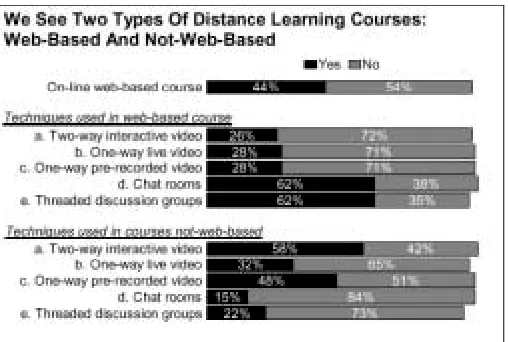
A survey conducted by the National Education Association (NEA) in Washington
DC reveals that two-way communication is more favoured and has a greater impact
as seen the figure 2.1. Hence web based format is of growing popularity and gives
more communication possibilities.
Therefore, using a distance education teaching platform like computer-mediated
communication (CMC) would give good learning outcomes because of the variety of
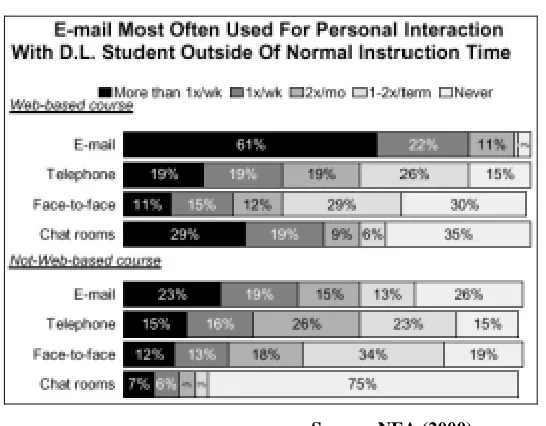
communication possibilities. To further boost interaction, the NEA states, “e-mail is
the dominant means of communication employed by faculty and students outside of
normal instruction time – both the Web-based courses and the not-Web-based
courses. Indeed, there is a tremendous amount of faculty-student contact via e-mail”.
Figure 2.2 gives a good overview of the trends for student interactions.
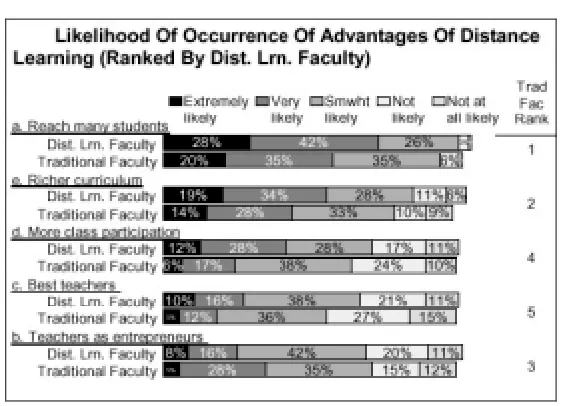
Another interesting trend found in the NEA survey is that both distance learning and
traditional faculty intimate that it is extremely or very likely that distance education
will reach many students who could not take traditional college courses. Applying
this to the maritime fraternity, the onboard potential for seafarers is very positive.
The NEA feels that smaller institutions will be able to offer a richer curriculum and
Figure 2.2: Preferred means of communication for students enrolled in distance learning
both are extremely important advantages of distance learning. Figure 2.3 illustrates
the advantages of distance learning.
The synopsis of the current trends in distance education demonstrates that the
emerging technologies available are only to improve the ‘media of delivery’ and to
enhance student outcomes derived from distance education. The maritime fraternity,
particularly MET institutions, must therefore poise themselves to take full advantage
of distance learning. Being that most MET institutions are small and based on the
NEA’s survey, smaller institutions can offer a richer curriculum, the ‘richer
curriculum’ would be the beginning of quality assurance.
2.2 Effective Methodologies
In order to review effective methodologies appropriate for distance learning, a
foundation or base has to be established. The base concept lies in the traditional
classroom setting, being that the face-to-face classroom setting has been the core
Figure 2.3: Advantages of distance learning
teaching students is through lecturing and this method requires the teacher to have
special skills to be effective. A vital aspect of the lecturer’s skill is how effective
he/she is in communicating. Hence communication in lecturing or teaching is of
utmost importance.
If communication is the nucleus of teaching, then as Brown et al (1999) postulate,
the major skills in teaching are explaining, presenting information, generating
interest and lecture preparation. The outcomes associated with these major skills are
the topic coverage, understanding and motivation. As a guarantee to ensure that these
outcomes are achieved the proper didactic strategies are vital. These strategies
include, but are not limited to, using audiovisuals, varying students’ activities and
maintaining the attention of the audience.
Revisiting the major teaching skills alluded to earlier of explaining, presenting
information, generating interest and lecture preparation, the figure 2.4 below
illustrates clearly the relationship and interrelationship of the vital teaching attributes.
Expounding on each to provide clarity of explanation, Brown et al (1999) deem as
giving understanding to another.
Understanding, they emphasize, is the creation of new connections between facts,
between ideas and between facts and ideas. Presenting information is linked to
explanation but more so directed at the methods or strategies used to provide clarity.
For the lecturer or teacher to be effective, the ability to captivate the audience by
generating interest is indeed the most challenging of the skills. The teacher’s
approach in effectively explaining a topic is a very vital goal. The presentation
techniques will stimulate interest leading to the motivation of the students. Brown
and Atkins (1999) support the former view when they state, “if a student is motivated
by the lecturers’ approach to a subject then he or she is likely to become
self-motivated and the lecture will have an influence long after the content has been
forgotten”. The all-important aspect of major skills of the teacher is embedded in the
preparation of the lecture. Preparation will provide the so-called ‘blue print’ for a
clear and coherent lecture. A teacher knowing his/her strengths and weakness can
take steps during proper preparation to minimize these weaknesses and also keep
them focused (Brown and Aktins, 1999).
Having set the foundation of effective methodology for good traditional classroom
face-to-face teaching, the task is to see how best the traditional classroom setting can
transfer and apply to distance education. Being that the teacher is separated from the
students, it becomes even more important to have these core foundation principles
engrained in distance education. This is communication is so important in teaching.
It is clear that, for distance education to be effective, communication between teacher
and student is fundamental. Therefore to propose effective, methodologies for
distance education, the proposition must embody methods that promote the best
communication possibilities.
Computer Mediated Communication (CMC)
Computer mediated communication (CMC) is a teaching tool or medium used in
that is generated and transmitted with the use of computer technology”. CMC
provides communication possibilities like electronic mail (e-mail), internet relay chat
(IRC), multiple user dungeons (MUD), news groups and computer conferencing.
These modes of communication have a very important role in distance education thus
making delivery more effective. D. C. Donovan (Magee et al, 2000) offers
explanation of the following modes as:
• E-mail: an asynchronous method of text communication; users have mailboxes and folders where messages can be composed, sent, received
and stored.
• Internet relay chat (IRC): also known as interactive messaging, is a synchronous form of CMC; all parties to the communication are online
simultaneously; each participant can see what all other participants are
seeing as it occurs. (i.e. typing words or generating graphics or
calculations on the screen).
• Multiple-user dungeons or sometimes multiple-user dimensions are virtual reality space, so that the user experiences different environments
and locations. The MUD concept is being developed further into such
applications as MUSE (multiple-user simulated environments) which are
mainly used for role playing games, although some more serious MUDs
are used for professional and educational networking.
• Computer conferencing: provide a shared working environment which is particularly suited to group communication and collaborative learning.
CMC and its capabilities undoubtedly afford several communication possibilities that
make the transferring of communication akin to the traditional classroom situation
feasible within the realm of distance education. These communication options are
effective methodologies for making distance education more meaningful. Figure 2.5
Tutor
Learner Learner
Tutor
Group Group
Within the communication options that the CMC model affords, a genuine link can
be established between figure 2.4 (skills of lecturing) and figure 2.5 (variety of
interactions possible in the online learning environment). This is because, through
the interaction made possible by CMC among tutor, individual learner, group and or
groups, an explanation can be enhanced thus providing clarity, generation of interest
from the information presented and the incorporation of other aids. The success of
the outcome is, however, dependent on the level of preparation the teacher has made
for stimulating interest and motivating learners, as illustrated by figure 2.6.
Figure 2.6:
Explanation
Interest/persuasion Clarity
TUTOR
Lecture Preparation Using audio-visual aids
& Other didactic
strategies Presenting
information
Generating Interest
Learner(s) Group(s)
Combining skills of lecturing communication possibilities
Constructivism
Constructivism is an effective methodology incorporated in distance education for
the promotion of learning. The responsibility of the learning outcome is centred on
the student. Beal (2000) explains the constructivist approach as:
“modelling behaviour for students, and giving them the opportunity to work
hands-on on their own projects. It means engaging students in the learning
process and allowing them to discover and construct their own meaning out
of their experience, using 3-D objects, models, computer assisted instruction
and workplace setting to simulate real-world situations for their learning”.
In the constructivist learning approach, students can be actively involved in the use
of interactive e-mail, chat-rooms, and bulletin boards and web browsers to further
enhance their learning.
Collaborative learning
The term ‘collaborative learning’ refers to an instruction method in which students at
various performance levels work together in small groups toward a common goal.
The students are responsible for one another's learning as well as their own. Thus, the
success of one student helps other students to be successful (Gokhale, 1995).
Gokhale’s research led him to conclude that the active exchange of ideas within
small groups not only increases interest among the participants but also promotes
critical thinking. The shared learning gives students an opportunity to engage in
discussion, take responsibility for their own learning, and thus become critical
thinkers. This methodology is effective in distance education particularly geared
toward higher education, being that it promotes higher order learning as categorized
by Bloom’s taxonomy (i.e. analysis, evaluation and synthesis). In their group
discussions leading to problem solving analysis of the facts, each other’s ideas,
evaluation of the problem given and the synthesis of the information are important
tools for higher order learning.
2.3 New Concept
The concepts that are being promoted more in distance education are constructivism
and collaborative learning approach. These concepts place the responsibility of
learning more on the student and foster extensive interrelationship among learners
through communication.
The use of CMC as a working platform, the constructivist approach and collaborative
learning techniques are as appropriate tools for offering distance education for
maritime education and training (MET) courses. Being that there is no large scale
offering of MET via distance education, then CMC in tandem with constructivism
and collaborative learning would become new concepts for MET.
The new paradigm being promoted in MET courses, where appropriate, is the use of
simulators through which competence can be more readily demonstrated. The
demonstration of competence is one of the hallmarks of the revised STCW
convention. A challenge that developers of MET courses would face is providing
debriefing sessions would further add to the challenge. If these can be successfully
done then there would be no limit to the MET courses that could be offered.
2.4 Positioning Maritime Education and Training: Focus on MET
portfolio of courses that are suitable for distance learning
The delivery of maritime education and training (MET) courses via distance
education is not popular. It is unknown if any MET institution that delivers the entire
International Convention for Standards of Training Certification and Watchkeeping
for Seafarers (STCW 78 as amended ‘95) courses via distance education exists.
Seagull AS is a company produces CBT modules based on STCW courses and this
can be in cooperated into distance learning programmes.
With the emergence of the new technology a number of STCW courses could be
offered via distance education and proposes the following portfolio proposal in
Chapter 5. The success of these courses via distance education will be very
dependent on how well the courses are developed for the distance education platform.
Extensive work will have to be focused on a curriculum based instructional design in
the developmental process.
2.5 Onboard Potential
The proliferation of technology and its application in just about every sphere
worldwide has made the old cliché ‘it’s a small world’ ring true. The various
possibilities that have opened up as it relates to communication, the transfer of
information and data are tremendous. In the maritime arena, the shipping industry is
taking great advantage of the technological phenomenon in the way ships are
operated and managed. The growing concept of electronic data interchange (EDI) is
an emerging paradigm in shipping business. EDI has made the transfer of
owners and other interests possible, resulting in economic efficiency. Kockums
Computer Systems is one such company that has used the concept of EDI through its
software TRIBON (Kockums Computer Services, 1999). This software provides
capabilities that can allow an owner to watch the progress of vessel design, through a
virtual walk through, and to suggest changes in design as it progresses. A key
question here is: are the ship owners, companies, shipyards and other interests
intimately involved with shipping willing to invest heavily in software systems for
education and training as they are for systems like TRIBON? For the shipping
industry to achieve economic efficiency, maritime education and training cannot be
ignored. Software like TRIBON, developed for MET to deliver distance education
with simulation capabilities, would be a maritime educator’s dream come true.
MET should not be limited to academies but should lie within the reach of every
seafarer irrespective of his/her geographic location. Hence if geographic location is
no barrier then the onboard environment has no limits. The shipowner should not
only view the vessel as a place of work but as an environment for continuing
education. It is only through upgrading one’s skill continually that human error will
be reduced, the factor that research indicates to be dominant in over 80% of all
maritime casualties.
Muirhead (1995) suggests “Technology today is providing the innovative vessel
operator with a window of opportunity to transfer much of the training for
operational skills to the on-board environment”. It is now time for shipowners to
visualise the benefits to be derived from MET onboard through distance education
and to bring MET within the reach of every serving seafarer on board. MET
institutions would have to respond to the demand by offering STCW, upgrading and
refresher courses for seafarers afloat.
In today’s shipboard environment minimum manning is the order of the day, which
CBT and CAL libraries on board which enable trainees to do self-study and allow
both trainees and companies to monitor progress with the appropriate administrative
tools. However the ideal solution would be a distance education facility through the
power of the Internet, affording them the opportunity to continue their education with
their MET institutions and monitoring their progress while gaining experience
onboard. Distance education in this regard could reduce the time spent in MET
institutions.
If simulation becomes a possibility via distance learning it would be a motivator and
confidence builder for the trainee. The trainee would be able to apply the simulation
training onboard directly to the real world. What would this mean to the professional
crew? It would mean that a Master going to a port for the first time could train and
become familiar with handling of the vessel for any unique characteristic of that port.
Therefore the possibilities of any mishap would be greatly reduced as more strategic
planning could be done.
The advantage of having distance education available onboard at the fingertips of
crews, which affords them the opportunity of continued education, upgrading,
refreshing knowledge and skills is only a step in the right direction. The availability
of the requisite technology is not lacking. The only mask to retard distance learning
onboard is probably the associated cost, but as technology evolves and the volume of
users increases cost decreases. Therefore cost will soon cease to be a prohibitive
factor and the industry can foresee a very favourable potential of distance education
CHAPTER 3
THE ROLE OF TECHNOLOGY IN THE 21ST CENTURY AND BEYOND
3.1 Current Technologies
The communication platform that information technology provides has ballooned
tremendously within the past two and a half decades. The rate of evolution of this
technology is growing exponentially and its application appears to be limitless. In
today’s environment, passive communication styles are rapidly becoming outdated; the
new order is for active and interactive means of communication. The ability to transfer
vast amounts of information to a single or multiple point destination is becoming more
and more commonplace. So what are the communication platforms available to support
this new order of communication and the ability to transfer vast amounts of information?
Current communication platforms include:
• Integrated Services Digital Network (ISDN)
• Asymmetric Digital Subscriber Line (ADSL)
• Very Small Aperture Terminal (VSAT)
• Teledesic (Broad Internet In The Skies)
• Fibre optics
The reader might ponder as to why these forms of technology are often referred to as
platforms. These are seen as stages, launching pads, or hosting environments for
communication applications. The communication applications referred to include but are
in no way limited to the Internet, World Wide Web (WWW) interactive video, online
video, e-mail and Internet relay chat. These forms of technology have drastically
reshaped the way businesses are conducted today. Their current applications have
impacted education in general and, in particular, higher education through distance
learning. The following is a brief explanation of the various communication platforms.
Integrated Services Digital Network (ISDN)
Integrated Services Digital Network (ISDN) emerged in the 1970’s, as user demands on
telecommunication networks began to include (in addition to voice) the transmission of
data, video, video image, text, facsimile, and graphics information (Williams et al, 1999
p. 42). They ascribe the evolution of ISDN mainly because those services mentioned
previously are not suitable for analogue networks. The introduction of an ISDN by the
telecommunications industry has revolutionised many business activities throughout the
world. What was once impossible is now made possible by direct access to dial-up
digital lines. Oliver (2001) states that the range of applications is constantly growing but
already includes:
• High quality audio - broadcasters can establish their own digital
quality audio links without having to book expensive analogue music
circuits in advance.
• Internet access - surf the Internet up to four times faster than
• Data transfer - move anything from simple data to large video
or image files.
• Desktop conferencing - real time on-line document discussion.
• Group 4 fax - transmit an A4 sheet in just three seconds with laser print
quality.
• LAN to LAN bridging - establish fast, reliable inter-connection
between small Local Area Networks.
• Newspapers - press photographers can instantly relay their pictures
around the world.
• Home/remote working - remote access is possible to your LAN or
computer network from any ISDN line, be this at home or in one of the
increasing number of hotels offering ISDN lines.
• Video conferencing and video telephony opening a new world of opportunity
-distance learning, business meetings and access to remote expertise.
• Video surveillance - allowing police and security firms to monitor
live pictures from remote surveillance cameras using video
codecs.
Interestingly, ISDN technology allows multiple digital channels to be operated
simultaneously through the same regular phone wiring used for analogue lines. The
change comes about when the telephone company's switches can support digital
of an analogue signal is transmitted across the line (Becker, 2000). There are 3 basic
ISDN services in use:
• 2B + D “S” interface is called the basic rate interface (BRI) that uses two twisted
pairs of plain old telephone (POT) wires to deliver two 64Kbps (kilo-bits per
second) and one 16 kbps data signalling channel. Each of the two 64Kbps bearer
or B channels can carry voice conversation, one high speed data transmission or
several separate data channels; these channels are multiplexed into one 64 Kbps
high speed data line.
• 2B + D “T” Interface delivers the same two 64 kbps bearer channels and one 16
Kbps data channel, except that it uses two wires (one pair) and can work at 5 to
10 kilometres.
• 23B + D (30B + D) – This is called primary rate interface (PRI). At 23B + D, the
channel is 1.5444Mbps (Mega bits per second). It is the standard T1 line in the
United States. The 23B + D operates on two twisted wire pairs. At 30B + D, the
channel is 2.048 Mbps. It is the standard E1 line in Europe. The 30B + D also
operates on two twisted pairs (Williams et al 1999, pp. 42-43).
In 1998, the ISDN technology further evolved with a new flexible bandwidth feature
called Always On Dynamic ISDN (AO/DI), which lets you maintain a constant
connection to your Internet service provider while minimizing line charges by only
bringing up bandwidth when you need it. The significant benefit to be derived from
ISDN technology would be a possible solution to developing countries’ needs in
offering PC-based distance learning. Williams et al (1999) explains the advantages of
ISDN as follows:
• It can integrate several applications (data, voice, fax video etc.) simultaneously over one line.
• It can run over plain old telephone (POT) lines (existing twisted pairs).
• It does not require fibre optics.
• It provides clear channel capabilities, so it’s not necessary to pay additional access lines.
Williams et al (1999, pp 43-44) states the applications of ISDN as follows:
• Simultaneous data calls: Two end users can talk over the B channel and at the
same time exchange information over the D channel.
• E-mail: It can carry information to and from unattended phones and PC modems.
• Collaborative shared-screen capabilities: Switched data services provided via
ISDN lets two or more remote locations, both equipped with computer/video
terminals, view the same information on their screens and discuss its contents
while making changes.
• Network access: It allows a person with a PC to gain access to virtually any
database on a network.
This type of technology will be more prevalent in developing countries as providers of
telecommunication services will transform existing analogue communications networks
to digital using the existing infrastructure in a more cost effective way. Hence,
educational institutions can make better use of the technology to provide DE using high
starting point for the educational institutions in developing countries, including maritime
academies. These services depend on the type of connection (e.g. EU 2) used in Europe
to provide some broadband capabilities, which would be an economical way to expand
broadband capabilities for developing countries.
Asymmetric Digital Subscriber line (ADSL)
Asymmetric Digital Subscriber Lines (ADSL) are used to deliver high-rate digital data
over existing plain old telephone (POT) lines like the ISDN service. A new modulation
technology called Discrete Multitone (DMT) allows the transmission of high-speed data.
ADSL facilitates the simultaneous use of normal telephone services, ISDN, and
high-speed data transmission, (e.g. video). DMT-based ADSL can be seen as the transition
from existing copper-lines to the future fibre-cables, making ADSL economically
interesting for local telephone companies. They can offer customers high-speed data
services even before switching to fibre-optics. The typical ADSL network is illustrated
in figure 3.1, and figure 3.2 depicts the multi-connectivity of communication hardware
on a single POT line.
Figure 3.1: ADSL in distribution network
According to Telstra (2001), a company that offers the service in Australia, ADSL can
host massive graphics and even interactive videos over the Internet at speeds up to 1.5
Mbps – which is 20 - 50 times faster than current analogue modems. The company
alludes to some of ADSL advantages as:
• telephone conversation at the same time as receiving data, and the user will not notice any difference
• whenever the computer is on, the user will be connected to the Internet- to browse, email and download
• no need for an additional line or phone rental
• no waiting time for connection
• no engaged tone
Figure 3.2: Hardware connectivity on a ADSL line