World Maritime University World Maritime University
The Maritime Commons: Digital Repository of the World Maritime
The Maritime Commons: Digital Repository of the World Maritime
University
University
World Maritime University Dissertations Dissertations
2000
The financial statements and the process of decision making in
The financial statements and the process of decision making in
shipping companies
shipping companies
Rolfi Manuel Chevalier Hernandez
WMU
Follow this and additional works at: https://commons.wmu.se/all_dissertations
Recommended Citation Recommended Citation
Chevalier Hernandez, Rolfi Manuel, "The financial statements and the process of decision making in shipping companies" (2000). World Maritime University Dissertations. 1105.
WORLD MARITIME UNIVERSITY
Malmö, Sweden
THE FINANCIAL STATEMENTS AND
THE PROCESS OF DECISION MAKING
IN SHIPPING COMPANIES
By
Rolfi Manuel Chevalier Hernandez
Dominincan RepublicA dissertation submitted to the World Maritime University in partial fulfillment of the requirements for the award of the degree of
MASTER OF SCIENCE
inSHIPPING MANAGEMENT
DECLARATION
I certify that all material in this dissertation that is not my own work has been identified, and that no material is included for which a degree has previously been conferred on me.
The contents of this dissertation reflect my own personal views, and are not necessarily endorsed by the University.
………
28 of August 2000
Supervised by:
Name: Prof. Patrick Donner
Office: Associate Professor, Shipping and Port Management.
World Maritime University
Assessor:
Name: Prof. Tor Wergeland
Office: Associate Professor, Shipping and Port Management.
World Maritime University
Co-assessor:
Name: Anna Kari Bill
Office: Head Finance & Administration
DEDICATION
TO
ACKNOWLEDGEMENT
My gratitude and appreciation go to My GOD who never let me alone and who has helped me to take this important step in my life.
To my parents Blanca and Juan Baron who gave me the life, thanks to them I am who I am, they gave an invaluable education.
My special thanks go to The IMO Global Project for financing my studies at WMU
I am very thankful for all the help and co-operation I received from WMU library staff, Susan W. Eklöw and Cecilia Denne also I would like to say thank you to the english lecturers Mr. Clive Cole and Mrs. Inger Batista and the same to all the lecturers and Professors for their assistance and guidance during my studies, specially Mr. Patrick Donner my supervisor.
To my sister, brothers and all my family members who in manyways have contributed in making my studies a reality.
ABSTRACTS
Title of Dissertation: The Financial Statements and The Process of Decision
Making in Shipping Companies
Degree: MSc
This dissertation tries to explain the different kinds of financial statements, the audit report and the notes to the financial statement as well as their uses in shipping companies, how the top shipping management uses those financial statements in order to make a decision.
A definition and brief explanation of the audit report, and its uses for the top shipping management is given. In addition we also explain the different kinds of opinions and how they can help or not the shipping financial analysis.
Moreover, this study deals with financial ratios, shipping decision makers and explains how these people make a big influence in the shipping activities apart from the shipowners.
To explain the process of decision making in shipping companies, we divided analysis by purposes of decision making : Ship Financing, Mergers and Outsourcing. Therefore, we explain each one of these processes and we comment why, and how the financial statements help top shipping management in this process.
TABLE OF CONTENTS
Declaration iii
Dedication iv
Acknowledgements v
Abstract vi
Table of Contents vii
List of Tables xi
List of Abbreviations xii
I INTRODUCTION 1
II. THE THREE ESSENTIAL FINANCIAL STATEMENTS AND THEIR NOTES IN SHIPPING COMPANIES.
2.1 The balance sheet, its parts and importance. 4
2.1.1 Assets. 5
2.1.2 Current Assets 6
2.1.3 Fixed assets 6
2.1.4 Fixed assets in the shipping industry 6
2.1.5 Depreciation of ships 7
2.1.6 Net value of ships 7
2.1.7 Liabilities 7
2.1.8 Current liabilities 7
2.1.9 Long term liabilities 7
2.1.11 Uses of balance sheet 8
2.1.12 Limitation of the balance sheet 9
2.2 The income statement, its part and importance 9
2.2.1 Revenues 10
2.2.2 Cost and Expenses 10
2.2.3 Gain or losses 10
2.3 The cash flow statement, its parts and importance
10
2.3.1 Statement of cash flow 10
2.3.2 Cash-flow from operating activities (cash from operation or CFO)
11
2.3.3 Investment cash flow (CFI) 11
2.3.4 Financing cash flow (CFF) 11
2.3.5 Importance and uses of the cash-flow statement.
11
2.3.6 Cash flow in shipping 12
2.4 The footnotes to the financial statements and the relation with them
12
2.4.1 Footnotes to the financial statements in shipping companies
13
III THE FINANCIAL REPORTING AND THE RECOMMENDATION LETTER IN SHIPPING COMPANIES.
3.1 The financial reporting and the audit opinion 15
3.1.1 Financial reporting 15
3.1.2 Conformity with professional standards in USA
17
3.1.5 Taxation of dividends in shipping companies 18
3.1.6 The audit opinion in shipping companies 19
3.2 Different kinds of audit opinion 20
3.2.1 Unqualified Opinion 20
3.2.2 Qualified Opinion 22
3.2.3 Adverse Opinion 22
3.2.4 Disclaimer of Opinion 22
IV FINANCIAL RATIOS AND THE PROCESS OF DECISION MAKING IN SHIPPING
COMPANIES.
4.1 The financial ratios 23
4.1.1 Most used financial ratios in the shipping industry
23
4.1.2 The importance of the financial ratios in the decision making process in shipping
companies
24
4.2 Who are the decision-makers in the shipping business?
25
4.3 The process of decision making in shipping companies based on the financial information
27
4.4 Financial Management in shipping Companies
27
4.5 Main sources of finance in shipping 29
4.5.1 Banks 29
4.5.2 Equity Investment 30
4.5.3 Leasing Financing 30
4.6.1 Types of mergers 33
4.6.1.1 Horizontal mergers 33
4.6.1.2 Vertical mergers 33
4.6.1.3Conglomerate mergers 34
4.6.2 Trend in merger 34
4.6.3 Motives for mergers 34
4.6.4 Uses of financial statement and
accounting techniques, in mergers in the shipping industry
36
4.7 Outsourcing in the shipping business 37
4.7.1 Outsourcing 37
4.7.2 What can be outsourced within the shipping industry?
38
4.7.3 Why and How Shipping companies should make decision when outsourcing?
39
a)Organizationally Driven 41
b) Improvement Driven 41
c) Financially Driven 41
d) Revenue Driven 42
e) Cost Driven 42
4.7.4 Maritime Logistic 42
V Conclusion 43
Bibliography 46
Appendices
Appendix 1 Financial statement of Anangel Shipping Companies and the Audit Report.
LIST OF TABLE
S
Table 1
Example of the tax assessment under a tonnage tax regime. 18
LIST OF ABBREVIATIONS
AICPA American Institute of Certified Public Accountants. CFF Cash flow from Financing Activities.
CFI Cash flow from Investment Activities. CFO Cash flow from Operations.
CP SHIPS Canadian Pacific Ships.
FASB Financial Accounting Standard Board. GAAP General Accepted Accounting Principles. GDP Gross Domestic Product.
MTO Multimodal Transport Operator. PWC Price WaterhouseCoopers.
CHAPTER 1
INTRODUCTION
The worldwide business environment has benefited from the financial data obtained through the financial statements. However, many new techniques have appeared and have made the decision making process much easier and more reliable for the players involved in it. The shipping sector, which is a totally international business, is not an exception.
In spite of these techniques the information of the financial statements is still useful for the decision-makers, which are mainly the shipowner, shipper, banker, shipbuilder, government regulatory authority and investor.
Financial analysis in some cases is nothing more than a simple report. Analysts accept the financial statement and what management tells them at face value. Good analysis is hampered by inadequacies of published financial data. Many analysts examine the trend of reported earnings but are unable to go “behind the numbers” or beyond them. The analysis taught in most areas starts and ends with reported financial statements.
Financial analysis requires the analyst to understand how the financial statements are generated in order to separate the economic process that generates the numbers from the accounting process that (sometimes) obscures it. Such analysis requires the use of assumptions and approximation, as reported financial data are inadequate. We may dislike the need to make assumptions, but most financial analysis depends on them. Good analysis also requires the recasting of reported data into other formats when the latter yield superior insight.
However, we do not believe that there are always simple solutions to analytic problems. There is for example, no precisely correct or “ optimal” leverage ratio; there are many possible ratios, depending on the goals of the analysis and the judgement of the analyst. Our view is that asking the right question is more than half the battle. (White. G.I.)
This paper attempts to examine the different factors involved in the process of decision making in shipping companies, and to explain at the same time how financial statements can help or not in this important process. Therefore, to have a clear vision about this topic we will have to analyse many techniques available and used in order to carry out a good decision.
This paper specifically sets out to:
• Clearly define and explain the financial statements.
• Analyse and evaluate every component of the financial statements.
• Understand the financial reporting issued by the external auditor.
• Analyse the uses of the recommendation letter to top shipping management.
• Evaluate some financial ratios, which may support or affect the decision making in shipping companies.
The research has been carried out with material gathered from lecture notes, interviews, seminar papers, field studies and library research, in addition to the financial statements of Anangel Shipping Companies, which are for public use.
CHAPTER 2
THE THREE ESSENTIAL FINANCIAL STATEMENTS AND THEIR NOTES IN SHIPPING COMPANIES.
The financial statements of the business firm serve as the primary financial reporting mechanism of the firm, both internally and externally. Financial statements are the method by which management communicates financial information to decision makers such as owners, personnel, customers, suppliers, competitors, regulatory agencies and academics, all of whom have their own view and goals in how they use the financial statements in their evaluation. Financial statement analysis is a prevalent method for processing relevant data for decision-makers. Typically, the information is summarised in the form of financial ratios. On the stock market the investors use market-based indicators of the stock-price behaviour combined with the firm’s accounting information.
2.1 The balance sheet, its parts and importance
Assets reported on the balance sheet are either purchased by the firm or generated through operation; the creditors and stockholders of the firm finance them, directly or indirectly. This fundamental accounting relationship provides the basis for recording all transactions in financial reporting and is expressed as the balance equation:
Assets (A)= Liabilities (L) + Stockholder’ Equity (E)
By simple definition this equation means: what is in the company’s name partly belongs to third parties, and the other part belongs to the shipowner (shareholder). If the situation is such that the company does not have any liabilities then all assets are owned by the shipowner. In the shipping activity this last situation is quite rare if we take into consideration that this industry is capital intensive and always needs a huge amount of capital.
2.1.1 Assets
Assets represent what the company has gotten and normally are presented in the following sections: cash, accounts receivables, inventory, machinery, buildings, etc., but are also shown under other assets, which are not tangible, e.g. marine insurance, royalties, etc.
Normally assets are grouped in the balance sheet according to their characteristics. In most of the cases this characteristic is liquidity, which is also used to define the structure of the liabilities.
Liquid Assets = Cash and Securities. Assets for sales = Inventory
Fixed Assets = Property, plant and equipment.
2.1.2 Current Assets
By definition, current assets are cash or equivalent or items which are expected to be converted into cash. These are listed in order of liquidity, so the first asset shown is the most easy to convert into cash.
a) Cash
b) Accounts receivable c) Inventory
d) Prepaid expenses.
The current assets are said to be ”working capital” because these are in a constant movement within the accounting cycle.
2.1.3 Fixed assets
Fixed assets are also known as property, plant and equipment. These are the resources that the organisation uses to produce income or profit. As we said before, fixed assets lose value through depreciation. Therefore, those asset need to be replaced in order to maintain the normal operation of the company.
2.1.4 Fixed assets in the shipping industry
Ships can be acquired by shipping companies in many ways, as we can see in chapter IV.
2.1.5 Depreciation of ships
The depreciation of a ship could be defined as:
“The decline in useful value of a ship due to wear and tear from use and the passage of time”. Depreciation indicates when the ship has to be replaced. In the balance sheet the sum of all the depreciation charges taken since the asset was first acquired are reflected.
2.1.6 Net value of ships
The company owns the total historic value of the ships less all depreciation charges taken per each fiscal period over the years (Accumulated depreciation).
2.1.7 Liabilities
Liabilities are economic obligations of the shipping companies, money that the organisation owes to third parties. Liabilities are also classified according to their liquidity, depending on the time of maturity for the obligation.
2.1.8 Current liabilities
These include the obligations the firm is expected to settle within one year. Liabilities exceeding this period of time then are named long term liabilities.
2.1.9 Long term liabilities
The acquisition of a ship could be done in two ways. The first one is when the ship is acquired in cash, and in which case there is no liability involved. The other way is when the ship is financed. Then we can say that the organisation acquired a long-term debt. Raising ship finance is essentially a matter of persuasion and extremely important, so it is a good starting point to return to two basic questions:
The first question is: Where does the money to finance a ship come from? The second is: what do businessmen have to do in order to get it?
The answers to these questions are developed chapter IV.
2.1.10 Equity Capital stock
This is the first amount of money that the owners contributed on their investment in the stock of the business unit.
Retained earnings
These are the accumulated earnings of the company, which have been retained, therefore not paid as dividend to owners.
Common stock
”Is the regular denomination of ownership” For the shipping companies, this defines a person as a shipowner.
2.1.11 Uses of balance sheet
2.1.12 Limitation of the balance sheet
Sometimes the usefulness of the balance sheet can be limited by the following factors:
a) Selective reporting: important assets and liabilities may be omitted from the balance sheet because of the General Accepted Accounting Principles (GAAP), e.g. leasing of ship and other off-balance sheet financing techniques.
b) Measurement: some assets and liabilities are carried at historical cost, others at market value. Historical cost may bear little relationship to their real market value. Inventories and long-lived assets are good examples of this.
c) Delayed recognition GAAP permit companies to delay recognition of value changes; one important example is an employee benefit plan. (White.G, 1997).
2.2 The income statement, its part and importance
The income statement documents for a specific period (quarter or year) the second basic equation of accounting:
Sales (revenues)-Costs and Expenses =Income.
2.2.1 Revenues
Revenues are the inflows of a shipping company from the delivering or rendering of services (transportation), or other activities that constitute the entity’s ongoing major or central operation.
2.2.2 Cost and Expenses
These are Outflows from delivering or rendering services, or carrying out other activities that constitute the entity’s ongoing major or central operation.
2.2.3 Gains or losses
Gains or losses can be defined as increases in equity (net assets) from peripheral or incidental transactions. Therefore, they can be considered as nonoperating events, eg. lawsuits and any changes in market values, including currency rates.
2.3 The cashflow statement, its parts and importance 2.3.1 Statement of cash flow
This statement is a real combination of information and data which supplements that provided by the income statements. Both link consecutive balance sheets. The major purpose of the cash flow statement is to supply information about the outflow and inflow of cash in the organisation for any specified period. This statement could also provide information about that period’s non-cash investing and financing activities.
cash equivalents during the period) has little information content by itself; it is the classification and individual components that are informative.
2.3.2 Cashflow from operating activities (cash from operation or CFO)
In this section the statement presents the amount of cash generated or used by the company as a result of its production and sale of good and services. Although deficits or negative cash flow from operation are expected in some circumstances (e.g. rapid growth), for most firms positive operating cash flow is essential for long term survival. Internally generated funds can be used to pay dividends or repurchase equity
2.3.3 Investment cash flow (CFI)
This part reports all the cash used by the firm in order to get assets such as property, plant and equipment (ships) as well as the investment and acquisition of entire businesses. These outlays are necessary to maintain a firm’s current operating capacity and to provide capacity for future growth. CFI also present any cash received by assets sold as well as cash received from sale of segments of the business.
2.3.4 Financing cash flow (CFF)
Includes cash flows related to the firm’s capital structure (debt and equity), including proceeds from the issuance of equity, returns to shareholders in the form of dividend and repurchases of equity, and incurrence and repayment of debt.
2.3.5 Importance and uses of the cashflow statement
concentration, but in addition, they are also involved in the company’s banking relationships, investment decisions, and forecasting.
2.3.6 Cash flow in shipping
As shipping is a very special industry, which needs large amounts of capital, proper cash management is essential all the time. The statement provides more objective information about the shipping company’s ability to generate cash flow from operations, it also identifies the trends in cash flow components and cash consequences for investment and financing decisions. The top shipping management uses it to make decisions regarding such critical areas as financial policy (leverage), dividend policy, and investment for growth. It is important to say that neither the statement of cash flows nor the income statement alone contain sufficient information for the decision making in shipping. Therefore, the income statement as well as the balance sheet must be combined with the cash flow in order get the real financial scenario in shipping companies and thereby assist the financial management in the development of other measures relevant for evaluation.
2.4 The footnotes to the financial statements and the relation with them
2.4.1 Footnotes to the financial statements in shipping companies
Footnotes give a better picture of the financial statements of shipping companies. They provide information about the accounting methods, assumptions, and estimates used by the top shipping management to develop the data reported in the financial statements. They are designed to allow the user to improve his assessment of the amount, timing, and uncertainty of the estimates reported in the financial statements.
Footnotes provide additional disclosure related to such areas as:
Fixed Assets (ships) Inventories (spare parts) Income taxes (tonnage tax) Debt (Mortgage or Collateral)
Lawsuits and other law contingencies (Limitation of liabilities) Marketable securities and other investment
Significant customer related party’s transactions, etc.
Footnotes often contain disclosures relating to contingent losses e.g. maritime liens, etc. Firms are required to accrue a loss (recognise a balance sheet liability) when both of the following conditions are met:
1-It is probable that the assets have been impaired or a liability has been incurred. 2-The amount of the loss can be reasonably estimated.
a loss. However, in practice, firms generally report contingencies as losses only when the probability of loss is significantly higher.
CHAPTER 3
THE FINANCIAL REPORTING AND THE RECOMMENDATION LETTER IN SHIPPING COMPANIES.
3.1 The financial reporting and the audit opinion 3.1.1 Financial reporting
The objectives of financial reporting vary in different countries. This reflects the importance given to the various parties who have an interest in accounting information. These are themselves the result of different business environments, in particular the significance of various sources of finance, and of more general differences in social attitudes.
The main distinction that can be made is between those nations where reporting the results and position of the particular business unit is the most important objective, a microeconomic approach, and those where providing information in conformity with rules is the principal aim, a macroeconomic basis. Ireland, the Netherlands and the UK naturally fall into the first class while France and Germany are part of the second. As with all such classifications, there is no rigid dividing line between the two groups and even within one group there are important differences in approach.
The macroeconomic approach arises where uniformity is necessary as the annual accounts are provided largely for the tax authorities and other government bodies interested in national economic planning. The assessment of tax liabilities must be based on standard rules regarding the recognition of income, deduction of expenses and valuation of assets. In this way, all businesses are subject to tax on the same basis. In Germany, Greece, Italy and Luxembourg and to a lesser extent in Belgium and France also, annual accounts have been used to measure taxable profits. The provisions of tax law, therefore, have had a significant influence on financial reporting. In other countries, particularly Ireland, the Netherlands and the UK, tax liabilities are based on calculations quite separate from the financial accounts. The various rules that determine taxable income have had only limited impact on the policies adopted and disclosures made in the annual accounts in these countries.
Where annual accounts are used to compile national statistics, this also creates a requirement for uniformity. Governments in certain countries, such as Belgium and France, seek to plan in some detail the development of the national economy. They base decisions on information derived from annual accounts. Such figures are only reliable if they have been compiled on a uniform basis. The law, therefore, prescribes in detail the method to be applied and the analyses to be given.
3.1.2 Conformity with professional standards in USA
In the USA the reports should conform to professional standards prescribed by the American Institute of Certified Public Accountants ( AICPA). Staff members are expected to be fully informed on these standards. All requirements of professional standards are not repeated.
Reports on financial statements should express an opinion on the fairness of presentation, report on the review or compilation of the financial information statements or disclaim an opinion and the reasons for not expressing an opinion. Disclaimers, however, are restricted to instances where the auditor has not performed an examination sufficient in scope to be able to form an opinion on the financial statements and, under certain rare circumstances, to cases involving substantial doubt about the entity’s ability to continue as a going concern.
3.1.3 Tax considerations in reports
In the preparation reports containing additional information, management reports, reports to audit committees or other reports, the external auditors should be careful how they word matters with tax connotations; careless wording, which does not accurately describe the facts may have unfortunate repercussions on a company’s tax situation.
3.1.4 Tax considerations in shipping companies’ reports
3.1.5 Taxation of dividends in shipping companies
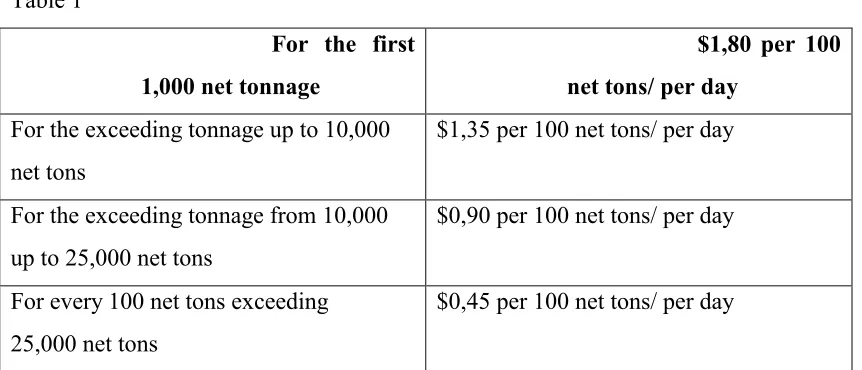
In a tonnage tax system, apart from dividends, the taxation of which normally depends on the tax and residence status of individual shareholders, shipping companies’ profits will not be taxed in any other jurisdiction. Nevertheless, the dividends obtained by a shareholder or shipowner are subject to taxation.
Example of the tax assessment under a tonnage tax regime.
The “assumed profit” is calculated as follows: Table 1
For the first 1,000 net tonnage
$1,80 per 100 net tons/ per day
For the exceeding tonnage up to 10,000 nettons
$1,35 per 100 net tons/ per day
For the exceeding tonnage from 10,000 up to 25,000 net tons
$0,90 per 100 net tons/ per day
For every 100 net tons exceeding 25,000 net tons
$0,45 per 100 net tons/ per day
Source: German Shipowners’ Association
3.1.6 The audit opinion in shipping companies
The auditor (independent certified public accountant) is responsible for seeing that the issued financial statements conform to generally accepted accounting principles. Therefore, the auditor must agree that the management’s choice of accounting principles is appropriate and any estimates are reasonable. The auditor also examines the company’s accounting and internal control systems, confirms assets and liabilities, and generally tries to be sure that there are no material errors in the financial statements. The auditor may express three types of opinions on audited financial statements:
a) Unqualified opinion b) Qualified opinion c) Adverse opinion
d) The auditor may also issue a disclaimer opinion or not to express an opinion, which is an alternative.
Additionally, certain circumstances, while not affecting the auditor’s unqualified opinion on the financial statements, may require that an explanatory paragraph or other explanatory wording be added to the report.
Circumstances which may require a departure from the standard report relate to
1) Limitation of the scope of audits
2) Part of the audit performed by other auditors
3) Departure from generally accepted accounting principles, including adequacy of disclosure.
6) Other circumstance identified by the auditor.
The Statement on Auditing Standard and the statement on Standard for Attestation engagements as well as the wording of the report on the firm should, in general, be uniform. It is of course, not practicable in all cases to adhere completely to the wording and the deviations should be supported by valid reasons.
3.2 Different kinds of audit opinion
As we expressed before, the statements are fairly presented in conformity with the General Accepted Accounting Principle (GAAP). The introductory paragraph identifies the statements being audited and defines responsibilities. The scope paragraph describes the nature of the audit and the opinion paragraph gives the auditor’s opinion as to fairness. As we mentioned before, opinions could be Qualified, Unqualified, Adverse or Disclaimer. Audited financial statements are always accompanied by the auditor’s report, which is normally referred to as an opinion. Failure to read this report, however, may cause the financial analyst to miss significant information.
3.2.1 Unqualified Opinion
In a situation where no qualifications or exceptions are to be taken either with respect to scope or accounting, the external auditor continues to issue an unqualified opinion, stating that the company has registered its data without any material mistake which could affect any decision to be taken.
The following is an example of an Unqualified Opinion:
To the Board of Director and Shareholders of X company.
3.2.2 Qualified Opinion
Qualified opinions should be issued when there is a lack of sufficient competent evidential matter or there are restrictions on the scope of the audit, which have led the auditor to conclude that he cannot express an unqualified opinion and the auditor has concluded not to disclaim an opinion. Another situation is when the external auditor believes, on the basis of the audit, that the financial statements contain a departure from generally accepted accounting principles, the effect of which is material, but the auditor has concluded not to express an adverse opinion.
An auditor expressing a qualified opinion should disclose all of the substantive reasons in one or more separate explanatory paragraphs preceding the opinion paragraph of the report.
3.2.3 Adverse Opinion
An adverse opinion on the financial statements taken as whole may be expressed only when the auditor has completed his audit in accordance with generally accepted auditing standards and he has concluded that the financial statements do not present fairly the financial position or result of operations or cash flow in conformity with generally accepted accounting principles.
3.2.4. Disclaimer of Opinion
CHAPTER 4
FINANCIAL RATIOS AND THE PROCESS OF DECISION MAKING IN SHIPPING COMPANIES.
4.1 The financial ratios
Financial ratios are the figures the companies and third parties use in order to know and compare the risk and return of any other companies. The investor and creditors make intelligent decisions based on the financial ratios. A primary advantage of ratios is that they can be used to compare the risk and return relationship of firms of different sizes. A common analysis of financial ratios can provide the economic characteristics and competitive strategies of a company, and its unique operating, financial, and investment characteristics.
4.1.1 Most used financial ratios in the shipping industry
As we have said before shipping activities demand at every moment large amounts of money. Therefore, in order to obtain these resources the shipping companies normally are analysed by the provider of funding. The main ratios that creditors and investors commonly look at in the shipping business are:
Current Ratio= Current assets Current Liabities.
Cash Ratio= Cash +Marketable Securities. Current Liabilities
Debt to Total Capital= Total Debt (Current+Long Term) Total Capital (Debt+Equity)
Capital Expenditure Ratio= Cash from Operation Capital Expenditures.
4.1.2 The importance of the financial ratios in the decision making process in shipping companies
In the shipping industry, as in other companies the objective of the financial analysis is to evaluate the performance of the company in function of its strategies and objectives. In the financial analysis of shipping there are two main tools: The analysis of the financial ratios and the cash flow analysis.
The analysis of the financial ratios attempts to evaluate the relationship of different items of the financial statements of a shipping company.
The analysis of the financial ratios is extremely useful in the credit evaluation for the financial forecasting, and the analysis for fusion, merger or acquisition of another business. In all these contexts, the analysis of the financial ratios constitutes a key factor to execute a reliable prediction of the future perspectives of a company.
Additionally, the shipping financial analysts very often use the financial ratios to carry out analysis of tendencies that consist at present of two types of comparison. Secondly, the analyst can compare a current ratio with the previous ratio and others that are expected for the near future of the same company.
Because the presented financial information and the ratios calculated through them are numeric, They tend to be considered as exact representations of the true financial situation, resulting from the operation and cash flows of a company. For some shipping companies, the financial information can be very approximate to the economic reality; for others, it is necessary to go beyond the shown quantities with the purpose of calculating in an appropriate form its financial situation.
In the shipping industry analysts regularly tend to group the financial ratios in four groups: Liquidity ratios, Debt ratio, ratios of profitability and covering ratios.
None of the financial ratios provides enough information to be able to judge the financial condition and the performance of a company. Only when the financial ratios are analysed and classified in groups is this possible. It is necessary in the shipping industry to take into consideration seasonal freight variations. The fundamental tendencies should be evaluated through the comparison of the gross quantities and the ratios in the same part of the year; a balance sheet issued at December 31 should not be compared with a balance sheet issued at May 31.
4.2 Who are the decision makers in the shipping business?
1) Shipowner: places the order for the ship. However, his ability to do so depends largely on the availability of finance and shipbuilding capacity.
2) Shippers: control cargo and have a direct influence on investment through issuing “bankable” long term charters which can be used by owners as cash flow collateral. Their chartering policy plays a crucial part in investment planning and it is interesting to contrast the current unwillingness to make long term commitments with their willingness to do so in the early 1970’s.
3) Bankers: control the flow of debt finance into the shipping industry. The willingness to lend, the rate of advances available and the amount of risk they are prepared to accept have a major impact on the investment in new ships.
4) Shipbuilders: control the volume of shipyard capacity, and the rate at which orders are taken. Shipyard capacity is not particularly flexible because facilities take several years to build and nowadays adjusting the personnel level is a slow and painful exercise.
5) Governments: provide shipbuilder credit and may be active in controlling domestic shipping and shipbuilding capacity.
6) Regulatory Authorities: have an increasing impact on shipping through safety and environmental control, which impact on tecnical obsolescence.
The root of the problem is that in reality many needs in this sector are controlled by decision makers remote from the marketplace. These decision maker banks, shipbuilders and shippers, probably do not see it as their responsibility to plan according to the needs of the shipping industry. Even if they do, the corporate decision making process makes it difficult for their planning to divert significantly from the crude market consensus and take a different tack when this is required.(Stopford,M 1990. Page 41)
4.3 The process of decision making in shipping companies based on the financial information
Decision making is a big word, so to discuss this topic and address the shipping industry it is better to separate the following purposes of the decision:
1) Ship financing 2) Mergers 3) Outsourcing
4.4 Financial Management in shipping companies
The role of financial management has been changing a lot, the responsibilities that lay in the job of a financial manager are now vital for the companies whole existence to raise and allocate financial capital.
competing uses immediate requirements, profit prospects and financial and overall management plans.
The following discussion on sources of finance, management of risk credit control, income, cost, cash flow and cash management can help the management of shipping companies.
The cash flow in the recent years of the shipping market has gone through booms and depressions in the freight markets. Since profits are easily made in booms they are not a big deal. With a robust cash flow the enterprise can decide to expand through the procurement of additional ships, replacement of old ships and maintenance of the existing ships.
Cash-Flow represents the difference between cash receipts and cash payments in the accounting period. In practice, the shipping market operates by using cash flow pressures of the type described above to force shipowners to make the necessary decisions to bring the market into balance. Cash flow is therefore a criterion for survival in the shipping market and it can be determined by the revenue received from operations.
Income from operations: For any shipping company to be viable, revenue must be assured. It involves squeezing the maximun revenue out of the operation. Revenue is generated from the freight charge collected for a voyage.
Cost: This is vital in shipping. Why? Because in today’s business it does not matter how much revenues you are getting, if you do not control the cost. During periods of low freight rates, many shipping companies have slashed their budgets in an attempt to maintain their profitability level.
4.5 Main sources of finance in shipping
Apart from the individual shareholders, there are potential sources of financing for the purchases of ships which have not changed over the past five to seven years. Among the most important sources of finance are:
a) Bank borrowings b) Equity Investments c) Leasing
4.5.1 Banks
4.5.2 Equity Investment
Equity investments can be seen to form two different aspects, external or internal. The latter one is obtained from the normal operation of the company, eg. profit from prior periods, earnings, sales of assets, accumulated depreciation or other reserves. In the past, internal sources have played a dominant role in the capital structure in existing shipping enterprises.
External funds are in the form of issuing shares on the stock exchange, limited liability or ship fund shares. The stock exchange may offer the all-important source of new equity to shipping companies. This source has been neglected, mainly because of shipowner ‘s reluctance to disclose publicly information about their company and the project, their desire to be sole owners of the company, and because of the volatile freight market rates.
4.5.3 Leasing Financing
This rental system is designed to facilitate the amortisation of the capital cost of the equipment to the owner and earn a return representing a financing charge on the initial cost. Leasing can be considered as “off balance sheet” financing. There are two principal types of leasing arrangements- the financial lease and the operating lease. Under the terms of a financial lease substantially all the risks and rewards of
4.5.4 Risk Management techniques
In the shipping industry today, there is a need for all shipping companies to develop a risk management system, and for the managers of the company to address risk identification and assessing techniques.
Financial risk management can be accomplished by using on-balance sheet transactions. For example, a company can manage a foreign exchange exposure resulting from foreign competition by borrowing in the competitions’ currency or by moving their office abroad. But such on-balance methods can be costly.
Financial risk can be also managed with the use of off-balance sheet instruments or derivatives. The use of these instruments by shipowners to hedge, or manage risk has been limited. In the past, interest rate risk management has been considered a zero sum game by many given that the cost and revenues of many companies are denominated in US dollars, the demand for currency based derivatives has naturally been limited.
The idea of a hedge is to reduce physical contractual exposure by purchasing an appropriate paper contract or derivative such that a rise in one contract would be offset by a fall in the other, thus fixing the cost of the physical contract that is hedged. (Mustapha; A 1997).
4.5.5 The uses of the financial statement in ship finance
The financial statements are regularly used in the process of acquisition of assets by the following entities that can intervene in this process:
c) The entities that are going to acquire the ship.
Among the institutions that will finance the acquisition of the assets, we can mention the commercial banks, cash providers and leasing institutions. It is very important for these institutions to use the financial statements of the entities that will carry out the acquisition or leasing of the ship. The main purpose of this is the interpretation and the financial analysis of any company. This analysis will be the initial base, which will provide information about the ability of the shipping company to generate necessary cash in order to pay back the present and future commitments, since the most important thing for these entities is that the shipping company acquirer can generate sufficient cash in order to pay the debt.
In addition, the financial statements can provide information to the financial institutions and shipyard about the structure of the company, the shareholders, as well as the debt capacity. Finally, they can be used to identify inherent risk associated with the industry. The same financial statements can give information, if the assets that will be acquired are going to be used in a segment of the existing business or if these are going to be used in a new unit of the company. In such a situation the financial statements can be analysed by business segment.
4.6 Mergers in the shipping industry
cost. In 20 to 30 years time no more than 10 top operators in each market are expected to control 85% of the business. Therefore, shipping companies have to either make alliances or merge. (Maersk Sealand, 2000).
Economic globalisation is now affecting the transport and logistic industries in a more profound manner, particularly as importers/ exporters seek multi-trade deals with their service providers, in order to make more efficient the processes of delivering and selling of goods.
4.6.1 Types of mergers
For our concern mergers, alliances, joint ventures and acquisitions will be treated as synonyms, although the term merger is often restricted to big corporate combinations. Three types of mergers can be identified:
1) Horizontal 2) Vertical 3) Conglomerate.
4.6.1.1 Horizontal merger
4.6.1.2 Vertical merger
A vertical merger is one in which a firm acquires the sources of its supply of raw material, or other input of the productive process, or alternatively, acquires control over sale outlets for its products or services. Essentially, such a combination represents the replacement of part of the market allocation mechanism by internal organisation and control within the company. This kind of merger raises questions about the possible building of market power and restriction of complexion.
4.6.1.3 Conglomerate mergers
This kind of combination is done when companies whose economic activities are relatively unrelated are combined. Such mergers often appear to spread the risk, rather than aim at the achievement economic of scale. Normally these types of mergers create a new type of company, e.g. Multimodal Transport Operator (MTO).
4.6.2 Trend in mergers
While economies of scale played a role, monopolisation and promoters’ profit were the prime movers behind many of the most famous and largest mergers. In many ways this was the most important of the merger movements. Although many of the mergers of this period have been of the conglomerate type, it also marks the reappearance of horizontal and vertical mergers. Two changes in government policy have sparked the latest increase in merger activity. The removal, in 1982 of the anti-trust rule against vertical mergers and the deregulation for specific industries, for example the deregulation of the banking, transportation and communication industries, has permitted the combination of assets of those industries.(Levy, H.1990 page 617)
4.6.3 Motives for mergers
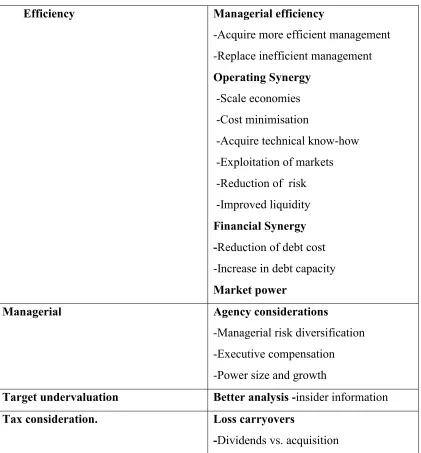
and so on. At simple sight these objectives are achievable via the alternative route of internal expansion. The motivation for a merger can be divided into four major categories for financial management purposes:
Table. 2 Merger Motives.
Efficiency Managerial efficiency
-Acquire more efficient management -Replace inefficient management
Operating Synergy
-Scale economies -Cost minimisation
-Acquire technical know-how -Exploitation of markets -Reduction of risk -Improved liquidity
Financial Synergy -Reduction of debt cost -Increase in debt capacity
Market power
Managerial Agency considerations
-Managerial risk diversification -Executive compensation -Power size and growth
Target undervaluation Better analysis -insider information
Tax consideration. Loss carryovers
4.6.4 Uses of financial statement accounting techniques, in mergers in the shipping industry
As mergers became a fashion in the shipping industry in late 90’s, as is so often the case in finance, mergers also have some implications for the firm’s accounting staff. Generally speaking there are two alternative accounting treatments which can be used. The combination of the two shipping business organisations can be handled as a pooling of interests or as a purchase.
In the first case, any payment beyond the tangible book value of the acquired firm must be shown as goodwill in the balance sheet and written off over a reasonable period of time. Since the depreciation of goodwill is not deductible for tax purposes, future net income will be reduced as the goodwill is amortised, which constitutes perhaps an economic disadvantage of this type of treatment. On the other hand, this disadvantage can be avoided by combining the balance sheets of the two organisations, assets and liabilities are simply combined together, (e.g. Maersk Sealand). In this approach neither goodwill, nor charges against future income are created. Unfortunately, this type of accounting has led to some abuse, called “dirty pooling” by overvaluation of asset values at the time of merger. As a result, in many jurisdictions this kind of merger has been restricted to companies of the same size in which, most of the time, both managements continue to function in the merged companies, e.g. P&O Nedlloyd.
During the processes of mergers and acquisitions the uses of the financial statements play important role. The companies involved use the financial statements as their main tools in a process called “Due diligence” which is one of the initial steps when shipping companies merge.
With the simple analysis of the financial statements, which method normally is called “Tiger”, the shipping companies will easily identify matters of big interest.
• The amount of intangibles assets
• The capacity of the entity to generate revenues and pay back its liabilities and debt
• Capital structure of the company
• Operational result in the last years, months, by market , by sector, etc.
• Loss contingencies, if these are probable or less probable
• Litigation and other legal problems
• Accounting practices in order to alter the figures or numbers in the financial statements
• The quality of the assets which form the company’s structure
• Level of indebtedness of the company
• Method of acquisition of shareholders capital.
• Operational cash flow and financial investments.
Conjugating and analysing the factors mentioned above the analyst can reach a conclusion about the feasibility or viability that an entity can be merged or acquired.
4.7 Outsourcing in the shipping business 4.7.1 Outsourcing
which an organisation buys major, non-core functions from specialised, and efficient service providers.
Companies have always hired special contractors for particular types of work, or to level off peaks and valleys in their workload. They have always partnered-formed long-term relationships with firms whose capabilities complement their own. Companies have always contracted for shared access to resources that were beyond their individual reach-whether it be buildings, technology or people. But the difference between simply subcontracting and outsourcing is that outsourcing involves the wholesale restructuring of the corporation around core competencies and outside relationships.
http://www.outsourcing.com/profiles/ey/index.htm
4.7.2 What can be outsourced within the shipping industry?
For a shipping company that requires high level distribution or transportation, outsourcing these functions can show an immediate and dramatic return on investment. Depending on the size of the company there can be areas, which can be outsouced by any shipping company:
Freight audit
Consulting and training Freight brokering Leasing
Warehousing
Distribution and logistics Information systems
Operations and Fleet operations Rail and road transportation Fleet management
The outsourcing offers significant benefits to shippers, carriers and advisors within the shipping marketplace. It allows managers from the industry to concentrate on their core business. For example, shipping service providers will be better able to anticipate market place demand for various services and better allocate resources and infrastructure based on current and projected demand.
4.7.3 Why and how shipping companies should make decisions when outsourcing?
For any shipping business to benefit from outsourcing, the initiative should come from the top shipping management. Only the top-level executives have the power to define the vision and implement the changes that are necessary for outsourcing to succeed. As you develop a strategy, consider the following:
Clarify organisational goals in relation to outsourcing and also identify areas to outsource. Define core competencies of the organisation and the functions of the business that are not core. An organisation should outsource its non-core functions so that in can focus on its core competencies. Having identified non-core functions, gather facts and figures to determine where you will get the quickest and best return on investment. To determine the return on investment, analyse current return compared to what an outside vendor may offer.
People inside and outside of the shipping business provide more detailed information and advice. This is a research phase in which you learn about your own specific needs, and find out which qualified vendors will be best to meet those needs.
To find out more about the shipping needs, research the needs within the organisation, and learn from other shipping companies who have outsourced the same kind of function. Plan to visit these companies to find out what their experience has been. Form a team of people to help you ask the right questions and analyse the information the company gathers. The shipping company may need team members with expertise in the following areas:
Legal
Human resources
Finance
Procurement
Logistic.
http://www.outsourcing.com/profiles/ey/index.htm
To make the right choice, be sure the vendor demonstrates a clear understanding of your needs and ability to solve your problems, financial stability, cultural fit and proven track record. Shipping companies should take into account that shipping is a very special business, which is totally regulated. Therefore, when shipping companies select other companies to outsource any services all such regulations and conventions should be taken into consideration, e.g. Solas, Marpol, STCW etc.
Decide in advance how the company is going to manage the relationship. Create a system that allows you ways to:
Monitor and evaluate performance Identify and communicate issues early Resolve issues quickly and fairly
It is critical, that in the shipping business the company understands the market reasons for considering outsourcing and the benefits the company seeks. A list of examples of reasons to outsource and the related benefits sought are summarised as follows:
Organisationally Driven
Enhance effectiveness by focusing on what the shipping company does best
Increase flexibility to meet changing business conditions, demand for products/services, and technologies
Transform the organisation
Increase products/services, customer satisfaction and shareholder value
Improvement Driven
Improve operating performance
Obtain expertise, skills and technologies, which would not otherwise be available. Improve management and control
Improve risk management
Receive innovative ideas for improving the business, products, services, etc. Improve credibility and image by associating with superior providers
Financially Driven
Revenue Driven
Gain market access and business opportunities through the provider’s network. Accelerate expansion by tapping into the provider's developed capacity, processes and systems.
Expand sales and production capacity during periods when such expansion could not be financed.
Commercially exploit the existing skills.
Cost Driven
Reduce costs through superior provider performance and the provider’s lower cost structure.
4.7.4 Maritime Logistics
The maritime logistics form a key-component of international logistics Without maritime transport, the major international seaborne trade flows would be physically impossible and world trade and the world economy would look quite different from what we see today.
CHAPTER 5
CONCLUSION
The financial statements can be described by a simple definition as the presentation of all financial data of a year or the history of the company. Therefore, the financial statements give to the readers a better picture of the real situation at a specific moment.
As we can see, the three financial statements have their purpose in common and all of them are closely related. The advantages that the financial statements can offer to investors and other decision-makers are tangible. Financial statements give important information in terms of the company, the reports clarify doubts, notes to the financial statements provide a clear understanding of the figures and numbers, the audit report can alert a decision maker about future problems.
As observed in chapter number two, the financial statements sometimes present difficulties and limitations.
-Important assets and liabilities may be omitted.
-Some assets and liabilities are carried at historical cost and others at market value. -Financial statements always have to be compared at the same date or for the same period of time.
Nevertheless the financial statements constitute one of the most important tools in today’s financial analysis.
In chapters number one and two it was pointed how the balance sheet, income statement and cash flow allow the top shipping management to make decisions on how to reduce cost and how to improve the cash flow management.
The financial reports issued by the external auditor help the readers to understand and analyse the company’s performance. The financial analyst as well the investor may use these reports issued by the external auditor in order to make future financial decisions.
BIBLIOGRAPHY
Alderton, P.M. (1995). Sea transport: operation and economic. London: Thomas Reed.
Branch, E.B. (1988). Economics of shipping and management. London: Chapman & Hall.
Branch, E.B. (1989). Elements of shipping. London: Chapman & Hall.
Donelly, J.H., Gibson, J.M. & Ivancevich, J.M. (1987). Fundamentals of Management. Plato, Texas: Business Publications.
Drewry Shipping Consultants (1996). Shipping finance: a high risk-low Return Business. London: Author
Grammenos, C.T. (1987). Problem and propects in ship finance. International Conference on the Problems of the Developing Maritime World, Sharjah, UAE, 26-28 January 1987 (pp.57-60, 75-76). London: IMarE.
Haralambides, H.E. (1999). The economic impact of shipping on the national economy. Unpublished lecture notes. World Maritime University, Malmö Sweden.
Haralambides, H.E. (2000). Maritime risk and analysis. Unpublished lecture notes. World Maritime University, Malmö, Sweden.
Haim, L.; Marshall, S. (1990). Capital investment and financial decision. London: Chapman & Hall.
Rathjen, H.H (2000). “Interview by the Author”. German Shipowoner Association. Head of shipping policy.
Ma, S. (1996). Maritime economic and transport. Lectures notes. World Maritime University, Malmö, Sweden.
Motram, D (1999). Shipping and project finance. Lecture notes. World Maritime University, Malmö, Sweden.
Norman. E. (2000) “ Inteview by the Author”. Finance Director, Leif Höegh & Co.
Plewa, F. J., Jr.; Friedlob, G.T. (1995). Understanding cash flow. New York: John Wiley & Sons
Price WaterhouseCoopers (1999). Accounting auditing and reporting: Volume 1.
New York.
Price WaterhouseCoopers (1999). Accounting auditing and reporting: Volume 2.
New York.
Stephen, L. ( 1991). Investment appraisal and financing decisions: A first course in financial management. London: Chapman & Hall
Stopford, M. (1989). Maritime economics. London: Allen Unwin
Strandness, S.P. (1990). Shipping Strategies and bulk shipping in the 1990’s: Challenges and pitfall of maritime forecasting in a corporate environment. Bergen, Norway: Norwegian School of Economics.
Wengerland. T. (2000). Shipping management and strategic. Unpublished lecture notes. World Maritime University, Malmö, Sweden.
Wengerland, T.; Wijnolst, N. (1997). Shipping. Delft, The Netherlands: Delft University Press