Issues
ISSN: 2146-4138
available at http: www.econjournals.com
International Journal of Economics and Financial Issues, 2017, 7(3), 575-580.
The Causal Relationship between Economic Growth, Banking
Sector Development and Stock Market Development in Selected
Middle-East and North African Countries
Vahid Puryan*
Business Management (Sub Branch: Financial), Science and Research University, Qazvin, Iran. *Email: [email protected]
ABSTRACT
Economic growth is the major indicator of government’s performances; hence, economists always trying to help policy-makers in this field through accurate recognizing of dynamisms and factor affecting this indicator. On the other hand, financial and monetary markets play a vital role in directing existing funds in economy toward producing and industrial sectors to improve economic growth. In this regard, some economists believe that expanded financial markets are driving force of economic growth is countries. This research has investigated the causal relationship between economic growth, banking sector development, and stock market development (SMD) in selected Middle-East and North African (MENA) countries during 1988-2012. To measure development of banking and stock market sectors, 4 indexes are introduced that are converting to two general indexes for each sector using decomposition method for principle components. To test causal relationship between economic growths, banking sector and SMD, granger causality test based on vector auto regression of error correction has been applied. According to the results of this study, there is a one-way causal relationship from banking sector development toward economic growth, a mutual causal relationship between SMD and economic growth, and a one-way causal relationship from banking sector development toward stock market. SMD has a long-run positive effect on economic growth.
Keywords: Stock Market Development, Banking Sector Development, Economic Growth, Selected Middle-East and North African Countries JEL Classifications: C32, O13, O47
1. INTRODUCTION
The long-run relationship between financial development and economic growth, in particular after the advent of endogenous growth theories, has attracted the attention of economists. Financial development is defined as a process that leads to development in quality, quantity, and efficiency of financial intermediaries’ services. Nowadays, financial development is introduced as an important factor for economic growth while the causality direction between these two variables is the bone of contention between economists. Schumpeter (1911) expressed the role of financial intermediaries in accumulation of funds, valuation and project selection, risk management, and facilitating transactions (as some elements for economic growth) assuming that there is a positive relationship between financial system size, quantity and quality of financial services. Robinson (1952) points out that economic growth would lead to financial development as well as demand for financial services; Levine (2005) expresses that economic
growth would firstly facilitate formation of financial markets and then the financial market would contribute to economic growth improvement at coming steps; Patrick (1966) concluded that there is supply-leading relation at early steps of economic growth and causality direction is from financial development toward economic growth, while demand-following appears at next steps of economic growth and causality direction becomes reverse (economic growth would create demand for financial services); King and Levine (1993) found a positive relationship between financial development and economic performance in a 35-country sample of his study. Zhang et al. (2012) introduced government’s interference in financial system development as an obstacle for economic growth process (Anwar and Nguyen, 2009).
The first hypothesis is designed in framework of supply-leading assuming that financial development is precondition for economic growth. According to this hypothesis, financial development leads to economic growth and causality is from financial development toward economic growth (King and Levine, 1993). The second hypothesis is demand-following claiming that economic growth is driven for financial development (Robinson, 1952). It is claimed by this hypothesis that when an economy is grows, the market demand is increased for financial institutions as well as financial products and services.
There is another hypothesis in addition to mentioned hypotheses assuming that financial development and economic growth complete each other and there is a mutual causality between financial development and growth. According to proponents of this hypothesis, financial development is a vital factor for economic growth and economic growth needs an efficient and optimal financial system. Nevertheless, some argue that there is not any support for the idea that financial growth necessarily leads to growth (Menyah et al., 2014).
This paper aims at responding these questions: Whether financial development (banking sector and stock market development [SMD]) is driving force for economic growth in selected Middle-East and North African (MENA) countries; whether economic growth of selected MENA countries explains financial sector growth; whether there is a mutual causality between economic growth and financial development.
Accordingly, this paper has been organized to main 5 sections to respond the mentioned questions. After introduction, theoretical bases of the relationship between banking system development and economic growth, SMD and economic growth, and banking sector and SMD have been reviewed. Section 2 consists of review of previous researches. Model of this study is explained in Sections 3 and 4 is related to model estimation. Results and recommendations are expressed in Section 5.
2. THEORETICAL LITERATURE
The viewpoint about importance of financial sector in economic growth is classified to two main categories. The first viewpoint that is rooted in opinions of Schumpeter (1911) emphasizes on the importance of financial sector within economic development process. The second viewpoint that is rooted in Robinson’s studies considers financial system as a relative less important factor for growth process. Robinson argues that if other conditions are constant, financial development will be created resulted by economic growth, because an increase in product in economy leads to increase in demand for financial services and direction is not from financial development toward economic growth.
Patrick (1966) presents these two viewpoints under the title of two models in financial development and economic growth literature. The first model is Supply-Leading in which, developed financial markets increase economic growth. The effect of financial development on economic growth has been highlighted in theories related to capital structure. These theories consist
of bank-based, market - based, financial services-based and law and finance-based theories. Bank-based theory focuses on positive impact of commercial banks on financial development. This theory explains that banks can contribute to mobilization of resources and reducing risk (Anwar and Cooray, 2012). Market-based theory emphasizes on advantages of financial markets with optimal performances in promotion of successful economic performance. According to the theory, markets with good performances would accelerate profitability incentive and economic growth. Moreover, markets with good performances can improve affairs handling in firms, risk management and diversity (Levine, 2005). Financial services-based theory that is based on both bank-based and market-based theories emphasizes on importance of key financial services that is provided by financial system. This theory explains that financial services are involved in industrial development and economic growth (Kose et al., 2010), because financial markets and institutes contribute to optimal distribution of risk and yield. Law and finance-based theory argues that financial systems are vital factors for firms, industries, and success of national economy (Anwar and Cooray, 2012). There is a friction in markets due to laws, rules and policies. Improvement and correction of financial rules leads to better performance of economic firms and markets.
The second model is known as demand-following believing that creation of modern financial services and institutions is formed to respond to demand for these services by investors and savers in real sector (Patrick, 1966); therefore, financial sector development is the outcome of real economic growth.
The advent of endogenous growth theory in 1980s attracted the attention toward the relationship between financial development and economic growth again. There have been numerous studies in this field to explain how performance of financial sector might effect on economic growth rate in framework of endogenous growth models. At these studies, financial mediocrities have been modeled collecting and analyzing information, involving in risk, and providing liquidity and financial development would generally increase economic growth based on this modeling.
Levin (1997) and Robinson (1952) raised a question about the importance of financial system in increasing economic growth. Particularly, Hassan et al. (2011) expresses that importance of financial sector has been too much highlighted. Adu et al. (2013) emphasize that risk of financial bankrupt and economic recession might be because of rapid deregulation of repressed financial systems. Kose et al. (2010) expresses that none of economic development leaders have considered financial sector as a development factor (Kar et al., 2011).
between financial development and economic growth can help governments to choose priorities in field of correction in financial sectors. Proponents of first viewpoint explain that government’s policies should be directly subjected to improvement of financial system, because financial development has considerable effects on economic growth; hence, causality direction is from financial development toward economic growth. On the other hand, proponents of second viewpoint argue that government’s policies on improving financial system have low effects on growth, because financial development is resulted by economic growth.
There have been numerous studies on relationship between financial development and economic growth that the newest ones have been mentioned herein.
Asiri and Abdullah (2015) studied the relationship between SMD and economic growth in Bahrain for a 25-year period (1990-2014). To estimate model, the stepwise multiple regression analysis of economic growth and SMD. In this research, economic growth was indicated with gross domestic production (GDP) growth and indicators of stock market consisted of liquidity, total index of stocks, financial turnover, and capital market. The results indicated that indicators of stock market can effect on economic growth in Bahrain and the most effective variables consists of general index of stocks, capital market, and financial turnover rate. These results imply that SMD leads to economic growth. Also, it is confirmed based on the study on effect of economic growth on SMD that economic growth leads to SMD.
Samargandi et al. (2015) studied the relationship between financial development and economic growth in a panel including 52 average-income countries during 1980-2008. It has been indicated in this research that there is a reverse relationship (U-shape) between financial affairs and economic growth in long term while this relationship is narrow in short term and these results have been obtained using estimation of merged mean group based on dynamic heterogeneous panel model. This point indicates that financial sector development have a high negative effect on growth of average-income countries. The results of this research show that financial development has a non-monotonic effect on economic growth that has been confirmed by estimation of threshold model.
Menyah et al. (2014) conducted a study to examine the relationship between financial development and economic growth for 21 African countries. They used Panel Granger Causality Technic with Bootstrap approach. The results obtained from this study show that financial development and commercial liberalization have no significant effect on growth.
Adu et al. (2013) examined long-run effects of financial growth and development. They found that effects of financial development and growth are sensitive to the selected index for financial development. They concluded that goodness or badness of financial development depends on the index considered as proxy of financial development.
Zhang et al. (2012) conducted a study to examine financial development and economic growth according to current evidences
from China during 2001-2006. They used cross-sectional regression and generalized method of moments (GMM) system for dynamic panel data. The results obtained from this study show that even the most traditional indexes for financial development has a positive relationship with economic growth.
Hassan et al. (2011) examined the relationship between financial development and growth in average and low-income countries. Results of their research indicate that the causality relationship between financial development and growth exists in majority of studied countries.
Kar et al. (2011) studied the relationship between financial development and economic growth in MENA countries during 1980-2007. They used the method of panel causality test presented by Kónya (2006) that is based on unrelated regression and Wald test with critical values of specific Bootstrap for each country. The obtained results show that there is not any agreement on the causality direction between financial development and economic growth in studied countries.
Jalil et al. (2010) examine the relationship between financial sector and economic growth in China using autoregressive distributed lag method. The results of this research showed the relationship directed from financial development toward economic growth. Ozturk (2008) investigated the causality between financial development and economic growth in Turkey for the period 1975-2004. The empirical findings in the paper show a two way causality (bidirectional) between financial development and economic growth.
Wolde-Rufael (2009) conducted a study to examine the relationship between financial development and economic growth in Kenya during 1996-2005 using self-explanatory vector model. The result of this study implied that financial development led to economic growth in Kenya so that improved financial sector development can lead to increased economic growth. Acaravci et al. (2009) review the literature on the finance-growth nexus and investigate the causality between financial development and economic growth in sub-Saharan Africa for the period 1975-2005. Using panel co-integration and panel GMM estimation for causality, the results of the panel co-integration analysis provide evidence of no long-run relationship between financial development and economic growth. The empirical findings in the paper show a bi-directional causal relationship between the growth of real GDP per capita and the domestic credit provided by the banking sector for the panels of 24 sub-Saharan African countries.
3. MODEL ESTIMATION, DATA, AND
EXPLAINING VARIABLES
3.1. Data and Variables
3.2. Banking Sector Development
In majority of economic systems, banks are the centers for financial system and payments so they play a vital role in saving mobilization process, identification of investment opportunities, and risk integration. Hence, the structure size and efficiency of baking sector is considered as an independent dimension of financial development. Banking profitability, paid credits, and simple access of private sector to bank facilities are examined based on this aspect. According to the conducted studies, activity of banks in competitive environment consisting of lower interference of government, lower concentration on market, and more facilities for profit of efficient foreign banks leads to more growth. This part of study is related to evaluation of indicators of financial development in banking sector.
Banking sector development is determined by four banking indexes. These indexes are as follows:
• Broad money supply (BRM): Definition of broad money supply is the same definition for money or liquidity. Liquidity (M2) is equal to total of money volume (M1) and quasi money (T). Money volume is equal to sum of currencies in hand of people (CU), demand deposits (DD) and quasi money (T). • Domestic credit provided by the banking sector (DCB): Gross
credits provided by banking sector except for granted credit to the government.
• Claims on private sectors (CPS): Gross CPS from financial sector.
• Domestic credit to the private sector (DCP): The effect of is depicted by this variable that the ratio of financial sources allocating to banks to private sector has been used as percent. • Increase in credits granted to private sector provides
investment opportunities for private sector that is more efficient; accordingly, economic growth will be accomplished.
3.3. Non-banking Sectors Development
Transformations in non-banking financial sector examines capital industries development and substitute financial services. Diversity of markets and products of this sector provides the field for change in tasks of system and firms and enables families to improve their finance in terms of cost efficiently, to mobilize financial sources, to monitor management of financial sector, and to distribute risks.
Non-banking financial sector consists of stock market activity, housing non-banking finance methods, and other financial institutes such as retirement fund, insurance, and leasing. Only SMD indicators are examined herein due to limited activity of some of these institutions and lack of required data.
SMD is determined based on four indexes of stock market. These indexes are as follows:
• Market capitalization (MAC): Is defined as sum of daily value and conventional value of stock of a joint-stock cooperative bank stock company. This value is equal to daily and current value of a stock multiplied by number of published stocks by a company.
• Traded stocks (TRA): This variable is the percentage of changes in total value of traded stocks.
• Turnover ratio (TUR): Indicates activity of stock market
dividing total transactions to value of stocks of active companies in stock market.
• Number of listed companies (NLC): NLC is another scale for size of stock market and is measured as a percentage of GDP.
3.4. Economic Growth Index
The importance of economic growth rate is that it shows how and when each economy reaches economic growth.
Per capita economic growth rate (GNP): Of economic growth indexes, GNP is highly important, because it determines future per capita income of a country.
3.5. Model Estimation
Four separate variables have been considered for each of financial and banking sectors in this research and these variables can be converted to one variable for each sector using Principle Components Analysis (PCA). Multiple data analysis has a vital role in data analysis. Multiple data collection consists of numerous variables or states for each observation. If there is n variable in each data set, each variable can have several dimensions. Since it is difficult to understand multi-dimensional space, PCA method reduces dimensions of all observations based on the composite index and categorization of similar observations. In general, major application of PCA method is to reduce number of variables and find relational structure between variables that is indeed categorization of variables. The main advantage of this method in econometrics is to eliminate co-linearity in models because of high number if effective factors in model. The number of extracted components in each model is equal to the studied variables. However, it is possible to select a certain number of these components. Usually, two or three firs components take a considerable number of data dispersion into account. Therefore, it is enough to choose two or three first component. To calculate the index that indicates situation of stock market in financial system of a country, decomposition of principle components is applied. In this method, three financial development indicators related to stock market are weighted so that their mean weight is similar; in this regard, multi-dimensional index of SMD will be obtained. The same method is implemented to create multi-dimensional index for financial (banking) sector development (BSD) using three relevant indexes.
All variables should be stationary when using VAR model; otherwise, it is necessary to convert non-stationary variables to stationary ones before estimating the model, because non-stationary of variables, in either time-series data or panel data, leads to spurious regression. For this purpose, Levin, Lin and Chu (LLC) that is related to panel data, is applied.
To examine causal relationship between economic growth, SMD, and banking sector development in selected MENA countries, panel vector error correction method has been used in this research. Anwar and Nguyen (2009) proved that if variables are first-ordered integrated and co-integrated, Granger causality test in VAR model is not appropriate, because the term of error correction that corrects short-run non-equilibrium will be ignored. Therefore, it is recommended using vector error correction to examine the casual relationship between variables. This method not only determines direction of causality between variables but also provides the field to distinguish short-run and long-run causality. Therefore, the mentioned model has been used in this research to examine causality relationship. This model can be depicted as follows:
∆
∆ ∆ ∆
GDP
GDPt j BSD SMD ECT +
j=1 p
2j t j 3 t j 4 t 1t
t= +
+ + +
− − − −
∑
φ
φ φ φ φ
0
1 1 1 ε
jj= p
j=1 p
1
∑
∑
∆BSD
GDP BSD SMD + ECT +
t
1j t j 2j t j 3 t-j 4 1t-1 2t
j=1 p
= +
+ +
− −
β
β ∆ β ∆ β ∆ β ε
0
∑
∑
∑
∑
j=1 p
j=1 p
∆ γ
γ ∆ γ ∆ γ ∆ γ ε
SMD =
GDP BSD SMD ECT
t 0
1j t j 2j t j 3 t j 4 t 3t
j=1 p
+
+ + + +
−
∑
−∑
∑
− 1 1−∑
j=1 p
j=1 p
3.6. Estimation of Empirical Model 3.6.1. Stationary variables
The hypothesis of presence of unit root in each of variables is tested before estimating the model. For this purpose, LLC test has been used. According to the results of unit root test, variables of economic growth and SMD are stationary at level and variable of banking sector development is stationary after first-order differentiation (Table 1).
3.6.2. Co-integration
For this purpose, Cao test and ADF value have been used and the obtained results have been provided in Table 2.
Since the H0 is lack of co-integration, presence of co-integration between variables of model can be accepted.
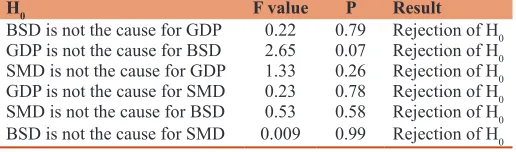
3.6.3. Granger causality relationship between variables
Although regression analyses examine the dependence of a variable to other variables, it does not mean that there is causality relationship between variables. Hence, Angle-Granger test is used to examine causal relation between data. Accordingly, the casual relationship between data is examined using granger causality test before estimating regression model and the obtained results are expressed in Table 3.
According to Table 3, there is a mutual relationship between all variables of research. It is necessary to estimate an appropriate regression model between data using a proper method and considering data structure after examining the causal relationship between research variable in order to study the type of relationship in terms of effectiveness and direction of this effect on each other within short-run and long-run.
3.6.4. Causal relationship between variables based on panel vector error correction
In this research, panel vector error correction method has been used to examine causal relationship between economic growth, SMD, and banking sector development in selected MENA countries; because co-integration between variables indicates that there is at least one long-term relationship between variables.
Table 4 shows results of long-term relationship estimation of vector error correction model for economic growth.
SMD has a positive and significant effect on economic growth in long term. Results related to short-run relationship of vector error correction model are presented in Table 5.
Table 1: Stationary variables
Variable GDP SMD BSD
At level −2.40** −2.10* 0.90
AR1 −6.19** −5.90** −3.69**
**Significant at 1% level, *significant at 5% level, GDP: Gross domestic production, SMD: Stock market development
Table 2: Co-integration test
Test value Value P
ADF −5.12* [0.00]
*Significant at 1% level
Table 3: Granger causality relationship between variables
H0 F value P Result
BSD is not the cause for GDP 0.22 0.79 Rejection of H0 GDP is not the cause for BSD 2.65 0.07 Rejection of H0 SMD is not the cause for GDP 1.33 0.26 Rejection of H0 GDP is not the cause for SMD 0.23 0.78 Rejection of H0 SMD is not the cause for BSD 0.53 0.58 Rejection of H0 BSD is not the cause for SMD 0.009 0.99 Rejection of H0
GDP: Gross domestic production, SMD: Stock market development
Table 4: Long-term results of vector error correction model
Variable Coefficient t value
GDP 1.00
-BSD 0.03 2.95
SMD 0.34 1.46
GDP: Gross domestic production, SMD: Stock market development
Table 5: Short-run relationship of vector error correction model
Independent
variable GDP Dependent variableBSD SMD
GDP - 0.34 (1.058) 0.12 (2.06)
BSD 0.78 (0.24) - 0.74 (0.28)
SMD 0.04 (3.23) 0.31 (1.15)
-ECM 0.00 (7.95) 0.31 (1.007) 0.0056 (2.80)
According to short-run results, there is a mutual relationship between two indexes of SMD and economic growth. Also, there is a one-way causal relationship from index of banking sector development toward SMD. Finally, there is a one-way causal relationship from index of banking sector development toward economic growth.
4. CONCLUSION
There is short-run causal relationship between baking sector development and economic growth so that the direction of this relationship is from banking sector development toward economic growth. Also, there is a mutual short-run relationship between SMD and economic growth. Also, there is a one-way short-run causal relationship from banking sector toward stock market. Since banking sector development can be the cause for economic growth, it is required to take necessary steps for finance corrections through banking systems in these countries. SMD can stimulate economic growth.
The relatively rapid development of stock market has still low growth in MENA region compared with developed countries. Credits and facilities are usually granted by banks; however, it is possible to develop economic growth through developing stocks exchange, bonds, funds, Islamic financial products, and derivative securities. Since, majority of MENA countries are bank-based and have fledgling stock market, banks can contribute to dynamism of stock market sector with their financial supports.
REFERENCES
Acaravci, S.K., Ozturk, I., Acaravci, A. (2009), Financial development and economic growth: Literature survey and empirical evidence from Sub-Saharan African countries. South African Journal of Economic and Management Sciences, 12(1), 11-27.
Adu, G., Marbuah, G., Mensah, J.T. (2013), Financial development and economic growth in Ghana: Does the measure of financial development matter? Review of Development Finance, 3(4), 192-203.
Anwar, S., Cooray, A. (2012), Financial development, political rights, civil liberties and economic growth: Evidence from South Asia. Economic Modelling, 29, 974-981.
Anwar, S., Nguyen, L.P. (2009), Financial development and economic growth in Vietnam. Journal of Economics and Finance, 10, 624-653. Asiri, K., Abdollah, A.M. (2015), Economic growth and stock market
development in Bahrain. Journal of Applied Finance and Banking,
5(7), 67-80.
Hassan, M.K., Sanchez, B., Yu, J.S. (2011), Financial development and economic growth: New evidence from panel data. The Quarterly Review of Economics and Finance, 51(1), 88-104.
Jalil, A., Feridun, M., Ma, Y. (2010), Finance-growth nexus in China revisited: New evidence from principal components and ARDL bounds tests. International Review of Economics and Finance, 19(2), 189-195.
Kar, M., Nazlıoğlu, Ş., Ağır, H. (2011), Financial development and economic growth nexus in the MENA countries: Bootstrap panel granger causality analysis. Economic Modelling, 28(1), 685-693. King, R.G., Levine, R. (1993), Finance and growth: Schumpeter might
be right? Quarterly Journal of Economics, 108(3), 717-737. Kónya, L. (2006), Exports and growth: Granger causality analysis on
OECD countries with a panel data approach. Economic Modelling, 23(6), 978-992.
Kose, M.A., Prasad, E.S., Rogoff, K., Wei, S. (2010), Financial globalization and economic policies. In: Rodrik, D., Rosenzweig, M., editors. Handbook of Development Economics. Vol. 5. North-Holland: Elsevier B.V. p4283-4359.
Levin, H.M., Cyrus, E. D. (1997), Cost of an educational voucher system. Education Economics, 5(3), 265-283.
Levine, R. (2005), Finance and growth: Theory and evidence. In: Aghion, P., Durlauf, S., editors. Handbook of Economic Growth. Netherlands: Elsevier Science. p865-934.
Menyah, K., Nazlioglu, S., Wolde-Rufael, Y. (2014), Financial development, trade openness and economic growth in African countries: New insights from a panel causality approach. Economic Modeling, 37, 386-394.
Ozturk, I. (2008), Financial development and economic growth: Empirical evidence from Turkey. Applied Econometrics and International Development, 8(1), 85-98.
Patrick, H.T. (1966), Financial development and economic growth in underdeveloped countries. Economic Development and Cultural Change, 14, 174-189.
Robinson, J. (1952), The Generalization of the General Theory, the Rate of Interest and Other Essays. London: Macmillan. p67-142. Samargandi, N., Fidrmuc, J., Ghosh, S. (2015), Is the relationship between
financial development and economic growth monotonic? Evidence from a sample of middle-income countries. World Development, 68, 66-81.
Schumpeter, J.A. (1934), The Theory of Economic Development. London: Transaction Publishers.
Wolde-Rufael, Y. (2009), Re-examining the financial development and economic growth nexus in Kenya. Economic Modeling, 26(6), 1140-1146.