*Corresponding author
Computational evaluation of the homogeneity of composites processed
by accumulative roll bonding (ARB)
Mahsa Gharechomaghlu and Hamed Mirzadeh*
School of Metallurgy and Materials Engineering, College of Engineering, University of Tehran, P.O. Box 11155-4563, Tehran, Iran
Article info:
Type: Research
Abstract
A new computational method based on MATLAB was used to study the effect of different parameters on the homogeneity of composites produced by a severe plastic deformation technique known as accumulative roll bonding. For a higher number of passes, the degree of particle agglomeration and clustering decreased, and an appreciable homogeneity was obtained in both longitudinal and transverse directions. Moreover, it was found that the rolling temperature does not have any tangible effect on the distribution of particles. Furthermore, it was shown that while faster homogeneity can be obtained in the transverse direction by a cross accumulative roll bonding process, there is not any significant difference between homogeneity of particle distribution between this technique and other routes. In fact, after enough passes, the homogeneity level in all processing methods tends to a common value. Finally, the evolution of the mechanical properties of the composites sheets based on the work hardening, composite strengthening, grain refinement at high accumulative roll bonding cycles, and bonding between particles and the matrix was also briefly discussed.
Received: 27/10/2017 Revised: 06/11/2018 Accepted: 08/11/2018 Online: 10/11/2018
Keywords:
Metal-matrix composites, Accumulative roll bonding, Particle distribution, Tensile properties.
1. Introduction
Metal-matrix composites (MMCs) are among the main types of composite materials with a metallic matrix reinforced with hard ceramic particles to enhance the stiffness and specific strength [1, 2]. Conventionally, MMCs can be processed by casting, powder metallurgy, and mechanical alloying [3-7]. However, friction stir processing (FSP) [8,9] and accumulative roll bonding (ARB) [10-15] have been recently used to process composite materials. During ARB process, the sheets stack together and roll
bonded by 50% reduction in thickness. After cutting, the same processes are repeated several times to produce the ARB processed sheets. The reinforcement powder can be added between sheets during the ARB process. The rolling step, itself, might be performed at ambient or elevated temperatures or by the method of cross rolling. These variables might influence the distribution of particles.
evaluate the distribution of particles in composite materials but the computation cost and the human factor in the analysis are among the problems of these techniques. To solve these issues, a new computational method for unambiguous image analysis has been proposed by the present authors [16]. This technique can be applied to the composites processed by different routes of ARB to examine the particle distribution. The present work is intended to deal with this subject.
2. Experimental details
The commercial purity AA1050 aluminum alloy (100L× 50W × 0.5T mm3) and the B
4C powder
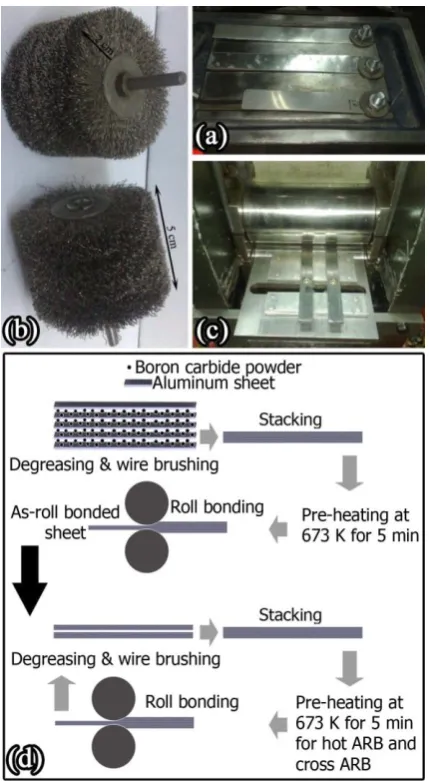
with an average particle size of 20 µm were used as the matrix and reinforcement, respectively. Five aluminum sheets were degreased in acetone and wire brushed (Fig. 1a) using a stainless steel circumferential brush (Fig. 1b) operating at a rotation speed of 2400 rpm. This was followed by dispersing the B4C powder (6 wt%) among
the four contacting surfaces. Roll bonding (Fig. 1c) was carried out with a reduction in thickness of 50% under an unlubricated condition on the pre-heated assembly (5 minutes at 400 °C). The resulting composite sheet denotes “as-roll bonded sheet”. Then the following operations were done to prepare different samples (Fig. 1d): (1) Cold ARB: The as-roll bonded sheet was cut in half, and after surface preparation, the roll bonding operation was repeated up to 5 cycles at room temperature.
(2) Hot ARB: The as-roll bonded sheet was cut in half, and after surface preparation and pre-heating at 400 °C for 5 minutes, the roll bonding operation was repeated up to 5 cycles.
(3) Cross ARB: The as-roll bonded sheet was cut in half, and after surface preparation and pre-heating at 400 °C for 5 minutes, the roll bonding operation was repeated up to 5 cycles. In this case, after each cycle, the sheet was rotated by an angle of 90° in the same direction for the next cycle. Cross rolling might be an effective approach in improving the distribution of particles due to the fact that the stretching of the sheets occurs along both the rolling direction (RD) and the transverse direction (TD).
Finally, tensile test samples were prepared along the RD direction according to ASTM E8 standard and tested at room temperature with crosshead speed of 1 mm/min using SANTAM STM-20 machine.
Fig. 1. Experimental setup and applied routes; (a) wire brushing desk, (b) stainless steel circumferential brushes, (c) roll bonding process, and (d) schematic representation of the experimental processes used in this work.
3. The developed computational approach
After dividing the micrograph to n meshes, the area fraction occupied by particles in each mesh (xi) was taken into account. The volume fraction
n
i
i f
x n RMSE
1 2
1 was considered as the basis
for the evaluation of particle distribution homogeneity. Fig. 2 shows that by increasing the number of meshes, the RMSE increases until reaching a plateau at very small mesh sizes (RMSEB). The inflection point (Point A)
corresponds to the highest growth rate of RMSE. Therefore, the magnitude of RMSEA/RMSEB
was considered as a measure of nonuniformity of the particle distribution. This is equivalent to the usual approach used for sigmoidal phase transformations [17-19]. With decreasing RMSEA/RMSEB, the particles will be more
homogeneously distributed in the matrix.
Fig. 2. Representing the concept of the developed computational technique.
4. Results and discussion
4.1. Cold ARB
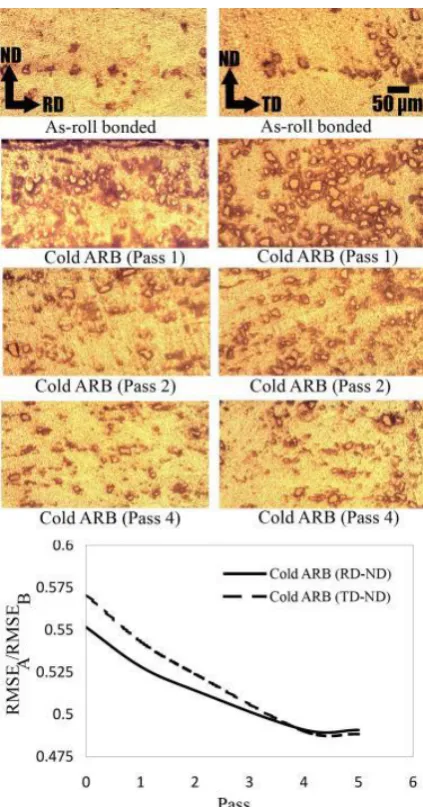
Fig. 3 shows optical micrographs and the magnitude of the RMSEA/RMSEB parameter
versus ARB pass number for the Cold ARB described in Section 2. As it can be deduced from the microstructures, in the case of the as-roll bonded sheet, the distribution of particles is very heterogeneous because the powder is just between primary sheets and very large particle-free zones are available. After ARB, since the sheets are stacked on each other, the number of layers increases, and this is an important factor in improving the distribution of particles in the normal direction (ND). The stretching of the sheets during rolling, however, separates the particles from each other, which is useful for removing clustering zones and enhancement in particle distribution along RD direction.
Therefore, by increasing the ARB pass number, more homogeneous distribution of the particles will be achieved as it is evident in Fig. 3. The evolution of the RMSEA/RMSEB parameter
versus pass number quantitatively demonstrates these effects. It can be seen that the RMSEA/RMSEB parameter decreases
continuously with increasing ARB pass number.
Fig. 3. Optical micrographs and the RMSEA/RMSEB
parameter versus ARB pass number for the Cold ARB technique.
stacking of sheets on each other. The particles are crushed and refined by the ARB process (Fig. 3), which can be ascribed to the fracturing of brittle B4C particles during rolling.
4.2. Hot ARB
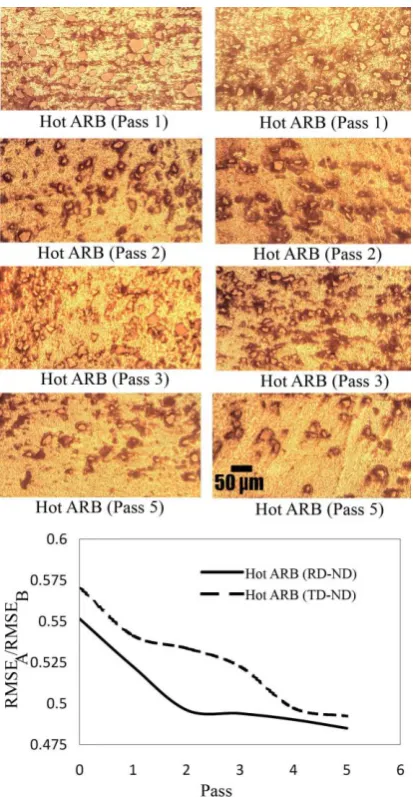
The as-roll bonded sheet was cut in half, and after surface preparation and pre-heating at 400 °C for 5 minutes, the roll bonding operation was repeated up to 5 cycles. The results are shown in Fig. 4. Again, by increasing the ARB pass number, there is an enhancement in the particle distribution, which can be verified by analyzing the RMSEA/RMSEB parameter.
Fig. 4. Optical micrographs and the RMSEA/RMSEB
parameter versus ARB pass number for the Hot ARB technique.
Likewise, similar enhancements can be seen in the RD-ND and TD-ND directions. By comparing Fig. 4 with Fig. 3, it can be deduced that the dependency of particle distribution on rolling temperature is negligible. Therefore, performing ARB at elevated temperatures is not advantageous for particle distribution. However, Hot ARB might help to develop a stronger metallurgical bond via enhancing the possibility of extrusion of virgin metal through the surface cracks. Note that the fracture of the wire brushed brittle surface layer during rolling and the extrusion of the virgin metals through the cracks results in the establishment of localized contact between extruded metal from two contacting sheets and brings about the possibility of bonding between sheets [20-22].
4.3. Cross ARB
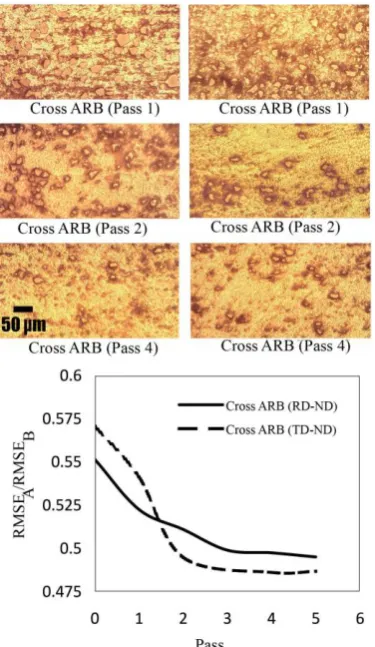
The as-roll bonded sheet was cut in half, and after surface preparation and pre-heating at 400 °C for 5 minutes, the roll bonding operation was repeated up to 5 cycles. In this case, however, after each cycle, the sheet was rotated by an angle of 90° in the same direction for the next cycle. The results are shown in Fig. 5 and it is evident that by increasing ARB pass number, there is an enhancement in the particle distribution. However, as expected, obtaining a homogeneous distribution of particles along TD is more rapid compared to the aforementioned ARB techniques. The stretching of the sheets along TD helps to attain rapid particle distribution along TD.
4.4. Comparing the ARB techniques
The evolution of the RMSEA/RMSEB parameter
versus ARB pass number is shown collectively in Fig. 6 for all of the ARB techniques used in this work. It can be seen that while various techniques show some differences at low cycles of ARB, the values of RMSEA/RMSEB
Cold ARB and Cross ARB was reported even after 8 passes as determined by other techniques [15]. This reveals that the proposed method [16] has better applicability for analyzing the composite microstructures.
Fig. 5. Optical micrographs and the RMSEA/RMSEB
parameter versus ARB pass number for the Cross ARB technique.
Fig. 6. Evolution of the RMSEA/RMSEB parameter
versus ARB pass number.
4.5. Mechanical properties
From engineering stress-strain curves shown in Fig. 7, it can be seen that the as-roll bonded sheet has ~ 40 MPa higher tensile strength compared to the initial aluminum sheet. This increase can be related to the elongation of grains and the development of substructure during roll bonding at 400 °C due to work hardening and dynamic recovery [23-25]. The presence of B4C particles
might also result in composite strengthening effects. However, the stress-strain curves reveal that the elongation to failure of the initial aluminum sheet and the as-roll bonded sheet is ~ 28.7% and 1.2%, respectively. The latter value might be explained by the poor bonding between the matrix and B4C particles.
Fig. 7. Tensile stress-strain curves of the composite sheets.
5. Conclusions
A new computational method based on MATLAB was used to study the effects of different parameters on the homogeneity of composites produced by accumulative roll bonding (ARB) process. The following conclusions can be drawn from this study: (1) The degree of particle agglomeration and clustering decreased with an increase in pass number, and after enough passes, appreciable homogeneity was obtained in both longitudinal and transverse directions concerning the rolling direction.
(2) The rolling temperature did not have any tangible effect on the distribution of particles. The cross accumulative roll bonding resulted in obtaining a faster homogeneity in the transverse direction. However, after enough passes, the homogeneity level in all methods led to a common value.
(3) Rolling at room temperature (Cold ARB) significantly enhanced the tensile strength of the composite sheets compared to rolling at elevated temperatures (Hot ARB). This is related to the strain hardening during rolling at room temperature and subsequent development of fine grains at high ARB cycles.
(4) For all processing routes, the tensile ductility was poor, which was connected to the poor bonding between particles and matrix. By increasing the ARB pass number, the homogeneity of particle distribution and their bond with the matrix enhanced, which in turn to ductility properties.
Acknowledgements
The authors would like to greatly thank the members of the Advanced Steels and Thermomechanically Processed Engineering Materials Laboratory for their help and support. Financial support by the University of Tehran is also gratefully acknowledged.
References
[1] P. Asadi, M. K. Besharati Givi, K. Abrinia, M. Taherishargh, and R. Salekrostam, “Effects of SiC particle size
and process parameters on the microstructure and hardness of AZ91/SiC composite layer fabricated by FSP”, Journal of Materials Engineering and Performance, Vol. 20, No. 9, pp. 1554-1562, (2011).
[2] H. Mirzadeh, “Quantification of the strengthening effect of reinforcements during hot deformation of aluminum-based composites”, Materials and Design, Vol. 65, No. 1, pp. 80-82, (2015).
[3] M. Rezayat, M. R. Bahremand, M. H. Parsa, H. Mirzadeh, and J.M. Cabrera, “Modification of As-cast Al-Mg/B4C composite by addition of Zr”, Journal of Alloys and Compounds, Vol. 685, No. 1, pp. 70-77, (2016).
[4] R. Zamani, H. Mirzadeh, and M. Emamy, “Magnificent Grain Refinement of Al-Mg2Si Composite by Hot Rolling”,
Journal of Ultrafine Grained and Nanostructured Materials, Vol. 51, No. 1, pp. 71-76, (2018).
[5] M. Rabiee, H. Mirzadeh, and A. Ataie, “Unraveling the Effects of Process Control Agents on Mechanical Alloying of Nanostructured Cu-Fe Alloy”, Journal of Ultrafine Grained and Nanostructured Materials, Vol. 49, No. 1, pp. 17-21, (2016).
[6] R. Zamani, H. Mirzadeh, and M. Emamy, “Mechanical properties of a hot deformed Al-Mg2Si in-situ composite”, Materials Science and Engineering A, Vol. 726, No. 1, pp. 10-17, (2018).
[7] M. Rabiee, H. Mirzadeh, and A. Ataie, “Processing of Cu-Fe and Cu-Fe-SiC Nanocomposites by Mechanical Alloying”, Advanced Powder Technology, Vol. 28, No. 8, pp. 1882-1887, (2017).
[8] Gh. Faraji, and P. Asadi, “Characterization of AZ91/alumina nanocomposite produced by FSP”, Materials Science and Engineering A, Vol. 528, No. 6, pp. 2431-2440, (2011). [9] M. Bahrami, K. Dehghani, and M. K.
technique”, Materials and Design, Vol. 53, No. 1, pp. 217-225, (2014).
[10] N. Mohammad Nejad Fard, H. Mirzadeh, M. Rezayat, and J. M. Cabrera, “Accumulative Roll Bonding of Aluminum/Stainless Steel Sheets”, Journal of Ultrafine Grained and Nanostructured Materials, Vol. 50, No. 1, pp. 1-5, (2017).
[11] H. R. Akramifard, H. Mirzadeh, and M. H. Parsa, “Microstructural Evolution of Roll Bonded Al-Clad Stainless Steel Sheets at Elevated Temperatures”, International Journal of ISSI, Vol. 13, No. 1, pp.38-44, (2016).
[12] M. Alizadeh, M. H. Paydar, D. Terada, and N. Tsuji, “Effect of SiC particles on the microstructure evolution and mechanical properties of aluminum during ARB process”, Materials Science and Engineering A, Vol. 540, No. 1, pp. 13-23, (2012).
[13] R. Jamaati, M. R. Toroghinejad, J. Dutkiewicz, and J. A. Szpunar, “Investigation of nanostructured Al/Al2O3 composite produced by accumulative roll bonding process”, Materials and Design, Vol. 35, No. 1, pp. 37-42, (2012).
[14] M. Rezayat, A. Akbarzdeh, and A. Owhadi, “Fabrication of High-Strength Al/SiCp Nanocomposite Sheets by Accumulative Roll Bonding”, Metallurgical and Materials Transactions A, Vol. 43, No. 6, pp. 2085-2093, (2012). [15] M. Alizadeh, and E. Salahinejad, “A
comparative study on metal–matrix composites fabricated by conventional and cross accumulative roll-bonding processes”, Journal of Alloys and Compounds, Vol. 620, No. 1, pp. 180-184, (2015).
[16] M. Rezayat, M. Gharechomaghlu, H. Mirzadeh, and M. H. Parsa, “A comprehensive approach for quantitative characterization and modeling of composite microstructures”, Applied Mathematical Modelling, Vol. 40, No. 19-20, pp. 8826-8831, (2016).
[17] H. Mirzadeh and A. Najafizadeh, “Aging kinetics of 17-4 PH stainless steel”, Materials Chemistry and Physics, Vol. 116, No. 1, pp. 119-124, (2009).
[18] H. Mirzadeh, J.M. Cabrera, A. Najafizadeh, and P.R. Calvillo, “EBSD Study of a Hot Deformed Austenitic Stainless Steel”, Materials Science and Engineering A, Vol. 538, No. 1, pp. 236-245, (2012).
[19] M. Naghizadeh, and H. Mirzadeh, “Microstructural Modeling the kinetics of deformation-induced martensitic transformation in AISI 316 metastable austenitic stainless steel”, Vacuum, Vol. 157, No. 1, pp. 243-248, (2018).
[20] K. Mori, N. Bay, L. Fratini, F. Micari, and A. E. Tekkaya, “Joining by plastic deformation”, CIRP Annals, Vol. 62, No. 2, pp. 673-694, (2013).
[21] H. R. Akramifard, H. Mirzadeh, and M. H. Parsa, “Cladding of aluminum on AISI 304L stainless steel by cold roll bonding: Mechanism, microstructure, and mechanical properties”, Materials Science and Engineering A, Vol. 613, No. 1, pp. 232-239, (2014).
[22] H. R. Akramifard, H. Mirzadeh, M. H. Parsa, “Estimating interface bonding strength in clad sheets based on tensile test results”, Materials and Design, Vol. 64, No. 1, pp. 307-309, (2014).
[23] M. Abo-Elkhier, “Modeling of high-temperature deformation of commercial pure aluminum (1050)”, Journal of Materials Engineering and Performance, Vol. 13, No. 2, pp. 241-247, (2004). [24] H. Mirzadeh, “Simple Physically-Based
Constitutive Equations for Hot Deformation of 2024 and 7075 Aluminum Alloys”, Transactions of Nonferrous Metals Society of China, Vol. 25, No. 5, pp. 1614-1618, (2015).
[26] R. Z. Valiev, and T. G. Langdon, “Achieving exceptional grain refinement through severe plastic deformation: new approaches for improving the processing technology”, Metallurgical and Materials Transactions A, Vol. 42, No. 10, pp. 2942-2951, (2011).
[27] A. Sanchuli, M. H. Parsa, H. M. Ghasemi, H. Mirzadeh, “Mathematical modeling of energy transfer to sheet surface layers and optimization of roll bonding strength”,
International Journal of Materials Research, Vol. 106, No. 12, pp. 1250-1257, (2015).
[28] A. Khajezade, M. H. Parsa, H. Mirzadeh, M. Montazeri-Pour, “Grain refinement efficiency of multi-axial incremental forging and shearing: A Crystal Plasticity Analysis”, Journal of Ultrafine Grained and Nanostructured Materials, Vol. 49, No. 1, pp. 11-16, (2016).
How to cite this paper:
Mahsa Gharechomaghlu and Hamed Mirzadeh, “ Computational evaluation of the homogeneity of composites processed by accumulative roll bonding (ARB)”, Journal of Computational and Applied Research in Mechanical Engineering, Vol. 9, No. 2, pp. 351-358, (2019).