Effect of Self-Efficacy and Job Satisfaction on Individual Citizenship Behavior and Its
Impact on Professional Commitments
Author’s Details: (1)
Maya Ida Kesumawatie (2)Ujianto (3)Siti Mujanah 1
Doctoral Student in Economics Doctoral Program 2lecturer of S-3 Doctoral Program in Economics 3lecturer of S-3 Doctoral Program in Economics Agust 17, 1945 University, Surabaya, East Java, Indonesia
Manuscript type: Research paper.
Research aims: This research study intends to analyze exactly how contextual variables, including self-efficacy and job satisfaction, affect individual citizenship behavior and have an impact on the professional commitment of lecturers at the College of Economics in East Java, Indonesia.
Design/ Approach/ Method : This research study utilizes a quantitative method to discuss the connection between variables. Information from 170 participants was gathered and after that, evaluated with the Architectural Equational Modeling (SEM) method.
Research findings: The results show that Self Efficacy has no critical impact on ICB, and Professional Commitment has an irrelevant effect on ICB, ICB substantially affects Professional Commitment, Self Efficacy has no extensive impact on Professional Commitment, Job Satisfaction significantly affects Professional Commitment and unimportant effect on Professional Commitment.
Theoretical contributions/ Originality: This study extends previous work by investigating the influence of blessed variables in which the results of this study can be input for decision-makers for the development of Private Colleges especially the College of Economics in order to pay more attention to the professional commitment of lecturers in dealing with changes that are so fast and complex in the progress of Information and Communication Technology and globalization.
Practitioner/ Policy implications: This research study offers understanding right into exactly how the impact of self-efficacy and complete task satisfaction on Private Citizenship Habits and Expert Dedication will be the primary emphasis of this research study.
Research limitation: This research study concentrates on the secondary school from business economics in East Java District, Indonesia. For that reason, the generalization from searchings for can be restricted. Future research studies have to consist of task complete satisfaction in a bigger and much more varied example.
Keywords: Self-efficacy, job satisfaction, individual civic behavior, professional commitment.
1. Introduction
Lecturers in carrying out their duties as educators, professionalism is needed by lecturers with full responsibility and always maintain a conducive academic atmosphere. Lecturers need the availability of infrastructure in learning in the implementation of learning. The problem faced by lecturers today is the rapid development of technology, especially technology that supports the tri dharma of higher education, namely learning, research, and community service. So to develop professional skills and career development of lecturers to improve professionalism will encounter many obstacles. Globalization requires lecturers to develop their abilities in the field of IT-based learning. For that reason, lecturers also need to have the ability to innovate learning more than in their areas.
The job satisfaction of lecturers and the professional commitment of educators become very important in the field of education. This shows that task complete satisfaction and expert dedication are adjoined (Sunardi, 2017). There‘re precursor elements that have a considerable impact on worker task complete satisfaction, including factors related to work, factors related to work conditions, considerations about coworkers, factors related to supervision, factors related to promotion, and factors related to salary. The lecturers will continue to work in higher education, as well as a high commitment to lecturers. The opposite condition is the low satisfaction with external factors, which causes low performance, loyalty, and opens up opportunities to find other jobs to fulfill the satisfaction.
Previous research conducted on variables related to the effect of Self-Efficacy, Job Satisfaction on Individual Citizenship Behavior and Professional Commitment, researchers found several research results including H. Shamina (2014) who examined the effect from task complete satisfaction on expert dedication in college with the number of respondents was 250 lecturers from the University of Bharathiar Coimbatore. Similar research was also conducted by Debora E. Purba, Janneke K. Oostrom, Henk T. Van der Molen and Marise Ph Birthed (2015) on Character and business citizenship habits in Indonesia : The mediating impact from affective dedication of 300 Indonesian cement employees with seven the factory in West Java also Liqayat Bashir (2017) about Job Satisfaction of Teachers in Relation to Professional 300 Punjab teachers in India and Sarah Basu (2016) who researched Professional Commitment and Job Satisfaction among Secondary School Teachers as many as 98 Bareilly District Middle School teachers. Some research gaps that researchers found from previous research can be used as a reference for research that researchers will do and based on the research gaps, the influence of self-efficacy and job satisfaction on individual Citizenship Behavior and Professional Commitment will be the main focus in this study.
2. Literature Review and Hypotheses Development 2.1Paradigma theory
Theories and concepts used as a reference to explain the variables to be studied the variables of self-efficacy, job satisfaction, Individual Citizenship Behavior, and Professional Commitment. In the aggregate that the theories and concepts put forward cover these research variables from the perspective of organizational behavior theory. This research is explanatory research in which the focus in this study is how the effect of self-efficacy, and job satisfaction on Individual Citizenship Behavior and Professional Commitment of College Lecturers in Economics in East Java by using the theory of Self-Efficacy (Bandura (1997), where it is a belief on one's ability to do tasks.
subscription in the occupation (Mowday et alia., 1979). As one of the important factors in explaining work behavior, Professional Commitment is one of the attractive topics that get a lot of attention from academics and practitioners.
2.2Grand Theory
Theories and concepts used as a reference to explain the variables to be studied the variables of self-efficacy, job satisfaction, Individual Citizenship Behavior, and Professional Commitment. In the aggregate that the theories and concepts put forward cover these research variables from the perspective of organizational behavior theory. Complete satisfaction or discontentment really felt by people is the outcome from contrasts or spaces made by oneself to different examples that he‘s acquired from the job and that ends up being his assumptions. The private will really feel pleased if the distinction of space in between the individual's requirements and what is acquired from a little task, or else discontentment will be gotten in touch with by the private if the distinction or inconsistency in between the individual's requirements with what is made from a remarkable task.
Job satisfaction and dissatisfaction are two different things. According to this theory, job characteristics can be grouped into two categories, one called Dissatisfier or hygiene factors, and the other is called satisfier or motivator. The importance of an intelligent understanding of human behavior in determining organizational effectiveness has been felt in the twenty-first century today by every organization, both profit-oriented and non-profit. In today's business world, which is increasingly competitive, demanding that everyone is running a business requires creative and innovative management. Although creative and innovative business management efforts are very important to do to improve organizational performance.
2.3Theoretical Framework and Hypotheses Development
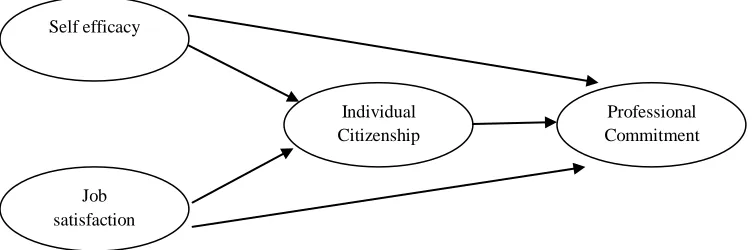
Based on several literature studies and the results of the empirical studies described above, the conceptual framework can be illustrated in this study as follows:
Figure 1. Conceptual framework
Based upon the formula from the issue, research study goals, literature review and conceptual framework proposed, the following hypothesis is proposed H1: Self-Efficacy has a significant effect on the Individual Citizenship Behavior of the College of Economics lecturers in East Java, H2: Self-Efficacy has a significant effect on the Professional Commitment of School lecturers College of Economics in East Java, H3: Job Satisfaction has a significant effect on Individual Citizenship Behavior Lecturers at the College of Economics in East Java, H4: Job Satisfaction has a significant effect on the Professional Commitment of College of Economics Lecturers in East Java and H5: Individual Citizenship Behavior influences significantly towards the Professional Commitment of College Lecturers of Economics in East Java.
3. Research Methodology
To operationalize this research construct, operational definitions and actions are developed as follows. Self-efficacy is a lecturer's assessment of the confidence in his own abilities and the belief in the success that is always achieved, which makes him work harder and always produce the best. Measurement of self-efficacy
Self efficacy
Job satisfaction
Individual Citizenship BEHAVIOR
variables based on indicators of the development of the dimensions according to Bandura, namely the Dimension Magnitude / Level, Generality Dimension and Strength dimensions.
Job Satisfaction is defined as a match between employee expectations and the reality obtained at work. Job satisfaction in this study is the job satisfaction of lecturers on their work as a lecturer in the School of Economics in East Java. The indicator to measure this variable refers to Wexley and Yukl (1977), namely the gap between the difference between what should be and the reality that can be felt, Justice is the level of fairness or injustice obtained in carrying out the task, a supportive work environment, work mentally challenging, namely liking work that provides an opportunity to use the skills, opportunities, and abilities in offering work and promotion, which is carried out on the basis of work performance.
Individual Citizenship Behavior is specified as private habits that are totally free, is not straight or clearly associated with the benefit system, and can improve the efficient performance of the company. There‘re four signs from ICB industrialized by William and Anderson (1991) Altruism, Courtesy, Peacekeeping, Cheerleading. Commitment to the profession is the involvement of individuals in having identification and values and loyalty to the profession they carry. This variable is measured through five dimensions, which are further detailed in the indicator. The five dimensions referred to are Education and training, Responsibilities, Code of Ethics, Professional Organizations and Life Careers.
The population in this study are lecturers who do not yet have functional functions. According to hair et. (1998), The recommended number of samples for Structural Equation analysis ranges from 100 to 200 or more but should not exceed 400 because the model will be very sensitive. Therefore, the example was taken utilizing the Slovin equation (Umar 2004). The quantity of tests is resolved to utilize the Slovin equation as pursues:
Information:
n = Number of Samples N = Number of population
e = Percent of allowance for inaccuracy due to sampling errors that can still be tolerated (in this study an estimated 5%)
From these calculations, a total of 170 lecturer samples were obtained. The dimension range is equated right into Indonesian, and back-to-back translations are put on guarantee a high degree from uniformity. Dimension products exist where participants are asked to price their understandings on a 5-point Likert range, varying from 1 (highly disagree) to 5 (highly concur). The analytical tool used is Structural Equational Modeling with the help of AMOS 24.0 Software.
4 Data Analysis and Findings 4.1 Measurement Model Analysis
The construct in the SEM technique is called the latent variable (the variable that cannot be measured directly), and the indicator is the observed variable (the observed variable, as the operationalization of the measurement of the latent variable). After the constructs of the constructs and indicators are stated in the model, then using the SEM procedure, a validity and reliability test is performed. The calculation results show that the value of t (indicated by the value of CR) for loading each indicator is greater than the critical value at the Significance level of 0.05 (Critical value = 1.96) and the probability value is smaller than α (0.05) or loading factor value> 0.5, so it can be concluded that all indicator variables are significantly related to the five constructs that are determined. All indicators can be declared valid. Construct reliability of all variables based on the calculation results, is known to be above the recommended value of 0.7. Thus all indicators for each construct are declared reliable.
4.2Structural Model Analysis
understood that from the 8 requirements utilized to evaluate whether a design is possible or otherwise, 7 requirements are satisfied, and one limited criterion, therefore the design can be stated to be considerable, which implies that there‘re a suit in between design and information.
Tabel 1. Goodness of fit test
Criteria Cut-off value The calculation results Remarks
Chi Square Expected to be small
( < χ2 dengan df = 578 is 628,409)
Prob. > 0,05
628,49 Prob.= 0,072
Good
Sig. Probability ≥ 0,05 0,072 Good
RMSEA ≤ 0,08 0,023 Good
GFI ≥ 0,90 0,849 Marginal
AGFI ≥ 0,90 0,817 Marginal
CMIN/DF ≤ 2 or 3 1,087 Good
TLI ≥ 0,90 0,985 Good
NFI ≥ 0,90 0,858 Marginal
The following stage is to test the theories created in the model. The path coefficient test results are presented below, and from the corresponding model, each path coefficient can be implemented.
Table 2. Hypothesis Testing
Hypothesis Causality relationship Path coefficient
Standard
Error CR Probability
H1 ICB <--- SE 0.312 0.171 1.823 0.068
H2 ICB <--- JS 0.098 0.061 1.617 0.106
H3 PC <--- ICB 0.204 0.088 2.323 0.020
H4 PC <--- SE 0.305 0.169 1.807 0.071
H5 PC <--- JS 0.112 0.054 2.060 0.039
From the count, results got an examination that Self-Efficacy has no critical impact on Individual Citizenship Behavior in the College of Economics in East Java. The estimation consequences of the Self-Efficacy variable parameters for the Individual Citizenship Behavior show unimportant outcomes, which can be seen from the positive way coefficient of 0.312 with C.R. of 1,823 and got a critical likelihood (p) of 0.068 higher than the degree of Significance (ά) expected of 0.05. Proficient Commitment insignificantly affects Individual Citizenship Behavior at the College of Economics in East Java. The estimation aftereffects of the parameters of the Professional Commitment towards Individual Citizenship Behavior demonstrated inconsequential outcomes, which can be seen from the positive way coefficient of 0.098 with C.R. equivalent to 1.617 and a critical likelihood (p) of 0.106 is higher than the degree of Significance (ά) expected of 0.05.
way coefficient of 0.112 with C.R. of 2.060 and got an extensive likelihood (p) of 0.039 littler than the degree of Significance (ά) expected of 0.05.
4.3Indirect Effect
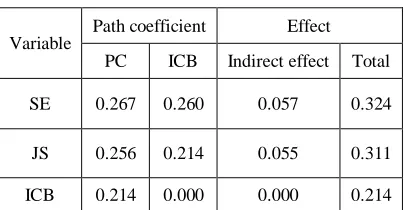
Path analysis is used to assess the direct and indirect effects between exogenous and endogenous variables through intervening variables. The calculation results from the report are as follows:
Table 3. Path coefficient
Variable
Path coefficient Effect
PC ICB Indirect effect Total
SE 0.267 0.260 0.057 0.324
JS 0.256 0.214 0.055 0.311
ICB 0.214 0.000 0.000 0.214
From the calculation results, obtained analysis is known that the direct effect given self-efficacy on the professional commitment of 0.267. While the indirect effect of self-efficacy through the Individual Citizenship Behavior on professional commitment is the multiplication between the beta value of the self-efficacy variable against the Individual Citizenship Behavior with the Individual Citizenship Behavior beta value of professional commitment Namely: 0.260 x 0.214 = 0.056. Then the total effect given self-efficacy on professional commitment is the direct effect coupled with the indirect effect, namely: 0.260 + 0.057 = 0.323. Based on the calculation above, it is known that the value of direct influence is 0.267 and the indirect effect is 0.056, which means that the value of indirect effect is smaller than the value of direct influence, this result shows job satisfaction that indirectly Self-Efficacy through Individual Citizenship Behavior has an indirect effect significant to professional commitment.
The direct effect of job satisfaction on professional commitment is 0.256. While the indirect effect of job satisfaction through Individual Citizenship Behavior on professional commitment is the multiplication of the beta value of job satisfaction on Individual Citizenship Behavior with the Individual Citizenship Behavior beta value on professional commitment, 0.256 x 0.214 = 0.046. Then the total effect given by job satisfaction on professional commitment is the straight impact combined with the indirect impact, specifically : 0. 256 + 0. 046 = 0. 302. Based upon the over computation outcomes acquired the worth from the straight impact from 0. 256 and indirect impact from 0. 046 Which implies that the worth from indirect impact is smaller sized compared to the worth from straight impact, these results indicate job satisfaction that indirectly jobs satisfaction through Individual Citizenship Behavior has an indirect effect significant to professional commitment.
5 Discussion
problems that occur, especially those related to materials and materials as well as the development or progress of science and technology because it is the duty of lecturers to provide up-to-date knowledge to students, it will be increasing it is likely to do a good job even exceeding what should be done or exceeding the obligations imposed by universities.
Self-efficacy has a positive and not significant effect on professional commitment. This shows job satisfaction that the positive self-efficacy of the lecturer cannot contribute to the lecturer professional. Based on the value of the biggest loading factor, self-efficacy is characterized by lecturers' confidence in their abilities related to IT development in the learning model when there is SPADA namely the online learning system held by the government requires lecturers to innovate in learning especially with the use of Information Communication Technology. Lecturers of the College of Economics like assignments even though the task is difficult, which shows job satisfaction that lecturers must complete their IT-based assignments even though the lecturer concerned is an economics lecturer. This indicates that the better the self-efficacy of lecturers who are appointed to job satisfaction with the nature of Strength, the lecturer believes in his ability to prove that a lecturer is always trying new things, thinking open to new ideas or thoughts and easily adapting to new situations or circumstances, this is very in accordance with the task of a lecturer who must update or update a lot of problems that occur, especially those related to materials and materials as well as the development or progress of science and technology because it is the duty of lecturers to provide up-to-date knowledge to students, it will be increasing it is likely to do a good job even exceeding what should be done or exceeding the obligations imposed by universities.
Job satisfaction has a positive and not significant effect on Individual Citizenship Behavior. This shows job satisfaction that lecturers who feel job satisfaction will not be compelled to show the behavior. Based on the loading factor of the job satisfaction variable with the Gap indicator. From the results of the description of the variable job satisfaction with a gap indicating job satisfaction answers from respondents agreed by 27%. This indicates that the lecturer earns income as a lecturer profession, not in accordance with his expectations. Higher education provides salary based on merit pay, which is getting a salary based on performance, so if the lecturer actively conducts tri dharma of higher education, he will get income according to his expectations. This makes many lecturers who do not do Individual Citizenship Behavior is a lecturer will find it challenging to do work that exceeds the demands of the tertiary institution. Lecturers must apply knowledge, abilities, and skills for the advancement of higher education. Meanwhile, in terms of age, the dominant respondents aged 46-55 years and older indicate wisdom in carrying out and enforcing work on academic rules and relationships or relationships with fellow lecturers, superiors, and students. Perfect maturity in optimizing the opportunities available in developing themselves and the moral responsibilities that are carried out in carrying out the profession as a lecturer.
Job Satisfaction has a positive and significant impact on Professional Commitment, and this shows job satisfaction that positive job satisfaction possessed by lecturers can contribute to higher education. This finding supports the results of previous studies conducted by this study, pointing to job satisfaction and the effect between job satisfaction and professional commitment. Liqayat Bashir (2017); Sarah Basu (2016); Shamima (2014); Yang et., al (2012); Emami (2012). There is a significant positive relationship between job satisfaction and professional commitment. This proves that job satisfaction and professional commitment are significantly interrelated. These findings support the results of previous studies conducted by this study, pointing to job satisfaction effects between Individual Citizenship Behavior with professional commitment. Purba et., al (2015); Özdem (2012); Rika (2017); Bogler (2004), a positive and significant relationship between professional commitment and Individual Citizenship Behavior.
6 Conclusion
Based on previous studies and discussions, this can be wrapped up that self-efficacy belongs to the expert dedication, where if somebody has high self-efficacy, this has the tendency to be a dedication to what he‘s doing. Bandura (1997) exposed that people with high self-efficacy would accomplish much better efficiency because these people have powerful inspiration, remove objectives, are mentally steady, and have the capability to offer the very best efficiency. Success in self-leadership depends on the ability to coordinate intentions, thoughts, and actions. With the right support, individuals can monitor and control their own behavior (Robbins, 2006). It can be concluded that one of the elements or factors that can increase commitment to the profession is self-leadership. Therefore, if a lecturer applies self-leadership to himself well and maximally, then it will have a positive effect and is directly proportional to professional commitment.
There are two factors that affect commitment to the profession, namely internal factors and external factors. Internal factors are more directed at teachers themselves, both individually and as institutions, as a profession that demands greater awareness and responsibility in carrying out their roles and functions as educators. External factors in this context are more related to how government policies encourage policy and atmosphere that can stimulate and produce professional lecturers. In order to increase the commitment of the professors' professions, lecturer competencies are needed on yearly or semi-annual job records as a method to screen, empower, and enhance lecturer self-confidence.
REFERENCES
i. Bandura, A.1977. Self-efficacy:Toward an unifying theory of behavioral change. Psychological Review, 84, 191-215
ii. Bandura. 1997. Self Efficacy The Exercise of Control. New York : W.H. freean and Company.
iii. Bashir, Liqayat. 2017.Job Satisfaction of Teacher In Relation to Professional. The International Journal of Indian Psychology ISSN 2348-5396 (e) | ISSN: 2349-3429 (p) Volume 4, Issue 4, DIP: 18.01.007/20170404 DOI: 10.25215/0404.007. pp 52-59
iv. Bogler, Ronit & Anit Somech. 2004. Influence of teacher empowerment on teachers organizational commitment, professional commitment and organizational citizenship behavior in schools. Teaching and Teacher Education 20. Elsevier. doi:10.1016/j.tate.2004.02.003. pp. 277–289
v. Emami, Mostafa. 2012. Investigating the job satisfaction and professional commitment. Elixir Human Resource Mgmt. 48 (2012).ISSN : 2229-712X. pp 9652-965.
vi. Herminingsih, Anik. 2012. Spiritualitas Dan Kepuasan Kerja Sebagai Faktor Organizational Citizenship Behavior (OCB) ( Spirituality and Job Satisfaction as a factor of Organizational Citizenship Behavior (OCB)). Jurnal Ilmu Ekonomi dan Sosial, Jilid 1, Nomor 2, November 2012, hlm. 126-1
viii. Intaraprasong, Bhusita, Warunee Dityen , and Peera Krugkrunjit, Thanya Subhadrabandhu. 2012. Job Satisfaction and Organizational Citizenship Behavior of Personnel at One University Hospital in Thailand. Journal Med Assoc Thai;Vol. 95, No. 6: pp:102- 108.
ix. Kamaruddin, W. N. W., & Ibrahim, M. S. (2010). Lecturer efficacy, professional and general competencies of Malaysian polytechnic technical lecturers. Proceedings of the Regional Conference on Engineering Education & Research in Higher Education.
x. Özdem, Güven. 2012. The Relationship Between The Organizational Citizenship Behaviors and The Organizational and Profesional Commitment of Secondari School Teachers. Journal of Global Strategic Management. Vol 6 No.2. pp 47-64
xi. Purba, Debora E., Janneke K. Oostrom, Henk T. Van der Molen dan Marise Ph Born .2015. Personality and organizational citizenship behavior in Indonesia : The mediating effect of affective commitment. Asian Business & Management advance online publication, 28 January 2015; doi:10.1057/abm.2014.20. pp 1- 24
xii.Prasetio, A. P., Azis, E., Fadhilah, D. D., & Fauziah, A. F. (2017). Lecturers’ Professional Competency and Students’ Academic Performance in Indonesia Higher Education. International Journal of Human Resource Studies. https://doi.org/10.5296/ijhrs.v7i1.10902
xiii. Robbins, Stephen P. & Timothy A. Judge. (2008). Perilaku Organisasi Edisi ke-12, Jakarta: Salemba Empat. ISBN : 978979691459
xiv.Robbins, Stephen P. 2006. Perilaku Organisasi : Kontroversi, Aplikasi, Edisi Bahasa Indonesia, Jilid 2. Jakarta : PT Prehallindo. ISBN : 0022-2836 (Print)\r0022-2836 (Linking). DOI : 10.1006/jmbi.1999.3279 xv. Rubiono, G., & Finahari, N. (2017). Dosen: Profil-profil Sederhana dalam Profesi yang Rumit. (Lecturer:
Simple profiles in complicated professions) JAS-PT Jurnal Analisis Sistem Pendidikan Tinggi. https://doi.org/10.36339/jaspt.v1i1.35
xvi.Sambung, Roby. Armanu Thoyib, Eka Afnan Troena, Surachman. 2012. Pengaruh Kepuasan Kerja, Komitmen Organisasional, Kepribadian dan Profesionalisme Dosen terhadap Organizational Citizenship Behaviour serta Dampaknya terhadap Kinerja Dosen (Studi pada Universitas Palangka Raya) (Effect of Job Satisfaction, Organizational Commitment, Personality and Professionalism of Lecturers on Organizational Citizenship Behavior and Its Impact on Lecturer Performance (Study at Palangka Raya University). Jurnal Aplikasi Manajemen. ISSN : 1693-5241. Pp : 13-20. DOI: http://dx.doi.org/10.18202/jam.v10i1.396
xvii. Rika, Agustina Maulidatur & Tatiek Nurhayati. 2017. Improving Professional Competence and Knowledge Sharing Based on Organizational Citizenship Behavior Toward Human Resources Performance. International Jurnal of Islamic Business Ethics (IJIBE) Vol. 2 No. 2 September 2017. Pp. 314-331
xviii. Basu, Sarah. 2016. Professional Commitment and Job Satisfaction among Secondary School Teachers. Educational Quest: An Int. J. of Education and Applied Social Sciences Vol 7 l Issue 3 l December 2016. Pp 255-259
xix.Shamina, H. 2014. Impact of job satisfaction on professional commitment in higher education. GALAXY International Interdisciplinary Research Journal. GIIRJ, Vol.2 (2), FEBRUARY (2014). ISSN 2347-6915. pp 1-11