
Instance Segmentation in Videos
Suman Saha
A Thesis Submitted in Partial Fulfilment of the Requirements for the Degree of
Doctor of Philosophy in
Computer Science and Mathematics
Department of Computing and Communication Technologies Artificial Intelligence and Vision Research Group School of Engineering, Computing and Mathematics
Oxford Brookes University
Supervised by :
Prof. Fabio Cuzzolin, Prof. Nigel Crook and Dr. Tjeerd Olde Scheper
proposed publication must seek copyright release from the author.
Professor Mubarak Shah (External Examiner)
Director of Center for Research in Computer Vision (CRCV) University of Central Florida
Professor Andrea Vedaldi (External Examiner) Visual Geometry Group (VGG)
University of Oxford
Dr Faye R Mitchell (Internal Examiner) School of Engineering, Computing and Mathematics
Oxford Brookes University
This dissertation is submitted for the degree of Doctor of Philosophy at The Oxford Brookes University of United Kingdom. The research presented herein was undertaken under the kind supervision of Prof. Fabio Cuzzolin, Prof. Nigel Crook and Dr. Tjeerd Olde Scheper between September 2014 and January 2018. To the best of my knowledge, this work is original, excluding those previous works for which acknowledgement and reference have been made. Neither this, nor any substantially similar dissertation has been or is being submitted for any other degree, diploma or qualification at any other university. Part of this work are published in the following publications:
• S. Saha, G. Singh, M. Sapienza, P. H. S. Torr, and F. Cuzzolin, Deep Learning for Detecting Multiple Space-time Action Tubes in Videos, proceedings of the British Machine Vision Conference (BMVC) 2016.
• S. Saha, G. Singh, M. Sapienza, P. H. Torr, and F. Cuzzolin, Spatio-temporal Human Action Localisation and Instance Segmentation in Temporally Untrimmed Videos, arXiv preprint arXiv:1707.07213,2017.
• S. Saha, G. Singh, and F. Cuzzolin, AMTnet: Action-micro-tube Regression by End-to-end Trainable Deep Architecture, proceedings of the IEEE Inter-national Conference on Computer Vision (ICCV) 2017.
• G. Singh, S. Saha, and F. Cuzzolin, Online Real-time Multiple Spatio-temporal Action Localisation and Prediction on a Single Platform, proceedings of the IEEE International Conference on Computer Vision (ICCV) 2017.
The author has contributed to the following publications during his PhD, but they are not included in this thesis:
• S. Saha, R. Navarathna, L. Helminger, R. Weber, Unsupervised Deep Rep-resentations for Learning Audience Facial Behaviors, Computer Vision and Pattern Recognition (CVPR) workshop, Salt Lake City United States, June 2018.
• F. Cuzzolin, M. Sapienza, P. Esser, S. Saha, M. M. Franssen, J. Collett, H. Dawes, Metric learning for Parkinsonian identification from IMU gait mea-surements, Journal Gait & Posture 54 (2017): 127-132.
In memory of my father Late Shri Gour Chandra Saha With love and eternal appreciation
I would like to dedicate this work to my parents, sisters, wife Sunita (Tika) and my son Aman. Without such loving and caring people around me, it would not have been possible for me to learn both Science and gen-eral aspects of life in the course of these three and a half years journey.
“I believe that at the end of the century the use of words and general educated opinion will have altered so much that one will be able to speak of machines thinking without expecting to be contradicted.”
[Alan Turing, Computing machinery and intelligence]
First and foremost I would like to express my heartfelt thanks to my supervi-sors Prof. Fabio Cuzzolin, Prof. Nigel Crook and Dr. Tjeerd Olde Scheper for providing such an exceptional opportunity for me to pursue a doctorate in Com-puter Vision! I also thank my supervisors for their invaluable time, guidance and support. In particular, Fabio’s strive for excellence, openness and positive criticism always inspire me to push myself beyond my limits and allow me to gradually improve my scientific, technical and academic skills through several projects. Moreover, human values like elegance and generosity that I found in Prof. Cuzzolin has given me inspiration to work in the Artificial Intelligence and Vision Group, School of Engineering, Computing and Mathematics, Oxford Brookes University. Furthermore, I am grateful to Professor Philip H. S. Torr for allowing me to work in a close collaboration with the world renowned Torr Vision Group (TVG), the Department of Engineering Science, University of Oxford.
I would also like to thank my co-author Dr. Michael Sapienza for his time and effort during those long technical discussions at TVG lab. Also I am grateful to Dr. Sapienza for his consistent guidance, help and support throughout the first two years of my PhD. A special thanks to my lab mate and co-author Gurkirt Singh for his close collaboration and daily discussions led to several exciting works and three publications in BMVC 2016 and ICCV 2017 ( which are considered as the top ranked conferences in Computer Vision).
I want to thank: Cigdem Sengul and Tjeerd Olde Scheper for their invaluable guidance and support as research tutors; Jill Organ, Catherine Joyejob, Lorna Denby, Lynn Farrell, Amanda Holden who helped me in all administrative tasks; Gerald Roy for excellent technical, software and hardware support. I would like to thank the MSc students I guided during my PhD, Misbah Munir, Kurt Degiorgio, Stavros Gasparis, Manuele Di Maio, Shashwat Shukla (B. Tech. IIT Bombay, India). It was a great and valuable experience. I am grateful to all my fellow colleagues and friends I met over the past few years: Ruomei Yan, Jalawi Alshuduki, Cristian Roman, Luis Fuente Fernandez, Paul Sturgess, Basel Yousef, Bedour Alshaigy, Mireya Munoz Balbontin, Mohamed Idries, Alla Vovk, Will Guest, at the TDE department, School of Engineering, Computing and Mathematics, Oxford Brookes University.
My special thanks go to Dr. Romann Weber for offering me an internship at Disney Research Zurich (DRZ), Switzerland - it was really exciting! Many thanks to Romann for his invaluable time and guidance during those long hours
help and support: Rajitha Navarantha, Leonhard Helminger, Johannes Brand, Leon Palaic, Ivan Ovinnikov, Gerhard Rothlin. The experience I gained at DRZ is extremely valuable, and help me to understand and apply some very recent cutting-edge Deep Learning algorithms in Computer Vision domain.
Due acknowledgment goes to my MSc supervisors Dr. Ashutosh Natraj and Dr. Sonia Waharte for their time, advice and support during my MSc disser-tation, and for offering me to work as a research intern at the Department of Computer Science, University of Oxford. It is unthinkable for me to write ac-knowledgement without mentioning a few names of my colleagues I worked with for past few years at the Research and Development and Scientific Services di-vision, Tata Steel Limited, Jamshedpur, India. I am thankful to my Tata Steel colleagues for inspiring me to pursue a PhD: Dr Sumitesh Das, Dr Abhishek Raj, Dr. Raju Venkat Dasu, Dr. Shoaib Jameel. My heartfelt thanks go to Sumitesh Das (Chief of R&D Tata Steel Ltd. India) and Nagaraja B.N. (HOD Computer Science Dept. Siddaganga Polytechnic, India) for providing their references to support my PhD application at Oxford Brookes University, UK.
Last but not the least, I am thankful to my sisters and parents in India for their generosity; my friendDebleena Chaudhuri for her consistent moral support, and my wife Sunita for her unbounded patience!
With an exponential growth in the number of video capturing devices and digital video content, automatic video understanding is now at the forefront of computer vision research. This thesis presents a series of models for automatic human action detection in videos and also addresses the space-time action in-stance segmentation problem. Both action detection and inin-stance segmentation play vital roles in video understanding.
Firstly, we propose a novel human action detection approach based on a frame-level deep feature representation combined with a two-pass dynamic pro-gramming approach. The method obtains a frame-level action representation by leveraging recent advances in deep learning based action recognition and object detection methods. To combine the the complementary appearance and mo-tion cues, we introduce a new fusion technique which significantly improves the detection performance. Further, we cast the temporal action detection as two energy optimisation problems which are solved using Viterbi algorithm.
Exploiting a video-level representation further allows the network to learn the inter-frame temporal correspondence between action regions and it is bound to be a more optimal solution to the action detection problem than a frame-level representation. Secondly, we propose a novel deep network architecture which learns a video-level action representation by classifying and regressing 3D region proposals spanning two successive video frames. The proposed model is end-to-end trainable and can be jointly optimised for both proposal generation and action detection objectives in a single training step. We name our new network as“AMTnet” (ActionMicro-Tube regression Network). We further extend the AMTnet model by incorporating optical flow features to encode motion patterns of actions.
Finally, we address the problem of action instance segmentation in which multiple concurrent actions of the same class may be segmented out of an image sequence. By taking advantage of recent work on action foreground-background segmentation, we are able to associate each action tube with class-specific seg-mentations.
We demonstrate the performance of our proposed models on challenging ac-tion detecac-tion benchmarks achieving new state-of-the-art results across the board and significantly increasing detection speed at test time.
With an exponential growth in the number of video capturing devices and digital video content, automatic video understanding is now at the forefront of computer vision research. This thesis presents a series of models for automatic human action detection in videos. One of the models presented in this work also addresses action instance segmentation alongside detection. Both action detection and instance segmentation play vital roles in video understanding. Systems capable of detecting human actions have far-reaching applications such as Google-style video indexing and retrieval, autonomous driving, robot-assisted surgery, human-robot interaction, virtual reality gaming to name but a few.
Human action detection consists in classifying actions present in a video, such as “clapping”, “running”, and simultaneously predicting the spatial and temporal extents of these actions. The existing promising deep feature based approaches perform action detection at the cost of using expensive multi-stage detection frameworks and unsupervised region proposal algorithms. Moreover, either temporal detection is not addressed at all, or solved using an expensive sliding-window scheme. To overcome these issues, we propose a novel approach based on a frame-level deep feature representation combined with a two-pass dynamic programming approach. The method obtains a frame-level action rep-resentation by leveraging the two-steam CNN architecture where an appearance (RGB) and a motion (optical flow) stream are trained separately for frame-level action classification and 2D proposal regression. To combine the complementary appearance and motion cues, we introduce a new fusion technique which signifi-cantly improves the detection performance. Further, we cast the temporal action detection as two energy optimisation problems which are solved using Viterbi al-gorithm. Unlike previous approaches, our model uses an inexpensive single-stage pipeline, supervised region proposals and replaces sliding window with dynamic programming. We demonstrate the performance of our approach on challenging action detection benchmarks achieving new state-of-the-art results across the board and significantly increasing detection speed at test time.
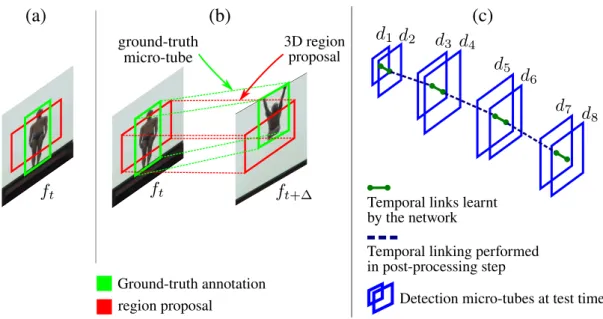
Exploiting a video-level representation further allows a network to learn those inter-frame temporal associations (between action regions) which can not be learnt using a frame-level representation, and thus, with frame-level features we have to entirely rely on a post processing step to connect per frame detections in time. To this end, we propose a novel deep network architecture which learns a video-level action representation by classifying and regressing 3D region
detection objectives in a single training step. At test time the network predicts “micro-tubes” encompassing two successive frames, which are linked up into complete action tubes via a new algorithm which exploits the temporal encod-ing learned by the network and cuts computation time by 50% (Chapter 7). We name our new network as“AMTnet” (ActionMicro-Tube regressionNetwork). Promising results on standard benchmarks show that AMTnet does outperform the state-of-the-art when relying purely on appearance.
We further extend the AMTnet architecture by incorporating a motion stream and introduce a new fusion technique which fuses RGB and flow CNN features at training time, allowing the network to learn pixel-wise correspondences between appearance and motion features. We name this new deep network as “AMTnet-Flow”. We quantitatively demonstrate that the AMTnet-Flow outperforms the top competitor in video-mAP by large margins of 6.28% and 4.79% on higher IoU thresholds 0.5 and [0.5:0.95] respectively on one of the most challenging action detection benchmarks. Moreover, we introduce a new bounding-box interpola-tion algorithm for extracting longer detecinterpola-tion micro-tubes which significantly improves the detection speed at test.
Unlike action detection, an instance segmentation method can accurately localise actions at a finer pixel-level by assigning a class- and instance-aware label to each pixel. We address the problem of action instance segmentation in which multiple concurrent actions of the same class may be segmented out of an image sequence. By taking advantage of recent work on action foreground-background segmentation, we are able to associate each action tube with class-specific segmentations. We demonstrate the performance of our algorithm on the challenging benchmark and achieve a new state-of-the-art result which is 14.3 times better than previous methods.
Preface vii
Dedication ix
Acknowledgements xi
Abstract xiii
Extended Abstract xv
List of Figures xxiii
List of Tables xxvii
Nomenclature xxxi
1 Introduction 1
1.1 Motivating Real world applications of action detection . . . 2
1.2 What is a spatio-temporal action instance? . . . 4
1.3 Challenges in spatio-temporal human action detection . . . 6
1.3.1 Intra-class variability . . . 6
1.3.2 Inter-class confusion . . . 6
1.3.3 Spatial localisation . . . 7
1.3.4 Inter-frame data association . . . 7
1.3.5 Temporal localisation . . . 8
1.4 Dissertation outline . . . 8
1.5 Contributions of this thesis . . . 10
1.6 Software packages and media . . . 13
1.6.1 List of Software Packages . . . 13
1.6.2 In the media . . . 13 xvii
2.2 Deep feature representation of spatio-temporal action instances . . 19
2.2.1 Illustrations of video-level action representation . . . 21
2.3 Deep learning of action micro-tubes using 3D proposal regression 22 2.4 Inter-frame data association and temporal detection . . . 23
2.5 Spatio-temporal action instance segmentation . . . 25
2.6 Two-stream hypothesis - fusion of appearance and motion cues . . 27
2.7 Capturing inter-frame motion pattern using optical flow . . . 28
3 Related work 29 3.1 Action classification . . . 29
3.1.1 Shallow representation . . . 29
3.1.2 Human location centric approach . . . 31
3.1.3 Deep representation . . . 31
3.2 Action detection . . . 33
3.2.1 Temporal action detection . . . 33
3.2.2 Spatio-temporal action detection . . . 34
3.3 Action instance segmentation . . . 38
4 Datasets and evaluation metrics 41 4.1 Datasets . . . 41
4.1.1 Temporally trimmed videos . . . 41
4.1.2 Temporally untrimmed videos . . . 43
4.2 Evaluation metrics . . . 51
4.2.1 Accuracy . . . 51
4.2.2 Precision, recall and F1 measure . . . 51
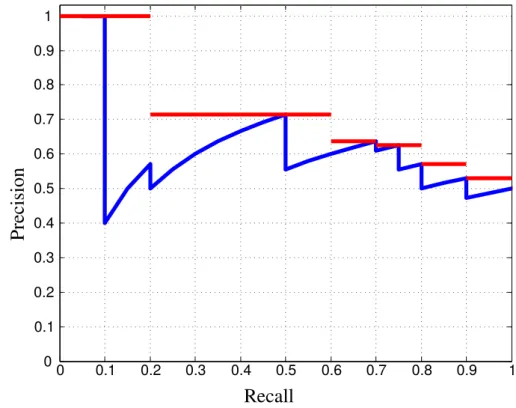
4.2.3 mean Average Precision (mAP) . . . 53
4.2.4 Intersection over Union (IoU) . . . 56
4.2.5 LIRIS HARL evaluation metrics . . . 57
4.3 Chapter wise evaluation metrics . . . 58
5 Deep Learning for Detecting Multiple Space-Time Action Tubes in Videos 61 5.1 Introduction . . . 61
5.2 Overview of the approach . . . 62
5.3 Methodology . . . 65
5.3.1 Region Proposal Network . . . 66 xviii
5.3.4 Action tube generation . . . 67
5.4 Experimental validation . . . 71
5.4.1 Performance comparison on UCF-101 . . . 71
5.4.2 Performance comparison on J-HMDB-21 . . . 73
5.4.3 Performance comparison on LIRIS-HARL . . . 74
5.4.4 Comparative analysis of region proposal quality . . . 75
5.4.5 Ablation study . . . 76
5.4.6 Impact of label smoothing on detection performance . . . . 77
5.4.7 Additional qualitative detection results . . . 77
5.4.8 Computing time analysis for training and testing . . . 78
5.5 Implementation details . . . 80
5.5.1 Generating correct ground truth annotations . . . 80
5.5.2 Modifications in the existing codebase . . . 80
5.5.3 Selective Search region proposals . . . 81
5.5.4 Network training and testing . . . 81
5.6 Discussion . . . 82
6 Spatio-temporal Action Instance Segmentation and Localisa-tion 87 6.1 Introduction . . . 87
6.2 Overview of the approach . . . 88
6.3 Methodology . . . 89
6.3.1 Region proposal generation . . . 89
6.3.2 Appearance- and motion-based detection networks . . . 95
6.3.3 Training region proposal classifiers . . . 96
6.3.4 Testing region proposal classifiers . . . 97
6.3.5 Action tube generation and classification . . . 98
6.4 Experimental results . . . 98
6.4.1 Instance classification performance - no localisation (NL) . 98 6.4.2 Detection and localisation performance . . . 98
6.4.3 Performance vs detection quality curves . . . 100
6.4.4 Qualitative action instance segmentation and localisation results . . . 102
6.5 Discussion . . . 103 xix
7.1 Introduction . . . 109
7.2 Overview of the approach . . . 113
7.3 Network Architecture . . . 114
7.3.1 Convolutional Neural Network . . . 114
7.3.2 3D region proposal network . . . 115
7.3.3 3D region proposal sampling . . . 116
7.3.4 Bilinear Interpolation . . . 117
7.3.5 Fully connected layers . . . 118
7.4 Network training . . . 118
7.4.1 Multi-task loss function . . . 118
7.4.2 Optimisation . . . 120
7.5 Action-tube generation . . . 120
7.6 Model evaluation . . . 121
7.6.1 Training data sampling strategy . . . 122
7.6.2 Impact of different positive IoU thresholds on detection performance . . . 122
7.6.3 Impact of our training data sampling strategy on detection performance . . . 123
7.6.4 Impact of exploiting appearance features . . . 123
7.6.5 Detection performance comparison with the state-of-the-art 124 7.7 Supporting experiments and discussion . . . 127
7.7.1 Impact of the number of predicted 3D proposals . . . 127
7.7.2 Loss function hyper-parameters . . . 127
7.7.3 Computing time required for training/testing . . . 128
7.7.4 Ablation study . . . 129 7.7.5 Qualitative results . . . 129 7.8 Implementation details . . . 130 7.8.1 Mini-batch sampling . . . 131 7.8.2 Data preprocessing . . . 132 7.8.3 Data augmentation . . . 132 7.8.4 Training batch . . . 132 7.8.5 Training iteration . . . 132 7.8.6 Fusion methods . . . 133 xx
8.1 Introduction . . . 137
8.2 Network architecture . . . 138
8.2.1 Appearance streams . . . 139
8.2.2 Motion stream . . . 139
8.2.3 Fully connected, classification and regression layers . . . . 139
8.3 Bounding box interpolation and action tube generation . . . 140
8.3.1 Bounding box interpolation . . . 141
8.3.2 Action tube generation . . . 141
8.4 Train and test data sampling schemes . . . 142
8.4.1 Training data of RGB video frames . . . 143
8.4.2 Training data of optical-flow maps . . . 143
8.4.3 Test time data sampling . . . 143
8.5 Model Evaluation . . . 143
8.5.1 Impact of adding motion stream on action detection per-formance . . . 144
8.5.2 Impact of bounding box interpolation on detection perfor-mance and speed . . . 145
8.5.3 Impact of our action tube generation algorithm on com-pute time . . . 146
8.5.4 Comparison with the state-of-art . . . 146
8.5.5 Comparison of class-specific frame- and video-level APs . . 147
8.6 Implementation details . . . 152
8.6.1 Hardware and software platform . . . 152
8.6.2 Data preprocessing and train data augmentation . . . 152
8.6.3 Network weight initialisation and optimisation . . . 152
8.6.4 Architectural modification for motion stream . . . 153
8.6.5 Training iterations . . . 153
9 Conclusions and Future Research Directions 155 9.1 Summary of contributions of the thesis . . . 155
9.1.1 Action detection using frame-level deep features . . . 155
9.1.2 Action instance segmentation . . . 156
9.1.3 Action detection using video-level deep features . . . 157
9.2 Future research directions . . . 158
9.2.1 Improving 3D action proposal quality . . . 158 xxi
9.2.3 Improving action representation . . . 159 9.2.4 Improving temporal action detection . . . 160
Appendices 163
A 165
A.1 Optical flow maps . . . 166 A.1.1 Dense optical flow computation . . . 166 A.2 RPN training objective . . . 168 A.3 Region proposal generation using 2D connected components . . . 170 A.4 Pruning Selective Search region proposals at test time . . . 171 A.5 Problem formulation for action tube generation . . . 172 A.5.1 Constructing action paths . . . 173 A.5.2 Temporal localisation . . . 174
References 177
1.1 Spatio-temporal human action detection problem. . . 1 1.2 Spatio-temporal human action instance segmentation. . . 2 1.3 Illustrates an example of real-world scenario where an action
de-tection system is useful. . . 3 1.4 Examples of motivating real-world applications of an automatic
human action detection system. . . 4 1.5 Spatio-temporal action instances. . . 5 1.6 The main challenges involved in action detection. . . 7 1.7 temporal correspondence problem in action detection. . . 9 1.8 Temporal detection problem. . . 9 2.1 R-CNN and Faster R-CNN architectural difference. . . 17 2.2 Frame-level and video-level action representation. . . 19 2.3 Video-level representations of actions - approach 2. . . 22 2.4 3D region proposals and action micro-tubes. . . 24 2.5 Advantages of action instance segmentation. . . 26 2.6 Sample optical flow images computed from pairs of video frames. . 27 4.1 J-HMDB-21 sample video frames illustrating the spatial extents
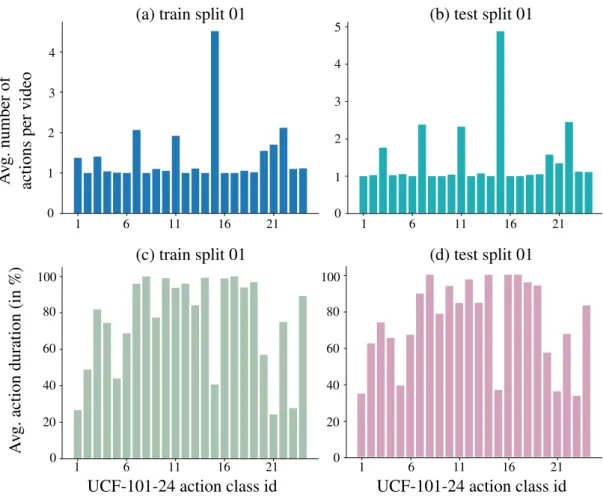
of various actions. . . 42 4.2 UCF-101-24 dataset statistics. . . 43 4.3 UCF-101-24 sample video key-frames illustrating the sptio-temporal
extents of different actions. . . 45 4.4 Histogram of video duration for J-HMDB-21, UCF-101-24 and
LIRIS HARL dataset. . . 47 4.5 Sample LIRIS HARL video frames representing short and long
duration activity categories. . . 47 4.6 Class-specific average activity durations (%), LIRIS HARL dataset. 48 4.7 Sample LIRIS HARL videos where multi-label detection is required. 49 4.8 Sample LIRIS HARL video frames showing co-occurring activities. 50
5.1 Two-stream based deep action detection pipeline overview. . . 63 5.2 Visualising action tube detection in a “biking” video. . . 65 5.3 An illustration of the fusion method to combine appearance and
motion cues. . . 68 5.4 An illustration of a predicted action tube. . . 69 5.5 Class-specific K action paths and tubes. . . 70 5.6 Action detection results on UCF101 [33]. . . 72 5.7 Sample space-time action localisation results on JHMDB [33]. . . 73 5.8 space-time action detection results on LIRIS-HARL [33]. . . 75 5.9 Performance comparison between Selective Search and RPN-based
region proposals. . . 84 5.10 Sample qualitative spatio-temporal localisation results on UCF-101. 85 6.1 Action instance segmentation and detection. . . 88 6.2 Overview of the proposed spatio-temporal action instance
seg-mentation and detection pipeline. . . 90 6.3 Visualization of the motion saliency response. . . 91 6.4 Supervoxel response for DPM mask and pairwise connections. . . 91 6.5 Visualization of the hierarchical graph based video segmentation. 93 6.6 Human motion segmentation binary maps. . . 94 6.7 Instance segmentation results on the LIRIS-HARL dataset [128]. . 99 6.8 LIRIS HARL performance metric - Performance vs detection
qual-ity curves. . . 101 6.9 Confusion matrix to show the classification accuracy of HMS- and
SS-based methods. . . 104 6.10 Qualitative action instance segmentation and localisation results
on LIRIS HARL dataset. . . 105 6.11 Qualitative action instance segmentation and localisation results
on UCF-101-24 dataset. . . 106 6.12 Qualitative action instance segmentation and localisation results
on UCF-101-24 dataset. . . 107 7.1 The 3D region proposals generated by our 3D-RPN network. . . . 110 7.2 AMTnet: Action-Micro-Tube Regression Using Deep
Architec-ture - pipeline overview. . . 112 7.3 3D-RPN architecture. . . 115
7.6 Spatio-temporal action detection results on UCF-101-24 dataset. . 135 7.7 Additional sample detection results on UCF-101-24 dataset. . . . 135 7.8 Spatio-temporal action detection results on J-HMDB-21 dataset. . 136 8.1 Overview of the proposed AMTnet-Flow action detection network. 138 8.2 Action micro-tube generation by linear interpolation. . . 140 8.3 Generation of detection bounding boxes for detection micro-tubes
using linear interpolation. . . 140 8.4 Train and test time data sampling schemes. . . 142 9.1 Illustrating the key limitation of 3D action proposals. . . 158 A.1 Dense optical flow computation from a pair of video frames. . . . 166 A.2 An illustration of a displacement vector. . . 167 A.3 Region Proposal Network (RPN). . . 168 A.4 An illustration of action tube. . . 172
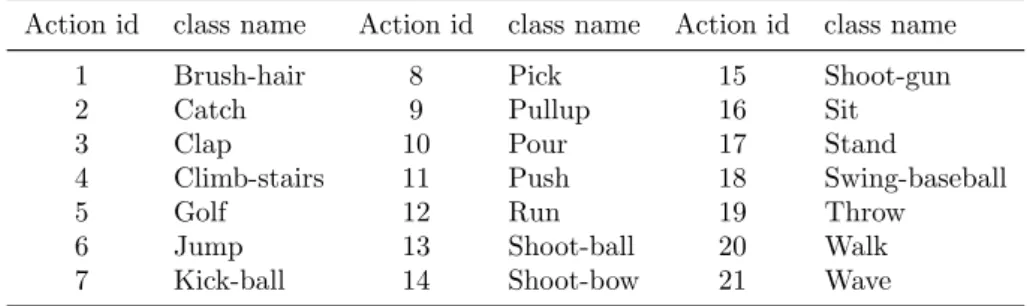
4.1 A list of J-HMDB-21 action classes and their corresponding action ids. . . 41 4.2 A list of UCF-101-24 action classes and their corresponding action
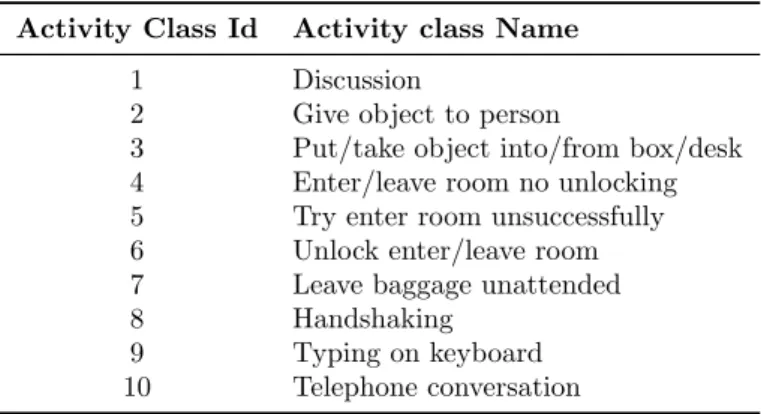
ids. . . 43 4.3 LIRIS HARL dataset - list of human activity categories and their
corresponding activity class ids. . . 47 4.4 A typical confusion matrix for an action classification task with
C= 3 classes. GTL: ground truth label; PL: predicted label. . . 51 4.5 Contingency table. . . 52 5.1 Quantitative action detection results (mAP) on the UCF-101 dataset. 72 5.2 Quantitative action detection results (mAP) on the J-HMDB-21
dataset. . . 73 5.3 Classification accuracy on the J-HMDB-21 dataset. . . 74 5.4 Quantitative action detection results on the LIRIS-HARL dataset. 74 5.5 Quantitative action detection results on the LIRIS-HARL dataset. 75 5.6 Quantitative action detection results (mAP) on LIRIS-HARL for
different δ. . . 75 5.7 An ablation study of the spatio-temporal detection results (video
APs in %) on UCF-101. . . 76 5.8 Spatio-temporal detection results (mAP) on UCF-101 using two
different sets ofαc values. . . 77 5.9 Class specific αc values for each action category in UCF-101
ob-tained from cross validation. . . 78 5.10 Training and test time detection speed comparison on UCF-101
with [14, 20]. . . 79 5.11 Test time detection speed comparison on J-HMDB-21 with [14, 20]. 80 6.1 Quantitative measures precision and recall on LIRIS HARL dataset.100 6.2 Qualitative thresholds and integrated score on LIRIS HARL dataset.100
7.2 Impact of our training data sampling strategy on per class frame-AP at IoU threshold δ = 0.5, JHMDB-21 dataset (averaged over 3 splits). . . 124 7.3 Impact of our training data sampling strategy on per class
video-AP at IoU threshold δ = 0.5, JHMDB-21 dataset (averaged over 3 splits). . . 125 7.4 Per class video-AP comparison at IoU threshold δ = 0.2,
UCF-101-24 dataset. . . 125 7.5 Impact of our training data sampling strategy on video-mAP,
JHMDB-21 (averaged over 3 splits). . . 126 7.6 Spatio-temporal action detection performance (video-mAP)
com-parison with the state-of-the-art on J-HMDB-21. . . 126 7.7 Spatio-temporal action detection performance (video-mAP)
com-parison with the state-of-the-art on UCF-101. . . 126 7.8 Impact of the number of predicted 3D proposals on video-mAP
for J-HMDB-21 dataset (averaged over 3 splits). . . 127 7.9 Impact of different combinations of hyper-parameters on
video-mAP for J-HMDB-21 split-1 train set. . . 128 7.10 An ablation study on J-HMDB-21 (split-01). . . 128 7.11 Computing time comparison for training and testing. . . 129 8.1 Impact of adding motion stream on action detection performance,
J-HMDB-21 (*) dataset. . . 144 8.2 Impact of adding motion stream on action detection performance,
UCF-101-24 (*) dataset. . . 144 8.3 Impact of bounding box interpolation on action detection
perfor-mance (video-mAP). . . 145 8.4 Impact of bounding box interpolation on action detection speed
(seconds / video). . . 145 8.5 Impact of our action tube generation algorithm on compute time
(in seconds per video). . . 146 8.6 Comparison with the state-of-art on J-HMDB-21 dataset. . . 146 8.7 Comparison with the state-of-art on UCF-101-24 dataset. . . 147 8.8 J-HMDB-21: per class frame-AP comparison with the
state-of-the-art. . . 148 xxviii
8.10 UCF-101-24: per class video-AP comparison with the state-of-the-art. . . 150
Acronyms
AMTnet: Action Micro Tube Regression network. HMS: Human Motion Segmentation.
ROI: Region of Interest. Reg layer: Regression layer. SS: Selective Search.
SVM: Support Vector Machine.
2PDP: Two Pass Dynamic Programming. BoVW: Bag-of-Visual-Words.
Cls layer: Classification layer.
CNN: Convolutional Neural Network. DPM: Deformable Part based Model. FC (or fc) layer: Fully connected layer. IoU: Intersection over Union.
LSTM: Long Short-Term Memory recurrent neural network. RNN: Recurrent Neural Network.
R-CNN: Region-based CNN.
Introduction
The spatio-temporal humanaction detection 1 problem in computer vision refers to the following three sub-problems: 1) action classification, 2) spatial detection and 3) temporal detection. Given an input video, the detection model is sup-posed to classify each action instance, localise them spatially using bounding boxes and detect the temporal extent of each action instance by inferring its start and end time points.
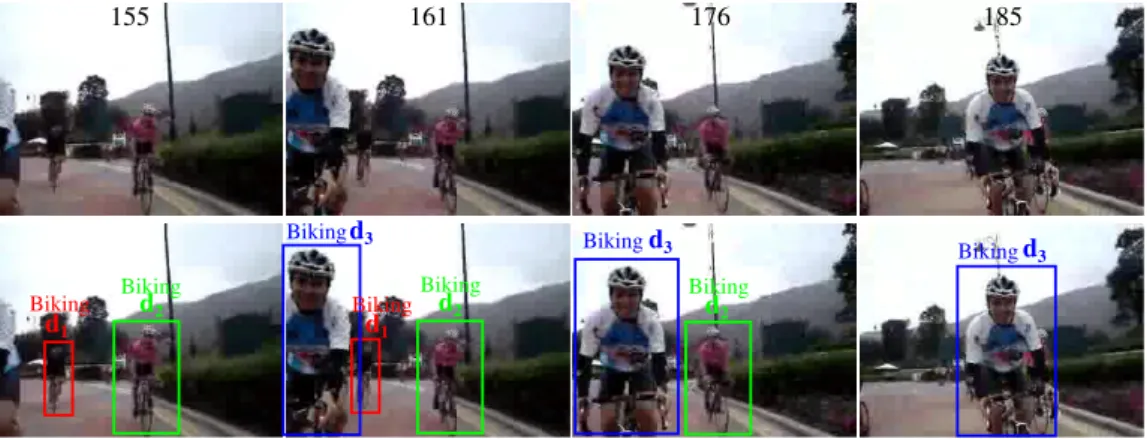
Consider Figure 1.1 (top row) an input video sequence to the detection system, i.e. frames at different time steps from a “biking” video sequence. The number on the top of each video frame denotes the frame number. Figure 1.1 (bottom row): the output of an ideal detection system, i.e. the predicted class labels, bounding boxes (spatial detection) and temporal extents (temporal detection) of three different “biking” action instance. Each colour represents an action instance.
155 161 176 185
d1
Biking Biking BikingBiking Biking
Biking Biking Biking d1 d2 d2 d2 d3 d3 d 3
Figure 1.1: Top row: input video sequenceBottom row: output of an ideal detection system.
1Action detection is also called action localisation in the literature. 1
Action instance segmentation, in contrast, is the problem of detecting and delineating each distinct action instance present in a video [1]. In other words, we assign a label to each pixel of the frame where labels are class-aware and instance-aware. Consider again the same input video sequence as shown in Figure 1.1
top row). The output of an ideal detection system capable of performing both action detection and instance segmentation is depicted in Figure 1.2.
d1
Biking Biking BikingBiking Biking
Biking Biking Biking d1 d2 d2 d2 d3 d3 d 3
Figure 1.2: Output of an ideal detection system capable of performing action instance segmentation. Note that, the system is able to uniquely identify the three different in-stances of a “Biking” action class and assign each pixel (belongs to an action instance) a class- and instance-aware label where the colours red, green and blue represent the three unique instance-aware labels.
1.1
Motivating Real world applications of
ac-tion detecac-tion
With an exponential growth in the number of video capturing devices (CCTV cameras, smartphones), uploaded videos on the web (e.g. YouTube, FaceBook, DailyMotion) 2 and Internet users 3 [2–4], automatic video understanding has become the forefront of computer vision research. Thus, there is an increasing demand for a tool which can automatically understand (or analyse) this massive amount of video data.
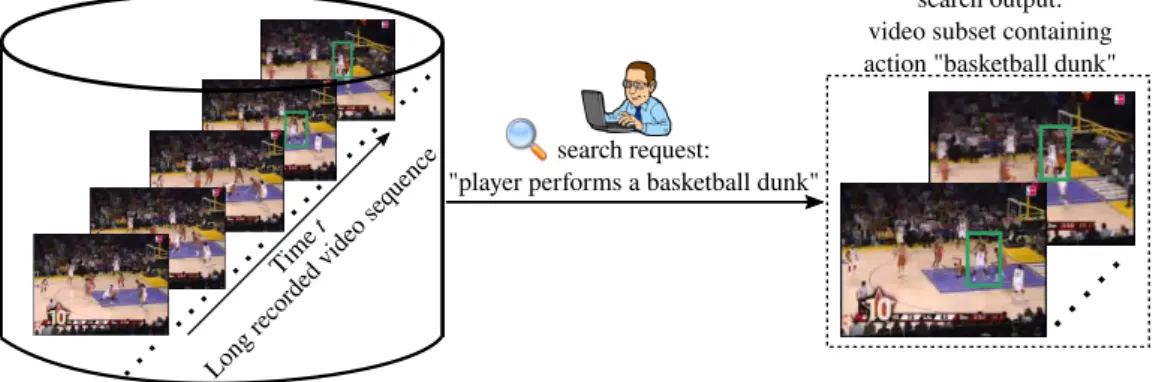
Automatic detection of human actions will allow a Google-style video search and retrieval. Figure 1.3 illustrates an example of real-world scenario where an action detection system is useful. A user wants to retrieve video subsets from an online repository of huge video data. In particular, he wants to access only those video frames where action “basketball dunk” happens. Such a video retrieval system requires action detection capabilities to recognise the “basketball dunk” action and localise its spatial and temporal extents within a video. Another in-teresting application could be a movie recommendation system where automatic
2https://www.youtube.com/yt/press/statistics.html 3http://www.reelseo.com/
action detection of audiences within a movie theater may help in better under-standing the audience group behaviour resulting high quality recommendation system beneficial to writers, directors, marketers, advertisers [5, 6]. Significant
search request:
"player performs a basketball dunk"
Time
t
Long recor ded video seq
uence
search output: video subset containing action "basketball dunk"
Figure 1.3: Based on the search “basketball dunk” the system detects video frames where this action happens.
progress has been made in image understanding e.g. object detection and seg-mentation, image captioning, face recognition. However, for video undersanding, we need effective tools to analyse raw video data, and in particular human ac-tions.
The action detection algorithms can be categorised as either “offline” or “online”. Examples of motivating real-world applications of an automatic human action detection system is shown in Figure 1.4. Those detection systems which require the entire video clip beforehand to generate detection results fall into the offline category, and those which are able to generate detections from a small subset of the video and can incrementally link those detections over time as more and more frames are visible to the system are categorised as online. Offline algorithms are suitable for applications such as video indexing and retrieval. On the other hand, applications such as self-driving cars, robot-assisted surgery and human-robot interaction require online algorithms to process the streaming video frames as they arrive. In autonomous driving [7,8], the space-time localisation of human actions will allow the system to detect different categories of actions, e.g. “walking” and “running”, thus enabling the vehicle controller to adjust speed and course accordingly. In robot-assisted surgery 4 [9–11], an accurate action detector enables the robot to provide the surgeon an environment to carry out complex procedures with better precision and control. The quality of human-robot interaction and virtual reality gaming can be improved with smarter action 4Our group head, AI and Vision research group, was awarded the Horizon 2020 project,
on the development of robotic assistant surgeons for laparoscopy:http://cms.brookes.ac. uk/staff/FabioCuzzolin/
detection algorithms.
(a) (b) (c) (d)
Figure 1.4: Examples of motivating real-world applications of an automatic human action detection system. (a) autonomous drones, (b) self-driving cars, (c) robot-assisted surgery, (d) human-robot interactions.
Furthermore, instance segmentation can significantly enhance the quality of the action detection by providing (a) more accurate pixel level (as opposed to bounding-box level) localisation results and (b) class- and instance-aware (as opposed to only class-ware) labels to delineate each instance of the same action. The greater part of this dissertation is focused on action detection, whilst in Chapter 6 we introduced an detection pipeline which can perform both action instance segmentation and detection.
The action detection pipelines presented in Chapter 5 and Chapter 6 are suit-able for offline applications, as they follow a multi-stage detection process and are relatively expensive. In contrast, Chapter 7 and Chapter 8 are devoted to de-signing faster and single-stage end-to-end trainable action detection frameworks which can be easily extended to online versions just by replacing their offline action tube generation algorithms with the online tube building algorithm [12].
1.2
What is a spatio-temporal action instance?
Before answering the above question, we might be interested to know even: “what is an action?”. A very nice explanation of this question can be found in Section 1.2 of [13]. An action can be defined in two different perspectives, depending on whether the definition is tailored for a computer or a human. Here we are interested in defining an action for computers. From a computer’s perspective, in order to explicitly programme for an action, it must have a precise definition. However, due to high complexity and variation associated with human actions, it is impractical to define an action down to small details, and difficult to come up with a well thought out definition which can be programmed by a computer. Due to these aforementioned reasons, researchers often use their own definition tailored for their application. In this way, we can say that an action is simply what you defined it to be. In this thesis, we adopt the definition of human actions
provided by the standard benchmarks in action detection (Chapter 4). Some examples of human actions defined by these benchmarks are: “run”, “jump”, “biking”,‘horse ridding”,“handshake” etc.
In a given input video, an action may be present in any spatial and tempo-ral locations. Besides, multiple co-occurring instances of the same or different action class can be present in a video. Consider Figure 1.5 (a) and (b) in which multiple action instances of the same class “fencing” (4 instances) and “bik-ing” (3 instances) appear in the respective video frames. In Figure 1.5 (c) and (d), multiple action instances of the two different classes “handshaking”, “leave baggage unattended” and “unlock enter/leave room”,“put/take object into/from box/desk” are present respectively. As anticipated, bounding boxes are used to spatially localise each action instance in a video frame. Each colour repre-sents a unique action instance, no matter the class it belongs to. The set of bounding boxes connected over time without any whole/gap in between forms a spatio-temporal action instance as shown in Figure 1.5 (e). In the action de-tection literature, each spatio-temporal action instance is typically termed an “action tube” [14]. Note that each action tube also tells us about the temporal duration/extent of that action, i.e. the start and end times.
(a) (b) (c) (d) (e) Fencing Fencing Fencing Fencing Biking Biking
Biking Handshaking baggageLeave
unattended Unlock enter leave room
Put take obj into from box desk
d1 d2 d1 d2
d1 d2
d1
d2
Figure 1.5: Spatial localisation of action instances of class: (a) “fencing” (4 in-stances), (b) “biking” (3 instances), (c) “handshaking” and “leave baggage unat-tended”, (d)”unlock enter leave room” and “put take object into from box desk”. (e)
spatio-temporal localisation of two “Fencing” action instances, where t denotes time and t1 < t2 < t3 < t4. Dotted lines represent temporal association between frame-level detections over time.
1.3
Challenges in spatio-temporal human
ac-tion detecac-tion
Spatio-temporal human action detection is a hard problem. It is extremely chal-lenging to design a representation (for a machine to understand) which is robust enough to deal with both intra-class variability and inter-class confusion prob-lems. Other major difficulties arise from spatial and temporal localisation, and Inter-frame data association. In addition, human actions possess high variations in geometry and topology [15].
1.3.1
Intra-class variability
The appearance and motion of a particular class may differ significantly due to variation in illumination, camera motion and viewing angle, partial occlusions, background, scale. In addition, action instances belonging to the same class may differ due to a large variability in the execution style of an action in terms of poses, motion dynamics, contextual information, speed etc. For instance, the two action instances in Figure 1.6 (a) and (b) exhibit variation in pose, camera viewing angle, contextual information (a door and a bench) yet they belong to the same action class “Sit”.
1.3.2
Inter-class confusion
There are cases in which instances from different action categories possess simi-lar: (a) appearances, (b) contextual information (e.g. players in both“basketball” and “basketball dunk” look the same, and in both actions context is provided by the presence of basketballs, (c) motions and (d) poses (e.g. actions“stand” and “sit”). Some other interesting examples are: run and walk, laugh and yawn, crawl and swim where it is hard to generate a discriminative representation.
Thus, learning a representation which has good generalisation ability over a wide range of action instances belonging to the same class, and yet able to discriminate between actions of different classes is challenging [16]. Figure 1.6 highlights some of the above problems (video frames are taken from action de-tection datasets: UCF-101-24 [17] and J-HMDB-21 [18]).
(a) (b) (c) (d) (e) (f) (g) (h) Sit Sit Biking Biking Biking Biking Biking Run Jump Sit Stand
Figure 1.6: (a-b): intra-class variability - the two action instances show variation in pose, camera viewing angle, contextual information (a door and a bench) yet they be-long to the same action class “Sit”. (c-d): in (c), the “Biking” instance depicted with a red bounding box is hard to detect due large variation in scale; in (d), the “Biking” instance localised by a green coloured bounding box is partially occluded by the blue coloured one and thus difficult to detect. (e-f ): inter-class confusion - although these two action instances share similar poses, motions, contextual information (chairs) they belong to two different classes “Stand” and “Sit”. (g-h): these action instances are hard to detect due to poor illumination (g) and motion blur (h), respectively.
1.3.3
Spatial localisation
Finding the spatial locations of action instances present in a video is challenging due to several factors: (a) they may vary over time, (e.g. the locations of the “biking” instance d3 and the “fencing” instance d1 change over time as shown in Figure 1.1 and Figure 1.5 respectively; (b) the actor is partially occluded by other actor or object (e.g. the one of the bikers (located with green bounding box) is partially visible due to occlusion as shown in Figure 1.6 (d)); (c) co-occurring action instances belonging to the same or different action classes may be present (Figure 1.5); (d) in addition, an actor can perform multiple actions at the same time (e.g. a person is “waving his hand” while “walking”).
1.3.4
Inter-frame data association
Consider Figure 1.7. It shows a video with a sequence length of 80 frames (f1 to f80) in which there are two action instances. To correctly detect these two instances, one approach would be to associate or link the frame-level detections (d1 and d2) in time to obtain two valid action tubes. The temporal linking of detections in action detection can be assimilated to the data association prob-lem [19] in the “multi-target tracking” domain [20]. However, in tracking data
association is done for detections of a single class such as “pedestrian”, whereas in action detection data association is to be performed for detections belong-ing to multiple human action categories. In Figure 1.7, the correct inter-frame data associations for each action instance are depicted using blue and red solid lines. Data association is hard because of the following main reasons. (a) As the number of frame-level detections m and the sequence length n of an input video increase the running time complexity of the data association algorithm also increases - e.g. in the case of a Viterbi algorithm the complexity increases in polynomial time, the running time is O(nm2) [21]. (b) Another challenge is to make the data association algorithm robust to position-swapping (Figure 1.7) and associate the inter-frame detections in time correctly (in the figure, the lo-cations of action instancesd1 and d2 are interchanged between framef20tof40). (c) Lastly, the data association problem is made harder by partial occlusion, sudden-change in illumination, camera motion and/or viewing angle.
1.3.5
Temporal localisation
Modelling a system which can correctly infer the temporal extent (start and end time points) (Figure 1.7) of each action instance present in a video is extremely difficult - action instances may appear and disappear within a video at any time point. Consider Figure 1.1. The “biking” action instances d1 and d2 disappear after frames 161 and 176 respectively. Whereas, d3 starts at frame 161. Even though the actor is present throughout the entire video, the actual start and end time of the action may be at any time point within the duration of the video (Figure 1.8) which make the temporal detection problem harder. A naive sliding window algorithm for detecting the temporal extent of actions will have a running time O(n2) wheren is the number of frames in a video.
1.4
Dissertation outline
In spite of these aforesaid challenges in action detection, substantial research initiatives have been taken in this area [14, 20, 22–26]. For a detailed list of works, please refer Chapter 3).
First and foremost, we present the avenues of investigation in Chapter 2 which provides insights into the evolution of the action detection problem. Next, we introduce the human action detection datasets used throughout this work in Chapter 4. We then formulate a spatio-temporal action detection approach in
Temporally untrimmed action paths
d2
Targets position swapping
d1 Action-1 start time d1 d1 d 1 d 1 d1 d2 d2 d2 d2 d2 Action-2
start time Action-1end time Action-2end time Action tube 2
Action tube 1
Figure 1.7: Linking frame level bounding boxes to build two action tubes. Each action tube is assigned a unique id, here ids are 1 and 2. Two different colours (red and blue) are used to denote two different action tubes. Solid lines show valid detections and temporal links whereas, the dotted lines denote detections and links discarded during temporal localisation of action instances. Note that, in frame 40 (f40) the tube ids get swapped which is hard to track. Also note that the start and end times are different for two action tubes, and detecting these temporal extent/duration of each tube is again challenging.
Action start time
Action end time
Figure 1.8: Temporal detection problem: Even though the actor is present throughout the entire video the actual “basketball” action starts at t4 and ends at t8 which makes the temporal detection more difficult.
Chapter 5 in which frame-level RGB and optical flow image data are mapped to a feature space using a two-stream convolutional neural network (CNN) architec-ture [27] and subsequently, these CNN feaarchitec-tures are used for action classification and bounding box regression. In addition to predicting the frame-level confi-dence score and spatial location of each action instance in a video, the proposed framework also links the detections in time and apply temporal label smoothing to solve for temporal localisation.
In Chapter 6 we consider the problem of spatio-temporal action instance segmentation, where the task is to detect and delineate each action instance by assigning each pixel a label. Unlike the bounding-box level class-aware action labels in Chapter 5, the labels obtained from instance segmentation are at
pixel-level and they are both class- and instance-aware.
We present a more appropriate solution to the action detection problem in Chapter 7. Note that the framework presented in Chapter 5 can only provide a suboptimal solution to the problem as it relies on training CNNs which can predict only frame-level class confidence scores and bounding boxes. As these CNNs are trained on individual video frames, they do not learn the temporal associations between inter-frame action detections. The new action detection framework presented in Chapter 7 addresses this limitation by training CNNs on pairs of video frames and predicting video-level confidence scores and detections (i.e. action “micro-tubes” (Section 2.3)).
An extension of the work in Chapter 7 to incorporate motion features, and predict action micro-tubes over more widely separated pairs of videos frames is presented in Chapter 8. The detection frameworks presented in Chapter 7 and Chapter 8 are computationally efficient, faster and both adopt single-stage end-to-end training and testing strategies. In contrast, the detection pipelines presented in Chapter 5 and Chapter 6 are relatively expensive and slower, follow multi-stage training and testing strategies and are thus not suitable for online applications. As we move along the chapters the state of the art was changing in time, and as a result we are comparing ourselves with a moving bar.
1.5
Contributions of this thesis
Firstly, the main contributions of the work presented in Chapter 5 are: (1) a novel action tube formulation, (2) a new deep learning framework for powerful action representation, and (3) an efficient fusion scheme for fusing appearance and motion cues. Unlike the previous state-of-the-art approach [20] which solves the temporal action localisation using an expensive sliding window scheme, our action tube formulation uses an efficient two-pass Viterbi algorithm for tempo-ral detection. Moreover, by leveraging the latest advancements in object de-tection, our deep network learns better action representation than the previous work [14, 20]. The detailed contributions of this chapter are as follows. I cast the expensive multi-stage action detection approach [14, 20] (Section 2.1) into a relatively less expensive single-stage setting where appearance- and motion-based CNNs are trained on RGB and optical flow data to perform frame-level action classification and spatial localisation. Subsequently, frame-level RGB and flow detections are fused and then linked in time to generate class-specific action paths. Finally, label smoothing is applied to each action path to generate In
or-der to achieve a better representation of image data and to design a single-stage detection framework, I replace the R-CNN architecture [28] used in [14, 20] with Faster R-CNN [29]. The relatively deeper representation of VGG-16 [30] (used in Faster R-CNN) is beneficial for the classification accuracy and allows our model to generalise well to a wide range of action detection datasets. I then report the outperforming action classification results (Section 5.4.2) of our framework on the J-HMDB-21 action detection dataset [18]. As a by-product of using Faster R-CNN, our detection network has access to relatively better quality action proposals (predicted by a RPN network) than those generated by the Selective Search (SS) algorithm [14]. I present a quantitative comparision (Section 5.4.4) between SS- and RPN-based region proposals and demonstrate that RPN-based proposals exhibit much better recall-to-IoU than SS-based boxes. Furthermore, I propose an original test time fusion strategy to fuse the RGB and optical flow information based on the detections’ softmax probability scores and their inter-frame spatial overlaps (Section 5.3.3). I demonstrate quantitatively that our fusion strategy significantly improves the detection accuracy (Section 5.4). Besides, I report an ablation study (Section 5.4.5) which again support the sig-nificance of our fusion method. Further, (a) to link the frame-level detections (after fusion) over time and (b) to perform temporal localisation, I bring for-ward a two-pass dynamic programming (2PDP) approach, in which the Viterbi algorithm is used to solve optimisation problems (a & b). I also demonstrate the efficacy of our temporal detection algorithm (the 2nd pass of DP) which significantly improves the action detection performance (Section 5.4.6).
Secondly, in Chapter 6 I propose a variant of the above action detection pipeline which can perform action instance segmentation alongside action detec-tion. To allow our model to output pixel-level instance segmentation, I apply the human motion segmentation algorithm [31] on the testset videos to extract binary silhouettes of human actions in space and time. I then propose a simple but effective region proposal algorithm (Section 6.3.1) which generates region proposals based on the power set of connected components in the space-time bi-nary silhouettes of human actions. To the best of my knowledge, this is the first work which addresses jointly both space-time action instance segmentation and action detection problems. I also demonstrate quantitatively that the proposed model outperforms the existing methods in one of the most challenging action detection datasets available to date (Section 6.4). Moreover, I am the first to show qualitative action instance segmentation results.
in Chapter 7 which represents a key conceptual step forward from the frame-level action representation (Section 2.1) (heavily exploited in [14, 20, 32, 33]) towards a video-level representation (Section 2.2). In place of encoding frame-level ac-tion regions to a feature space, I encode video-level acac-tion regions (i.e. acac-tion regions span across a pair of successive frames) to a feature space using a fusion technique (Section 7.3.1) which performs element-wise fusion of convolutional features computed from two successive video frames. Unlike the frame-level representation, the video-level feature encoding can effectively encodes the tem-poral associations between action instances present in a video subset. On the network design side, I propose a novel end-to-end trainable deep neural network architecture which facilitates video-level feature encoding. This new network architecture also addresses region proposal generation and action detection task jointly using a single round of optimisation (Section 7.4). One of the core build-ing blocks of this new architecture is a 3D regional proposal network (RPN) (Section 7.3.3). I design a 3D-RPN which generates space-time video region hy-potheses in place of frame-level 2D proposals. Unlike what happens in standard action detection approaches [14, 20, 32, 33], I implement a simple but efficient re-gression technique for regressing such 3D proposals (Section 7.4.1). The output of this new action detection network is a set of action micro-tubes (Section 2.3) instead of a set of 2D detection windows as in [14, 20, 32, 33]. I also propose a new action tube generation algorithm suitable for connecting these micro-tubes so generated, which exploits the temporal encoding learnt by the network (Section 7.5). I demonstrate quantitatively that our model outperforms state-of-the-art appearance-based models, while being highly competitive with methods which exploit both appearance and motion features (Section 7.6). Moreover, to the best of my knowledge, in the action detection community I am the first to apply “bilinear interpolation” [34, 35] (instead of a max-pooling [29]) for ROI 5 feature pooling (Section 7.3.4). A bilinear interpolation layer allows the gradients of the loss to flow backwards with respect to both the inputs (a) con-volutional features and (b) coordinates of bounding boxes. Thus, using bilinear interpolation layer, affine or morphed region proposals can be predicted in place of rectangular windows [36]. We keep this extension as a future work.
Finally, in Chapter 8 an extension of Chapter 7 where the action detec-tion performance and speed are significantly improved by leveraging optical flow based deep features and a training strategy which incorporates both long and 5A ROI (region of interest) is a rectangular bounding box parameterized as 4 coordinates
short distance frames. More specifically, I propose to add an additional opti-cal flow based motion stream to the existing deep architecture in Chapter 7. I demonstrate that by training the network on both long and short distance video frame pairs, and subsequently testing it on long distance pairs can improve the detection performance and speed (Section 8.5). To deal with micro-tubes gen-erated from long distance frame pairs at test-time, I implement a simple but elegant bounding box interpolation algorithm (Section 8.5.2) which makes the tube generation process relatively faster (Section 8.5.3).
The above contributions and these conceptual steps will lead, in the medium term, to a deep network architecture able to regress whole action tubes which is considered as an optimal solution to the action detection problem.
1.6
Software packages and media
1.6.1
List of Software Packages
The following software packages from this thesis are available online.
• Source code for our BMVC 2016 [33] work is publicly available online at: https://bitbucket.org/sahasuman/bmvc2016_code.
Source code developed using MatCaffe (the Matlab wrapper for Caffe deep learning toolbox).
• Matlab source code for our action instance segmentation work [37] is available online at:
https://bitbucket.org/sahasuman/matvis/ (private access).
• Lua and Torch based source code for our AMTnet work [38] is available online at:
https://bitbucket.org/sahasuman/amtnet_iccv2017 (private access).
1.6.2
In the media
The following YouTube videos showcasing various qualitative results of this the-sis.
• BMVC 2016 work [33] - YouTube demo video link https://youtu.be/vBZsTgjhWaQ.
• Action instance segmentation work [37]: (a) YouTube demo video link - main paper
https://youtu.be/fqqgFQzmkfM
(b) YouTube demo video link - generation of optical flow trajectories [39] https://youtu.be/iaZ2x1LqFxA
(c) YouTube demo video link - generation of supervoxels [40] https://youtu.be/skzG4uolcyw
(d) YouTube demo video link - human action segmentation [41] https://youtu.be/cPjbjAPm2jo.
Avenues of investigation
“Features matter”! Powerful visual features or image representation techniques are the key to the success of any computer vision algorithm such as image clas-sification and object recognition systems [42]. Over the past several years, the improvements in the performance of computer vision based systems can be at-tributed to the evolution of effective data representation starting from early Bag-of-Visual-Words (BoVW) [43, 44], to Improved Fisher Vector (IFV) [45], and more recently, the deep feature representation provided by Convolutional Neural Networks (CNNs) [46]. In recent years, deep feature representations have demonstrated significant quantitative improvements in image understand-ing over classical ones (e.g. BoVW, IFV etc.) [42].
Unlike still images, videos contain highly dynamic appearance and motion patterns. Therefore, problems such as human action detection in videos require effective visual representation which is robust to the time varying visual data. Further, as discussed earlier (Section 1.3.4), the two main challenges in action detection are: (1) inter-frame data association and (2) temporal action local-isation. Most action detection approaches try to solve these problems using a graph-based video segmentation and sliding window technique (Chapter 3) which are computationally expensive and inefficient to deal with real-world longer ac-tion sequences.
In this work, we mainly focus on exploiting deep features for image and video data representation and pose inter-frame data association and temporal local-isation as energy optimlocal-isation problems which can be efficiently solved using the Viterbi algorithm. In the following sections, we introduce the frame- (Sec-tion 2.1) and video-level (Sec(Sec-tion 2.2 & 2.3) deep feature representa(Sec-tion used in this work, combined with the original methods proposed (Section 2.4 & 2.5) to address the spatio-temporal action detection problems set out in Section 1.4.
2.1
Deep feature representation of spatial
ac-tion instances
Unlike action recognition, our goal is to both localise (in space and time) and classify action instances in temporally untrimmed videos. Two promising efforts in this direction were proposed by Gkioxari and Malik [14] and Weinzaepfel et al. [20]. They used CNN-based deep feature representation to encode both spa-tial and temporal features of human actions to detect action tubes. The success of these methods [14, 20] are mainly due to: (1) the use of regions with CNN (R-CNN) features [28] for video data representation which not only provides bet-ter feature encoding of human actions but also improves the spatial localisation accuracy with the help of region proposals [47]; (2) use of a two-stream CNN approach [27] to effectively capture the complementary information from video data i.e. frame-level appearance and inter-frame motion dynamics associated with human actions.
However, [14, 20] have a number of drawbacks: 1) they are computationally expensive, 2) require multi-stage training and 3) rely on unsupervised region proposal algorithms such as Selective Search [14] or EdgeBoxes [20]. The main cause of such limitations is that, these action detectors [14, 20] rely on R-CNN object detection framework. Unlike [48, 49], R-CNNs do not share computation and perform a separate forward pass through convolutional layers for each ob-ject proposal (see Figure 2.1 (a)), which is expensive in terms of both time and computing resources. For example, during training R-CNNs require to execute 2000 conv forwards passes for 2000 Selective Search proposals, amounting to relatively longer training time and more GPU resources than [48, 49]. Besides, the R-CNN framework follows a multi-stage training pipeline which includes (a) fine-tuning a CNN, (b) extracting CNN features, (c) caching features to disk, (d) training a number of one-vs-all SVMs and finally (e) solving a regression problem to fit the region proposal bounding-boxes as per the ground truths, re-sulting in a very computationally expensive pipeline. Furthermore, the detection accuracy of R-CNNs is limited by their relying on unsupervised region proposal algorithms [14, 20] which, besides being resource-demanding, cannot be trained for a specific detection task and are disconnected from the overall classification objective.
For instance, on large datasets such as UCF-101 [17], Gkioxari and Ma-lik [14]’s action detection pipeline takes a week for training and feature
extrac-(1) Input image (2) Extract region proposals (3) Warped regions (4) Compute CNN features (5) Conv feature maps handshaking? no. typing on keyboard? yes. telephone conversation? no. (6) Classify regions (a) R-CNN (b) Faster R-CNN
OFP: output of a forward pass R: a warped region R1 R2 R2k OFP1 OFP2 OFP2k (2) Compute CNN features (4) Classify and regress
regions cls. reg. Predefined anchor boxes (3) Conv feature map for the entire image (1)
Input
image handshaking? no.
typing on keyboard? yes.
telephone conversation? no.
Figure 2.1: (a) R-CNN and (b) Faster R-CNN architectural difference.
tion 1 plus one extra day for SVM training. At test time, detection is slow as features need to be extracted for each region proposal via a CNN forward pass. Moreover, Gkioxari and Malik [14]’s work does not address temporal localisation, whereas Weinzaepfel et al. [20]’s sliding window approach for temporal action detection is relatively expensive.
To deal with these limitations, we explored the possibility of modelling a deep feature-based action detection framework which is capable of sharing computa-tion during a forward pass (see Figure 2.1 (b)), can avoid multi-stage training by training a CNN for both action classification and bounding box regression. Such a detection system is bound to be computationally less expensive than that of [14, 20] and eliminates the need for feature extraction, caching and SVM training. However, this new action detection framework still relies on frame-level action representation to solve for spatio-temporal action localisation. In Section 2.2, we show that a frame-level representation gives a suboptimal so-lution to the action detection problem, and thus, a video-level action represen-tation is desirable to achieve an optimal solution. In this section, we mainly focus on addressing the problems associated with the existing action detection
systems [14, 20] such as, poor feature representation, inefficient and expensive network architecture, expensive multi-stage training.
Moreover, previous spatio-temporal human action detection methods [14, 20] use unsupervised region proposal generation algorithms (such as Selective Search [47] and EdgeBoxes [50]) to generate rectangular region hypotheses. As these are unsupervised algorithms, they can not utilise the ground truth ac-tion locaac-tion informaac-tion provided with a specific dataset. By leveraging deep CNN features and posing the region proposal generation as a supervised ma-chine learning problem, we can generate better quality action region hypotheses with higher recall-to-IoU [29]. Besides, to generate region proposals using these unsupervised methods, each video frame is to be processed individually which is indeed computationally expensive. Whereas, in a supervised approach [29], this expensive per-frame region proposal generation process can be completely eliminated using a fixed set of anchor boxes. Therefore, in order to improve the detection accuracy and reduce the computing cost, it is desirable to model an action detection framework which can (a) generate high quality region proposals by taking advantage of deep representation under a supervised setting and (b) jointly optimise both the region proposal and action detection objectives.
This idea drives us towards designing a novel deep network based action de-tection framework (Chapter 5) which can generate region proposals by optimising jointly a binary “actionness” [51] classification and a bounding-box regression ob-jectives by exploiting deep features combined with the ground truth class labels and spatial location information associated with each action instance present in the training videos. The “actionness” classification objective assigns high scores to those proposals which are highly likely to contain an action instance (posi-tive training samples) and low scores otherwise, and the box regression objec(posi-tive helps to improve the localisation accuracy of the positive training samples by regressing them towards the corresponding ground truth boxes. Once the region proposals are obtained, they can be sorted as per their actionness scores and the topk proposals then can be used to train a deep network for action classification and bounding-box regression.
We refer to the visual representation mentioned above as “frame-level” rep-resentation because it encodes only the static appearance of the actor(s) and the scene from a single video frame, but it fails to encode the motion pattern inherently associated with the action.
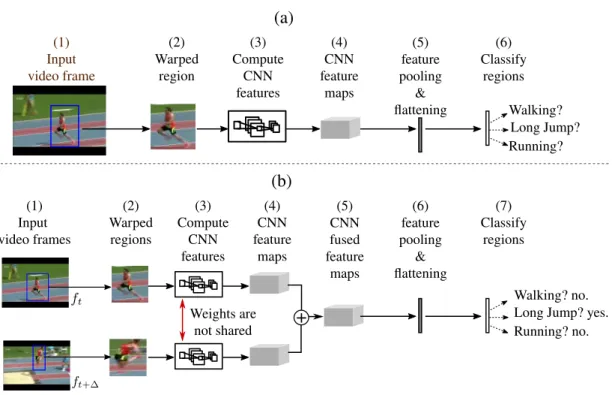
An illustration of a frame-level deep action representation. Consider Figure 2.2 (a). A cropped image patch is passed as input to a CNN which
(1) Input video frame (2) Warped region (3) Compute CNN features (4) CNN feature maps (5) feature pooling & flattening (6) Classify regions Walking? Long Jump? Running? (a) (b) (1) Input video frames (2) Warped regions (3) Compute CNN features (4) CNN feature maps + (5) CNN fused feature maps (6) feature pooling & flattening (7) Classify regions Walking? no. Long Jump? yes. Running? no. Weights are
not shared
Figure 2.2: Frame-level and video-level representations of actions. (a) frame-level representation, (b) video-level representation - approach 1.
computes deep convolutional features encoding the static appearance of the path. Subsequently, high-level feature encoding is used to train a classifier for action recognition. Note that, this feature encoding encodes only the static appearance cues due to the fact that it belongs to a single video frame. In the following section, we discuss a “video-level” representation able to encode both spatial and temporal features of an action instance within a video.
2.2
Deep feature representation of spatio-temporal
action instances
This dominant paradigm for action detection [14, 20, 32, 33], however, only pro-vides a suboptimal solution to the problem. Indeed, rather than solving for
T∗ = arg max.
T⊂V score(T), (2.1)
whereT is a subset of the input video of durationDassociated with an instance of a known action class, they seek partial solutions for each video frame
R∗(t)= arg max.
to later compose in a post-processing step partial frame-level solutions into a solution
ˆ
T = [R∗(1), ..., R∗(D)] (2.3) to the original problem (Equation 2.1), typically called action tubes 2 [14]. By definition,
score( ˆT)≤score(T∗) (2.4) as ˆT is selected after searching a much smaller (sub)space of solutions compared to the original problem (Equation 2.1). Therefore, such methods are bound to provide suboptimal solutions. Note that, the action classification accuracy of the system solely depends on the tube score (score( ˆT) or score(T∗)), i.e., we assign a class label to a test video with the label predicted for the best scoring tube. Thus, an optimal solution (T∗, see Equation 2.1) is expected to improve the classification accuracy resulting an overall improvement in the detection performance.
More specifically, in the post-processing step frame-level detection bounding boxes are linked in time to build action tubes either by using a Viterbi [14,32,33] or a tracking-based [20] algorithm. This post-processing step is essential as those CNNs do not learn the temporal associations between region proposals belonging to successive video frames (i.e. the inter-frame data associations (Section 1.3)). For instance, an“archery” action can be easily identified only from a still video frame due to its salient appearance cues like the presence of bow and arrow. How-ever, actions with similar appearance features such as: “crawl”, “breaststroke” and “swim”, “laugh” and “yawn”, “w

![Figure 5.2: Action tube detection in a ‘biking’ video taken from UCF-101 [17]. (a) Side view of the detected action tubes where each colour represents a particular in-stance](https://thumb-us.123doks.com/thumbv2/123dok_us/783914.2599129/97.892.130.737.144.742/figure-action-detection-biking-detected-action-represents-particular.webp)
