Towards a Heterogeneous Navigation Team of
Aerial-Ground Robots Based on Fuzzy Image
Processing
Rami Al-Jarrah, Bashra Kadhim, Aamir Shahzad, and Hubert Roth
Automatic Control Engineering Department, Siegen University, Siegen, Germany Email: {rami.al-jarrah, bashra.kadhim, aamir.shahzad, hubert.roth}@uni-siegen.deAbstract—In this paper, aerial-ground robots system has been presented that composed by ground and blimp robots. The blimp robot equipped with single camera in order to scan the environment to detect the ground robot and any obstacles in the environment. The detection algorithm has been designed based on fuzzy edge detection and shape-color features techniques. The blimp will share the environment map to the ground control station. Then, the global optimal path with avoiding obstacles is generated by enhanced genetic algorithm by modified the search A*. Several experiments were carried out in a simulation as well as indoor environments to verify the system applicability. The proposed robotic system shows good results in simultaneous navigation and mapping applications.
Index Terms—fuzzy edge detection, aerial-ground, navigation, genetic algorithm, computer vision, path planning
I. INTRODUCTION
Your goal is to simulate the usual appearance of papers in a Journal of the Engineering and Technology Publishing. We are requesting that you follow these guidelines as closely as possible.
Actually, in order to cooperate among multiple robots there is a need of an interface which addresses various issues such as communication protocols and a ground control station in order to monitor and control the multiple robots. Multi-robot systems can be used in cooperative planetary exploration, search and rescue in areas affected by disasters. Recently, the unmanned aerial vehicles UAVs have been used extensively in exploration, surveying and reconnaissance applications. In fact, a combined between UAV and ground robots have been studied and developed because such system can provide aerial imagery and perception along with ground robot GR inspection capabilities. Some of those applications are focused on using GR to help in dangerous tasks, as well as to explore large unstructured environments. Since the GR must be able to navigate from a start to target destination with suitable and collision-free motion path, then, this navigation problem consists of using the
Manuscript received Mar 18, 2014; revised June 18, 2014.
sensing capabilities to obtain the representation of unknown obstacles in such a manner that it is useful for navigation [1]. Therefore, blimp and GR have the peculiarity to be endowed with different characteristics. By merging all those capacities and characteristics together, it is possible to develop a unique sensing and perception collaborative system. In other words, as a typical lighter-than-air vehicle, the autonomous blimp robot is a unique and promising platform for many different kinds of applications, such as telecommunication, broadcasting relays, disaster guard, and scientific exploration [2]. The blimp robot not only creates a good opportunity to explore the environments, but also it increases the efficiency of the exploration since it has many advantages over the small airplanes robots such as long time hovering, much less energy consumed, very low noise and cost efficiency which made them ideal for exploration of areas without disturbing environment [3].
system depends on a vision-guide autonomy quad-rotor and describe a methods to take off, land and track over the ground robot. However, the quad-rotor does not provide information to the ground robot about the surrounding environment. Also, [12] presents a motion-planning and control system based on visual servoing without cameras on board. In [13], they integrated and fuse vision data from the aerial and ground robots for best target tracking and for allowing leveraging of multi-domain sensing and increase opportunities for improving line of sight communications. These studies and others have been tested for several purposes such as environment monitoring [14], fire detection and fighting [15] and multi purposes collaborative tasks [16].
In this paper a strategy that takes advantage of mixed robotic system heterogeneity for collaborative navigation and obstacle avoidance is addressed. In other words, the GR navigation is supported by visual environment map from the blimp robot. The blimp robot will scan the environment to detect the GR and the obstacles. The fuzzy edge detection and the shape-color features technique have been used to scan the environment and detect the objects. These maps will send directly to the ground station which has the proposed approach using Enhanced Genetic Algorithm modified by the search A* algorithm to find the optimal trajectory and path for the GR.
This paper is organized as follows. First, after this introduction, fuzzy image processing based on edge detection is stated. Section III presents the navigation and the genetic algorithm. Then, we present the experiments results in IV. Finally, the conclusions and the future works are addressed.
II. FUZZY IMAGE PROCESSING
As it was already mentioned, the features extracted with the camera shipped on the blimp were obtained by applying computer vision techniques. Edge detection is one of the most important algorithms in image processing and plays an important role in the higher level processing [17, 18]. Edge is defined as object border, and extracted by features such as gray, color or texture discontinuities [19]. Many of edge detection algorithms such as Sobel, Prewitt and Robert are based on gradient value [20] where the estimated gradient pixel value higher than a threshold is counted as an edge pixel. Because threshold value is often empirically determined, it is possible to lose some edges or over estimation occurs. Another important gradient based edge detection method is canny algorithm which solves an optimization problem to detect the edges [21]. The tradeoff between detection and location of edge pixels make a problematic inaccuracy. By changing threshold values, edge detection rate increases, but the accuracy of edge locating decrease. Because of noise, low contrast, and some other factor edge detection methods that have been mentioned cannot give satisfactory results [22]. In addition, fuzzy logic is a powerful problem-solving methodology with a myriad of applications in control and information processing. Fuzzy can provide a remarkably simple way to draw definite
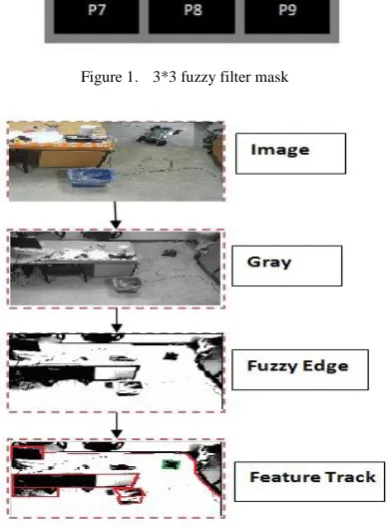
conclusions from vague information. In a sense, fuzzy logic resembles human decision making with its ability to work from approximate data and find precise solutions for the issues. Different algorithms for fuzzy based edge detection have been proposed [23]-[31]. However, all of these approaches were simulated in MATLAB or other software. In this work, we studied edge detection methods based on fuzzy logic control FLC which is developed by C++ and implemented in real OpenCV package and in the on-board the blimp robot. This FLC was designed with 9 inputs and 1 output.
Figure 1. 3*3 fuzzy filter mask
Figure 2. Image processing algorithm
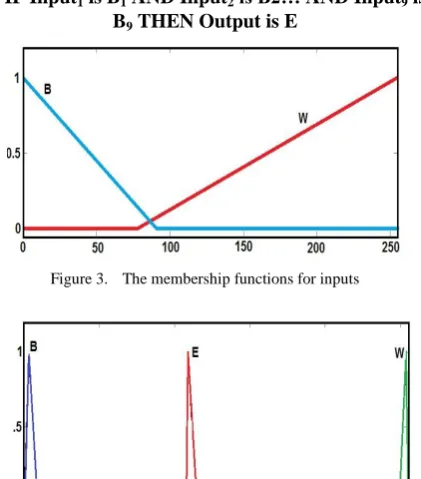
variables (B: Black, E: Edge, W: White) as it is shown in Fig. 3 and Fig. 4. In fuzzy reasoning, the most important fuzzy implication inference rule is the generalized modus ponens (GMP), which uses an IF-THEN rule that implicitly represents a fuzzy relation. The use of fuzzy rules is important when the causal link between domains is not known. Usually partial knowledge about the relation between these domains exists in the form of fuzzy rules. The fuzzy rules define the connection between input and output fuzzy (linguistic) variables. The rule consists of two parts: an antecedent and a consequence part. In this work we have 52 base rules. A typical rule, which describes this simple fact as:
IF Input1 is B1 AND Input2 is B2… AND Input9 is
B9 THEN Output is E
Figure 3. The membership functions for inputs
Figure 4. Output membership functions
III. NAVIGATION AND GENETIC ALGORITHM
Figure 5. Blimp robot
This section describes the algorithms used for the navigation of both the ground and blimp robots. The blimp robot had been designed and developed in our previous works [32]-[35].It has control system to provide
the blimp with the main behaviors such as the height (altitude), stabilization around the Z-axis as well as the ability to avoid obstacles. The control system also provides a pose stabilization algorithm that attempts to keep the blimp as steady as possible in order to obtain a better image as it is shown in Fig. 5. Also, the blimp robot could detect the ground robot and follow it in the environment.
these drawbacks. Therefore, in order to avoid fall into a local minimum complex static environment, the proposed approach has several genetic operators such as deletion operator and enhanced mutation operator by adding basic A* to improve the best path. In addition, the approach could reduce the energy consumption of the ground robot since it takes into account the time as an objective.
Figure 6. Ground control center
Figure 7. The whole process and communication
IV. THE EXPERIMENTAL RESULTS
In order to verify the complete proposed system, some experiments were conducted. During these experiments the blimp robot was flying at a certain altitude (2 meter) as it is shown in Fig. 8. The experiments were done in lab in where the background is very clear and there is not any disturbance except for the illumination variance. The ground robot and the obstacles would be identified and detected in the video sequence by the fuzzy edge detection and the shape-color features algorithm.
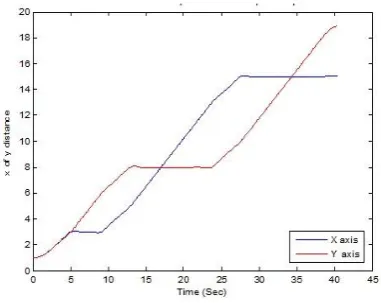
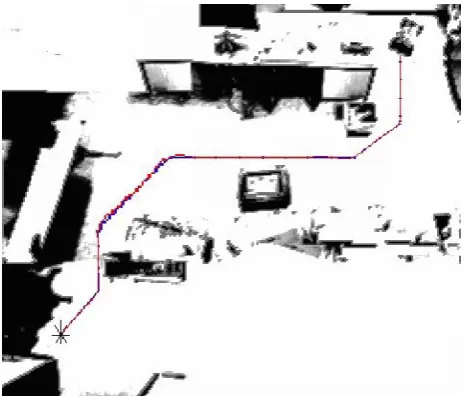
The mobile robot velocity profile in x and y direction is shown in Fig. 9. Fig. 10 shows the velocity of the robot with respect to time for optimum and it starts increasing from 0 to maximum 0.75 m/s and the robot might reduce its speed in case there is a static obstacle close to its path in order to turn left or right. Also, the optimal trajectory generating of mobile robot navigation is illustrated in Fig. 11. Therefore, the optimal trajectory (red) and path (blue)
that have been simulated and generated are shown in Fig. 12.
Figure 8. Altitude of the blimp robot.
Figure 9. Mobile robot velocity profile in x and y direction
Figure 10. Mobile robot velocity profile of optimal trajectory
Figure 12. Trajectory and path for the ground robot
V. CONCLUSION
In this paper, a project towards a heterogeneous system has been presented based on blimp and ground robots. The blimp will explore the environment and detect the objects based on the fuzzy based edge detection algorithm. The fuzzy system includes appropriate defined membership function and fuzzy rules, decide about pixel classification as edge or non-edge. Then, these data were simulated to find the optimal path and trajectory for the ground robot by using an simulation approach that combines enhanced genetic algorithm and modified A*. The proposed approach also provides the robot with the optimal velocity based on the optimal trajectory and path. Also, these obstacles are memorized and a global map with all obstacles was built to enable the system to merge reactive and deliberative methods. In the future, more extensive tests and more complex control are needed to create more complex architecture which allows in next phases to build local-maps. Also, the robot will run the genetic algorithm by itself and communicate with the blimp robot without using GCC in the future.
REFERENCES
[1] H. Choset, K. Lynch, S. Hutchinson, G. Kantor, W. Burgard, L. Kavraki, and S. Thrun, Principles of Robot Motion: Theory,
Algorithms, and Implementations, Boston, USA: MIT Press, 2005.
[2] A. Chu and M. Blackmore, “Novel concept for stratospheric communications and surveillance: Star light,” in Proc. AIAA
Balloon System Conf., 2007, pp. 1-9.
[3] T. Xu and Y. Lu, “Onboard controlling system design of unmanned airship,” in Proc. International Conference on
Electronic & Mechanical Engineering and Information
Technology , vol. 6, 2011, pp. 3028- 3031.
[4] M. Mikolajczyk and C. Smid, “A performance evaluation of local descriptors,” IEEE Trans. Pattern Analysis and Machine
Intelligence, vol. 27, no. 10, pp. 1615-1630, 2005.
[5] D. Nister, O. Naroditsky, and J. Bergen, “Visual odometry for ground vehicle applications,” Journal of Field Robotics, vol. 23, no. 1, pp. 3-20, 2006.
[6] F. Bonin-Font, A. Ortiz, and G. Oliver, “Visual navigation for mobile robots: A survey,” Journal of Intelligent and Robotic
Systems, vol. 53, pp. 263-296, 2008.
[7] S. Ishikawa, H. Kuwamoto, and S. Ozawa, “Visual navigation of an autonomous vehicle using white line recognition,” IEEE
Transactions on Pattern Analysis and Machine Intelligence, vol.
10, no. 5, pp. 743 –749, September 1988.
[8] Y. Matsumoto, M. Inaba, and H. Inoue, “Visual navigation using view sequenced route representation,” in Proc. IEEE International
Conference on Robotics and Automation, vol. 1, April 1996, pp.
83–88.
[9] N. X. Dao, B. J. You, and S. R. Oh, “Visual navigation for indoor mobile robots using a single camera,” in Proc. IEEE/RSJ
International Conference on Intelligent Robots and Systems,
August 2005, pp. 1992–1997.
[10] A. Cherubini and F. Chaumette, “Visual navigation with obstacle avoidance,” in Proc. IEEE/RSJ International Conference on
Intelligent Robots and Systems, September 2011, pp. 1593–1598.
[11] W. Li, T. Zhang, and K. A. Klihnlenz, “Vision-guided autonomous quadrotor in an air-ground multi-robot system,” in
Proc. 2011 IEEE International Conference on Robotics and
Automation, Shanghai, China, May 2011, pp. 2980-2985.
[12] R. Rao, V. Kumar, and C. Taylor, “Visual servoing of a UGV from a UAV using differential flatness,” in Proc. IEEE/RSJ
International Conference on Intelligent Robots and Systems, Las
Vegas, USA, 2003, pp. 743–748.
[13] M. Moseley, B. P. Grocholsky, C. Cheung, and S. Singh, “Integrated long-range UAV/UGV collaborative target tracking,”
in Proc. SPIE Unmanned Systems Technology XI Conference,
2009.
[14] A. Elfes, M. Bergerman, J. H. Carvalho, E. C. Paiva, J. J. Ramos, and S. S Bueno, “Air-ground robotic ensembles for cooperative applications: Concepts and preliminary results,” in Proc. 2nd
International Conference on Field and Service Robotics,
Pittsburgh, PA, USA, 1999, pp. 75–80.
[15] C. Phan and H. Liu, “A cooperative UAV/UGV platform for wildfire detection and fighting,” in Proc. Asia Simulation Conference: 7th International Conference on System Simulation
and Scientific Computing, Beijing, China, 2008, pp. 494–498.
[16] J. Valente, A. Barrientos, A. Martinez, and C. Fiederling, “Field tests with an aerial–ground convoy system for collaborative tasks,” in Proc. 8th Workshop de RoboCity2030-II, Madrid, Spain, 2010, pp. 233–248.
[17] V. Mittal and M. S. Batra, "Edge detection technique by using nero fuzzy system," in Proc. 2nd National Conference on
Challenges & Opportunities in Information Technology,
RIMT-IET, Mandi Gobindgarh, 2008.
[18] R. Gonzalez and R. Wood, Digital Image Processing, Addison– Wesley, 1992.
[19] R. Wang, L. Gao, S. Yang, and Y. Liu, "An edge detection method by combining fuzzy logic and neural networks," Machine
Learning and Cybernetics, vol. 7, pp. 4539-4543, 2005.
[20] L. Liang and C. Looney, "Competitive fuzzy edge detection,"
Applied Soft Computing, vol. 3, pp. 123-137, 2003.
[21] J. Canny, "A computational approach to edge detection," IEEE
Trans, Pattern Anal. Mach. Intel., vol. 8, no. 6, pp. 679-687, 1986.
[22] D. Marr and E. Hildreth, “Theory of edge detection,” Pross. Royal Soc., London, vol. 207, pp. 187-217, 1980.
[26] F. Russo, "Edge detection in noisy images using fuzzy reasoning,"
IEEE Trans. on Instrumentation and Measurement, vol. 47, no. 5,
1998.
[27] M. Zhao, A. Fu, and H. Yan, "A technique of three-level thresholding based on probability partition a fuzzy 3-partition,"
IEEE Trans. on Fuzzy Systems, vol. 9, no. 3, pp. 469-479, June
2001.
[28] L. Liang and C. Looney, "Competitive fuzzy edge detection,"
Applied Soft Computing, vol. 3, pp. 123-137, 2003.
[23] K. Cheung and W. Chan, "Fuzzy one–mean algorithm for edge detection," inProc. IEEE Inter. Conf. on Fuzzy Systems, 1995, pp. 2039- 2044.
[24] Y. Kuo, C. Lee, and C. Liu, "A new fuzzy edge detection method for image enhancement," in Proc. IEEE Inter. Conf. on Fuzzy
Systems, pp. 1069-1074, 1997.
[25] S. El-Khamy, N. El-Yamany, and M. Lotfy, "A modified fuzzy sobel edge detector," in Proc. Seventeenth National Radio Science
[29] M. N. Mahani, M. K. Moqadam, H. N. pour, and A. Bahrololoom, "Dynamic edge detector using fuzzy logic," CSISS' 2008, Sharif University of Technology, Kish, 2008.
[31] N. K. Suryakant, “Edge detection using fuzzy logic in matlab,"
International Journal of Advanced Research in Computer Science
and Software Engineering, vol. 2, no. 4, pp. 38-40, 2012.
[32] R. Al-Jarrah and H. Roth, “Ground robot navigation relies on blimp vision information,” in Proc. 3rd International Conference
on Information Computer Application, Barcelona, Spain, February
19-20, 2014.
[33] R. Al-Jarrah, R. A. Jellal, and H. Roth, “Blimp based on embedded computer vision and fuzzy control for following ground vehicles,” in Proc. 3rd IFAC Symposium on Telematics
Applications, Seoul, Korea, November 11-13, 2013.
[34] R. Al-Jarrah and H. Roth, “Design blimp robot based on embedded system & software architecture with high level communication & fuzzy logic,” in Proc. 9th International
Symposium on Mechatronics & its Applications, Amman, Jordan,
April 9-11, 2013.
[35] R. Al-Jarrah and H. Roth, “Developed blimp robot based on ultrasonic sensors using possibilities distributions and fuzzy logic,” in Proc. 5th International Conference on Computer and
Automation Engineering, Bruxelles- Belgium, Jan. 2013.
[36] M. Breyak and P. Ivan, “Time optimal trajectory planning along predefined path for mobile robots with velocity and acceleration constraints,” in Proc. IEEE, 2011.
[37] B. K. Oleiwi, R. Al-Jarrah, H. H. Roth, and B. Kazem, “Multi objective optimization of trajectory planning of non-holonomic mobile robot in dynamic environment using enhanced GA by fuzzy motion control and A*,” in Proc. the 8th International
Conference on Neural Network and Artificial Intelligence.
[38] B. K. Oleiwi, H. Roth, and B. Kazem, “Modified genetic algorithm based on A* algorithm of multi objective optimization for path planning," in Proc. 6th International Conference on Computer and Automation Engineering.
[39] B. K. Oleiwi, H. Roth, and B. Kazem, “A hybrid approach based on ACO and GA for multi objective mobile robot path planning,”
Applied Mechanics and Materials, vol. 527, pp. 203-212, 2014.
Rami A. Al-Jarrah, completed a Master
degree inMechatronics Engineering at Jordan University of Science and Technology JUST. He is currently a PhD student and research assistant at Automatic Control Engineering Department (RST), Siegen University, Germany. His research interests are Fuzzy Logic analysis, Image Processing, Wireless Sensor Networks and Flying robotics. He w o r k e d a s a l e c t u r e r i n M e c h a n i c a l Engineering Department at JUST 2002-2005 and in Technical and Vocational Training Corporation, Computer Engineering Department, Saudi Arabia, 2006-2009.
Bashra K. Chabor Alwaw,born in Baghdad,
completed a Master degree in Mechatronics Engineering at University of Technology (UOT) Bagdad-Iraq. She is currently a PhD student at Automatic Control Engineering Department (RST), Siegen University, Germany. Her research interests are multi mobile robot, path planning, multi objective optimization and intelligent algorithm. She worked as a lecturer in control and systems Engineering Department at UOT 2005.
Hubert Roth, born in Oppenau, Germany
1954, completed a Doctorate degree at Karlsruhe Technical University, Germany in 1983. He employed at Dornier System GmbH in Friedrichshafen, Aerospace Systems Department 1983-1988. Currently he is the Chair in Control Engineering Department (RST) at Siegen University, Faculty of Electrical Engineering and Informatics since 2001.Prof. Dr.-Ing. Roth is a vice Director of “Technical Committee on Computers and Telematics” of International Federation of Automatic Control (IFAC) since 2008 and vice Director of Centre for International Capacity Development (CICD) since 2009.
[30] G. Mansoori and H. Eghbali, "Heuristic edge detection using fuzzy rule-based classifier," Journal of Intelligent and Fuzzy