https://doi.org/10.5194/gmd-12-167-2019 © Author(s) 2019. This work is distributed under the Creative Commons Attribution 3.0 License.
Particle swarm optimization for the estimation of surface
complexation constants with the geochemical model
PHREEQC-3.1.2
Ramadan Abdelaziz1,2, Broder J. Merkel2, Mauricio Zambrano-Bigiarini3, and Sreejesh Nair4
1College Of Engineering, A’Sharqiyah University, Ibra, Oman 2TU Bergakademie Freiberg, Freiberg, Germany
3Department of Civil Engineering, Universidad de La Frontera, Temuco, Chile 4Institute of Environmental Physics, University of Bremen, Bremen, Germany
Correspondence:Ramadan Abdelaziz ([email protected], [email protected]) Received: 16 March 2017 – Discussion started: 17 July 2017
Revised: 24 August 2018 – Accepted: 14 September 2018 – Published: 8 January 2019
Abstract. Sorption of metals on minerals is a key process in treatment water, natural aquatic environments, and other water-related technologies. Sorption processes are usually simulated with surface complexation models; however, iden-tifying numeric values for the thermodynamic constants from batch experiments requires a robust parameter estimation technique that does not get trapped in local minima. Re-cently, particle swarm optimization (PSO) techniques have attracted many researchers as an efficient and effective opti-mization technique to find (near-)optimum model parameters in several fields of research. In this work, uranium at low con-centrations was sorbed on quartz at different pH, and the hy-droPSO R optimization package was used – the first time – to calibrate the PHREEQC geochemical model, version 3.1.2. Results show that thermodynamic parameter values iden-tified with hydroPSO are more reliable than those identi-fied with the well-known parameter estimation (PEST) soft-ware, when both parameter estimation software are coupled to PHREEQC using the same thermodynamic input data. In addition, post-processing tools included in hydroPSO were helpful for the correct interpretation of uncertainty in the obtained model parameters and simulated values. Thus, hy-droPSO proved to be an efficient and versatile optimization tool for identifying reliable thermodynamic parameter values of the PHREEQC geochemical model.
1 Introduction and scope
sur-face complexation model as the PHREEQC (Parkhurst and Appelo, 1999).
Nowadays, a number of PSO software codes exist, such as MADS (Harp and Vesselinov, 2011; Vesselinov and Harp, 2012) and OSTRICH (Matott, 2005), with most of the codes using the basic PSO formulation developed in 1995. How-ever, in this paper, we use the latest standard particle swarm optimization proposed in literature (Clerc, 2012; Zambrano-Bigiarini et al., 2013), named SPSO2011, as implemented in the hydroPSO R package (R Core team, 2016) version 0.3-3 (Zambrano-Bigiarini and Rojas, 2010.3-3, 2014). hydroPSO is an independent R package that includes the newest stan-dard PSO (SPSO-2011), which was specifically developed to calibrate a wide range of environmental models. In addition, the plotting functions in hydroPSO are user-friendly and aid the numeric and visual interpretation of the optimization re-sults. The source code, installation files, tutorial (vignette), and manual are available on https://cran.r-project.org/web/ package=hydroPSO (last access: 12 June 2018).
hydroPSO is used in this article, for the first time, to estimate the parameters of a surface complexation for uranium(VI)–quartz system, to properly capture the non-linear interactions between the model parameters. The aim of this article is to examine the suitability of hydroPSO as a global optimization tool for parameter estimation of geo-chemical models, in particular PHREEQC v3.1.2. To this end, surface/sorption reaction constants (logK) of the SCM obtained with hydroPSO will be compared to those previ-ously obtained with parameter estimation (PEST) software (Doherty, 2010) by Nair et al. (2014).
PEST and PSO are both model-independent parameter op-timizers; i.e., they do not require making any change to the model code. PEST uses the Gauss–Marquardt–Levenberg method to minimize, in the weighted least squares sense, the differences between observations and the corresponding model-simulated values (Abdelaziz and Bakr, 2012; Edet et al., 2014). PEST is a gradient-based algorithm that initially calculates the Jacobian matrix and is then used to build and upgrade parameter set, to enhance the searching ability to obtain a better objective function value (Doherty, 2010). The model then iterates adjusting the model parameters on the basis of a new Marquardt lambda value (Doherty, 2010), which drives the objective function for faster convergence. As a local optimizer, PEST is sensitive to the initial condi-tion (see a complete descripcondi-tion in Doherty, 2010). In con-trast, PSO is global optimizer which randomly initializes a population of particles within the D-dimensional parame-ter space. PSO allows initializing the position of each par-ticle using a random uniform distribution or Latin hypercube sampling (LHS), while velocities can be initialized at zero, with two different random distributions, or with two different LHS strategies (see Zambrano-Bigiarini and Rojas, 2013). Velocity and position of each particle in the parameter space are updated in successive iterations following equations spe-cific to the selected PSO version (see a complete description
in Zambrano-Bigiarini and Rojas, 2013, and Abdelaziz and Zambrano-Bigiarini, 2014). As a state-of-the-art global opti-mizer, PSO is less subject get trapped in local minima com-pared to PEST.
2 Model description
PHREEQC version 3.1.2 (Parkhurst and Appelo, 1999) and the database of Nuclear Energy Agency thermodynamic (NEA_2007) (Grenthe et al., 2007), as well as the LLNL database (Lawrence Livermore National Laboratory) are used to model sorption of metal species. Both databases were modified by setting constant values for MUO2(CO3)23− and
M2UO2(CO3)03species (M equals Ca, Mg, Sr) obtained from
Geipel et al. (2008) and Dong and Brooks (2006, 2008). PHREEQC is a geochemical software which is able to sim-ulate sorption, surface complexation, and other types of re-actions. SCMs are considered to be able to describe the pro-cesses at liquid–solid interfaces (Huber and Lützenkirchen, 2009), and have been widely used to simulate the sorption of metal species from aqueous solution depending on its con-centration, pH value, ionic strength, and redox conditions (Davis et al., 2004; Štamberg et al., 2003; Zheng et al., 2003). A different group of reactions has taken place between aque-ous species in the bulk solution and the surface of the sor-bent leads to the formation of surface complexes (Nair et al., 2014). The surface complexation constants for these re-actions are indispensable and independent of changes in so-lution condition or soso-lution complex (Dzombak and Morel, 1990; Hayes et al., 1991; Volesky, 2003).
There are different type of SCMs, such as the gener-alized two-layer model (GTLM), non-electrostatic model (NEM), constant capacitance model (CCM), diffuse-layer model (DLM), and modified triple-layer model (modified TLM). Here, a GTLM (Dzombak and Morel, 1990) was used to simulate the sorption behavior of U(VI) on quartz. The GTLM was used instead of other models because it is rel-atively simple and can be used in a wide range of chem-ical conditions. A comprehensive review of the GTLM is presented in Dzombak and Morel (1990). Quartz is a non-porous and non-layered mineral, and therefore the actual area of surface is supposed to be equal to the specific sur-face area. In this study, the sursur-face of quartz is considered as a single binding site which takes the charge for every surface reaction. The sorption reactions and logK values are related to the aqueous species and thus depend on the thermodynamic database used. Uranyl carbonate complexes ((UO2)2CO3(OH)3−, UO2(CO3)22−, and UO2(CO3)43−) are
the dominant species under our experimental conditions. Therefore, the surface complexation reactions for quartz were calculated with respect to these species.
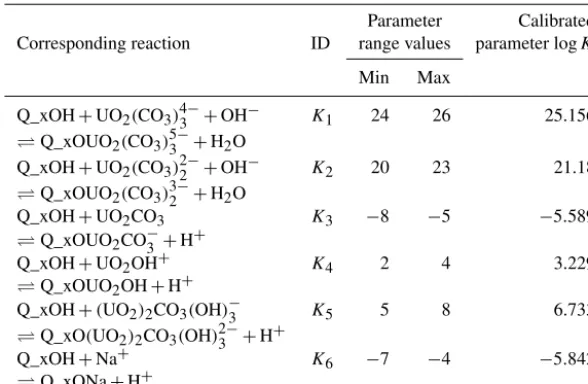
Table 1.Complexation reactions with their respective logKrange values.
Parameter Calibrated Corresponding reaction ID range values parameter logK
Min Max
Q_xOH+UO2(CO3)34−+OH− K1 24 26 25.156 Q_xOUO2(CO3)53−+H2O
Q_xOH+UO2(CO3)22−+OH− K2 20 23 21.18 Q_xOUO2(CO3)32−+H2O
Q_xOH+UO2CO3 K3 −8 −5 −5.589 Q_xOUO2CO−3 +H+
Q_xOH+UO2OH+ K4 2 4 3.229
Q_xOUO2OH+H+
Q_xOH+(UO2)2CO3(OH)−3 K5 5 8 6.733 Q_xO(UO2)2CO3(OH)23−+H
+
Q_xOH+Na+ K6 −7 −4 −5.842 Q_xONa+H+
Q_xOH is the silanol surface site.
formation of Mg-, Ca-, and Sr–uranyl-carbonato complexes shows a significant impact on the sorption of uranium on quartz. This was studied by Nair and Merkel (2011) in batch experiments adding 10 g of powdered quartz to 0.1 L of water containing rather low U(VI) concentrations (0.126×10⁻⁶M) in the absence and presence of Mg, Sr, and Ca (1 mM) at a pH value between 9 and 6.5 in steps of 0.5. NaHCO3
(1×10⁻³M) and NaCl (1.5×10⁻³M) were used as ionic strength buffers. The low U concentrations were used to avoid precipitation of Ca–U carbonates. In the absence of al-kaline earth elements, the percentage of uranium was sorbed on quartz approximately 90 % independent from pH. In the existence of Mg, Sr, and Ca, the percentage of sorption of uranium on quartz decreased to 50 %, 30 %, and 10 % re-spectively (Nair and Merkel, 2011). In this paper, the surface was the generalized two-layer model and was taken from Dzombak and Morel (1990) with no explicit calculation of the diffuse-layer composition.
Table 1 displays the parameter ranges used to optimize the six parameters selected to calibrate PHREEQC, based on Nair et al. (2014).
3 Computational implementation
Inverse modeling is a complex issue for modelers as a result of the numerous uncertainties in model parameters and ob-servations (e.g., Carrera et al., 2005; Beven, 2006). PSO is an evolutionary optimization algorithm originally developed by Kennedy and Eberhart (1995), which has proven to be highly efficient when solving a large collection of case stud-ies from different disciplines (see, e.g., Poli, 2008). In PSO, each individual of the population searches for the global op-timum in a multi-dimensional parameter space, considering
the individual and collective past experiences. The canonical PSO algorithm starts with a random initialization of the par-ticles’ positions and velocities within the parameter space. Velocity and position of each particle in the parameter space are updated in successive iterations following equations spe-cific to the selected PSO version, in order to find the mini-mum or (maximini-mum) value of a user-defined objective func-tion (see a complete descripfunc-tion in Zambrano-Bigiarini and Rojas, 2013). In the last decades, several improvements have been proposed to the canonical PSO algorithm, and the se-lected optimization tool implements several of them in a single piece of software. The hydroPSO R package v0.3-3 (Rojas and Zambrano-Bigiarini, 2012; Zambrano-Bigiarini and Rojas, 2013, 2014) is a model-independent optimization package, which implements a state-of-the-art PSO algorithm to carry out a global parameter optimization, and it has been successfully applied as calibration tool for both hydrogeolog-ical and hydrologhydrogeolog-ical models (Zambrano-Bigiarini and Ro-jas, 2013; Thiemig et al., 2013; Abdelaziz and Zambrano-Bigiarini, 2014; Bisselink et al., 2016). In particular, hy-droPSO implements six PSO variants (equations used to up-date particles’ position and velocities), four topologies (ways in which particles are linked during each iteration), two ini-tialization of particles’ positions (random uniform distribu-tion or Latin hypercube sampling), and five alternatives for initializing particles’ velocities, among other fine-tuning op-tions (see Zambrano-Bigiarini and Rojas, 2013). In the ap-plication of hydroPSO to PHREEQC, the following configu-ration was used: a swarm with 10 particles, 200 iteconfigu-rations, LH initialization of particle positions and velocities, ran-dom topology with five informants, acceleration coefficients
c1 and c2 equal to 2.05, linearly decreasing clamping
con-Figure 1.Flow chart used to couple(a)PHREEQC with hydroPSO and(b)PHREEQC with PEST for inverse modeling of surface complex-ation constants for uranium carbonate (U(VI)) species on quartz using the PHREEQC geochemical model.
striction factor instead of the inertia weight. hydroPSO re-quires no instruction or template files as UCODE (Poeter et al., 2005; Abdelaziz and Merkel, 2015) and PEST software (Doherty, 2010, 2013) do. In order to couple hydroPSO with the PHREEQC geochemical model, three text files have to be prepared by the user to handle data transfer between the model code and the optimization engine. These files include (i)ParamFiles.txt, which describes the names of a set of pa-rameters to be estimated and locations in the model input files to be utilized in the inverse modeling, (ii)ParamRanges.txt, which defines the minimum and maximum values that each selected parameter might have during the optimization, and (iii)PSO_OBS.txt, which contains the observations that will be compared against its simulated counterparts. In addition, a user-defined R script file (Read_output.R) should define the instructions to read model outputs. Finally, for coupling hy-droPSO with PHREEQC, an R script template provided by hydroPSO developers was slightly modified by the user in order to carry out the optimization. Figure 1a shows a flow chart that depicts how hydroPSO is coupled with PHREEQC to calibrate its parameters. Run-phreeqc.bat is a batch file to run PHREEQC-3.1.2 in the DOS environment, which reads *.phrq files to produce *.prn files as output (simulated data); *.ins files are instructions to read model outputs, by us-ing the Read_output.R script. At each iteration, hydroPSO modifies model parameter values to minimize the value of the user-defined objective function. Finally, the new param-eter values are updated following the locations provided in the “ParamFiles.txt” file. In contrast, to couple PEST with PHREEQC, four files are required. These include (i) tem-plate files (*.tpl), (ii) instruction files (*.ins), (iii) a main con-trol file (*.pst), and (iv) a batch file to execute PHREEQC and PEST(*.bat). Template files are built to modify the input files for PHREEQC with other values while an instruction file is used to extract the simulated values from the output file for PHREEQC. The main control file includes the model application to be run, the observations, parameters to be
es-timated, control data keywords, and others. Further informa-tion about PEST can be found in its manual (Doherty, 2010). Figure 1a, b show the key files used to couple PHREEQC with hydroPSO and explain the flowchart and files involved in the inverse modeling of the surface complexation con-stants for the U(VI) sorption model.
For numerical optimization, the residual sum of squares (RSS or SSR; see Eq. 1) was utilized to compute the good-ness of fit (GoF) between the corresponding model outputs (Cjs) and observed U-carbonate concentration values (Cjo)
at different pH values for every iteration step i; n is the number of observation points (measured sorption U(VI) onto quartz). Minimizing the residual sum of squares was cho-sen as the method for estimating the surface/sorption reac-tion constants in calibrareac-tions by Nair et al. (2014) when PEST was combined with PHREEQC. It was decided for consistency to select SSR as the criterion for goodness of fit when applying hydroPSO with PHREEQC. After some initial trials, the number of maximum iterations (T) was set to 200 and the number of particles used to search for the minimum RSS in the parameter space was fixed at 10 (i.e., 2000 model runs). All the input files required for running PHREEQC and hydroPSO can be found at Zenodo (https: //zenodo.org/record/1044951#.WgVTbVuCzIU, last access: 10 November 2017), including all the optimization results. SSR=X
j=1 nCs
j−Coj
2
(1)
4 Results and discussion
Figure 2.Scatter plot with the experimentally observed and calcu-lated values of uranium carbonate (sorption percentage).
able to explain a good portion of the variability of the re-sponse data (Fig. 2).
In hydroPSO, there are two types of criteria for conver-gence:
i. “absolute”, when the global optimum found in a given iteration is below/above a user-defined threshold (useful for minimization/maximization problems where the true minimum/maximum is known); and
ii. “relative”, when the absolute difference between the model performance in the current iteration and the model performance in the previous iteration for the best performing particle is less than or equal to a user-defined threshold (useful to prevent too many model runs without any improvement in the optimum found by the algorithm).
If none of the two previous criteria are met, then the algo-rithm stops when the user-defined number of iterations is finally achieved. Figure 3 shows the evolution of the best model performance (i.e., smallest RSS) found by all the par-ticles in a given iteration, and the normalized swarm radius (δnorm, a measure of the spread of the population in the range
of search-space) versus the iterations number. One may ob-serve that both δnorm and the best model performance
be-come smaller with an increasing iteration number, which in-dicates that the main particles are “flying” around a small region within the parameter space. Only 100 iterations (i.e., 100×10=1000 model runs) were enough to reach the region of the global optimum (i.e., RSS ca. 2.52), and the remain-ing iterations were just used to refine the search, as shown in Fig. 3.
Figure 3.Evolution of the normalized swarm radius (δnorm) and the global optimum (SSR) over 200 iterations.
The boxplots in Fig. 4 are graphical representations of the values sampled during optimization. The bottom and top of the box show the first and third quartiles of the distribution of each one of the surface/sorption reaction constants (logK) sampled during the optimization, respectively. The horizon-tal line within the box denotes the median of the distribu-tion. Points outside the whiskers are considered to be out-liers, where notches are within±1.58IQR/√(n), IQR repre-sents the interquartile range andnthe total number of param-eter sets used in the optimization. The horizontal red lines in Fig. 4 point out the optimum value found during optimization for each parameter.
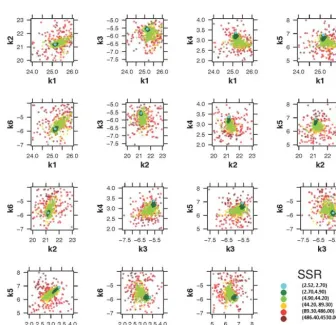
Quasi-three-dimensional dotty plots in Fig. 5 depict the goodness-of-fit values achieved by different parameter sets. They are suitable for identifying ranges where different sets of parameters lead to the same model performance (equifi-nality, Beven, 2006). So, Fig. 5 also shows the model per-formance as function of the interaction of different parame-ter ranges. The (quasi-)three-dimensional dotty plot shown in Fig. 5 is a projection of the values of pairs of parameters onto the RSS response surface. Parameter values where the model presents high performance are shown in light blue (points density), whilst the parameter values where the model shows low performance are shown in dark red (points density). Fig-ure 5 was used to identify regions of the solution space with good and bad model performance.
Visual inspection of Fig. 5 shows a good exploratory ca-pability of PSO because the particles are well spread over the entire range space. It is clearly visible that the param-eter samples are denser around the optimum value (lowest SSR), showing a small uncertainty range around the opti-mum value.
Figure 4.Boxplots for the optimized parameters. The horizontal red lines indicate the optimum value for each parameter. Parameter names are defined in Table 1.
Figure 6.Empirical cumulative density functions for each calibrated parameter.
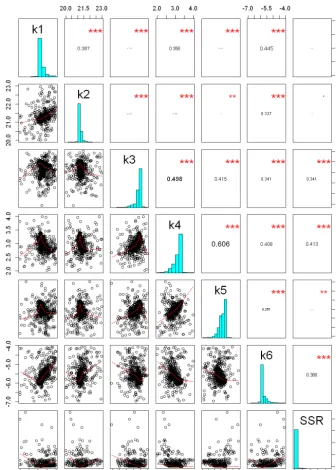
Figure 8.Correlation matrix between model performance (SSR) and calibrated parameters. Red lines represent lowest smoothing, using locally weighted polynomial regression, and numbers in the upper panel represents the Pearson-moment correlation coefficient between each pair of parameters. Vertical and horizontal axes illustrate the physical range utilized for parameter optimization.∗∗∗stands for ap <0.001; ∗∗stands forp <0.01, according to level of statistical significance
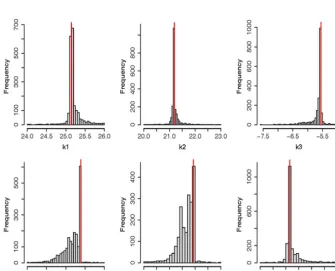
while the vertical gray dotted lines depict the correspond-ing parameter value displayed at the top of every panel in Fig. 6. The thin vertical red line in Fig. 7 points out the opti-mum value achieved for each parameter. Histograms in Fig. 7 show near-normal distributions forK1andK2, whileK4and
K5 follow a skewed distribution with sampled values
con-centrated near the upper boundary of each parameter. Figure 8 illustrates the correlation matrix amongKvalues and model performance (SSR), with horizontal and vertical
axes displaying the ranges used for the calibration of each parameter. The figure shows that the highest correlation co-efficient occurred among the measure of model performance (SSR) andK4,K6, andK3. In addition, a higher correlation
coefficient was observed betweenK4 andK5, K3 andK4,
andK1andK6.
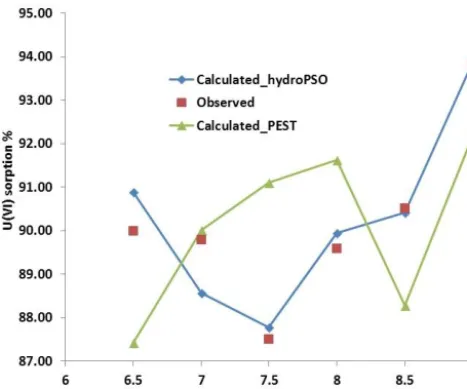
Figure 9.Observed and simulated sorption of uranium in quartz vs. pH with both PEST and hydroPSO calibrated logKvalues.
It is worthwhile to mention that the surface complexation constants for Eqs. (1), (2), and (5) (Table 1) are more impor-tant, and the equations that are less important are Eqs. (3), (4), and (6) in optimizing the logK values. It proves that UO2(CO3)43−, UO2(CO3)22−, and(UO2)CO3(OH)−3 are the
most dominant species for sorption on quartz. The surface complexation constants for Eqs. (2) and (4) were 21.18 and 3.229, respectively (Nair et al., 2014), which is higher than the electrostatic (ES) and non-electrostatic (NES) models, while the optimized value for Eq. (1) is 25.156, which is higher than the NES model and almost the same as the ES model (Nair et al., 2014).
The experimental conditions used to calibrate PHREEQC with hydroPSO were the same as during the PEST optimiza-tion carried out by Nair et al. (2014). In other words, PEST was applied for the same experiment and the same data, and Fig. 9 shows that the logKvalues obtained with hydroPSO are better than those obtained by PEST, except for pH=7. The main reason is that PSO is a global optimization tech-nique, which searches for optimum values in the whole pa-rameter space using the papa-rameter ranges given in Table 1, while PEST searches in a neighborhood of the initial solu-tion. In particular, local optimization carried out by PEST minimize a weighted least squares objective function via the Gauss–Marquardt–Levenberg non-linear regression method (Marquardt, 1963). Actually, a major drawback of PEST, as of all gradient-based techniques, is the dependency of the quality of the optimization results upon the initial point used for the optimization, which might lead to a local opti-mum rather than the global one. Thus, PSO techniques offer promising possibilities for similar surface complexation and reactive transport applications in hydrogeology and hydro-chemistry.
5 Conclusions
The coupling of hydroPSO and PHREEQC was success-fully carried to estimate surface complexation constants for uranium (VI) species on quartz, based on a data set pub-lished by Nair and Merkel (2011), and Nair et al. (2014). The open-source hydroPSO R package proved to be a use-ful tool for inverse modeling of surface complexation models with PHREEQC and allowed a prompt evaluation of the cali-bration results. Furthermore, thermodynamic values obtained with hydroPSO provided a better match to observation sorp-tion rates in comparison to those obtained with PEST, using the same input data and experimental setup.
Code and data availability. PHREEQC is available at http://www. hydrochemistry.eu/ph3/index.html (Parkhurst and Appelo, 2016). Source code, tutorials, and the reference manual of hydroPSO can be obtained from https://CRAN.R-project.org/package=hydroPSO (Zambrano-Bigiarini and Rojas, 2012). The PHREEQC model in-put files along with the R scripts used for coupling it with hydroPSO and the model outputs can be obtained from the Zenodo reposi-tory (https://zenodo.org/record/1044951#.WgVTbVuCzIU, last ac-cess: 10 November 2017; Abdelaziz, 2017).
Author contributions. All authors contributed to the writing of the paper. RA developed the coupling of PHREEQC and hydroPSO, carried out all simulations, and prepared the manuscript. MZB, BJM, and SN were involved in visualizing and writing some chap-ters. RA and co-authors contributed in reviewing and editing.
Competing interests. The authors declare that they have no conflict of interest.
Acknowledgements. The authors thank the topical editor Claire Levy and the anonymous reviewers whose helped us to improve the original manuscript significantly. The authors would also like to thank Autumn Dinkelman for proofreading this paper.
Edited by: Claire Levy
Reviewed by: two anonymous referees
References
Abdelaziz, R.: Coupling of hydroPSO and PHREEQC (Version version3) [Data set], Zenodo, https://doi.org/10.5281/zenodo.1044951, 2017.
Abdelaziz, R. and Bakr, M. I.: Inverse modeling of groundwater flow of Delta Wadi El-Arish, J. Water Resour. Protect., 4, 432, https://doi.org/10.4236/jwarp.2012.47050, 2012.
Abdelaziz, R. and Zambrano-Bigiarini, M.: Particle Swarm Op-timization for inverse modeling of solute transport in frac-tured gneiss aquifer, J. Contam. Hydrol., 164, 285–298, https://doi.org/10.1016/j.jconhyd.2014.06.003, 2014.
Abdelaziz, R., El-Rahman, Y. A., and Wilhelm, S.: Landsat-8 data for chromite prospecting in the Logar Massif, Afghanistan, He-liyon, 4, e00542, https://doi.org/10.1016/j.heliyon.2018.e00542, 2018.
Beck, M., Hecht-Méndez, J., de Paly, M., Bayer, P., Blum, P., and Zell, A.: Optimization of the energy extraction of a shallow geothermal system, 2010 IEEE Congress on Evolutionary Com-putation, 1–7, https://doi.org/10.1109/cec.2010.5585921, 2010. Beven, K.: A manifesto for the equifinality thesis, J. Hydrol., 320,
18–36, https://doi.org/10.1016/j.jhydrol.2005.07.007, 2006. Bisselink, B., Zambrano-Bigiarini, M., Burek, P., and de Roo,
A.: Assessing the role of uncertain precipitation estimates on the robustness of hydrological model parameters under highly variable climate conditions, J. Hydrol., 8, 112–129, https://doi.org/10.1016/j.ejrh.2016.09.003, 2016.
Clerc, M.: Standard Particle Swarm Optimisation, Technical Re-port, Particle Swarm Central, available at: http://clerc.maurice. free.fr/pso/SPSO_descriptions.pdf, last access: 24 September 2012.
Carrera, J, Alcolea, A., Medina, A., Hidalgo, J., and Slooten, L. J.: Inverse problem in hydrogeology, Hydrogeol. J., 13, 206–222, https://doi.org/10.1007/s10040-004-0404-7, 2005.
Das, P.: Economics of Distributed Generation Using Particle Swarm Optimization: A Case Study, Economics, International Journal of Science, Engineering and Technology Research (IJSETR) vol. 1, issue 5, available at: http://ijsetr.org/wp-content/uploads/2013/ 08/IJSETR-VOL-1-ISSUE-5-191-199.pdf (last access: January 2017), 2012.
Davis, J. A., Meece, D. E., Kohler M., and Curtis, G. P.: Approaches to surface complexation modeling of uranium(VI) adsorption on aquifer sediments, Geochim. Cosmochim. Ac., 68, 3621–3641, https://doi.org/10.1016/j.gca.2004.03.003, 2004.
Doherty, J.: PEST: Model-independent Parameter Estimation, User Manual, 5th edn., Watermark Numerical Computing, Brisbane, Queensland, Australia, 2010.
Doherty, J.: Addendum to the PEST manual, Technical Report Wa-termark Numerical Computing, Brisbane, Queensland, Australia, 2013.
Donelli, M. and Massa, A.: Computational approach based on a particle swarm optimizer for microwave imaging of two-dimensional dielectric scatterers, IEEE T. Microw. Theory, 53, 1761–1776, https://doi.org/10.1109/tmtt.2005.847068, 2005. Dong, W. M. and Brooks, S. C.: Determination of the formation
constants of ternary complexes of uranyl and carbonate with al-kaline earth metals (Mg2+, Ca2+, Sr2+, and Ba2+) using an-ion exchange method, Environ. Sci. Technol., 40, 4689–4695, https://doi.org/10.1021/es0606327, 2006.
Dong, W. M. and Brooks, S. C.: Formation of aqueous MgUO2(CO3)23−complex and uranium anion exchange mech-anism onto an exchange resin, Environ. Sci. Technol., 42, 1979– 1983, https://doi.org/10.1021/es0711563, 2008.
Dzombak, D. A. and Morel, F. M.: Surface complexation modeling: Hydrous ferric oxide, John Wiley & Sons, New York, 1990. Eberhart, R. and Kennedy, J.: A new optimizer using particle
swarm theory, Proceedings of the Sixth International
Sympo-sium on Micro Machine and Human Science, MHS’95, 39–43, https://doi.org/10.1109/mhs.1995.494215, 1995.
Eberhart, R. C. and Shi, Y.: Comparison between genetic algo-rithms and particle swarm optimization, in: Evolutionary Pro-gramming VII, edited by: Porto, V., Saravanan, N., Waagen, D., and Eiben, A., Springer, Berlin, Heidelberg, 1447, 611–616, https://doi.org/10.1007/BFb0040812, 1998.
Edet, A., Abdelaziz, R., Merkel, B., Okereke, C., and Nganje, T.: Numerical groundwater flow modeling of the coastal plain sand aquifer, Akwa Ibom State, SE Nigeria, J. Water Resour. Protect., 6, 43934, https://doi.org/10.4236/jwarp.2014.64025, 2014. Formetta, G., Kampf, S. K., David, O., and Rigon, R.: Snow
wa-ter equivalent modeling components in NewAge-JGrass, Geosci. Model Dev., 7, 725–736, https://doi.org/10.5194/gmd-7-725-2014, 2014.
Geipel, G., Amayri, S., and Bernhard, G.: Mixed complexes of al-kaline earth uranyl carbonates: a laser-induced time-resolved flu-orescence spectroscopic study, Spectrochim. Acta A, 71, 53–58, https://doi.org/10.1016/j.saa.2007.11.007, 2008.
Gill, M. K., Kaheil, Y. H., Khalil, A., McKee, M., and Basti-das, L.: Multiobjective particle swarm optimization for param-eter estimation in hydrology, Water Resour. Res., 42, W07417, https://doi.org/10.1029/2005WR004528, 2006.
Grenthe, I., Fuger, J., Konings R., Lemire, R. J., Muller, A. B., and Wanner, J.: The Chemical Thermodynamics of Uranium, Else-vier, New York, 2007.
Harp, D. and Vesselinov, V. V.: Recent developments in MADS al-gorithms: ABAGUS and Squads, EES-16 Seminar Series, LA-UR-11-11957, 2011.
Hayes, K. F., Redden, G., Ela, W., and Leckie, J. O.: Surface complexation models: an evaluation of model parameter esti-mation using FITEQL and oxide mineral titration data, J. Col-loid Interf. Sci., 142, 448–469, https://doi.org/10.1016/0021-9797(91)90075-j, 1991.
Huang, F. Y., Li, R. J., Liu, H. X., and Li, R.: A modified parti-cle swarm algorithm combined with fuzzy neural network with application to financial risk early warning, in: Services Comput-ing, 2006, APSCC’06, IEEE Asia-Pacific Conference, 168–173, https://doi.org/10.1109/apscc.2006.12, 2006.
Huang, T. and Mohan, A. S.: A microparticle swarm optimizer for the reconstruction of microwave images, IEEE T. Antenn. Propag., 55, 568–576, https://doi.org/10.1109/tap.2007.891545, 2007.
Huber, F. and Lützenkirchen, J.: Uranyl Retention on Quartz-New Experimental Data and Blind Prediction Using an Existing Surface Complexation Model, Aquat. Geochem., 15, 443–456, https://doi.org/10.1007/s10498-009-9060-9, 2009.
Kaveh, A. and Talatahari, S.: A particle swarm ant colony optimiza-tion for truss structures with discrete variables, J. Constr. Steel Res., 65, 1558–1568, https://doi.org/10.1016/j.jcsr.2009.04.021, 2009.
Kennedy, J. and Eberhart, R.: Particle swarm optimiza-tion, in: neural networks, 1995, Proceedings IEEE In-ternational Conference on Neural Networks, 1942–1948, https://doi.org/10.1109/icnn.1995.488968, 1995.
Marquardt, D.: An algorithm for least-squares estimation of non-linear parameters, J. Soc. Ind. Appl. Math., 11, 431–441, https://doi.org/10.1137/0111030, 1963.
Matott, L.: Ostrich: An Optimization Software Tool, Documenta-tion and User’s Guide, Version 1.6, Department of Civil, Struc-tural and Environmental Engineering, University at Buffalo, Buf-falo, NY, 2005.
Nair, S. and Merkel B. J.: Impact of Alkaline Earth Metals on Aqueous Speciation of Uranium(VI) and Sorption on Quartz, Aquat. Geochem., 17, 209–219, https://doi.org/10.1007/s10498-011-9120-9, 2011.
Nair, S., Karimzadeh, L., and Merkel, B. J.: Surface complexation modeling of Uranium (VI) sorption on quartz in the presence and absence of alkaline earth metals, Environ. Earth Sci., 71, 1737– 1745, https://doi.org/10.1007/s12665-013-2579-5, 2014. Parkhurst, D. L. and Appelo, C. A.: User’s Guide to PHREEQC
(version 2). A Computer Program for Speciation, Batch-Reaction, One-Dimensional Transport, and Inverse Geochemical Calculation, USGS, Water Resources Investigation Report, 99– 4259, https://doi.org/10.3133/wri994259, 1999.
Parkhurst, D. L. and Appelo, C. A.: PHREEQC v3.1.2 (Version v3.1.2), available at: http://www.hydrochemistry.eu/ph3/index. html (last access: July 2017), 2016.
Poeter, E., Hill, M., Banta, E., Mehl, S., and Christensen, S.: UCODE 2005 and six other computer codes for universal sensitivity analysis, calibration, and uncertainty evaluation, US Geological Survey Techniques and Methods, vol. 6-A11, https://doi.org/10.3133/tm6a11, 2005.
Poli, R.: Analysis of the publications on the applications of par-ticle swarm optimisation, J. Artif. Evol. Appl., 2008, 685175, https://doi.org/10.1155/2008/685175, 2008.
R Core team: R: A Language and Environment for Statistical Com-puting, R Foundation for Statistical Computing. Vienna, Austria, available at: http://www.R-project.org/, last access: 10 March 2016.
Rojas, R. and Zambrano-Bigiarini, M.: Tutorial for interfacing hydroPSO with SWAT-2005 and MODFLOW-2005, Techni-cal Report, available at: http://www.rforge.net/hydroPSO/files/ hydroPSO_vignette.pdf (last access: 3 February 2014), 2012. Schutte, J. F. and Groenwold, A. A.: Sizing design of truss
struc-tures using particle swarms, Struct. Multidiscip. O., 25, 261–269, https://doi.org/10.1007/s00158-003-0316-5, 2003.
Sedki, A. and Ouazar, D.: Swarm intelligence for groundwa-ter management optimization, J. Hydroinform., 13, 520–532, https://doi.org/10.2166/hydro.2010.163, 2011.
Štamberg, K., Venkatesan, K. A., and Vasudeva Rao, P. R.: Surface complexation modeling of uranyl ion sorption on mesoporous silica, Colloid Surface A, 221, 149–162, https://doi.org/10.1016/s0927-7757(03)00139-0, 2003.
Thiemig, V., Rojas, R., Zambrano-Bigiarini, M., and De Roo, A.: Hydrological evaluation of satellite-based rainfall estimates over the Volta and Baro-Akobo Basin, J. Hydrol., 499, 324–338, https://doi.org/10.1016/j.jhydrol.2013.07.012, 2013.
Vesselinov, V. V. and Harp, D. R.: Adaptive hybrid opti-mization strategy for calibration and parameter estimation of physical process models, Comput. Geosci., 49, 10–20, https://doi.org/10.1016/j.cageo.2012.05.027, 2012.
Volesky, B.: Biosorption process simulation tools, Hy-drometallurgy, 71, 179–190, https://doi.org/10.1016/s0304-386x(03)00155-5, 2003.
Zambrano-Bigiarini, M. and Rojas, R.: hydrPSO V0.3.3 (Ver-sion V0.3.3), available at: https://CRAN.R-project.org/package= hydroPSO (last access: 6 December 2018), 2012.
Zambrano-Bigiarini, M. and Rojas, R.: A model-independent Particle Swarm Optimisation software for model calibration, Environ. Model. Softw., 43, 5–25, https://doi.org/10.1016/j.envsoft.2013.01.004, 2013.
Zambrano-Bigiarini, M. and Rojas, R.: hydroPSO: Particle Swarm Optimisation, with focus on Environmental Models, available at: http://www.rforge.net/hydroTSM/ (last access: August 2017), R package version 0.3-3, 2014.
Zambrano-Bigiarini, M., Clerc, M., and Rojas, R.: Stan-dard particle swarm optimisation 2011 at cec-2013: A baseline for future pso improvements, Evolutionary Computation (CEC), 2013 IEEE Congress, 2337–2344, https://doi.org/10.1109/cec.2013.6557848, 2013.