Iranian Journal of Language Teaching Research 6(1), (Jan., 2018) 41-62 41
* Corresponding author: Department of TEFL, Payame Noor University, Tehran, Iran Email address: [email protected]
Urmia University
According to discoursal views on language, variations in textualization strategies are always socio-contextually motivated and never happen at random. The textual forms employed in a text, along with many other discoursal and contextual factors, could certainly affect the readability of the text, making it more or less processable for the same reader. On the basis of these assumptions, the present study set out to examine how our data varied across genres and disciplines in terms of our target textual forms. These forms are as follows: the magnitude of T-unit (MOTU), the degree of embeddedness of the main verb in T-unit (DE), the physical distance between the verb and its satellite elements (PD), the magnitude of the noun phrase appearing before the verb (MOX), and the magnitude of noun phrase appearing after the verb (MOY). Our data consisted of 20 research articles randomly selected from two different disciplines of Biology and Applied Linguistics, to be analyzed in terms of the above-named textual strategies. One way ANOVA and post hoc Tukey tests were used for data analyses. The results revealed cross-generic as well as cross-disciplinary differences in the employment of the above textual forms. These findings were discussed in terms of the academic concepts and discourse on the one hand and the possible effect of the required textual forms on the readability of the text on the other hand.
Keywords: contextual factors; degree of embeddedness; difficulty indices; processability/readability; physical distance; textual variations; T-unit magnitude
© Urmia University Press
Received: 31 July 2017 Revised version received: 27 Sept. 2017 Accepted: 3 Dec. 2017 Available online: 1 Jan. 2018
Variations in Textualization: A generic and
Cross-disciplinary Study, Implications for Readability of the
Academic Discourse
Mina Abbasi Bonabi
a, *, Kazem Lotfipour-Saedi
b, Fatemeh Hemmati
a,
Manoochehr Jafarigohar
aa
Payame Noor University, Iran
b
University of Tabriz, Iran & Algonquin College, Canada
A B S T R A C T
A R T I C L E H I S T O R Y
Content list available at http://ijltr.urmia.ac.ir
Iranian Journal
of
42 M. Abbasi, K. Lotfipour-Saedi, F. Hemmati & M. Jafarihohar/Variations in …
Introduction
The present study is intended to investigate the textual variations in academic discourse across disciplines and genres and the effect such variations in the textual form may have on the reading process (keeping all the other factors constant, of course). Adopting a functional view of language, we consider any variation in the form to be motivated by the underlying socio-contextual factors. In other words, a piece of academic discourse appears in the form it does because of the nature of the topic and the concepts and notions under discussion, the target audience, the conventions specific to the discipline and many other ethnographic factors. But any change in the text, among many other factors, would naturally affect the accessibility of the underlying discourse to the same reader. After a brief look at some of the studies carried out on the accessibility of a text and its readability, we shall report our study of variations in the academic texts in terms of a set of textual forms/features as dimensions of the textuality of a text with the ultimate possible implications for reading and writing pedagogy of academic discourse.
Text and context
Nowadays the necessity of incorporating the theory of context in the scientific and comprehensive studies of language is generally accepted by most models of language studies and different approaches to text and discourse analysis (Bialin & Grafstein, 2016; Fairclough, 2003, 2010; Hasan, 2004, 2009; Martin & White, 2005; van Dijk, 2008). The notion of context is of “crucial importance in understanding how discourse is embedded in society” (van Dijk, 2008, p. vi). It is demonstrated that “a context-free approach to study of discourse and conversation is constrained and leads to superficial, formalistic, and sometimes trivial descriptions that seriously under-analyze discourse” (van Dijk, 2008, pp. vi-viii). Following Malinowski’s argument which states the uses of language “have left their trace in linguistic structure” (Malinowski, 1956/1923; p. 327, cited in van Dijk, 2008, p. 32), proponents of functionally–based approaches to language studies believe that all variations in textualization strategies are socio-contextually motivated and attempt to explain the nature of relations between ‘micro verbal events’ and social ‘macro structures’ (Fairclough, 2010), namely to explain how texts/discourses are related to social contexts. Context-based approaches to language studies necessarily entail looking at the linguistic variations as motivated choices which are opted for in response to the demands of the communication situations.
Texts “represent their underlying context; and they vary in response to any variation in their contextual factors, communication goals and any element in the composition of their respective ethnography of communication” (Lotipour-Saedi, 2015, p. 4). The author further notes that: “textual choices …… are all motivated by the socio-contextual factors of the given discourse production process; and it is due to such choices that one piece of academic text may be more or less readable for the same reader” (p. 4). The notion of ‘choice’ is central for Systemic Functional Linguistics (henceforth: SFL) and it is closely related to the “modeling of meaning as a function of context” (Fontaine, Bartlett & O’Grady, 2013; p. 6).
Iranian Journal of Language Teaching Research 6(1), (Jan., 2018) 41-62 43
context” (Lotfipour-Saedi, 2015, p. 2). Secondly, it is highly instrumental to understand “what it is that discursive variation produces in its turn” (Hasan, 2004, p. 15). In other words, it is crucial to make explorations on any possible socio-cognitive effects which the discursive variations may bring about.
While reasoning on the basis of the premise that texts and textual choices vary in response to co-textual as well as the conco-textual factors, which are comprised of both factors involved in the immediate context of situation and also those related to the broader context of culture, the present paper is basically concerned with the study of the variations in the textualization strategies and more particularly linguistic variations employed in different texts of academic discourse to explore how these variations are opted for in response to the variations existing in their context of use. Following Fairclough (2003, 2010), we believe in ‘textually oriented discourse analysis’ and try to perform our text studies within this approach to discourse analysis, adopting Systemic Functional Grammar as a framework for the linguistic analysis of different texts of academic discourse. In this version of discourse analysis, “text analysis is an essential part of discourse analysis, but discourse analysis is not merely the linguistic analysis of texts” (Fairclough, 2003, p. 3). We want to find out why different texts exhibit linguistic variations across different varieties of academic discourse and how such variations are motivated by socio-contextual factors. It is also our special interest to find out how readability of texts can be affected by the textual strategies employed in a text among many other contextual and reader factors.
Text vs. discourse
There is no consensus on the definitions of the notions of ‘text’ and ‘discourse’ in applied linguistics. While some linguists use text and discourse interchangeably (see Halliday & Matheissen, 2004; Stubbs, 1983), some others prefer to discriminate the notions (see Fairclough, 2003, 2010; Lotfipour-Saedi, 2015; Widdowson, 2004). On the basis of the new trends in discourse analysis and text analysis (e.g. Flairclough, 2003; 2010) and accepting Widdowson’s characterization of text as product and discourse as process, we have summarized the characteristics of a text as follows:
1- Text is considered as “a part of social events” (Fairclough, 2003, p. 21).
2-Text is seen as embodiment of discoursal strategies acting as an interface or mediator between senders’ and receivers’ discourses (Lotfipour-Saedi, 2008, p. 45)
3- Text is indexical in nature. That is to say texts are embodiment of a set of “textual indices” (Lotfipour-Saedi, 2008, p. 45). This means that there is no predetermined or objective meaning put in the text. Rather meaning making is a complex socio-cognitive process which is strongly controlled and becomes increasingly “overdetermined” by various social structures, social practices and social events (Fairclough, 2003, p. 24). 4-Texts are interdiscursive entities. “The concept of interdiscursivity highlights the normal heterogeneity of texts in being constituted by combinations of diverse genres and discourses. The concept of interdiscursivity is modeled upon and closely related to intertextuality” (Fairclough, 2003, p. 95).
5-Texts are “multimodal” (Fairclough, 2003, p. 7). Texts represent a set of different semiotic modes.
44 M. Abbasi, K. Lotfipour-Saedi, F. Hemmati & M. Jafarihohar/Variations in …
Discourse, on the other hand, is a pre-textual mental process, discursively operated and motivated by a set of socio-contextual factors. It is physically manifested by a text. For some linguists the notion of discourse is used in a very general way to refer to all semiotic systems- language system included- which constitute the reality of culture. Kramsch (2013) mentions:
Because language is essential in the way reality is given meaning, [some] applied linguists ………. have used the term ‘discourse’ instead of language when they study the links between language and culture. Pennycook sees verbal discourse as only one of the many modalities in which culture gets constructed: “discourse does not refer to language or uses of language, but to ways of organizing meaning that are often, though not exclusively, realized through language” (Pennycook, 1994, p.128). Gee, Hull and Lankshear broaden the notion of discourse to encompass all aspects of what we usually call ‘culture’ (p, 63).
Register, genre and style
Registers, being the semiotic or discursive part of social practices, in connection with other elements of social practices (i.e. genres and styles) mediate between the potentialities of language system and actualities of texts as social events. Orders of discourse as “filtering mechanisms” control the selective actualization of potentialities (Fairclough, 2010, p. 74). Orders of discourse as social practices, mediating between language structure (system of language), and texts “constitute the social structuring of semiotic variation or difference”, that is to say “they control the selective actualization of potentials” (Fairclough, 2010, p. 74). Categories of orders of discourse, in Fairclough’s terminology, are: discourses, genres and styles. We prefer to use the notion of register instead of Fairclough‘s discourse as a category of orders of discourse to avoid any possible confusion resulting from using the term discourse in different senses. We prefer to use discourse to mean any pretextual decision making process which comes to be embodied in text. Besides, it seems that register is a well- known notion in the sense that fits our purpose.
In SFL, texts are said to be multifunctional in the sense that they are used to act, represent and identify at the same time. Fairclough argues “when people act, represent, identify in (texts as parts of) events, they orient to more or less established and stabilized ways of acting, representing, and identifying, which are parts of social practices” (Fairclough, 2010, p. 75). Genres correspond with semiotic ways of acting. Registers (in Fairclough’s terminology discourses) correspond with ways of representing, and styles with ways of being (Fairclough, 2010). It should be mentioned that any text can draw upon and articulate together different registers, genres and styles. Fairclough refers to these characteristics of texts as interdiscursitivity (Fairclough, 2010, p. 7). As an example of a text in which different genres are realized, we can mention research papers. Abstracts, Introductions, and Methods represent different genres which are realized in a single text. Science fictions are also another example of interdiscursitivity. In science fictions, different registers of scientific language and literary language are realized in a single text. Even in scientific textbooks some quotations from literary language may be used (i.e. some guest elements from literature can be incorporated in a scientific host text (see Lotfipour-Saedi & Abbasi Bonabi, 2000 ).
Iranian Journal of Language Teaching Research 6(1), (Jan., 2018) 41-62 45
In SFL, the direction of fit between context and language is two-way: the context determines the language, but also the language construes the context. In this sense, for Halliday, register is the mediation between the social view and the linguistic one and, therefore, lies at the heart of language as social semiotic (Hunston, 2013, p. 619).
Regarding the notions of register, genre, and style as interlevels relating ‘micro verbal events to social macro structures’ (Fairclough, 2010), that is to say relating texts/ discourses to social contexts, we can justify the significance of the study in the sense that its findings may potentially clarify some of the missing links in text-context relations (especially when the readability of the texts is concerned) shedding some light on the nature of such relations and explaining how formal elements of the text come to be related to the abstract macro structures of the social world. By doing so, our findings might potentially contribute to the development of theory of context along with its implications for teaching English for Academic Purposes (EAP).
Readability of a text
Readability can be defined as those properties of “written texts that aid or hinder the effective communication of ideas and information” (Bailin & Grafstein, 2016; p. 10). While traditional studies on readability regarded text comprehensibility as the sole characteristics of text, the new approaches to readability acknowledge that readability studies, like all other studies concerning language, should be guided by a context-based theory of language because readability is not the static concern of texts rather it is the property of discourses that is, texts in context (see Bailin & Grafstein, 2016). As van Dijk notes, readability depends on many factors, including the grammatical ones. It depends on the communicative context as well as on many properties of the reader: mostly general and specialized knowledge, previous experience, interest in a topic, motivation, etc. No wonder readability studies (even modern ones) are necessarily always incomplete, because they only capture a very small part of all these variables (van Dijk, 2017 personal communications).
While in the traditional studies on readability, the assumption was that text difficulty is the result of the syntactic properties of the texts, the proponents of modern theories of readability believe that text difficulty is the result of different syntactic, semantic, textual, intertextual and contextual factors. Different text-types may vary from each other in terms of the different indices of readability employed in them. More importantly it is not the mere appearance of a form which may contribute to readability of the texts rather it is the contextual factors which determine the value of a form in affecting readability. For example, we can argue the repetition of a word as a cohesive device in a poem may not “assist a lay reader how to interact with the text” while the inclusion of the same mode in scientific texts “can lubricate the negotiation of meaning between the reader and the text to a high extent” (Lotfipour-Saedi, & Sarhadi, 2001, p. 40) enhancing readability of text. The use of intertextual elements may also affect readability of different texts in different ways. It is found out that the use of direct quotations as a mode of intertextuality in the scientific texts in most cases contributes to the readability enhancement. While in other text-types, they contribute to performing other functions. For example, in the journalistic texts, direct quotations may contribute to the interpersonal meaning and in most cases decrease the level of text readability (see Lotfipour-Saedi & Abbasi Bonabi, 2000).
Processability of discourse, language learner proficiency and pedagogic remediation
46 M. Abbasi, K. Lotfipour-Saedi, F. Hemmati & M. Jafarihohar/Variations in …
speakers of the language or they use the language as their non-native language. Babaii, Atai, & Saidi (2017) mention:
Scientists publish their scientific findings in the form of academic papers as “the main vehicle … to make new knowledge” (Russell, 2010, p. 54). These scientific products are understood and endorsed by the scientists, who are well-trained to read and write the professional products. At the same time, the public has the right to be engaged in the outcomes of science. It is actually the need for scientific, technical, and societal development (Ren & Zhai, 2010) that necessitates “translation of scientific issues into contexts that mean something to audiences” (Russell, 2010, p. 88) in order to make professional communication of science to the public a realistic goal (p. 2).
What is implied in this quotation is that scientific discourse is, in most cases, unprocessable for unprofessional persons and it is almost impossible for untrained persons to make sense of what the professionals couch in their writings. Admitting that science language is generally very difficult to understand and indeed most students, especially those who use English as their second or foreign language, usually spend lots of energy and time to process academic texts, science teachers and language educators have strong motivations to find out the sources of the difficulties of science texts as well as any possible remediation plans to enhance students’ processing capabilities in dealing with these texts. It is the concern of discourse analysis and text linguistics to explore why and how some texts have higher processing loads and which remediation plans language educators have available to opt for. For our research project, we have first isolated a few textual ‘forms’ or rather ‘textualization strategies’ which have been observed to be more frequently employed in academic discourse. We have then analyzed our data in terms of a few of these forms trying to see if and how academic discourse in our data would vary across disciplines, registers and genres in terms of these textual forms.
Within the boundary of the present paper, we have delimited the number of these textual forms to only a few, attempting to explore how they vary across disciplines and genres, and hoping that the results arrived at would enable us to suggest some remediation strategies toward the reading and writing pedagogy in academic discourse. In this paper by focusing on some textual features we have attempted to find out:
1- Cross disciplinary variations in different academic texts (i.e. research articles) in terms of the selected textual forms/features
2- Cross generic variations across different sections of research articles (RA) in terms of selected textual forms/features.
Iranian Journal of Language Teaching Research 6(1), (Jan., 2018) 41-62 47
1) Are there any cross-disciplinary variations in different sections of RAs (i.e. Abstract, Introduction and Method) across two different disciplines of Biology and Applied Linguistics in terms of the magnitude of T-units (MOTUs), the degree of embeddedness of the main verb in the T-unit (DE), the physical distance of satellite elements from the verb (PD), the magnitude of the noun phrase appearing before the verb (MOX), and the magnitude of noun phrase appearing after the verb (MOY)? 2) Are there any textual variations across different genres (i.e. Abstract, Introduction, and Method) of research articles (RAs) in terms of MOTU, DE, PD, MOX, and MOY in the Biology research articles?
3) Are there any textual variations across different genres (i.e. Abstract, Introduction, and Method) of research articles (RAs) in terms MOTU, DE, PD, MOX, and MOY in the Applied Linguistics research articles?
Method
For the purpose of this study and in order to test the hypothesis that linguistic features of texts vary according to the elements of context of situations, we randomly selected 20 research articles from 2 disciplines of Biology and Applied Linguistics from different journals (10 articles for each discipline). The articles were selected from well- known journals such as TESOL in Applied linguistics and Nature in Biology (see Appendix 1 for the titles of the articles and the journals in which they were published). We analyzed the texts in terms of 5 different textual features. The textual features focused on in this study are:
1- Magnitude of Text-units (T-unit) in terms of the number of the words contained in each T-unit
2- Physical distance between the main verb and its satellite elements
3- Degree of embeddedness of the main verb in each T-unit
4- Magnitude of X satellite elements (i.e. noun phrase appearing before the verb) of each T-unit
5- Magnitude of Y satellite elements (i.e. noun phrase appearing after the verb) of each T-unit
The texts were analyzed in terms of these textual features and cross generic and cross disciplinary comparisons were carried out across 20 different research articles to find out the differences. Each of these textual featured will be further elaborated in the following sections.
Magnitude of T-unit
T-48 M. Abbasi, K. Lotfipour-Saedi, F. Hemmati & M. Jafarihohar/Variations in …
unit rendering it more demanding to process. So we have considered MOTU as a textual feature and compared different genres of RAs in terms of this textual feature across different disciplines.
Physical Distance between the main verb and its satellite elements
By Physical distance (henceforth PD), we mean the number of intervening words occurring between the main verb and its satellite elements (see Lotfipour-Saedi, 2015). By ‘satellite elements’ we mean the number of nouns or noun phrases which are semantically required for the syntactico-semantic operation of a verb. They are called ‘participant roles’ in SFG (Halliday, 1985). Lotfipour-Saedi (2008) calls them satellite elements. He has classified all the verbs in English into 6 verb forms in terms of the number and type of satellite elements. He has labeled different types of these elements as X, Y, Z, C and VC (cf. Lotfipour-Saedi, 2008). X stands for any noun or noun phrase appearing before the verb, Y stands for the noun phrase appearing after transitive verbs; Z stands for the second noun phrase semantically required by some transitive verbs; C stands for the noun phrase, adjective or adverbs appearing after linking verbs; and VC stands for a verb occurring in the form of infinitive with or without ‘to’ and also present or past participle complementing the meaning of the main verb (see Lotfipour-Saedi, 2008, for examples and more details).
We have considered the physical distance existing between a verb and its satellite elements as a textual feature affecting the cognitive load of T-units. Studies done in psycholinguistics and cognitive linguistics (see Gibson 1998, 2000; for the dependency locality theory (DLT)) have shown that the distance between two elements in a sentence affect the processability of the sentence. This is because the capacity of short term memory is limited and indeed if the number and nature of the intervening structures go beyond some limit, the sentence would be unprocessable for human mind. For calculating PD, we have added up all words intervening between the satellite elements and the main verb.
The degree of embeddedness of the main verb in T-unit
Another textual feature focused on in this study is the degree of embeddedness of the main verb in T-units (henceforth DE). Since the perception of the main verb of the sentence is essential for its processing, any delay in its perception may add to the cognitive load of the T-unit. We have calculated DE in terms of all words appearing before the main verb in the T-unit or the last main verb in T-units with coordinating clauses.
Magnitude of satellite elements
Iranian Journal of Language Teaching Research 6(1), (Jan., 2018) 41-62 49
<The development of bovine oocytes to the blastocyst stage following maturation, fertilization and culture in vitro is limited to about 30±40%.>
In the above T-unit, MOX = 15.
Magnitude of the noun phrase appearing after the verb of a T-unit is another factor which is presumed to affect the cognitive load of the T-unit. It is calculated in terms of words contained in Y element. In the following sentence, the high cognitive load of the T-unit can be assumed to be due to the high magnitude of the Y satellite element. In the following example, the magnitude of Y is 40.
<The illustrative texts (X) show (V) how two teachers, through their interactions with students, mediate between the students' current linguistic levels in English and their commonsense understandings of science, on the one hand, and the educational discourse and specialist understandings of the subject, on the other (Y=40). >
Results
In this paper, the attempt was to make some explorations on textual variations and their possible effect on readability of different texts of academic discourse. For this purpose, we focused on some textual forms and examined their cross-generic and cross-disciplinary variations. The textual forms and indices focused on in this paper are as follows: the magnitude of T-units (MOTU), the degree of embeddedness of the main verb in the T-unit (DE), physical distance of satellite elements from the main verb (PD), the magnitude of X satellite elements (MOX) and magnitude of Y satellite elements (MOY) of T-units.
Cross-disciplinary comparisons of different genres of research articles
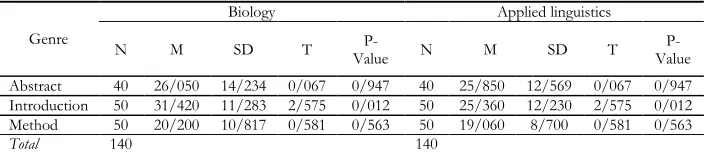
In order to understand how different sections of RAs (i.e. Abstract, Introduction and& Method) show cross-disciplinary variations in terms of MOTU, DE, PD, MOX and MOY, we used independent t-test to compare the means of these variables in different genres of RAs across two different disciplines (see Tables 1-5 in the Appendix). The analysis of data showed that there is no significant difference in terms of the different textual forms focused on in this paper in the Abstract sections across the two disciplines of Biology and Applied Linguistics. In other words, the same genre (i.e. Abstract) has similarities in terms of our target textual forms across different disciplines (see tables 1-5 in Appendix 2).
50 M. Abbasi, K. Lotfipour-Saedi, F. Hemmati & M. Jafarihohar/Variations in …
meaningful and significant; that is to say the verbs are more deeply embedded in Biology Introduction sections compared with Applied Linguistics Introductions. The means of PD in Introductions are 9.68 and 3.64 in Biology and Applied Linguistics RAs, respectively. Independent t-test revealed that the difference is significant; meaning the average distance between the main verb and its satellite elements is larger in the T-units of Introductions in Biology RAs compared with Applied Linguistics RAs. The means of MOX in Introductions are 8.16 and 3.2 in Biology and Applied Linguistics RAs, respectively. The independent t-test revealed a meaningful and significant difference in this regard. As far as MOY is concerned, the means are 8.47 and 12.96 in Introductions of Biology and Applied Linguistics RAs, respectively. In this difficulty index, T-units of Introduction section belonging to Applied Linguistics RAs have higher magnitude compared with the T-units of Introduction sections belonging to Biology RAs (see tables 1-5 in Appendix 2). As McNamara, Graessser, & Louwerse (2012) mention “rare should be the text that is difficult according to all features of text difficulty, but also rare is the text that is easy to all features of text difficulty” (p, 113).
As far as Method section is concerned, the analysis of data showed that there is no significant difference in terms of the different textual forms in this section across the two disciplines of Biology and Applied Linguistics. Here again like the Abstract section, the same genre (i.e. Method) has similarities in terms of our target textual forms across different disciplines (see tables 1-5 in Appendix 2).
Cross-generic study of variations in textual strategies of T-units in Biology RAs
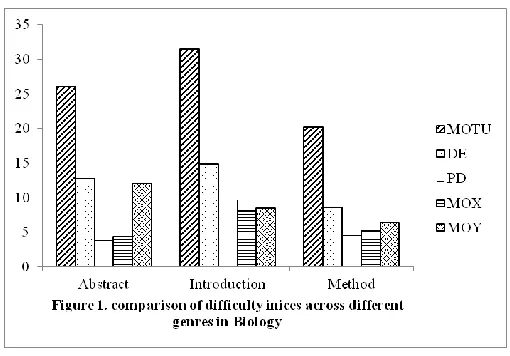
In order to find out whether and to what degrees the different T-units belonging to the different genres (i.e. abstract, introduction, method) of research articles of Biology RAs show variations in terms of MOTU, DE, PD, MOX, and MOY, one way ANOVA was used. In the case of generic differences regarding MOTU, the results of F test (F=10.852) with sig=0.000<0.05 indicated 99% significant difference among the T-units belonging to different genres of research articles. Post hoc Tukey test was further used to indicate differences between pairs. The results of analyses indicated that MOTU of Introduction is higher than MOTU of Method. No significant difference was found among the other pairs (see table 6 in Appendix 2 & figure 1 below).
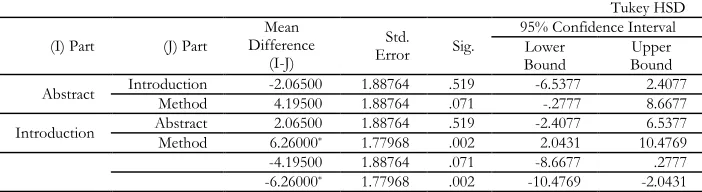
As far as variations on DE are concerned, the result of F test (F=6.391) with sig=0.002<0.01, indicated 99% significant difference among the T-units belonging to different genres of RAs concerning this textual form. We used post hoc Tukey test to discover differences among the pairs. The result indicated that DE of Introduction is higher than DE of Method (see table 7 in Appendix 2 and figure 1 below).
Iranian Journal of Language Teaching Research 6(1), (Jan., 2018) 41-62 51
magnitude of MOX in Introduction is higher than Abstract and Method (see table 9 & figure 1 below).
As far as MOY is concerned, the results of one way ANOVA test, with F=1.450 and sig=0.242>0.05, indicated no meaningful difference among different genres of biology RAs in terms of this textual strategy (see figure one below).
Figure 1. Comparison of difficulty indices across different genres in Biology
Cross-generic study of variations in textual strategies of T-units in Applied Linguistics RAs
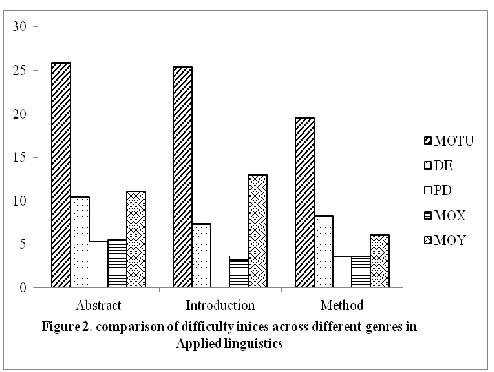
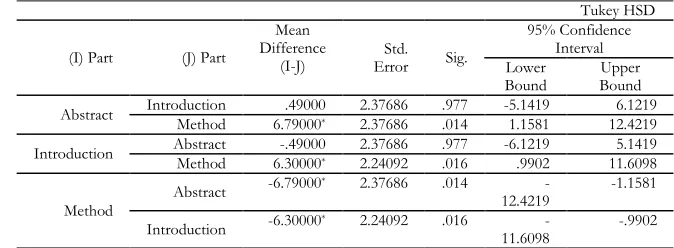
In RAs belonging to the other discipline in our data, significant difference were found among different genres of Applied Linguistics research articles regarding the magnitude of their T-units (MOTU). The results of one way ANOVA, with (F=5.460) and sig=0.005<0.05, indicated 99% significant difference among the T-units belonging to different genres of research articles. To find out the differences between pairs, a post-hoc Tukey test was used. The magnitude of MOTU of Methods is significantly lower compared with Abstracts and Introductions (see table 10 & figure 2). As far as DE is concerned, the results of one way ANOVA, with (F=1.724) and sig=0.182>0.05, indicated that there is no significant difference among the T-units belonging to different genres of Applied Linguistics RAs. Regarding PD, again, the result of analyses with (F=1.741) and sig=0.179>0.05 revealed no significant difference among the T-units belonging to different genres of Applied Linguistics research articles.
52 M. Abbasi, K. Lotfipour-Saedi, F. Hemmati & M. Jafarihohar/Variations in …
Figure 2. Comparison of difficulty indices across different genres in Applied linguistics
Discussion
Our study is a corpus-based analysis of different texts of academic discourse within a functional framework, attempting to relate the linguistic features of texts to their contextual factors. Corpus studies, as Hyland (2009) mentions “require a focus on ‘action’ to balance the focus on language…. to understand how and why writers make the choices they do when they write” (p. 110). Following this, in this section, we attempt to relate the variations in textualization (in terms of our target textual strategies) to the contextual factors of their production and use.
Considering the interactive nature of RAs, the writer of a research paper always tries to create a balance between processability and persuasiveness of his text. The writer of a research article, in producing his text, “must make assumptions about the reader’s processing abilities, contextual resources and disciplinary knowledge” (Hyland, 1998, p. 440), on the one hand, and the acceptability of the text on the other hand. This necessitates that in the analysis of research articles, two concepts should be taken into consideration: stance and engagement. According to Hyland (2009), “stance is a writer’s community-recognized persona…. [it is] writer-oriented features of language…. or the ways that writers explicitly intrude into the discourse to stamp their personal authority onto their arguments” (p. 111). For him, engagement means the ways the writers “bring readers into the text” (ibid, p. 111).
Iranian Journal of Language Teaching Research 6(1), (Jan., 2018) 41-62 53
Introductions and Methods. But the results of one way ANOVA test, with F=1.450 and sig=0.242>0.05, show no meaningful difference among different genres of Biology RAs in terms of this textual strategy (see table 6 in Appendix). Since Abstracts have lower magnitudes in terms of almost all indices compared with Introductions, and since we speculate that these textual forms may contribute to the text processability, we can suggest Abstracts might have higher degrees of processability and readability from syntactic point of view compared with Introductions. In Biology RAs, the writers, by opting for some textual forms, seem to do their best to boost the manageability of the Abstracts by the reader. But it should be noted that this speculated higher level of processability of Abstracts is only related to our target textual forms. It can be the concern of a further research to investigate the processability of Abstracts and other sections of RAs in terms of other textual forms/features such as degree of cohesiveness or thematization strategies.
Considering the different textual forms, in Biology RAs, the differences between Abstracts and Method sections are not meaningful and significant in terms of any of the indices focused on in this study. In this discipline, Introductions have higher magnitude regarding almost all indices examined in this paper. Based on our findings we can suggest that in terms of our target forms Introductions might be more demanding sections in Biology RAs.
As far as Applied Linguistics RAs are concerned, Abstracts, compared with Methods, have higher magnitudes in terms of MOTU and these differences are meaningful and significant statistically. Abstracts are also higher than Introductions in terms of MOX index. In terms of DE and PD, there are no significant differences among the different sections of Applied Linguistics RAs. In terms of MOY, the difference between Abstracts and Introductions is not statistically meaningful and significant. In this discipline, Abstracts compared with Introductions and Methods are speculated to be more demanding to process considering the textual forms focused on in our study. The authors, in Applied Linguistics RAs, by making Abstracts the most demanding section of the research article, seem to be concerned with constructing a “credible academic identity” for themselves (Hyland, 2009, p. 111).
In both disciplines, the Method section, can be suggested to be the most or (one of the most) processable section(s) in RAs. This can be justified through considering the purpose of Method section in RAs across different disciplines. Generally, the writer of research articles attempts to produce new knowledge in Method section. In Introductions, the writer usually presents already established knowledge or talks about “what is thought” about (Hunston, 2013, p. 625). The different functions of Method and Introduction would necessarily entail different choices of linguistic resources. As Hunston (2013) mentions, “particular combination of lexis and grammar are preferred when knowledge is presented as in the process of formation, and other combinations are preferred when knowledge is presented as in a state of completion” (p. 617). In sum, variations in our data academic discourse in terms of our target textual forms/features seem to be related to the different functions they fulfill as well as to the disciplinary conventions of the texts.
Conclusion
54 M. Abbasi, K. Lotfipour-Saedi, F. Hemmati & M. Jafarihohar/Variations in …
the potential effect of these textual variations on T-unit processability and text readability. Variations across genres and disciplines were justified in terms of the function they fulfill. As far as generic studies are concerned, Method sections in both disciplines are relatively more processable compared with other sections of RAs. This is because of the function of Method section of RAs in formation of new knowledge. Abstract sections in Biology RA seem to be one of the most processable sections of RAs. It seems that the writers of Biology RAs are more concerned about their readers’ engagement in the text. In Applied Linguistics RAs, Abstracts are the most demanding section regarding the textual forms focused on in this study. It seems that the writers are more concerned with their stance, creating a sense of credible academic identity for themselves (Hyland, 2009). Cognitive load of text and its processability would be partly determined by the purpose of the text as well as disciplinary conventions governing text production. It should be mentioned that this study mainly involves text analysis and any discussion on the cognitive issues and readability resulting from the textual forms is only speculative not experimental. But in another study, we have experimentally investigated the effect of some of textual indices (i.e. PD, DE, & MOX) on text processability. The results of our experiments have verified the speculations we have made in this paper regarding the potential effect of the textual indices on the text processability. (Abbasi Bonabi,M. forthcoming).
We believe that the kind of investigations we have done in this paper may be of value for text and discourse analysis. The findings might be useful for readability studies too. The findings of this study may have some implications for ESL/EFL education especially for academic discourse reading/writing education. Understanding different sources of text difficulty in different texts especially finding out what textual/conceptual factors make academic texts more challenging and difficult to understand can be useful for language teachers in guiding their learners to overcome the challenges they may face in handling academic discourse. For example, our study revealed that the textual forms such as physical distance between the verb and its satellite elements may increase the cognitive load of the T-unit. The teacher by raising the learners’ consciousness on these textual forms can help them to overcome the sources of text difficulty. It should be noted that different factors may contribute to text difficulty of different texts. For example, in literary discourse, intertextual elements such as metaphors, among many other textual and contextual factors, may lead to reading challenges. In academic texts some other textual forms such as grammatical metaphors or syntactic elements among many other factors may contribute to difficulty of texts. It is the concern of readability studies to find out the different sources of difficulty in different texts. A form which may cause text difficulty in one text-type, may behave differently in other text-types. So our study and similar studies with the objective of making explorations in the sources of text difficulty in different texts may be of great help for the academic discourse education. It is also the concern of readability studies to find out the other contextual factors of text readability, such as readers’ characteristics, which may affect the reading outcome. It should be noted that the same factor which is not related to text readability for one group of learners may cause problems for another group.
Iranian Journal of Language Teaching Research 6(1), (Jan., 2018) 41-62 55
References
Abbasi Bonabi, M., (forthcoming). Texts and different levels of readability: Exploration in cognitive effects of
academic discourse. Ph.D. thesis. Tehran: Payame Noor University.
Babaii, E., Atai, M., R., & Saidi, M. (2017). Are scientists objective? An investigation of appraisal resources in English popular science articles. Iranian Journal of Language Teaching Research 5(1), 1-19.
Bailin, A., & Grafstein, A. (2016). Readability: Text and Context. Palgrave Macmillan.
Biber, D., & Conrad, S. (2009). Register, Genre and Style. Cambridge University Press.
Crossley, S. A., Louwerse, M., McCarthy, P.M., & McNamara, D. S. (2007). A linguistic analysis of simplified and authentic Texts. In The Modern Language Journal, 91, 15-30.
Crossley, S. A., Dufty, D. F., McCarthy, P. M., & McNamara, D. S. (2007). Toward a new readability: A mixed model approach. In D. S. McNamara & G. Trafton (Eds.),
Proceedings of the 29th annual conference of the Cognitive Science Society (pp.197-202). Austin,
TX: Cognitive Science Society.
Fairclough, N. (2003). Analysing discourse: Textual Analysis for Social Research. London: Routledge.
Fairclough, N. (2010) Critical discourse analysis: The critical study of language. Second edition, Longman.
Fontaine, L., Bartlett, T., & O’Grady, G. (2013). Systemic functional linguistics: Exploring choice. Cambridge University Press.
Gibson, E. (1998). Linguistic complexity: Locality of syntactic dependencies. Cognition, 68 (1), 1- 76.
Gibson, E. (2000). The dependency locality theory: A distance-based theory of linguistic complexity. In Alec Marantz, Yasushi Miyashita, and Wayne O’Neil (Eds.), Image,
Language, Brain. MIT press, Cambridge, Massachusetts London, England. 95-126.
Halliday, M.A.K. & Matthiessen M.I.M.C,. (2004). An introduction to functional grammar. Third edition. London: Arnold.
Halliday, M.A.K., & Hasan. R. (1976). Cohesion in English. London: Longman.
Hasan, R. (2004). Analysing Discursive Variation. L. In Young and C. Harrison (eds), Systemic functional linguistics and critical discourse analysis. London: Continuum. 15-52.
Hasan R. (2009 ). The place of context in a systemic functional model. In M.A.K. Halliday & Jonathan J. Webster (eds), Continuum companion to systemic functional linguistics. London: Continuum International Publishing Group, 166-189.
56 M. Abbasi, K. Lotfipour-Saedi, F. Hemmati & M. Jafarihohar/Variations in …
Hyland, K.(1998). Persuasion and context: The pragmatics of academic metadiscourse. Journal of Pragmatics. 30 (1), 437-55.
Hyland, K. (2009). Writing in the disciplines: Research evidence for specificity. Taiwan International ESP journal, 1 (1), 5-22.
Kramsch,C., (2013). Culture in foreign language teaching. Iranian Journal of Language Teaching Research 1(1), 57-78.
Lightman, E., J.,McCarthy, P., M.,Dufty, D., F.,& McNamara, D., S., (2007). Cohesion and structural organization in high school texts. In American Association for ArtificialIntelligence (www. aaai org). 235- 240
Lotfipour-Saedi, K. (2006). Towards the textuality of a text: A grammar for communication. Tabriz: Forozesh.
Lotfipour-Saedi, K. (2008). Discourse and the act of translation: A discoursal approach to characterization
translation equivalence. Tabriz: Isalamic Azad University press.
Lotfipour-Saedi, K. (2015). Suggestions toward some discourse-analytic approaches to text difficulty: With special reference to ‘T-unit configuration’ in the textual unfolding. Iranian Journal of Language Teaching Research, 3(1), 1-18.
LotfipourSaedi, K., & Sarhadi, T. (2000). Redundancy, its discoursal functions and textual realizations in different genres. Research in Humanities. 7(1), 50-60.
Lotfipour-Saedi, K., & Abbasi Bonabi, M. (2000). Intertextuality as a textual strategy: Explorations in its modes & functions. IJAL, 4(2), 79-112.
Martin, J.R., & White, P.R.R. (2005). The language of evaluation: Appraisal in English. Palgrave Macmillan.
McCarthy, P.M., Briner, S.W., Rus, V., & McNamara, D.S. (2007). Textual signatures: identifying text-types using latent semantic analysis to measure the cohesion of text structures. In A. Kao & S. Poteet (Eds.), Natural language processing and text mining (pp. 107-122). London, UK: Springler- Verlag.
Stubbs, M. W. (1983). Discourse Analysis. Oxford: Blackford.
Van Dijk, T.A. (2008). Discourse and context: A socio-cognitive approach. Cambridge University press.
Iranian Journal of Language Teaching Research 6(1), (Jan., 2018) 41-62 57
Mina Abbasi Bonabi has got her M.A. from Tabriz University. She is currently a Ph.D. student at TEFL department at Payame Noor University, Tehran. She is a faculty member at Payame Noor University. Her areas of interest include discourse analysis, EAP, and SLA.
Kazem Lotfipour- Saedi is an Emeritus professor of Applied Linguistics, University of Tabriz, Iran. He is also a Professor of Applied Linguistics, Algonquin College, Ottawa, Canada. He has published several books on translation and also other areas of Applied Linguistics. He has published several papers on Iranian and international journals. His areas of interest include discourse analysis, translatology, EAP and Applied Linguistics.
Fatemeh Hemmati is an associate professor in English Language Teaching at Payame Noor University, Tehran, Iran, where she teaches different courses to graduate students. She has published nationally and internationally on issues related to her area of interest which include classroom discourse, second language skills, and teacher education.
58 M. Abbasi, K. Lotfipour-Saedi, F. Hemmati & M. Jafarihohar/Variations in …
Appendix 1
The title of articles and the journals where they appear
A. Applied linguistics articles
1-Mediating Language Learning: Teacher Interactions With ESL Students in a Content- Based Classroom. In
TESOL Quarterly . VOL. 37. Number 2.
2-Influences of Sentence Length and Syntactic Complexity on the Speech Motor Control of Children Who Stutter. In Journal of Speech, Language, and Hearing Research • Vol. 56 • 89–102 • February 2013
3-L1 and L2 glosses: their effects on incidental vocabulary learning. In Language Learning & Technology .September 2006, Volume 10, Number 3
4-The two faces of Janus? Anxiety and enjoyment in the foreign language classroom. In Studies in Second Language Learning and Teaching 2014 4(2).
5-Is multilingualism linked to a higher tolerance of ambiguity?. In Bilingualism: Language and Cognition 16 (1), 2013, 231–240.
6-Gender differences in reading ability and attitudes: examining where these differences lie. In Journal of Research in Reading, Volume 32, Issue 2, 2009, pp 199–214
7-Exploring the Gender Effect on EFL Learners’ Beliefs about Language Learning. In Australian Journal of Educational & Developmental Psychology. Vol 7, 2007
8-Social Presence in Synchronous CMC-based Language Learning: How does it affect the productive performance and consciousness of learning objectives? In Computer Assisted Language Learning Vol. 20, No. 1, February 2007, pp. 37 – 65
9-Effects of Stress and Working Memory Capacity on Foreign Language Readers’ Inferential Processing During Comprehension. In Language Learning 61:1, March 2011, pp. 187–218
10 - Why do some young learners drop foreign languages? A focus on learner-International Journal of Bilingual Education and Bilingualisminternal variables. In International Journal of Bilingual Education and BilingualismVol. 12, No. 6, November 2009, 635 649.
B. Biology articles
1- Distinguishing protein-coding and noncodinggenes in the human genome. In PNAS December 4, 2007 vol. 104 no. 49.
2- The Human Microbiome Project. In NATURE Vol 449|18 October 2007.
3- Analysis of Relative Gene Expression Data Using Real-Time Quantitative PCR and the 22DDCT Method.
In METHODS 25, 402–408 (2001).
4-Distinct Light-Initiated Gene Expression and Cell Cycle Programs in the Shoot Apex and Cotyledons of Arabidopsis. In The Plant Cell, Vol. 20: 947–968, April 2008.
5- Mechanical, biochemical, and extracellular matrix effects on vascular smooth muscle cell phenotype. In J Appl Physiol 98: 2321–2327, 2005.
6- DNA METHYLATION AND HUMAN DISEASE. In Nature VOLUME 6 | AUGUST 2005.
7- Energy Metabolism in Preimplantation Bovine Embryos Derived In Vitro or In Vivo. In BIOLOGY OF REPRODUCTION 62, 847–856 (2000).
8- Analysis of Differential Messenger RNA Expression Between Bovine Blastocysts. In BIOLOGY OF REPRODUCTION 66, 589–595 (2002).
9- Developmental, Qualitative, and Ultrastructural Differences Between Ovine and Bovine Embryos Produced In Vivo or In Vitro. In MOLECULAR REPRODUCTION AND DEVELOPMENT 62:320–327 (2002).
Iranian Journal of Language Teaching Research 6(1), (Jan., 2018) 41-62 59
Appendix 2 Tables
Table 1
Comparison of MOTU of Different Genres of RAs across Two Different Disciplines
Applied linguistics Biology
Genre
P-Value T SD M N P-Value T SD M N 0/947 0/067 12/569 25/850 40 0/947 0/067 14/234 26/050 40 Abstract 0/012 2/575 12/230 25/360 50 0/012 2/575 11/283 31/420 50 Introduction 0/563 0/581 8/700 19/060 50 0/563 0/581 10/817 20/200 50 Method 140 140 Total Table 2
Comparison of DE of Different Genres of RAs across Two Different Disciplines
Applied linguistics Biology
Genre
P-Value T SD M N P-Value T SD M N 0/312 1/018 11/457 10/450 40 0/312 1/018 8/798 12/775 40 Abstract 0/000 4/354 6/573 7/320 50 0/000 4/354 10/294 14/840 50 Introduction 0/788 0/270 5/930 8/220 40 0/788 0/270 7/335 8/580 40 Method Total Table 3
Comparison of PD of Different Genres of RAs across Two Different Disciplines
Applied linguistics Biology
Genre
P-Value T SD M N P-Value T SD M N 0/318 -1/006 7/350 5/325 40 0/318 -1/006 5/795 3/825 40 Abstract 0/000 4/915 4/116 3/440 50 0/000 4/915 7/978 9/680 50 Introduction 0/408 0/831 3/960 3/560 40 0/408 0/831 6/753 4/480 40 Method Total Table 4
Comparison of MOX of Different Genres of RAs across Two Different Disciplines
Applied linguistics Biology
Genre
60 M. Abbasi, K. Lotfipour-Saedi, F. Hemmati & M. Jafarihohar/Variations in …
Table 5
Comparison of MOY of Different Genres of RAs across Two Different Disciplines
Applied linguistics Biology
Genre
P-Value T SD M N P-Value T SD M N 0/818 0/232 9/158 11/115 26 0/818 0/232 17/427 12/059 17 Abstract 0/05 -1/941 11/947 12/967 30 0/05 -1/941 6/496 8/472 36 Introduction 0/844 0/198 6/074 6/074 27 0/844 0/198 5/824 6/421 19 Method Total Table 6
Multiple Comparisons of MOTU in Biology RA
Tukey HSD
(I) Part (J) Part Difference Mean (I-J)
Std.
Error Sig.
95% Confidence Interval Lower
Bound BoundUpper Abstract IntroductionMethod -5.370005.85000 2.555122.55512 .093.061 -11.4243-.2043 11.9043.6843
Introduction Abstract 5.37000 2.55512 .093 -.6843 11.4243
Method 11.22000* 2.40899 .000 5.5120 16.9280
Method IntroductionAbstract -11.22000-5.85000* 2.555122.40899 .061.000 -11.9043-16.9280 -5.5120.2043 *. The mean difference is significant at the 0.05 level.
Table 7
iology RAs e Comparisons of DE in B Multipl
Tukey HSD
(I) Part (J) Part Difference Mean (I-J)
Std.
Error Sig.
95% Confidence Interval Lower
Bound BoundUpper Abstract IntroductionMethod -2.065004.19500 1.887641.88764 .519.071 -6.5377-.2777 2.40778.6677
Introduction AbstractMethod 6.260002.06500* 1.887641.77968 .519.002 -2.40772.0431 10.47696.5377
-4.19500 1.88764 .071 -8.6677 .2777
* 6.26000
- 1.77968 .002 -10.4769 -2.0431
Iranian Journal of Language Teaching Research 6(1), (Jan., 2018) 41-62 61
Table 8
Multiple Comparisons of PD in Biology RAs
Table 9
iology RAs Multiple Comparisons of MOX in B
Tukey HSD
(I) Part (J) Part Difference Mean (I-J)
Std.
Error Sig.
95% Confidence Interval Lower
Bound BoundUpper Abstract IntroductionMethod -3.76000-.80000* 1.141981.14198 .004.764 -6.4659-3.5059 -1.05411.9059
Introduction AbstractMethod 3.760002.96000** 1.141981.07667 .004.018 1.0541.4089 6.46595.5111
Method Abstract .80000 1.14198 .764 -1.9059 3.5059
Introduction -2.96000* 1.07667 .018 -5.5111 -.4089
*. The mean difference is significant at the 0.05 level.
Table 10
Multiple Comparisons of MOTU in Applied Linguistics RAs
Tukey HSD
(I) Part (J) Part
Mean Difference
(I-J) ErrorStd. Sig.
95% Confidence Interval Lower
Bound BoundUpper Abstract IntroductionMethod 6.79000.49000* 2.376862.37686 .977.014 -5.14191.1581 12.42196.1219
Introduction Abstract -.49000 2.37686 .977 -6.1219 5.1419
Method 6.30000* 2.24092 .016 .9902 11.6098
Method Abstract
* 6.79000
- 2.37686 .014
-12.4219 -1.1581
Introduction -6.30000* 2.24092 .016 11.6098- -.9902 *. The mean difference is significant at the 0.05 level.
Tukey HSD
(I) Part Method IntroductionAbstract ErrorStd. Sig. 95% Confidence IntervalLower Bound BoundUpper Abstract IntroductionMethod -5.85500-.65500* 1.479401.47940 .000.898 -9.3604-4.1604 -2.34962.8504
Introduction AbstractMethod 5.855005.20000** 1.479401.39479 .000.001 2.34961.8951 9.36048.5049
Method Abstract .65500 1.47940 .898 -2.8504 4.1604
Introduction -5.20000* 1.39479 .001 -8.5049 -1.8951
62 M. Abbasi, K. Lotfipour-Saedi, F. Hemmati & M. Jafarihohar/Variations in …
Table 11
Magnitude of Satellite Elements Dependent Variable:
Tukey HSD
(I) Part (J) Part Difference Mean (I-J)
Std. Error Sig.
95% Confidence Interval Lower
Bound BoundUpper
Abstract Introduction 2.27500* .90537 .035 .1298 4.4202
Method 1.83500 .90537 .110 -.3102 3.9802
Introduction AbstractMethod -2.27500-.44000* .90537.85359 .035.864 -4.4202-2.4625 1.5825-.1298
Method IntroductionAbstract -1.83500.44000 .90537.85359 .110.864 -3.9802-1.5825 2.4625.3102 *. The mean difference is significant at the 0.05 level.
Table 12 Multiple Comparisons
e of Satellite Elements Dependent Variable: Magnitud
Tukey HSD
(I) Part (J) Part Mean Difference (I-J)
Std.
Error Sig.
95% Confidence Interval Lower
Bound Upper Bound
Abstract Introduction -1.85128 2.53089 .746 -7.8953 4.1928
Method 5.04131 2.59535 .134 -1.1567 11.2393
Introduction AbstractMethod 1.851286.89259* 2.530892.50566 .746.020 -4.1928.9088 7.895312.8764
Method AbstractIntroduction -5.04131-6.89259* 2.595352.50566 .134.020 -11.2393-12.8764 1.1567-.9088 *The mean difference is significant at the 0.05 level
Table 13 Multiple Comparisons
Tukey HSD
(I) Part (J) Part Difference Mean (I-J)
Std. Error Sig.
95% Confidence Interval Lower
Bound BoundUpper Abstract IntroductionMethod -1.851285.04131 2.530892.59535 .746.134 -7.8953-1.1567 11.23934.1928
Introduction Abstract 1.85128 2.53089 .746 -4.1928 7.8953
Method 6.89259* 2.50566 .020 .9088 12.8764