Firas et al. World Journal of Pharmaceutical and Life Sciences
ASTHMA CONTROL
Dr. Yaarub Madhloom Abbas1, Dr. Firas Raad Shihab*2 and Dr. Adnan M. Al Jubouri3
1,2(M.B.Ch.B), Chest Physician. 3Professor, M.R.C.P (UK), F.R.C.P (EDIN).
Article Received on 02/08/2018 Article Revised on 23/08/2018 Article Accepted on 13/09/2018
INTRODUCTION
Asthma is a chronic inflammatory disorder of the airways, in which many cells and cellular elements play a role. The chronic inflammation is associated with airway hyper-responsiveness that leads to recurrent episodes of wheezing, breathlessness, chest tightness and coughing, particularly at night and in the early morning. These episodes are usually associated with widespread but variable airflow obstruction within the lung that is often reversible, either spontaneously or with treatment.[1] These variations are often triggered by factors such as exercise, allergen, irritant exposure, change in weather or viral respiratory infection.[2]
Asthma is a global health problem that affects around 300 million individuals of all ages, ethnic groups, and countries.[3] It is estimated that 250,000 people die prematurely each year as a result of asthma[4] Proper care of patients with asthma involves the triad of systematic chronic care plans, self-management support, and appropriate medical therapy.[5,6]
Assessment of asthma should include the assessment of asthma control (both symptom control and future risk of adverse outcome), treatment issues particularly inhaler technique and adherence, and any comorbidities that could contribute to symptoms burden and poor quality of
life. Lung function, particularly forced expiratory volume in 1 second (FEV1) as a percentage of predicted, is an important part of future risk.[2]
Achieving and maintaining asthma control are fundamental elements of asthma management.[2] Practical tools are needed to assess asthma control in asthma management. Most tools used to evaluate asthma control consider airflow obstruction as a criterion. However, this is often very difficult to perform in developing countries such as Iraq because spirometers and peak flow meters are not readily available. A tool is required that measures the multidimensional nature of asthma control and that is easy and quick to administer and interpret in order to facilitate the assessment of asthma control in clinical practice. The ACT has proved to be a valid tool for this purpose.[7,8,9]
There are different validated measures for assessing symptoms to determine control of asthma, one of which is The Global Initiative for Asthma (GINA 2014) guideline which has proposed four criteria for evaluating asthma control. Well controlled asthma is defined by the absence of daytime symptoms (no more than twice a week), the absence of night-time waking, no limitations in activities, no need for rescue medication (no more than twice a week).[2]
World Journal of Pharmaceutical and Life Sciences
WJPLS
www.wjpls.org SJIF Impact Factor: 5.088
*Corresponding Author: Dr. Firas Raad Shihab
(M.B.Ch.B), Chest Physician.
ABSTRACT
Background: Asthma is a global health problem that affects 300 million individuals of all ages around a world.
Despite international guidelines, asthma control is short of the goal in different parts of the world. Aims of study: To determine if the ACT can be as useful as the GINA-guidelines criteria in assessing asthma control. Methods: A cross-sectional study recruiting 64 patients aged >18 years with asthma were seen at chest clinic of Baghdad Teaching Hospital between February 2015 and May 2015. Asthma control was assessed using the GINA algorithm and the ACT score. Results: There were 64 patients enrolled in this study, 44 patients (68.8%) were female and 20 patients (31.2%) were male. According to ACT score 43 patient (67.2%) had an ACT score of (<15) and 21 patients (32.8%) had an ACT score of (15-19) and none patients had ACT (20-25). According to GINA classification, 49 patient (76.56%) classified as uncontrolled and 15 patients (23.44) classified as partly controlled and none patients classified as controlled. Conclusion: In our study we found high agreement between ACT score and GINA classification thus ACT score can substitute GINA in assessment of asthma control. Asthma control was also dependently associated with the individual patient's age group.
Table 1: GINA assessment of asthma control in adults.
Asthma symptom control Level of asthma symptom control
In the past 4 weeks, has the patient had:
Daytime asthma symptom more than twice/week? Yes or No
Any night waking due to asthma? Yes or No
Reliever needed for symptom more than twice/week? Yes or No
Any activity limitation due to asthma? Yes or No
Well Partly Uncontrolled controlled
None 1-2 3-4 of these of these of these
The validated and international asthma control test (ACT) has also been developed to facilitate and standardize the assessment of symptom control of asthma control. The ACT survey is a patient-completed questionnaire with 5 items assessing asthma symptoms (daytime and nocturnal), use of rescue medications, and the effect of asthma on daily functioning. Each item includes 5 response options corresponding to a 5-point rating scale. In scoring the ACT survey, responses for the 5 items are summed to yield a score ranging from 5 to 25. The patient classified as uncontrolled if had score <15 and classified as partly controlled if had score 15-19 and classified as well controlled if had score 20-25. A cut-off point <1 was used for under control of asthma.[10]
Asthma control test
A. In the past 4 weeks, how much of the time did your
asthma keep you from getting as much done at
work, school, or at home? 1. All of the time.
2. Most of the time. 3. Some of the time. 4. A little of the time. 5. None of the time.
B. During the past 4 weeks, how often have you had shortness of breath?
1. More than once a day. 2. Once a day.
3. 3 to 6 times a week. 4. Once or twice a week. 5. Not at all.
C. During the past 4 weeks, how often did your asthma symptoms (wheezing, coughing, shortness of breath, chest tightness or pain) wake you up at night or earlier than usual in the morning?
1. 4 or more nights a week. 2. 2 to 3 nights a week. 3. Once a week. 4. Once or twice. 5. Not at all.
D. During the past 4 weeks, how often have you used your rescue inhaler or nebulizer medication (such as albuterol)?
1. 3 or more times per day. 2. 1 or 2 times per day. 3. 2 to 3 times per week.
4. Once a week or less. 5. Not at all.
E. How would you rate your asthma control during the past 4 weeks?
1. Not controlled at all. 2. Poorly controlled. 3. Somewhat controlled. 4. Well controlled. 5. Completely controlled.
Exacerbations of asthma are episodes of a progressive increase in shortness of breath, cough, wheezing, or chest tightness, or a combination of these symptoms requiring systemic steroids or emergency department visits and admission.[6] Assessment of the risk of exacerbations can be inferred from the medical history. Patients who have had exacerbations requiring emergency department (ED) visits, hospitalization or intensive care unit (ICU) admission, especially in the past year, have a great risk of exacerbations in the future.[11]
The test most used for assessing the risk of future adverse events is spirometry, especially forced expiratory volume in 1st second (FEV1) expressed as a percent of the predicted value or a proportion of the forced vital capacity (FVC) or FEV1/FVC. A low forced expiratory volume in 1st second (FEV1) is associated with an increased risk of asthma exacerbations-the lower the FEV1, the greater the risk.[12]
AIM OF STUDY
1- To determine if the ACT can be as useful as the GINA-guidelines criteria in assessing asthma control.
2- To determine the agreement between the two rating systems.
3- To determine the consistency across age, gender, and body mass index.
PATIENTS AND METHODS
Study design, setting and timming
Sampling and patients
64 patients participated in our study, 44 of them were female and 20 were male. Data about (age, gender, body mass index and educational level were collected from participant. Asthma control was assessed in two ways: using the GINA classifications scheme and ACT score. The characteristics of GINA classification used in the study were daytime symptoms, nocturnal symptoms, need for reliever medication, limitation of activity.
The validated and international asthma control test (ACT) questionnaire was used to assess the control of asthma. The ACT survey is a patient-completed questionnaire with 5 items assessing asthma symptoms (daytime and nocturnal), use of rescue medications and the effect of asthma on daily functioning. Each item includes 5 response options corresponding to a 5-point rating scale. In scoring the ACT survey, responses for each of the 5 items were summed to yield a score ranging from 5 (poor control of asthma) to 25 (complete control of asthma). A cut-off point <19 was used for under control of asthma.
Inclusion criteria
1- Patients who satisfied the inclusion criteria (>18) years old.
2- Asthmatic since 12 months at least.
Exclusion criteria
1- Subjects were excluded if hospitalised for asthma or had an acute upper or lower respiratory tract infection within 4 weeks prior to study.
2- Pregnant ladies were excluded from the study due to variable effects of pregnancy on bronchial asthma.
3- Patients with diagnosis other than asthma such as physician diagnosed COPD, bronchiectasis, lung cancer, and cardiac illness were also excluded due to confounding effects.
4- Smokers and ex smokers were also excluded. 5- Patients with significant respiratory distress due to
an exacerbation that required emergency department visit or admission.
Statistical analysis
Data of all patients were entered and analyzed by using the statistical package for social sciences (SPSS) software for windows version 22. Descriptive statistics were presented as mean ± standard deviation (SD) for continuous variables and as frequencies and proportions (%) for categorical variables.
Student’s t test (independent 2 samples) was used to compare means of age in between two groups according to ACT level (<15 or 15- 19).
Chi square was used to assess the significance of association in between groups regarding the categorical variables.
Agreement between ACT and GINA was calculated using percent agreement calculation and Kappa statistics.
RESULTS
There were 64 patients enrolled in this study, of them 44 (68.8%) were female and 20 patients (31.2%) were male.
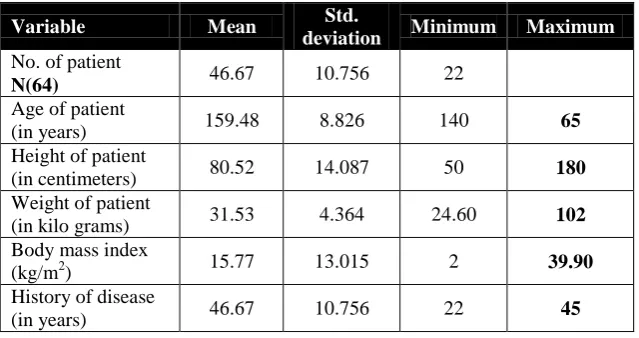
Mean, standard deviation, minimum and maximum values for continous variable age, height, weight, body mass index and history of disease in years.
Table 3-1: Distribution of patients according to age, body mass index and history of disease in years.
Variable Mean Std.
deviation Minimum Maximum
No. of patient
N(64) 46.67 10.756 22
Age of patient
(in years) 159.48 8.826 140 65
Height of patient
(in centimeters) 80.52 14.087 50 180
Weight of patient
(in kilo grams) 31.53 4.364 24.60 102
Body mass index
(kg/m2) 15.77 13.015 2 39.90
History of disease
Table 3- 2: Distribution of patients according to gender, educational level and professional status.
(%)
فس Frequency
Variable
31.2 68.8 20
44 Gender of participant
Male Female
29.7 53.1 9.4 4.7 3.1 19
34 6 3 2 Education level of participant
Cannot read Primary Secondary University Higher education
43.8 56.3 28
36 Professional status
Non active Active
There were 64 patients enrolled in this study, of them 43patient (67.2%) had an ACT score of (<15) and 21 patients (32.8%) had an ACT score of (15-19) and none patients had an ACT 20-25.
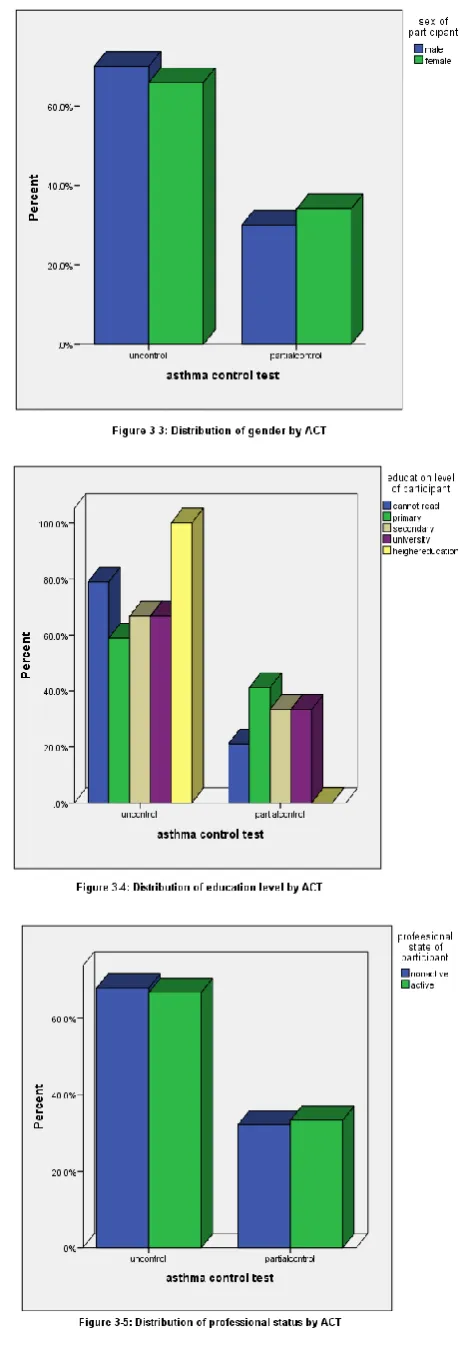
Table 3-3: Summarizes the patients characteristics distributed by ACT score level, There was significant differences had been found in between those patients with <15 ACT score vs. those with 15- 19, regarding the age and in both comparison P<0.05.
There was no significant differences had been found in between those patients with < 15 ACT score vs. those with 15- 19, regarding the gender and in both comparison P>0.05.
There was no significant differences had been found in between those patients with < 15 ACT score vs. those with 15- 19, regarding the BMI.
Educational level, professional status and history of disease in years, in each comparison P>0.05.
Regarding the distribution of GINA classification by ACT score, It had been found that out of the 49 patients with GINA classification which classified as uncontrolled, 43 patients (87.8%) were labeled as uncontrolled on ACT (ACT<15), and 6 patient (12.2%) labeled as partially controlled ACT (15-19) and none labeled as controlled P.value <0.001, in contrast out of 15 patient with GINA classification which classified as partial control 15 patient (100%) were labeled as partially controlled on ACT(15-19), and none patients classified as uncontrolled.
Table 3-3: Patients characteristics and GINA classification distributed by ACT score.
Variable ACT score P. value
<15 (n=43) 15- 19 (n=21)
Age (years) Mean ± SD 48.26 ± 8.432 43.43 ± 14.095 0.001 [S]
Gender n (%) Male 14 (70) 6( 30) 0.491 [NS]
Female 29 (65.9) 15 (34.1)
GINA classification
Uncontrolled 43 (87.8) 6(12.2) .000 [S]
Partially controlled 0 (0.0) 15(100)
Controlled 0 0 (0.0)
Body mass index Mean ± SD 31.541±4.292 31.521±4.614 0.991 [NS]
Education level of participant (%)
Cannot read Primary Secondary University Higher education
15(23.4) 20(31.3) 4(6.3) 2(3.1) 2(3.1)
4(6.3) 14(21.9)
2(3.1) 1(1.6) 0(0.0)
0.124 [NS]
Professional Status (%)
Non active Active
19(29.7) 24(37.5)
9(14.1)
Table 3-4: Distribution of asthma treatment by ACT.
Asthma Control Test
Uncontrolled Partially Controlled
Asthma Treatment
SABA Count 13 0
% of Total 20.3% 0.0%
ICS Count 3 0
% of Total 4.7% 0.0%
ICS+LABA Count 0 2
% of Total 0.0% 3.1%
SABA+ICS+LABA Count 5 2
% of Total 7.8% 3.1%
SABA+ICS+ANTICHOL Count 4 0
% of Total 6.3% 0.0%
ICS_LABA+THEO Count 2 2
% of Total 3.1% 3.1%
ICS+LABA+ANTILEUKO % of Total 1.6% 7.8%
SABA+ICS Count 1 4
% of Total 1.6% 6.3%
SABA+ICS+LABA+THEO Count 6 0
% of Total 9.4% 0.0%
SABA+ICS+LABA+ANTILEUKO Count 4 0
% of Total 6.3% 0.0%
SABA+(ICS+LABA)+theop.+antileuk Count 1 0
% of Total 1.6% 0.0%
SABA+AMINOPHI..INE Count 0 4
% of Total 0.0% 6.3%
SABA+ANTILEUK Count 0 2
% of Total 0.0% 3.1%
ICS+THEO+ANTICHOL Count 3
% of Total 4.7% 0.0%
Total Count 43 21
% of Total 67.2% 32.8%
The distribution of ACT categories by the GINA classes is shown in table (3-5). it had been found that good agreement present between ACT and GINA, 77.1% and this percent is high due to small sample size.
ACT agreed the GINA in 43 patients with uncontrolled, 15 patients with partially controlled and none patients with controlled) and had been found the uncontrolled patients by GINA is (49) while uncontrolled patients by ACT is (43) and this indicate small difference between them.
Table 3-5: Agreement between GINA classification and ACT classification of asthma control.
GINA
ACT
GINA-defined control
Total Uncontrolled
N(%)
Partially controlled N(%)
Controlled N(%)
Uncontrolled(<15) 43(87.8) 0(0.0) 0(0.0) 43(67.2%) Partially controlled (15-19) 6(12.2) 15(100) 0(0.0) 21(32.8%)
Controlled (≥20) 0.(0.0) 0(0.0) 0(0.0) 0(0.0%)
Total 49(100) 15(100) 0(0.0) 64(100%)
Percent agreement = 77.1%
Kappa=0.77, p<0.001 ACT=Asthma Control Test; GINA=Global Initiative for Asthma.
DISCUSSION
The principal finding of this study is that asthma control in the chest clinic of Baghdad Teaching Hospital is very poor and one of the explanations for this is that Baghdad Teaching Hospital is a tertiary center and as referral for many hospitals in the country so the severe cases from
these hospitals were referred to Baghdad Teaching Hospital.
partly controlled asthma, and none patient classified as controlled asthma. Using the ACT score also, 43 patients (67.2%), scored <15 that corresponds to poor control of asthma in the current study, and 21 patients (32.8%) individuals scored 15-19 that corresponds partly control of asthma and none classified as well-controlled asthma 20-25, which is a better estimate of asthma control compared with results that obtained from GINA algorithm.
The results observed were similar with the worldwide control of asthma in the AIR trial in North America, Europe, Japan and the Asia-Pacific region with data from 10,939 patients in 29 countries.[13] Another study in North Africa, the Maghreb Study, showed only 7.6% of the subjects were considered to have controlled and 50.9% to have uncontrolled asthma and 41.5% considered to have partly controlled when the GINA based algorithm was used.[14]
This finding is poor comparable with a pan-European cross-sectional survey done in 2008, with results of 57% of adult asthmatics had ‘not well-controlled’ asthma on a validated symptom instrument,[15] (ACT score <19).
Another study done in Vietnam predicted GINA defined ‘not controlled asthma’ with a sensitivity of 70% and specificity of 93%. The questionnaire score correlated well with treatment modifications and lung function parameters (FEV1 and PEF). The ACT is easily and quickly completed by patients and can serve as a useful tool in everyday practice to guide adjustments in asthma therapy.[16]
Finally, asthma control was also dependently associated with the individual patient's age group, P.value=0.001. This finding was similar with the study done in the Netherlands, Disease control in the general practice patients with asthma, where patients inadequately controlled were usually older compared to those with a good disease control.[17]
The poor level of control likely resulted from the relatively very low proportion of patients using the recommended prophylactic controller medication (inhaled corticosteroids alone or in association with long acting b-agonists which are the prophylactic treatments recommended by GINA). Most of the patients used only medications that quickly relieve asthma symptoms, but that has no role in controlling the underlying inflammation of the airways.
The kappa level of agreement between the two systems was 0.77, representing high agreement between the two rating systems. Another positive finding in this study was no extreme difference in classification of asthma control between the two rating systems: no patient had an ACT score of >20 while having GINA-defined uncontrolled asthma and no patient with GINA defined controlled asthma had an ACT score of <15 (Table 3-5).
CONCLUSION AND RECOMMENDATION
Conclusions
1. In our study we found high agreement between ACT score and GINA classification thus ACT score can substitute GINA in assessment of asthma control. 2. The ACT is easily and quickly completed by
patients and can serve as a useful tool in everyday practice to guide adjustments in asthma therapy. 3. Asthma control was also dependently associated
with the individual patient's age group, where patients inadequately controlled were usually older compared to those with a good disease control.
Recommendation
The ACT is a reliable and simple tool that does not require spirometry measurements. this might be a significant asset in the management of outpatients with asthma in Iraq.
List of Abbreviations
Forced expiratory volume in the first second FEV1
Forced vital capacity FVC
Peak expiratory flow PEF
Global initiative for asthma GINA
Asthma control test ACT
Emergency department ED
Intensive care unit ICU
Chronic obstructive pulmonary disease COPD
Body mass index BMI
statistical package for social sciences SPSS
Asthma insight and reality AIR
REFERENCES
1. Innes J.A, Reid P.T: Respiratory disease: Asthma: Davidson’s Principles and Practice of Medicine 22nd edition, 2014; 19: 666-673.
2. Mark Fitzgerald J, Eric D, Alvaro A, et al. Global strategy for asthma management and prevention, global initiative for asthma (GINA), 2014.
3. Bousquet J, Khaltaev AN: Global surveillance, prevention and control of chronic respiratory diseases: a comprehensive approach. Global Alliance against Chronic Respiratory Diseases. Geneva: World Health Organization, 2011.
4. Bousquet J, Kiley J, Bateman ED, et al: Prioritised research agenda for prevention and control of chronic respiratory diseases. Eur Respir J, 2010; 36: 995–1001.
5. Elward KS, Pollart SM: Medical Therapy for Asthma: Updates from the NAEPP Guidelines. Am Fam Physician, 2010; 82: 1242–1251.
6. Fredrickson DD, Molgaard CA, Dismuke SE, Schukman JS, Walling A: Understanding frequent emergency room use by Medicaid-insured children with asthma: a combined quantitative and qualitative study. J Am Board Fam Pract, 2004; 17: 96–100. 7. Nathan RA, Sorkness CA, Kosinski M, et al.
assessing asthma control. J Allergy Clin Immunol, 2004; 113(1): 59-2008.
8. Schatz M, Sorkness CA, Li JT, et al. Asthma Control Test: reliability, validity, and responsiveness in patients not previously followed by asthma specialists. J Allergy Clin Immunol, 2006; 117(3): 549-56. http://dx.doi.org/10.1016/j.jaci.2006.01.011. 9. Schatz M, Mosen DM, Kosinski M, et al. Validity of the Asthma Control Test completed at home. Am J Manag Care, 2007; 13(12): 661-701.
10. Michael S, Christine A S, Li James T, et al. Asthma Control Test Reliability, validity, and responsiveness in patients not previously followed by asthma specialists. J Allergy Clin Immunol, 2006; 117: 549–556.
11. National Asthma Education and Prevention Program, author. Expert panel report III: Guidelines for the diagnosis and management of asthma. Bethesda, MD: National Heart, Lung, and Blood Institute, 2007.
12. Osborne ML, Pedula KL, O'Hollaren M, et al. Assessing future need for acute care in adult asthmatics: the Profile of Asthma Risk Study. Chest, 2007; 132: 1151.
13. Klaus F, Mitsuru A, Christopher K, et al. Worldwide severity and control of asthma in children and adults: The Global Asthma Insights and Reality surveys. J Allergy Clin Immunol, 2004; 114: 40–47. 14. Ali B, Hend B, Salim N, et al. Control of Asthma Maghreb: results of the AIRMAG study. Respiratory Medicine, 2009; 103: 12–20.
15. Rabe KF, Vermeire PA, Soriano JB, et al. Clinic management of asthma in 2007: the Asthma Insights and Reality in Europe (AIRE) study. Eur Respir J., 2008; 16: 802–807.
16. Nguyena Vinh Nhu, Chavannesb Niels, Lec Lan Thi Tuyet, et al. The Asthma Control Test (ACT) as an alternative tool to Global Initiative for Asthma (GINA) guideline criteria for assessing asthma control in Vietnamese outpatients. Prim Care Respir J., 2012; 21(1): 85–89.