35
Copyright © 2018. IJEMR. All Rights Reserved.
Importance of Organizational Culture for Gaza Strip Construction
Companies
Othman A. Tayeh1, Khalid El-Hallaq2 and Bassam A. Tayeh3
1M.Sc Degree, Department of Civil Engineering, Islamic University of Gaza, Gaza, PALESTINE
2,3Assistant Professor, Department of Civil Engineering, Islamic University of Gaza, Gaza, PALESTINE
3Corresponding Author: [email protected]
ABSTRACT
Despite of different definitions of organizational culture, shared meanings, assumptions, beliefs and understandings held by a team are considered as the basic component of the organizational culture definition. Organizational culture gives identity to an organization. Nowadays with the increasing of the internationalization of the construction industry, the organizational culture become more importance than any other times. The aim of this research is to investigate the importance of the organizational culture for Gaza Strip construction companies. The study used a questionnaire that was administered by contracting companies classified at the Palestinian Contractors Union. Out of 134 questionnaires were distributed, only 74 questionnaires were received. The research found out that the existence of the organizational cultural in the organization is very important for its survival and continuity, where the organizational cultural help in achieving the organization goals, the organizational cultural help the organization to take right actions and decisions, the organizational cultural help in creating policies and assignments to increase profitability, growth, and respond to market demands, the organizational cultural help the individuals and teams to do the assigned work efficiently, and the organizational cultural play basic role in sharing of information rapidly inside the organization.
Keywords-- Environment, Stakeholders, Quality review
I.
INTRODUCTION
Any organization is driven by their own kind of culture known as „organizational culture‟, which has important affect upon member‟s perceptions as well as behaviors and guides daily workers activities to meet organization goals [1].
With the worldwide globalization trends, special attention has been given to the study of organizations and
their cultures [2]. Therefore, organizations should always be considered as social and cultural systems and examine the interaction with the environment. Organization's characteristic formed within the framework of the society, environment, law and norms [3].
In all companies, organizational culture is a basic phenomenon. The organizational culture has a positive impact on the financial situation of the company by generating competitive advantages [4]. The study of the organizational culture within any organization, regardless of the nature of the activity carried out by the organization, is very important to understand what goes on in the organization and, how to run it and make the necessary plans for the future to improve it [5].
The company‟s growth is the core of strategic purpose of the companies in the competition market; the organizational culture seems to have more influence on growth [6]. The organizational culture has an important effect on the growth of dynamic organization; if the organizational culture is established then it became a communication tool to deliver ideas and orders from senior management to all members in the organization [7].
II.
LITERATURE REVIEW
2.1 Organizational Culture in Construction Industry
36
Copyright © 2018. IJEMR. All Rights Reserved.
employees according the project lifecycle, the permanent employees are affected by the organizational culture. There exist small differences between the cultures of each project but the dominant culture is the culture of the organization which refers to the subcultures of company‟s managers and engineers [3].
2.2 Importance of Organizational Culture
Desson & Clouthier, (2010) proposed that the organizational culture very important to achieve the organization goals, creating a positive public image, building respectful relationships with stakeholders, attracting and keeping desirable employees, help the organization to take right actions and decisions, keep the employees behaving properly with everyone within the organization and with the outside stakeholders, help individuals and teams to do the assigned work efficiently, and the viability of the organization to accept the changes [10].
Mowat, (2002) suggested that the organizational culture facilitate [11]:
Hiring employees that will succeed in the
organization (lowering recruitment, development, and human resource maintenance and management costs).
Creating policies and assignments to increase
profitability, growth, and respond to market demands.
Making significant changes to the organization in
response to real threats to its continued existence.
Facilitating mergers, joint ventures, and
acquisitions.
Elena & Elena, (2013) proposed that the importance of organizational culture lie in organizational culture contribution in proper functioning of the organization, fostering communications, socialization of new members, create trust means and methods to achieve organization objectives. In addition to teach the employees what is accepted and what is not in the organization [12]. Sadri & Lees, (2001) stated that the benefits of a positive culture, it leads to work environment that more enjoyable, increase levels of teamwork, sharing of information, create new ideas, and increase employees interaction for learning and continuous improvement [13].
Kajewski et al., (2001) determined that there exist six reasons for why organizational culture is very important [14]:
Culture focuses on communication at all levels of the organization hierarchy.
By focusing on culture, one inevitably focuses on
the daily routine and sense-making that is the process of
building identities and shared reality among organization members.
A cultural approach focuses on largely ignored
issues such as assumptions and brings underlying values and motives to the surface.
The organizational culture offers a better insight to
the managers and leaders of the organization, in terms of participation and sense-making.
Helping in identify new approaches and
understandings of future organizations.
Culture is not simply a variable that affects the organization, but its indistinguishable from the organization.
III. RESEARCH METHODOLOGY
The objective of this research is to determine the importance of the organizational culture in the construction companies. After making a review for all studies that focusing on organizational culture spatially in construction industry. The questionnaire was designed with all necessary information that can help in achieving the research objectives. The questionnaire was contained a covering letter, that explained the study purpose, the research aim and the security of the information for encourage high response. The questionnaire structure divided into two parts: (i) General information about the response person which contain position of the respondent in the company, experience of the respondent, age of the respondent, scientific degree of the respondent, scientific specialization of the respondent, and the respondent gender, (ii) The importance of the organizational culture for the construction organization contains 15 questions which aims to determine the importance of organizational culture for the construction organizations in Gaza Strip. These questions have been selected after a well review of studies that covered the importance of organizational culture.
A pilot study was managed by 10 professionals and academics in Gaza Strip. The professionals for the pilot study were selected based on their technical and managerial capabilities to ensure quality review of the questionnaire. At the end of the pilot study, a few minor changes, modifications and additions were accommodated to finalize the questionnaire.
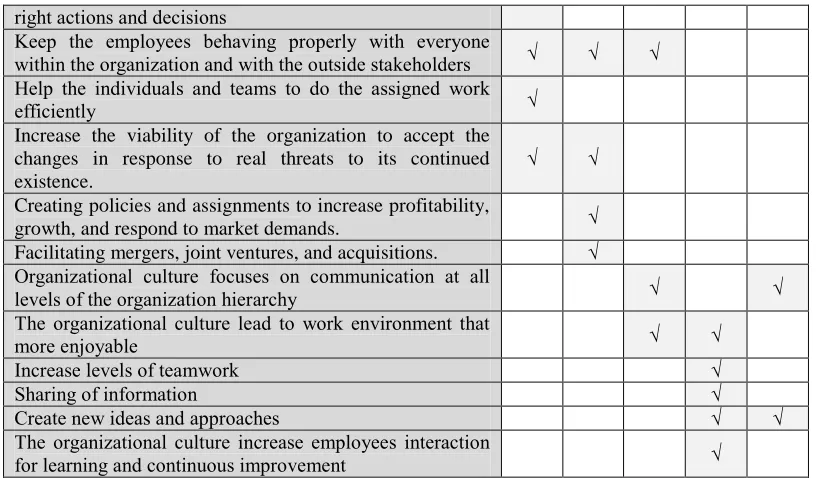
Table1 summarize the importance factors of the organizational culture that was determine from the previous literature with the source for each factor.
Table 1: The importance of organizational culture
The importance of organizational culture [10] [11] [12] [13] [14]
The organizational culture help in achieving the
organization goals √ √
Creating a positive public image √
Building respectful relationships with stakeholders √
37
Copyright © 2018. IJEMR. All Rights Reserved.
right actions and decisions
Keep the employees behaving properly with everyone
within the organization and with the outside stakeholders √ √ √
Help the individuals and teams to do the assigned work
efficiently √
Increase the viability of the organization to accept the changes in response to real threats to its continued existence.
√ √
Creating policies and assignments to increase profitability,
growth, and respond to market demands. √
Facilitating mergers, joint ventures, and acquisitions. √
Organizational culture focuses on communication at all
levels of the organization hierarchy √ √
The organizational culture lead to work environment that
more enjoyable √ √
Increase levels of teamwork √
Sharing of information √
Create new ideas and approaches √ √
The organizational culture increase employees interaction
for learning and continuous improvement √
3.1 Validity of the Research
Validity is often defined as the extent to which an instrument measures what it purports to measure [15]. Drost, (2011) stated that Validity is concerned with the meaningfulness of research components, when researchers measure behaviors, they are concerned with whether they are measuring what they intended to measure. Validity has a number of different aspects and assessment approaches. Statistical validity is used to evaluate instrument validity, which include internal validity and structure validity [16].
The internal validity of the questionnaire is the
first statistical test that used to test the validity of the questionnaire. It is measured by a scouting sample through measuring the spearman correlation coefficients between each factor in-group and the whole group. Table 2 present the spearman correlation coefficient for each paragraph and the whole group for importance of organizational culture part, which indicated that the correlation coefficients is significant at the level of α= 0.01 and at the level of α= 0.05, so it considered significant for to measured what they intended to measure.
Table 2: The spearman correlation coefficient
No. Importance of Organizational Culture Spearman
correlation coefficient
P-value (Sig.)
1 Help in achieving the organization goals. 0.542** 0.00
2 Help the organization to take right actions and decisions. 0.586** 0.00
3 Keep the employees behaving properly with everyone within the
organization and with the outside stakeholders. 0.691** 0.00
4 Increase the viability of the organization to accept the changes in
response to real threats to its continued existence. 0.733** 0.00
5 Creating policies and assignments to increase profitability,
growth, and respond to market demands. 0.622** 0.00
6 Increase employees interaction for learning and continuous
improvement. 0.693** 0.00
7 Creating a positive public image. 0.633** 0.00
8 Building respectful relationships with stakeholders. 0.623** 0.00
9 Help the individuals and teams to do the assigned work
efficiently. 0.626** 0.00
10 Focuses on communication at all levels of the organization
hierarchy. 0.729** 0.00
11 Lead to work environment that more enjoyable 0.715** 0.00
38
Copyright © 2018. IJEMR. All Rights Reserved.
13 Increase levels of teamwork. 0.550** 0.00
14 Sharing of information rapidly inside the organization. 0.757** 0.00
15 Create new ideas and approaches. 0.635** 0.00
IV.
RESULTS AND DISCUSSION
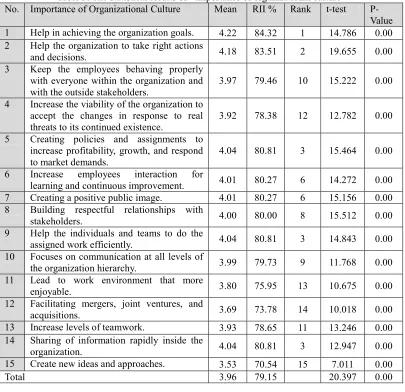
The mean, RII, t-test and significant of sign test were calculated for each factor, then the overall mean, RII, t-test and significant of sign test about (3) neutral value for the whole part were calculated and presented in Table 3.
As illustrated in table (3), “Help in achieving the organization goals” was the most important factor with (RII=84.32%). Organizational culture is considered today as one of the factors influencing a firm performance. In
most of the cases, the good and very good results are associated to the ability of the owners, managers, leaders of creating, maintaining and developing a strong organizational culture, which helps the components to achieve the organization goals [12]. Desson & Clouthier, (2010) the organizational culture has a significant impact on the achievement the goals of the organization, because it can supportive of –hinder – the implementation of new initiatives and the achievement of its overall goals [10].
Table 3: The statistical results of ''importance of organizational culture''
No. Importance of Organizational Culture Mean RII % Rank t-test
P-Value
1 Help in achieving the organization goals. 4.22 84.32 1 14.786 0.00
2 Help the organization to take right actions
and decisions. 4.18 83.51 2 19.655 0.00
3 Keep the employees behaving properly
with everyone within the organization and
with the outside stakeholders. 3.97 79.46 10 15.222 0.00
4 Increase the viability of the organization to accept the changes in response to real threats to its continued existence.
3.92 78.38 12 12.782 0.00
5 Creating policies and assignments to
increase profitability, growth, and respond
to market demands. 4.04 80.81 3 15.464 0.00
6 Increase employees interaction for
learning and continuous improvement. 4.01 80.27 6 14.272 0.00
7 Creating a positive public image. 4.01 80.27 6 15.156 0.00
8 Building respectful relationships with
stakeholders. 4.00 80.00 8 15.512 0.00
9 Help the individuals and teams to do the
assigned work efficiently. 4.04 80.81 3 14.843 0.00
10 Focuses on communication at all levels of
the organization hierarchy. 3.99 79.73 9 11.768 0.00
11 Lead to work environment that more
enjoyable. 3.80 75.95 13 10.675 0.00
12 Facilitating mergers, joint ventures, and
acquisitions. 3.69 73.78 14 10.018 0.00
13 Increase levels of teamwork. 3.93 78.65 11 13.246 0.00
14 Sharing of information rapidly inside the
organization. 4.04 80.81 3 12.947 0.00
15 Create new ideas and approaches. 3.53 70.54 15 7.011 0.00
Total 3.96 79.15 20.397 0.00
The factor of "help the organization to take right actions and decisions" comes in the second position with (RII=83.51%). The organizational culture help the employees and leaders to take right actions and decisions and this is due to the positive affect of the organizational culture in the way of the organizations think and
behave[10].
39
Copyright © 2018. IJEMR. All Rights Reserved.
rated in the third position with (RII=80.81%).
“creating policies and assignments to increase
profitability, growth, and respond to market demands” If the organization desire to fulfilled its strategic objectives, it must be sure that if the organizational culture support the vital actions to achieve its strategic goals; whereas, if it‟s not support, it should be taken new policies and assignments in consideration and should be communicated in a manner congruent to the existing work strategies and beliefs [11].
"help the individuals and teams to do the assigned
work efficiently" Because any organization are made up of individuals with different talents, personalities, and goals, the organization will have a distinct culture. But the existing of the organizational culture help the individuals and teams to do the assigned work efficiently.
"sharing of information rapidly inside the
organization " When the organization members identify with the culture, the work environment tends to be more enjoyable, that helps in increasing the interaction between the employees activates and continuous improvement because the information flows more freely in the organization [13].
V. CONCLUSION
This research was aimed to determine the importance of organizational culture for the Gaza Strip construction organizations. For this purpose the data was collected from the construction organizations that operate in Gaza Strip by using the questionnaire technique.
The results reveal the importance of the existence of organizational culture in the organization for its survival and continuity. The researcher defines 15 importance of organizational culture for any organization. Where the organizational culture help the organization in achieving the setting goals and objectives, also help the organization to take right actions and decisions. In other words the good and very good results are associated to the ability of the owners, managers, leaders of creating, maintaining and developing a strong organizational culture, which helps the components to achieve the organization goals.
REFERENCES
[1] Amah, E. (2012). Corporate culture and organizational effectiveness. A study of the nigerian banking industry.
European Journal of Business and Management, 4, 212-229.
[2] Dulaimi, M., Oney-Yazici, E., Giritli, H., Topcu-Oraz, G. & Acar, E. (2007). Organizational culture: The case of Turkish construction industry. Engineering, Construction and Architectural Management, 14, 519-531.
[3] Albayrak, G. & Albayrak, U. (2014). Organizational culture approach and effects on Turkish construction sector. APCBEE Procedia, 9, 252-257.
[4] Ilieş, L. & Gavrea, C. (2008). The link between organizational culture and corporate performance–An overview. Annals of Faculty of Economics, 4, 322-329. [5] Schein, E. H. (2010). Organizational culture and leadership (4th ed.). U.S: John Wiley & Sons.
[6] Calori, R. & Sarnin, P. (1991). Corporate culture and
economic performance: A french study. Organization
studies, 12, 049-74.
[7] Madu, B. C. (2012). Organization culture as driver of
competitive advantage. Journal of Academic and Business
Ethics, 5, 1-9.
[8] Oney-Yazic, E., Arditi, D. & Uwakweh, B. O. (2005). Organisational culture in US construction companies.
Proceedings of the Task-Group,23.
[9] Nifa, F. A. A. & Ahmed, V. Year. (2010). The role of organizational culture in construction partnering to produce innovation. In: Procs of 26th Annual ARCOM Conference, 6th-8th September, 725-734.
[10] Desson, K. & Clouthier, J. (2010). Organizational culture–why does it matter. Symposium on International Safeguards International Atomic Energy Agency, 1-9. [11] Mowat, J. (2002). Corporate culture. The herridge
group, 3. Available at:
http://www.herridgegroup.com/pdfs/corp_cultures.pdf [12] Elena, G. M. & Elena, P. D. (2013). On the importance of organizational culture in a company. Anale. Seria Stiinte Economice. Timisoara, 19, 292.
[13] Sadri, G. & Lees, B. (2001). Developing corporate
culture as a competitive advantage. Journal of
Management Development, 20, 853-859.
[14] Kimberlin, C. L. & Winterstein, A. G. (2008). Validity and reliability of measurement instruments used in research. American Journal of Health System Pharmacy, 65, 2276-84.