R E S E A R C H
Open Access
A neuroligin-3 mutation implicated in
autism causes abnormal aggression and
increases repetitive behavior in mice
Emma L. Burrows
1*, Liliana Laskaris
1, Lynn Koyama
1, Leonid Churilov
2, Joel C. Bornstein
3, Elisa L. Hill-Yardin
3†and Anthony J. Hannan
1,4*†Abstract
Background:Aggression is common in patients with autism spectrum disorders (ASD) along with the core symptoms of impairments in social communication and repetitive behavior. Risperidone, an atypical antipsychotic, is widely used to treat aggression in ASD. In order to understand the neurobiological underpinnings of these challenging behaviors, a thorough characterisation of behavioral endophenotypes in animal models is required. Methods:We investigated aggression in mice containing the ASD-associated R451C (arginine to cysteine residue 451 substitution) mutation in neuroligin-3 (NL3). Furthermore, we sought to verify social interaction impairments and assess olfaction, anxiety, and repetitive and restrictive behavior in NL3R451Cmutant mice.
Results:We show a pronounced elevation in aggressive behavior in NL3R451Cmutant mice. Treatment with risperidone reduced this aggression to wild-type (WT) levels. Juvenile and adult social interactions were also investigated, and subtle differences in initiation of interaction were seen in juvenile NL3R451Cmice. No genotype differences in olfactory discrimination or anxiety were observed indicating that aggression was not dependent on altered olfaction, stress response, or social preference. We also describe repetitive behavior in NL3R451Cmice as assessed by a clinically relevant object exploration task.
Conclusions:The presence of aberrant aggression and other behavioral phenotypes in NL3R451Cmice consistent with clinical traits strengthen face validity of this model of ASD. Furthermore, we demonstrate predictive validity in this model through the reversal of the aggressive phenotype with risperidone. This is the first demonstration that risperidone can ameliorate aggression in an animal model of ASD and will inform mechanistic and therapeutic research into the neurobiology underlying abnormal behaviors in ASD.
Keywords:Autism, Brain disorder, Cognitive disorder, Gene mutation, Mutant mice, Neuroligin-3, Psychiatric disorder, Repetitive and restrictive behavior, Social interaction, Synaptic protein
Background
Autism spectrum disorder (ASD) is a behaviorally de-fined condition involving a broad range and degree of symptom expression for which the etiology is unknown [1]. The study of highly penetrant ASD susceptibility genes have identified convergent downstream pathways
involved in ASD [2, 3]. Furthermore, systems biology approaches have combined disease risk, protein-protein interaction, gene ontology, conserved domains, and transcriptomics databases to create functional networks of genes implicated in ASD. The results of these studies group genes in functional networks enriched for pro-cesses such as neuronal migration, cytoskeleton dynam-ics, axon growth, and importantly, trans-synaptic signaling as a major network hub [4, 5].
Neuroligins are synaptic cell-adhesion molecules that mediate trans-synaptic signaling through their binding partner neurexins and shape neural network properties * Correspondence:[email protected];anthony.hannan@florey.
edu.au
†Equal contributors
1Florey Institute of Neuroscience and Mental Health, The University of
Melbourne, Kenneth Myer Building, Melbourne Brain Centre, Cnr Genetics Lane and Royal Pde, Parkville, Victoria 3010, Australia
Full list of author information is available at the end of the article
by specifying synaptic functions [6]. Importantly, muta-tions in genes encoding neuroligins [7] and neurexins [8] have been identified in ASD patients. To study the mechanisms by which these mutations and subsequent disruptions to cellular processes contribute to ASD, animal models have been generated that recapitulate important aspects of the human disorder. These animal models have become a major in vivo tool to investigate the neurobiological mechanisms leading to the expres-sion of behavioral traits in ASD.
Mice expressing the arginine to cysteine residue 451 substitution (R451C) mutation in the synaptic adhe-sion gene neuroligin-3 (NL3) have been proposed as a model of ASD. The ASD-causing point mutation in neuroligin-3 causing R451C substitution [7] impairs intracellular trafficking and reduces neuroligin-3 protein levels at the cell membrane by 90 % [9, 10]. NL3R451C mice show a diverse range of behavioral abnormalities and synaptic dysfunction as shown by increased cortical inhibition together with enhanced hippocampal excitation in brain slices [9, 11–14]. However, conflicting reports have arisen from studies of social behavior in NL3R451Cmice [9, 15].
While the core diagnostic symptoms include social communication deficits alongside the presence of repetitive behaviors, patients also exhibit a variety of comorbid traits such as aggression, which adversely impact on patient quality of life [16]. Aggression is ob-served in up to 70 % of individuals with ASD [17] and significantly limits patient access to education, health care, and employment [18]. The atypical antipsychotic risperidone is frequently prescribed for treatment of aggressive behaviors in children with ASD [19]; how-ever, side effects significantly limit its use [20–22].
The serious negative outcomes associated with
behavioral impairments in ASD highlight the inherent importance of understanding the underlying neurobio-logical mechanisms with the aim of developing more effective treatments.
Aggression in mice is a robust, innate, social behavior and serves to assist the acquisition of social ranking and resources from the environment. Dominance hierarchies are established and maintained through confrontations between rival male mice. Territorial aggression between males can be measured utilising the resident-intruder test whereby a juvenile intruder mouse is introduced to the home cage of a test mouse [23]. This paradigm mimics many elements of the behavior displayed by resi-dent males to exclude other breeding males from their home territory and their mates [23]. Escalated, patho-logical, and abnormal forms of aggression are charac-terised by prolonged and frequent attacks and brief latencies to attack following the introduction of an in-truder mouse [24, 25].
In order to determine whether the NL3 R451C muta-tion impacts on social and repetitive behavior in mice, we assessed aggressive interactions in this model. Ju-venile social interaction and adult sociability were also investigated in an attempt to resolve previously con-flicting reports in the literature [9, 11, 13, 15]. Repeti-tive and restricRepeti-tive behavior was also investigated using an adaptation of a clinical task applied to chil-dren with ASD.
Methods Animals
B6;129-Nlgn3tm1Sud/J mice were obtained from Jackson Laboratories (Bar Harbor, Maine USA) and maintained to generation F9 on a Sv129/C57BL6 background. NL3R451C and wild-type (WT) animals were derived by mating het-erozygous females with NL3R451C males, which produced 50:50 WT and NL3R451C male offspring (Y/+ and Y/ R451C) that were genotyped as previously described [9]. Experimental animals were weaned at 4 weeks of age and housed in groups of four per cage with food and water available ad libitum. The holding room was maintained on a 12:12-h light/dark cycle with lights on at 7.00 a.m. and at an ambient temperature of 20 ± 1 °C. All proce-dures were approved by the Florey Institute of Neurosci-ence and Mental Health Animal Ethics Committee. All behavioral testing was conducted in the light cycle, the an-imals were allowed at least 1 h to habituate to testing rooms, and the experimenter was blinded to genotype and exact sample sizes for each test are reported in figure leg-ends. Four separate cohorts of mice were exposed to be-havioral testing: cohort 1: repetitive object novel contact test (6 weeks of age) and olfactory discrimination (7 weeks of age); cohort 2: reciprocal juvenile social interaction test (3–4 weeks of age), social approach (9 weeks of age); co-hort 3: light/dark arena test (7 weeks of age), elevated plus test (8 weeks of age); and cohort 4: resident-intruder test (10 weeks of age).
Repetitive object novel contact test
randomised to avoid any effect of circling or thigmotaxis behavior. Recorded video files were scored for object investigation by an observer blinded to genotype. Investi-gation was defined as clear facial or vibrissae contact and/ or sniffing of the object. To assess for sequential patterns of investigation of the four objects, each object was allo-cated a number from one to four. The pattern of visitation of each individual mouse was then scored, and a record of investigation for each mouse was generated in a Microsoft Word document. For example, if the objects (designated 1–4) were visited in the designated order, the resulting sequence would be 1-2-3-4 in the word document. Subse-quent visits were added contiguously to the visitation data string in the word document. The investigation data were subsequently searched using the ‘Find and Replace’ func-tion in Microsoft Word for all possible four object visit-ation sequences. According to our criteria, a visitvisit-ation sequence could include multiple visits to the same object, provided they were interrupted by a visit to another ob-ject. To determine if mice showed recurring visitation pat-terns, the total number of repetitions of identical four object visitation sequences was calculated for each mouse and then averaged by genotype.
Grooming
The mice were placed in a clear Plexiglas cage (32 x 18 x 10 cm) lined with 1 cm of sawdust and allowed to habitu-ate for 30 mins. They were then videoed for 10 mins and scored by a rater, blinded to genotype.
Reciprocal juvenile social interaction
The mice aged 3–4 weeks were placed in a 30 cm2cage with an unfamiliar mouse for 30 min. Equal representa-tions of all possible pairs was achieved (WT/WT, WT/ NL3, NL3/NL3). Testing sessions were recorded by a video camera mounted above the testing arena and multiple body point tracking software Cleversys LTD (Virginia, USA) was used to automatically measure time in social interaction.
Social approach (three-chamber) test
The social approach test was performed as described [28]. In brief, after 10 min of habituation, a mouse was placed in the central chamber of a clear Plexiglas box (60 x 40 x 25 cm) divided into three interconnected chambers and was given the choice to interact with ei-ther an empty wire cup (located in one side of the cham-ber) or a similar wire cup with an unfamiliar 7– 8-week-old C57BL/6J male mouse inside (located in the opposite chamber). Time in each chamber and interacting with each cup was measured by an observer blinded to genotype. The chambers were cleaned, and fresh bed-ding was added between trials. The position of the stranger mouse was randomised between the left and
right side chambers to control for any chamber pref-erence. The animals serving as strangers were habitu-ated to placement under the wire cage for 5 min prior to the commencement of the test. Testing ses-sions were recorded by a video camera mounted above the testing arena, Cleversys LTD (Virginia, US) was used to automatically measure time in chambers, and time in direct social interaction was manually scored by a rater blinded to genotype.
Olfactory discrimination test
This test was conducted in order to determine the ability of the mice to discriminate between and habituate to dif-ferent odor types, e.g., social vs. non-social odors. The experimental room was cleared of all strong odors, and the mice were habituated to the room for a minimum of 1 h prior to testing. Concurrently, they were habituated to a clean cotton tip applicator placed in a weigh boat and inserted through the wire bars of the home cage. The testing arena consisted of a clear Plexiglas cage (32 × 18 × 10 cm) lined with 1 cm of sawdust. The odors were presented in sequential order: water, vanilla, al-mond, female urine, and male urine in accordance with a protocol previously described [29]. Vanilla and almond cooking essence were used, and urine was obtained from adult C57Bl/6J male and C57Bl/6J female mice in es-trous. Each odor was presented for a period of 2 min, re-peated over three trials with an inter-trial interval of 1 min. All odors were diluted in distilled water at a 1:4 dilutions factor and the investigator pipetted 10 μL of each odor onto a fresh cotton tip applicator, at the be-ginning of every trial. Recorded video files were scored for the amount of time the mouse spent sniffing the cot-ton tip applicator during each odor presentation by an observer blinded to genotype.
Light-dark arena
Photo beam arenas (E63-10, TruScan, Coulbourn Instru-ments, Allentown, PA, USA) with a light-dark box insert placed over half of the arena were used to monitor the exploratory activity of the mice. The animals were placed in the light area facing into the dark area and allowed to enter. The light (750 lx) was then switched on, and the 10 min trial started.
Elevated plus maze
subjects, and scoring was performed using the Noldus Ethovision automated tracking system (version 3).
Resident-intruder test
The male resident mice were isolated for 1 week, during which their home cages were not changed. Aggressive behaviors in 3-month-old mice were monitored during four 5 min test exposures to 8-week-old C57BL/6 male intruder mice conducted over 4 days as aggression is a highly variable behavior in mice [30, 31]. Mice were injected intraperitoneally with a non-sedative [32–37] dose of risperidone (0.05 mg/kg; Sigma) or saline 15 min prior to testing (Additional file 1: Figure S1). Testing was conducted by an experimenter blinded to genotype, and drug treatment and treatment group assignment was randomised ensuring sufficient spread of animals from different litters, housing boxes, and genotypes in each group. The trials were aborted if the experimenter observed tufts of hair being removed from either animal. Two NL3R451C animals were excluded from testing on the first day due to extreme aggression towards the in-truder. Latency to first attack, attack incidence, attack duration, tail rattles, and non-aggressive social interac-tions (sniffing, climbing, and grooming) were scored by a rater, blinded to genotype from video recordings of each test session.
Statistical analyses
Where data distribution were normal and variance compar-able (juvenile social interaction, adult social approach test, olfactory discrimination test, light-dark arena, elevated plus maze, repetitive object novel contact test, grooming), un-paired Student’sttest or ANOVAs with repeated measures where appropriate followed by Bonferroni post hoc tests were used as indicated. Aggression data was not normally distributed, and regression models were applied to estimate the effect size (Additional file 2: Figure S3). Two independ-ent analyses were conducted in accordance with our hy-potheses; (a) estimating the effect of the NL3R451C mutation on aggression and (b) estimating the effect of ris-peridone treatment on aggression in NL3R451C mice. Due to absence of prior estimates of effect sizes, no power ana-lysis was conducted. In both analyses, the animals were re-peatedly tested over 4 days, thus these observations are correlated within a given animal. Hierarchical regression models were used to estimate the effect of the NL3R451C gene mutation on aggression and the effect of risperidone treatment on NL3R451Cmice. Both Bonferroni adjusted for multiple comparisons and unadjusted two-sided p values were reported together with appropriate effect size esti-mates and 95 % confidence intervals (95 % CI) to indicate the precision. The latency data describes the time to an attack and may be censored (e.g., when an animal does not attack during the 300-s observation period).
Survival analysis, in particular the Cox regression model, is appropriate for analysis of these data [38]. A hierarchical Cox regression model that accounts for the effect of multiple test days was used to esti-mate the effect size, measured as the hazard ratio of the first attack occurring at any time over the 300-s observation period. Attack incidence is a count vari-able, and a hierarchical Poisson regression model was used to estimate the effect size, measured as the ra-tio of expected number of attacks. Although the dur-ation of social interaction data violated the normality assumption, a hierarchical random effects generalised least squares regression model did not violate the assumptions of model fit. Both Bonferroni adjusted for multiple comparisons and unadjusted two-sided p values were reported together with appropriate ef-fect size estimates and (95 % CI) to indicate the pre-cision. Results for aggression data are graphically presented as a box and whiskers plot showing the 25th to the 75th percentile and the minimum to max-imum of the data range and the median was shown by a line. Statistical analyses were performed with STATA and SPSS software.
Results
NL3R451Cmice exhibit repetitive behavior in an object exploration task
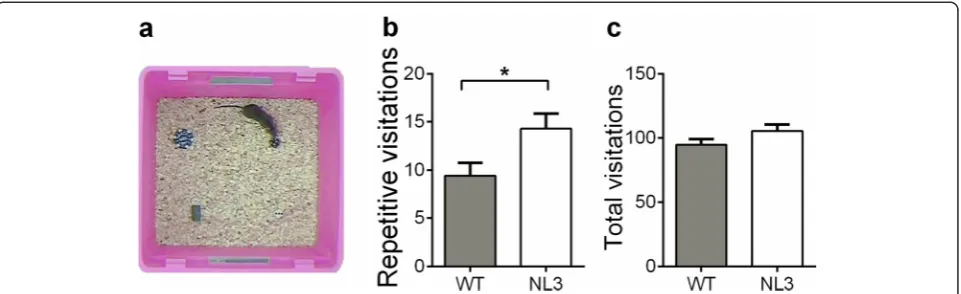
The repetitive novel object contact test involved pla-cing four clearly distinguishable objects (one in each corner) in a neutral arena, and repetition of visitation patterns were recorded as a measure of repetitive/ ritualistic behavior (Fig. 1a). The NL3R451C mice re-peated sequential patterns of investigation consisting of four objects more often than the WT mice (Fig. 1b; t45=−2.35, p= 0.024). The total number of object vis-itations was assessed as a measure of general explor-ation and hyperactivity and were comparable between the NL3R451C and WT mice (Fig. 1c). Grooming was assessed as a measure of stereotypy, and no differ-ences were uncovered between the NL3R451C mice and WT mice (Additional file 2: Figure S3).
in same genotype pairs were more likely to make so-cial contact compared to the WT/WT pairs (Fig. 2b; F2, 37= 7.44, p= 0.002; WT/WT vs. NL3/NL3, p< 0.001). This increase in episodes of social interaction but not in duration could be due to the NL3R451C mice exhibiting hyperactivity in the arena. The total distance covered by the NL3R451C mice was significantly greater when compared to the WT (Fig. 2c; t17=−2.7, p= 0.015).
We investigated this change in social behavior in an independent experiment with the widely used social approach (three-chamber) test performed in adult mice at 9 weeks. In this test, mice are given the choice to interact with either an empty cage or a similar cage containing an unfamiliar stimulus mouse, matched for age and sex. The amount of time in the chamber containing the mouse and also interacting
with the cage containing the mouse is compared as a measure of sociability. Normal sociability is defined as spending significantly more time interacting with the cage containing the mouse than with the empty cage [39, 40]. One-way ANOVA with repeated measures (chamber) revealed a significant effect of chamber (Fig. 3a; main effect of chamber: F2,34= 79.28; p< 0.001). Both the WT and NL3R451C mice showed nor-mal sociability, demonstrating preference for the chamber containing the stranger mouse (mouse vs. center, empty p< 0.001). Normal sociability in both genotypes was also reflected in directed interactions with the mouse vs. the empty cage (Fig. 3b; one-way ANOVA main effect of cage: F1,17= 89.85; p< 0.001, mouse vs. empty p< 0.001). WT and NL3R451C mice cover comparable differences during the social inter-action trial (Fig. 3c).
Fig. 1NL3R451Cmice display increased repetitive behavior in the repetitive novel object contact test.aThe arena contained four clearly
distinguishable objects, one located in each corner, and the repetition of visitation patterns was recorded as a measure of repetitive/ritualistic behavior.bThe NL3R451Cmice showed increased repetition of identical object sequences of visitation (four objects) compared to the WT.
A four-object visitation sequence could include multiple visits to the same object, provided they were interrupted by a visit to another object.cThe NL3R451Cand WT mice made a comparable number of total visits to novel objects. Values are displayed as mean ± SEM.Asterisksrepresent
a statistically significant difference between the indicated groups. *p< 0.05;n= 21 mice in each group
Fig. 2Juvenile NL3R451Cmice display abnormal social interaction in a free interaction arena.aA trend for the juvenile NL3R451Cmice to spend
less time interacting with novel genotype-matched (NL3/NL3;n= 10) mice compared to mixed genotype pairs (WT/NL3;n= 14) and WT mice (WT/WT;n= 15) was seen.bThe NL3R451Cmice engage in more episodes of social interactions andccover a greater distance in the arena during
NL3R451Cmice display normal olfactory habituation and dishabituation to social and non-social odors
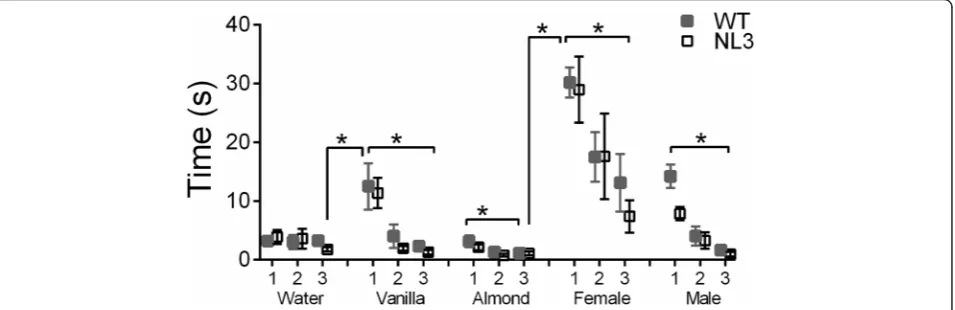
Sniffing time in both WT and NL3R451Cmice was influ-enced by both the type of odorant presented (Fig. 4; F4,180= 30.74,p< 0.001) and whether it was the first, sec-ond, or third presentations of that odorant with the first presentation of each odorant eliciting greater sniffing be-havior (F2,90= 51.71, p< 0.001). There was also a signifi-cant interaction of sniffing time and order of odorant presentation (F8,360= 8.36, p< 0.001) as indicated by re-peated measures ANOVA. Both the WT and NL3R451C mice exhibited significantly longer durations sniffing female urine on first presentation when compared to all other odors. The NL3R451Cand WT mice exhibited simi-lar preferences for odorants, and there was no inter-action between odorant and genotype. All mice showed an aversive reaction to almond; however, the duration of time spent sniffing water, vanilla, and male urine did not differ significantly.
NL3R451Cmice show normal anxiety levels
The NL3R451C mice show no difference in the percentage of time they spend in the light side of the light-dark arena compared to the WT mice (Additional file 3: Figure S2a). Similarly, the NL3R451C and WT mice show comparable time in the open and closed arms of the elevated plus maze (Additional file 3: Figure S2b).
Heightened aggression in NL3R451Cmutant mice is reversed with risperidone treatment
The NL3R451C and WT mice were assessed for aggressive behavior utilising the resident-intruder test, whereby a ju-venile intruder mouse is introduced to the home cage of a test mouse. This paradigm mimics innate social behavior displayed by resident males to exclude other breeding males from their home territory and their mates [23]. Ab-normal aggression is characterised by brief latencies to at-tack and prolonged periods of aggression following the introduction of an intruder mouse [24].
Fig. 3aIn the three-chamber interaction task, adult WT and NL3R451Cmice demonstrated preference for the chamber containing the novel
C57Bl6 mouse and also forbinteracting directly with this caged mouse vs. the empty cage.cNo difference in distance covered was seen between genotypes. Values are displayed as mean ± SEM.Asterisksrepresent a statistically significant difference between the indicated groups. ***p< 0.001;n= 10 mice in each group
Fig. 4NL3R451Cmice display normal olfactory habituation and dishabituation. There were no significant differences in the habituation and
dishabituation patterns displayed by the WT (n= 27) and NL3R451Cmice (n= 21). Both genotypes exhibited significant dishabituation of water to
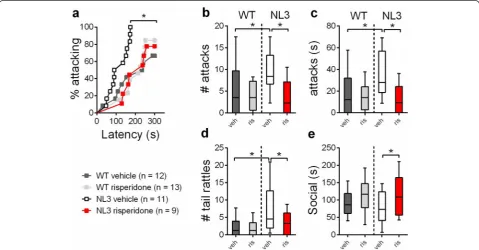
When confronted by an intruder, the resident vehicle-treated NL3R451Cmice were 7.8-fold more likely to initi-ate a first attack compared to the WT mice (Fig. 5a; haz-ard ratio = 7.84, p= 0.003; 95 % CI 2.04, 30.22; for all statistical details, refer to Additional file 4: Table S1). The NL3R451C mice also attacked more often (Fig. 5b; ratio of expected number of attacks = 24.84; p< 0.001; 95 % CI 7.45, 82.84) and for longer periods of time than the WT littermates (Fig. 5c; difference in mean dur-ation = 28; p< 0.001; 95 % CI 14, 41). Furthermore, the NL3R451C mice displayed significantly more tail rattles (a territorial behavior initiated in response to a threat) than the WT animals (Fig. 5d; ratio of expected number of tail rattles = 20.92;p< 0.001; 95 % CI 6.40, 68.39).
An important goal in developing mouse models of neuropsychiatric diseases is testing therapeutic treatments. Risperidone was the first drug approved by the US Food and Drug Administration (FDA) for symptomatic treat-ment of ASD, alleviating aggression and repetitive, self-injurious behavior [41, 42]. The NL3R451Cmice and their WT littermates were treated with risperidone or vehicle and were tested for improvement in aggressive behavior. There were no significant changes in open field activity in the risperidone-treated NL3R451Cmice, indicating that the dose used was not sedating (Additional file 1: Figure S1).
We found that risperidone significantly reduced aggres-sion in the NL3R451C mice (Fig. 5a–e). Risperidone treat-ment reduced the risk of attack in the NL3R451Cmice and had no effect on the WT mice (Fig. 5a; hazard ratio = 0.22, 95 % CI 0.10, 0.55;p< 0.001). The number of attacks and attack duration were both reduced by risperidone (Fig. 5b; ratio of expected number of attacks = 0.41;p< 0.001; 95 % CI 0.27, 0.64; Fig. 5c; difference in mean duration =−22; p< 0.001; 95 % CI −35, −8). The risperidone-treated NL3R451C mice displayed less tail rattles towards intruders compared to the vehicle-treated mutants (Fig. 5d; ratio of expected number of tail rattles = 0.47; p= 0.023; 95 % CI 0.25, 0.90). While the NL3R451Cmice did not show a reduction in agonistic social behavior, risperidone increased the time that mutants spent en-gaging in this behavior (Fig. 5e; difference in mean dur-ation = 58 s;p< 0.001; 95 % CI 24, 92).
Discussion
The development of mouse models of ASD is crucial to study the disorder at molecular and cellular levels, to gain insight into disease mechanisms, and test potential pharmacological interventions. Here, we have shown that risperidone efficiently reduces aggression in the NL3R451C mouse, while having no effect on the WT
Fig. 5NL3R451Cmice display heightened aggression which is rescued by risperidone.aVehicle-treated NL3R451Cmice showed an increased risk of
attacking compared to WT mice, which was reversed with risperidone. In the WT mice, the risk of an attack was unchanged following risperidone treatment. The NL3R451Cmice attackedbmore often ,cfor longer andddisplayed more tail rattles compared to the WT mice. All measures of
aggression were also reduced by risperidone.eRisperidone increased the duration of agonistic social interactions in the NL3R451Cmice compared
to the vehicle-treated mice. Values fora–eare an average of four tests, and data inb–eare displayed asbox plotswith medians plus the 25th
and 75thpercentiles. Whiskers represent the minimum and maximum values. Asterisks represent a statistically significant difference between
behavior or on locomotor activity levels. This is the first demonstration of risperidone rescuing aggression in mice with an ASD-associated genetic mutation and demonstrates predictive validity in this model. The NL3R451C mice exhibit normal anxiety levels and olfac-tory discrimination indicating that abnormal aggressive behavior is not due to altered anxiety or olfaction. Fur-thermore, while we uncover subtle differences in social behavior in the juvenile NL3R451C mice, as adults, mu-tants show similar sociability to the WT littermates. Using a novel assay of repetitive and restrictive behavior, we show that the NL3R451C mice exhibit stereotypical object exploration, further confirming the face validity of the NL3R451Cmodel in the context of ASD.
Previous characterisations of NL3R451C mouse behav-ior have focused on potential deficits in social interac-tions [9, 13–15], but less attention has been given to the analysis of repetitive and restrictive movements and routines. In order to assess this domain in the NL3R451C mice, we employed a behavioral assay based on findings from a clinical trial demonstrating that children with ASD tended to play with toys in a particular order [26]. Upon exposure to four objects, we observed that the NL3R451Cmice repeated particular patterns of visitation more frequently than the WT littermates. Compared to the initial study by Pearson et al., utilising this task, we report a higher frequency of four sequence patterns, despite time and total visitations being similar. This discrepancy is most likely due to the fact that both studies defined a visitation sequence as one that could include multiple visits to the same object, provided they were interrupted by a visit to another object. It is pos-sible therefore that the mice in the study by Pearson et al. made more consecutive visits to the same object, which would lower the frequency of four-object se-quences recorded. The emphasis of this task is primar-ily on the repetition of these sequences of investigation rather than the specific order of objects. If mice were retested, it is likely that each NL3R451C mouse would generate a different pattern of investigation, but that the object exploration would be repeated to a higher degree than WT mice. The exact order of object ex-ploration would depend upon the time between the ini-tial and subsequent tests and the ability of mice to recall their previous visitation pattern. Given the nov-elty of this test, this point has not been addressed in the behavioral literature and is one that we may explore in the future.
It has also been recently shown that NL3R451Cmutants show enhanced acquisition of repetitive motor routines on the rotarod [43]. This repetitive phenotype was recapit-ulated by the conditional deletion of NL3 in adult mice and was shown to be exclusively mediated by a reduction of synaptic inhibition onto ventral striatum dopamine D1
medium spiny neurons. While the neural mechanisms underlying object exploration are likely to differ from those governing motor habit formation, it is likely that the NL3R451Cmutation could disrupt striatal circuits to shape a broad range of repetitive and stereotypic behaviors asso-ciated with ASD. This has been demonstrated by volumet-ric MRI studies that have shown smaller striatal volume in the NL3R451C mice [44, 45]. Furthermore, the disruption of striatal circuitry demonstrated in the NL3R451C mouse model is in keeping with striatal structural and functional alterations in ASD patients [46–48].
increased frequency of interaction seen in the mutants in the current study contrasts with one report that ju-venile NL3R451Cmice show no difference in this param-eter [15], our present finding is likely a result of hyperactivity shown by the NL3R451C mice during the 30-min testing period. No aggression was noted during juvenile social interaction testing, suggesting that the heightened aggression expressed in the adult NL3R451C mouse could be territorial in nature.
We have demonstrated that heightened aggression is a robust phenotype in the NL3R451C mouse model of ASD. While we assessed aggression specifically to-wards a novel juvenile mouse following a period of isolation, a lower incidence of aggression was noted in the home cages of the animals. This observation has implications for interpretation of adult behavior in studies utilising this mutant, as repeated exposure to aggression can lead to stress, alter baseline behavior in the WT mice and impact on health [49]. Furthermore, this is the first demonstration that risperidone can ameliorate aggression in a mouse model of ASD. How risperidone decreases aggression in NL3R451C mice is not known. Risperidone has a broad antagonist recep-tor profile with greatest affinity for serotonin (5-hy-droxy-tryptamine (5-HT)) 2A receptors, followed by 5-HT1B, 5-HT7, and dopamine D2 receptors [50]. Both antagonists acting at 5-HT2A [51, 52] and D2 re-ceptors [53, 54] reduce aggressive behaviors in mice, suggesting that these specific receptor candidates may mediate the effects of risperidone in NL3R451C mice; however, this requires further examination.
Conclusions
The serious negative outcomes associated with behav-ioral impairments in ASD highlight the inherent import-ance of understanding the underlying neurobiological mechanisms, with the aim of developing more effective treatments. We have shown novel behavioral phenotypes of repetitive and restrictive object exploration and ag-gression in the NL3R451C mice, strengthening the face validity of the mouse model. Social impairments are considered an essential readout when validating ASD animal models, and while our findings showed normal interaction in the three-chamber assay, the expression of heightened aggression in the NL3R451C mice indicates that abnormal social behavior is indeed present in this mutant. Our demonstration that risperidone reduced ag-gression in the NL3R451C mice is the first of its type in ASD research and is in line with clinical treatment of ag-gression in ASD. The NL3R451C mouse model of ASD demonstrates construct validity, face validity, and now strong predictive validity and represents a powerful tool to explore pathogenesis and the development of new treatments for ASD.
Additional files
Additional file 1: Figure S1.Risperidone (0.05 mg/kg) treatment did not alter locomotor activity in NL3R451Cmice. NL3R451Cmice treated with
risperidone (n= 6) showed no difference in distance travelled compared to vehicle-treated controls (n= 4) as assessed in Truscan (Coulbourn Instruments) locomotor activity arenas (two-way repeated measures ANOVA, F1,9 = 0.1;p= 0.75). Arrow denotes time of drug or saline treatment. Values are displayed as mean + SEM.
Additional file 2: Figure S3.No differences between grooming behavior were observed between NL3R451C(n= 12) and WT mice (n= 14).
Values are displayed as mean ± SEM.
Additional file 3: Figure S2.NL3R451Cmice show no differences in
measures of anxiety. (a) WT and NL3R451Cmice spent comparable time in
the light side of the light-dark arena. (b) Both WT and NL3R451Cmice showed a preference for the closed arm in the elevated plus maze and no differences in time spent in either closed or open arms. Values are displayed as mean ± SEM.n= 10 mice in each group.
Additional file 4: Table S1.The effect of risperidone treatment on the risk of aggressive behavior in WT and NL3R451Cmice. Hierarchical Cox regression was used to estimate the effect size (ES) of latency to attack, measured as the hazard ratio of the first attack occurring at any time over the 300-s observation period. Number of attacks and tail rattles were analyzed with hierarchical Poisson regression models, and effect sizes are listed as the ratio of expected number of attacks or tail rattles. Hierarch-ical random effects generalised least squares regression models were used to estimate the mean difference for duration of attacks and social interaction. Effect size, 95 % confidence intervals (CI), andpvalues for each parameter are shown for interaction (genotype vs. treatment), genotype (WT vs. NL3) and treatment (vehicle vs. risperidone) comparisons. All analyses were adjusted for the effect of day.
Abbreviations
5-HT:5-hydroxy-tryptamine (serotonin); ASD: autism spectrum disorders; D1: dopamine D1 receptors; D2: dopamine D2 receptors; FDA: US Food and Drug Administration; NL3: neuroligin-3; R451C: arginine to cysteine residue 451 substitution; WT: wild-type.
Competing interests
The authors declare that they have no conflicts of interest.
Authors’contributions
ELB, ELH, and AJH conceived of the study and participated in its design and coordination. ELB carried out and supervised all behavioral tests, collated the data, and performed the statistical analysis. LL carried out the juvenile social interaction test, olfactory, grooming, repetitive and restrictive behavior studies and the data analysis and contributed to the drafting of the manuscript. LK carried out the anxiety tests and the data analysis and revised the manuscript. LK and ELH carried out the initial aggression study that identified the phenotype. LC performed the statistical analysis for aggression data and revised the manuscript. ELB, ELH, AJH and JCB drafted and edited the manuscript. All authors read and approved the final manuscript.
Acknowledgements
We thank past and present laboratory members for useful discussions. Thank you to Leah Catalano, Daniel Drieberg, Ana Hudson, Maddison Lee Ible, Brett Purcell, Nerida Taylor, and Craig Thomson for their technical assistance; Dr Brandon Pearson for support on the repetitive behavior experiment, and Alexander Eastwood for comments on the manuscript.
Funding
This work was funded by National Health Medical Research Council (NHMRC) Project Grant 1047674 to AJH and ELH-Y. AJH has been supported by an Australian Research Council (ARC) FT3 Future Fellowship (FT100100835) and an NHMRC Senior Research Fellowship.
Author details 1
Lane and Royal Pde, Parkville, Victoria 3010, Australia.2Florey Institute of Neuroscience and Mental Health, 245 Burgundy St, Heidelberg, Victoria 3084, Australia.3Department of Physiology, The University of Melbourne, Royal Pde, Parkville, Victoria 3010, Australia.4Department of Anatomy and Neuroscience, The University of Melbourne, Royal Pde, Parkville, Victoria 3010, Australia.
Received: 2 June 2015 Accepted: 5 November 2015
References
1. APA. Diagnostic and statistical manual of mental disorders. 5th ed. Washington, DC: American Psychiatric Publishing; 2013.
2. Anney R, Klei L, Pinto D, Regan R, Conroy J, Magalhaes TR, et al. A genome-wide scan for common alleles affecting risk for autism. Hum Mol Genet. 2010;19(20):4072–82.
3. Betancur C, Sakurai T, Buxbaum JD. The emerging role of synaptic cell-adhesion pathways in the pathogenesis of autism spectrum disorders. Trends Neurosci. 2009;32(7):402–12.
4. An JY, Cristino AS, Zhao Q, Edson J, Williams SM, Ravine D, et al., Towards a molecular characterization of autism spectrum disorders: an exome sequencing and systems approach. Transl Psychiatry. 2014;4:e394. 5. Cristino AS, Williams SM, Hawi Z, An JY, Bellgrove MA, Schwartz CE, et al.
Neurodevelopmental and neuropsychiatric disorders represent an interconnected molecular system. Mol Psychiatry. 2014;19(3):294–301. 6. Sudhof TC. Neuroligins and neurexins link synaptic function to cognitive
disease. Nature. 2008;455(7215):903–11.
7. Jamain S, Quach H, Betancur C, Rastam M, Colineaux C, Gillberg IC, et al. Mutations of the X-linked genes encoding neuroligins NLGN3 and NLGN4 are associated with autism. Nat Genet. 2003;34(1):27–9.
8. Ching MS, Shen Y, Tan WH, Jeste SS, Morrow EM, Chen X, et al. Deletions of NRXN1 (neurexin-1) predispose to a wide spectrum of developmental disorders. Am J Med Genet B Neuropsychiatr Genet. 2010;153B(4):937–47.
9. Tabuchi K, Blundell J, Etherton MR, Hammer RE, Liu X, Powell CM, et al. A neuroligin-3 mutation implicated in autism increases inhibitory synaptic transmission in mice. Science. 2007;318(5847):71–6.
10. Comoletti D, De Jaco A, Jennings LL, Flynn RE, Gaietta G, Tsigelny I, et al. The Arg451Cys-neuroligin-3 mutation associated with autism reveals a defect in protein processing. J Neurosci. 2004;24(20):4889–93.
11. Etherton MR, Tabuchi K, Sharma M, Ko J, Sudhof TC. An autism-associated point mutation in the neuroligin cytoplasmic tail selectively impairs AMPA receptor-mediated synaptic transmission in hippocampus. EMBO J. 2011;30(14):2908–19.
12. Foldy C, Malenka RC, Sudhof TC. Autism-associated neuroligin-3 mutations commonly disrupt tonic endocannabinoid signaling. Neuron.
2013;78(3):498–509.
13. Jaramillo TC, Liu S, Pettersen A, Birnbaum SG, Powell CM. Autism-related neuroligin-3 mutation alters social behavior and spatial learning. Autism Res. 2014;7(2):264–72.
14. Etherton M, Foldy C, Sharma M, Tabuchi K, Liu X, Shamloo M, et al. Autism-linked neuroligin-3 R451C mutation differentially alters hippocampal and cortical synaptic function. Proc Natl Acad Sci U S A. 2011;108(33):13764–9. 15. Chadman KK, Gong S, Scattoni ML, Boltuck SE, Gandhy SU, Heintz N, et al. Minimal aberrant behavioral phenotypes of neuroligin-3 R451C knockin mice. Autism Res. 2008;1(3):147–58.
16. Argyropoulos A, Gilby KL, Hill-Yardin EL. Studying autism in rodent models: reconciling endophenotypes with comorbidities. Front Hum Neurosci. 2013;7:417.
17. Kanne SM, Mazurek MO. Aggression in children and adolescents with ASD: prevalence and risk factors. J Autism Dev Disord. 2011;41(7):926–37. 18. Card NA, Little TD. Proactive and reactive aggression in childhood and
adolescence: A meta-analysis of differential relations with psychosocial adjustment. Int J Behav Dev. 2006;30:466–80.
19. Sharma A, Shaw SR. Efficacy of risperidone in managing maladaptive behaviors for children with autistic spectrum disorder: a meta-analysis. J Pediatr Health Care. 2012;26(4):291–9.
20. Aman MG, Arnold LE, McDougle CJ, Vitiello B, Scahill L, Davies M, et al. Acute and long-term safety and tolerability of risperidone in children with autism. J Child Adolesc Psychopharmacol. 2005;15(6):869–84.
21. Canitano R, Scandurra V. Risperidone in the treatment of behavioral disorders associated with autism in children and adolescents. Neuropsychiatr Dis Treat. 2008;4(4):723–30.
22. Lemmon ME, Gregas M, Jeste SS. Risperidone use in autism spectrum disorders: a retrospective review of a clinic-referred patient population. J Child Neurol. 2011;26(4):428–32.
23. Miczek KA, Maxson SC, Fish EW, Faccidomo S. Aggressive behavioral phenotypes in mice. Behav Brain Res. 2001;125(1–2):167–81. 24. Miczek KA, Fish EW, De Bold JF. Neurosteroids, GABAA receptors, and
escalated aggressive behavior. Horm Behav. 2003;44(3):242–57. 25. Miczek KA, Fish EW, De Bold JF, De Almeida RM. Social and neural
determinants of aggressive behavior: pharmacotherapeutic targets at serotonin, dopamine and gamma-aminobutyric acid systems. Psychopharmacology (Berl). 2002;163(3–4):434–58.
26. Pierce K, Courchesne E. Evidence for a cerebellar role in reduced exploration and stereotyped behavior in autism. Biol Psychiatry. 2001;49(8):655–64.
27. Pearson BL, Pobbe RL, Defensor EB, Oasay L, Bolivar VJ, Blanchard DC, et al. Motor and cognitive stereotypies in the BTBR T + tf/J mouse model of autism. Genes Brain Behav. 2011;10(2):228–35.
28. Yang M, Silverman JL, Crawley JN. Automated three-chambered social approach task for mice. Curr Protoc Neurosci. 2011;Chapter 8:Unit 8 26. 29. Yang M, Crawley JN. Simple behavioral assessment of mouse olfaction. Curr
Protoc Neurosci. 2009;Chapter 8:Unit 8 24.
30. Velez L, Sokoloff G, Miczek KA, Palmer AA, Dulawa SC. Differences in aggressive behavior and DNA copy number variants between BALB/cJ and BALB/cByJ substrains. Behav Genet. 2010;40(2):201–10.
31. Burrows EL, Hannan AJ. Characterizing social behavior in genetically targeted mouse models of brain disorders. Methods Mol Biol. 2013;1017:95–104.
32. Bespalov A, Jongen-Relo AL, van Gaalen M, Harich S, Schoemaker H, Gross G. Habituation deficits induced by metabotropic glutamate receptors 2/3 receptor blockade in mice: reversal by antipsychotic drugs. J Pharmacol Exp Ther. 2007;320(2):944–50.
33. Rogoz Z. Effects of co-treatment with mirtazapine and low doses of risperidone on immobility time in the forced swimming test in mice. Pharmacol Rep. 2010;62(6):1191–6.
34. Rogoz Z, Kabzinski M. Enhancement of the anti-immobility action of antidepressants by risperidone in the forced swimming test in mice. Pharmacol Rep. 2011;63(6):1533–8.
35. Siuciak JA, McCarthy SA, Martin AN, Chapin DS, Stock J, Nadeau DM, et al. Disruption of the neurokinin-3 receptor (NK3) in mice leads to cognitive deficits. Psychopharmacology (Berl). 2007;194(2):185–95.
36. Bradford AM, Savage KM, Jones DN, Kalinichev M. Validation and pharmacological characterisation of MK-801-induced locomotor hyperactivity in BALB/C mice as an assay for detection of novel antipsychotics. Psychopharmacology (Berl). 2010;212(2):155–70. 37. Rodriguez-Arias M, Broseta I, Aguilar MA, Minarro J. Lack of specific
effects of selective D(1) and D(2) dopamine antagonists vs. risperidone on morphine-induced hyperactivity. Pharmacol Biochem Behav. 2000;66(1):189–97.
38. Cleves M, Gould W, Gutierrez R, Marchenko Y. An introduction to survival analysis using STATA.2nd ed. College Station, TX: StataCorp LP; 2008. 39. Silverman JL, Smith DG, Rizzo SJ, Karras MN, Turner SM, Tolu SS, et al.
Negative allosteric modulation of the mGluR5 receptor reduces repetitive behaviors and rescues social deficits in mouse models of autism. Sci Transl Med. 2012;4(131):131ra51.
40. Smith SE, Zhou YD, Zhang G, Jin Z, Stoppel DC, Anderson MP. Increased gene dosage of Ube3a results in autism traits and decreased glutamate synaptic transmission in mice. Sci Transl Med. 2011;3(103):103ra97. 41. McDougle CJ, Scahill L, McCracken JT, Aman MG, Tierney E, Arnold LE, et al.
Research Units on Pediatric Psychopharmacology (RUPP) Autism Network. Background and rationale for an initial controlled study of risperidone. Child Adolesc Psychiatr Clin N Am.
2000;9(1):201–24.
42. McDougle CJ, Stigler KA, Erickson CA, Posey DJ. Atypical antipsychotics in children and adolescents with autistic and other pervasive developmental disorders. J Clin Psychiatry. 2008;69 Suppl 4:15–20.
44. Ellegood J, Lerch JP, Henkelman RM. Brain abnormalities in a neuroligin3 R451C knockin mouse model associated with autism. Autism Res. 2011;4(5):368–76.
45. Kumar M, Duda JT, Hwang WT, Kenworthy C, Ittyerah R, Pickup S, et al. High resolution magnetic resonance imaging for characterization of the neuroligin-3 knock-in mouse model associated with autism spectrum disorder. PLoS One. 2014;9(10), e109872.
46. Di Martino A, Kelly C, Grzadzinski R, Zuo XN, Mennes M, Mairena MA, et al. Aberrant striatal functional connectivity in children with autism. Biol Psychiatry. 2011;69(9):847–56.
47. Hollander E, Anagnostou E, Chaplin W, Esposito K, Haznedar MM, Licalzi E, et al. Striatal volume on magnetic resonance imaging and repetitive behaviors in autism. Biol Psychiatry. 2005;58(3):226–32.
48. Langen M, Schnack HG, Nederveen H, Bos D, Lahuis BE, de Jonge MV, et al. Changes in the developmental trajectories of striatum in autism. Biol Psychiatry. 2009;66(4):327–33.
49. Jin HM, Shrestha Muna S, Bagalkot TR, Cui Y, Yadav BK, Chung YC. The effects of social defeat on behavior and dopaminergic markers in mice. Neuroscience. 2015;288:167–77.
50. Nasrallah HA. Atypical antipsychotic-induced metabolic side effects: insights from receptor-binding profiles. Mol Psychiatry. 2008;13(1):27–35.
51. Sakaue M, Ago Y, Sowa C, Sakamoto Y, Nishihara B, Koyama Y, et al. Modulation by 5-HT2A receptors of aggressive behavior in isolated mice. Jpn J Pharmacol. 2002;89(1):89–92.
52. White SM, Kucharik RF, Moyer JA. Effects of serotonergic agents on isolation-induced aggression. Pharmacol Biochem Behav. 1991;39(3):729–36. 53. Couppis M, Kennedy C. The rewarding effect of aggression is reduced by
nucleus accumbens dopamine receptor antagonism in mice. Psychopharmacology. 2008;197(3):449–56.
54. Schwartzer JJ, Melloni RHJ. Dopamine activity in the lateral anterior hypothalamus modulates AAS-induced aggression through D2 but not D5 receptors. Behav Neurosci. 2010;124(5):645–55.
Submit your next manuscript to BioMed Central and take full advantage of:
• Convenient online submission
• Thorough peer review
• No space constraints or color figure charges
• Immediate publication on acceptance
• Inclusion in PubMed, CAS, Scopus and Google Scholar
• Research which is freely available for redistribution