Nasution Sri Lestari Ramadhani, Putri Monica, Hulu Welpin, Girsang Ermi, Nasution Ali Napiah. Healing Potential of Senna Alata Leaves Extract in Rats. Journal of Education, Health and Sport. 2019;9(5):127-136. eISSN 2391-8306. DOI
http://dx.doi.org/10.5281/zenodo.2707605
http://ojs.ukw.edu.pl/index.php/johs/article/view/6889
The journal has had 7 points in Ministry of Science and Higher Education parametric evaluation. Part B item 1223 (26/01/2017). 1223 Journal of Education, Health and Sport eISSN 2391-8306 7
© The Authors 2019;
This article is published with open access at Licensee Open Journal Systems of Kazimierz Wielki University in Bydgoszcz, Poland
Open Access. This article is distributed under the terms of the Creative Commons Attribution Noncommercial License which permits any noncommercial use, distribution, and reproduction in any medium, provided the original author (s) and source are credited. This is an open access article licensed under the terms of the Creative Commons Attribution Non commercial license Share alike.
(http://creativecommons.org/licenses/by-nc-sa/4.0/) which permits unrestricted, non commercial use, distribution and reproduction in any medium, provided the work is properly cited. The authors declare that there is no conflict of interests regarding the publication of this paper.
Received: 28.04.2019. Revised: 28.04.2019. Accepted: 09.05.2019.
HEALING POTENTIAL OF SENNA ALATA LEAVES EXTRACT IN RATS
Sri Lestari Ramadhani Nasution*1, Monica Putri2, Welpin Hulu3, Ermi Girsang4,
Ali Napiah Nasution5
*Corresponding author: [email protected]
1,4Public Health Department, Medical Faculty, Prima Indonesia University, Medan,
Indonesia
2,3Medical Faculty, Prima Indonesia University, Medan, Indonesia
5Tropical Medicine Department, Medical Faculty, Prima Indonesia University, Medan,
Indonesia
Abstract
taste which believed could heal itching, skin damage and others. This study aimed to analyze the optimization of Senna Alata leaves extract in healing burn. Thirty Wistar rats or Rattusnorvigicus were used as the sample. Those Wistar rats were divided into 6 groups with 5 rats in each group which treated differently. Group 1 was negative control which given no treatment at all, group 2 was treated with bioplacenton cream, while the rest of the groups were treated using Senna Alata leaves extraction cream with different concentration; 25% for group 3, 50% for group 4, 60% for group 5, and 95% of extraction cream for group 6. This study used experimental research as the methodology using ANOVA and Tukey test. The result showed that healing potential of Senna Alata’s leaves extract had significant effect in healing burn.
Keywords: healing potential, Senna Alata leaves extract, burn, ethanol extract
Introduction
Burn is known as damaged tissue due to contact with agents, thermal, chemical, or electricity. Burn loses its tissue since its interaction with heat sources, such as; water, fire, chemical materials, electricity, and radiation which could inflicts to skin damage and the whole
body systems(1). Burn’s healing process could be divided into three phases, including;
inflammation, proliferation, and (c) respectively. The inflammation phase happens since the early occurrence of burn to the seventh days of burn. Then, continued to the proliferation phase which happens in the end of the inflammation phase until the end of the third week. While the respectively phase happens for several months and could be declared healed after the whole
inflammation signs are gone(2). Another way in healing burn is by giving plant’s extract to the
aloe-emodina, rein aloe-emodinadiantron, chrysophanic acid, alkaloid, saponin, flavonoid, and anthraquinone glycosides. Basically, the pharmacology effects on Senna Alata (Cassia alata L) could be used as laxative, anthelmintic, anti-itch cream, and drug for skin disorder caused by skin parasite(4).
Materials and Methods Tools and Materials
The tools used in this study were metal with 2x2 mm diameter, analytical balance, blender, mortar porcelain, filter cloth, spatula, container, razor, brush, digital caliper, maceration tank, rotary evaporator, aluminum foil, tissue paper, plaster, gauze bandage, hand gloves, and electric oven. While the materials consisted of ketamine, Senna Alata (Cassia Alata L) leaves extract, 96% ethanol and Vaseline.
Experimental Design and Animal Grouping
This study was using thirty Wistar rats (Rattusnorvegicus) aged around 2-3 months with average weight of 200-250g which taken from the Pharmacology Laboratory of North Sumatera University. Those Wistar rats were divided in 6 groups, each group consisted of 5 with classification as below;
F1 : no treatment
F2 : treated with bioplacenton cream or ointment for burn
F3 : given 25% concentration of Senna Alata leaves extract ethanol preparation cream
F4 : given 50% concentration of Senna Alata leaves extract ethanol preparation cream
F5 : given 60% concentration of Senna Alata leaves extract ethanol preparation cream
F6 : given 95% concentration of Senna Alata leaves extract ethanol preparation cream
Wistar rats in group 1 was given no treatment at all, while in group 2 bioplacenton cream was given. The rest of the groups were given Senna Alata leaves extract ethanol preparation cream, ranged from 25% for group 3, 50% for group 4, 60% for group 5 and 95% for group 6.
Phytochemical screening
Preparation of ethanol extract
Senna Alata leaves were dried in a room temperature for 1 - 5 days. After thatSenna Alata leaves were cut into small pieces and dried again using oven for an hour with temperature
of 50 – 60oC. The dried leaves then blended using blender until it had smooth powder texture and
measured for 1000g. The measured leaves then placed into a container and dissolved in 96% ethanol until the whole leaves were sunken. Then covered with cap in order to protect from light and rested for 5 days long with regular stirring for each days. After that, filtered into an empty container and the dregs were macerated back with 96% ethanol. The maceration process was done until 3 times filtering. Thus, the extract was collected and concentrated with rotary evaporator, and the ethanol was removed from the extract.
Table 1. The Making of Cream and Senna Alata Leaves Extract Preparation
Ingredients Sample Preparation in Cream Base
Concentration 25% w/w
Concentration 50% w/w
Concentration 60% w/w
Concentration 95% w/w Senna Alata
Leaves Extract
25 gr 50 gr 60 gr 95 gr
Vaseline 75 gr 50 gr 40 gr 1. Gr
The Making of Cream and Senna Alata Leaves Extract Preparation
The making of cream using Senna Alata leaves extract was started with the defined measurement which put into mortar and stirred until it homogeny. The extract then, added into each concentrations. Therefore, the preparation cream had concentration of Senna Alata leaves extract for 25%, 50%, 60%, and 95%.
Making Wound in Wistar rats
rats’ skin for about 2 – 5 seconds until it formed the burn injury, which marked with red color on the skin. The burns area in the back of Wistar rats were treated based on the control groups, including negative control (without giving any treatment), positive control (giving burn ointment or bioplacenton), and given the extract of Senna Alata leaves with the concentration ranged from 25%, 50%, 60%, and 95%. The treatment were done by treating the rats two times a day started from day one until day twenty two. The wound were left open until it heal which indicated with the closed wound.
Observation on Wistar rats Burns
This study used quasi experimental design by observing the Wistar rats three times a day in 21 days long. The wounded area was measured in day 3, day 6, day 9, day 12, day 15, day 18, and day 21 from various directions.
lx=lx(1)+lx(2) 2
Information:
lx : wound area in day x (cm)
lx (1) and lx (2) : wound area measured from various directions (cm)
Result
Extraction Results and Phytochemical Screening
The percentage yield of the extract was 1200gr of Senna Alata leaves which macerated in 96% ethanol. The weight after immersion was 6000 gr and rotated until it became caramel preparation cream weighted for 250 gr. The phytochemical screening of Senna Alata leaves’ extract and ethanol could be seen on tables below:
1. Alkaloid Identification
Sample Reactor
Bouchardart Dragondoff Maeyer Wagner
2. Steroid and Triterpenoid Identification
Sample Reactor
Salkowsky
Dried Senna Alata
-3. Saponin Identification
Sample Reactor
Aquadest Aquadest + Alcohol
96%
Aquadest + Alcohol 96% + HCL 2N
Dried Senna Alata + +
-4. Flavonoid Identification
Sample Reactor
FeCL3 5% NaOH 10% H2SO4 (p) Mg(s) + HCL(p)
Dried Senna Alata ++ - - +
5. Tannin Identification
Sample Reactor
FeCL3 5%
Dried Senna Alata ++
6. Polyphenol Identification
Sample Reactor
FeCL3 5%
Dried Senna Alata ++
Based on the tables above, it showed that Senna Alata leaves extract contained with tannin, saponin, flavonoid, alkaloid and polyphenol.
Optimization Result based on Treatment Concentration.
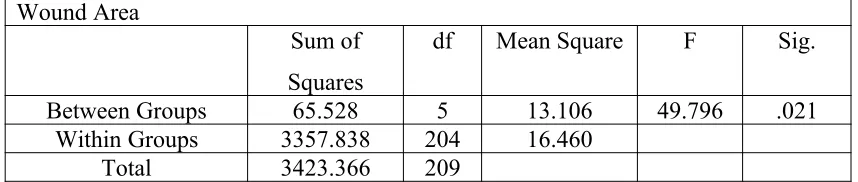
Table 2. ANOVA test Wound Area
Sum of Squares
df Mean Square F Sig.
Between Groups 65.528 5 13.106 49.796 .021
Within Groups 3357.838 204 16.460
Total 3423.366 209
Table 2 above showed that value of sig-p = 0.021 was smaller than 0.05. It meant thatSenna Alata leaves’ extract significantly affected the wound area. The application of Senna Alataleaves extraction based on concentration successfully narrowed wound area significantly. In other words, Senna Alataleaves’ extract was effective to regenerate burn on Wistar rats’ skin. Moreover, Tukey test was conducted to identify the how much Senna Alata leaves’ extract concentration that effectively regenerated burn. The results as follow:
Table 3. Results of Tukey test between wound area and treatment concentration
Treatment N Subset for Alpha = .05
1
60% 35 16.5486
50% 35 17.0529
K - 35 17.4843
95% 35 15.5014
25% 35 17.5743
K + 35 18.3914
Sig. 35 .405
Means for groups in homogeneous subsets are displayed Uses harmonic mean sample size = 35.000
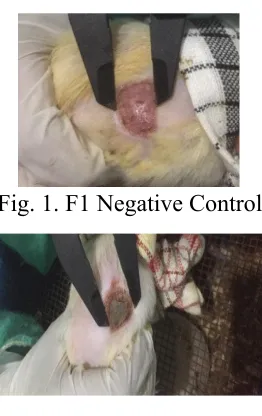
Fig. 1. F1 Negative Control Fig. 2. F2 Positive Control
Fig. 3. F3 25% Concentration Fig. 4. F4 50% Concentration
Fig. 5. F5 60% Concentration Fig. 6. F6 95% Concentration
Discussion
It also similar to the study written by Mahmudah et al, entitled, “Uji Efektivitas Ekstrak Etanol pada Daun Ketepeng Cina (Cassia Alata L) terhadap Mikroba Penyebab Sariawan (Stomatitis Aphtosa)”. This study showed that flavonoid in Senna Alata leaves could inhibit the bacterial growth that caused sprue identified by the decrease of bacteria colony. The higher the
extract’s concentration, the lower the amount of the bacteria colony(6). Some chemical substance
in Senna Alata leaves extract that could inhibit bacteria or fungus growth were; tannin, rein aloe-emodine, rein aloe-emodina-diantron, chrysophanic acid, alkaloid, saponin, flavonoid and gulcoside antraxion. Generally, pharmacologic effect of Senna Alata leaves was functioned as
laxative, worm medicine, itching remover, and skin abnormalities caused by skin parasites(4).
Conclusion
Based on the experiment result, it could be concluded that Senna Alata leaves’ extract (Cassia alata L) had significant effect toward burn healing in Wistar rats (Rattus norvegicus), either based on the treatment time or treatment concentration. Moreover, the most optimal concentration treatment in healing burn was using 95% concentration of Senna Alata leaves’ extract with thewound area for 15.50, smallest from the other concentrations.
Conflict of Interest
Authors declares there is no conflict of interest
References
1. Nina R. Efek Penyembuhan Luka Bakar Dalam Sediaan Gel Ekstrak Etanol 70% Daun
Lidah Buaya (Aloe Vera L.) pada Kulit Punggung Kelinci New Zealand. Skripsi. Fakultas Farmasi Universitas Muhammadiyah Surakarta. Surakarta; 2008.
2. Sjamsuhidajat D J. Buku Ajar Ilmu Bedah. Jakarta: EGC; 2017.
3. Wasito H. Meningkatkan Peran Perguruan Tinggi melalui Pengembangan Obat
Tradisional. MIMBAR Vol. XXIV (2), 2008; 117-127.
4. Hariana A. Tumbuhan Obat dan Khasiatnya. Penebar Swadaya; Jakarta; 2008.
5. Hujjatunaini, N. Uji Potensi Ekstrak Daun Ketepeng Cina (Cassia alata L) terhadap