Figure 7.0-2
Chapter 7: Big Ideas
An Introduction to Photosynthesis
The Light Reactions: Converting Solar Energy
to Chemical Energy
7.1 Photosynthesis fuels the biosphere
• Plants are autotrophs, which
• sustain themselves,
• do not usually consume organic molecules derived from other organisms, and
• make their own food through the process of
7.1 Photosynthesis fuels the biosphere
• Photoautotrophs use the energy of light to
produce organic molecules.
• Chemoautotrophs are prokaryotes that use
inorganic chemicals as their energy source.
• Heterotrophs are consumers that feed on plants
7.1 Photosynthesis fuels the biosphere
• Photoautotrophs
• feed us,
• clothe us (think cotton),
• house us (think wood), and
7.1 Photosynthesis fuels the biosphere
• Photosynthesis in plants takes place in chloroplasts.
• Photosynthetic bacteria have infolded regions of
7.2 Photosynthesis occurs in chloroplasts in
plant cells
• Chlorophyll
• is an important light-absorbing pigment in chloroplasts,
• is responsible for the green color of plants, and
7.2 Photosynthesis occurs in chloroplasts in
plant cells
• Chloroplasts are concentrated in the cells of the
mesophyll, the green tissue in the interior of the
leaf.
• Stomata are tiny pores in the leaf that allow
• carbon dioxide to enter and
• oxygen to exit.
Figure 7.2-0
Leaf Cross Section Mesophyll
Leaf Vein
Mesophyll Cell
CO2
O2
Stoma
Chloroplast
Granum
Inner and outer membranes
7.2 Photosynthesis occurs in chloroplasts in
plant cells
• Chloroplasts consist of an envelope of two
membranes, which encloses an inner compartment filled with a thick fluid called stroma that contains a system of interconnected membranous sacs
7.2 Photosynthesis occurs in chloroplasts in
plant cells
• Thylakoids
• are often concentrated in stacks called grana and
• have an internal compartment called the thylakoid space, which has functions analogous to the
7.2 Photosynthesis occurs in chloroplasts in
plant cells
• Thylakoid membranes also house much of the
machinery that converts light energy to chemical energy.
• Chlorophyll molecules
• are built into the thylakoid membrane and
Figure 7.2-2
Mesophyll Cell
Chloroplast
Granum
Inner and outer membranes
7.4 Photosynthesis is a redox process, as is
cellular respiration
• Photosynthesis, like respiration, is a redox (oxidation-reduction) process.
• CO2 becomes reduced to sugar as electrons, along with hydrogen ions (H+) from water, are added to it.
Figure 7.4a
Becomes reduced
Becomes oxidized
7.4 Photosynthesis is a redox process, as is
cellular respiration
• Cellular respiration uses redox reactions to harvest the chemical energy stored in a glucose molecule.
• This is accomplished by oxidizing the sugar and reducing O2 to H2O.
• The electrons lose potential as they travel down the electron transport chain to O2.
7.4 Photosynthesis is a redox process, as is
cellular respiration
• In photosynthesis,
• light energy is captured by chlorophyll molecules to boost the energy of electrons,
• light energy is converted to chemical energy, and
Figure 7.4b
C6H12O6 + 6 O2 6 CO2 + 6 H2O
7.5 The two stages of photosynthesis are
linked by ATP and NADPH
• Photosynthesis occurs in two stages.
1. The light reactions occur in the thylakoid membranes. In these reactions
• water is split, providing a source of electrons and giving off oxygen as a by-product,
• ATP is generated from ADP and a phosphate group, and
• light energy is absorbed by the chlorophyll molecules to drive the transfer of electrons and H+ from water to the
electron acceptor NADP+, reducing it to NADPH.
7.5 The two stages of photosynthesis are
linked by ATP and NADPH
2. The second stage is the Calvin cycle, which occurs
in the stroma of the chloroplast.
• The Calvin cycle is a cyclic series of reactions that
assembles sugar molecules using CO2 and the energy-rich products of the light reactions.
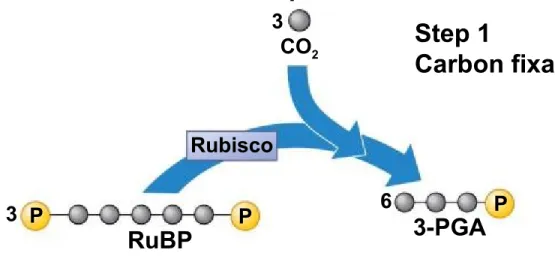
• During the Calvin cycle, CO2 is incorporated into organic compounds in a process called carbon fixation.
• After carbon fixation, the carbon compounds are reduced to sugars.
Figure 7.5-3
Light
Chloroplast
Light Reactions (in thylakoids)
NADP+
ADP
H2O
P
+
ATP
NADPH
O
CO2
Calvin Cycle (in stroma)
THE LIGHT REACTIONS:
7.6 Visible radiation absorbed by pigments
drives the light reactions
• Sunlight contains energy called electromagnetic
energy or radiation.
• Visible light is only a small part of the
electromagnetic spectrum, the full range of electromagnetic wavelengths.
• Electromagnetic energy travels in waves.
7.6 Visible radiation absorbed by pigments
drives the light reactions
• Light behaves as discrete packets of energy called
photons.
• A photon is a fixed quantity of light energy.
Figure 7.6a
Shorter wavelength Longer wavelength
Lower energy Higher energy
Visible light
Wavelength (nm)
380 400 500 600 700 750
Gamma
rays X-rays UV Infrared
Micro-waves
Radio waves
7.6 Visible radiation absorbed by pigments
drives the light reactions
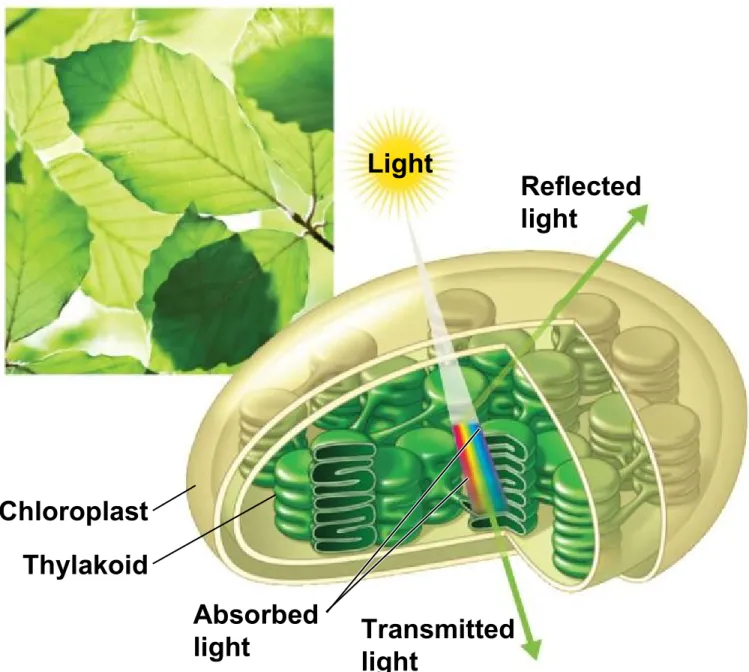
• Plant pigments
• are built into the thylakoid membrane,
• absorb some wavelengths of light, and
• reflect or transmit other wavelengths.
• We see the color of the wavelengths that are
Figure 7.6b-0
Light
Reflected light
Transmitted light
Absorbed light
7.6 Visible radiation absorbed by pigments
drives the light reactions
• Chloroplasts contain several different pigments, which absorb light of different wavelengths.
• Chlorophyll a absorbs mainly blue-violet and red light and reflects mainly green light.
• Chlorophyll b absorbs mainly blue and orange and
reflects (appears) olive-green.
• Carotenoids
• broaden the spectrum of colors that can drive photosynthesis and
7.7 Photosystems capture solar energy
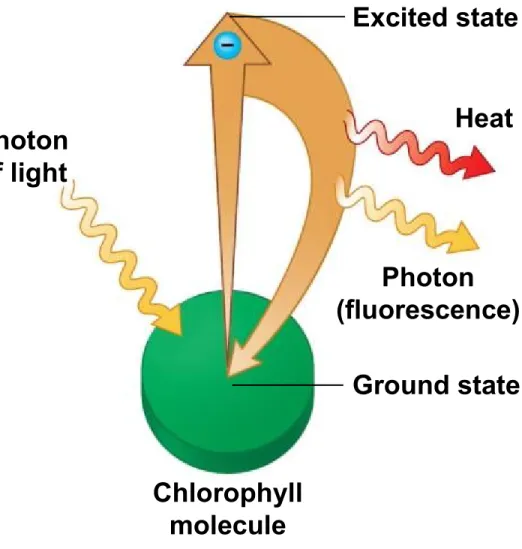
• Pigments in chloroplasts absorb photons
(capturing solar power), which
• increases the potential energy of the pigments’ electrons and
• sends the electrons into an unstable state.
• Generally, when isolated pigment molecules
absorb light, their excited electrons drop back
Figure 7.7a-0
Excited state
Heat Photon
of light
Chlorophyll molecule
7.7 Photosystems capture solar energy
• Within a thylakoid membrane, chlorophyll and
other pigment molecules
• absorb photons and
• transfer the energy to other pigment molecules.
• In the thylakoid membrane, chlorophyll molecules
7.7 Photosystems capture solar energy
• A photosystem consists of a number of
light-harvesting complexes surrounding a reaction-center complex.
• A light-harvesting complex contains various
pigment molecules bound to proteins.
Figure 7.7b Light STROMA Light-harvesting complexes Photosystem Reaction-center complex Primary electron acceptor THYLAKOID SPACE Transfer of energy Pair of
chlorophyll a
7.7 Photosystems capture solar energy
• The light energy is passed from molecule to
molecule within the photosystem.
• Finally it reaches the reaction center, where a
primary electron acceptor accepts these electrons and consequently becomes reduced.
• The solar-powered transfer of an electron from the reaction-center chlorophyll a pair to the primary
electron acceptor is the first step in the
7.7 Photosystems capture solar energy
• Two types of photosystems (photosystem I and
photosystem II) cooperate in the light reactions.
• Each photosystem has a characteristic
reaction-center complex, with a special pair of chlorophyll a
7.8 Two photosystems connected by an
electron transport chain generate ATP and
NADPH
• In the light reactions, light energy is transformed into the chemical energy of ATP and NADPH.
• To accomplish this, electrons are
• removed from water,
• passed from photosystem II to photosystem I, and
• accepted by NADP+, reducing it to NADPH.
• Between the two photosystems, the electrons
• move down an electron transport chain and
7.8 Two photosystems connected by an
electron transport chain generate ATP and
NADPH
• A simple mechanical analogy helps unpack this
rather complicated system.
• This construction analogy shows how the coupling
Figure 7.8
ATP
NADPH
Electron transport
chain ramp hP
o to n
Ph oto
n
7.9 VISUALIZING THE CONCEPT: The light
reactions take place within the thylakoid
membranes
• A thylakoid membrane includes numerous copies
of
• the two photosystems and
7.9 VISUALIZING THE CONCEPT: The light
reactions take place within the thylakoid
membranes
• Light energy absorbed by the two photosystems
drives the flow of electrons from water to NADPH.
• The electron transport chain helps to produce the
concentration gradient of H+ across the thylakoid
membrane, which drives H+ through ATP synthase,
producing ATP.
• Because the initial energy input is light (“photo”),
this chemiosmotic production of ATP is called
Figure 7.9-0 Thylakoid sac Light Photosystem II H+ H+ H+ H+ H+ H+ H+ Electron transport chain Light Photosystem I H+
H2O
H+
H+ H + H+ H+ H+ H+ H+ H+ H+ H+ H+ H+ H+ THYLAKOID SPACE
O2 + 2
1 2
NADP++ H+
NADPH To Calvin Cycle Chloroplast STROMA H+ H+
Figure 7.9-1
Light
Photosystem
II
Primary electron acceptor Pigment molecules
Reaction center pair of
chlorophyll a molecules
H2O
O2 + 2 H+
Figure 7.9-5
Light
Photosystem
II
H2O
O2 + 2 H+
1 2 1 Electron transport chain H+ H+ H+ H+ H+ H+ H+ H+ Light Photosystem I H+ H+ H+ H+ H+ NADP+ NADPH To Calvin Cycle H+ H+ THYLAKOID SPACE STROMA Thylakoid membrane H+ ATP synthase H+ H+ H+ H+ H+
H+ H
+ H
+
H+ H+
P ATP
THE CALVIN CYCLE:
7.10 ATP and NADPH power sugar synthesis
in the Calvin cycle
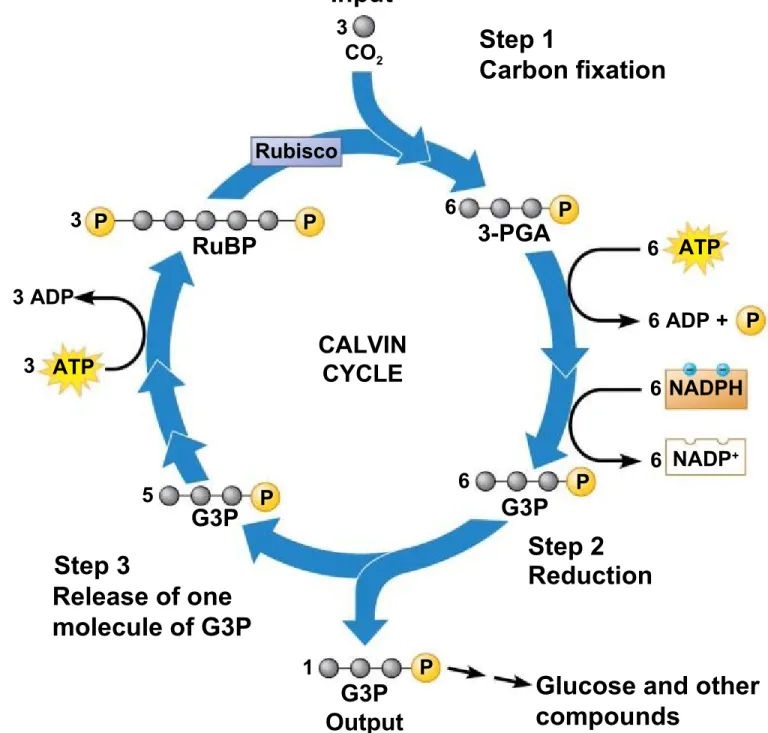
• The Calvin cycle makes sugar within a chloroplast.
• To produce sugar, the necessary ingredients are
• atmospheric CO2 and
7.10 ATP and NADPH power sugar synthesis
in the Calvin cycle
• The Calvin cycle uses these three ingredients to
produce an energy-rich, three-carbon sugar called glyceraldehyde 3-phosphate (G3P).
• A plant cell uses G3P to make
• glucose,
• the disaccharide sucrose, and
7.10 ATP and NADPH power sugar synthesis
in the Calvin cycle
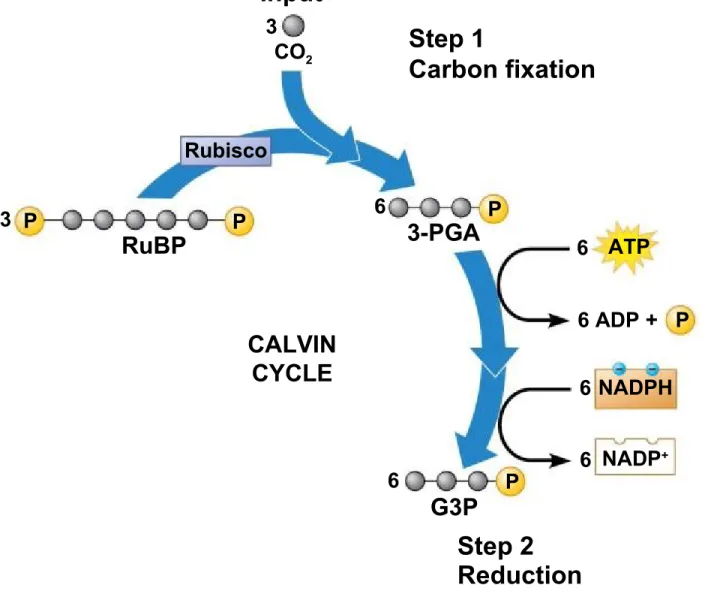
• The steps of the Calvin cycle include
• carbon fixation,
• reduction,
• release of one molecule of G3P, and
• regeneration of the starting molecule, ribulose bisphosphate (RuBP).
• Photosynthesis is an emergent property of the
Figure 7.10-1
Chloroplast
O2 Sugar
Light
Light
Reactions CalvinCycle CO2 H2O
NADP+
ADP P +
Figure 7.10-2 Step 4 Regeneration of RuBP 3 P P RuBP 3 ATP 3 ADP Rubisco 5 G3P 1 Step 3
Release of one molecule of G3P
Glucose and other Step 2 Reduction G3P 6 P P P P CALVIN CYCLE 6 6 ATP
6 ADP + P
Figure 7.10-3-1
3 P
RuBP
Rubisco
P 6 3-PGA P
3 CO2
Input
Step 1
Carbon fixation
Figure 7.10-3-2
3 P
RuBP
Rubisco
P 6 3-PGA P
3 CO2 Input Step 1 Carbon fixation CALVIN CYCLE Step 2 Reduction G3P 6 P 6 ATP
6 ADP + P
6
6
NADPH
Figure 7.10-3-3
3 P
RuBP
Rubisco
P 6 3-PGA P
3 CO2 Input Step 1 Carbon fixation CALVIN CYCLE Step 2 Reduction G3P 6 P 6 ATP
6 ADP + P
6 6 NADPH NADP+ P 5 G3P 1 G3P Step 3
Release of one molecule of G3P
Glucose and other
Figure 7.10-3-4
3 P
RuBP
Rubisco
P 6 3-PGA P
3 CO2 Input Step 1 Carbon fixation CALVIN CYCLE Step 2 Reduction G3P 6 P 6 ATP
6 ADP + P
6 6 NADPH NADP+ P 5 G3P 1 Step 3
Release of one molecule of G3P
Glucose and other
7.11 EVOLUTION CONNECTION: Other
methods of carbon fixation have evolved in
hot, dry climates
• Most plants use CO2 directly from the air, and
carbon fixation occurs when the enzyme rubisco
adds CO2 to RuBP.
• Such plants are called C3 plants because the first product of carbon fixation is a three-carbon
7.11 EVOLUTION CONNECTION: Other
methods of carbon fixation have evolved in
hot, dry climates
• In hot and dry weather, C3 plants close their
stomata to reduce water loss, but this prevents CO2 from entering the leaf and O2 from leaving.
• As O2 builds up in a leaf, rubisco adds O2 instead of CO2 to RuBP, and a two-carbon product of this
reaction is then broken down in the cell.
• This process is called photorespiration because it occurs in the light, consumes O2, and releases CO2.
7.11 EVOLUTION CONNECTION: Other
methods of carbon fixation have evolved in
hot, dry climates
• An alternate mode of carbon fixation has evolved
that
• minimizes photorespiration and
• optimizes the Calvin cycle.
• C4 plants are so named because they first fix CO2
into a four-carbon compound.
• When the weather is hot and dry, C4 plants keep their stomata mostly closed, thus conserving
7.11 EVOLUTION CONNECTION: Other
methods of carbon fixation have evolved in
hot, dry climates
• Another adaptation to hot and dry environments
has evolved in the CAM plants, such as pineapples, cacti, aloe, and jade.
• CAM plants conserve water by opening their
stomata and admitting CO2 only at night.
• CO2 is fixed into a four-carbon compound, which
Figure 7.11-0
Mesophyll cell
Bundle-sheath cell
Sugarcane Pineapple
Day CAM plant Sugar Sugar
C4 plant Calvin
Cycle
Calvin Cycle
CO2 Night CO2
4-C compound
4-C compound
7.12 Photosynthesis makes sugar from CO
2and H
2O, providing food and O
2for almost all
living organisms
• Two photosystems in the thylakoid membranes
capture solar energy, energizing electrons in chlorophyll molecules.
• Simultaneously,
• water is split,
• O2 is released, and
7.12 Photosynthesis makes sugar from CO
2and H
2O, providing food and O
2for almost all
living organisms
• The photoexcited electrons are transferred through
an electron transport chain, where energy is harvested to make ATP by the process of
chemiosmosis, and finally to NADP+, reducing it to
Figure 7.12
Chloroplast
O2 Sugars
Light Light Reactions Calvin Cycle (in stroma) CO2
H2O
NADP+ ADP P + NADPH ATP RuBP G3P Stroma
Photosystem II
Electron transport chain
Thylakoids Photosystem I
7.12 Photosynthesis makes sugar from CO
2and H
2O, providing food and O
2for almost all
living organisms
• About 50% of the carbohydrates made by
photosynthesis is consumed as fuel for cellular respiration in the mitochondria of plant cells.
• Sugars also serve as the starting material for
making other organic molecules, such as proteins, lipids, and cellulose.
• Many glucose molecules are linked together to
7.12 Photosynthesis makes sugar from CO
2and H
2O, providing food and O
2for almost all
living organisms
• Most plants make much more food each day than
they need. They store the excess in
• roots,
• tubers,
• seeds, and
• fruits.
• Plants (and other photosynthesizers) are the
7.13 SCIENTIFIC THINKING: Rising
atmospheric levels of carbon dioxide and
global climate change will affect plants in
various ways
• The greenhouse effect operates on a global scale.
• Solar radiation passes through the atmosphere and warms Earth’s surface.
• Heat radiating from the warmed planet is absorbed by greenhouse gases, such as CO2, water vapor, and methane, which then reflect some of the heat back to Earth.
7.13 SCIENTIFIC THINKING: Rising
atmospheric levels of carbon dioxide and
global climate change will affect plants in
various ways
• Increasing concentrations of greenhouse gases
have been linked to global climate change, of
7.13 SCIENTIFIC THINKING: Rising
atmospheric levels of carbon dioxide and
global climate change will affect plants in
various ways
• The predicted consequences of global climate
change include
• melting of polar ice, • rising sea levels,
• extreme weather patterns,
• droughts,
• increased extinction rates, and • the spread of tropical diseases.
7.13 SCIENTIFIC THINKING: Rising
atmospheric levels of carbon dioxide and
global climate change will affect plants in
various ways
• How may global climate change affect plants?
• Increasing CO2 levels can increase plant productivity.
• Research has documented such an increase,
7.13 SCIENTIFIC THINKING: Rising
atmospheric levels of carbon dioxide and
global climate change will affect plants in
various ways
• How do scientists study the effects of increasing CO2 on plants?
• Many experiments are done in small growth chambers in which variables can be carefully controlled.
• Other scientists are turning to long-term field
7.13 SCIENTIFIC THINKING: Rising
atmospheric levels of carbon dioxide and
global climate change will affect plants in
various ways
• In the Free-Air CO2 Enrichment (FACE) experiment
set up in Duke University’s experimental forest, scientists monitored the effects of elevated CO2
levels on an intact forest ecosystem over a period of 15 years, using six study sites, each 30 m in
7.13 SCIENTIFIC THINKING: Rising
atmospheric levels of carbon dioxide and
global climate change will affect plants in
various ways
• Another study compared the growth of poison ivy
in experimental and control plots. The results
showed that poison ivy in the elevated CO2 plots
• showed an average annual growth increase of 149% compared to control plots and
• produced a more potent form of poison ivy’s
Figure 7.13b
Control plots Key
Elevated CO2 plots
Year
Source: Adaptation of Figure 1A from “Biomass and Toxicity Responses of Poison Ivy (Toxicodendron Radicans) to Elevated Atmospheric CO2” by Jacqueline E. Mohan, et al., from PNAS, June 2006, Volume 103(24). Copyright © 2006 by National Academy of
7.14 Scientific research and international
treaties have helped slow the depletion of
Earth’s ozone layer
• Solar radiation converts O2 high in the atmosphere to ozone (O3), which shields organisms from
damaging UV radiation.
• A gigantic hole in the ozone layer has appeared
Figure 7.14a
September 2012 Southern
tip of South America
7.14 Scientific research and international
treaties have helped slow the depletion of
Earth’s ozone layer
• Industrial chemicals called CFCs have caused
dangerous thinning of the ozone layer.
• This destruction of the ozone layer was
documented by scientists from the British Antarctic Survey, NASA, and National Oceanic and
7.14 Scientific research and international
treaties have helped slow the depletion of
Earth’s ozone layer
• In response to these scientific findings, the first treaty to address Earth’s environment was signed in 1987.
• As research continued to establish the extent and
7.14 Scientific research and international
treaties have helped slow the depletion of
Earth’s ozone layer
• In 1995, Molina and Rowland shared a Nobel Prize
for their work in determining how CFCs were damaging the atmosphere.
• Global emissions of CFCs are near zero now, but
because these compounds are so stable, recovery of the ozone layer is not expected until around
2060.
• Meanwhile, unblocked UV radiation is predicted to
Figure 7.UN03 (a) (b) (c) (d) (e) (f) (g) (h) converts includes both in which Photosynthesis chemical energy
H2O is split light-excitedelectrons of chlorophyll
CO2 is fixed to RuBP 3-PGA is reduced are passed down in which to and producing to produce by chemiosmosis Reduce
NADP+ to
using
Figure 7.UN04
Mitochondrion
Intermembrane space
Membrane
Matrix
a. b.
Chloroplast
H+ c.
d.