
| | 227 © ARCHIVES OF BUDO | SCIENCE OF MARTIAL ARTS
Gender differences in preferences of martial arts in
Polish adolescents
Michal Kudláček
1ABCD, Karel Frömel
1BCE, Dorota Groffik
2B1
Faculty of Physical Culture, Palacký University, Olomouc, Czech Republic
2
Academy of Physical Education, Katowice, Poland
Source of support: The research was supported by the Czech Science Foundation – research project “Objectification
of comprehensive monitoring of school mental and physical strain in adolescents in the context of physical and mental
condition” (No. 13-32935S).
Received: 09 October 2014; Accepted:
26 June 2015;
Published online:
10 July 2015
ICID: 1161010
Abstract
Background & Study Aim:
The prevalence of physical activity (PA) depends greatly on the options of executing preferable and favorite PA. Objective information about individual preferences in types of PA can support successful integration of adolescents into regular participation in PA. Defining the role of martial arts in regard to girls’ and boys’ sport preferences is a permanent problem that requires objective and continuous diagnostics. The aim of the study is the relationship among girls’ and boys’ preferences in martial arts and further among these preferences and PA participation.Material & Methods:
Online research was conducted in Katowice region and 518 boys and 559 girls at the age from 15 to 17 years participated. All high schools in the region were called for participation, but only schools that allowed the re-search examination participated. Sport preferences survey that participants completed online via INDARES system was used to diagnose preferences in individual and team sports. The results were analyzed using basic statistical procedures, nonparametric correlational analysis, and Mann-Whitney test.Results:
The structure of martial arts preferences is stable without any radical changes throughout the time. Among the first top five activities in girls are: karate, box, judo, kick-box and aikido; in boys: box, kick-box, karate, judo, and wrestling. Top five martial arts correlate with the nature of masculine and feminine sense of life. There is a strong positive correlation among the preferences of martial arts regarding gender across all age groups: 15 years old (rs = .850; p < .001 ), 16 years old (rs = .833; p < .001) and relatively strong correlation also among 17 years old (rs = .733; p < .001).Conclusions:
Polish version of the online system INDARES is a suitable diagnostic tool for the examination of sport pref-erences sphere in adolescents. Understanding gender diffpref-erences in sport prefpref-erences of adolescents can in-crease their participation in organized PA.Keywords: combat sports, INDARES system, interest, online research, type of physical activity
Author’s address: Michal Kudláček, Faculty of Physical Culture, Palacký University, tř. Míru 115, 771 11 Olomouc, Czech Republic; e-mail: [email protected]
Authors’ Contribution: A Study Design
B Data Collection
C Statistical Analysis
D Manuscript Preparation
E Funds Collection
228 | VOLUME 11 | 2015 www.archbudo.com introduction
Character and preferences of various types of phys-ical activity (PA) of adolescents vary greatly in differ-ent educational systems and socio-cultural conditions. The biggest differences are then found between girls and boys [1]. That is related to the sound differences in social-ization and upbringing of both genders [2]. Children embrace behavioral traits that are perceived by society as “typical” for particular gender and when they enter the first grade in the elementary school they already express behavioral patterns appropriate for the masculine or fem-inine stereotype. It is also the result of more or less suc-cessful socialization in the particular culture [3, 4].
Since girls are less physically active than boys [5, 6], it is more than important to understand the specifics of PA in girls (but also boys) and their preferences. Understanding these specifics can increase the effec-tiveness of potential interventions in physical pro-grams (school, public) that were created in attempt to support PA in children and adolescents [7].
Current educational polish system (similarly to sys-tems of other post communist countries), in spite of attempts for change, is suited better for feminine types of behavior where teachers demand especially discipline, subordination, behavioral control, focus, willingness to submit to leadership, etc. Consequently many teachers still prefer rigid, conformal, respect-able, thoughtful, passive, calm, and neat students rather than students who are nonconformist, flexible, active, independent, and so on. Preferable character-istics have predominantly feminine traits.
Decreasing differences between feminine and mascu-line sports is to certain degree a result of social phi-losophy of activists/reformers who try to declassify traditional sports to the masses of women and also a result of feminists’ critique of positivistic traditions in sport psychology [8, 9]. Formerly women were neglected in sports and the majority of studies were conducted only with masculine population. Currently it seems appropriate to conduct comparative studies or only studies with feminine population. There was also a trend to look at masculine and feminine sports as on two distinct units that were absolutely unrelated. However, the reason for that was spurious (physiolog-ical rightfulness, series of similarities, etc.). Therefore, it suggests itself that these two units should be unified and only certain specifics that are particular for males or females should be set aside [9, 10].
Everyday activities of children and adolescents rep-resent important developmental opportunities that
serve as a tool for socialization and cultural knowledge and skills acquisition. Young population selects vari-ous activities to actively engage in, activities that can and often do create their lifestyle and habits associated with it. Identification of the activities preferred by boys and girls is important especially because various activi-ties can enhance different cognitive, social, and motor skills and moreover because these gender-related inter-ests/preferences change with age. Boys incline more to intense activities, activities that are more physically demanding and team sports while girls incline to par-ticipate in sedentary activities, individual sports, and uncompetitive sport activities [11, 12]. Cherney et al. [13] in their study emphasized the fact that gen-der related preferences are present across all domains of human life (including PA) and that differences are more evident in younger individuals.
In the interest of strengthening the role of phys-ical education (PE) at schools PE teachers should respect students’ preferences and needs when choos-ing activities for particular educational units [14, 15]. PE can more likely survive and increase its prestige if the activities preferred by both boys and girls are included in the educational PE units. There are many factors that can influence students’ selection or pref-erences of sport activities. These include sport and environmental influence, gender, age, skill level and individual’s level of PA outside the school [16–18].
Bradley et al. [11] indicate that girls at high schools prefer uncompetitive or individual sport activities, while boys at the same age incline to team sports. [17] further indicate that adolescent girls participate more often in individual or noncontact sport activi-ties such as swimming, volleyball, aerobics, gymnas-tics, and jumping rope, while boys more often choose contact or power sports such as working out, hockey, or soccer. Research done with high school students shows that boys prefer to participate in physical activ-ities that give them the opportunity to experience competition, while girls focus more on social param-eters of physical activities [14].
The purpose of the present study is the relationships among boys’ and girls’ preferences in martial arts and further among these preferences and boys’ and girls’ participation in an organized PA.
materialandmethods
Data description
Online research was conducted in Katowice region and 2199 students participated in the study (Table 1). Aikido – a Japanese art of
self-defense employing locks and holds and utilizing the principle of nonresistance to cause an opponent’s own momentum to work against him; a modern, non-violent martial art that was developed early in the 20th century; it is effective as
a martial art but its essence goes beyond the resolution.
Box – the sport or practice
of fighting with the fists, especially with padded gloves in a roped square ring according to prescribed rules (the Queensberry Rules); the goals have been to weaken and knock down the opponent.
Judo – is a modern martial art,
combat sport created in Japan; its most prominent feature is its competitive element, where the objective is to either throw or takedown an opponent to the ground, immobilize or otherwise subdue an opponent with a pin, or force an opponent to submit with a joint lock or a choke.
Karate – a martial art developed
in Japan under the influence of Chinese martial arts, particularly Fujian White Crane; karate is now predominantly a striking art using punching, kicking, knee strikes, elbow strikes and open hand techniques such as knife-hands, spear-knife-hands, and palm-heel strikes.
Kick-box – a group of stand-up
combat sports based on kicking and punching, historically developed from karate, Thai-box, taekwondo and boxing; it is practices for self-defense, general fitness, or as a contact sport.
Thai-box – a combat sport
of Thailand that uses stand-up striking along with various clinching techniques; the physical and mental discipline which includes combat on shins is known as “the art of eight limbs” because it is characterized by the combined use of fists, elbows, knees, shins, being associated with a good physical preparation.
Kung-fu – a Chinese term
referring to any study, learning, or practice that requires patience, energy, and time to complete, often used in the West to refer to Chinese martial arts
All high schools in the region were invited to partici-pate but only individuals from the schools that agreed with the research participated. All participants gave researchers their consent to participate in the study and to complete a sport preferences questionnaire.
Sport preferences questionnaire
A sport preferences questionnaire that partici-pants completed via the online system INDARES (www.indares.com) was used to determine the prefer-ences in individual and team sports. The questionnaire includes seven groups of sport activities: individual sports, team sports, conditional activities, water sport activities, outdoor sport activities, martial arts, rhyth-mical and dancing activities. Only results from the groups of individual and team sports were used in the study. Furthermore, overall preferences related to par-ticular groups of sports activities were used.
In regard to standardization of the questionnaire, sta-bility was tested using the test-retest and Spearman correlational coefficient (rs). The closest results between the first and the second measurements were in the group of team sports (0.81, 0.76 respectively). The biggest range was then recorded for the group of rhythmical and dancing activities and martial arts (0.62, 0.68 respectively for Rhythmical and dancing activities; 0.68, 0.61 respectively for martial arts) [19].
Procedures
Data were collected in computer labs in selected schools. Participants completed the questionnaire in the online system while supervised always by the same members of the research team in order to secure the identical introductory information for research com-pletion. Participants’ questioned only the differentia-tion of organized and unorganized PA in reladifferentia-tion to teachers’, coaches’, instructors’ etc. leadership.
The completion of the sport preferences question-naire includes several steps. First, it is examined, whether participants engage in an organized PA or not. Then, researchers investigate in which activities students participate the most during summer and winter. The subsequent forms already contain par-ticular groups of PA and participants are asked to select up to 5 activities from the offered lists. They are asked to arrange the activities in a descending order starting with their most favorite activity. There is no required number of activities they have to enter so in extreme case it can happen that there will be no activities recorded for a particular group. The system will notify the user, but will not require a response. This way participants record individual sports, team sports, conditional activities, water sport activities, outdoor sport activities, martial arts, rhythmical and dancing activities. The last form is dedicated to the groups in general and to the selection of the overall most favorite activity.
Data analysis is conducted in several steps. First, researchers set up point values for particular PA. If PA was entered by a participant, its point value equals to the position of that PA in the participant’s ranking. If the participant did not record any activity within a particular group, its value has to be counted accord-ing to the followaccord-ing formula:
(PAS + PZAS + 1) / 2
where:
PAS stands for the overall number of activities in a particular group;
PZAS stands for the number of activities that were recorded by a participant in the group.
Musado – is a modern martial
art which is divided into two branches: the traditional musado destined for civil persons and the Musado MCS (Military Combat System) destined for the army and the police; the term musado (from Korean language) means “the way of warrior”. Nevertheless, the musado is a German martial art, based on the Korean arts.
Taekwondo – a Korean martial
art with a heavy emphasis on head-height kicks, jumping and spinning kicks, and fast kicking techniques; taekwondo was developed ruing the 1940s and 1950s by various Korean martial artists, as a blend of the indigenous Korean fighting styles.
Wrestling – a competition in
which two people try to pin the other person to the ground; striking is not allowed; wrestlers use throws, takedowns, and trips to get their opponents to the ground. Wrestling is a popular and effective base for fighters in mixed martial arts competitions.
Table 1 Sample characteristics
Characteristics
Boys
(n=1095) (n=1104)Girls
M SD M SD
Age (Years) 15.87 1.42 16.00 1.78
Weight (kg) 69.41 13.19 56.70 9.51
Height (cm) 178.39 8.56 167.14 6.05
BMI (kg·m-2) 21.86 3.44 20.81 3.02
Organized PA (hours) 5.23 5.31 3.36*** 3.51 Organized PA (participation %) 82.5 - 7.1
-Note. PA – Physical activity ***p< .001
230 | VOLUME 11 | 2015 www.archbudo.com The next step is matching the point value with the
sports group using the same principle as for the indi-vidual activities. Therefore, the most favorite PA, respectively sports groups, have the lowest values in the overall summary.
An evaluation of the most favorite activity follows. That makes sense especially for a larger group of par-ticipants. Votes for particular activities are added up and at the end researchers create a ranking of activi-ties that were mentioned most frequently.
The last step is an evaluation of PA characteristics. A list of 39 characteristics that may specify partic-ipants’ personal traits according to the selected PA was created. A team of specialists further processed a table where point values of all characteristics were specified for each activity. The range of the values is 1 to 5, decimal numbers can be used. Value 1 means a high integration of the particular characteristic in PA while value 5 means the lowest integration of the particular characteristic.
Only activities that were placed on the first position in the ranking for a particular group were added to the computation of the overall values in certain character-istics. In case there were no PA in some groups, aver-ages of the characteristics from the recorded groups were computed and added to the overall point values. To refine the computation and to enable a compar-ison of individual characteristics among each other, researchers also included an overall characteristic point power. Point value for the characteristics is thus adjusted with the following formula:
(SZB / CBC) * 100
where:
SZB is an overall value of obtained points for given characteristic;
CBC is an overall computation of point characteris-tics for all PA.
Therefore, the final table enables us to observe which characteristics within physical activities are pre-ferred by an individual, eventually the whole group. Characteristics with the lowest number of points are the most preferred ones, while those with the highest values are represented in a selected PA less. Eight boys and 7 girls had to be excluded from the study during data analysis because they did not correctly indicate their somato-metric indicators or age.
Data analysis
For statistical analysis in Statistica CZ 9 and SPSS 19.0 we used basic statistical procedures, Mann-Whitney U test, Spearman test and coefficient d to evaluate functional significance of the “effect size” [20, 21]. We interpret coefficient d as a small effect size when d<0.2–0; medium effect size when d = 0.2– 0.8; and a large effect size when d<0.8 [20]. One hour of a documented PA is considered to be significantly important in a weekly organized PA.
results
The most preferred martial art in girls is karate and that applies to all age groups (Table 2). The second most popular martial art is box, but it is closely fol-lowed by judo. The acquired differences are mini-mal and there is a potential space for predicting the tendency of the increase of judo popularity. There is aikido as well as kick-box (Thai-box) on the fourth, respectively the fifth position. Aikido can be described as the activity with positive tendency (increase of the popularity), while kick-box (Thai-box) with the neg-ative tendency (decrease of the popularity).
Among the least preferred martial activities are tae-kwondo and musado.
The most preferred martial arts among the boys of all age groups are box and kick-box (Thai-box). There is a visible decrease of the karate popularity, as well as decrease of the wrestling popularity. Meanwhile, there is a visible increase of the popularity – positive ten-dency – of aikido.
There is a strong positive correlation among the pref-erences of martial arts regarding gender across all age groups: 15 years old (rs = 0.850; p<0.001), 16 years old (rs = 0.833; p<0.001) and relatively strong corre-lation also among 17 years old (rs = 0.733; p0<0.001).
The comparative analysis of all sport groups proved following - among the selected groups of sports boys and girls agreed in preferences of team sports fol-lowed by individual sports (Figure 1). They also corre-sponded in the placement of Outdoor sport activities. The biggest difference in the placement of preferences is recorded in the group of rhythmical and dancing activities, which girls placed on the third place, while boys ranked them last.
Martial arts are ranked on the fifth place among boys, and on the seventh place among girls. In com-parison with other sport categories, we can see the
© ARCHIVES OF BUDO | SCIENCE OF MARTIAL ARTS 2015 | VOLUME 11 | 231 placement of martial arts in the second half of the
preferred activities.
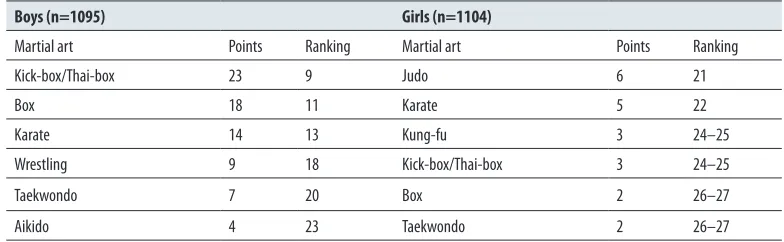
Respondents were also asked to highlight their absolutely most popular sport activity (Table 3). In the overall pop-ularity of each surveyed sport activity (83 activities) we found out following ranking within the martial arts group:
discussion
Taking various age groups into consideration, we are able to anticipate potential development, possibly
the stability of preferred sport activities within the preference structure. This research conducted with the population of polish adolescents indicates gen-der differences and variation in preferences for the group of martial arts.
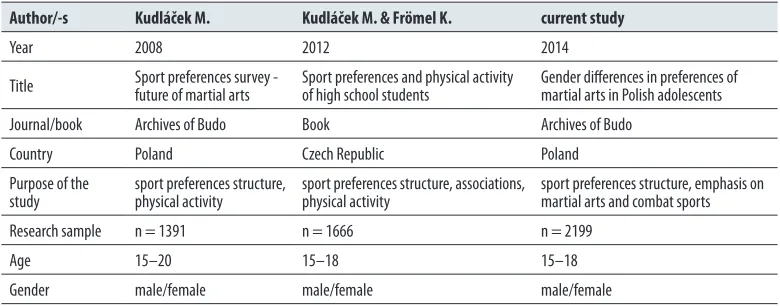
Systematic review of the sport preferences surveys (Table 4) conducted via the same research tool in last six years (2008 and 2014) proved really strong correlation in the structure of preferred martial arts among girls (rs = 0.949; p<0.001), and strong correla-tion among boys (rs = 0.733; p<0.001). We can state
Table 2. Boys’ (n=1095) and girls’ (n=1104) preferences in martial arts
Gender Boys (n=1095) Girls (n=1104)
Age 15 (n=367) 16 (n=388) 17 (n=334) 15 (n=369) 16 (n=464) 17 (n=277) Individual Sports Ranking Points - M Ranking Points Ranking Points Ranking Points Ranking Points Ranking Points
Aikido 7 6.01 5 6.08 5 5.92 5 5.99 4 5.87 4 5.83
Box 1 4.42 1 4.62 2 4.86 2 5.45 2 5.33 3 5.41
Judo 4 5.55 3 5.41 3 5.15 3 5.66 3 5.45 2 5.32
Karate 3 5.36 4 5.58 4 5.39 1 5.26 1 5.14 1 5.21
Kick-box
(Thai-box) 2 4.93 2 4.98 1 4.77 4 5.81 5 5.96 5 6.01
Kung-fu 6 5.98 6 6.19 7 6.31 6 6.04 6 6.09 6 6.13
Musado 9 6.66 9 6.82 8 6.52 9 6.78 9 6.74 9 6.85
Taekwon-do 8 6.04 8 6.46 9 6.86 8 6.26 8 6.37 8 6.44
Wrestling 5 5.6 7 6.31 6 6.12 7 6.4 7 6.22 7 6.30
Note: M average point value for rankings, computed for one participant
Recorded sports also include a variety of executions and kinetically very similar activities
16
Figure 1. Boys’ (n=1095) and girls’ (n=1104) preferences in sport categories
1
2
3
4
5
6
7
Martial arts Individualsports Conditionalactivities
Rhythmical and dancing activities
Outdoor sport
activities Water sportactivities Team sports
Ranking
Boys
Girls
Figure 1. Boys’ (n=1095) and girls’ (n=1104) preferences in sport categories
232 | VOLUME 11 | 2015 www.archbudo.com that the structure of martial arts preferences is stable
without any radical changes throughout the time [22]. Among the first top five activities in girls are: karate, box, judo, box and aikido; in boys: box, kick-box, karate, judo, and wrestling. Top five martial arts correlate with the nature of masculine and feminine sense of life. Boys are much more into the real hard contact activities (box and kick-box on the first two positions), while girls prefer more accurate and pre-cise activities (karate and judo), whose require more skills than hard and rough strength.
The similarity or stability of the preference structure is really high and it can be explained as the unchanged trend within socio-demographic issues, with good proportion and knowledge of children’s and youth preferences of martial arts. This can put more emphasis on those activi-ties which are generally and long-term preferred.
There are lower correlations in the cross-national comparison – Poland and Czech Republic. Based on the results of Kudláček et al. [23], we can state the stronger correlation among girls (rs = 0.683; p<0.001), than among boys (rs = 0.616; p<0.001). It can be caused by different educational system, slightly different cultural settings, social heritage, socio-eco-nomic status, ratio of family affluence scale and tradi-tions. On the other hand, these two countries are not so different, and found differences can be seen only as the limitation of the study, even though the size of both research samples was quite big.
Martial arts closely relate with gymnastics, as the essential activity for moves used in martial arts. We can’t confirm the statement of Hill et al. [17], high-lighting the decreasing tendency in preferences of sports gymnastics with age. If it would be so, those relationships/correlations would not be so strong.
A factor that significantly influences the structure of preferences may be identified especially in the case
of gymnastics. Kudláček [24] explains the prefer-ence structure of Czech population at the same age in his research where adolescents of various ages ranked sports gymnastics last. The factor that shapes personality during socialization since early child-hood is cultural environment and habits. Differences in preferences of sports gymnastics between boys and girls require, especially during co-ed exercises, respect of interest in different gymnastic disciplines and exercises.
Attempts to promote participation in any kind of PA are more effective when they aim at needs and inter-ests (indeed preferences) of particular target groups. Thus it is a systematic approach to the problems of PA in the context of preference sphere. In this regard, schools have a special opportunity to influence and motivate children and adolescents in the field of phys-ical activities and healthy lifestyle.
Regular diagnostics of the preference structure of PA and preferences of sport activities of particular high school students should be undoubtedly important components to improve the current situation regard-ing prevalence of physical activity and healthy life-style. That is also proclaimed in other studies related to the field of preferences of physical or sport activi-ties [10, 25–28].
Respecting sport preferences in the development of kinetic skills and physical condition is reckoned typ-ical in school PE in the modern approach of educa-tional process because the center of our educaeduca-tional attention is especially the student [29, 30].
Strengths and weaknesses of the study
The main contribution of the research is the practi-cal verification of the opportunity to use the online research system for sport preferences in its polish ver-sion Indares and the objective data analysis associated with it. Another strength of the study was its ability
Table 3. Overall ranking of martial arts among other activities
Boys (n=1095) Girls (n=1104)
Martial art Points Ranking Martial art Points Ranking
Kick-box/Thai-box 23 9 Judo 6 21
Box 18 11 Karate 5 22
Karate 14 13 Kung-fu 3 24–25
Wrestling 9 18 Kick-box/Thai-box 3 24–25
Taekwondo 7 20 Box 2 26–27
Aikido 4 23 Taekwondo 2 26–27
Note: Points – number of highlights of the particular martial art on the top place
to provide the school managements and PE teachers with an immediate feedback related to sport prefer-ences of their students.
One of the limitations of the study is the section, where students express their participation in orga-nized PA in their free time. The questionnaire does not give the option to differentiate the organized PA in free time at school (extracurricular school PA lead by the teacher) from the organized PA outside school. To certain degree, another limitation might be that the completion of questionnaires took place at various times during the school year and not during vacation when students engage in other sport activities than they do during the school year. That could influence the selection of sport preferences.
conclusions
• Among the first top five activities in girls are: karate, box, judo, kick-box and aikido.
• Among the first top five activities in boys: box, kick-box, karate, judo, and wrestling.
• Acquired results indicate, that differences of mar-tial arts between boys and girls are not so obvious.
• There was found strong correlation between the sport preferences survey conducted in 2008 and the same survey in 2014.
• Described structure of preferences within martial arts seems to be stable.
• Diagnostics of sport preferences sphere in adoles-cents can contribute to the increased interest in PA and thus contribute to more effective and economic
improvement of conditions for physical activity of adolescents at and outside of schools.
• Further research should focus on the relationships among sport preferences, sport-environmental con-ditions, and level of PA in adolescent boys and girls.
• Respecting the relationships among preferences and organized PA and its consecutive application in educational units should enable us to prepare conditions to enhance PA in adolescent population.
• Top five martial arts correlate with the nature of masculine and feminine sense of life.
• Boys tend to prefer “real hard contact activities” (box, kic-box), while girls tend to prefer more accu-rate and precise activities (kaaccu-rate, judo).
• Acquired data allow reappraise efficiency of current sport programs, PE curriculum and sport facilities.
• Acquired results in context with real status and conditions in particular region/area can increase total amount of physical activity.
• Sport preferences survey can help with socializa-tion of students via activities which are preferred by both boys and girls, resulting in co-educational PE classes.
acknowledgements
This study was supported by the Center for Kinanthropology Research within Institute of Active Lifestyle in Faculty of physical culture, Palacký University, Olomouc. The main initiative for this
Table 4. Related studies dealing with sport preferences of adolescents (with an emphasis on martial arts)
Author/-s Kudláček M. Kudláček M. & Frömel K. current study
Year 2008 2012 2014
Title Sport preferences survey - future of martial arts Sport preferences and physical activity of high school students Gender differences in preferences of martial arts in Polish adolescents
Journal/book Archives of Budo Book Archives of Budo Country Poland Czech Republic Poland Purpose of the
study sport preferences structure, physical activity sport preferences structure, associations, physical activity sport preferences structure, emphasis on martial arts and combat sports Research sample n = 1391 n = 1666 n = 2199
Age 15–20 15–18 15–18
Gender male/female male/female male/female
234 | VOLUME 11 | 2015 www.archbudo.com support came from the grant “The objectification
of comprehensive monitoring of school mental and physical strain in adolescents in the context of phys-ical and mental condition”. Smaller support came from the grant “Strengthening scientific potential of the research teams in promoting physical activity at Palacký University”.
competinginterest
The authors declare that they have no competing interests.
references
1. Aaron DJ, Storti KL, Robertson RJ et al. Longitudinal study of the number and choice of leisure time physical activities from mid to late ado-lescence: implications for school curricula and com-munity recreation programs. Arch Pediatr Adolesc Med 2002; 156(11): 1075–1080
2. McHale SM, Crouter AC, Whiteman SD. The fam-ily contexts of gender development in childhood and adolescence. Soc Dev 2003; 12: 125–148 3. Pryor J. Self-esteem and attitudes toward gender
roles – contributing factors in adolescents. Aust J Psychol 1994; 46: 48–52
4. Alexander GM. An evolutionary perspective of sex-typed toy preferences: Pink, blue, and the brain. Arch Sex Behav 2003; 32: 7–15
5. Azevedo MR, Araujo CL, Da Silva MC et al. Tracking of physical activity from adolescence to adulthood: A population-based study. Rev Saúde Públ 2007; 41(1): 69–75
6. Kjønniksen L, Torsheim T, Wold B. Tracking of lei-sure-time physical activity during adolescence and young adulthood: A 10-year longitudinal study. Int J Behav Nutr Phys Act 2008; 5: 69–79
7. Pate RR, Sallis JF, Ward DS et al. Age-related changes in types and contexts of physical activity in middle school girls. Am J Prev Med 2010; 39(5): 433–439
8. Cratty BJ. Psychology in contemporary sport – Guidelines for coaches and athletes. Englewood Cliffs, NJ: Prentice-Hall; 1983
9. Singer RN, Murphey M, Tennant LK. Handbook of research on sport psychology. New York, NY: Macmillan publishing company; 1993
10. Wilson KS, Spink KS. Social influence and phys-ical activity in older females: Does activity prefer-ence matter? Psychol Sport Exer 2009; 10: 481–488
11. Faucette N, Sallis JF, McKenzie T et al. Comparison of fourth grade students´out-of-school physical activity levels and choices by gender: project spart. J Health Educ 1995; 26: 82–90
12. Bradley CB, McMurray RG, Harrell JS et al. Changes in common activities of 3rd through 10th graders: the CHIC study. Med Scie Sports Exer 2000; 32: 2071–2078
13. Cherney ID, London K. Gender-linked differences in the toys, television shows, computer games, and outdoor activities of 5- to 13-year-old children. Sex Roles 2006; 54: 717–726
14. Greenwood, M, Stillwell J. Activity preferences of middle school physical education students. Phys Educ 2001; 58(1): 26–30
15. Pate RR, Dowda M, O´Neill JR et al. Change in physical activity participation among adolescent viros from 8th to 12th grade. J Phys Act Health 2007; 4: 3–16
16. Frömel K, Formánková S, Sallis JF. Physical activiy and sport preference of 10-14-year-old children: a 5-year prospective study. Act Uni Palac Olom. Gymnica 2002; 32(1): 11–16
17. Hill G, Cleven B. A comparison of 9th grade male and female physical education activities preference and support for coeducational groupings. Phys Educ 2005; 62(4): 187–198
18. Eyler A, Nanney MS, Brownson RC et al. Corelates of after-school activity preference in children agens 5-12: the PARADE study. Am J Health Educ 2006; 37(2):69–77
19. Sigmund E, Mitáš J, Kudláček M et al. Stability of physical activity preferences survey in physical edu-cation students aged 21-24 [Abstract]. Act Uni Palac Olom. Gymnica 2007; 37(2): 100–101
20. Cohen J. Statistical power analysis for the behavioral
sciences (Second Edition). New York, NY: Lawrence Erlbaum Associates; 1988
21. Cortina JM, Nouri H. Effect size for ANOVA design. Thousand Oaks, CA: Sage; 2000
22. Kudláček M. Sport preferences survey – future of martial arts. Arch Budo 2008; 4: 101-105 23. Kudláček M, Frömel K. Sport preferences and
phys-ical activity of high school students/Sportovní pref-erence a pohybová aktivity studentek a studentů středních škol. Olomouc: Univerzita Palackého; 2012 [in Czech]
24. Kudláček M. Sportovní preference a pohybová akti-vita studentek a studentů středních škol. Disertační práce, Univerzita Palackého, Fakulta tělesné kultury, Olomouc; 2010 [in Czech]
25. Booth ML, Bauman A, Owen N et al. Physical activity preferences, preferred sources of assistance, and perceived barriers to increased activity among physically inactive Australians. Prev Med 1997; 26: 131–137
26. Burgeson CR, Wechsler H, Brener ND et al. Physical education and activity: Results from the school health policies and programs study 2000. J Phys Educ Recr Dance 2003; 74(1): 20–36 27. Tammelin T, Näyhä S, Hills AP et al. Adolescent
participation in sports and adult physical activity. Am J Prev Med 2003; 24(1): 22–28
28. Burke SM, Carron AV, Eys MA. Physical activity context: Preferences of university students. Psychol Sport Exerc 2005; 7: 1–13
29. Jones D, Ward P. Changing the face of secondary physical education through sport education. J Phys Educ Recr Dance 1998; 69(5): 40–45
30. Virgilio SJ. Physical activity motivation: The miss-ing link. Teach Elem Phys Educ 2000; 11(2): 5–7
Cite this article as: Kudláček M, Frömel K, Groffik D. Gender differences in preferences of martial arts in Polish adolescents. Arch Budo 2015; 11: 227-234


![Crystal structure of 3 {[4 (2 methoxyphenyl)piperazin 1 yl]methyl} 5 (thiophen 2 yl) 1,3,4 oxadiazole 2(3H) thione](data:image/gif;base64,R0lGODlhAQABAIAAAP///wAAACH5BAEAAAAALAAAAAABAAEAAAICRAEAOw==)