GENERAL CONTRIBUTIONS
Testing the viability of Henczel’s information audit methodology in practice
Lufuno Raliphada
1Deonie Botha
2Department of Information Science,Information Technology , University of Pretoria, 0002 [email protected]
Received 12th August 2005 Accepted: 30 August 2006
Effective information management is of crucial importance to the survival of organisations in the 21st century. This is due
to the emergence and dominance of information as an economic resource in the information economy. One of the building blocks and a cornerstone of information management is the information audit. It is one of the methods that can be used to identify and determine the value, functioning, evaluation and utility of information resources, and is conducted to establish or improve effective information management within an organisation.
There are various methodologies that can be used to conduct an information audit, such as the methodologies of Barker (1990), Orna (1990), Stanat (1990), Hamilton (1993) and Swash (1997) and Henczel’s methodology. The aim of this study is to test the viability of Henzcel’s (2000) methodology within the context of the Chief Directorate of Statistical Information Services. This particular methodology comprises seven stages, namely: planning, data collection, data analysis, data evaluation, communicating recommendations and the continuum. The study, which included the first five stages of the methodology, indicated that this particular methodology is viable and practical in nature. The advantages and the disadvantages of the methodology are discussed and recommendations are made to ensure the successful implementation and use of Henzcel’s methodology.
Keywords: Information audit; information audit methodology; Henczel’s information audit methodology;
1 Introduction
An audit is the examination of financial statements covering the transactions made over a period of time and the financial position of an organisation on a certain date in order for an auditor to issue a report on them (Howard, 1992:1). The American Accounting Association Committee on Basic Auditing Concepts (cited in Guy, Alderman and Winters, 1996:3) defines an audit as a systematic process of objectively obtaining and evaluating evidence regarding assertions about economic actions and events to ascertain the degree of correspondence between those assertions and established criteria, and communicating the results to interested users. This definition is very descriptive in that it indicates that the auditor obtains and evaluates data (evidence), ascertains if there is correspondence between assertions from economic data collected and established data and then communicates the results to interested users. Both the definitions of Howard (1992:1) and the American Accounting Association Committee on Basic Auditing Concepts (cited in Guy, Alderman and Winters, 1996:3) are limited in the sense that they only cover the audit from a financial perspective. Carmichael, Willingham and Schaller (1996:4) defined it as an independent investigation of some particular activity. It therefore shows that an audit does not need to be confined to finance, but it can be done in any activity. The limitation of this definition is that it is not as descriptive as the afore-mentioned definitions. For the purposes of this study an audit is defined as an independent investigation of some particular activity, in which the auditor obtains and evaluates the evidence, ascertains if the evidence corresponds with established criteria within the particular field and then communicates the results to the interested users. Information audit is part of an audit. Information audit is defined as a process that provides a snapshot of an organisation’s use of information and a diagnosis of the efficiency of the information (Information audit,2001). Henczel defines information audit as a process that identifies the information needed by an organisation and rates it according to its strategic significance (Henczel, 2000:214). Information and knowledge are the dominant resources of the information and knowledge economy respectively. Marchand and Horton (cited in Burk and Horton, 1988:5) succinctly write that: ‘The firms that just survive in the information economy will be the ones that use
information resources and computer technologies only as cost-displacement and labour-saving tools. The firms that compete effectively and flourish will be the ones that use information technologies and information resources in strategic ways to manufacture new and better products, find new markets and enlarge their share of existing markets, and distribute products and services in creative ways. These will be the intelligent organisations for the future.’
The strategic significance of information resources provide a compelling motive for the development of methods to identify, cost, value, map and assess these resources (Burk and Horton, 1988:5). The information audit is one of the methods that can be used to identify and determine the value, functioning, evaluation and utility of information entities and is conducted to establish or improve effective information management processes within an organisation (Lubbe and Boon, 1993:215). The information audit forms an integral part of the information management function within enterprises and therefore an abundance of literature can be found on the topic. Some of the studies that report on the extent and nature, as well as the value of an information audit, are Barker (1990), Orna (1990), Stanat (1990), Hamilton (1993) and Swash (1997). This study was unable to find any sources that reported specifically on the extent and nature or use of Henczel’s (2000) methodology at the stage in which the study was conducted
There are various methodologies that can be used in order to conduct an information audit. Seeing that Henczel’s methodology was only developed in 2000 and therefore not as commonly used as the methodologies of Burk and Horton (1988), Orna (1990) and others, this study aims or attempts to test the viability of Henczel’s methodology in practice.
The aim of this study was to determine the extent to which Henczel’s methodology is viable for conducting an information audit. The study will contribute to the field of information and knowledge management since it indicate the viability of Henczel’s methodology for conducting an information audit. An information audit is one of the methods that can be employed to manage information resources. The aim is addressed by the following objectives:
• Firstly, to describe Henczel’s information audit methodology.
• Secondly, to apply Henczel’s methodology in a specific environment; and • Thirdly, to discuss the advantages and disadvantages of Henczel’s methodology.
2 Research methodology
The study was limited to Henczel’s (2000) methodology. In order to ascertain the viability of Henczel’s methodology of the information audit, evaluation research was conducted. According to Babbie and Mouton (2001:335) evaluation research is the systematic application of social research procedures for assessing the conceptualisation, design, implementation and utility of social intervention programmes. Evaluation research was used in order to test the effectiveness of Henzcel’s methodology of an information audit as an example of a social intervention programme.
only ensure that information resources meet the needs of individuals, but will also ensure that the data gathered during the initial of first generation audit are built on (Henczel, 2000:224).
The study covered five divisions within the Chief Directorate of Statistical Information services at Statistics South Africa (Stats SA). The Chief Directorate has two directorates: User Management Services and Publishing. The former consists of User Inquiries Services (UIS), Library, Marketing Services and Web Development, and the latter consists of Design, Editing and Proofreading, Cross-sectional Compilations and Printing and Distribution. Library, Marketing Services and Web development responded to the questionnaire. Only two divisions from Publishing responded. These were Design, Editing and Proofreading. The study used purposive sampling, thereby collecting data from the managers (2) and supervisors (7) of the divisions as key informants. According to Babbie and Mouton (2001:176), purposive sampling selects the sample on the basis of one’s knowledge of the population, its elements and the nature of the research. One of the authors is working in the Chief Directorate and is therefore familiar with the extent and nature of this specific environment. Managers and supervisors were used as the sample population due to the fact that they are well versed in the situation regarding information in their respective environments.
We used questionnaires as a data collection method (Henczel, 2000:220). The questionnaire that was distributed to participants consisted of the same set of questions that was used by Henzcel (2000) in her research on the use of an information audit within a special library. According to Henczel (2000:220), data analysis comprises three types of analysis, namely: general, significance and mapping of information flows (Henczel, 2000:220). The study was done by making use of a general analysis and through the mapping of information flows. The data evaluation stage enabled us to identify problems and opportunism in terms of managing information as a resource and to interpret and evaluate them within the context of the Chief Directorate of Statistical Information Services (Henczel, 2000:222-223). We identified certain recommendations based on the evaluation of the data, which will be communicated to the managers of the Directorate by means of a written report (Henczel, 2000:224).
The objectives of the information audit were to determine: • Information needs of respondents;
• Information sources and their significance; • Information flow;
• Gaps in availability of information sources; • Characteristics of information sources; • The use of library resources.
3 Results of the study 3.1 Presentation of results
The objectives of the information audit were to determine: • Information needs of respondents;
• Information sources and their significance; • Information flow;
• Gaps in the availability of information sources.
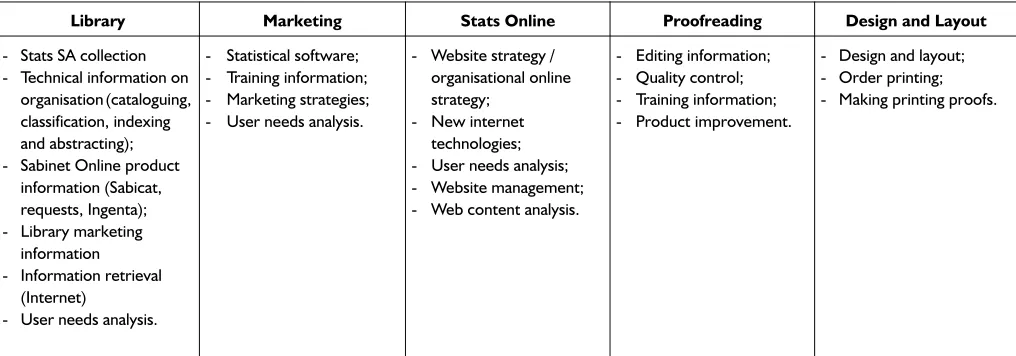
The summarised results of the study in tabular format are as follows:
Question 1.1 Information needs based on tasks
Table 1 Information needs based on tasks
Library Marketing Stats Online Proofreading Design and Layout
-Stats SA collection Technical information on organisation (cataloguing, classification, indexing and abstracting); Sabinet Online product information (Sabicat, requests, Ingenta); Library marketing information Information retrieval (Internet)
User needs analysis. -Statistical software; Training information; Marketing strategies; User needs analysis.
-Website strategy / organisational online strategy;
New internet technologies; User needs analysis; Website management; Web content analysis.
-Editing information; Quality control; Training information; Product improvement.
Question 1.1 identifies information needs and indicates that the needs are determined by the tasks that the unit performs. Table 1 clearly indicates each unit has its own needs based on their unique tasks they perform. It however also shows that units that have common tasks have common information needs as attested by Marketing, Library and Stats Online. All these units have common information needs ‘user needs analysis’ based on their common task of dissemination of information to users.
Question 1.2 The format and importance of information resources and sources
Question 1.2 of information resources and sources portray the information sources of different units. Table 2 indicates both tacit and explicit information. Colleagues and personal communication indicate tacit knowledge sources. Explicit sources are Stats SA collection, technical manuals, databases, and dictionary, style guides.
Question 1.3 Information flow
Question 1.3 Information flow indicates the flow information created by the units. Table 3 shows that information flows both internally and externally. Information from Library, Marketing and Stats Online flows from both internal and external sources, whilst information from Proofreading and Design and Layout flows internally as they only serve internal users. The latter’s information is only shared with users served. Marketing’s information flows externally but not between the units, so there is no information sharing between units.
Question 1.4 Gap analysis
Question 1.4 of gap analysis indicates the missing information desired by the units but unavailable as reflected in Table 4. Library ‘s missing information is desired information by the users served. Marketing unit is missing data mining whilst Stats
Table 2 Format and importance of information resources and sources
Library Marketing Stats Online Proofreading Design and Layout
-Stats SA collection for example reports, releases;
Technical manuals, e.g. ACCR II, DDC, LCSH;
Internet, online databases;
Colleagues (internal and external); Print and electronic.
-Databases; Colleagues (internal and external).
-Recorded information on the web server;
Internet;
Printed media and conferences Personal communication (colleagues);
Training institute; Print and electronic.
-Dictionary; Style guides; Old documents; Personal communication (colleagues);
Print and electronic. -Computer Technical manuals Personal communication (colleagues).
Table 3 Information flow
Library Marketing Stats Online Proofreading Design and Layout
-Stats SA collection (internal and external); External acquired information (internal); New acquisition list (internal). -Census database (external);
Pricing policy (external); Stats SA collection (external).
-User satisfaction survey results (internal); Stats SA collection (external);
Activity on the web (internal)
Newsletter (internal and external).
-Style guides (internal annual);
Other standards (internal quarterly).
- Style guide (internal on request).
Table 4 Gap Analysis
Library Marketing Stats Online Proofreading Design and Layout
-Commercial databases; Subscription to journals catering all units within the organisation.
- Data mining information.
-Require information resources like more funds to acquire software and training materials; High performance computers;
Better IT infrastructure.
Online is missing information resources like costs and IT infrastructure. Design and Layout is missing better information from the users whilst Proofreading has no missing information.
Question 1.5 Characteristics of information
Accessibility, accuracy, relevance, comprehensiveness, cost, currency, delivery method, technical accuracy, and timeliness were indicated as important by the units.
Question 1.6 Importance of library resources
Question 1.6 indicates resources used by the units that are located in the library, as reflected in Table 5. Marketing unit uses current awareness service, handbooks and internal technical reports. Stats Online uses handbooks, internal technical reports, legislation and technical standards. Proofreading and Design and Layout do not use any resources from the library.
3.2 Discussion of the results
Information audit is defined as a process that provides a snapshot (picture) of an organisation’s use of information and a diagnosis of efficiency of the information. The afore-presented results depict the following snapshot or picture of SIS’s use of information and diagnosis of the efficiency of information.
Table 5 Importance of library resources
Library Marketing Stats Online Proofreading Design and Layout
- Current awareness service, Sabinet gazette, Sabinet request, Ingenta, annual reports, handbooks, internal technical reports, journals, technical standards, statutes
- Current awareness service, handbooks, internal technical report.
- Handbooks, internal technical reports, legislations (specific to tasks) and technical standards (critical).
- Do not use any available resources from the library.
- Do not use any availed resources from the library.
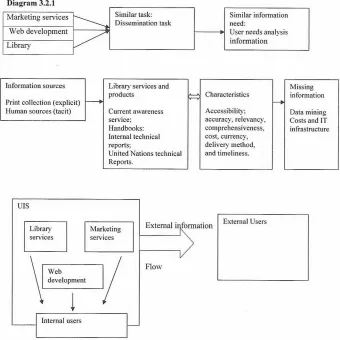
The discussion below is based on Diagram 1 3.2.1 Information needs of respondents
Respondents indicated that their information needs are determined by the tasks they perform. Respondents from Marketing services, Web development and the Library that perform similar tasks have the same type of information needs, as a result of their shared responsibility of disseminating information to users. The results indicate that the information needs of an organisation (employees / users) are driven by the tasks (responsibilities). It is therefore critical that when one conducts an information audit, identification of the tasks or responsibilities should be a part of the planning stage.
3.2.2 Information sources
Information is obtained from printed sources such as the collection of Stats SA, technical manuals, databases, dictionaries and style guides. The fact that results show that human sources relied upon is important because it shows that tacit knowledge is also being used. This finding balances the use of explicit information and tacit knowledge.
3.2.3 Information flow
Information flows in both external and internal directions. External information flow refers to information flows between divisions of Stats SA Chief Directorate and users outside the organisation. Internal information flow refers to information flows between divisions within this Stats SA Chief Directorate.
Information from the Marketing Services, the Library and Web Development flow in both an internal as well as external direction because they deal directly with divisions within Stats SA and users outside the organisation. This implies that there is no information sharing between the Marketing division and its sister divisions within the same Chief Directorate. In terms of diagnosis, this result shows a lack of information sharing among the three units, a ‘perpetuation of silo-mentality’. It may seem that these results contradict or contrast with the earlier results of the human sources. The human sources used are within one unit. This implies that there is information flow within units but not between units. When moving forward this particular Chief Directorate will need to build and broaden the information and knowledge sharing culture that currently exists within units in order to ensure that it exists across units.
All the divisions share information with users through formal channels. However, this information is not necessarily shared between divisions. The researcher has therefore identified a lack of internal information flow, which needs to be addressed.
However, information flows only in an internal direction at the Editing and Proofreading and Design and Layout divisions. This is due to the fact that these divisions only serve internal clients or staff. Information in the Marketing division flows only in an external direction.
3.2.4 Gaps in availability of information sources
Not all the information that divisions require is available in the library.
Marketing Services: This division is in need of data mining in order to enable them to market and ensure that marketers are familiar with data manipulation, storage and packaging. This is fundamental in ensuring that Stats SA products are easily accessible on time and that users can access the raw data.
Web Development: This division needs information on costs and IT infrastructure in order to enable them to plan, develop and implement Stats SA online which delivers Stats SA products online to the users. This is driven by IT tools, facilities and infrastructure rather than by the content of information itself.
The results show that there is missing information, and this refers to information needed that is currently unavailable. This finding is critical for collection management; whoever is responsible for information collection should ensure that these information needs are addressed.
Design and Layout: This division needs better information from users in order to deliver better-designed Stats SA products that meet users’ expectations. This finding shows the communication problem or issue that needs to be addressed within this particular unit. The audit produced a finding that was unanticipated but useful.
Editing and Proofreading: This division seems to be satisfied in terms of the availability of the information sources they need in order to function optimally. They are satisfied because all the technical publications they need to execute their tasks are readily available.
3.2.5 Characteristics of information sources
3.2.6 Use of library resources
Divisions make use of the information sources available in the library. These sources are:
Marketing Services: This division makes use of a Current awareness service, handbooks, e.g. The United Nations statistical handbooks and technical reports from the United Nations and other international statistical agencies.
Web Development: The Web Development division uses handbooks, internal technical reports, legislation and technical standards, for example. United Nations statistical handbooks, E-government policy and the Act on the Promotion of Access to Information.
Proofreading and Editing as well as the Design and layout divisions indicated that they do not make use of sources available from the library, since the library procures them technical sources and they borrow them on permanent loan.
These findings serve as a feedback mechanism that will help the library to know which services and products are used. It also helps to find out what is working and what not. Although the researcher identified sources used by the divisions, it seems as if a large part of the divisions does not make use of the library because it does not meet their needs. This necessitates a review of the applicability and relevance of sources available in the library. This situation impacts negatively on the internal flow of information between the library and divisions.
4 Recommendations to Statistical Information Services
Based on the above discussion on the use of Henzcel’s methodology, the following recommendations are made: • The units prefer print collection and human sources, therefore it is recommended that human sources should be
identified so that they can used as foundation of knowledge management activities like Communities of Practice; • It is also recommended that the print collection be the preferred format if available;
• It is recommended that the units should be encouraged to share information amongst them because the study finds that they are beset with a silo mentality;
• It is recommended that the library as a unit responsible for information acquisition should ensure that the missing information is addressed within their collection development plan;
• It is recommended that any information acquired should meet most of these characteristics, therefore these characteristics should be part of selection criteria of information;
• It is recommended that further the issue of communication between Design and Layout and its users should be addressed;
• The library should further understand the reasons why the Proofreading and Design and Layout are not using any available library resources.
5 Advantages and disadvantages of Henczel’s methodology
On completion of the information audit conducted at the Chief Directorate of Statistical Information Services the following advantages and disadvantages of Henzcel’s (2000) methodology were identified:
Flexibility and cost effectiveness are the two biggest advantages of Henzcel’s method. 5.1 Flexibility
Henzcel’s methodology is regarded as flexible in terms of the following aspects thereof: application, scope, objectives, techniques for data collection and analysis.
Application: The manner in which the methodology is applied within a specific context can vary. Henzcel provides a framework in terms of the seven stages, which constitute the methodology. However, the manner in which these stages manifest themselves, the methodology application or use, can vary from one situation or environment to another. She explains (2000:216): ‘… it is a structured framework that is flexible and can "blend" to meet the varying conditions and constraints of an organisation. In other words, the components can be "tailored" to suit to the objectives of the organisation and the resources available.’
Scope: The scope of the audit was limited to two divisions of the Chief Directorate of Statistical Information Services. However, Henzcel’s (2000) methodology can also be used to conduct an information audit of a larger scope within the organisation.
Objectives: Henzcel (2000:218) indicates that an information audit is conducted for the following reasons: • “To identify the tasks and activities that potentially produce strategically significant knowledge assets; • To identify strategically significant information resources;
• To identify and map information flows.”
However, Henzcel’s methodology also proved to be an effective method to identify the following: • Information needs of respondents;
• Characteristics of information sources; • The use of library resources.
Techniques for data collection and analysis: The methodology is not prescriptive in terms of the techniques that are used in collecting and analysing the data. This implies that the most suitable techniques for a particular environment can be chosen. Techniques that are used to collect data are questionnaires, personal interview or focus group interviews while data are analysed by means of a general analysis, significance analysis or a mapping of information flows.
5.2 Cost-effectiveness
Henczel’s methodology is economical to implement and cost-effective in terms of its benefits. The cost of conducting an information audit can be reduced by making use of technical (e-mail, computers, telephones) and physical (desks, working space) resources that are already available in the organisation. Costs can also be reduced by making use of internal experts that are familiar with the structure, culture, communication issues, political issues, stakeholders, internal and external relationships as well as the information and knowledge management strategy of the organisation.
5.3 Cumbersome
The biggest disadvantage of Henzcel’s methodology is the fact that it involves a cumbersome process. The researcher experienced the use of Henzcel’s method as tedious and wearisome.
The planning stage is repetitive at times, since activities need to be repeated later. This can impact on the effectiveness of the audit, especially if it is conducted organisation-wide. However, if the activities included in the planning stage are not thoroughly executed, it may impact negatively on the results of the audit, thus defeating its purpose.
6 Conclusion
The researcher established that Henczel’s methodology could be effectively used as an information management activity within a medium sized public organisation. This particular method can be used to identify and determine the value, functioning, evaluation and utility of information resources. Henzel’s methodology built on earlier methodologies; as indicated in the literature review most of her steps are similar to the earlier ones. Since Henczel’s methodology was new, this study wanted to test the viability in practical settings and also identify the advantages and disadvantages based on her methodology. If it differs from the earlier methodologies, what then are its advantages and disadvantages.?
The methodology is practical in nature and is a cost-effective method of determining the ‘what, where and how’ of information as a valuable resource. Since the only disadvantage of the methodology is the fact that it is rather cumbersome in nature, it is clear that its advantages far outweigh its disadvantages.
Henzcel’s method of information audit is therefore recommended for use by medium sized organisations as part of their information management activities. The significance of the study is that anyone who is interested in conducting an information audit using Henczel’s methodology can use this one as a basis in conceptualisation of one’s study.
In summing up the discussion, the methodology enabled one to depict the snapshot (picture) of an organisation’s use of information and a diagnosis of efficiency of the information. It further indicated the pros and cons of the methodology. The study tested the viability of a methodology and with the results it produced it showed that it can be used to conduct an information audit. It also shows that the methodology, like any other methodology, is viable. It is important that one should know the pros and cons of the method before using it so that one can contextualise and adjust it accordingly.
References
Aslib Information Resource Centre. 2002. Glossary. [Online]. Available: http://www.aslib.co.uk/info/glossary.html Babbie, E. & Mouton, J. 2001. The practice of social research. Cape Town: Oxford University Press.
Barker, R.L. 1990. Information audits: designing a methodology with reference to the R and D division of a pharmaceutical company. Sheffield: Department of Information Studies, University of Sheffield.
Bellinger,G. Castro, D. & Mills, A. 2002. Data, information, knowledge and wisdom. [Online]. Available: http://www.outsights.com/ systems/dikw/dikw.htm
Boon, J.A. 1990. Information Management: an Educational perspective. South African Journal of Library and Information Science, 58 (4):319-327
Carmichael, D. Willingham, J. & Schaller, C. 1996. Auditing concepts and methods: a guide to current theory and practice. New York: McGraw-Hill.
Dubois, C.P. 1995. The information audit: its contribution to decision-making. Library management, 16 (7): 20-24. Gibson, P. 1996. Information audits: can you afford not to? Library manager, 17: 12-13.
Guy, D. Alderman, C. & Winters, A. 1996. Auditing. 4th ed. Fort Worth: Dryden Press
Hamilton, F. 1993. The Information audit. In: Management skills for the information manager. Aldershot: Ashgate pp.75-96 Henczel, S. 2000. The information audit as a first step towards effective knowledge management: an opportdivisiony for the special
Information audit: know thyself. 2001. [Online]. Available: http://www.arnoldit.com/articles/PDF_Web/article1998/ chap3_info_audit.pdf
Liebowitz, J., Rubenstein-Montano, B., McCaw, D., Buchwalter, J. & Browning, D. 2000. The knowledge audit. [Online]. Available: http://userpages.umbc.edu/~buchwalt/papers/KMaudit.htm
Lubbe, W.F. & Boon, J.A. 1993. Information audit at University of Pretoria. South African journal of Library and Information Science, 60 (4): 214 – 223
Orna, E. 1990. Practical information policies: how to manage information flow in organisations. Aldershot: Gower.