4402
MATHEMATIC CONCEPT REPRESENTATION
OF HIGH ABILITY STUDENT IN SOLVING
ALGEBRAIC PROBLEM
Mustangin, St. Suwarsono, Agung Lukito
Abstract— This research aims to describe how high intelligent students represent Mathematic concepts to solve algebra. It is a qualitative descriptive-explorative research with 2 junior high schoolers as the research subjects in order to solve the mathematic problems. Data were collected from the interviewed-based task of the selected subjects and analyzed using data reduction, presentation, and conclusion. The result indicates that high intelligent students are capable in solving algebra though verbal representation, symbolism, imagination, and formal notation. These Mathematic concepts allow the students to successfully solve mathematic problems from analyzing, understanding, to concluding in order to obtain the correct result. Index Terms— Concept Representation, Algebra Problem Solving.
—————————— ——————————
1 INTRODUCTION
Concept representation and problem solving are two important competences in Mathematics learning. Students‟ mathematic representation shows their capacities in mathematic concepts and problem solving. Representation was instrumental in helping increase students‟ understanding of mathematical concept. Then representation can also improve communication skill, and students‟ mathematical problem solving [22]. Concept representation and problem solving skills are highly related to mathematical thinking. It requires various representative forms to think both mathematically as well as to communicate the ideas such as verbal representation, images, numeric, symbols, algebra, tables, and graphs [27].Mathematic concepts representation is very important in problem solving, especially in mathematic problems to decipher the abstract to further concepts in student critical thinking. Mathematical representation encodes and communicates mathematical ideas, connects them with a larger field of reference, and provides a mechanism through which ideas can be further investigated and modified [5]. Mathematic concept representation possibly forms pictures, symbols, words, tables and so forth. Vergnaud states that representations are important in mathematics learning, not only because of the importance in using symbols, but also due to its functions and roles in the conceptualization of the empirical world [10], [26]. Mathematics is a human mind, caused by its abstract nature meaning that representation is needed in simplifying or clarifying the problem by transforming notional and integrated idea into a more tangible concept that can be recognized by students (in form of pictures, symbols, words, graphics , also tables). While [25] refers representation as an externalizing internal and mental abstraction acts. Thus, when a student has a broader scope on various representations of mathematic ideas, he considers havingfacilities to improve his ability to think mathematically [19]. In problem solving activities, students ability to represent concepts is significant. Difficult mathematic problems become easier and more simple by implementing proper strategy through running the concept representation that are synchronous and relevant it. However, it turns to difficult, if the concept representation are inadequate and unaccurately selected. The difficulty level increasingly rise, when students misselect the right concept representation because of the limited alternative choice of concept representation. The patterns and mechanisms used by students in selecting representations play an important and decisive role in selecting and deciding an appropriate, relevant, and accurate problem solving strategies. The standard representation process in Mathematics learning is neccessary to formulate mathematic concepts. The students' ability to express mathematical ideas in various representations is an crucial indicator in showing students ability to solve specific problems. According to NTCM, representation in Mathematics learning has the ability to: (1) organize, respond, and communicate mathematical ideas; (2) select, utilize, transcribe mathematic representations to problem solving; and (3) model and interpret the physical, social, and mathematical phenomena. Mathematic problem solving is one of the most important topics studied and the most complex taught. The main objective in teaching it is that students develop generic abilities to solve real life problems and apply mathematics in real life situations [7] which lead them to be able to deduce real-life problems using mathematic concept/logic. This, of course, proposes to those with ability to live more productively and innovatively as they have competence to create a better standard of life (privately or socially). Through problem solving, people can be independence to decide and select the options on how to do their assignment. Hence, the more independent students are, the more capable they are to make rational decisions on what, how, when, and why they learn something [24].Researches on the concept representation in solving mathematic problems are urgently needed because: first; representation as a process is a relatively new idea compared to other standards (stated in the NCTM document on Principles and Standards for School Mathematics) [19]. Initially, it was only a small part of communication standards in ————————————————
Mustangin is currently pursuing doctoral’s degree program of Mathematics Education in State University of Surabaya, Indonesia, PH-0628123396636. E-mail:
St Suwarsono is currently a lecturer in Sanata Dharma University, Indonesia, PH-06281328030757. E-mail: [email protected]
Mathematics learning. However, it develops becoming an essential further, so its status is elevated becoming equivalent to other 4 standard processes. This means that the ability to represent various mathematic ideas is a basic need of students in Mathematics learning. Second, in Mathematics representations have crucial role due to the notional characteristics of Mathematics which normally raise many problems for both teachers and students. Various representations are needed as a tool (for teacher) to teach mathematic problems and develop the understanding capacity in problem solving (for students). In addition, Mathematics can play a very important role in conceptualization of the real world. Third, it possibly improve quality of all related parties (teacher, students, and researchers) and it can be used to enrich the repertoire and reference of them in textbooks and scientific journals. Therefore, this research becomes necessary in order to elaborate various aspects of concept representation related to problem solving as well as provide adequate references on representation aspects for teachers and other related parties.From initial observations on two junior high schooler, it was concluded that the mathematic concept representation is an important component in problem solving. Of course, these observations were less adequate to obtain a comprehensive picture of various aspects in mathematic concept representation, especially algebra. There are several points interestingly studiedd and explored in this research, such as: (1) various types of representations, (2) the number of representations, (3) the reasons on selecting the representation concepts, (4) the accuracy and relevance of the representation used to solve problem, (5) the effectiveness of the representations, and (6) the differences of representation in terms of mathematics abilities and gender. There are several reason why the researchers selected algebra as the problem in analyzing student mathematic concept representation. One, algebra is a branch of Mathematics that uses mathematical statements to describe patterns of relationships between various concepts in Mathematics and it has important role to generalize and solve problems [20]. Two, it can be a means or tool to solve mathematical, scientific, economic, commercial, computing, and other contextual problems in daily life [3]. Three, algebra can also be used to train students to build their critical, creative, reasoning, and notional thingking. And last, algebra is also possibly to be a means to build students' character and competence.However, for junior high school students, algebra is difficult subject. One of the reasons is due to their learning start as there is a division of algebra and arithmetic [14]. Students who are accustomed to work with arithmetic terms of reference tend to ignore to the relational aspects of operations as they generally focus more on calculations. In the early stages of learning algebra, students face several obstacles [28]. First, algebra requires students to develop abstract reasoning and problem solving abilities. These conditions make algebra more difficult than arithmetic. Second, learning algebra requires them to learn the mathematic symbols that are completely different from their previous knowledge/understanding. During this transition, students have to shift their knowledge in arithmetic equations with number operations to algebraic equations by operating on unknown numbers and requiring them to map standard mathematic symbols to mental models of preexisting
arithmetic [35]. As a result, several previous researches indicate the low category of students' algebraic mastery which is caused by the misconception in understanding the algebra. Therefore, this research is expected to contribute significantly in improving students' learning outcomes and mathematics learning in schools, especially related to solving algebra.Researches on the mathematic concept representation and problem solving have been previously carried out. However, researchers deem it necessary to conduct further research that specifically examines the mathematic concept representation in solving algebraic problems. This research is expected to provide both theoretical and practical benefits. Theoretically, this research is expected to: (1) provide an objective description of mathematic concepts used by students to solve algebra and (2) enrich the knowledge and references on the mathematic concept representation to solve algebraic problems considering to students' mathematic abilities and gender. Practically, this study are expected to provide: (1) reference materials for teachers in designing and implementing Mathematics learning in order to improve the students' ability to represent mathematical concepts, especially in problem solving; (2) empirical experiences for students in using various representations to solve problems (especially algebra, and other mathematic problems in general); and (3) reference materials for other researchers to conduct further research relating to the mathematic concept representation.
2
RESEARCH
METHODS
This research is a descriptive-explorative research with qualitative approach. Subjects were seventh graders from SMP Negeri I Batu, East Java Indonesia who were selected due to their mathematical ability obtained from Mathematics scores of questions given. From the initial Mathematics test, two students were selected, one female (S1) and one male (S2) students. The initial test to select the subject was meant to obtain the comprehensive description of student representation. Instruments used were Mathematical Ability Testing (MAT) and Algebraic Problem Solving-Task (APST). Both instruments use to obtain the data of students‟ mathematic ability for further analysis in this research. The APST is designed to be in line with the materials of linear equation of two variables. This object (material) selection considers to the basic algebra concepts (including numbers and their operation, variables, constants, coefficients, mathematic sentence, linear equation, as well as linear equation system. The algebra material developed as the research instrument is validated theoretically by Mathematics experts and academicians who own both practical and theoretical experiences using expert judgment technique. The algebraic question in the research instrument is:
“One day, Mr. Hasan wants to know his total chickens and rabbits by counting their heads and feet. From all his livestocks, he got 50 heads and 140 feet. So, how many chickens and rabbits does Mr Hasan have?”
4404 ayam dan banyaknya kelinci yang dimiliki Pak Hasan?)
Data analysis was conducted referring to Miles and Huberman. The analysis process was carried out in three stages, namely: data reduction, data presentation, and data conclusion and verification [16]. Qualitative analysis is conducted through dividing the data into units that can be managed, synthesize, as well as find the patterns (which are important and learned). In qualitative research, data collection and data analysis activities are carried out simultaneously or simultaneously [2][33].
3 RESULT
AND
DISCUSSION
3.1 Mathematic Concept Representation on both Female Subject (S1) and Male Subject (S2)
Data obtained from S1 shows the mathematic concept representation in algebraic problem (see Figure 1).
Fig. 1 and Fig. 2 show that in reading and exploration stages, both subjects (S1 and S2) use verbal representation to read, understand, and explore the problems by stating and writing the information and problem asked. S1 uses symbolic representation to simplify the problem [8][26]. In the strategy selection, S1 and S2 use imaginastic and verebal representations by applying the elimination and substitution methods. S1 and S2 use imaginastic representation or „feeling‟ to employ the appropriate strategy according to material given and previous knowledge. Both subjects apply syntactic and verbal representation to verbally explain/describe in non-mathematical way how to select the problem solving strategy [11][34]. In problem solving, S1 and S2 employs formal notational and symbolic representations by presupposing the information obtained into mathematic model followed by eliminating and substituting them to find the value/result. They use imagiinatic representation to catch the „feeling‟ of mathematic concept by deducing other possible strategies to solve the problem using elimination, substitution, and graphic method. However, the subjects (S1 and S2) prefer using the
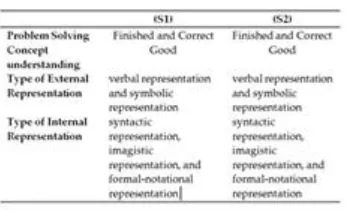
verbal and symbolic representation method (see Fig. 1 and Fig. 2) to other methods [21][36]. In checking and reflecting stage, S1 and S2 use verbal representation to confirm whether their solution is correct or not. They use both formal notational and symbolic representations to check the result by inserting the result (number obtained) through linear equation. If equation has the same result meaning that her answer (solution) is correct [21][36].Based on above descriptions, it is generally found that mathematic concept representation used by both subjects in solving algebraic problem are different, however, they tend to lean to certain type, namely: symbolic and verbal representation. Similarly, this research found an interesting similarity in mathematic ability as well as in selecting strategy in solving problem. But, they use different approach by writing the solution differently (see Table 1). The comparison shows that there is no difference on how both subjects (S1 and S2) in solving the problem. This indicates that subject with same mathematical ability has same representation ability as well. However, although both subjects have same abilities, they are different, especially in the orderliness and writing method. Female subject (S1) tends to use symbol x and y to represent the equation which is more abstract, while the male subject (S2) uses the initial letter for the information to represent the equation which means semi-concrete.
4 CONCLUSION
From data analysis, it is concluded that students with high mathematic ability are able to solve algebraic problem through verbal, symbolic, imaginatic, and formal-notational representation. Verbal representation is to read, understand,
and explore the problem in form of words (both spoken and written). This is also to describe the strategy used and confirm the result obtained. Symbolic representation is to state the situation in simplified forms using algebraic symbols. Imaginatic representation is to portray the alternative strategies optioned in order to „catch‟ the „feeling‟ of mathematic concept in solving the problem given. Meanwhile, the formal-notational representation is to solve the problem using algebraic equation. This representation is also used to check/confirm whether the result obtained is correct or not.
ACKNOWLEDGMENT
The authors wish to thank the Ministry of Research and Technology of Higher Education (KEMENRISTEKDIKTI) which
TABLE 1
ANALYSIS COMPARISON OF S1 AND S2 Fig. 1 Result of S1 in solving algebraic question.
has provided financial assistance in the activities of Doctoral Dissertation Research Grant (PDD) through the Islamic University of Malang and Surabaya State University.
REFERENCES
[1] Anwar, R.B. & Rahmawati, D. (2017). Symbolic and Verbal Representation Process of Student in Solving Mathematics Problem Based Polya‟s Stages. International Education Studies. Vol. 10, No. 10; 2017. p-ISSN 1913-9020, e-ISSN 1913-9039. Published by Canadian Center of Science and Education. [2] Bogdan, R.C. & Biklen, S.K. (1992). Qualitative Research for
Education, An Introduction to Theory and Methods. Boston: Allyn and Bacon Inc.
[3] Booker, G. (2009). Algebraic Thinking: Generalising Number and Geometrry to Express Patterns and Properties Succinetly. Brisbane: Griffith University.
[4] Borg, W.R. & Gall, M.D. (1983). Educational Research: An Introduction. Fourth Edition. New York: Longman, Inc.
[5] Bossé, M.J., Bayaga, A., Fountain, C., & Young, E.S. (2019). Mathematical Representational Code Switching. International Journal For Mathematics Teaching And Learning 2019, Vol. 20.1.
[6] Cuoco, A.A. (2001). The Roles of Representation in School Mathematics 2001 Year Book. Reston, VA: NCTM.
[7] Dendane, A. (2009). Skills Needed for Mathematical Problem Solving. Paper presented at the 10th Annual Research Conference - UAE University - 13th -16th April, 2009.
[8] Fiedlander A. & Tabach, M. (2001). Promoting Multiple Representations in Algebra. In Cuoco, Albert A. The Roles of Representation in School Mathematics 2001 Year Book. Reston, VA: NCTM.
[9] Fonna & Mursalin. (2018). Role of Self-Efficacy toward Students‟ Achievement in Mathematical Multiple Representation Ability (MMRA). JIP-The International Journal of Social Science. Vol. 6, No. 1, January 2018 p-ISSN:2338-8617, e-ISSN: 2443-2067. doi: 10.26811/peuradeun.v6i1.174.
[10]Goldin, G. A. (2002). Representation in Mathematical Learning and Problem Solving. In L. D. English (Ed.), Handbook of International Research in Mathematics Education . Mahwah, NJ: Lawrence Erlbaum Associates, Publishers.
[11]Goldin, G.A. & Shteingold, N. (2001). System of Representation and the Development of Mathematical Concept. In Cuoco, Albert A. (Ed). The Roles of Representation in School Mathematics 2001 Yearbook. Reston, VA: NCTM.
[12]Helingo, D.D.Z, Amin, S.M., & Masriyah, M. (2019). D D Z Helingo, S M Amin and M Masriyah. Journal of Physics: Conf. Series 1188 (2019) 012055. IOP Publishing doi:10.1088/1742-6596/1188/1/012055.
[13]Hitt, F. (Eds). (2002). Representations and Mathematics Visualization. Mexico: Departamento Dematemática Educativa, Cinvestav-IPN.
[14]Kieran, C. (2004). Algebraic Thinking in the Early Grades: What Is It?. The Mathematics Educator, Vol.8, No.1.
[15]Kilpatrick, J., Swafford, J. & Findell, B. (2001). Adding it up. Helping Children Learn Mathematics. Washington: National Academy Press.
[16]Miles, B.M. & Huberman, M.A. (1994). Qualitative Data Analysis: an Expanded Sourcebook, 2ndEd. New Delhi: Sage Publications, Inc.
[17]Minarni, A., Napitupulu, E.E., & Husein, R. (2016). Mathematical
Understanding And Representation Ability Of Public Junior High School In North Sumatra. Journal on Mathematics Education. Volume 7, No. 1, January 2016. p-ISSN 2087-8885, e-ISSN 2407-0610.
[18]Miura, I.T. (2001). The Influence of Language on Mathematical Representations. In Cuoco, Albert A. The Roles of Representation in School Mathematics 2001 Year Book. Reston, VA: NCTM.
[19]National Council of Teachers of Mathematics. (2000). Principles and Standards for School Mathematics. Reston, VA: NCTM. [20]National Council of Teachers of Mathematics. (2008). Principles
and Standards for School Mathematics. Reston, VA: NCTM. [21]Nizaruddin, Muhtarom, & Murtianto, Y.H. (2017). Exploring of
Multi Mathematical Representation Capability in Problem Solving on Senior High School Students. Problems of Education in The 21st Century Vol. 75, No. 6, 2017 591, ISSN 1822-7864 (Print) ISSN 2538-7111 (Online).
[22]Nizarudin. (2014). Role of Multiple Representations in Mathematical Problem Solving. Proceeding of International Conference on Mathematics, Science, and Education 2014 (ICMSE2014).
[23]Nurrahmawati, Sa‟dijah, C., Sudirman, Muksar, M., As‟ari, A.R., & Nusantara, T. (2018). Pre-Service Mathemathics Teachers‟ Preferences in Using Multiple Representation of Word Problem Solving. International Journal of Insight for Mathematics Teaching Volume 01, No. 2, October 2018.
[24]Ollerton, M. (2007). Teaching and Learning Through Problem Solving. Mathematics Teaching Incorporating Micromath 20. [25]Pape, S.J. & Tchoshanov, M.A. (2001). The Role of
Representation(s) in Developing Mathematical Understanding. Theory into Practice, 40(2).
[26]Putra, I.S., Masriyah, & Sulaiman, R. (2018). Students Translation Ability of Mathematical Representation (Symbolic and Visual) Based on Their Learning Styles. Journal of Physics: Conf. Series 1108 (2018) 012079. doi:10.1088/1742-6596/1108/1/012079.
[27]Rahmawati, D., Purwanto, Subanji, Hidayanto, E., & Anwar, R.B. (2017). Process of Mathematical Representation Translation from Verbal into Graphic. IEJME- Mathematics Education 2017, VOL. 12, NO. 4.
[28]Rakes, C.R. (2010). Misconception in Rational Numbers, Probability, Algebra, and Geometry. USA: The University of Louisville.
[29]Rohmah, M. & Sutiarso, S. (2018). Analysis Problem Solving in Mathematical Using Theory Newman. EURASIA Journal of Mathematics, Science and Technology Education. ISSN: 1305-8223 (online) 1305-8215 (print) 2018 14(2). DOI: 10.12973/ejmste/80630.
[30]Sahendra, A., Budiarto, M.T., & Fuad, Y. (2017). Students‟ Representation in Mathematical Word Problem Solving: Exploring Student Self-efficay. Journal of Physics: Conf. Series 947 (2017) 012059. doi:10.1088/1742-6596/947/1/012059. [31]Tchoshanov, M.A. (2002). Representation and Cognition:
Internalizing Mathematical Concept. In Hitt, F. (Eds). Representations and Mathematics Visualization. Mexico: Departamento Dematemática Educativa, Cinvestav-IPN. [32]The Vermont Department of Education. (2007). Vermont
4406 Math and Technology.
[33]Ulfatin, N. (2013). Metode Penelitian Kualitatif di Bidang Pendidikan: Teori dan Aplikasinya. Malang: Bayumedia Publishing.
[34]Villegas, J.L., Castro, E., & Gutiérrez, J. (2009). Representations in Problem Solving: A Case Study with Optimization Problems. Electronic Journal of Research in Educational Psychology. ISSN. 1696-2095. No 17, Vol 7 (1). [35]Warren, E. (2003). The Role of Arithmetic Structure in the
Transition from Arithmetic to Algebra. Australian Catholic University Mathematics Education Research Journal, Vol. 15, No. 2.