Transform Role Modeling
Into SUPERmodeling
Nicholas M. Potisek, MD,aBarrett Fromme, MD, MHPE,bMichael S. Ryan, MDc
Role modeling is the process by which a learner observes a clinical teacher to develop and refine his or her practice. Compared to other learning methods, role modeling is inherently student driven and may occur with or without the clinical teacher’s awareness.1,2 Perhaps this is why learners often experience poor role modeling behaviors,2and clinician teachers struggle to identify role modeling opportunities.3Although role modeling is traditionally considered a passive or implicit learning method, newer evidence suggests clinical teachers can transform the role modeling process into a more explicit teaching method to enhance the development of their leaners.2,4
IMPORTANCE
Clinical teachers serve a critical role in shaping attitudes and behaviors of future generations of physicians. Role modeling can be effectively used to teach
challenging clinical skills such as verbal and nonverbal
communication, humanism, professionalism, and teamwork.1 Role modeling may also be the most effective and efficient learning method in busy clinical environments or when a patient care task is beyond the learner’s current clinical abilities.5A learner’s observations of the clinician teacher’s behaviors may influence his or her professional development and career
decisions.5,6Unfortunately, not all experiences are positive. Learners commonly witness unprofessional behavior and report difficulty identifying positive role models.7 Furthermore, learners may perceive observation experiences as“shadowing”and may subscribe less value to these opportunities than seeing patients
independently. A clinical teacher’s ability to role model effectively and explicitly can significantly enhance the learner experience and his or her development into a clinician.
TOOLS AND TIPS
In this article from the Council on Medical Students in Pediatrics series on great clinical teachers, we offer specific strategies for transforming role modeling into SUPERmodeling. The SUPER mnemonic (increasing self-awareness, helping the
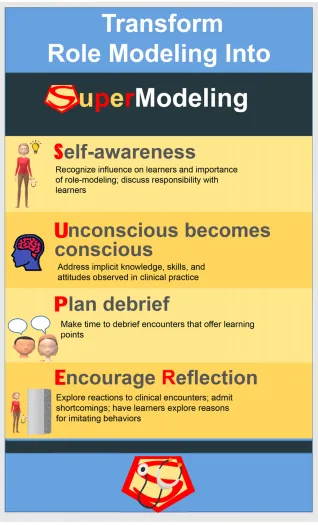
unconscious become conscious, plan debriefing, and encourage reflection) provides clinical teachers with a toolbox to enhance role modeling strategies. These strategies are summarized in Fig 1. To demonstrate each, we will provide illustrative examples through the following clinical teacher-learner dyad: Dr Paul is a busy community-based pediatrician. She is an excellent clinician continuously seeking ways to improve her teaching. Dr Paul decides to focus on
developing her role modeling skills in various clinical encounters with a
Department of Pediatrics, Wake Forest School of Medicine, Winston-Salem, North Carolina;bDepartment of Pediatrics, Pritzker School of
Medicine, University of Chicago, Chicago, Illinois; andcDepartment of
Pediatrics, School of Medicine, Virginia Commonwealth University, Richmond, Virginia
Drs Potisek, Fromme, and Ryan conceptualized and designed the manuscript, drafted the initial manuscript, and reviewed and revised the manuscript; and all authors approved thefinal manuscript as submitted and agree to be accountable for all aspects of the work.
DOI:https://doi.org/10.1542/peds.2019-2624
Accepted for publication Aug 13, 2019
Address correspondence to Nicholas M. Potisek, MD, Department of Pediatrics, Wake Forest School of Medicine, Medical Center Blvd, Winston-Salem, NC 27157. E-mail: [email protected]
PEDIATRICS (ISSN Numbers: Print, 0031-4005; Online, 1098-4275).
Copyright © 2019 by the American Academy of Pediatrics
FINANCIAL DISCLOSURE:The authors have indicated they have nofinancial relationships relevant to this article to disclose. FUNDING:No external funding.
POTENTIAL CONFLICT OF INTEREST:The authors have indicated they have no potential conflicts of interest to disclose. The authors have no potential conflicts of interest to disclose.
To cite:Potisek NM, Fromme B, Ryan MS. Transform Role Modeling Into SUPERmodeling. Pediatrics. 2019;144(5): e20192624
a third-year medical student by the name of Taylor who is coming to her office for the next month.
Self-awareness
Extraordinary role modeling begins by increasing the clinical teacher’s self-awareness of their influence on learners.1,2,8Clinician teachers continuously model behaviors and must therefore recognize their influence on learner behaviors in all circumstances. An increased self-awareness can prompt clinical teachers to anticipate and identify clinical scenarios to incorporate role modeling into practice and to identify specific objectives from each patient encounter.8Discussing this
responsibility with learners can help hold clinical teachers accountable for their actions and heighten their own awareness of their impact on learners.
Illustrative Example:
Previous learners have praised Dr Paul’s ability to navigate challenging patient conversations. As a result, she is more mindful of clinical scenarios a learner may view as challenging. She identifies vaccine-hesitant families, concerns for child abuse, and situations of medical uncertainty as potential role modeling opportunities. On thefirst day of the rotation, Dr Paul relays to Taylor there will be opportunities to see patients directly and observe Dr Paul’s bedside manner. She describes the benefits of both experiences.
Unconscious Becomes Conscious
The impact of learning through role modeling is dependent on the learner’s awareness, engagement, and accurate assessment of the observed behavior.2,9,10On occasion, a learner may unconsciously incorporate an observed behavior without fully understanding the clinical teacher’s intent.2,10This may result in the learner modifying his or her practice in a way that is detrimental.
Therefore, addressing unconscious
elements of learning in role modeling is essential to ensure learners thoughtfully include or exclude observed behaviors into their own practice. Clinical teachers can do this by preparing the learner in advance for what they will observe and how
the clinician plans to navigate the situation.
Illustrative Example
The mother of a 12-month-old patient well known to Dr Paul is hesitant about vaccination. The patient is
FIGURE 1
Four strategies to transform role modeling into SUPERmodeling.
scheduled for a routine follow-up with Dr Paul. Dr Paul takes a moment to recall how challenging such encounters can be for a new clinician and identifies this interaction as a good opportunity for Taylor to observe. After sharing the background perspective, Dr Paul presents her planned approach to navigate today’s discussion and her rationale behind this approach. She asks Taylor to actively observe and create his own perspective on how the encounter goes.
Plan Debriefing
Because role modeling is often viewed as a passive process, an intentional debrief is not generally considered a core component of this teaching method.1This is grounded in the assumption that learners will accurately recognize the rationale behind a clinical teacher’s behavior. However, this approach is susceptible to misinterpretation, particularly during difficult encounters. In situations such as these, role modeling may be enhanced by incorporating a more explicit and planned debrief. The purpose of a planned debrief is for the clinical teacher to discuss why they used a certain behavior or particular language and to address the learner’s reaction.2Clinical teachers may highlight the motivation for a behavior by including previous experiences and why they favor the observed approach.
Illustrative Example
Dr Paul debriefs with Taylor after their previous patient encounter. She asks Taylor to describe observations from the interaction between Dr Paul and the mother. Taylor articulates observations regarding verbal and nonverbal communication and mentions being surprised Dr Paul was not more assertive regarding the need to vaccinate the infant. Dr Paul shares her perspective on the value of building a therapeutic relationship with families in hopes that, over time,
she would be able to change the mother’s perspective on vaccines.
Encourage Reflection
Reflection on part of both the clinical teacher and learner helps reveal the implicit benefits of role modeling.9 Before patient encounters, clinical teachers can encourage learners to not just adapt or abstain from clinical behaviors they witness but to explore their own reactions and reasons for imitating certain clinical behaviors. The clinician can take the lead on demonstrating reflection by readily admitting shortcomings and/or clinical uncertainty to reinforce a learning environment conducive to self-reflection. Engaging learners in such conversations can promote the need for self-reflection throughout a career.
Illustrative Example
Two days ago, a patient Dr Paul had referred for subspecialty evaluation returned to her clinic. Dr Paul was disappointed in the evaluation the subspecialist provided and voiced her displeasure to Taylor. Today, Dr Paul intentionally sat down with Taylor to acknowledge that she had been impatient the previous afternoon and had wanted to advocate for her patient, not disrespect the
subspecialist. She expressed regret to the learner in the way she talked about the subspecialist. She asked how Taylor might have done things differently in his own practice in the future.
CONCLUSIONS
Role modeling is a powerful teaching strategy. Clinician teachers can make role modeling SUPERmodeling through incorporating the various teaching components of increasing self-awareness, making the unconscious more conscious, plan debriefing, and encourage reflection. Ideally, all 4 role modeling teaching strategies can be used in a given clinical encounter; however, even in
isolation, the use of any of these strategies can enhance a clinical teacher’s ability to role model.
ABBREVIATION
SUPER: increasing self-awareness, helping the unconscious become conscious, plan debriefing, and encourage reflection
REFERENCES
1. Weissmann PF, Branch WT, Gracey CF, Haidet P, Frankel RM. Role modeling humanistic behavior: learning bedside
manner from the experts.Acad Med.
2006;81(7):661–667
2. Cruess SR, Cruess RL, Steinert Y. Role
modelling–making the most of
a powerful teaching strategy.BMJ. 2008; 336(7646):718–721
3. Côté L, Leclère H. How clinical teachers perceive the doctor-patient relationship
and themselves as role models.Acad
Med. 2000;75(11):1117–1124
4. Kenny NP, Mann KV, MacLeod H. Role
modeling in physicians’professional
formation: reconsidering an essential
but untapped educational strategy.Acad
Med. 2003;78(12):1203–1210
5. Yoon JD, Ham SA, Reddy ST, Curlin FA. Role models’influence on specialty choice for residency training: a national
longitudinal study.J Grad Med Educ.
2018;10(2):149–154
6. Wright S, Wong A, Newill C. The impact of
role models on medical students.J Gen
Intern Med. 1997;12(1):53–56
7. Wright S. Examining what residents look for in their role models.Acad Med. 1996; 71(3):290–292
8. Wright SM, Carrese JA. Excellence in role modelling: insight and perspectives
from the pros.CMAJ. 2002;167(6):
638–643
9. Benbassat J. Role modeling in medical education: the importance of a reflective imitation.Acad Med. 2014;89(4):550–554
10. Epstein RM, Cole DR, Gawinski BA, Piotrowski-Lee S, Ruddy NB. How students learn from community-based
preceptors.Arch Fam Med. 1998;7(2):
149–154
DOI: 10.1542/peds.2019-2624 originally published online October 29, 2019;
2019;144;
Pediatrics
Nicholas M. Potisek, Barrett Fromme and Michael S. Ryan
Transform Role Modeling Into SUPERmodeling
Services
Updated Information &
http://pediatrics.aappublications.org/content/144/5/e20192624
including high resolution figures, can be found at:
References
http://pediatrics.aappublications.org/content/144/5/e20192624#BIBL
This article cites 10 articles, 2 of which you can access for free at:
Subspecialty Collections
dev_sub
http://www.aappublications.org/cgi/collection/teaching_curriculum_ Teaching/Curriculum Development
b
http://www.aappublications.org/cgi/collection/medical_education_su Medical Education
following collection(s):
This article, along with others on similar topics, appears in the
Permissions & Licensing
http://www.aappublications.org/site/misc/Permissions.xhtml
in its entirety can be found online at:
Information about reproducing this article in parts (figures, tables) or
Reprints
http://www.aappublications.org/site/misc/reprints.xhtml
Information about ordering reprints can be found online:
at Viet Nam:AAP Sponsored on August 28, 2020
www.aappublications.org/news
DOI: 10.1542/peds.2019-2624 originally published online October 29, 2019;
2019;144;
Pediatrics
Nicholas M. Potisek, Barrett Fromme and Michael S. Ryan
Transform Role Modeling Into SUPERmodeling
http://pediatrics.aappublications.org/content/144/5/e20192624
located on the World Wide Web at:
The online version of this article, along with updated information and services, is
by the American Academy of Pediatrics. All rights reserved. Print ISSN: 1073-0397.
the American Academy of Pediatrics, 345 Park Avenue, Itasca, Illinois, 60143. Copyright © 2019 has been published continuously since 1948. Pediatrics is owned, published, and trademarked by Pediatrics is the official journal of the American Academy of Pediatrics. A monthly publication, it
at Viet Nam:AAP Sponsored on August 28, 2020
www.aappublications.org/news