Page 336
MANAGEMENT OF GRADUATE STUDENT’S THESIS WRITING THROUGH A SPECIALIZED SOFTWARE SYSTEM
Desislava Baeva
“Angel Kanchev” University of Ruse, Faculty of Natural Sciences and Education, Bulgaria
Abstract
The inclusion of Learning Management Systems (LMSs) in the Bulgarian academic institutions has augmented students’ learning experience. The paper presents a software system for managing and supporting the interaction between graduate students and their supervisors in the course of theses writing. The system allows to plan, manage and track the progress of students’ theses/graduation projects. The author makes a comprehensive critical examination of the specialized software systems’ impact on the process of teaching and learning. Further studies and practical implications are also discussed.
Key words: LMS, project management, e-learning
Nearly every sphere of society has benefitted from the rapid development of information and communication technologies, the higher academic institutions in particular, which have applied ICT for e-learning and management of educational processes since long time ago. The inclusion of ICT in Bulgarian higher schools is boosting their prestige, competitiveness and teaching process quality. Building of data bases and information systems for all areas of institutional activities has become a high priority task. Prestigious academic institutions use various web based information systems to assist the processes of student admission and training.
In view of the administrative management of education, the decision-taking officers have to be equipped with quantitative indices for measuring the reported factors and the logical relationships of the managed objects. If the quantitative data related to planning, operational management and result reports is processed manually, it may lead to decision-making mistakes and unjustified cost of qualified labor. This is one of the basic reasons for the growing interest in learning management systems (LMSs) and their methodical application in the training process.
Majority of academic institutions apply different approaches to the problem solution concerning the choice of appropriate learning management system. They refer to either existing Web Content Management Systems (Web CMSs), or LMS tools, or individual applications created through their own efforts for solving specific problems. The choice of technology depends on the requirements, budget, resources and software products which have already been used within the academic institution.
The list of commercial software for learning management systems includes popular products as Teamwork PM, Basecamp, Intervals, Podio and Asana.
Teamwork PM is used at universities like Tulane University in New Orleans (Louisiana), Neely School of Business in Fort Worth (Texas), University of Washington in Seattle, the Remington College, etc. This software provides possibilities for teamwork, time tracking, risk management, management of the whole project by the team leader, monitoring the tasks and activities of the team members as well as the communication among them. The software supports unlimited number of project participants.
Page 337
Intervals is used at the University of Oklahoma and Canterbury Christ Church University. It supports multiple functions which sometimes hinder the work. The software system provides a large number of report options, comment support and task updates. Intervals system does not include Gantt charts though it supports Gantt chart equivalent.
Podio launched an online platform free to university students worldwide. Podio offers personal communication and productivity tools including messaging, calendaring, contacts, tasks, and extends its functionality with a large collection of free plugins. It is available for iPhone and Android. Podio is used at Harvard University.
Asana is sooner an application for team tasks management than a project management tool. The platform is a smart solution for solo teams aiming to assist their organization.
Nowadays there are scores of LMSs on the market which support functions for organization of the training. They offer a wide range of services directed to various educational activities. Such platforms are Moodle, LatitudeLearning, EduBrite.
The majority of LMSs include some common features like: Managing users, courses, roles, and generating reports; Instructor-led course management;
Administration;
Making a course calendar; Messaging and notifications;
Assessments that can handle pre/post testing;
Certification and display employees’ score and transcripts; Competency management.
Over the last decade the academic institutions have invested considerable funds in support of the e-learning process. The justification of investments, however, needs to have clarified what is the extent of satisfaction related to the application of recent technologies (Keegan et al. 2008) as well as which factors effect students’ progress. Research conclusions of scientific teams confirm that students enjoy working with learning management technologies (Baeva 2013). Furthermore, alumni relations can be challenging, yet, rewarding. Reviving alumni relationships is not easy, but managing teamwork projects with them contributes to the efficiency of training.
The organization and management of training is an influential factor for its success or failure. Many researchers consider that the multi-dimensional character of learning management assessment determines the categories of influential factors groups depending on the focus of examination: instructor’s competence, student’s competence (Naveh, Tubin, & Pliskin 2010), technological infrastructure, institution support and collaboration level (Soong, Chan, Chua, & Loh, 2001). Learning management assessment is defined also by factors such as: course content (Selim, 2007), perceived usefulness (Sun, Tsai, Finger, Chen, & Yeh, 2008), perceived enjoyment, computer literacy, quality of
communication and knowledge conveyance (Lonn & Teasley 2009), administrative support
(Emelyanova & Voronina 2014), etc.
Yet, there are some educational niches whose requirements have not found solutions that could be implemented with the existing software products and the combination of multiple applications may lead to non-optimum working process (Тодоров, Иванова & Смрикаров 2002). Our studies show that the management of graduate thesis writing is in need of a popular software system to raise the effectiveness of the training process.
Page 338
research, specific and practical implementation of known and unknown relationships, objects investigations, so as to achieve the goals of the thesis. The supervision of graduate student’s thesis writing includes management, monitoring and decision-taking which require an efficient, timely access to the information concerning the chosen theme, and on the other hand, it is bound to a set of procedure rules. The process can be facilitated and intensified by means of an automated information system providing relevant data collection, storage, processing and quick access. The application of specialized software for organizing the supervision process of graduate’s thesis writing contributes to its optimization and facilitates the relationships between graduate students and their supervisors.
This study proposes a concrete conception for supervising student’s thesis writing by means of specialized software that boosts the effectiveness of the training process. The software is a specialized system directed to thesis writing management in accordance with the requirements and guidelines of the relevant university department.
In comparison with the specialized software system mentioned above, the existing software products are featured with the following drawbacks:
Not personalized to meet a concrete goal;
Have a complex interface owed to the support of sets of additional functionalities; Require more powerful hardware resources or a continual online connection; Do not support general monitoring of all projects by the team of supervisors;
Last but not least, the price of 40-150 $/month is a serious factor when choosing the appropriate software for Bulgarian academic institutions, etc.
Though being a standardized process with pre-set consecutive stages, the graduation project (thesis) writing has lots of specific technological components and execution rules to be followed. The software applied should automatically show the work stages, monitor their execution and send reports to the supervisor – steps which are not possible for execution with spreadsheets or Word processors.
The quality of training management is a priority feature aiming to correspond and exceed students’ expectations. The educational process must include modern teaching and managerial concepts so as to be consistent with the quality management standards. The implementation of processes is realized on the basis of the decision–making cycle following a definite succession, i.e. Planning: start with definition of goals and tasks (What?), after that give grounds of the necessity (Why?) and specify the responsibilities (Who?). The next step is to determine the method (methods) of research (In what way/ How?), the place (Where?) and the schedule of thesis performance (When?).
The requirements to be complied with by a specialized software product for operational management of thesis activities can be systemized according to the following user-driven measurements: functionality, interface, accessibility, availability, administration, security and openness.
As a complex solution consistent with the standards for organizing and management of processes, the specialized software system provides:
Administration of activities – adding new users, editing the existing accounts; Working out individual development plan for graduate student’s thesis work;
Work stages management – planning, automatic scheduling and tracking, warning for delays; Regulation of the interaction between a graduate student and the supervisor – reporting and
verification of the activities in the course of work;
Resources management – maintenance of database related to themes availability and relevant meta-data; maintenance of database related to graduate students and supervisors;
Page 339
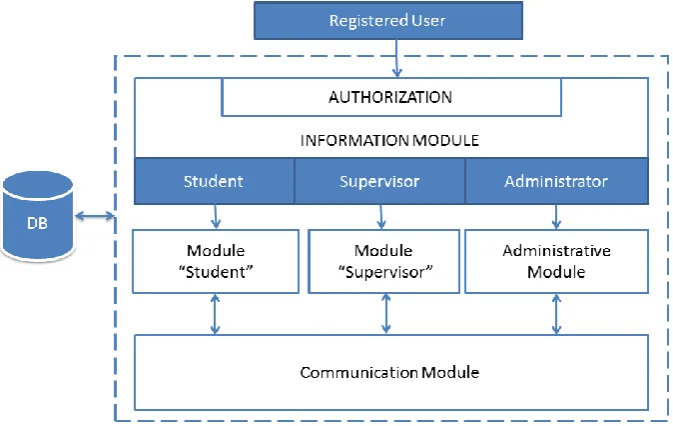
The functional model of the software system (Fig.1) includes basic modules, known from research management systems, expert and operational management systems.
Fig. 1. Functional model of specialized software system
The software system is intended for three types of target users: 1. Teachers, as graduate students’ supervisors; 2. Students, who complete their education with thesis writing; 3. Administration staff (e.g. Head of department), for which reason it must generate various queries and reports, and track the adequate involvement of the participants (Fig. 2).
Page 340
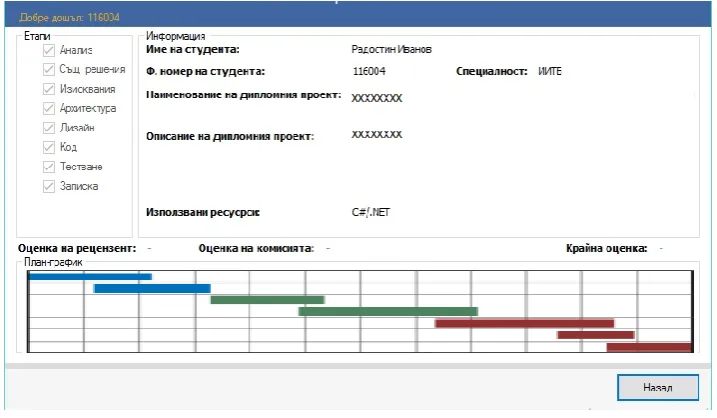
The software includes an application for automatic calculation of starting/final dates (scheduling), for tracking whether the tasks are executed by graduates and supervisors, for presenting the thesis progress in graphical form. It also provides calendaring the project stages pointing the effective dates of execution. Time duration of project stages is presented in Gantt charts. The charts are convenient to display if free time is available and whether task stages overlap. (Fig. 3)
Fig. 3. Screen accessed via student’s account
The observations on the application of the software system for managing thesis writing can be summed up in the following conclusions and recommendations:
Strongly dependent on information technologies, modern universities have to make relevant investments in the development and integration of newly released software. The adoption of suitable information systems allows optimizing the interaction between different authorities in academic institutions by improving the business processes and it turns into a source of tangible benefits.
The information systems include processes, tools and technologies for data conversion into information and knowledge so as to assist the effective decision-making.
Page 341 REFERENCES
Тодоров, Г, Г. Иванова & А. Смрикаров (2002) Влияние на информационните и комуникационните технологии върху развитието на висшите училища., Сб. н. тр. научна конф. РУ, Русе, 2002.
Baeva, D.(2013) Learning theories in computer-assisted foreign language acquisition, Сборники конференций НИЦ Социосфера, Vol 9
Emelyanova, N. & E. Voronina (2014) Introducing a Learning Management System at a Russian
University: Students’ and Teachers’ Perceptions, The International Review of Research in Open and Distributed Learning, Vol 15, No 1
Keegan, D., G. Kismihok, B. Krämer, N.Mileva, B. Simpson, B. Vertecchi.(2008) The Impact of new technologies on distance learning students, Research Report 3/2008, ISSN 1865-3944
Lonn, S., & Teasley, S. D. (2009). Saving Time or Innovating Practice: Investigating Perceptions and Uses of Learning Management Systems. Computers & Education, 53, 686-694.
Naveh, G., D. Tubin, & N. Pliskin (2010) Student LMS use and satisfaction in academic institutions: The organizational perspective, The Internet and Higher Education, Volume 13, Issue 3, Pages 127– 133
Selim, H. M. (2007). Critical success factors for e-learning acceptance: ConWrmatory factor models. Computers & Education, 49, 396−413.
Soong, B. M. H., Chan, H. C., Chua, B. C., & Loh, K. F. (2001). Critical success factors for on-line course resources. Computers & Education, 36(2), 101-120.