A CHEMISTRY TEACHER’S DRAMA IN THE GREEK HIGH SCHOOL WITH BIOLOGY AS THE PROTAGONIST
Stefanos Karageorgiou1, Eirini Savvidou2, Parthena Katikaridou2, Pericles D. Akrivos2, Hector Katsikis3
1
1st General Lykeio of Kilkis, 611 00 Kilkis, Greece
2
Aristotle University of Thessaloniki, Department of Chemistry, P.O.B. 135, 541 24 Thessaloniki, Greece
3
General Lykeio of Kassandra, 630 77 Kassandra, Greece
Abstract
Chemistry in the Greek secondary school suffers substantially more than other sciences owing, to the construction of its curriculum. The apparent and necessary interactions with the rest of the sciences and notably with Biology, affect the perception by the students of chemical aspects, mainly atomic structure, bonding and energetic. These interactions do not always promote the interdisciplinary nature of science, a problem mainly caused by the independent construction of the curriculum leading to several hysteron-proteron situations and, furthermore, application of different terminologies and/or interpretation in the two scientific domains. Some simple, cost-free amendments to the Biology textbooks currently used in the Greek high school are proposed in order to provide the necessary back-up for Chemistry and support the interdisciplinary approach in teaching both sciences. The presentation of the case is expected to act as an indication of situations to avoid in constructing or processing analogous curriculum in general.
Key words: Chemistry, Biology, secondary school, Science curriculum, chemical terms
1. INTRODUCTION
Teaching of Science is a topic that attracts interest in the recent days as far as the introduction of secondary school students to Science is concerned, mainly because in the present world it is practically impossible to live without any interaction with items or substances that are not related to some application of recent technological advances (Hodson 1992). Furthermore, since the Natural Law stands above human laws in the sense that it is not dictated by local beliefs and/or interests and applies to all material bodies alive or not in an identical and predictable way there is need for youngsters to be introduced to it at an age that would secure its firm incorporation to their knowledge (Armstrong 1973). Of course care must be taken, especially during the introductory period of Science to the secondary school students, because in the often quoted words of Isaak Asimov “science can be introduced to children well or poorly. If poorly, children can be turned away from science; they can develop a lifelong antipathy; they will be in a far worse condition than if they had never been introduced to science at all”. Furthermore, it is well documented that school science engages when it makes connections to the pupils’ everyday lives. “Hence the success of human Biology — knowledge whose application is immediate, transparent and unquestionable. Physics and Chemistry, in contrast, have less points of contact with pupils’ experiences” (Osborne & Collins, 2001). When such a straightforward connection is not evident help should be sought in the treasury of neighbouring sciences especially in the case of overlapping interests.
At the present Greek students of ages between 12 and 18, i.e. attending the three grades of Gymnasio (freely translated as junior high-school) and subsequently three grades of Lykeio (senior high-school), are expected to understand the intercalation between Chemistry and Biology mainly in the form of the chemical interpretation of biologically important phenomena. Such an attempt is, of course, not free from possible misconceptions like the confusion when similar or similarly sounding words are used bearing different meanings in the two scientific domains. A notable example is the recorded belief that atoms are like cells with membrane and nucleus and can reproduce following a nucleus division
(Wheeler & Kass 1978; Horton 2007). The situation is further complicated since the two scientific domains have different basic orientations and different objectives which gives rise to several inconsistencies as far as the much needed common scientific language is concerned. A common scientific language is required, in our belief, in order that young students would understand the unity of Science and the interdisciplinarity of the “separate sciences” they are introduced to. While the biological applications or relations are mentioned very often in the chemical textbooks it has been observed that the corresponding biological ones suffer from the occurrence of irrelevant remarks, or inaccurate representations, simplifications or extreme elaborations of aspects related to Chemistry and in this respect do not contribute in the above required objective as much as it would be desirable. Hoping to contribute towards a more unified science curriculum we point out at several cases where it is not so and therefore hope to help towards creating a common scientific background which would benefit all Greek high school students. Furthermore, we hope that the presentation of this case will help others to avoid getting into the same or similar situations when constructing or processing the specific scientific curriculae they are involved in teaching.
2. CHEMICAL EDUCATION 2.1 Need for chemical education
Science has become an essential part of children education during the last decades of the 20th century in an effort to keep future citizens literate about subjects that will govern their lives as adults. Chemistry as an integrated part of the Science corpus has to be taught and taught properly in order for the students to acquire a body of knowledge and incorporate it to their overall scientific knowledge. Scientific knowledge is indivisible and when people grow wise in one direction, they are sure to make it easier for themselves to grow wise in other directions as well (Asimov 1983, p.116). Unfortunately the term “chemical” has acquired the reputation of “dangerous” and inimical to the health since it is referred to, in everyday speech, in direct relation to chemical products which have caused or are capable of causing health problems to persons coming in contact with them and are regarded as alien to the environment and should be avoided at any cost. The same origins of information to the general public fail to recognize that everything existing in the present material word is composed of chemical compounds irrespective of their useful or hazardous nature. They do not develop the notion that Chemistry is one of the sciences which follows certain laws and rules, natural and not human in origin and that chemists are trying to understand these rules by performing experiments, analyzing existing natural materials and trying to synthesize new non-naturally existing ones which possess properties well-defined and well-established. It is these artificially produced materials that are termed as “chemicals” in an effort to discriminate them from naturally occurring materials and they provide the basis for the blind generalization of the term to include anything and everything that has or may have hazardous consequences if used.
It follows that the teacher of Chemistry at the secondary school has to overcome greater difficulties than his Physics and Biology colleagues in the sense that he has to fight the above prejudice in his approach of the young students before passing them the information that Chemistry is related to everyday life and culture in many ways through its applications for example in Medicine, Agronomics, Biology and Archaeology. In his efforts the Greek teacher of Chemistry aims at its designation as a central science like it has been done in several Western countries already and in this respect there is an adequate list of allies in the form of the wide interdisciplinary aspects of Chemistry, however there are several drawbacks which hold back the achievement of this goal.
2.2 Chemical education in the Greek high-school
Chemical education in the Greek secondary school suffers from the general drawbacks present in the Greek educational system as well as the additional problems associated with the existence or not of appropriate laboratory classroom, its adequate or not equipment and the need to use it as a common classroom for several other classes besides Chemistry due to lack of space. An additional drawback is
the absence of any auxiliary personnel, even not substantially qualified; therefore demanding that the full care of the laboratory in both the pre- and post- experimental periods be the sole responsibility of the teacher. Furthermore the discussion of abstract ideas like “reactivity” or the micro-world of atoms for which the students do not have any prior perception or equivalent common experiences adds to the difficulty in understanding the terms which are related to them. A final problem is the use of the symbolic language of Chemistry to which the students are not introduced properly and, upon occasional orders issued by the Ministry of Education are explicitly required not to be introduced to, the formal way to put it being “to avoid formalism”.
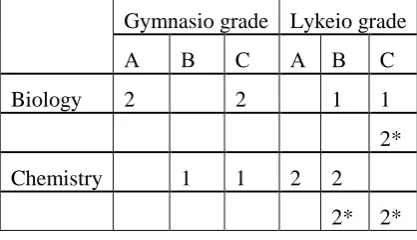
A simple look at the recently established curriculum presented in Table 1 reveals that first year Gymnasio students (being in their seventh year of the total nine-year compulsory educational system) have a two hour per week class in Biology and none in Chemistry (or in Physics too). It appears, therefore, that the institutional power and influence of the Biology association by far exceeds that of the corresponding Physics and Chemistry ones in Greece or at least it was so over a period of at least ten years (Kind & Taber 2005). On the contrary in their following year they have to follow a one hour per week Chemistry class and no Biology while in their third and final grade at this level they attend classes of both sciences with Biology dominating by two hours to one per week over Chemistry.
Table 1. Hours per week for teaching Biology and Chemistry throughout the secondary school. Asterisks indicate hours devoted to teaching to students that have elected to follow the scientific
direction. In general they represent 15-20% of the total students.
Gymnasio grade Lykeio grade
Α Β C Α Β C
Biology 2 2 1 1
2*
Chemistry 1 1 2 2
2* 2*
There is no need to emphasize at this point that the limited hours of Chemistry teaching provoke application of teaching techniques relying mainly on justification of chemical concepts which has an impact of its own on the cognitive understanding of chemical aspects (Van Aalsvoort 2004). Furthermore, precedance of Biology in the high school provides grounds for the formation of preconceptions on chemical aspects which will be harder to amend at a later stage (Coll & Treagust 2002; Ozmen 2004).
2.3 Biological interference to chemical education
Some of the drawbacks in teaching Chemistry to the secondary school can be overcome by applying the well-known approach of metaphor (Lakoff & Johnson 1980) or the well-defined interdisciplinary concept which has a very profound role among the sciences. In this respect and since Chemistry draws to a certain degree on physical aspects and provides grounds for understanding and interpretation of a wide range of biological phenomena, the support it can get from Physics and Biology is valuable. However, this does not appear to occur in the Greek high-school and there are several lines of thought about what is wrong in this inter-scientific interaction scheme. The use of different terminologies between scientists-teachers within each of the above scientific domains when referring to the same concept has been indicated as the main reason (Garnett et al. 1995) and efforts are made in order to remove, wherever possible, the unavoidable overlapping or at least to introduce in the textbooks some supporting information related to topics which are of key importance to the “neighboring” science. The main cause for this is, in our belief, the independent construction and the different epistemic aims
of the curricula of the sciences which provide grounds for the occurrence of dramatic hysteron-proteron situations which further help to build-up and/or retain confusion and misconceptions among the young students.
Following is a presentation of several points in the current Greek high-school Biology textbooks where little, none or erroneous reference is made to chemical principles while a proper one would benefit the teaching of both sciences. The majority of these points addresses the main and important aspect of chemical bonding which by itself presents an area susceptible to misconceptions within the Chemistry curriculum (Taber 2011).
In the introductory chapter of the Biology textbook for Gymnasio grade A there is a well-placed paragraph providing the definition of the scientific method. This is especially useful since Biology is the only science taught at this grade. It is stressed therein that observation consists the basis of the scientific method followed by reasoning. It clearly omits the essential part of experimentation and interpretation of experimental results in the form, if possible, of mathematical formulae. It becomes therefore more tedious for Physics and Chemistry teachers who will come in contact with the students during the next year of their studies to elevate experiment to its normal status and significance within the scientific method process. This is clearly a misunderstanding on the side of the biologists who undertook the task of preparing the textbook and not a case of simplification since it does not appear to lead to some conceptual development (Taber 2008).
In Chapter 2 of the same textbook there is reference to chemical compounds in a way that is certain to provoke misunderstandings among the students. There exist frequent references to “compounds” especially when dealing with nutrition and digestion (hydrochloric acid is specifically named and the term “enzyme” is also present in the text) while there is just a single one such to “chemical compounds” in the opening paragraphs of the chapter where there is also present a descriptive term about “simple” and “composite” compounds. This has been proved to provoke a widespread misconception among students who tend to regard common everyday materials as simple whatever their composition may be (Bouma & Brandt 1990; Ryan 1990). Furthermore, the term “compounds” in general and, without any additional characterization, is related by the students to the very existence of the cell and therefore of the living organisms and may conceptually be regarded as different from the explicit term “chemical compound” which is presented in the Chemistry textbook of the following year where it further indicated that there exist potential hazards from the use of certain chemical compounds.
Lack of reference to “chemical” compounds is also notable in the chapter dealing with blood and its constituents. It has been argued that introduction of the term “substance” should be made prior to any related discussion of the atom because it relates more directly to students’ own experiences (Vogelezang 1987), however it has also been pointed out that the term cannot stand alone as a concept because 11-14 year old students intuitively relate it to other “component” ideas developing an understanding of the word different from the scientific one (Johnson 1996).
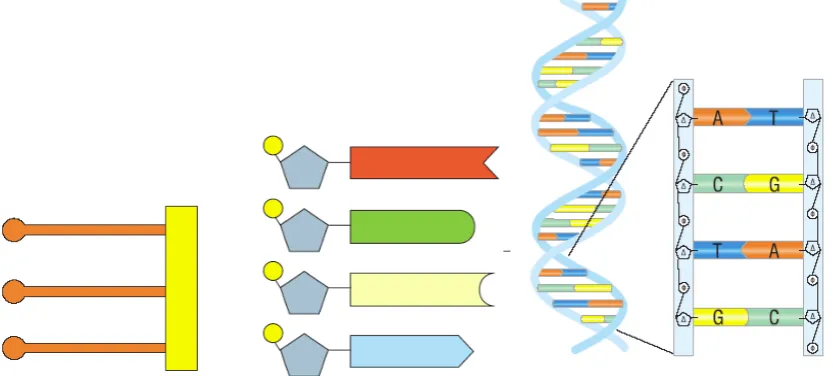
Biology is taught again at the third grade of the Gymnasio, now alongside Physics and Chemistry. At this point the students have had a year of 1 hour per week introductory Chemistry. They lack however basic knowledge of Organic Chemistry and they cannot relate terms like “protein”, “hydrocarbon”, “lipid” or “nucleic acid” to any structure let alone physico-chemical property and reactivity. Of course the aim of the Biology curriculum at this stage is to present a descriptive term for each of the above as well as other groups of compounds and one should not overlook it (Taber 2000). However, there is need to describe these chemical compounds in a way that will be easily incorporated into the scientific background of the students when they will come to know of them in chemical terminology within the chemical curriculum. Consistency of nomenclature and presentation should be something not just desirable but rather required among the sciences and this goal is not approached effectively by the selected representations of biologically important chemical compounds described in the textbook. For example the schematic approach to the lipid and nucleic acid groups (Figure 1) although informative of the presence within these molecules of discrete constituents drawn in different colors provides no indication that the chemical bonds between the constituents are of identical nature in both groups of
compounds. Instead, in the lipid draw one gets the idea that the two parts of the molecule are stuck to each other like lego bricks while in the nucleic acids one can clearly identify some “thread” connecting in pairs the three constituents. Furthermore the different colors are not explained and it is only in a subsequent chapter where the schematic representation of the nucleic acids is repeated that the differently shaped and colored terminal parts are related to specific compound names. At that point there appears also a reference to the complementarity of the nucleic acids and their pair wise interactions are implied but not discussed nor related to any chemical property. The only way that a student can deduce this complementarity principle is by inspection of the figures presented (Fig. 1) in case they can be understood as parts of a jigsaw puzzle. A uniform presentation of the chemical bonding between any two fragments within any type of molecule discussed should be applied for the sake of underlying the similarity of the interactions presented. The presentation itself may be chosen in any way that would satisfy the intended balance between the aims of realism, precision and generality of the Biology curriculum.
One of the main sufferings of Chemistry is its symbolic language (Gabel 1999) and the effort needed in order to make it simple and clear and at this point the young Greek students have been just and only marginally introduced to this language. It is our opinion that a common approach concerning the presentation of chemical bonding should be adopted by every science making use of the chemical bonding concept during its classes and this approach should rely mainly on the symbolic language of Chemistry. To add to the problem, in the chapter where the genome is discussed, it is stated that the DNA consists of nucleotides connected with strong bonds while their chains are connected in pairs through weak bonds formed between their nitrogen-containing bases (the above mentioned colored terminal parts). Weak and strong bonds have not been mentioned before in the text nor are they standard descriptions of chemical bonds and the nomenclature used is at least obscure to the students and no doubt is not defined appropriately by the Biology teachers. In addition the chapter contains the typical DNA double helix with detail designed to reveal the interaction between the two chains where again the nitrogen-containing bases appear to be interlocked in a lego-brick fashion depriving any further teaching of the nature of the chemical bond of its main characteristic, namely that the interacting atoms are not actually in touch with each other. In fact the contact of the atoms participating in a bond forms one of the universal student misconceptions (as quoted in Driver et al 1994, chapter 11).
Figure 1. Schematic representations of a lipid (left) the nucleic acids (middle) and the DNA double helix (right) as presented in the junior high-school grade C Biology textbook.
The lack of proper reference to chemical principles and therefore dismissal of interdisciplinarity between Biology and Chemistry continues in the biological textbooks taught in the three Lykeio grades (forming the first non-compulsory step of the Greek education system). In the first Lykeio
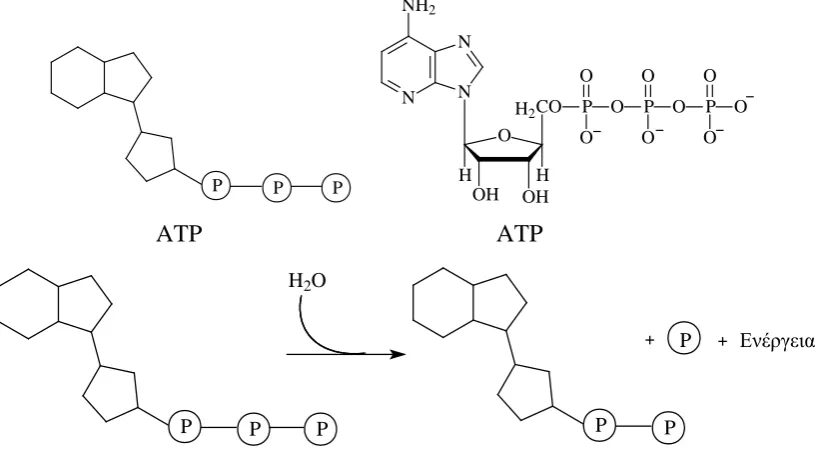
grade Biology textbook there exists a vast number of references to the interactions and reactions occurring within the living cell but nowere are they referred to as chemical reactions. This again subtracts a substantial positive weight from the term “chemical” which remains only related to some potentially dangerous processes discussed, as they should, in the corresponding chemistry textbooks. The numerous occurrences of the terms ATP, ADP, phosphorylation and lactic fermentation cannot be overlooked; however there is total lack of chemical description even in the supporting information sections of the appropriate chapters. A proposal about a consistent abstract scheme which would serve the purpose of underlying the chemical significance of the above terms is presented in Figure 2, providing two options for the representation of ATP and one for the phosphorylation reaction.
Directly related to the above is the absence of relevant chemical information in the introduction of hormones which are stated to be “...chemical-substances messengers which although they reach all the cells they stimulate selectively the target-cells to perform specific biochemical activities”. No indication of the stimulation mechanism is given although a nice picture giving the traditional key-lock scheme has been presented in the textbook at the third Gymnasio grade in relation to the term “biological catalyst”.
P P P
ATP
N N
N NH2
O
OH OH CO
H H
P O
O O P
O
O O P
O
O O H2
ATP
P P P P P
P P H2O
Ενέργεια
Figure 2. Proposed simple representations of the ATP molecule (above) and the phosphorylation process (botton). The two presentations of ATP are in accordance with analogous presentations both occurring within the same Biology textbook. Our proposal is to choose whichever fits the needs of the
Biological educational approach and keep it throughout the text.
In the textbook of the second Lykeio grade there is almost complete substitution of Organic Chemistry about which the student has been taught practically nothing in the preceding grade. In the numerous references to biological macromolecules there is not an indication about the bonds existing between the constituent monomeric units and only in the case of peptides there is a description of this bond in an erroneous way, i.e. “... constituent aminoacids are connected through the same basic chemical mechanism called condensation”. Clearly condensation is the process by which the bond is formed. There are references to other types of biological polymeric compounds like DNA where the process of condensation is referred to again giving the wrong impression that it is the same like in protein formation. Furthermore in a later chapter there exists a pictorial representation of the formation of a protein where two different aminoacids are shown to form a variety of tripeptides (Figure 3). Contrary to chemical intuition as well as to the content of the chapter the bonds assumed between the constituent aminoacids are nowhere to be seen in any of the previously used representations.
A variety of other bonding interactions are mentioned in the same chapter, notably hydrophobic interactions, hydrogen bonds and even van der Waals interactions about which the student will only come to know at a later stage and only if he/she has chosen to take up the scientific direction, which generally less than 15 % of the students are attending. In this respect the lack of any chemically based explanation does not offer much to the understanding of the phenomena by the students. Only hydrogen bonding is described in the supporting information section at the end of the chapter but then it is only restricted to the hydrogen bond between water molecules and the students are allowed to find out by themselves the correspondence with the hydrogen bonds in DNA and RNA macromolecules.
Figure 3. Schematic representation used to describe the formation of various tripeptide sequencies produced using two aminoacids A and Σ.
A more general note regarding Chapter 2 is that there exist again numerous references to “procedures” that take place within the cell but none to “chemical reactions”. The term is true and exact and at this stage students are expected to give it the full apprehension it deserves.
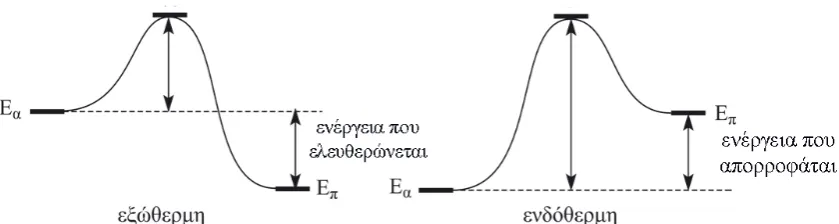
In Chapter 3 where the metabolic reactions are discussed there is reference to endothermal and exothermal reactions for which nothing is known as far as their chemical background is concerned. Instead of introducing in the supporting information section some explanation and possibly a simple diagram to visualize the various terms like the one we present in Figure 4, there is yet another mention and presentation of ADP and ATP molecules. What is more interesting is that a related pictorial representation appears in a form more suited for students belonging to a cognitive age preceding the one expected for 17-year olds and it is presented at a later section when catalysts are being discussed.
Numerous other cases appear in the rest of the text as well as in the textbook of Lykeio grade C, where a term for a group of compounds or organisms (notable examples are acetyl coenzyme A, hydrocarbons, heterocyclic compounds, antibodies, interferons) appears without any previous notification, without taking into consideration that the Chemistry curriculum does not offer analogous information and without presenting the needed chemical information in the supporting material part of the text.
Figure 4. Proposed simple diagram to account for exothermal and endothermal reactions.
3. CONCLUSIONS
There are several cases in which the Biology curriculum adopted by Greek secondary schools presents inconsistencies with the concurrent one of Chemistry to which it has close contact throughout the six year span of the secondary school education program. Several points are described in the present work where inaccuracies, oversimplifications, hysteron-proteron descriptions and pictorial representations can be amended without any loss of integrity or alteration of the basic principles and aims of the biological curriculum while at the same time sound support will be given to the corresponding chemical one.
REFERENCES
1. Armstrong, DM 1973, Belief, Truth and Knowledge. Cambridge University Press.
2. Asimov, I 1983, The Roving Mind, Prometheus Books.
3. Bouma, J & Brandt, L 1990, ‘Words as tools: A simple method for the teacher to obtain information on pupils' preconceptions’, Journal of Chemical Education, vol. 67, no. 1, pp. 24-25.
4. Coll, RK & Treagust, DF 2002, ‘Exploring tertiary students’ understanding of covalent bonding’, Research in Science and Technological Education, vol. 20, no. 2, pp. 241-267.
5. Driver, R Squires, A Rushworth, P & Wood-Robinson, V 1994, Making sense of secondary science: Research into children’s ideas, Routledge, New York.
6. Gabel, D 1999, ‘Improving Teaching and Learning through Chemistry Education Research: A Look to the Future’, Journal of Chemical Education, vol.76, no. 4, pp. 548-553.
7. Garnett, PJ, Garnett, PJ & Hackling, MW 1995, ‘Students' Alternative Conceptions in Chemistry: A Review of Research and Implications for Teaching and Learning’, Studies in Science Education, vol. 25, pp. 69-95.
8. Hodson, D 1992, ‘In search of a meaningful relationship: an exploration of some issues relating to integration in science and science education’, International Journal of Science Education, vol. 14, no. 5, pp. 541–562.
9. Horton, C 2007, ‘Student Alternative Conceptions in Chemistry’, California Journal of Science Education., vol. 7, no. 2, pp. 1-78.
10. Johnson, PM 1996, ‘What is a substance?’, Education in Chemistry, vol.33, no. 2, pp. 41-42.
11. Kind, V & Taber, KS 2005, Science: Teaching School Subjects 11–19, Routledge, London as reported in Taber (2008).
12. Lakoff, G & Johnson, M 1980, Metaphors We Live By. University of Chicago Press, Chicago.
13. Osborne, J & Collins, S 2001, ‘Pupils’ views of the role and value of the science curriculum: a focus-group study’, International Journal of Science Education, vol. 23, no. 5, 441–467.
14. Ozmen, H 2004, ‘Some Student Misconceptions in Chemistry: A Literature Review of Chemical Bonding’, Journal of Science Education and Technology, vol. 13, no. 2, pp. 147‐170.
15. Ryan, C 1990, ‘Student Teachers’ Concepts of Purity and of States of Matter’, Research in Science and Technological Education, vol. 8, no. 2, pp. 171-183.
16. Taber, KS 2000, ‘Finding the optimum level of simplification: the case of teaching about heat and temperature’, Physics Education, vol. 35, no. 5, pp. 320-325.
17. Taber, K 2008, ‘Towards a Curricular Model of the Nature of Science’, Science & Education, vol. 17, no. 2-3, pp. 179-218.
18. Taber, KS 2011, ‘Chemical bonding’, Education in Chemistry, vol. 48, no. 3, pp. 87-91.
19. Van Aalsvoort, J 2004, ‘Logical positivism as a tool to analyse the problem of chemistry’s lack of relevance in secondary school chemical education’, International Journal of Science Education., vol. 26 , no. 9, pp. 1151–1168.
20. Vogelezang, MJ 1987, ‘Development of the concept ‘chemical substance’‐some thoughts and arguments’, International Journal of Science Education,vol. 9, no. 5, pp. 519-528.
21. Wheeler, AE & Kass, H 1978, ‘Student misconceptions in chemical equilibrium’, Science Education, vol. 62, no.2, pp. 223-232.