INTRODUCTION
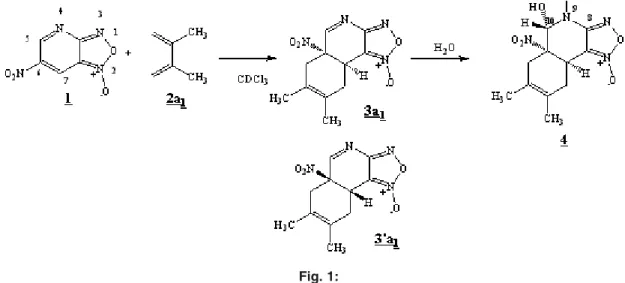
Experimental study done by auteurs shows that the addition of 2,3-dimethylbutadiene to a solution of 4-aza-6-nitrobenzofuroxan 1 in CDCl3 gives the product 3a1 and 3’a1.The auteurs carry out another experience, under similar conditions, but with a longer reaction time this reaction did not allow the isolation of 3a1 and 3’a1, but in adding advantage water in the solution, he obtained the hydrate 4, likes pale yellow solid, resulting from the reaction of 3a1. The structure of 4 was determined by X-ray crystallography, which confirm that the addition of H2O has taken place at the C10=N9 double bond¹.
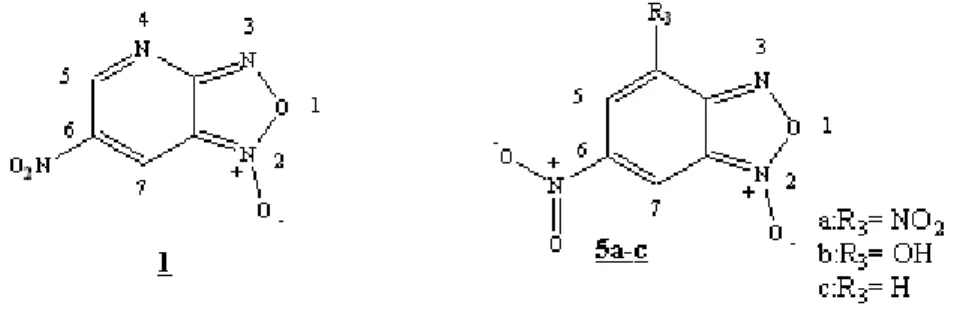
Recently, it has been showed that the nitrobenzofuroxan (DNBF) are able to react as a dienophile or heterodiene in the Diels-Alder reactions [2-5]. In first stage, we have choice the 6-nitrobenzofuroxane molecules which looks like the 4-aza-6-nitrobenzofuroxan 1. We have only substitue the nitrogen atome number 4 of the molecule 1 by the C-R3 groupment, then we obtient the molecules 5a-c (figure 2) which seems
Oriental Journal of Chemistry Vol. 24(1), 121-128 (2008)
Theoretical study of the heterocyclic molecules reactivity
in the normal electron demand Diels-Alder reaction
SAMEH AYADI¹, KHALED ESSALAH,
SLAHEDDINE KRICHANE and MANEF ABDERRABBA
¹Unite de recherche Physico-Chimie Moleculaire. IPEST, Boite postale 51, 2070 la Marsa, Tunisie.
(Received: February 25, 2008; Accepted: April 11, 2008) ABSTRACT
The purpose of this work is a theoretical study of the Diels-Alder reactions between, a diene 2 like 2,3-dimethylbutadiene 2a1 and 2-trimethylsilyloxybuta-1,3-diene 2b1 with a series of 6-nitrobenzofuroxane 5a-c . From a thermodynamic and orbital point view, we discuss the possibility and the stereoselectivity of these kinds reactions.
Key words: normal electron demand Diels-Alder (NEDDA), DFT method, DNBF.
particulary interessants for experimental study. The diene substitution was studied by substitution of 2,3-dimethylbutadiene 2a1 by the 2-trimethylsilyloxybuta-1,3-diene 2b1. In order to find the better calculation method which lead to better convergence for these kind of system, we have optimazed molecule 4 by two different method SCF/ 6-31G and DFT/B3LYP with the basis set 3-21G. In second stage, we have studied the addition of diene 2a1-b1 on the 6-nitrobenzofuroxane 5a-c. In the end, from thermodynamic and orbital point of view we have discussed the possibility and the stereoselectivity of normal electron demand Diels-Alder reaction.
Theoretical study of the compound 4 Calculation method
the gradient method available in GAUSSIAN 98. Calculations of harmonic vibrational frequencies were carry out to determine the nature of each critical point.
RESULTS
In order to deter mine the reliability calculation methods in the treatment of this system type, we optimized the geometry of the compound 4. Putting in mind the stereochemistry of this molecule 4, we compare our theoretical results with the experimental data of the X-ray [1]. Table 1 regroups some geometric parameters of the optimized molecule and the X-ray data.The figure 2 shows the stereochemistry of the molecule 4 optimised at DFT level.
The SCF/6-31G and DFT method give result which agree with the experimental X-ray data of the compound 4. We noticed that the DFT method gives the best results. Therefore the calculation method of DFT/B3-LYP with the standard basis set 3-21G is more reliable with this system type9.
The geometry parameters data assigned to 4 is in complet agreement with our theoretical results. The distance ( dH7-H10 =2.47 A°) calculated by DFT/B3Lyp with the standard basis set 6-31G was in good accord with the distance obtained by X-Ray crystallography : dH7-H10 = 2.186 A°.
Fig. 1:
Table 1 : Selected optimized geometrical parameters for the compound 4
SCF/ DFT/3 X-ray [6]
6-31G -21G
N4-C5 1.457 1.455 1.445
C7-C10 1.525 1.526 1.537
C11-C12 1.348 1.347 1.327
N2-C6 1.565 1.563 1.536
C5-O5 1.414 1.412 1.408
N4-C9 1.354 1.391 1.366
C13-C12 1.487 1.489 1.499
C6-C7 1.473 1.474 1.543
C5-C6 1.449 1.448 1.547
N4-H4 1.001 1.001 0.86
C9-N4-C5 115.373 115.377 115.8 N4-C5-C6 124.34 124.257 109.37 C5-C6-C7 119.587 119.585 111.81 C6-C7-C8 109.287 109.285 105.06 C11-C12-C13 121.030 121.050 122.55 C10-C11-C12 118.347 118.415 123.16 C7-C10-C11 108.642 108.768 116.39 C7-C8-C9 125.381 125.546 125.72 Distances are in Angstrom (A°) and Angles in degrees (°)
Vibrational analysis
IR spectra calculate by DFT/3-21G method are also in accord with the experimental one (νC6=C5(theo) =1755 cm-1 et ν
Fig. 2:
Fig. 3: DFT/ B3-LYP optimized geometries of the compound 4
We noticed that the DFT method using the functional B3LYP and the standard basis set 3-21G gives the most resultats with this type of heterocyclic molecules. Therefore, we continuous the thermodynamic study on Diels-Alder reaction between the heterocyclic molecules such as 4-aza-6-nitrobenzofuroxan 1 and 4-aza-6-nitrobenzofuroxan 5a-c with the diene 2a1-b1, by using the DFT method with the functional B3LYP and the standard basis set 3-21G of the GAUSSIAN 98 program6. DFT study of Diels-Alder reaction
Like the figure 4 shows, we have studied the possibility and also the stereoselectivity of normal electron demand Diels-Alder reaction between heterocyclic molecules such as 4-aza-6-nitrobenzofuroxan 1 and 6-4-aza-6-nitrobenzofuroxan 5a-c with the diene 2a1-b1. The diene is activated by the substituant groupement – ( CH3) or – (OSi (CH3)3.
In the case of diene 2a1-b1 addition on the 6-nitrobenzofuroxane 5a-c, we have focussed our attention to study the R3 groupement on the Diels-Alder reaction. This study seems to be interessant from synthetic point of view.
The orbitals border study
We have determinated the LUMO and the HOMO of diene 2a1-b1, by DFT/B3LYP with standard basis set method, and as well the LUMO and the HOMO of molecules 1 and 5a-c see table I. In each case of these reactions, the orbital diagramm between the molecules 1 and the diene 2a1-b1, give a very good quantitatively indication about the reactivity of our system. The most predominant interaction existe between the LUMO of dienophile and the HOMO of diene 2a1-b1. Therefore these reactions could be considered like the Diels-Alder reaction with nor mal electron demand10,11. As example, we present Fig 5.
Table 1: The LUMO and the HOMO of diene 2a1-b1 and heterocyclic molecules such
as 4-aza-nitrobenzofuroxan 1 and 6-nitrobenzofuroxan 5a-c
LUMO HOMO
1 -0.132 -0.254
5a -0.179 -0.289
5b -0.149 -0.256
5c -0.151 -0.264
2a1 -0.005 -0.225
2b1 -0.021 -0.217
Fig. 4:
Fig. 5 : orbital diagram between molecule 5c with le diene 2a1. DFT/3-21G The table 1 shows, that the difference of
energy HOMO-LUMO is smaller in the case of the diene 2b1 reaction with the molecule 5a that in the case of the reaction between 2b1 with 5c. Therefore the reaction should be easier in the case of the diene 2b1 addition on the molecule 5a.
Study of regioselectivity reaction
The study of (2pz) coefficients of the border orbitals by DFT/3-21G level for the 4-aza-6-nitrobenzofuroxan 1 and 6-4-aza-6-nitrobenzofuroxan 5a-c
show that the LUMO coefficient of carbone C5 is always less then carbone C7 (Table II).This means that the addition of diene 2a1-b1, appear more reactif on the molecules 1 and the 5a-c is obtained firstly on carbone C7. This constatation is agree with experimental resultats in the case of diene 2a1 add on the 4-aza-6-nitrobenzofuroxan 1¹.
In pur pose to deter mine the stereoselectivity of the reaction between the molecules 5a-c and the diene 2b1, we have Ayadi et al., Orient. J. Chem., Vol. 24(1), 121-128 (2008)
Table 2 : The LUMO Coefficient of carbone C5, C6 and C7of molecule 1 and 5a-c, The HOMO coefficient of carbone C’1 and C’4 of diene 2a1-b1.
LUMO coefficient LUMO coefficient LUMO coefficient
of C7 of C6 of C5
1 0.241 0.255 -0.145
5a 0.201 0.241 -0.145
5b 0.183 0.226 -0.134
5c 0.153 0.186 -0.138
HOMO coefficient of HOMO coefficient of
C’1 C’4
2a 0.285 0.285
2b 0.236 0.264
calculated the (2pz) coefficient of LUMO for diene 2b1 and also the 2pz coefficient of LUMO which correspond to carbone C7 and C6 of molecules 5a-c and this leads to the formation of produ5a-ct 6. The formation of (1’)-(7) and (4’)-(6) liaisons are more favorised. See the example on Fig 5 Thermodynamic approach
As it is shows in figure 6, we studied the interaction of this heterocyclic molecules1 and 5a-c with the diene 2a1-b1. The heterocyclic molecules react as dienophile and the molecules of 2,3-dimethylbutadiene 2a1 and 2-trimethylsilyloxybuta-1,3-diene 2b1 react as a diene, Therefore we have a normal electron demand Diels-Alder (NEDDA). We found, it is interesting to examine from a thermodynamic approach the possibility and the stereoselectivity of Diels-Alder reactions. In each case of these reactions, we calculated by the DFT / B3LYP with the standard basis set 3-21G, the
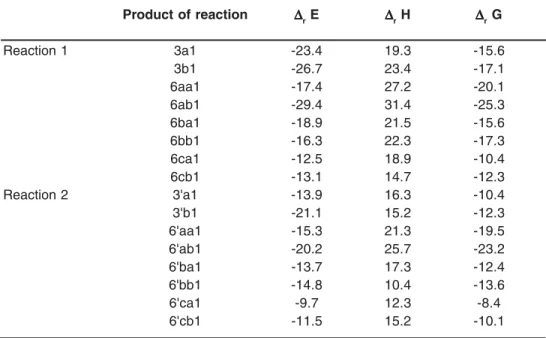
variation of free energy ΔrG (Kcal.mol-1) correspond to every type of reaction.The table III regroups the different values obtained by the DFT method.
The reactions (I) and (II) between the 2,3-dimethylbutadiene 2a1 with the benzofuroxane molecules 5a-c and molecule 1 are possible, since the variation of free energy are negative. On the other hand , we sudy the add of the 2-trimethylsilyloxybuta-1,3-diene 2b1 to the molecules 5a-c and 1. We notice that reactions (I) and (II) are possible and favored thermodynamically.
Fig. 5: orbitalairy interaction between the HOMO coefficient of the diene 2b1 with LUMO coefficient of the dienophile 5a.
Table 3: Thermodynamic results for some reaction calculated at the DFT/B3LYP level of theory. (Kcal.mol-1)
Product of reaction ΔΔΔΔΔr E ΔΔΔΔΔr H ΔΔΔΔΔr G
Reaction 1 3a1 -23.4 19.3 -15.6
3b1 -26.7 23.4 -17.1
6aa1 -17.4 27.2 -20.1
6ab1 -29.4 31.4 -25.3
6ba1 -18.9 21.5 -15.6
6bb1 -16.3 22.3 -17.3
6ca1 -12.5 18.9 -10.4
6cb1 -13.1 14.7 -12.3
Reaction 2 3'a1 -13.9 16.3 -10.4
3'b1 -21.1 15.2 -12.3
6'aa1 -15.3 21.3 -19.5
6'ab1 -20.2 25.7 -23.2
6'ba1 -13.7 17.3 -12.4
6'bb1 -14.8 10.4 -13.6
6'ca1 -9.7 12.3 -8.4
6'cb1 -11.5 15.2 -10.1
From these results, we can give answer about some experimently question¹. In fact, the addition of H2O molecule could be done only on the majority of the reaction product. For this reason, the addition of H2O is done only on the C10=N9 bond of product 3a1 which could be considered from our calculation as the majority reaction product.
In each case of reactions (I ) and (II ), we have determine the energy which leads to the formation of reaction product. We have make the follow constatation that the energy formation of endo products 6 is more weak then the energy formation of exo products 6’. This is a new confirmation of the stability of endo products which is considered as major product part of Diels-Alder reaction between the molecules 1 and 5a-c with the diene 2a1-b1. Ayadi et al., Orient. J. Chem., Vol. 24(1), 121-128 (2008)
126
CONCLUSION
We study the Diels-Alder reaction between a diene 2 like 2,3-dimethylbutadiene and 2-tr imethylsilyloxybuta-1,3-diene with 6-nitrobenzofuroxane 5a-c, which is specially interesting for scientist in experimental workshop. Therefore the diene is actived by differents substituants and the 6-nitrobenzofuroxane 5
substituate by –NO2, -OH and -H. We also study the influence by R1 and R2 in the Diels-Alder reactions.Our theoretical results show, that the reactions (I) give always the main product which is the endo products.the reaction between the diene 2-trimethylsilyloxybuta-1,3-diene 2b1 and DNBF 5a gives most results than DNBF 5a with the diene 2,3-dimethylbutadiene 2a1.
REFERENCES
1. F. Terrier, M. Sebban, R. Goumont, J.C. Hallé, G. Moutiers, E. Buncel, J. Org. Chem., 65: 7391 (2000).
2. J. C. Hallé, D. Vichard, M. J. Pouet, F. Terrier J. Org. Chem., 62: 7178 (1997).
3. P. Sepulcri, J. C. Hallé, R. Goumont, D. Riou, F. Terrier, J. Org. Chem., 64: 9254 (1999). 4. P. Sepulcri, R. Goumont, J. C. Hallé, D. Riou,
F. Terrier, J. Chem. Soc., Perkin Trans. 2: 51 (2000).
5. D. Vichard, L. J. Aley et F. Terrier, Tetrahedron Letters, 42: 7571-7574 (2001).
6. M.J.Frisch, G.W. Trucks, H.B.Schlegel, G.E. Scuseria, M.A.Robb, J.R. Cheeseman, V.G. Zakrzewski, J.A.Montgomer y, Jr., R.E. Stratmann, J.C. Burant, S. Dapprich, J.M. Millam, A.D.Daniels, K.N. Kudin, O. Farkas, J. Tomasi, V.Barone, M.Cossi, R. Cammi, B. Mennucci, C.Pomelli, C. Adamo, S. Clifford, J. Ochterski, G.A. Petersson, P.Y. Ayala, Q. Ayadi et al., Orient. J. Chem., Vol. 24(1), 121-128 (2008) 127
Fig. 6: DFT study of normal electrons demand Diels-Alder reaction between the diene 2a1-b1 with some heterocyclic molecules such as the 4-aza-6-nitrobenzofuroxane
Cui, K. Morokuma, P.Salvador, J.J. Dannenberg, D.K.Malick, A.D. Rabuck, K.Raghavachar i, J.B.Foresman, J.Cioslowski, J.V.Or tiz, A.G. Baboul, B.B.Stefanov, G.Liu, A.Liashenko, P. Piskorz, I.Komaromi, R. Gomperts, R.L.Martin, D.J. Fox, T. Keith, M.A. Al-Laham, C.Y. Peng, A. Nanayakkara, M. Challacombe, P.M.W.Gill, B. Johnson, W.Chen, M.W. Wong, J.L.Andres, C.Gonzalez, M. Head-Gordon, E.S.Replogle, J.A.Pople, Gaussian 98, Revision A.11, Gaussian, Inc., Pittsburgh PA, (2001). 7. Lee C.; Yang W.; Parr R.G. Phys. Rev. B, 37:
785 (1988).
8. Becke A.D Phys. Rev. A., 38: 3098 (1988). 9. Goldstein E.; Brett Beno; Houk K. N.; J. Am.
Chem. Soc., 118: 6036 (1996).
10. Carruthers W.Cycloadditions Reactions in Organic Synthesis ; Tetrahedron Organic Chemistry Series, Vol 8;Pergamon; New York, (1990).
11. a) Fleming I, Frontier Orbitals and Organic Chemical Reactions, John Wiley and Sons, New York, 1976. b) Houk K.N.; Li Y.; Evanseck J.D. Angew. Chem, Int. Ed. Engl. 31: 682 (1992).