Survey on Cluster-based Wireless Sensor
Network (WSN) Methods for Secure & Efficient
Data Transmission
Swapnil S. Jagtap PG Student
Department of Computer Engineering
Vidya Pratishthan’s College of Engineering, Baramati – 413133, India
Abstract
Secure information transmission is a basic issue for Wireless Sensor Networks (WSNs). Clustering is a practical approach to improve the execution of WSNs. In this paper we study about the safe and efficient data transmission in Cluster based Wireless Sensor Networks (CWSNs). Here two Secure and Efficient data Transmission (SET) protocols are proposed namely (SET-IBS) and (SET-IBOOS) by using digital signature schemes. The SET-IBS security depends on the hardness of the discrete logarithm issues. In this paper the feasibility of the SET-IBS and SET-IBOOS protocols is shown with respect to the security requirements and analysis against various attacks. The calculations and simulations are given to represent the effectiveness of the proposed execution over the current secure protocols for CWSNs, as far as security overhead and energy consumption is considered. A WSN system consist of distributed devices using wireless sensor nodes to monitor the physical or the environmental conditions, such as sound, temperature, air, vibration and motion. The individual nodes in WSN are capable of sensing their environment, processing the information locally and sending data to one or more collection points in WSN. In this process efficient data transmission is one of the most important issues in WSN. Many WSN are deployed in extreme physical environments for applications such as military domains, natural or artificial disasters or certain rescue operations with trustless surroundings. Secure and efficient data transmission is thus especially necessary and is demanded in many such practical WSNs.
Keywords: Cluster-based Wireless Sensor Networks (CWSNs), Secure and Efficient data Transmission (SET), Identity-Based digital Signature (IBS), Identity-Identity-Based Online/Offline digital Signature (IBOOS)
_______________________________________________________________________________________________________
I. INTRODUCTION
A wireless sensor network (WSN) is a network system comprised of spatially distributed devices using wireless sensor nodes to monitor physical or environmental conditions like temperature, sound, pollution levels, humidity, wind speed and direction, pressure, etc. WSNs were initially designed to facilitate military operations but its application has since been extended to health, traffic, and many other consumer and industrial areas. A WSN consists of anywhere from a few hundreds to thousands of sensor nodes. The sensor node equipment includes a radio transceiver along with an antenna, a microcontroller, an interfacing electronic circuit, and an energy source, usually a battery. The size of the sensor nodes can also range from the size of a shoe box to as small as the size of a grain of dust. As such, their prices also vary from a few pennies to hundreds of dollars depending on the functionality parameters of a sensor like energy consumption, computational speed rate, bandwidth, and memory.
WSN applications such as the electricity grid, streetlights, and water municipals, wireless sensors offer a lower-cost method for collecting system health data to reduce energy usage and better manage resources. Remote monitoring covers a wide range of applications where wireless systems can complement wired systems by reducing wiring costs and allowing new types of measurement applications.
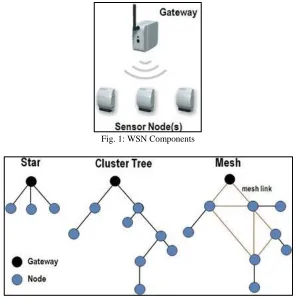
Fig. 1: WSN Components
Fig. 1: WSN Network Topologies WSN Network Topologies
WSN Network Topologies
WSN nodes are typically organized in one of three types of network topologies. In a star topology, each node connects directly to a gateway. In a cluster tree network, each node connects to a node higher in the tree and then to the gateway, and data is routed from the lowest node on the tree to the gateway. To offer increased reliability, mesh networks feature nodes that can connect to multiple nodes in the system and pass data through the most reliable path available. This mesh link is often referred to as a router.
Components of a WSN Node
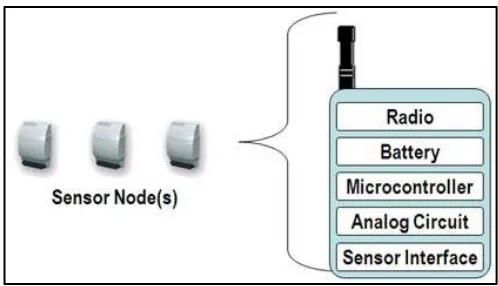
A WSN node contains several technical components. These include the radio, battery, micro-controller, analog circuit, and sensor interface. When using WSN radio technology, you must make important trade-offs. In battery-powered systems, higher radio data rates and more frequent radio use consume more power. Often three years of battery life is a requirement, so many of the WSN systems today are based on low-power consumption. Because battery life and power management technology are constantly evolving and because of the available IEEE 802.11 bandwidth, Wi-Fi is an interesting technology.
The second technology consideration for WSN systems is the battery. In addition to long life requirements, you must consider the size and weight of batteries as well as international standards for shipping batteries and battery availability. The low cost and wide availability of carbon zinc and alkaline batteries make them a common choice.
Fig. 2. WSN Sensor Node Components
Network Architecture
Consider a CWSN consisting of a fixed base station (BS) and a large number of wireless sensor nodes, which are homogeneous in functionalities and capabilities. We assume that the BS is always reliable, i.e., the BS is a trusted authority (TA). Meanwhile, the sensor nodes may be compromised by attackers, and the data transmission may be interrupted from attacks on wireless channel. In a CWSN, sensor nodes are grouped into clusters, and each cluster has a cluster-head (CH) sensor node, which is elected autonomously. Leaf (non-CH) sensor nodes, join a cluster depending on the receiving signal strength and transmit the sensed data to the BS via CHs to save energy. The CHs perform data fusion, and transmit data to the BS directly with comparatively high energy. In addition, we assume that, all sensor nodes and the BS are time synchronized with symmetric radio channels, nodes are distributed randomly, and their energy is constrained.
In CWSNs, data sensing, processing and transmission consume energy of sensor nodes. The cost of data transmission is much more expensive than that of data processing. Thus, the method that the intermediate node (e.g., a CH) aggregates data and sends it to the BS is preferred, than the method that each sensor node directly sends data to the BS. A sensor node switches into sleep mode for energy saving when it does not sense or transmit data, depending on the TDMA (time division multiple access) control used for data transmission. In this paper, the proposed SET-IBS and SET-IBOOS are both designed for the same scenarios of CWSNs above.
II. LITERATURE SURVEY
Paper Title: A Survey of Security Issues in Wireless Sensor Networks
This paper analyzes the efficiency of the Wireless sensor networks which are mainly used for military purpose for send and receive the code or message. It rectifies the open research issues for direction on security in WSNs. Secure routing protocols are be considered in key distribution the node sends the message from one node to base station. Aggregation of sensor data is to be secured. It produce less important for low level data to save energy level and produce high level security for more sensitive data.
The main purpose of security requirements is to identify the information and resource from attacks and misbehavior. Symmetric key cryptography is power consumption in sensor nodes. Open research issues are high speed and low energy cost. In this efficient and flexible key distribution are to be design. There are many routing techniques are been designed for WSNs. Some networks are been design security as a goal. Wireless sensor network are vulnerable to many kind of attack in secure routing protocols.
Secure routing is a ad hoc network similar to sensor network. It depends on appropriate key management scheme in WSNs. Data aggregation is mainly for WSNs. The nodes are been provide by pair wise key and other node are in multiple hops. The cluster head collect all the information and send it to the base station as they required. Sensor nodes are constrained by less energy.
Paper Title: Secure Routing In Wireless Sensor Networks: Attacks & Countermeasures
Hello Flood Attack
An attacker outside the network who has large transmission power may send a HELLO packet to every node in the network and them to believe that it is within the network. So, attacker can easily steal the data.
a) Countermeasure
Each node is provided with an ID. And during data transmission each node should authenticate its neighboring node using Identity verification protocol to avoid Hello Flood attack. Multipath protocol can be used to avoid compromised nodes. In this protocol the data is routed over ‘n’ paths and the nodes in it are disjoint.
Paper Title: Routing Techniques in Wireless Sensor Networks: A Survey
This paper enhances the major issue in Wireless Sensor Network is Energy consumption which would reduce the lifetime of the network. Since the entire sensor nodes are battery powered, certain steps should be taken to conserve the battery power. Clustering could reduce the energy consumption to some extent.
Another method to reduce the energy-consumption is using Routing techniques. The data sensed by the sensor nodes are routed to the base station by some strategy which will reduce the energy consumption to a great extent. Routing in Wireless Sensor Network has three classification and they are
Flat-based routing - all the nodes have equal functionality in the network.
Hierarchical-based routing - nodes have different functionality in the network.
Location-based routing - position of the nodes in the network decides the functionality.
In all the above routing techniques the best path that consumes less energy for the data transmission than any other path in the network is found and data is sent through it. If any node in the founded path is damaged or failed then the routing algorithm itself should accommodate a new path to the base station. The main objective is reducing the energy consumption of the nodes in the network. But the data delivery is not compromised.
Paper Title: Balanced Energy Sleep Scheduling Scheme for High Density Cluster-based Sensor Networks
This in paper the concept analyzed as, Conserving Battery power in sensor network is an important aspect , to achieve this nodes which are ideal can be put to sleep so that the energy can be used only those nodes which are active. Three scheduling schemes can be used, which are Balanced-energy Scheduling scheme (BS), Randomized Scheduling scheme (RS), Distance based Scheduling scheme (DS).
Randomized Scheduling scheme (RS) selects the nodes randomly, which are ideal and puts them to sleep. Distance based Scheduling scheme (DS) selects the ideal nodes with respect to the distance of those nodes from the cluster head. Balance-energy scheduling scheme (BS) maintains the average energy consumption of all the nodes in the cluster to be same. The BS is as same as DS. The mechanism used to put the ideal nodes to sleep has to be aware of putting only the ideal nodes and not the nodes which are active. Timer will be provided to those nodes which are put to sleep which will consume very low energy in order to keep track of the time duration of the sleeping nodes.
III. PROTOCOLS
Steps for SET-IBS Protocol for CWSN
An IBS protocol implemented for CWSN performs the following operations, setup at the BS, key extraction and signature signing of the data sending nodes, and verification of the data receiving nodes.
Setup
The BS generates a master key msk and public parameters param for the private key generator (PKG), and gives them to all sensor nodes.
Extraction
Given an ID string, a sensor node generates a private key sekID associated with the ID using msk. Signature Signing
Given a message M, time-stamp t and a signing key ϴ, the sending node generates a signature SIG.
Verification: Given the ID, M and SIG, the receiving node outputs “accept” if SIG is valid, and outputs “reject” otherwise.
Steps for SET-IBOOS Protocol for CWSN
An IBOOS protocol implemented for CWSN performs the following four operations, setup at the BS, key extraction and offline signing at the CH, online signing of the data sending nodes, and verification of the receiving nodes.
Setup
The BS generates a master key msk and public parameters param for the private key generator (PKG), and gives them to all sensor nodes.
Extraction
Given an ID string, a sensor node generates a private key sekID associated with the ID using msk. Offline Signing
Given public parameters and time-stamp t, the CH sensor node generates an offline signature SIGoffline , and transmit it to the leaf nodes in its cluster.
Online signing
From the private key sekID, SIGoffline and message M, a sending node (leaf node) generates an online signature SIGonline . Verification
Given ID, M and SIGonline, the receiving node (CH node) outputs “accept” if SIGonline is valid, and outputs “reject” otherwise.
IV. ATTACK MODELS
In order to evaluate the security of the proposed protocols, we have to investigate the attack models in WSNs which threaten the proposed protocols, and the cases when an attacker exists in the network. In this paper, we group attack models into three categories according to their attacking means as follows, and study how these attacks may be applied to affect the proposed protocols.
Passive Attack on Wireless Channel
Passive attackers are able to perform eavesdropping at any point of the network, or even the whole communication of the network. Thus, they can undertake traffic analysis or statistical analysis based on the monitored or eavesdropped messages.
Active Attack on Wireless Channel
Active attackers have greater ability than passive adversaries, which can tamper with the wireless channels. Therefore, the attackers can forge, reply and modify messages. Especially in WSNs, various types of active attacks can be triggered by attackers, such as bogus and replayed routing information attack, sinkhole and wormhole attack, selective forwarding attack, HELLO flood attack, and Sybil attack.
Node Compromising Attack
Node compromising Attackers are the most powerful adversaries against the proposed protocols as we considered. The attackers can physically compromise sensor nodes, by which they can access the secret information stored in the compromised nodes, e.g., the security keys. The attackers also can change the inner state and behavior of the compromised sensor node, whose actions may be varied from the premier protocol specifications.
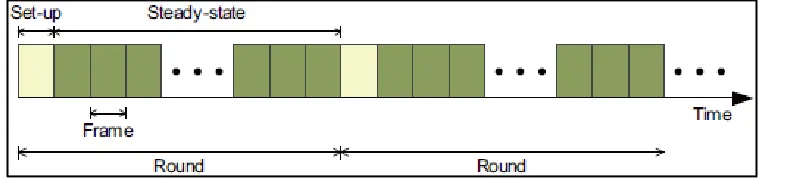
The proposed SET-IBS and SET-IBOOS provide different types of security services to the communication for CWSNs, in both setup phase and steady-state phase. Both in SETIBS and SET-IBOOS, the encryption of the message provides confidentiality, the hash function provides integrity, the nonce and time-stamps provide freshness, and the digital signature provides authenticity and non-repudiation.
V. CONCLUSION
[6] R. Yasmin, E. Ritter, and G. Wang, “An Authentication Framework for Wireless Sensor Networks using Identity-Based Signatures,” IEEE CIT, 2010. [7] H. Lu, J. Li, and H. Kameda, “A Secure Routing Protocol for Cluster-Based WSNs Using ID-Based Digital Signature,” IEEE GLOBECOM, 2010. [8] Y. Jia, L. Zhao, and B. Ma, “A Hierarchical Clustering-based Routing Protocol for WSNs Supporting Multiple Data Aggregation Qualities,” EEE Trans.
Parallel Distrib. Syst., vol. 4, no. 1-2, 2008.
[9] B. Sun, L. Osborne, Y. Xiao, “Intrusion Detection Techniques in Mobile AdHoc and Wireless Sensor Networks,” IEEE, vol. 14, no. 5, 2007.
[10] Deng, Jing; Han, Yunghsiang S.; Heinzelman, Wendi B.; and Varshney, Pramod K., “Balanced energy sleep scheduling scheme for high density cluster-based sensor networks” Electrical Engineering and Computer Science, 2004.