Design Optimization & Fatigue Analysis of
Composite Mono Leaf Spring
Mr. A. K. Tarange Dr. A. M. Badadhe
PG Student Professor
Department of Mechanical Engineering Department of Mechanical Engineering RSSOER, Pune, Maharashtra, India RSCOE, Tathwade, Pune, Maharashtra, India
Prof. M. B. Bankar Prof. M. C. Dhere
Assistant Professor Assistant Professor
Department of Mechanical Engineering Department of Mechanical Engineering SCSCOE, Pune, Maharashtra, India SCSP, Pune, Maharashtra, India
Abstract
In automobiles like light motor vehicles, heavy duty trucks and in rail systems, Leaf springs are mainly used in suspension systems to absorb shock loads. As an alternative to material of steel spring in this work mechanical behavior of glass fiber reinforced polymer (GFRP) composite mono leaf spring have been investigated. The study of GPRF composite leaf springs has been popular for light weighting in automotive. So, the research on the fatigue life of composite leaf springs is crucial. The important issue now in automobile industries is to reduce the Weight. Weight reduction can be achieved by the introducing of better material, design optimization and manufacturing processes. In this work, all the dimensions of an existing mono steel leaf spring of a Maruti Alto 800 vehicle has to be taken after that modeling and analysis of a laminated composite mono leaf spring with glass fiber composite material has been done. After this we have taken the fatigue life of composite leaf spring by using FEA & results are validating with experimentally.
Keywords: Mono Leaf Spring, GFRP, Fatigue Analysis, FEA
________________________________________________________________________________________________________
I. INTRODUCTION
Today’s most automobiles like light motor vehicles, heavy duty trucks and in rail systems use Leaf springs to absorb shock loads in automobiles. It carries lateral loads, brake torque, driving torque in addition to shock absorbing. To meet the need of natural resources conservation, automobile manufacturers are attempting to reduce the weight of vehicles in recent years. Weight reduction can be achieved by the implementing the better material, design optimization and manufacturing processes. The suspension leaf spring is one of the potential items for weight reduction in automobiles unsprang weight. This achieves the vehicle with more fuel efficiency and improved riding qualities. It is possible that the introduction of composite materials, reducing the weight of leaf spring without any reduction of load carrying capacity.
The composite materials made to reduce the weight of machine element without any reduction of the load carrying capacity. FRP springs also have excellent fatigue life and durability. Glass fibers are strong as any of the newer inorganic fibers but they lack rigidity of on account of their molecular structure. The weight reduction of the leaf spring is achieved by material replacement and design optimization. Automobile manufacturers have main focus of Weight reduction in present scenario. In order to get the better performance the emphasis is given on reducing weight without compromising mechanical strength. The replacement of steel with composite leaf Spring, it can provide 75% to 78% weight reduction. Moreover, the composite leaf spring has lower stresses compared to steel spring.
II. LITERATURE REVIEW
analysis of leaf spring in Maruti 800 is intended for study using FEM software using ANSYS.
CAD Model
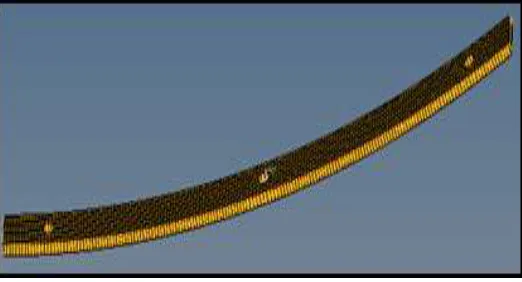
In this paper mono leaf spring of Alto 800 car with length 700 mm and width 40 mm was selected for study. The CAD model was prepared with CATIA software. Fig. 1 shows CAD model of mono leaf spring under study.
Fig. 1: CAD Model of Mono Leaf Spring of Alto800 Car
Meshing
Hypermesh software was used for meshing. A Quad type of meshing was used. Fig. 2 shows Quad meshing on mono leaf spring.
Fig. 2: Quad Meshing on Mono Leaf Spring
The following are the specifications of meshing: Number of nodes: 1873
Number of elements: 1678 Element size = 4 mm
Boundary Conditions
Fig. 3: Meshed Model with Applied Boundary Condition
This weight must be divided into front axle weight and rear axle weight. 52% of total weight is taken by front axle and 48% of total weight is taken by rear axle.
Front axle weight = 13513.5 N Reaction at one wheel = 6756.8 N Rear axle weight = 12474.05 N Axle weight on one wheel = 6237.02 N
Assuming 5 number of plates, Load on leaf spring= 1247.4 N Deformation and Stress in leaf spring,
Stress at center of constant cross section is given by 175.38 Mpa (Same for both steel and Glass fiber)
Maximum Deflection at load is given by, For Steel = 1.4 mm
For Glass fiber = 0.658 mm
Table - 1
Mechanical Properties of Steel
Property Value
Young’s modulus 2* 10 5 Mpa
Poisson’s Ratio ,ν 0.3
Density, ρ 7.85 x 10⁻⁶ kg/mm3 Tensile Yield Strength 250 Mpa Compressive Yield Strength 460 MPa
Table - 2
Mechanical Properties of GFRP
Property Value
Young’s modulus in z-direction 4* 10 5 Mpa
Poisson’s Ratio ,ν 0.36
Density, ρ 6x 10⁻⁶ kg/mm3
Tensile Yield Strength 2500 Mpa Compressive Yield Strength 3150 MPa
Spring Constant (N/mm) 4.83
Maximum Compression (mm) 83
Shear Stress (N/mm2) 83
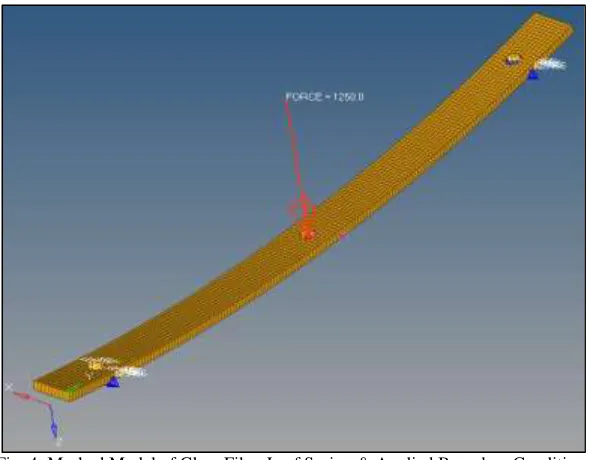
The calculated load was applied at joint 2 of leaf spring or existing material and glass fiber. Fig. 4 shows Meshed model of Glass fiber leaf spring and applied boundary conditions.
Results
Fig. 4: Meshed Model of Glass Fiber Leaf Spring & Applied Boundary Conditions
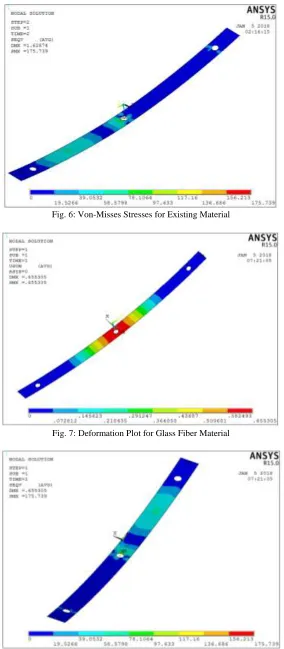
From deformation and Von-mises Stresses plot given below it was observed that leaf spring with glass fiber material is most feasible for considered loading conditions. Thus leaf spring with glass fiber material is highly recommended for fabrication.
Table - 3
Deformation and Von-Misses Stresses
Type of Analysis
Steel Glass Fiber
Deformation(mm) Stress (Mpa) Deformation(mm) Stress (Mpa)
Analytical 1.4 175.3 0.655 175.38
FEA 1.6 175.7 0.655 175.73
Fig. 6: Von-Misses Stresses for Existing Material
Fig. 7: Deformation Plot for Glass Fiber Material
Fig. 9: Fatigue Life of Mild Steel Leaf Spring
Fig. 10: Fatigue Life of Glass Fiber Leaf Spring
From Fatigue life plots it was observed that leaf spring with glass fiber material have more life than the Fatigue life of mild steel leaf spring. Hence, the newly material optimized glass fiber is recommended as high structurally stable than the steel mono leaf spring and considered for fabrication for further experimental validation.
V. EXPERIMENTAL SETUP
Fabrication of Test Model
Fig. 11: Fabricated Glass Fiber Reinforced Leaf Spring
Fatigue Testing of Fabricated Model
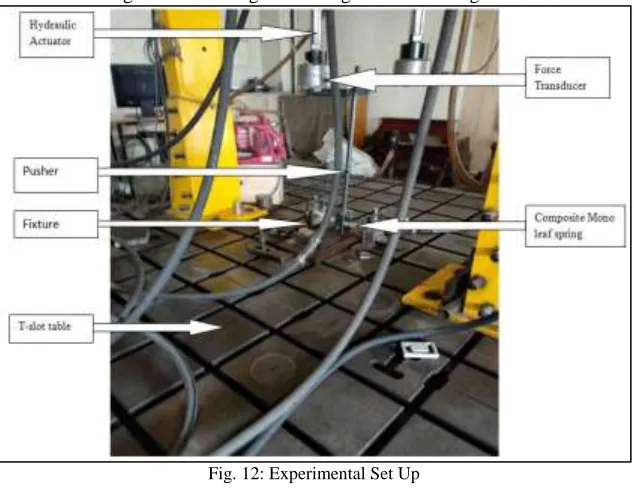
Fatigue Testing of fabricated model was done on Fatigue Test Rig Instron Actuator 25KN (AC/MC/059) at Auto Cluster, Pune. The model was tested for 1250N load. Fig.12 shows Fatigue Test Rig used for testing.
Fig. 12: Experimental Set Up
VI. RESULT & DISCUSSION
Table- 5. Shows numerical and experimental results for tested composite glass fiber leaf spring. Fatigue testing is performed on glass fiber leaf spring rod. It shows that at 1250N load & frequency 100Hz, No Crack observed after 1,00,000 cycles of glass fiber leaf spring structure with composite as a material in Experimental Test. Fatigue analysis has been performed for glass fiber leaf spring structure by using FEA method and No. of cracks observed is 199380 cycles. Based on Experimental and FEA it can be concluded that the glass fiber leaf spring has infinite life because it can withstands above 1,00,000 cycles in both tests and results are correlated. Table- 6 shows Weight optimization of leaf spring
Table - 5
Numerical & Experimental Results Method of Analysis No. of cycles Finite Element Analysis 1, 99,380 cycles
Experimentation 1,00,080 cycles (No Cracks) Table - 6
Weight Reduction
Type Weight
Existing 0.852 KG
Optimization”, State Key Laboratory of Automotive Simulation and Control, Jilin University, Changchun 130022, China.
[3] Mahmood M. Shokrieh[3], Davood Rezaei," Analysis and optimization of a composite leaf spring”, Elsevier Science (2003) 317–325.
[4] I. Rajendran, S. Vijayarangan," Optimal design of a composite leaf spring using genetic algorithms”, Elsevier Science Ltd. 79(2001) 1121-1129 . [5] H.A.Al-Qureshi "Automobile leaf springs from composite materials ",Journal of Materials Processing Technology118(2001)58-61
[6] J.P.Hou ,J.Y.Cherruault,I.Nairne,G.Jeronimidis R.M. Mayer," Evolution of the eye-end design of a composite leaf spring for heavy axle loads”, Elsevier Ltd. 78(2007)351–358.
[7] E. Mahdi et.al, “An experimental investigation into mechanical behavior of hybrid and no hybrid composite semi-elliptical springs” Materials and design 52 920130 504-513.
[8] R D V Prasad et.al, “Design& Analysis of Mono Composite Leaf spring” International journal of scientific research Engineering & Technology IJSRET0 Volume 2 issue 2 pp 103-107 May 2013.
[9] M. Raghavedra et.al, “Modeling and Analysis of Laminated composite leaf Spring under the static Load Condition by using FEA.” International Journal of Modern Engineering research (IJMER) www.ijmer.com Vol.2, Issue. 4, Jully-Aug, 2012 pp-1879.
[10] B. Raghu Kumar et.al, ”Static analysis of mono leaf spring with different composite materials”, Journal of mechanical research Vol. 592), pp.-1875-1. [11] ParekheRavindra et.al, “Modeling and Analysis of Carbon Fiber Epoxy based Leaf Spring under the Static load Condition by using FEA”, International
Journal of Emerging Science and Engineering Science and Engineering (IJESE) ISSN: 2319-6378, Volume-2, Issue-4, February 2014. [12] T.N.V. Ashok Kumar et.al ”Design and Material Optimization of Heavy Vehicle Leaf Spring” IJRMET Vol.4, issue Spl-1,noc 2013-April 2014.
[13] FengZhang,[13]Andryas Mawardi, Eugene SantosJr.Ranga Pitchumani, LukeE.K. Achenie," Examination of load-balancing methods to improve efficiency of a composite materials manufacturing process simulation under uncertainty using distributed computing", ElsevierB.V., 22 (2006) 571–587.
[14] Mr. Anandkumar A. Satpute, Prof. S.S.Chavhan, “Mono Composite Leaf Spring-Design and Testing” Indian Journal of Applied Research”, Volume:3, Issue7, July 2013, ISSN: 2249-555X.
[15] Wenku Shi, Chen Qian, Zhiyong Chen, Qianqian Song and Shixiang Yang, “Establishment of theoretical model of composite leaf springs by using the mechanics of composite materials”, Journal of Reinforced Plastics and Composites,I-II, 2017.
[16] Nahit Oztoprak, Mehmet Deniz Gunes, “Developing polymer composite-based leaf spring systems for automotive industry” , DE Gruyter, November 9, 2017. [17] Bartosz Kadziela · Michal Manka, “Validation and optimization of the leaf spring multibody numerical model”, Arch Appl Mech (2015) 85:1899–1914, 16
June 2015
[18] Harmeet Singh and Gurinder Singh Brar, “Finite Element Analysis of Composite Leaf Spring under Static and Fatigue Loads”, International Journal of Advanced Scientific Research and Management, Volume 3 Issue 4, Apr 2018.