Knowledge Management Critical Success Factors in Construction Projects
Adnan Enshassi1, Islam I. Falouji2, Suhair AlKilani3, and Matthias Sundermeieri4
1Department of Civil Engineering, Islamic University IUG, Gaza, Palestine 2Faculty of Engineering, University of Palestine UP, Gaza, Palestine
3University of New South Wales (UNSW), Australia 2Faculty of Berlin School of Technology (TU Berlin), Germany
*Corresponding E-mail: [email protected]
Received 12 April 2016; Revised 21 June 2016; Accepted 10 September 2016
Abstract
Knowledge management (KM) is defined as the act of establishing, sharing, and flowing of knowledge within an organization. Knowledge is an important driving force for business success and competiveness, especially in the construction industry, which is a project-based oriented that involves multidiscipline stakeholders. Knowledge management critical success factors (KMCSFs) are considered crucial for the construction industry. Previous works suggested a positive relation between addressing the critical success factors and the successful implementation of knowledge management. The objective of this paper is to identify and assess those factors. Data were collected by a structured questionnaire distributed randomly to 300 construction project professionals in the Palestinian construction industry concerning their knowledge management experiences. 277 questionnaires were received giving a response rate of 92%. Data were analyzed using Relative Importance Index (RII) and Exploratory Factor Analysis (EFA). It has been found that teamwork and face- to- face communication are considered the most significant critical success factors in managing knowledge. Moreover, three groups of critical success factors for managing knowledge have been categorized by EFA. They are related to culture, knowledge sharing process, and organizational structure. The findings of this study are significant in the understanding of knowledge management critical success factors in construction project. This knowledge may contribute to better decision-making and improvement of the construction projects performance.
Keywords: Knowledge management, critical success factors, construction, performance
1.0
Introduction
In today’s dynamic and complex environment, knowledge becomes a critical asset of an organization [1]. Consequently, effective knowledge implementation is becoming more significant for providing a sustainable competitive advantage [2, 3, 4]. Within the construction industry, where products and services are the end results of the several project initiatives of the organizations, the need for creating innovative and unique knowledge that leads to organizational sustainability in the marketplace is acknowledged [5]. This requires effective utilization and management of project knowledge, whereas knowledge management implementation is also being crucial.
There is sporadic evidence that failing to identify the critical success factors for knowledge implementation is one of the main reasons for businesses failing to implement KM successfully. This study attempts to explore these critical success factors in the construction industry in Palestine in accord with the participants' experience and concepts. The participators of this survey are construction project professionals and experts who are the main part of knowledge management practice in construction.
1.1
Definition of Knowledge Management
Knowledge management (KM) is defined as the creation, sharing and flow of knowledge within organizations [5]. It includes systematic management and processes of creating, gathering, organizing, utilizing, and exploiting information [9]; managing by creating, structuring, dissemination and applying the knowledge [10]; capability to create new knowledge disseminates it throughout the organization [11]; The creation of an environment encourages knowledge to be created, shared, enhanced, organized and utilized [12]; leveraging intellectual assets to enhance performance [13]; An integrated, systematic approach to identify, manage, and share department's information assets [14]; application of knowledge to maximize knowledge-related effectiveness and returns [15]. Peter Drucker was the first who introduced knowledge idea [16].There were various opinions of what is meant by knowledge. Some defined it as an absolute truth that exists separately from the knower [17], while others upheld that is socially constructed [18, 19]. Knowledge is reckoned as: facts and data that are organized to describe a particular situation [20]; multidimensional concept for gaining access to information[21]; information, ideas, expertise [22]; information that drive people’s actions [23]; something deeper than data or information [4]; power for acting and making decisions [19, 23]; information that merged with creativity, intuition [24], interpretation, context and experience that is gained [25]; insight, ideas, experience, skill, information or data, may be associated with knowledge [26].
Sarvary [27] suggested that knowledge management involves the process whereby organizations innovate, use, spread, and accumulate organizational knowledge. Nicolas [28] showed that it is a logical process for creating and using knowledge to attain organizational objectives. Lloria [29] stated that it included a sequence of policies and guidelines that enable the creation, and institutionalization of knowledge in order to attain the firm’s objectives. Gao et al. [26] confirmed KM as managing the activities of knowledge through motivating, leading, and supporting knowledge, providing a suitable working environment.
Knowledge is considered as a significant organizational resource [30]. Knowledge is the information that guides task execution, problem solving, and decision-making [18]. It justifies personal beliefs to take effective action [11], it also regarded as an important production factor that create values and sustainable competitive advantage [3, 24, 31, 32]. Researchers pointed out that knowledge is a conceptualized subject to an individual’s subjective interpretation [19, 33, 34]. While knowledge is not a physically identifiable entity [12], it is considered as a service by many researchers [35]. It is also considered as something that can be reused and transferred [4].
Knowledge in organizations can be both formal and informal in nature [46]. Hutchinson and Quintas [47] agreed that formal knowledge concerns policies, structures, and practices that are named and governed by the concepts of KM. In contrast, the informal management of knowledge refers to practices that are concerned with knowledge processes, but are not so rigid. According to Azudin et al., [46], formal exchange mechanisms, such as procedure, and formal language will ensure that people will exchange and combine their explicit knowledge, while, informal knowledge interchanges between and among staff is effective in building up knowledge base and facilitating faster learning. Zin and Egbu [48] stated that formal knowledge including activities designed by a company with the aim of learning from each other and encourage (knowledge sharing) KS in organizations, from basic instructions, to more complex interventions, regarding informal refers to informal networks and communication.
1.2
Knowledge management critical success factors (KMCSFs)
The success of KM implementation is determined by a group of CSFs that have been studied by several authors. Alazmi and Zairi [49] defined Knowledge management critical success factors (KMCSFs) as a restricted number of areas in which satisfactory results are guaranteed for a successful competitive performance. Wong [8] and Tan [8] regard CSFs related to KM as those activities and behaviors that are nurtured and created to achieve better implementation.
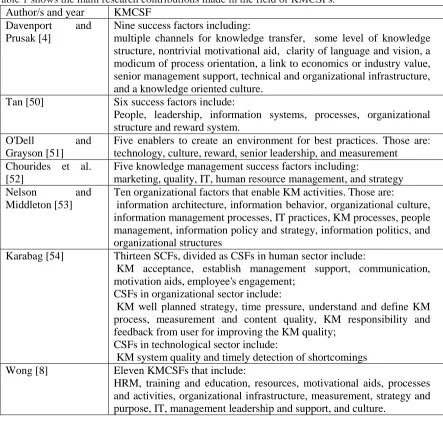
Table 1 shows the main research contributions made in the field of KMCSFs. Author/s and year KMCSF
Davenport and Prusak [4]
Nine success factors including:
multiple channels for knowledge transfer, some level of knowledge structure, nontrivial motivational aid, clarity of language and vision, a modicum of process orientation, a link to economics or industry value, senior management support, technical and organizational infrastructure, and a knowledge oriented culture.
Tan [50] Six success factors include:
People, leadership, information systems, processes, organizational structure and reward system.
O'Dell and
Grayson [51]
Five enablers to create an environment for best practices. Those are: technology, culture, reward, senior leadership, and measurement Chourides et al.
[52]
Five knowledge management success factors including:
marketing, quality, IT, human resource management, and strategy
Nelson and
Middleton [53]
Ten organizational factors that enable KM activities. Those are:
information architecture, information behavior, organizational culture, information management processes, IT practices, KM processes, people management, information policy and strategy, information politics, and organizational structures
Karabag [54] Thirteen SCFs, divided as CSFs in human sector include:
KM acceptance, establish management support, communication, motivation aids, employee's engagement;
CSFs in organizational sector include:
KM well planned strategy, time pressure, understand and define KM process, measurement and content quality, KM responsibility and feedback from user for improving the KM quality;
CSFs in technological sector include:
KM system quality and timely detection of shortcomings
Wong [8] Eleven KMCSFs that include:
Chong and Choi [55]
Eleven critical knowledge management enablers that include:
Employee training, employee involvement, teamwork, employee empowerment, top management leadership and commitment, organizational constraints, IS infrastructure, performance measurement, egalitarian culture, benchmarking, and knowledge structure.
Akhavan et al. [14] Sixteen KM CSFs, those include:
CEO’s commitment and support, organizational culture, pilot projects, knowledge identification, knowledge storage, knowledge review, knowledge capturing, business process engineering, organizational structure, trust, KM strategy, organizational transparency, KS, expert networking, knowledge architecture, and training.
Conley and Zheng [56]
Nine CSFs consists of:
the leadership and top management support, KM strategy, technology infrastructure, organizational culture, incentives, education and training, KM processes, KM practices, and the use of KM team
Steyn and Kahn [57]
Six factors that include:
training, collaborative organizational structures, leadership, information and communication technologies, organizational transparency and dimensions of KM
Salleh [58] Seven main success factors:
organizational planning efforts, project manager's goal commitment, project team's motivation and goal orientation, clarity of the project's scope and work definition, project manager's capabilities and experience, safety precautions and applied procedures, use of control systems and safety
Kanagasabapathy et al. [59]
Eleven CSFs including:
Trusting and open organizational culture, management, leadership and commitment, employee involvement, employee training, trustworthy teamwork, employee empowerment, information systems infrastructure, performance measurement, Benchmarking, and knowledge structure.
Rašul et al. [60] three categories of CSFs:
Information technology, organization and knowledge.
Lee and Choi [61] Collaboration, trust, learning, centralization, formalization, T-shaped skills, and information technology support.
AL-Hakim and Hassan [2]
HMR, information technology, leadership, organizational learning, organizational strategy, organizational structure, and organizational culture.
Bishop et al. [62] KM acceptance, establish management support, motivation aids, KM well planned strategy, understand KM process, and KM responsibility. Cristina [63] Eleven critical enablers such as
Employee training, employee involvement, teamwork, employee empowerment, top management leadership and commitment, organizational constraints, information system infrastructure, performance measurement, egalitarian culture, benchmarking, and knowledge structure.
2.0
Methodology
the Palestinian Contractors Union (PCU) in the Gaza Strip, which are 238 contracting companies. Those contractors are classified under five main grades. The sample of this study was the construction professional workings with the contracting companies including the five grades of registration. The following statistical equation was used to determine the sample size [64].
2 2
)
1
(
C
P
P
Z
SS
Where:
SS: The sample size
Z: Z value (e.g. 1.96 for 95% confidence interval)
P: Percentage picking a choice, expressed as decimal, (0.50 used for sample size needed) C: Maximum error of estimation (0.08)
150
)
08
.
0
(
)
5
.
0
1
(
5
.
0
96
.
1
2 2
SS
According to the equation, the minimum sample size is at least 150 based on 8% margin of errors. 300questionnaires were distributed randomly (more than three copies for each contracting company) to construction professionals with different professions and disciplines. 277 questionnaires were received back yielding 92% response rate.
2.1
Pilot study
A pilot study was conducted by sending the questionnaire and a cover letter via email to fifteen participants from different companies and academic professionals. The professionals were selected with more than 10 years’ experience in construction work. The respondents were asked to complete the questionnaire and to review the design and structure of the survey. This was followed with personal interviews with those participants. The aim was to test the suitability and comprehensibility of the questionnaire. During the interviews, feedback and comments related to the design of questionnaires and suggestions for refining the survey instruments were collected. As a result, few changes were made to the questionnaire. Mainly, the pilot study showed that some attributes were repeated, irrelevant, weak, or vague and should be omitted. Other attributes were modified to suit the Gaza Strip construction professionals work nature and some attributes were added by the respondents in the pilot study. In addition, grammatical and spilling mistakes were corrected.
2.2
Questionnaire sampling and distributing methods
The questionnaire was initially designed based on an extensive literature review of previous studies, which designed to investigate KM implementation and CSFs within construction organization. Most of those previous studies used the delivery and collection questionnaires method [65] in distributing the questionnaires, for example: [2, 3, 4, 17, 25, 33, 35, 42, 48, 49, 50, 53, 54, 56, 60, 66, 67]. Consequently, a self-administered questionnaire was used for data collection. However, as recommended by Saunders et al. [65] the survey was including an information cover letter, which gives brief information about the objective of the study, background about the researcher, the ethical approval that obtained from the research committee of the researcher's university and the when the questionnaire is likely to be collected.
3.0
Data analysis method
Sciences) was used to analyze the collected data. In this research, ordinal scales were used. Ordinal scale is a ranking or a rating data that normally uses integers in ascending or descending order. The numbers assigned to the important (1, 2, 3, 4, 5) do not indicate that the interval between scales are equal, nor do they indicate absolute quantities. They are merely numerical labels [70]. Researchers usually use Likert scales [71] as means to discover strength of feeling or attitude towards a given statement or series of statements. Likert scales can be a three, five, or seven-point range that asks respondents to indicate rank order of agreement or disagreement by circling the appropriate number [72, 73]. Five-point Likert scale) was used in this questionnaire, where the implication is that the higher the category chosen, the greater the strength of agreement. The respondents were asked to rate their agreement or disagreement about the identified KSCSFs by circling the appropriate box.
3.1
The relative importance index
Descriptive statistics namely relative importance index method (RII) was used to determine the ranks of all KSCSFs and to highlight the relative importance of attributes as perceived by the respondents. The relative importance index was computed as Enshassi et al. [74, 75]:
W
RII
A N
Where:
W is the weighting given to each factor by the respondents (ranging from 1 to 5) A = the highest weight (i.e. 5 in this case)
N = the total number of respondents
The RII value had a range from 0 to 1 (0 not inclusive), the higher the value of RII, the more impact of the attribute. However, RII does not reflect the relationship between the various attributes [76].
3.2
Factor analysis
Factor analysis is a powerful statistical technique that aims at providing greater insight. It is considered a data reduction technique, which is used to reduce a set of variables to a smaller number of variables or factors [77, 68]. To achieve this aim, SPSS 20 software was used, where EFA was employed to examine the pattern of inter-correlations between the variables and whether there are subsets of variables that correlate highly with each other. It is used to reduce a large number of related variables to a more manageable number, prior to using them in other analyses such as correlation or multiple regressions [77, 76, 78]. Exploratory factor analysis was adopted in this study to explore the inter-relationships among a set of variables.
In order to evaluate the adequacy of the survey data to employ factor analysis, two main assumptions should be tested, those are;
Kaiser-Meyer-Olkin (KMO) Measure of Sampling
Adequacy and Bartlett's Test of Sphericity [76, 78]. The value of (KMO) represents the ratio
of squared correlation between variables to the squared partial correlation between variables. It varies from 0 to 1. A value close to 1 indicates that pattern of correlation was relatively compact and hence factor analysis should give distinct and reliable results. A minimum value of 0.5 has been suggested [78]. Values that are higher than 0.5, were recommended by Field [76]. TheBartlett's Test of Sphericity should be significant (p < 0.5) for factor analysis to be
suitable [76, 78], which was met for this data set.
hypothesized value 3. The sign of the Test value indicates whether the mean is significantly greater or smaller than hypothesized value 3. On the other hand, if the P-value (Sig.) is greater than the level of significance, α=0.05, then the mean an item is insignificantly different from a hypothesized value 3 [76, 78].
3.3
Questionnaire validity
Statistical validity of the questionnaire refers to the degree to which an instrument measures what it is supposed to be measuring [79]. Validity has a number of different aspects and assessment approaches. To insure the validity of the questionnaire, two statistical tests should be applied. The first test is Criterion-related validity test (Spearman test) which measured the correlation coefficient between each item in one field and the whole field. The second test was structure validity test (Spearman test) that used to test the validity of the questionnaire structure by testing the validity of each field and the validity of the whole questionnaire. It measures the correlation coefficient between one filed and all the fields of the questionnaire that have the same level [79].
3.4
Criterion related validity
Internal consistency of the questionnaire was measured by a scouting sample, which consisted of 30 questionnaires through measuring the correlation coefficients between each item in one field and the whole filed. The p-values (Sig.) are less than 0.05, so the correlation coefficients of this field were significant at α = 0.05. Therefore, it can be said that the items of each field were consistent and valid to measure what it was set for [70].
3.5
Structure validity of the questionnaire
Structure validity was the second statistical test that used to test the validity of the questionnaire structure by testing the validity of each field and the validity of the whole questionnaire. It measures the correlation coefficient between one filed and all the fields of the questionnaire that have the same level of likert scale. The p-values (Sig.) were less than 0.05, so the correlation coefficients of all the fields were significant at α = 0.05. Therefore, it can be said that the fields were valid to measure what it was set for to achieve the main aim of the study.
3.6
Reliability analysis
Cronbach’s Coefficient Alpha was used to measure the reliability of the questionnaire between each field and the mean of the whole fields of the questionnaire [68]. The normal range of Cronbach’s coefficient alpha value between 0.0 and + 1.0 [68], and the higher values reflects a higher degree of internal consistency and vice versa. The value of Cronbach’s coefficient alpha is inflated by a large number of variables, so there is no set interpretation as to what is an acceptable limit.
4.0
Results and discussion
A list of the 16 attributes related to knowledge management was selected from literature and confirmed by the pilot study. These attributes were subjected to the views of respondents via the questionnaire survey. The following sections present the analysis results. It starts by presenting the descriptive results of mean value, RII, SD, test value, P-value, and ranks of each item (i.e. CSF) affecting the knowledge management implementation. It followed by explaining the results of the EFA.
the last one ‘the prevailing notion ----‘as it has a negative nature; if this belief is predominant in the company atmosphere, it will form obstacles in knowledge sharing perception. In addition, the rest of the attributes have a mean greater than the hypothesized value. Therefore, it can be concluded that the respondents agreed to the mentioned set of attributes of knowledge management critical success factors.
4.1
Descriptive results of the means, SD, RII, and ranks
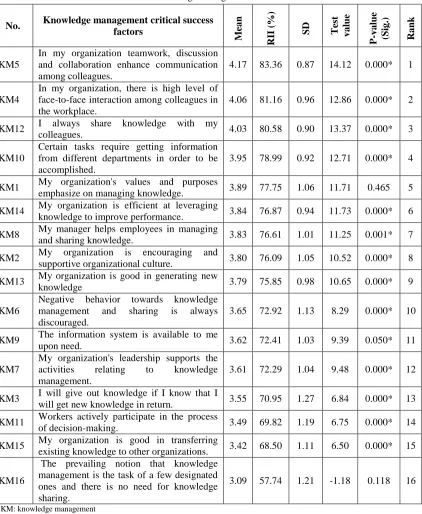
Table 2 shows the results of the initial descriptive analysis. It gives the results of mean value, RII, SD, test value, P-value, and ranks of each item (i.e. CSF) affecting the knowledge management implementation.
Table 2: RII ranks and Test value for knowledge management critical success factors
No. Knowledge management critical success factors M ea n RII ( %)
SD Test value
P -v a lue (Sig .) Ra nk KM5
In my organization teamwork, discussion and collaboration enhance communication among colleagues.
4.17 83.36 0.87 14.12 0.000* 1
KM4
In my organization, there is high level of face-to-face interaction among colleagues in the workplace.
4.06 81.16 0.96 12.86 0.000* 2
KM12 I always share knowledge with my
colleagues. 4.03 80.58 0.90 13.37 0.000* 3
KM10
Certain tasks require getting information from different departments in order to be accomplished.
3.95 78.99 0.92 12.71 0.000* 4
KM1 My organization's values and purposes
emphasize on managing knowledge. 3.89 77.75 1.06 11.71 0.465 5 KM14 My organization is efficient at leveraging
knowledge to improve performance. 3.84 76.87 0.94 11.73 0.000* 6 KM8 My manager helps employees in managing
and sharing knowledge. 3.83 76.61 1.01 11.25 0.001* 7
KM2 My organization is encouraging and
supportive organizational culture. 3.80 76.09 1.05 10.52 0.000* 8 KM13 My organization is good in generating new
knowledge 3.79 75.85 0.98 10.65 0.000* 9
KM6
Negative behavior towards knowledge management and sharing is always discouraged.
3.65 72.92 1.13 8.29 0.000* 10
KM9 The information system is available to me
upon need. 3.62 72.41 1.03 9.39 0.050* 11
KM7
My organization's leadership supports the activities relating to knowledge management.
3.61 72.29 1.04 9.48 0.000* 12
KM3 I will give out knowledge if I know that I
will get new knowledge in return. 3.55 70.95 1.27 6.84 0.000* 13 KM11 Workers actively participate in the process
of decision-making. 3.49 69.82 1.19 6.75 0.000* 14
KM15 My organization is good in transferring
existing knowledge to other organizations. 3.42 68.50 1.11 6.50 0.000* 15
KM16
The prevailing notion that knowledge management is the task of a few designated ones and there is no need for knowledge sharing.
3.09 57.74 1.21 -1.18 0.118 16
KM: knowledge management
*The mean is significantly different from 3 SD: Standard Deviation
The results indicated that “In my organization, teamwork discussion and collaboration enhance communication among colleagues” attribute was ranked first with a mean value = 4.17 and RII = 83.36%. This attribute is asserted as previous research that suitable teamwork's environment and managing collaboration is crucial for an effective knowledge management. For example, Rašul et al. [60], Davenport & Prusak [4], McDermott, and O'Dell [39] concluded that teamwork occupies the first rank highlighting the importance of building teamwork as influencing attribute in the success of organizational knowledge management.
This was followed by “In my organization, there is high level of face to face interaction among colleagues in the workplace” attribute with a mean value = 4.06 and RII = 81.16% as the second ranked attribute. The respondents' perceptions showed that there is a need for a flexible approach in administering the project to achieve the pre-determined objectives. Effective participation in a team environment requires a direct communication between employees, thus improving relationships. This is consistent with Wang and Noe [67] who assisted that knowledge sharing can occur via written documents or face-to-face communications through networking with other experts.
The results showed that “I always share knowledge with my colleagues.” attribute with a mean value = 4.03 and RII = 80.58 % was ranked third. It is indicated that employees must be aware about their strategies and attitudes on how to respond to their fellows' inquiries, and be aware of the permanent willingness to share knowledge. The knowledgeable workers are likely to be influenced by the expectations of their peers in deciding to engage in knowledge sharing. The obtained result is consistent with Abdul-Jalala et al. [81]; Abilia et al. [82]; Akhavan et al. [14]; Alazmi and Zairim [49]; Ardichvili et al. [83]; Bishop et al. [62]; Egbu [33]; Hau et al. [84]; Rasli et al. [85]; Sa´enz et al. [86]; Zin and Egbu [48] who focused on this attribute as a mean of maximizing information usage by sharing knowledge with the whole team.
“Certain tasks require getting information from different departments in order to be accomplished" attribute was ranked fourth with a mean value = 3.95 and RII = 78.99%. Top manager should make a delegation and impose authority to attain the knowledge management objective not only in a closed isolated system, but also between the entire organizational departments. This can be achieved by minimizing or avoiding any pessimistic concept, in particular managerial obstacles. Therefore, organization should create the atmosphere of collaboration predominant on department managers. This is in agreement with Nor et al. [42], Renzl [87], Hong et al. [9], and Chee [88]. As they asserted higher level of communication and coordination between departments within organization, departments will be sped up. “My organization's values and purposes emphasize on managing and knowledge sharing.” with a mean value = 3.89 and RII = 77.75% as the fifth ranked attribute. This result illustrates noticeably the influence of setting common goal and values of the organization in knowledge management process. Since the project manager should have a thorough understanding of the knowledge management during the construction project lifecycle. In this essence, a non-hierarchical, self-organizing organizational structure is the most effective for knowledge sharing. A similar result was found by Al-Alawi et al. [89], and Davenport & Prusak [4].
4.2
Factor analysis
Table 3: KMO and Bartlett's test of knowledge management critical success factor
Kaiser-Meyer-Olkin Measure of sampling adequacy. 0.906
Bartlett's Test of sphericity
Approx. Chi-Square 1,774.150
Df 120
P-value < 0.001
Cronbach's Alpha 0.880
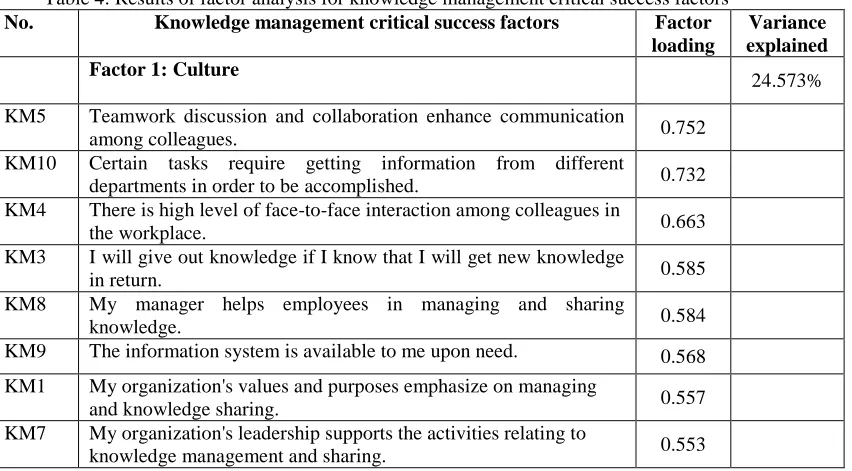
Figure 1 shows the scree plot of performance, which resulted in three factors; culture, knowledge sharing process, and organizational structure, because the regression line was severed up to attribute 3 and became almost straight line after that. Factor 1: culture explained 24.573% of total variance. Factor 2: knowledge sharing process explained 21.633% of total variance, and factor 3: organizational structure explained 11.153%of total variance.
Figure 1: Scree plot for knowledge management critical success factors
Table 4: Results of factor analysis for knowledge management critical success factors No. Knowledge management critical success factors Factor
loading
Variance explained Factor 1: Culture
24.573% KM5 Teamwork discussion and collaboration enhance communication
among colleagues. 0.752
KM10 Certain tasks require getting information from different
departments in order to beaccomplished. 0.732
KM4 There is high level of face-to-face interaction among colleagues in
the workplace. 0.663
KM3 I will give out knowledge if I know that I will get new knowledge
in return. 0.585
KM8 My manager helps employees in managing and sharing
knowledge. 0.584
KM9 The information system is available to me upon need. 0.568 KM1 My organization's values and purposes emphasize on managing
and knowledge sharing. 0.557
KM7 My organization's leadership supports the activities relating to
knowledge management and sharing. 0.553
0 1 2 3 4 5 6 7
Eige
n
valu
es
KM6 Negative behavior towards knowledge management is always
discouraged. 0.512
Factor 2: Knowledge sharing process
21.633% KM13 My organization is good in generating new knowledge. 0.801
KM14 My organization is efficient at leveraging knowledge to improve
performance. 0.795
KM12 I always share knowledge with my colleagues. 0.673 KM2 My organization is encouraging and supportive organizational
culture. 0.622
KM15 My organization is good in transferring existing knowledge to
other organizations. 0.572
Factor 3: Organizational structure
11.153% KM16 The prevailing notion that knowledge management is the task of a
few designated ones and there is no need for knowledge sharing. -0.678 KM11 Workers actively participate in the process of decision-making. 0.545
Factor 1: Culture
The first factor (culture) explained 24.573% of the total variance, which was represented by nine attributes. This factor included the attributes related to organizational and personality culture between employees within organization. The attributes had adequate factor loadings (
0.512). Table 4, shows that the highest factor loading attribute for culture factor is “In my organization, teamwork discussion and collaboration enhance communication among colleagues”. This emphasized the importance of teamwork as a core critical success factor for knowledge management. The obtained results are in the same line with Kanagasabapathy et al. [59], Chong and Choi [55], Conley and Zheng [56], and Lee and Choi [61].The second highest factor-loading attribute was “In my organization, certain tasks require getting information from different departments in order to be accomplished”. This result reflected the agreement of respondents regarding the importance of ensuring effective communication between different departments. This attribute indicated that interactions and cooperative relationships between departments should be more sedulous and conscientious given the competitive nature of the construction industry. In addition, knowledge-sharing activities between departments are certainly guided or interfered by managers. This is agreed with Lin [66] results revealed that organization should establish a mechanism for interactions and management style so that works can be pursue actively. The results also showed that the first two high loading attributes are homogenous and interrelated concepts. Organization goals should include creating a comprehensively atmosphere, and a knowledge-friendly culture.
Factor 2: Knowledge sharing process
The second factor "knowledge sharing process" accounted for 21.633% of the total variance and comprised five attributes. The attributes had appropriate factor loadings (
0.572). For this factor, the highest factor-loading attribute was “My organization is good in generating new knowledge”. This indicated that organization should look from employees' sight in addressing their needs and problems by making the radical transformation process for new knowledge to be advantageous to raise the level of the knowledge workers perceptions. As long as the transformation be seen as a ‘benefit change for the staff’. Organization process motivates and supports capturing, creating, sharing, and reusing of knowledge on individual and organizational levels. This comes to agreement with Rasli et al. [85] and Poonkundran [90] who assisted on the importance of organization in accepting new knowledge.needed to ensure an efficient information circulation. Therefore, increasing the degree of communication amongst the project participants, leading to higher the participant satisfaction and hence organizational success. Ruggles [91] had this attribute as first ranked in its group. Rasli et al. [85] outcomes emphasized the fact that organizations must give people the space to transfer and deliver their knowledge. These findings are similar to Abilia et al. [82] results, which showed that the two factors, culture and knowledge-sharing process, had the highest loading. This result is contrary with Hung and Chuang [91] who concluded that organizational mission and value was the most critical success factors and knowledge sharing was the least critical one.
Factor 3: Organizational structure
The third factor "organizational structure" explained 11.153% of the total variance and comprised only two attribute indicating the respondents’ degree of organizational structure. The attributes had relatively adequate factor loadings (
0.545). As indicated in Table 3, the highest factor loading attribute was “In my organization, the prevailing notion that knowledge management is the task of a few designated ones and there is no need for knowledge sharing”. It is concluded that prevailing belief that legitimacy of the employees’ involvement in the knowledge management reflects the social relations, moral behaviors, relationships nature between employees as well as top management. Knowledge should not be monopolized on certain people; it is preferred to be available for everyone to get the advantages and experiences of the qualified fellows.The second attribute of this factor was “In my organization, workers actively participate in the process of decision making”. The obtained result clarified that top managers often involve human resources particularly experienced ones to share their values and technical culture in decision-making. The importance of worker participation in decision-making is tightened to practical experience gained across their day-to-day involvement in the execution stage of the project. Consequently, they become more responsible. The role of project manager is to effectively manage the relationship between top management and workers as well as acquired knowledge distribution. Thus, the organization should hire the manager with a high management competence and skills. This is agreed with Akhavan et al. [14] who concluded that the workers have a right to play a part in the decision-making.
Community consultation concept can be implemented by activating the internet communication between municipalities and citizens since it’s the easiest and most comfortable way for citizens to communicate the local council. Feedback consulted from the public on the quality of services and fairness in distribution has a great impact on community consultation and satisfaction, and there is a real need for conducting town hall meetings that calling citizens and municipality council for attendance.
5.0
Conclusion and recommendations
This study is a part of a research that aims at developing a framework for effective knowledge management implementation in the Palestinian construction industry. The main objective of this study is to investigate knowledge management critical success factors in construction projects in the Palestinian construction industry. The Results obtained indicated that culture, knowledge sharing, organization structure are the main critical success factors for knowledge management. Findings revealed that teamwork, face to face interaction, generate new knowledge environment, resourceful process for sharing, workers participation are the highest factor loading attributes for culture, organizational structure and knowledge sharing factors. The study demonstrated that the factors derived from knowledge management factors could influence knowledge sharing behaviors.
face-to-face interaction. The findings of this study are significant in the understanding of knowledge management critical success factors in construction project. This knowledge may contribute to better decision-making and improvement of the construction projects performance.
References
[1] Z. A. Khalifa, and Y. Jamaluddin, "Key Success Factors affecting knowledge management implementation in construction industry in Libya", Australian Journal of Basic and Applied Sciences, vol. 6, ppt. 161-164, 2012.
[2] L. A. Y AL-Hakim, and S. Hassan, "Critical success factors of knowledge management, innovation and organisational performance", British Journal of Economics, Finance and Management Sciences, vol. 4, pp. 31-49, 2012.
[3] E. Aliakbar, R. Md. Yusoff, and N. H. Mahmood, "Determinants of knowledge sharing behavior. International Conference on Economics", Business and Marketing Management. vol. 29, ppt. 208-215. Singapore: IACSIT Press, 2012.
[4] T. H. Davenport, and L. Prusak, "Working knowledge: How companies manage what they know", Boston, MA: Harvard Business School Press, 1998.
[5] Y.C. Lin and L.K. Lin, "Critical success factors for knowledge management studies in construction", 2006.
[6] M. Mas-Machuca, and C. Martinez Costa, "Exploring critical success factors of knowledge management projects in the consulting sector", Total Quality Management & Business Excellence, vol. 23, ppt. 1297-1313, 2012.
[7] E. LY, C. Anumba, and P. Carrillo, "Knowledge management practices of construction project managers", 2005.
[8] K. Wong, "Critical success factors for implementing knowledge management in small and medium enterprises", Industrial Management & Data Systems, vol. 105, ppt. 261-279, 2005.
[9] D. Hong, E. Suh, and C. Koo, Developing strategies for overcoming barriers to knowledge sharing based on conversational knowledge management. Expert Systems with Applications, vol. 38, ppt. 14417– 14427, 2011.
[10] D. O’Leary, "Using AI in Knowledge management: Knowledge bases and ontolo-gies", IEEE Inteligent systems, vol. 13, ppt. 34-39, 1998.
[11] I. Nonaka, and H. Takeuchi, "The Knowlege Creating Company: How Japanese companies creat the dynamics of innovation", New York, NY: Oxford University Press, 1995.
[12] Abell and Oxbrow, "Competing with knowledge", London: Library Association Publishing, 2001. [13] M. Stankosky, "Key note address to ICICKM (International Conference on Intellectual Capital,
Knowledge Management and Organisational Learning) ", ppt. 9 – 10, 2008.
[14] P. Akhavan, M. Jafari, and M. Fathian, "Critical success factors of knowledge management systems: a multi-case analysis" European Business Review, vol. 18, ppt. 97-113.
[15] A. P. Schroeder, "KM governance: Iinvestigating the case of a knowledge intensive research organisation", Journal of Enterprise Information Management, vol. 20, ppt. 414-431, 2007.
[16] P. Drucker, "Concept of the corporation", New York: New American Library, 1983.
[17] T. T. Man, "Knowledge sharing within organizational boundaries of Hong Kong Construction Firms", Australia: The University of Newcastle, 2010.
[18] N. K. Kakabadse, A. Kouzmin, and A. Kakabadse, "From tacit knowledge to knowledge management: Leveraging invisible assets", Knowledge and Process Management, vol. 8, ppt. 137–154, 2001.
[19] T. M. Schwen, H. K. Kaiman, N. Hara, and E. L. Kisling, "Potential knowledge management contributions to human performance technology research and practice", Educational Technology, Research and Development, vol. 46, ppt. 73-89, 1998.
[20] K. Wiig, "Knowledge management Foundation", New York: Schema Press, 1993.
[21] I. Nonaka, "A dynamic theory of organizational knowledge creation", Organization Science, vol. 5, ppt. 14-37, 1994.
[22] K. Bartol, and A. Srivastava, "Encouraging knowledge sharing: The role of organisational rewards", Journal of Leadership and Organisation Studies, vol. 9, ppt. 64-76, 2002.
[23] A. Bourdreau, and G. Couillard, "System integration and knowledge management", Information Systems Management, vol. 16, ppt. 24-32, 1999.
[24] T. H. Davenport, and D.W. De Long, "Successful knowledge management projects", Sloan Management Review, vol. 39, ppt. 43-58, 1998.
outsourcing success", Information & Management, vol. 38, ppt. 323-35, 2001.
[26] F. Gao, M. Li, and S. Clarke, "Knowledge, management, and knowledge management in business operations", Journal of Knowledge Management, vol. 12, ppt. 3-17, 2008.
[27] M. Sarvary, "Knowledge management and competition in the consulting industry", California Management Review, vol. 41, ppt. 95-107, 1999.
[28] R. Nicolas, "Knowledge management impacts on decision making process", Journal of Knowledge Management, vol. 8, ppt. 20-31, 2004.
[29] M. Lloria, "A review of the main approaches to knowledge management", Knowledge Management Research & Practice, vol. 6, ppt. 77-89, 2008.
[30] M. Alavi, and D. E. Leidner, "Review: Knowledge management and knowledge management systems: conceptual foundations and research issues", MIS Quarterly, vol. 25, ppt. 107-136, 2001.
[31] R. Beijerse, "Questions in knowledge management: defining and conceptualizing a phenomenon", Journal of Knowledge Management, vol. 3, ppt. 94-110, 1999.
[32] B. M. Han, and V. S. Anantatmula, "Knowledge sharing in large IT organizations: a case study",VINE: The Journal of Information and Knowledge Management Systems, vol. 37, ppt. 421-439, 2007.
[33] C. Egbu, "Managing knowledge and intellectual capital for improved organizational innovations in the construction industry: An examination of critical success factors", Engineering, Construction and Architectural Management, vol. 11, ppt. 301-315, 2004.
[34] P. M. Herder, W. W. Veeneman, M. D. J. Buitenhuis, and A. Schaller, "Follow the rainbow: A knowledge management framework for new product introduction", Journal of Knowledge Management, vol. 7, ppt. 105-115, 2003.
[35] F. Zaini, A. Boha, K. Kipli, and A. Bujang, "Knowledge sharing barriers in construction industry in Sarawak", Sustaining the World with Better Structures& Construction Practice, ppt. 306-310. Surabaya, Indonesia: APSEC-ICCER, 2012.
[36] A. Anand, and M. D. Singh, "Understanding knowledge management: A literature review", International Journal of Engineering Science and Technology (IJEST), vol. 3, ppt. 926-939, 2011.
[37] M. Ipe, "Knowledge sharing in organizations: A conceptual framework", Human Resource Development Review, vol. 2, 337-359, 2003.
[38] J. Liebowitz, "Key ingredients to the success of an organization's knowledge management strategy", Knowledge and Process Management, vol. 6, ppt. 37-40, 1999.
[39] R. McDermott, and C. O'Dell, "Overcoming cultural barriers to sharing knowledge", Journal of Knowledge Management, vol. 5, ppt. 76-85, 2001.
[40] P. Duguid, "The art of knowing: social and tacit dimensions of knowledge and the limits of the community of practice", The Information Society, vol. 21, ppt. 109-118, 2005.
[41] I. Nonaka, H. Takeuchi, and K. Umemoto, "A theory of organizational knowledge creation", International Journal of Technology Management, vol. 11, ppt. 833-845, 1996.
[42] F. H. Nor, O. Mohamed, and C. Egbu, "Knowledge sharing initiatives in quantity surveying firms in Malaysia: Promoting, inhibiting and challenge factors", Procs 27th Annual ARCOM Conference, 593-601. Bristol, UK: Association of Researchers in Construction Management, 2011.
[43] M. Zack, "Managing codified knowledge", Sloan Management Review, vol. 40, ppt. 45-58, 1999. [44] S. Fernie, S.D. Green, S.J. Weller, and R. Newcombe, "Knowledge sharing: Context, confusion and
controversy", International Journal of Project Management, vol. 21, ppt. 177-187, 2003.
[45] U. Yozgat; O. Demirbağ, and S. Şahin, "The impact of knowledge sharing and partnership quality on outsourcing success", International Conference on Management and Artificial Intelligence – ICMAI, Bangkok, Thailand, April 8-9, 2013, vol. 63, ppt. 50-54, 2013.
[46] N. Azudin, M. N. Ismail, and Z. Taherali, "Knowledge sharing among workers: a study on their contribution through informal communication in Cyberjaya, Malaysia", Knowledge Management & E-Learning, vol. 1, ppt. 139-162, 2009.
[47] V. Hutchinson, and P. Quintas, "Do SMEs do Knowledge Management? Or Simply manage what they know? ", International Small Business Journal, vol. 26, ppt. 54-131, 2008.
[48] I. Zin, and C. Egbu, "The significance of knowledge sharing approaches in Malaysian construction organizations", In: Egbu, C. and Lou, E.C.W. (Eds.). Procs 27th Annual ARCOM Conference, 5-7 September. vol. 115, pp. 525-534. Bristol, UK: Association of Researchers in Construction Management, 2011.
[49] M. Alazmi, and M. Zairim, "Knowledge management critical success factors", Total Quality Management & Business Excellence, vol. 14, ppt. 199-204, 2003.
[50] M. Y. Tan, "The relationship between knowledge management factors and adoption of knowledge sharing: A study of Singapore organizations", Australia: MSc dissertation, University of Newcastle, 2012. Retrieved from http://hdl.handle.net/1959.13/935991
[52] P. Chourides, D. Longbottom, and W. Murphy, "Excellence in knowledge management: an empirical study to identify critical factors and performance measures", Measuring Business Excellenc, vol. 7, ppt. 29-45, 2003.
[53] K. Nelson, and M. Middleton, "An exploratory analysis of information and knowledge management enablers in business contexts, in E.Coakes (Ed.) ", Knowledge Management: Current Issues and Challenges, IRM Press, Hershey, PA, ppt. 104-115, 2003.
[54] A. Karabag, "Critical barrier and success factors for implementing knowledge management in organizations", IX.IACCM Conference. Preston, UK, 2010.
[55] S. Chong, and Y. Choi, "Critical factors in the successful implementation of knowledge management", Journal of Knowledge Management Practice, vol. 6, 2005.
[56] C. A. Conley, and W. Zheng, "Factors critical to knowledge management success", Advances in Developing Human Resources, vol. 11, ppt. 334-348, 2009.
[57] C. Steyn, and M. Kahn, "Towards the development of a knowledge management practices survey for application in knowledge intensive organisations", South African Journal of Business Management, vol. 39, ppt. 45-53, 2008.
[58] R. Salleh, "Critical success factors of project management for Brunei construction projects: improving project performance", Queensland University of Technology, 2009.
[59] K. A. Kanagasabapathy, R. Radhakrishnan; and S. Balasubramanian, "Empirical investigation of critical success factor and knowledge management structure for successful implementation of knowledge management system – a case study in Process industry", 2006.
[60] J. Rašul, V. B. Vukšić, and M. I. Štemberger, "The impact of knowledge management on organizational performance", Economic and Business Review, vol. 14, ppt. 147–168, 2012.
[61] H. Lee, B.Choi, "Knowledge Management Enablers, Processes, and Organizational Performance: An Integrative View and Empirical Examination", Journal of Management Information System, vol. 20, ppt. 179-228, 2003.
[62] J. Bishop, D. Bouchlaghem, J. Glass, and I. Matsumoto, "Critical success factors for implementing knowledge management in small and medium enterprises", Journal of Knowledge Management, vol. 12, ppt. 16-29, 2008.
[63] T. Cristina, "Critical factors to knowledge management implementation", The International Conference on Economics and Administration, Faculty of Administration and Business, University of Bucharest, ppt. 816-823, Romania: ICEA – FAA Bucharest, 2009.
[64] L. Kish, "Survey Sampling", New York: John Wiley and Sons, Inc., 1965.
[65] M. Saunders, P. Lewis, and A. Thornhill, "Research methods for business students, Harlow, U.K.", Harlow, U.K. : Financial Times- Prentice Hall, 2009.
[66] W. Lin, "The effect of knowledge sharing model", Expert Systems with Applications, vol. 34, ppt. 1508– 1521, 2008.
[67] S. Wang, and R. A. Noe, Knowledge sharing: "A review and directions for future research", Human Resource Management Review, vol. 20, ppt. 115–131, 2010.
[68] R. Fellows, and A. Liu, "Research methods for construction", 3rd ed., Chichester, WileyBlackwell, 2008.
[69] M. Muskat, D. Blackman, and B. Muskat, "Mixed methods: Combining expert interviews, cross- Impact analysis a scenario development", Electronic Journal of Buisiness Methods, vol. 10, ppt. 9-21, 2012. [70] S. G. Naoum, "Dissertation research and writing for construction students", 2nd edition,
Butterworth-Heinemann, Oxford, 2007.
[71] R. Likert, "A technique for the measurement of attitudes", Archives of psychology, vol. 22, ppt. 1-55, 1932.
[72] J. Bell, " Doing Your Research Project: A guide for first-time researchers in education", 2005.
[73] M. J. Nanna, and S. S. Sawilowsky, "Analysis of Likert scale data in disability and medical rehabilitation research", Psychological Methods, vol. 3, ppt. 55–67, 1998.
[74] A. Enshassi, J. Al-Najjar, and M. Kumaraswamy, "Delays and cost overruns in the construction projects in the Gaza Strip", Journal of Financial Management of Property and Construction, vol. 14, ppt. 126-151, 2009.
[75] A. Enshassi, S. Mohamed, Z. Abu Mustafa, and P. E. Mayer, "Factors affecting labor productivity in building projects in the Gaza Strip", Journal of Civil Engineering and Management, vol. 13, ppt. 245– 254, 2007.
[76] A. Field, "Discovering statistics using SPSS " (2nd edition), London: Saga, 2005.
[77] H. Doloi, A. Sawhney, K.C. Iyer, and S.Rentala, "Analysing factors affecting delays in Indian construction projects", International Journal of Project Management, vol. 30, ppt. 479-489, 2012. [78] H. Kaiser, "An index of factorial simplicity", Psychometrika, vol. 39, ppt. 31-36, 1974.
[79] D.F. Polit, and B.P. Hungler, "Essentials of Nursing Research", Philadelphia: Lippincott, 1997.
297-334, 1951.
[81] H. Abdul-Jalala, P. Toulson, and D. Tweed, "Knowledge sharing success for sustaining organizational competitive advantage", Procedia Economics and Finance, vol. 7, ppt. 150–157, 2013.
[82] K. Abilia, F. N. Thanib, F. Mokhtarianc, and M. M. Rashidi, "The role of effective factors on organizational knowledge sharing", Procedia - Social and Behavioral Sciences, vol. 29, ppt. 1701–1706, 2011.
[83] A. Ardichvili, V. Page, and T. Wentling, "Motivations and barriers to participating in virtual knowledge sharing communities of practice", Journal of Knowledge Management, vol. 7, ppt. 64-77, 2003.
[84] Y. S. Hau, B. Kimb, L. Leec, and Y. G. Kim, "The effects of individual motivations and social capital on employees’ tacit and explicit knowledge sharing intentions", International Journal of Information Management, vol. 33, ppt. 356– 366, 2013.
[85] A. Rasli, A. Madjid, and A. Asmi, "Factors that influence implementation of knowledge management and information technology infrastructure to support project performance in the construction industry", International Business Management Conference, Universiti Tenaga Nasional, 2004.
[86] J. Sa´enz, N. Aramburu, and O. Rivera, "Knowledge sharing and innovation performance; a comparison between high-tech and low-tech companies", Journal of Intellectual Capital, vol. 10, ppt. 22-36, 2009. [87] B. Renzl, "Trust in management and knowledge sharing: The mediating effects of fear and knowledge
documentation", Omega 36, vol. 44, ppt. 206 – 220, 2008.
[88] W. W. Chee, “The predictability of individual, organizational, and technology factors on knowledge sharing processes in the construction industry of Hong Kong", Australia: The Univiersity of Newcastle, 2009.
[89] A. I. Al-Alawi, N. Y. Al-Marzooqi, and Y. F. Mohammed, "Organizational culture and knowledge sharing: critical success factors", Journal of Knowledge Management, vol. 11, ppt. 22-42, 2007.
[90] B. Poonkundran, "Knowledge Sharing A Good Beginning with You", Available at http://ssrn.com/abstract=1513025 or http://dx.doi.org/10.2139/ssrn.1513025, 2009.
[91] R. Ruggles, "The state of the notion: Knowledge management in practice", California Management Review, vol. 40, ppt. 80-89, 1998.