3405 IJSTR©2019
www.ijstr.org
Mi-Em: Mobile-Based Learning Through Moodle
Apps For Electromagnetism
Hazimah Binti Ashamuddin, Nurul Syafiqah Yap Abdullah,Mazlina Mat Darus
Abstract: Recently, mobile-based learning is proliferating and has contributed significant benefits in education. This study discusses the development of an interactive module based on Modul Interaktif Elektromagnetik (MI-EM), a mobile-based learning approach which provides learning notes, videos and simulations, the example of problem-solving, exercises and also a quiz which focusses on Electromagnetic Induction topic. This study aims to assist students in learning this topic effectively. The concept used in developing MI-EM was based on ADDIE Instructional Model. This module is consists of five subtopics, and the learning outcomes were adapted from post-secondary school‘s syllabus as determined by the Ministry of Education. Theories involved are Mayer's Cognitive Multimedia and Bloom's Taxonomy. Four cognitive levels are being embedded in this module, including; remember, understand, apply, and analyze which students will acquire when using this module. The MI-EM was developed by using PowerPoint, Ispring, Toonwork, and Photoshop software. The designed module is uploaded to the MOODLE platform for students to access using their mobile phone. This MOODLE application is a free app that can be downloaded from Google Play Store or App Store. MI-EM is an innovation in helping students to have better experience in the learning process.
Index Terms: ADDIE Model, Bloom‘s Taxonomy, Electromagnetic induction, Mayer‘s Cognitive Multimedia, MOODLE, Mobile-based learning, 21st
century,
—————————— ——————————
1.
INTRODUCTION
There is an increasing demand for integration of technology in education towards borderless, open educational resources. The integration of device technology such as a computer, tablet, and smartphone bring many benefits in education at all level. Nowadays, students are equipped with the technology evolvement and able to make all the connections happen regardless of time and place. Thus, terms such as Virtual Learning Environment, VLE or Learning Management System, LMS are commonly used since they provided an online interaction between students and teachers in the learning process [1]. There is a variety of software and application for LMS, such as Moodle, Blackboard, Edmodo, Google Classroom, etc. Since a significant number of LMS are available in the educational industry, educators can choose to use from free to highly-priced LMS, simple to use or need some expertise in IT, and type of devices such as a computer, tablet or mobile devices. Currently, mobile learning is popular among educators and being used progressively in the educational system, because this approach promises more engagement, convenience, attainment, and excitement in students‘ learning experience [2], [3]. The alternative to using the mobile phone makes learning more efficient with the students' ability and pace. Also, a trend in the increasing number of mobile phone users among students provides a privilege in mobile learning. Mobile learning that designed with appropriate learning theories, approach, tools, and activities will bring a beneficial effect on student learning, especially in learning Physics [4], [5], [6], [7].
2
ISSUES
IN
PHYSICS
EDUCATION
The number of student‘s enrolment in Science stream is decreasing, and this is contradicted with the aspiration and policy of the Ministry of Education Malaysia [8], [9]. Learning
physics appear to be obsolete, has failed to boost the interest of learners, and has made it look like extraordinarily hard topic since it still adopts traditional methods such as chalk and speak, slide presentation, focused examinations, drilling and memorizing. As a result, students believe that learning Physics is very challenging due to lots of concepts and calculation involved, apart from the lack in the motivational approach used by educators [10], [11], [12]. Educators also face challenges in teaching Physics, because they are restricted in a source, time, and also technological expertise in an attempt to develop more efficient viable learning materials. Furthermore, studies found that Electromagnetism is one of the most challenging topics in Physics as it involves with non-visualizable concepts [9], [14], [15], [16], [17], [18]. In many countries, several studies have been conducted related to the Electromagnetism and the method used are vast including simulation, augmented reality, video game learning, and remote laboratories [3], [19], [20], [21], [22]. The studies demonstrate different methods of learning Electromagnetism offer by educators to enhance the student‘s understanding. This study seeks to assist Malaysian students confronting the same problems in the subject by proposing the development of an interactive module, MI-EM using mobile through Moodle apps for Electromagnetism. MI-EM was designed using the Moodle platform and will be used for post-secondary students in Malaysia as a self-learning tool.
3 METHODOLOGY
3.1 MOODLE Platform
Modular Object-Oriented Dynamic Learning Environment (MOODLE) is an open-source system and distributed under the General Public License, GNU which allows the user to download, use, or modify the system at no cost [22]. Moodle, a web-based platform is used worldwide [23], [24]. Currently, Moodle can also be used in the mobile version instead of a desktop interface. Among of the advantages in using Moodle as a platform are, it has high credibility as it has been used worldwide due to many features, it is flexible, to be used in almost all servers, uses variety of databases such as MySQL, PostgreSQL, and Oracle, and on top of that, it has strong support for safety and administration [1], [25].
————————————————
Author Hazimah Binti Ashamuddin is currently pursuing a master’s degree program in physic education in Universiti Pendidikan Sultan Idris, Malaysia.
Corresponding Author Nurul Syafiqah Yap Abdullah is currently a Physic lecturer in Universiti Pendidikan Sultan Idris, Malaysia. Email: [email protected]
3406 Moodle enables educators to provide lessons, assignments,
forum, and quiz in the form of an interactive approach and easy way. The sharing of knowledge becomes easier as Moodle offers flexibility, user-friendly, and also the learning process can be monitored. Besides, Moodle also supports the Shareable Content Object Reference Model (SCORM) standard and also provide educators to link materials from the web, YouTube, social media into their lesson in Moodle. Previous studies had found encouraging improvement in students‘ learning ability when using Moodle in terms of achievement, motivation, and satisfaction [24],[25],[26]. MI-EM used the Moodle platform application in mobile phone, so students can learn at any time and no matter where. It is user-friendly and easy to access. Some of the materials were uploaded in the cloud for more massive storage and to prevent data loading problem. Thus, for this module, only exercises and quiz are uploaded directly to the Moodle platform.
3.2 System Design
System design is the process of identifying a system's architecture, components, functions, interfaces, and data for a system to satisfy specified requirements. In producing a practical, interactive module intended for student‘s self-learning in Electromagnetism, various aspects need to be emphasized [5]. Three aspects that discussed in this paper, which is instructional design, theories, and software that had been used and applied to the MI-EM development.
3.2.1 ADDIE Model Instructional Design
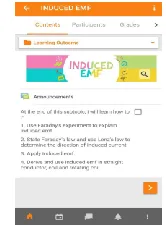
The development of the interactive module, MI-EM is based on the ADDIE Model. There are several instructional design model; however, this module is developed based on this model because it consists of systematical steps which can be revised from improvement [28]. There are five stages in the ADDIE model that is, analysis, design, develop, implement, and evaluate. The first step before the development of MI-EM, the developer had run a need analysis to post-secondary educators and found that there is a high requirement among the educators towards the development of an interactive module using a mobile phone. The second steps in ADDIE is designing the module. MI-EM was built based on learning outcomes in the Electromagnetism topic which adopted by the post-secondary syllabus. Learning outcomes are listed on the introduction for each subtopic, as shown in Figure (1). Besides, MI-EM module was designed by suitable learning theories for learning Electromagnetism using a mobile phone. The development of the module for the third stage of the ADDIE model was discussed in the following section. Further work of this study is the third and fourth steps in the ADDIE model, which is implementation and evaluation steps.
3.2.2
Theories in MI-EM
Learning theories are incredibly essential in education for identifying the appropriate strategy and instruments for producing efficient teaching. Hence, Mayer‘s Cognitive Multimedia and Bloom‘s Taxonomy of cognitive domains were used to be the principal theory of MI-EM development. Mayer‘s Cognitive Multimedia theory identified three assumptions in describing multimedia learning. First, humans have separate information processing channels for audio and visual materials. Second, there is a limited amount of processing capacity available in the audio and visual channels. The third assumption is, a substantial cognitive requires in learning processing in the audio and visual channels [29]. Based on Mayer, a person will only choose particular visual and audio to be arranged in the working memory, and if there is no integration with the previous knowledge, this knowledge will be lost. Thus, to reinforce the process of self-learning among students, the multimedia element is used as MI-EM content. Multimedia is a combination of text, sound, images, animation, audio, and video. Based on the three assumptions proposed by Mayer, multimedia is also able to interact, navigate, work, and communicate with students in the learning process [30]. The second theory, Bloom's Taxonomy of cognitive domains is known as six cognitive levels; that is recognition of concept, ability to understanding the concept, able to apply the concept, able to analyze the concept, able to construct the concept in the new form and able to argue the concept [31]. Education in Malaysia used Bloom‘s Taxonomy as a guideline to design the learning outcomes and the assessment. Moreover, a student‘s achievement in each cognitive domains from simple to complex ideas and from concrete to the abstract concept can be known [32]. Learning materials in MI-EM used only four domains, that is remember, understand, apply, and analyze parallel with the learning outcomes. The similarity between these two theories is that they emphasize on the steps in the learning process. Mayer mentions the steps to retain the information received in the learning process while Bloom discusses the steps in cognitive‘ domain for achieving the learning outcomes [31], [33].
3.2.3 Utilizations of Software and Website
Software and website were used to develop a quality of multimedia elements in MI-EM such as Powerpoint, Toonwork Deluxe, Adobe Photoshop, Ispring Suite version 9, Anyflip, OBS Studio, Biteable, Movavi, Audacity, Phet Colorado Simulation, and Physics Aviary. The software used to develop the module are mostly free software, and some are in the form of a trial version. For example, Toonwork deluxe was download from the website. Table 1 below shows the software that has been used in designing the learning materials and strategy that was applied when uploading toward Moodle platform.
3407 IJSTR©2019
www.ijstr.org
TABLE 1
SOFTWARE AND STRATEGY FOR MI-EM LEARNING MATERIALS
Learning Material Software/Websites Strategy Learning Notes Powerpoint
Toonwork Deluxe Any flip Adobe Photoshop
Link to flipbook
Problem-Solving Examples
Powerpoint Any flip
Link to flipbook
Exercises Powerpoint
Ispring
Interactive SCORM
Videos OBS Studio
Movavi Audacity Biteable Phet Colorado
Powerpoint Physic Aviary
Link to Youtube Channel
Simulations Physic Aviary Link to website
Quiz Moodle Quiz Moodle Quiz
4 OUTCOMES:
MI-EM
INTERACTIVE
MODULE
The content of the lesson is a crucial part of learning. MI-EM contains a variety type of learning tools to increase students‘ engagement, excitement, and also understanding in Electromagnetism such as diagrams and 3D images. There are five types of learning materials provided in MI-EM; that is; notes, an example of problem-solving, exercises, videos, and simulations. The lesson that was designed step by step in MI-EM can help weak students in learning Electromagnetism as this topic involves an abstract concept.
4.1 Learning Notes
In MI-EM module, the learning notes are designed with specific themes for different subtopics such as space and underwater. The learning notes also contain less but precise words and used suitable diagrams and images to represent Electromagnetism concepts. Moreover, the content in the learning notes was arranged from the basic concept of Magnetic Flux to the complex concept that is Mutual Inductance. Figure (2) shows the example of notes for Magnetic Flux. The figure shows an image of magnetic field lines that penetrate an area of a surface. Besides that, software that has been used in developing the learning notes is Powerpoint Version 2019, Toonwork Deluxe, Adobe Photoshop, and Anyflip. Toonwork Deluxe was used to produces simple cartoon images, while Adobe Photoshop was used to edit or modify free license pictures to make the notes more attractive. After designing the learning notes using Powerpoint, the notes was upload to the Anyflip. Then, it links to the Moodle Platform so that students can access it. The colorful diagram, images, and sound of flipping books in this learning notes can help students to enjoy their learning.
4.2 Problem-solving Examples
Bloom‘s Taxonomy cognitive domain was arranged in
problem-solving examples in MI-EM module. The first step in problem-solving problem require to list all the pieces of information from the
questions with the correct SI units. The second step is to choose a suitable formula or concept for the provided problem. This step was related to the two essential cognitive domains; remember and understand. Some students fail to remember the correct formula, and some are having difficulties with understanding the problem. The last step was related to the application of apply cognitive domain, and some questions need a higher cognitive domain of analyze. Figures (3) show an example of problem-solving in step two and three.
Furthermore, the questions were collected from past year questions of post-secondary examinations and some from the Physic textbook. After gathering the questions items, solutions for the problem solving were developed using Powerpoint Version 2019 upload to Anyflip. The Problem-solving examples linked to the course from the Moodle platform.
4.3 Exercises
MI-EM module provides practices to enhance students understanding in Electromagnetism topic. Exercises in MI-EM module have an interactive interface with various types of uses such as multiple-choice, drag and drop, short answer, rearrange the sequence, true and false, and hot spot. Different types of activities can increase student‘s interest to learn and do the exercises.
Fig. 2. Note in Magnetic Flux‘s topic.
3408 interactive exercises were developed by using Ispring Quiz
and Powerpoint before uploaded to Moodle using interactive SCORM. Ispring quiz is easy to use, have various types of questions format., and also provided feedback. Each item was built with a solution, thus students able to learn for a correct answer. Figure (4) show an example of exercises with feedback for an incorrect answer.
4.4 Learning Videos
Non-visualize concepts in Physic can be avoided by using 3D learning material such as video. In MI-EM, learning videos were created to help students that have a problem to learn abstract concept such as Magnetic Flux. On top of that, the uses of learning videos can increase student‘s attention to learn. Learning video also is used to boost students understanding and decrease the misconception. The learning videos consist of the definition, formula, and 3D view of simulations. Learning videos in MI-EM module were developed using software such as OBS Studio, Movavi, Audacity, Powerpoint, and also websites such as Biteable, Phet Colorado (http://phet.colorado.edu/), and Physicaviary (https://www.thephysicsaviary.com/index.html). OBS Studio was used to record three frames simultaneously, which is two webcams and a computer screen. Two webcams were used to record two frames of lab apparatus, and the computer screen was used to record the induced current produced by the Audacity software. Also, website Biteable was used as it makes the developing video easier, have beautiful templates and creative animations. For the 3D view, a simulation was recorded from Phet Colorado and Physicaviary websites.
Then, the complete learning video was uploaded to Youtube Channel in order to avoid the loading data problems. In the MI-EM module, students will be given the link to the Youtube channel. Figure (5) show an example of a scene in the video of Induced E.M.F.
4.5 Simulations
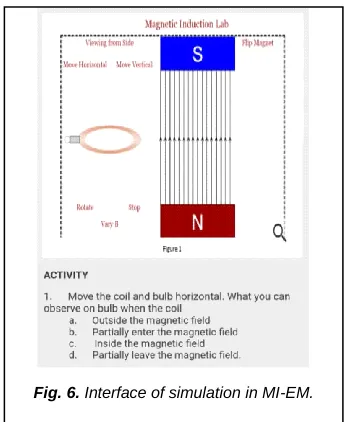
Apart from video, simulation also can help students to visualize the abstract concept and boost students understanding in Physic, especially for Electromagnetism. For example, magnetic field lines cannot be shown in real life but can be see-through simulations. Many websites provide simulations as the learning material for students, but unfortunately, not all simulations supported through mobile phone. Simulation activity in MI-EM was linked to the specific HTML5 simulation of Induced E.M.F in Physicaviary website after getting the consent from the developer. This simulation can be used by mobile phone, and there is an introduction of the simulation and activity to guide students to try with the simulation in MI-EM module. Figure (6) show the interface of simulation in MI-EM.
4.6 Quizzes
At the last session of MI-EM module, students able to identify their level of understanding using the quiz provided by themselves. Students can also repeat to learn at the specific subtopic that they did not master after doing the quiz. Quiz in MI-EM module was developed by using the Moodle platform using the quiz section. The quiz consists of four cognitive domains in the learning outcomes. Also, the quiz has ten multiple-choice questions and ten short answer questions. The questions also adopted from the previous example and examinations questions. Figure (7) show an example of a quiz in MI-EM module.
Fig. 4. Example of exercises with the feedback for incorrect answer.
3409 IJSTR©2019
www.ijstr.org To be discussed, the development of MI-EM module will give benefits to three main parties; that is, students, educators, and institutions. There were less interactive modules that have developed for post-secondary students, and none can be found for Electromagnetism topic in Malaysia. Therefore, MI-EM module was developed in allowing students to make use of it as their learning materials. This self-learning module can be utilized at students own pace, and they can learn according to their self-ability. They will also be responsible for their learning process [33]. Since the development of MI-EM module based on the syllabus from the Ministry of Education Malaysia, hence it will be easier for the students to learn effectively for the examinations. For educators, MI-EM can be used as a supplementary for their teaching and learning materials, which the interactive approach can enhance students understanding. Also, the MI-EM module will be useful, notably if students are absent or miss their class. MI-EM is simple to use and has a systematic compact lesson content that helps to reduce the consultation time between educators and students. The educators can focus on discussing challenging questions rather than revising from the beginning of the topic [33]. Moreover, educators can also use EM as a part of the flipped classroom. For institutions, MI-EM module is cost-effective as students do not need to use many papers or attend an extra class for their learning. This interactive module also uses mobile phone technology that supports the ideas of learning in the twenty-first century.
5 CONCLUSION
AND
IMPLEMENTATION
This interactive module, MI-EM has been developed systematically using a suitable instructional model, learning theories, and a variety of learning materials in order to achieve the learning outcomes in Electromagnetism topic specifically for post-secondary students in Malaysia. The use of this interactive module through the mobile phone was hoped to help students in their self-learning process in a more exciting but effective way. In the future, the works will be the focus on implementing the usage of MI-EM at post-secondary for the study of effectiveness and evaluations. MI-EM manual will be included within the interactive module as well.
CONFLICT
OF
INTEREST
The authors declare no conflict of interest.
ACKNOWLEDGMENT
The authors want to thank the Ministry of Education (MoE), Malaysia, and Universiti Pendidikan Sultan Idris (UPSI). This work was supported in part by the Ministry of Higher Education (MoHE), Malaysia under Grant 2019-0090-107-01.
REFERENCES
[1] A. Al-Ajlan and H. Zedan, ―Why moodle,‖ in Proceedings of the IEEE Computer Society Workshop on Future Trends of Distributed Computing Systems, pp. 58–64, 2008.
[2] L. K. W. Félix J. García Clemente, Francisco Esquembre, ―Deployment of physics simulation apps using Easy JavaScript Simulations,‖ in IEEE Global Engineering Education Conference, EDUCON, no. April, pp. 1093–1096, 2017.
[3] L. Li, F., Bao, Y., Wang, D., Wang, W., & Niu, ―Smartphones for sensing,‖ Sci. Bull., vol. 61, no. 3, pp. 190–201, 2016.
[4] S. D. Aji, M. N. Hudha, C. Huda, and G. Gufran, ―Computer Animation with Adobe Flash Professional Cs6 in Newton‘s Law,‖ in IOP Conference Series: Materials Science and Engineering, vol. 288, no. 1, p. 012131, 2018.
[5] R. M. Branch, Instructional Design: The ADDIE Approach. New York: Springer Science & Business Media, 2009.
[6] M. Kalogiannakis, M. Ampartzaki, S. Papadakis, and E. and Skaraki, ―Teaching natural science concepts to young children with mobile devices and hands-on activities . A case study.,‖ Int. J. Teach. Case Stud., vol. 9, no. 2, pp. 171–183, 2018.
[7] M. Papadakis, S., & Kalogiannakis, ―Mobile educational applications for children: what educators and parents need to know,‖ Int. J. Mob. Learn. Organ., vol. 11, no. 3, pp. 256–277, 2017.
[8] A. Karacop, ―The Effects of Using Jigsaw Method Based on Cooperative Learning Model in the Undergraduate Science Laboratory Practices,‖ Univers. J. Educ. Res., vol. 5, no. 3, pp. 420–434, 2017.
[9] Ministry of Education Malaysia, ―Malaysia Education Blueprint 2015-2025 (Higher Education),‖ 2015. [10] H. N. J. Ho and J. C. Liang, ―The Relationships Among
Scientific Epistemic Beliefs, Conceptions of Learning Science, and Motivation of Learning Science: A study of Taiwan high school students,‖ Int. J. Sci. Educ., vol. 37, no. 16, pp. 2688–2707, 2015.
[11] M. Saleh, M. Isa, and B. I. Ansari, ―Student s ‘ Error Types And Reasoning Ability Achievement Using The Indonesian Realistic Mathematics Education Approach,‖ Int. J. Sci. Technol. Res., vol. 8, no. 07, pp. 364–369, 2019.
[12] N. S. Y. Abdullah, M. N. S. Saufi, and M. I. H. Yaacob, ―Microcomputer-Based Laboratory (MBI) System With Automated Measuring Approach For Basic Electronics,‖ J. Fundam. Appl. Sci., 2018.
[13] S. Cai, F. K. Chiang, Y. Sun, C. Lin, and J. J. Lee, ―Applications of augmented reality-based natural interactive learning in magnetic field instruction,‖
3410 Interact. Learn. Environ., vol. 25, no. 6, pp. 778–791,
2017.
[14] J. Li and C. Singh, ―Developing A Magnetism Conceptual Survey And Assessing Gender Differences In Student Understanding Of Magnetism,‖ in AIP Conference Proceedings, pp. 43–46, 2012.
[15] W. Mueanploy, ―‗A study: Effect of Students Peer Assisted Learning on Magnetic Field Achievement,‘‖ in Journal of Physics: Conference Series, vol. 710, no. 1, 2016.
[16] M. Saǧlam, ―Students‘ performance awareness, motivational orientations and learning strategies in a problem-based electromagnetism course,‖ in Asia-Pacific Forum on Science Learning and Teaching, vol. 11, no. 1, p. 1, 2010.
[17] O. Zajkov, S. Gegovska-Zajkova, and B. Mitrevski, ―Textbook-Caused Misconceptions, Inconsistencies, and Experimental Safety Risks of a Grade 8 Physics Textbook,‖ Int. J. Sci. Math. Educ., vol. 15, no. 5, pp. 837–852, 2017.
[18] I. M. Astra and U. R. Fitri, ―Integrated Lecture Tools to Improve Student Comptencies to Develop Physical Learning Media Design,‖ J. Penelit. Pengemb. Pendidik. Fis., vol. 3, pp. 79–88, 2017.
[19] H. Y. Chou, Y. H., & Shyu, ―Virtual Laboratory of the Magnetic Field due to a Current Element,‖ in Society for Information Technology & Teacher Education International Conference, 2017, pp. 1484–1489, 2017. [20] G. Hookway, Q. Mehdi, T. Hartley, and N. Bassey,
―Learning physics through computer games,‖ in Proceedings of CGAMES‘2013 USA, 2013, pp. 119– 126, 2013.
[21] V. Potkonjak et al., ―Virtual laboratories for education in science, technology, and engineering: A review,‖ Comput. Educ., vol. 95, pp. 309–327, 2016.
[22] ―Moodle - Open-source learning platform.‖ [Online]. Available: https://moodle.org/. [Accessed: 15-Jan-2019].
[23] B. A. G. Beltrán, L. G. López, and A. R. Ortíz, ―USER-CENTERED DESIGN IN MOODLE REDESIGN FOR MOBILE USE,‖ Pist. Educ., no. 120, pp. 1212–1224, 2016.
[24] L. W. Foong, ―Concerns of Online Learning Portal Among,‖ in Seminar Penyelidikan Pendidikan Peringkat Kebangsaan, pp. 1–15, 2012.
[25] Y. C. Lee, K. Lau, and V. W. Y. Yip, ―Blended learning for building student-teachers‘ capacity to learn and teach science-related interdisciplinary subjects,‖ Asian Assoc. Open Univ. J., vol. 11, no. 2, pp. 166–181, 2016.
[26] Z. Bogdanović, D. Barac̈, B. Jovanic̈, S. Popovic̈, and B. Radenkovic̈, ―Evaluation of mobile assessment in a learning management system,‖ Br. J. Educ. Technol., vol. 45, no. 2, pp. 231–244, 2014.
[27] N. Petrovic, V. Jeremic, M. Cirovic, Z. Radojicic, and N. Milenkovic, ―Facebook Versus Moodle in Practice,‖ Am. J. Distance Educ., vol. 28, no. 2, pp. 117–125, 2014.
[28] M. S. Muslimin, N. M. Nordin, and A. Z. Mansor, ―THE DESIGN AND DEVELOPMENT OF MobiEko: A
MOBILE EDUCATIONAL APP FOR
MICROECONOMICS MODULE,‖ Malaysian J. Learn. Instr. Spec. Issues, pp. 221–255, 2017.
[29] P. Paas, Fred; Tuovinen, Juhani; Tabbers, Huib; Van Gerven, ―Nine Ways to Reduce Cognitive Load in Multimedia Learning Nine Ways to Reduce Cognitive Load in Multimedia Learning,‖ Educ. Psychol., vol. 1520, no. 38, pp. 43–52, 2010.
[30] H. Aulawi and A. S. Amin, ―E-Learning Analysis And Design Based On Technology Acceptance Model,‖ Int. J. Sci. Technol. Res., vol. 8, no. 04, pp. 126–132, 2019.
[31] B. S. Bloom, M. D. Englehard, E. J. Furst, and W. H. Hill, Taxonomy of educational objectives: The classification of educational goals: Handbook I, cognitive domain. 1956.
[32] O. Meerbaum-Salant, M. Armoni, and M. (Moti) Ben-Ari, ―Learning computer science concepts with Scratch,‖ Comput. Sci. Educ., vol. 23, no. 3, pp. 239– 264, 2013.